
Disability Insurance for Dermatologists
As an Independent Disability Insurance Broker, we have access to exclusive discounts and negotiated pricing most captive agents can’t offer — see the full breakdown near the end of this page.
Disability Insurance for Dermatologists

Jason Stolz CLTC, CRPC, DIA, CAA
Dermatologists occupy one of the most financially rewarding positions in American medicine — a specialty where physician compensation surveys document median total compensation ranging from approximately $450,000 to over $530,000 annually, with Mohs surgeons and cosmetic-procedural practitioners in high-demand markets regularly exceeding $700,000 or more. Every dollar of that exceptional income derives from the sustained ability to perform the visual examination, procedural precision, and clinical judgment that dermatology practice requires — work that engages the dermatologist’s hands, fine motor control, vision, and cognitive function in the daily delivery of both medical dermatology services and the surgical and cosmetic procedures that define the specialty’s procedural income. When disability eliminates any of those capacities — through a hand or wrist condition, a vision event, a latex or chemical sensitization that prevents gloved clinical work, a serious illness, or a mental health event — the procedural revenue stops and the exceptional income dermatology represents disappears with it. Disability insurance for dermatologists is the income protection structure that addresses what is at stake for a specialty where the financial consequences of an uninsured disability are among the most severe in medicine.
At Diversified Insurance Brokers, Jason Stolz, CLTC, CRPC, DIA, CAA works with dermatologists across the full spectrum of practice structures the specialty encompasses — employed dermatologists at health systems and multispecialty groups, private practice owners operating solo or group dermatology practices, Mohs surgeons whose procedural income makes own-occupation definition the paramount coverage priority, cosmetic dermatologists with mixed insurance and cash-pay revenue streams, and dermatology residents and fellows who are establishing their careers and their coverage architecture simultaneously. The income protection structure appropriate for an employed dermatologist with group benefits access differs substantially from what a private practice owner who generates $600,000 or more annually from a combination of medical dermatology, Mohs surgery, and cosmetic procedures needs — and getting that structure right requires understanding both the disability risk profile specific to dermatology practice and the high-earner group plan limitations that make individual coverage necessary at dermatology income levels.
Compare Disability Insurance for Dermatologists
We review coverage options across 100+ carriers and identify the policy structure — definition, benefit level, and practice overhead — that fits your dermatology income and practice setting.
Request Disability Insurance OptionsDermatologist Disability Risk — Clinical Hazards, Income Exposure, and the Protection Gap
| Risk Category | Source / Clinical Context | Resulting Disability Risk | Group Plan Coverage | DI Coverage Gap |
|---|---|---|---|---|
| Hand and fine motor conditions | Dermatology procedures — biopsies, Mohs surgery, excisions, laser treatments, injections, cryotherapy — require sustained fine motor precision; injury, arthritis, tremor, or neurological conditions affecting the hands directly threaten procedural capacity and the procedural income that drives dermatology compensation | Carpal tunnel syndrome, focal dystonia, hand tremor, arthritis, or injury conditions that impair the precision hand function on which dermatology procedures depend — career-altering for Mohs surgeons and procedure-heavy practitioners | Group plans cap benefits well below dermatology income levels; any-occupation transition at 24 months may deny benefits for a dermatologist who cannot perform procedures but could theoretically do other medical work | Full gap between group plan cap and actual income; individual own-occupation DI covers inability to perform dermatology procedures regardless of other theoretical capacity |
| Occupational allergic sensitization | Dermatologists are among the healthcare workers with elevated risk for occupational contact allergies — latex, rubber accelerators, acrylates used in dermatologic procedures, topical agents, and the full range of chemicals present in dermatology clinical settings; research documents healthcare workers as among the highest-risk occupations for latex allergy from repeated glove exposure | Developed allergic contact dermatitis or latex allergy severe enough to prevent gloved clinical work — a disability uniquely severe for a dermatologist whose entire procedural practice requires glove use | Group plan coverage inadequate for dermatology income levels; gradual sensitization not covered as discrete workplace incident | Full gap; own-occupation DI covers inability to perform dermatology practice due to sensitization without requiring discrete incident documentation |
| Vision impairment | Dermatology diagnosis is fundamentally visual — pattern recognition in skin lesions, dermoscopy, Mohs margin assessment under microscopy, laser targeting, and cosmetic assessment all require the visual acuity and fine discriminatory vision that serious eye conditions can eliminate | Vision conditions severe enough to impair dermoscopic examination, surgical margin assessment, or laser and injection targeting — impairing the visual precision on which dermatology diagnosis and procedures depend | Not specifically addressed in group plan design; benefit inadequacy at dermatology income levels regardless | Full gap; individual DI covers vision-related disability preventing dermatology practice regardless of cause |
| High-earner group plan inadequacy | Group plans cap monthly disability benefits at fixed dollar ceilings — typically $5,000 to $15,000 per month — regardless of actual dermatologist compensation; bonus, production, cosmetic revenue, and ownership distributions often excluded from the benefit calculation | A dermatologist earning $500,000+ receives a small fraction of actual income replacement from a capped group plan; effectively 10-20% of actual earnings rather than the stated 60% | Structural design failure at dermatology income levels; group plan is the foundation, not the complete solution | Major income protection gap above the cap; individual DI calibrated to documented total compensation fills the shortfall |
| Mental health and cognitive disability | Physician burnout is documented across specialties; dermatologists managing high-volume patient loads, cosmetic patient expectations, business management pressures, and the emotional demands of diagnosing skin cancer face the same burnout risk profile as other high-volume procedural specialists | Disabling anxiety, depression, or burnout preventing sustained clinical judgment, procedural precision, and the cognitive demands of dermatology practice management | Most group plans cap mental/nervous benefits at 24 months; at dermatology income levels, this cap represents an enormous financial exposure for long-term mental health disability | Full gap at 24 months; unlimited mental health benefit period in individual own-occupation DI is essential |
| Illness-based disability (non-occupational) | Cancer, cardiac events, neurological conditions — health events independent of dermatology practice that eliminate the cognitive and physical capacity for sustained clinical work | Extended inability to perform examinations, procedures, practice management, and clinical decision-making | Group plan adequacy fails at dermatology income levels regardless of cause; mental health cap and definition transitions apply | Approximately 90% of long-term disabilities are illness-based; individual DI to age 65 addresses the dominant risk category |
The table establishes the dermatologist’s disability exposure across the clinical, occupational, and financial dimensions — a profile anchored by the procedural precision demands of a specialty where hand function and visual acuity are the clinical instruments, the occupational sensitization risk unique to healthcare workers who perform extensive gloved procedures, and the high-earner group plan inadequacy that is most severe precisely at dermatology’s exceptional income levels. Disability insurance by occupation places dermatologists in the most favorable occupational class — a classification that produces the most competitive premium rates available — while recognizing that the income protection challenge for a dermatologist is not premium cost but income adequacy: ensuring the benefit amount is actually calibrated to the specialty’s exceptional income rather than to the arbitrary caps that make group plans inadequate at this compensation level.
Own-Occupation Definition — The Most Important Policy Decision for Any Dermatologist
The disability definition is the most consequential policy design decision for a dermatologist — more important than the benefit amount, the premium, or any rider selection — because it determines whether a dermatologist with a disabling hand condition or a sensitization that prevents gloved procedures actually receives benefits, or faces denial because the carrier argues that the dermatologist could theoretically perform some other medical or non-medical role. This is not a theoretical risk. Industry sources and physician disability insurance specialists specifically document that own-occupation coverage for physicians ensures that benefits are paid if the physician is unable to perform their specific specialty, even if they could work in another medical or non-medical role — and that this protection is critical precisely because it covers the scenario where the disability prevents specialty-specific practice while leaving some theoretical alternative capacity intact.
For a Mohs surgeon whose career income is built on microscopically controlled surgical excision of skin cancers — work that requires steady hands, visual acuity under magnification, and the precise manual technique of surgical tissue management — the disability definition determines whether a hand condition that eliminates surgical precision but theoretically permits teaching or administrative medical work generates benefit payments or a denial. A true own-occupation disability insurance policy specifically pays benefits when the insured cannot perform the material and substantial duties of their specific occupation — dermatology, and specifically Mohs surgery or whatever subspecialty defines the physician’s income — even if theoretically capable of other work. The policy recognizes that the dermatologist’s income derives from a specific clinical and procedural capacity that the disability has eliminated, and that this is a genuine economic disability regardless of what theoretical alternative might exist.
The own-occupation standard also matters specifically for the allergic sensitization scenario that is uniquely relevant to dermatologists: a dermatologist who develops a severe latex or rubber accelerator allergy preventing continued gloved clinical work has experienced a disability from their specific dermatology practice even if they could theoretically perform non-gloved work in some other medical setting. An own-occupation policy that specifically defines the occupation as the practice of dermatology — including the gloved procedural work that defines the specialty — protects against the carrier argument that alternative non-gloved medical employment could theoretically continue. Understanding how short-term and long-term disability coverage interact in a complete protection architecture ensures that disability events across the full severity spectrum — from a wrist injury with expected recovery to a permanent sensitization or neurological condition — are addressed without gaps in timing or benefit structure.
The Occupational Sensitization Risk Specific to Dermatologists
Among the disability risk factors that dermatology practice carries, occupational allergic sensitization represents a pathway that is specific to healthcare workers generally and particularly relevant to dermatologists — practitioners who perform extensive gloved procedures, work regularly with topical agents, acrylates used in phototherapy and cosmetic procedures, and the full range of chemical agents present in a comprehensive dermatology clinical setting. Research and healthcare occupational health literature document healthcare workers as among the highest-risk occupations for latex allergy from regular and prolonged occupational exposure, with repeated glove use representing the primary sensitization pathway. The irony for dermatologists — who specialize in diagnosing and treating conditions including contact dermatitis and latex allergy in their patients — is that the clinical work that defines their practice creates the sensitization exposure that can, in serious cases, make continuation of that work medically contraindicated.
A dermatologist who develops a documented severe latex allergy or allergic contact dermatitis to rubber accelerators in gloves — sensitization that produces systemic reactions or skin conditions severe enough to make regular glove use medically inadvisable — faces a clinical disability unique to their specialty. Dermatology procedures cannot be performed without proper glove use; the clinical hygiene and infection control requirements of the specialty are non-negotiable in that regard. A dermatologist whose sensitization prevents continued gloved procedural work has experienced a disability from dermatology practice even if they retain theoretical capacity for administrative or non-procedural medical work. Individual disability insurance with true own-occupation language covering the specific practice of dermatology — including its procedural and gloved-work requirements — is the protection structure that addresses this occupational sensitization pathway. Disability insurance for high-risk occupations covers how occupational sensitization and chemical exposure disability pathways are evaluated in underwriting for clinical professionals.
The High-Earner Group Plan Gap — Why Group Coverage Falls Dramatically Short for Dermatologists
Dermatologists represent one of the most extreme examples of the high-earner group plan adequacy failure in the medical profession — because dermatology compensation is among the highest in medicine, and the gap between what group plans provide and what dermatology income actually requires is correspondingly large. Physician disability insurance specialists specifically document that for high-income specialists, standard policies cap at $15,000 to $20,000 per month, meaning high earners may need policies from multiple insurers to achieve appropriate coverage. For a dermatologist earning $500,000 to $700,000 annually — requiring approximately $25,000 to $35,000 or more per month in disability benefits to replace 60 percent of gross income — a single group plan capping at $6,000 to $10,000 per month delivers 15 to 25 percent of actual income replacement rather than the stated 60 percent.
Three additional group plan limitations compound the income adequacy failure for dermatologists. First, group plan benefits are typically taxable as ordinary income when employers pay the premiums — reducing the already-capped benefit by another 30 to 40 percent at the marginal tax rates applicable to dermatology income. Second, bonus income, production bonuses, cosmetic procedure revenue, and ownership distributions that constitute a significant portion of many dermatologists’ total compensation are excluded from group plan benefit calculations — protecting only the base salary component. Third, the any-occupation definition transition at 24 months may cut off benefits for a dermatologist who cannot perform dermatology procedures but could theoretically perform some other medical work, at exactly the point when the disability has proven itself to be long-term. Understanding why dermatologists buy individual disability insurance begins with this numerical reality: the income at stake at dermatology compensation levels is too large to leave to a group plan’s arbitrary caps. Whether individual disability insurance is worth the cost at dermatology income levels is answered immediately by calculating the monthly income loss from a disability against any reasonable annual premium for adequate coverage.
Practice Ownership — The Two-Layer Financial Exposure for Dermatology Practice Owners
The substantial majority of private practice dermatologists operate as practice owners — physicians who own their practice entity, employ staff, carry overhead obligations, and generate income from both their personal clinical production and the business structure they have built. For these physicians, disability creates a two-layer financial crisis that personal income replacement alone cannot address. The personal income loss from not being able to see patients and perform procedures is one layer. The practice overhead layer — clinical staff wages, facility lease obligations, equipment financing for laser devices and surgical equipment, electronic health record and billing system costs, malpractice insurance premiums, and all the other fixed costs of a dermatology practice — continues whether the practice owner is performing procedures or recovering from disability.
A personal disability income policy replaces the dermatologist’s personal income. Business overhead expense disability insurance addresses the practice’s fixed operating costs during the disability period — paying a monthly benefit calibrated to the actual fixed costs of the dermatology practice to maintain staff, preserve patient relationships, and keep the practice operational during the owner’s disability. The BOE structure is particularly important for dermatology practice owners who have invested in capital equipment — laser systems, Mohs surgical suites, phototherapy units — that generates overhead financing obligations regardless of whether the owner-dermatologist is present. Self-employed dermatology practice owners carry none of the workers’ comp protection or employer-provided benefit baseline that employed physicians may have, making the combination of personal disability income and BOE coverage the complete protection architecture required.
Coverage Stacking, High-Limit Insurance, and Policy Design for Dermatologists
For dermatologists whose total compensation substantially exceeds the monthly benefit ceilings that standard individual disability insurance carriers allow, a stacked coverage architecture — combining coverage from multiple carriers or adding high-limit specialty market coverage above the standard carrier maximum — produces the income replacement level that the specialty’s compensation actually requires. Standard carriers generally allow maximum monthly benefits in the range of $20,000 to $30,000 per month at the highest level, which for a dermatologist earning $600,000 annually replaces only 40 to 60 percent of gross income even at the maximum single-carrier ceiling. Layering coverage across two standard carriers, or combining standard market coverage with high-limit supplemental coverage, brings the total monthly benefit into the range that genuinely replaces the dermatology income at stake.
Income documentation for dermatology practice owners requires capturing total compensation across all revenue streams — base salary, production bonuses, cosmetic procedure revenue, and ownership distributions — through Schedule C, K-1 income, and W-2 documentation as appropriate for the practice structure. How much disability insurance a dermatologist actually needs depends on documented total compensation, household financial obligations, and practice overhead obligations addressed separately through BOE coverage. The elimination period for a dermatologist with adequate reserves should typically be 90 days. The benefit period must extend to age 65. The rider options most important for dermatologists include the future increase option — critical for residents and early-career dermatologists — and the cost of living adjustment rider.
For dermatology residents and fellows: disability insurance during medical residency should be purchased now — before dermatology attendings’ income levels, before any documented hand, wrist, or occupational health history develops, and at the premium rates that age-rated policies make available during training years. Disability insurance with pre-existing conditions is available through independent broker channels for dermatologists with prior health histories. Disability insurance for 1099-earning locum tenens dermatologists uses the same self-employed documentation framework. Working with an independent disability insurance broker who understands dermatology’s specific income structures, coverage stacking requirements, and own-occupation definition priorities produces substantially better outcomes than any single-carrier application.
Get Your Dermatologist Disability Insurance Review
We compare true own-occupation definitions, practice owner BOE structures, and coverage stacking options across 100+ carriers to build the disability protection architecture that actually reflects your dermatology income.
Request Disability Insurance Options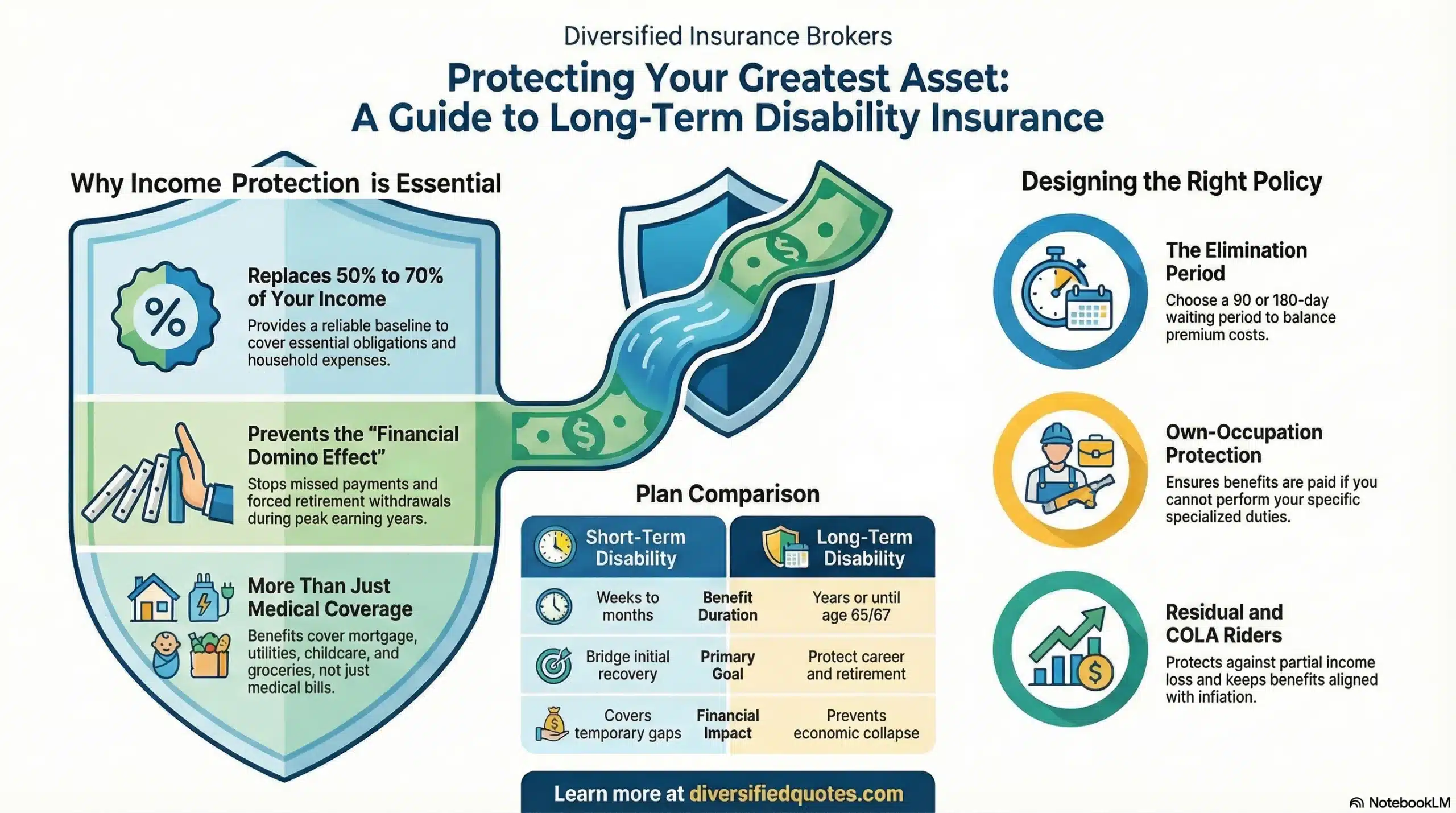
Talk With an Advisor Today
Choose how you’d like to connect—call or message us, then book a time that works for you.
Schedule here:
calendly.com/jason-dibcompanies/diversified-quotes
Licensed in all 50 states • Fiduciary, family-owned since 1980
FAQs: Disability Insurance for Dermatologists
What is the most important disability insurance feature for a dermatologist?
The disability definition — specifically true own-occupation language covering the practice of dermatology as the insured’s specific occupation — is the most important policy feature, more consequential than the benefit amount, premium, or any rider. For a dermatologist, this matters in two specific scenarios that other policies may fail to address. The first is any condition affecting hand precision or visual acuity that prevents dermatology procedures but theoretically leaves some other medical or non-medical capacity intact. A Mohs surgeon who develops essential tremor preventing surgical precision receives benefits under a true own-occupation policy regardless of whether they could theoretically teach or consult. An any-occupation or modified definition may deny that claim.
The second is the allergic sensitization scenario specific to dermatology: a dermatologist who develops a documented severe latex allergy or contact sensitization preventing continued gloved clinical work has experienced a disability from their specific specialty practice even if some other non-gloved medical role might theoretically continue. True own-occupation language that specifically covers the practice of dermatology — including its gloved procedural requirements — protects against this denial. A residual disability benefit provision is the second critical feature — because a dermatologist who can work reduced hours due to a hand condition or health event, but not their full schedule, has a genuine partial disability that a residual benefit addresses proportionally rather than forcing an all-or-nothing determination.
Are disability insurance benefits taxable for a dermatologist?
Tax treatment depends on how premiums are paid — a particularly important question for dermatologists given the income levels involved. For dermatologists who purchase individual disability insurance personally and pay premiums with after-tax dollars, monthly disability benefits received during a qualifying disability are generally received income-tax-free. The full benefit amount reaches the household without income tax reduction, which at dermatology income and tax rate levels represents a very significant planning difference. Whether disability insurance payments are taxable is especially consequential for high-earning dermatologists because the marginal tax rates applicable to their income mean the difference between taxable and tax-free benefits can represent tens of thousands of dollars in annual effective benefit value during a multi-year disability period.
For employed dermatologists whose employer pays group LTD premiums — as most health systems and multispecialty groups do — the resulting disability benefits are taxable as ordinary income at claim time. A group plan paying 60 percent of base salary is then taxed at 37 percent or more for a high-earning dermatologist, delivering approximately 38 to 40 percent of base salary in after-tax benefit — well below the stated 60 percent, and covering only base salary rather than total compensation. Dermatology practice owners who pay disability insurance premiums through the practice entity should confirm the specific tax treatment with a tax professional, as the deduction structure may affect whether benefits received during a claim are taxable income.
I’m an employed dermatologist with group LTD — why do I still need individual coverage?
For a dermatologist, the gap between what a group LTD plan provides and what dermatology income actually requires is among the largest in medicine — creating a specific and quantifiable need for individual supplemental coverage. The group plan’s monthly benefit cap — typically $5,000 to $15,000 per month regardless of actual income — means that an employed dermatologist earning $450,000 to $600,000 annually receives a small fraction of actual income in disability benefits from the group plan alone. A plan capping at $10,000 per month protects approximately $120,000 annually — less than 30 percent of a $450,000 dermatologist’s income, and less than 20 percent of a $600,000 earner’s compensation. Individual supplemental disability insurance sized to the gap between the group plan benefit and actual income replacement need fills this shortfall directly.
Beyond income adequacy, the group plan’s other structural failures matter specifically for dermatologists. The 24-month mental health cap limits benefit payments for the burnout and psychiatric conditions documented across high-volume physician specialties. The 24-month own-to-any definition transition may deny benefits for a dermatologist whose condition prevents specialty practice but leaves some theoretical alternative capacity. And the taxability of employer-paid group benefits further erodes the effective replacement rate. Individual own-occupation disability insurance with unlimited mental health coverage, specialty-specific own-occupation language, and benefit amounts calibrated to total dermatology compensation rather than base salary fills each of these structural gaps simultaneously. For Mohs surgeons and cosmetic-procedural dermatologists whose income substantially exceeds employed dermatologist benchmarks, the income adequacy gap may require coverage from multiple individual carriers stacked together to reach adequate monthly benefit levels.
I own my dermatology practice — what disability coverage layers do I need?
A dermatology practice owner needs three coordinated layers of protection. The first is personal disability income coverage — individual own-occupation insurance replacing your personal clinical production income when disability prevents you from practicing. This should be sized to your documented total earned income from dermatology including production bonuses, cosmetic revenue, and distributions, and should use true own-occupation specialty-specific language. The second layer is business overhead expense disability insurance — coverage paying the practice’s fixed operating costs during your disability period. Staff wages, facility lease, equipment financing for laser systems and Mohs surgical suites, EHR and billing platform costs, malpractice insurance premiums, and all other fixed practice overhead continue whether you are seeing patients or not. BOE funding maintains the practice infrastructure during your disability period so operations can resume when you recover rather than collapsing under unmet overhead.
The third layer — relevant for dermatology practice owners who have employed associate dermatologists, Mohs surgeons, or nurse practitioners whose production contributes significantly to practice revenue — is key person disability insurance. If an associate’s disability would create a significant revenue loss to the practice beyond that individual’s salary, key person coverage provides the practice with capital to recruit, hire, and train replacement clinical capacity during the disability period. The appropriate sizing of each layer — personal income, BOE benefit amount, and key person coverage if applicable — requires analysis of the practice’s actual financial structure and overhead obligations, which an independent broker familiar with medical practice structures can help develop accurately and completely.
I’m a dermatology resident — should I get disability insurance now or wait until I’m attending?
During residency — not after — is the optimal time to establish disability insurance coverage, and for dermatology specifically the case for residency-year purchase is particularly strong. Disability insurance premiums are age-rated, meaning the younger the applicant at purchase, the lower the annual premium locked in for the policy’s duration. A dermatology resident who purchases at 28 or 29 locks in a premium rate that will remain substantially below what a practicing attending purchasing the same coverage at 35 or 38 would pay — a difference that compounds significantly over a dermatology career.
The health history dimension makes residency purchase specifically urgent for dermatologists: the hand and wrist conditions, allergic contact sensitivities, and health events that accumulate over a clinical career have not yet developed at the beginning of residency. Purchasing comprehensive own-occupation coverage — including true specialty-specific own-occupation language and unlimited mental health coverage — before any such history is documented means full protection is in place for the entire career that follows. A dermatology resident who develops a wrist condition during residency and then tries to purchase disability insurance after graduation will find that condition triggers a wrist exclusion rider — exactly the coverage most critical for a procedure-dependent specialty that becomes restricted. The future increase option available on residency-year policies allows benefit increases as attending income grows without new medical underwriting, preserving the favorable residency-year health-based terms through the full income trajectory of a dermatology career. Disability insurance for medical residents covers how residency-year policies are sized and structured to protect the career investment that dermatology training represents.
How do I know if my current disability insurance is adequate for dermatology income levels?
The review of existing disability insurance for a dermatologist should answer four specific questions that most dermatologists have never investigated about their current coverage. First: what is the actual monthly benefit — not the stated replacement percentage but the fixed-dollar maximum — and does it actually replace 60 percent of total dermatology compensation including production bonuses and cosmetic revenue? For most dermatologists with only group LTD, the honest answer reveals a dramatic shortfall. Second: is the disability definition true own-occupation for the full benefit period to age 65, with language covering the specific practice of dermatology, or does it transition to any-occupation at 24 months or use generic language vulnerable to recharacterization as a general medical professional role?
Third: is the mental health benefit period unlimited, or capped at 24 months — and given the burnout documentation in high-volume physician specialties, does the existing architecture leave the 24-month mental health limitation as an uncovered gap? Fourth: if you own your practice, does the disability coverage extend to practice overhead obligations, or does only your personal income receive any protection during a disability period? Running these four questions honestly against existing coverage — group LTD, any existing individual policies, and practice owner provisions — reveals the specific gaps that need to be addressed. A second opinion on your disability insurance situation from an independent broker who understands dermatology income structures and specialty-specific definition requirements costs nothing and frequently reveals coverage gaps that existing policies leave open at exactly the income level where those gaps are most financially consequential.
About the Author:
Jason Stolz, CLTC, CRPC, DIA, CAA and Chief Underwriter at Diversified Insurance Brokers (NPN 20471358), is a senior insurance and retirement professional with more than 25 years of real-world experience helping individuals, families, and business owners protect their income, assets, and long-term financial stability. As a long-time partner of the nationally licensed independent agency Diversified Insurance Brokers, Jason provides trusted guidance across multiple specialties—including fixed and indexed annuities, long-term care planning, personal and business disability insurance, life insurance solutions, Group Health, Travel Medical and Evacuation Insurance, and short-term health coverage. Diversified Insurance Brokers maintains active contracts with over 100 highly rated insurance carriers, ensuring clients have access to a broad and competitive marketplace.
His practical, education-first approach has earned recognition in publications such as VoyageATL, and contributions from his agency featured in Kiplinger and GoBankingRates— highlighting his commitment to financial clarity and client-focused planning. Drawing on deep product knowledge and years of hands-on field experience, Jason helps clients evaluate carriers, compare strategies, and build retirement and protection plans that are both secure and cost-efficient. Visitors who want to explore current annuity rates and compare options across multiple insurers can also use this annuity quote and comparison tool.
Explore More Disability Insurance Options: Browse our complete guide to Disability Insurance for Physicians & Medical Specialists — covering physicians, surgeons, anesthesiologists, radiologists, podiatrists & medical specialists from 100+ carriers.
Last Reviewed: June 7, 2026 |
Reviewed by: Jason Stolz, CLTC, CRPC, DIA, CAA
Chief Underwriter, Diversified Insurance Brokers, Inc. | NPN: 20471358 | Diversified Insurance Brokers, Inc. — Licensed in all 50 states
Fact Checked by: Tonia Pettitt, CMIP©
Medicare Specialist, Diversified Insurance Brokers, Inc. | NPN: 14374308 | Diversified Insurance Brokers, Inc. — Licensed in all 50 states
Did you find this content helpful? Leave us a Google review — it helps others find trustworthy guidance too.
Editorial Standards: Diversified Insurance Brokers maintains rigorous editorial standards to ensure accuracy, clarity, and independence in all content. Learn more about our editorial standards and commitment to transparency.
