
Disability Insurance for Beekeepers
As an Independent Disability Insurance Broker, we have access to exclusive discounts and negotiated pricing most captive agents can’t offer — see the full breakdown near the end of this page.
Disability Insurance for Beekeepers

Jason Stolz CLTC, CRPC, DIA, CAA
Beekeeping occupies a distinctive position in the disability insurance market — an agricultural profession whose most significant occupational disability risk is not a physical injury in the conventional sense but a biological response that can develop at any point in a beekeeping career: venom allergy sensitization, and the anaphylaxis that repeated honeybee stings can eventually produce in beekeepers who were not previously allergic. Research published in medical literature specifically confirms that beekeepers are at increased risk for anaphylaxis due to frequent honeybee stings, and that the development of severe hypersensitivity reactions is an occupational health concern requiring dedicated educational programs for this professional population. The income at stake is real: beekeepers classified as agricultural managers under Bureau of Labor Statistics data earned a median annual wage of $87,980 in May 2024, while commercial beekeeping operations generate income through honey sales, pollination services for agricultural operators, beeswax products, and specialty hive products — income streams that depend entirely on the physical capacity to manage colonies, operate apiaries, and perform the hands-on hive work that beekeeping requires. When disability eliminates that capacity, the income stops. Disability insurance for beekeepers is the income protection structure that addresses what the standard agricultural workers’ comp framework handles poorly or not at all.
At Diversified Insurance Brokers, Jason Stolz, CLTC, CRPC, DIA, CAA works with hobbyist beekeepers who have turned professional, commercial apiary operators running pollination services, honey production enterprises, and beeswax product businesses, and the agricultural employees who manage colonies under a larger commercial operation. The income protection structure appropriate for a self-employed commercial beekeeper who owns their apiary operation and earns from multiple revenue streams differs from what an employed agricultural apiary worker with seasonal income needs — and both require specific attention to the anaphylaxis disability pathway that is unique to the beekeeping profession and that most disability insurance discussions underrepresent.
Compare Disability Insurance for Beekeepers
We review coverage options across 100+ carriers and identify the policy structure that fits your apiary income, business structure, and occupational risk profile.
Request Disability Insurance OptionsBeekeeper Disability Risk — Anaphylaxis, Physical Demands, and the Income Protection Gap
| Hazard Category | Primary Source | Resulting Disability Risk | Workers’ Comp Coverage | DI Coverage Gap |
|---|---|---|---|---|
| Venom allergy sensitization and anaphylaxis | Research confirms beekeepers are at increased risk for anaphylaxis from frequent honeybee stings; sensitization can develop at any career stage, including in beekeepers who tolerated stings for years without reaction | Developed venom allergy preventing safe hive work without medical risk; severe anaphylaxis requiring medical intervention; career-ending disability from inability to work safely around bees | Acute anaphylaxis incidents may be covered for employees; allergy sensitization developing gradually not covered as single incident; self-employed beekeepers unprotected | Major gap — own-occupation DI covers income loss when venom allergy prevents continued beekeeping regardless of when sensitization developed |
| Musculoskeletal loading from hive handling | Full honey supers can weigh 60–80 pounds; stacking, moving, and inspecting hive boxes requires repeated heavy lifting; seasonal pollination service operations involve moving hundreds of hive units by truck and forklift | Herniated disc, chronic lower back syndrome, rotator cuff conditions, knee degeneration from repeated heavy lifting in field conditions | Acute incidents covered for agricultural employees; cumulative musculoskeletal conditions disputed; self-employed beekeepers carry no automatic coverage | Significant gap for chronic and cumulative musculoskeletal conditions; individual DI covers disability from any qualifying cause |
| Pesticide and chemical exposure | Exposure to agricultural pesticides as bees forage treated crops; use of hive treatments including miticides for Varroa mite control; fumigants and other chemical treatments used in commercial apiary management | Occupational respiratory conditions, skin sensitization, neurological effects from chronic pesticide exposure; occupational chemical sensitization | Occupational disease provisions for agricultural employees with documented exposures; self-employed beekeepers unprotected; gradual chemical exposure conditions difficult to attribute to single incidents | Gap for gradual chemical exposure conditions; individual DI covers qualifying disability regardless of whether a single incident can be documented |
| Outdoor agricultural work hazards | Remote apiary locations requiring vehicle transport on rural roads; working in varied terrain during hive inspections; heat exposure during summer honey production; falls in apiary environments | Vehicle accident injuries in rural transport; heat illness and heat stroke during summer operations; fall injuries in apiary environments | Covers agricultural employees for acute work incidents; self-employed beekeepers unprotected without specific election | Full gap for self-employed; individual DI covers qualifying disability from agricultural work hazards regardless of specific cause |
| Illness-based disability (non-occupational) | Cancer, cardiac events, neurological conditions — health events entirely independent of beekeeping activity that eliminate the physical capacity to manage apiaries and perform hive work | Extended inability to perform colony inspections, honey extraction, hive transport, and the seasonal physical demands of apiary management | Not covered — workers’ comp applies only to work-related injury and occupational disease | Approximately 90% of long-term disabilities are illness-based; complete gap for all workers regardless of employment structure |
The table establishes that the beekeeper’s disability risk landscape is anchored by the anaphylaxis pathway that is specific to the profession — a disability trigger that can develop at any career stage, that workers’ comp handles poorly, and that individual disability insurance addresses directly — alongside the musculoskeletal loading of heavy hive handling, the chemical exposure of commercial apiary management, and the approximately 90 percent of long-term disabling conditions that are illness-based and that apply to beekeepers at population-average rates. Disability insurance by occupation recognizes that beekeeping’s agricultural classification produces lower occupational class assignments than professional office careers while confirming that the income at stake — for a commercial apiary operator with significant revenue from pollination services and honey production — makes comprehensive income protection not a marginal consideration but a core financial planning requirement.
The Anaphylaxis Disability Pathway — The Risk Unique to Beekeeping
Among the disability risk factors that beekeeping carries, venom allergy sensitization and anaphylaxis represents the most professionally distinctive — a disability pathway with essentially no parallel in other agricultural occupations, documented extensively in the medical literature on occupational allergic disease, and handled inadequately by both workers’ compensation and most standard disability discussions. Research published in peer-reviewed medical literature confirms that beekeepers are at increased risk for anaphylaxis due to frequent honeybee stings, and that this occupational risk requires dedicated educational and preventive health programming. The critical underwriting and planning reality is that sensitization does not necessarily develop early in a beekeeping career — a beekeeper who has been stung thousands of times over many years without allergic reaction can develop sensitization at any point, because the immunological response that produces venom allergy is cumulative and unpredictable in timing.
A commercial beekeeper who develops a medically documented venom allergy severe enough to put them at serious risk of anaphylaxis from work-related stings faces a genuine career-ending disability event. Continuing to work in and around active hives while carrying a diagnosed severe venom allergy creates an ongoing medical risk that reasonable professional and medical judgment cannot support. The beekeeper who can no longer safely manage their colonies, inspect hives, extract honey, or move hive equipment without substantial medical risk from a sting has been disabled from their occupation — the material and substantial duties of beekeeping cannot be performed without regular bee contact, and regular bee contact is medically contraindicated for a beekeeper with severe venom allergy. Long-term disability insurance with an own-occupation definition addresses this scenario directly: the beekeeper whose venom allergy prevents continued hive work qualifies for disability benefits regardless of whether they could theoretically perform some other non-beekeeping employment. The income that the commercial apiary generates stops when the beekeeper can no longer safely operate it. Short-term disability insurance addresses the immediate period following an anaphylaxis event requiring hospitalization and medical stabilization before longer-term disability status is established.
Workers’ compensation handles the anaphylaxis disability pathway for beekeepers poorly in two separate ways. For employed agricultural apiary workers, an acute anaphylaxis incident at work is a documented workplace injury — but the gradual development of venom allergy sensitization that preceded the incident is not a single dated workplace event and is frequently disputed in the workers’ comp framework. For self-employed commercial beekeepers, there is no workers’ comp protection at all unless specifically elected. Individual disability insurance covers disability from any qualifying cause — including venom allergy-based inability to perform beekeeping duties — without requiring the disability to have arisen from a single documentable workplace incident. Disability insurance for high-risk occupations covers how allergy and sensitization-based disability pathways are evaluated in underwriting for occupations with specific biological exposure risks.
Heavy Lifting and the Musculoskeletal Demands of Apiary Work
The physical demands of commercial beekeeping are more substantial than the profession’s image as a quiet agricultural craft might suggest. Full honey supers — the boxes placed on hives during honey production — can weigh between 60 and 80 pounds when fully loaded with comb and honey. A commercial beekeeper managing hundreds of colonies performs repeated heavy lifts throughout the inspection and harvest seasons, stacking, moving, unstacking, and transporting hive boxes in field conditions that are rarely ergonomically optimal. The musculoskeletal loading that this sustained heavy lifting creates across a commercial beekeeping career produces the same category of chronic back, shoulder, and knee conditions that affect other agricultural workers performing heavy lifting tasks — and the agricultural occupational health literature specifically identifies ergonomic risk from heavy lifting as a documented hazard in agricultural operations.
Commercial pollination services add a transport and logistics dimension that amplifies the physical demands beyond stationary apiary work. Moving hundreds or thousands of hive units by truck to agricultural fields for almonds, berries, tree fruits, and other crops that depend on managed bee pollination requires the physical labor of loading and unloading heavy hive equipment in conditions that include nighttime operations, rural road transport, and field placement work in varied terrain. A beekeeper who develops a disabling lumbar disc condition from years of hive lifting and transport work faces a disability that eliminates the fundamental physical capacity the commercial operation requires — and a workers’ comp framework that handles cumulative agricultural musculoskeletal conditions poorly for both employees and, completely, for self-employed owner-operators.
Workers’ Compensation and the Beekeeper — What It Covers and Where It Fails
Workers’ compensation provides the baseline income protection for employed beekeepers and agricultural apiary workers — covering approximately two-thirds of wages up to state maximums for documented work-related injuries and occupational diseases. For an agricultural employee at a commercial beekeeping operation who sustains a documented acute injury, workers’ comp provides what it is designed to provide. But for the beekeeping profession’s specific income structure and risk profile, three gaps are significant.
The self-employment gap is the largest single failure for the beekeeping population. The majority of commercial beekeeping operations in the United States are run by individual owner-operators — beekeepers who own their hives, manage their own colonies, make their own business decisions, and earn their income directly from the apiary. These self-employed commercial beekeepers carry no automatic workers’ comp protection for their own injuries or health events. The person whose disability would eliminate the apiary’s ability to function — the beekeeper whose knowledge, skills, and physical labor are the entire production capacity of the operation — has zero workers’ comp coverage by default. Understanding why beekeepers buy disability insurance begins here: for the self-employed commercial beekeeper, individual disability insurance is the entire income protection system, not a supplement to existing coverage.
The anaphylaxis gap is the second failure. Even for employed beekeepers with workers’ comp coverage, the development of venom allergy sensitization — the gradual immunological change that eventually produces anaphylaxis risk — is not typically a single dated workplace incident that workers’ comp processes cleanly. The disability that results from a documented venom allergy that prevents continued hive work is an illness-based disability from the workers’ comp perspective, not a traumatic workplace injury — and it falls into the coverage gap that individual disability insurance fills. Whether disability insurance is worth the cost for a beekeeper is answered most directly by calculating what an eliminated pollination service season or a lost honey production year would cost the household against the annual premium of the policy that replaces that income.
The illness-based disability gap applies universally: workers’ compensation does not cover disability from health events arising independently of any workplace incident — the cardiac event, the cancer diagnosis, the neurological condition. Since approximately 90 percent of long-term disabling conditions are illness-based, workers’ comp addresses the statistical minority of the disability risk that any beekeeper actually carries.
Own-Occupation Coverage — Why the Definition Matters for Beekeepers
The disability definition in a policy determines whether a venom allergy that prevents hive work but theoretically permits other employment generates a benefit payment or a denial. For a beekeeper whose entire professional income derives from the ability to perform hands-on apiary management, colony inspections, honey extraction, and pollination service operations, the own-occupation definition is the contractual language that determines whether the coverage is genuine.
A true own-occupation disability insurance policy pays benefits when the insured cannot perform the material and substantial duties of their specific occupation — beekeeping — even if theoretically capable of some other work. A commercial beekeeper who develops severe venom allergy preventing safe hive work receives benefit payments under an own-occupation policy regardless of whether they could theoretically work in a retail or office role. The policy recognizes that the beekeeper’s income derives from a specific agricultural craft and that the loss of the physical capacity to practice that craft is a genuine economic disability.
Understanding how short-term and long-term disability coverage interact in a complete protection architecture is equally important for beekeepers, because the disability scenarios the profession produces span from the recoverable — a back injury requiring a season of reduced operation — to the permanent, where severe venom allergy or a serious back condition ends active beekeeping entirely.
Business Overhead Expense Coverage for Commercial Apiary Owners
Commercial apiary owners face the two-layer financial exposure that all agricultural small business owners face during disability: personal income loss and business overhead continuation. The fixed costs of a commercial beekeeping operation — hive equipment maintenance and replacement, vehicle and transport equipment costs, apiary site rental or land costs, insurance, equipment for honey extraction and processing, and any employee wages during a pollination contract season — continue during a disability period regardless of whether the owner-beekeeper is managing colonies or recovering from injury. A personal disability income policy addresses the owner’s personal income. Business overhead expense disability insurance addresses the apiary’s fixed operating costs during the disability period.
The BOE structure pays a monthly benefit calibrated to the actual fixed costs of the beekeeping operation — preserving the equipment, the hive inventory, the extraction infrastructure, and the contracted pollination service relationships that represent a commercial apiary’s most valuable business assets. A beekeeper who has built a pollination service business with agricultural clients who contract for services years in advance, or a honey production operation with established retail and wholesale relationships, has built something that cannot easily be rebuilt after a multi-year disability-caused closure. BOE coverage is the financial mechanism that prevents that closure during the disability period.
Occupational Class, Income Documentation, and Policy Design for Beekeepers
Beekeepers receive lower-middle to middle occupational class assignments from most disability insurance carriers — a classification reflecting the agricultural work profile, physical demands, anaphylaxis risk, and outdoor work exposure of the profession. This classification produces higher premiums per dollar of monthly benefit than top-tier sedentary occupations but does not prevent beekeepers from obtaining meaningful comprehensive individual disability protection. Classification varies between carriers, and the distinction between a hobbyist-turned-professional beekeeper and a large-scale commercial apiary operator managing hundreds of hives for pollination services may affect classification at some carriers.
Income documentation for self-employed commercial beekeepers uses Schedule C and business financials, with the maximum approvable monthly benefit calculated as a percentage of documented net earned income. The seasonal income pattern of beekeeping — concentrated honey harvest revenue, seasonal pollination contract payments, variable honey market prices year to year — requires careful documentation to establish the most accurate and complete annual income picture for underwriting. For 1099-earning contract beekeepers or those providing seasonal pollination services, the same self-employed documentation framework applies. How much disability insurance a beekeeper actually needs depends on documented income, household financial obligations during a disability period, and for apiary owners, the overhead obligations that BOE coverage addresses separately.
The elimination period should reflect actual financial reserves — the seasonal income structure of beekeeping may mean reserves are available at certain times of year but not others. The benefit period should extend to age 65 — venom allergy-based career-ending disability, serious back conditions, and serious illness are not short-term recoverable events. The rider options worth evaluating include the future insurability option and the cost of living adjustment rider. Beekeepers who have a documented venom allergy history or prior anaphylaxis event should expect underwriting scrutiny of that history. Disability insurance with pre-existing conditions is available through independent broker channels, and no-exam disability insurance may serve beekeepers whose health history makes traditional underwriting uncertain. Working with an independent disability insurance broker who understands how the beekeeping occupation’s unique anaphylaxis risk profile and agricultural income structure are evaluated across the full carrier market produces consistently better outcomes than a direct single-carrier application.
Get Your Beekeeper Disability Insurance Review
We compare occupational class assignments, anaphylaxis underwriting outcomes, and benefit structures across 100+ carriers to identify the coverage architecture that fits your apiary income and business obligations.
Request Disability Insurance Options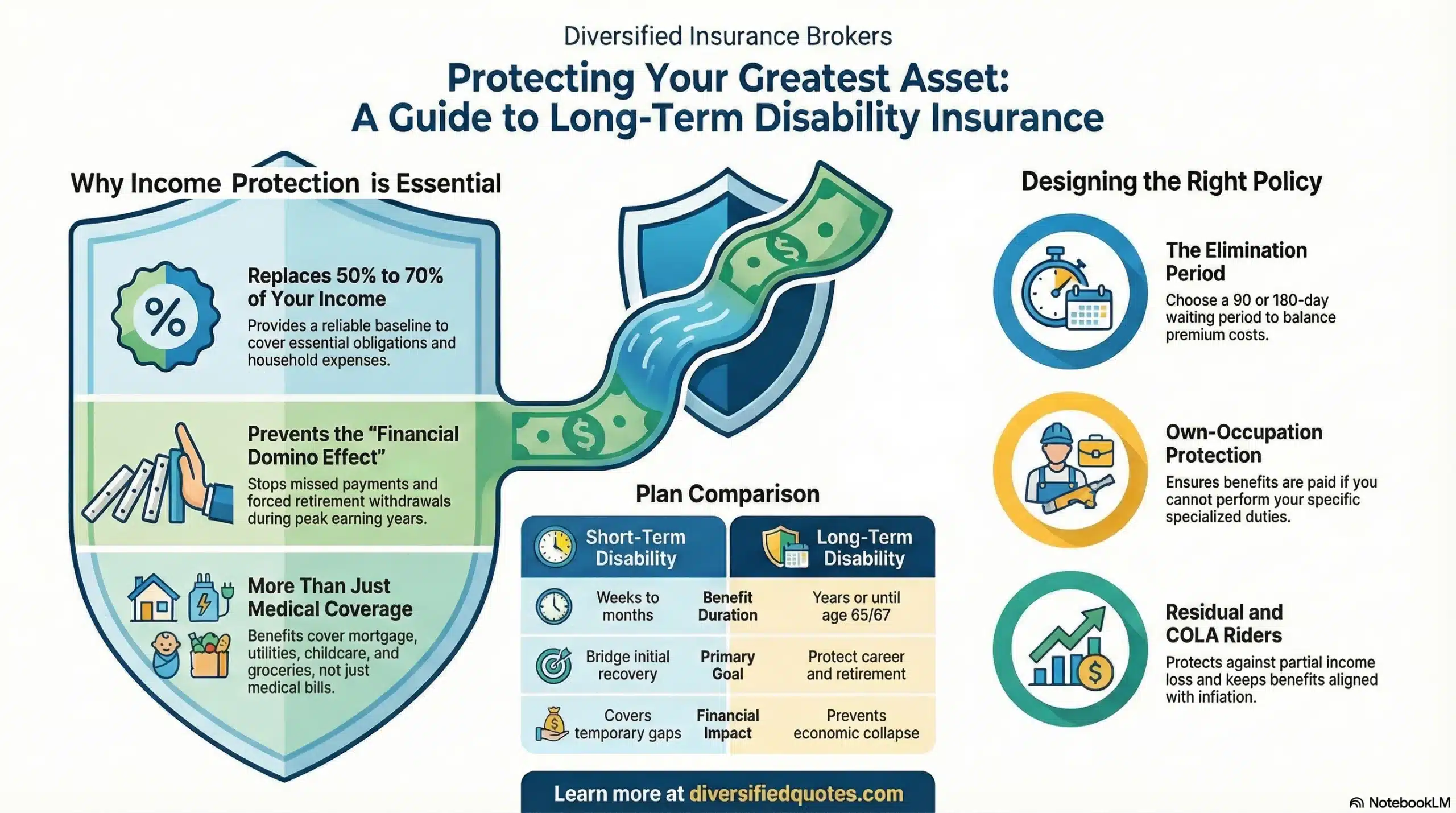
Talk With an Advisor Today
Choose how you’d like to connect—call or message us, then book a time that works for you.
Schedule here:
calendly.com/jason-dibcompanies/diversified-quotes
Licensed in all 50 states • Fiduciary, family-owned since 1980
FAQs: Disability Insurance for Beekeepers
If I develop a bee venom allergy, can disability insurance cover my inability to keep working?
Yes — and this is the most important disability insurance question specific to professional beekeepers. When a beekeeper develops a medically documented venom allergy severe enough to create serious anaphylaxis risk from occupational stings, individual disability insurance with a true own-occupation definition covers the resulting inability to perform beekeeping work as a qualifying disability. The policy does not require the allergy to have arisen from a single documented workplace incident — it requires the condition to prevent the insured from performing the material and substantial duties of their specific occupation, beekeeping, which it clearly does when continued hive work creates documented medical risk.
Research confirms that beekeepers are at increased risk for anaphylaxis due to frequent stings, and that sensitization can develop at any career stage — including in beekeepers who tolerated stings without reaction for many years. The timing of sensitization development does not affect individual disability insurance eligibility under a standard own-occupation policy: what matters is that the documented condition prevents continued beekeeping. Workers’ compensation handles this scenario poorly because venom sensitization typically develops gradually rather than from a single dated incident, and because self-employed beekeepers carry no workers’ comp protection for their own conditions. A residual disability benefit provision is worth including — if a beekeeper reduces hive exposure and income while managing the allergy but does not completely stop working, a residual benefit pays a proportional benefit based on actual income loss from the partial disability.
Are disability insurance benefits taxable for a self-employed commercial beekeeper?
For self-employed commercial beekeepers who own their apiary operation and purchase individual disability insurance with after-tax personal income, monthly benefits received during a qualifying disability are generally received income-tax-free. This means the full benefit amount reaches the household without income tax reduction — a meaningful planning factor when determining how much monthly benefit is needed to replace actual take-home apiary income during a disability period. Whether disability insurance payments are taxable is particularly relevant for beekeepers whose income varies seasonally — the annual income basis established for underwriting and benefit calculation should reflect the full annual earning capacity, not just the peak months, to ensure the monthly benefit actually covers household needs across the disability period.
For employed agricultural apiary workers whose employer pays disability insurance premiums through a group plan, the resulting benefits are typically taxable as ordinary income, reducing real purchasing power. Self-employed beekeepers who deduct disability insurance premiums as a business expense should confirm the specific tax treatment with a tax professional, as the deduction may affect benefit taxability at claim time. Beekeepers who earn income from multiple sources — honey sales, pollination contracts, farmers’ market revenue, beeswax product sales, educational workshops — should document all sources of earned income to establish the most complete and accurate income basis for benefit calculation, since the disability replaces all income streams simultaneously.
I’m a hobbyist beekeeper who has become more commercial — when should I get disability insurance?
The transition from hobby to commercial beekeeping is the right moment to establish individual disability insurance — for the same compounding reasons that make early career purchase optimal in any profession, plus a consideration specific to beekeeping: your sting history and current allergy status. Disability insurance premiums are age-rated, meaning younger applicants lock in lower premiums for the policy’s full duration. Early purchase also occurs at the point in a beekeeping career when venom sensitization has not yet developed — purchasing comprehensive coverage before a venom allergy is documented means full own-occupation coverage, including for venom-allergy-based disability, is in force as the career progresses through increasing sting exposure.
A beekeeper who waits to purchase disability insurance until after developing a documented venom allergy may find that allergy history triggers an exclusion rider for that specific condition at underwriting — meaning precisely the coverage most relevant to the profession’s unique disability risk is unavailable when it is most needed. Early purchase before that history develops prevents this outcome entirely. Why young and healthy beekeeping professionals need disability insurance is answered most directly by the venom allergy timeline: the window to purchase comprehensive coverage without venom-allergy-related restrictions closes when sensitization develops, and that development is neither predictable nor preventable through careful practice. Disability insurance for new agricultural and craft professionals covers how early-career policies can be sized for current income with future insurability riders allowing benefit increases as commercial operations grow.
I already have a known bee sting allergy — can I still get disability insurance?
Yes, though the underwriting outcome will depend on the severity and documentation of your allergy history. For most documented venom allergy histories, carriers respond with a partial exclusion rider for that specific condition rather than a full decline — meaning coverage is offered for all causes of disability except disability specifically attributed to the excluded venom allergy condition. This structure still provides meaningful protection for the full range of other health events a beekeeper faces — back conditions, serious illness, other health events unrelated to venom allergy — while excluding the specific condition documented in the history. In practice, this means a beekeeper with a documented mild venom allergy may receive an exclusion for venom-allergy-based disability while still having comprehensive coverage for all other disability causes.
The outcome varies significantly between carriers — some carriers have more favorable guidelines for applicants with managed venom allergy histories than others, and an independent broker who knows each carrier’s current underwriting position on this specific condition can target the application to the carrier most likely to produce the most favorable available terms. High-risk disability insurance options exist specifically for applicants whose health or occupational history creates underwriting complexity at standard carriers. Disability insurance with pre-existing conditions covers the range of underwriting approaches available, and an experienced independent broker familiar with agricultural occupation health histories is the most effective resource for navigating the application process when a documented allergy history is part of the picture.
I run pollination contracts and honey production — how does my seasonal income affect my benefit amount?
The seasonal and variable income pattern of commercial beekeeping — where pollination contract payments arrive in concentrated periods, honey harvest revenue fluctuates with annual yield and market prices, and farmers’ market and direct retail income varies by season — requires careful income documentation to establish the most complete and accurate annual income basis for disability insurance underwriting. The maximum approvable monthly benefit is calculated as a percentage of documented net earned income, typically 60 to 70 percent, which makes the income documentation process the direct determinant of the benefit ceiling. Using a single low-revenue year as the income basis understates the actual earning capacity of the apiary; using an unusually high year may not represent sustainable annual income.
Most carriers use a two-year income average to establish the income basis, which smooths out year-to-year variability from honey market prices and pollination contract fluctuations. For beekeepers with growing operations — adding colonies, expanding pollination contracts, building direct retail channels — the future insurability rider available on most individual disability policies allows benefit increases as documented income grows without new medical underwriting. This means the early-career or early-commercial beekeeper who purchases coverage at a modest benefit level consistent with current income can increase that benefit to match growing apiary revenue as the operation expands — without submitting to new health screening when that income growth occurs.
My disability insurance quote seemed expensive — what are my options as a beekeeper?
A single quote from a single carrier is not a market price — it is one carrier’s assessment of the occupational class and one carrier’s product terms. For an agricultural occupation like beekeeping, occupational class classifications and associated premiums vary between carriers, and the carrier that classifies commercial beekeeping most favorably produces meaningfully lower premiums for the same coverage terms than one with a more conservative classification. An independent broker who accesses the full market can identify which carrier offers the most competitive combination of occupational class and product terms for a specific beekeeper’s profile — a process that regularly produces lower premiums or better coverage terms than the first quote received.
Beyond carrier comparison, the elimination period and benefit period selections also affect premium cost in ways that can be meaningfully adjusted without sacrificing core protection. A beekeeper with adequate off-season savings reserves may find that selecting a longer elimination period — 90 days rather than 30 or 60 days — produces a meaningfully lower annual premium while still providing an adequate income floor for the scenarios most likely to produce long-term disability. The benefit period should not be shortened below age 65 to reduce cost — the venom allergy disability scenario and serious illness scenarios that most likely produce career-ending disability are not short-term events — but elimination period flexibility provides a lever for managing premium within the appropriate budget. A second opinion on your disability insurance quote through an independent broker costs nothing and regularly reveals better pricing, better terms, or both. Declining coverage because a first quote was expensive, without market comparison, is the outcome that costs most.
About the Author:
Jason Stolz, CLTC, CRPC, DIA, CAA and Chief Underwriter at Diversified Insurance Brokers (NPN 20471358), is a senior insurance and retirement professional with more than 25 years of real-world experience helping individuals, families, and business owners protect their income, assets, and long-term financial stability. As a long-time partner of the nationally licensed independent agency Diversified Insurance Brokers, Jason provides trusted guidance across multiple specialties—including fixed and indexed annuities, long-term care planning, personal and business disability insurance, life insurance solutions, Group Health, Travel Medical and Evacuation Insurance, and short-term health coverage. Diversified Insurance Brokers maintains active contracts with over 100 highly rated insurance carriers, ensuring clients have access to a broad and competitive marketplace.
His practical, education-first approach has earned recognition in publications such as VoyageATL, and contributions from his agency featured in Kiplinger and GoBankingRates— highlighting his commitment to financial clarity and client-focused planning. Drawing on deep product knowledge and years of hands-on field experience, Jason helps clients evaluate carriers, compare strategies, and build retirement and protection plans that are both secure and cost-efficient. Visitors who want to explore current annuity rates and compare options across multiple insurers can also use this annuity quote and comparison tool.
Explore More Disability Insurance Options: Browse our complete guide to Disability Insurance for Agriculture, Natural Resources & Outdoor Industries — covering farmers, ranchers, fishermen, foresters, miners, oil & gas workers & outdoor industries from 100+ carriers.
Last Reviewed: June 7, 2026 |
Reviewed by: Jason Stolz, CLTC, CRPC, DIA, CAA
Chief Underwriter, Diversified Insurance Brokers, Inc. | NPN: 20471358 | Diversified Insurance Brokers, Inc. — Licensed in all 50 states
Fact Checked by: Tonia Pettitt, CMIP©
Medicare Specialist, Diversified Insurance Brokers, Inc. | NPN: 14374308 | Diversified Insurance Brokers, Inc. — Licensed in all 50 states
Did you find this content helpful? Leave us a Google review — it helps others find trustworthy guidance too.
Editorial Standards: Diversified Insurance Brokers maintains rigorous editorial standards to ensure accuracy, clarity, and independence in all content. Learn more about our editorial standards and commitment to transparency.
