
Disability Insurance for Bail Bondsmen
As an Independent Disability Insurance Broker, we have access to exclusive discounts and negotiated pricing most captive agents can’t offer — see the full breakdown near the end of this page.
Disability Insurance for Bail Bondsmen

Jason Stolz CLTC, CRPC, DIA, CAA
Bail bondsmen occupy a uniquely complex position in both the legal system and the insurance industry. They are licensed insurance producers — holders of property and casualty or surety and fidelity producer licenses — who post financial guarantees on behalf of criminal defendants, accepting the personal and financial risk that comes with those guarantees. They are also business operators managing client relationships, court obligations, and in many cases active enforcement operations when defendants fail to appear. When a disability interrupts a bail bondsman’s ability to work, the consequences extend beyond lost income: previously-written bonds remain active liabilities, new bond production ceases, and the business infrastructure that supports ongoing bond management continues generating costs regardless of whether the owner can work. Understanding what drives the need for disability insurance is especially direct for bail professionals — income is entirely performance-based, there is no employer backup, and both personal finances and business obligations are immediately at risk when health interrupts production. The disability insurance services available to self-employed financial and legal professionals address this specific income exposure, and the income protection insurance framework covers how individual policies are built for business owners whose income flows from active performance rather than passive salary.
The dual-role structure of most bail bondsmen — part licensed insurance agent, part active enforcement operator — creates a disability insurance planning challenge that a single-category occupational description rarely captures accurately. The occupational class assigned by a disability carrier depends significantly on how the actual duties are described: a bail bond agent who primarily writes bonds, manages client relationships, coordinates court appearances, and occasionally visits jails and courthouses for administrative purposes presents a meaningfully different risk profile than one who also conducts regular fugitive recovery operations. At Diversified Insurance Brokers, we help bail professionals structure disability coverage that reflects the actual balance of their work — ensuring the occupational description supports the best available classification while the policy design addresses the full financial exposure that a disability would create.
Compare Disability Insurance for Bail Bondsmen
We compare options across 100+ carriers and structure coverage around the licensed insurance producer role, self-employed business structure, and field exposure of bail bond professionals.
Request Disability Insurance OptionsDisability Insurance for Bail Bondsmen — Coverage Dimensions and Risk Profile
| Coverage Dimension | The Bail Bondsman Reality | What the Right Design Looks Like |
|---|---|---|
| Occupational class — the critical variable | Bail bond agents who primarily write bonds, manage client relationships, and handle administrative court coordination present a more favorable occupational profile than those who also conduct active fugitive recovery; carriers evaluate actual duties — the balance of financial producer work versus field enforcement determines the class assigned and available definition quality | Accurate occupational description that reflects the actual proportion of bond-writing, administrative, and enforcement duties; independent broker comparison identifies which carriers evaluate bail bond agent profiles most favorably given the specific duties being described; this is an occupation where carrier selection drives outcomes more than most |
| Disability definition | A bail bondsman who cannot manage active bonds, write new bonds, coordinate court appearances, or conduct client intake due to illness or injury is disabled within their profession — but may still be capable of general office work or administrative employment; any-occupation language would deny this claim because alternative employment is possible | Own-occupation coverage that pays benefits when you cannot perform the material duties of bail bond production — client underwriting, bond writing, court coordination, case management — even if other types of work remain theoretically possible; the definition must reflect the licensed professional nature of the occupation |
| Income structure and documentation | Bail bond income is fee-based and directly tied to new bond production; fees (typically 10-15% of bail amounts) are non-refundable but also non-recurring — each client must be actively underwritten and written; income stops immediately when new bond production stops during a disability while existing bond liabilities and business overhead continue | Benefit sized to documented net income from bond premiums and fees averaged across two to three years of tax returns; variable income from fluctuating bond volumes is averaged; benefit should account for both personal income replacement and coordination with business overhead coverage for bond agency operations |
| Active bond liability during disability | Unlike most professions where disability simply stops income, bail bondsmen face an ongoing liability structure: active bonds written before disability remain in force and carry forfeiture risk if defendants fail to appear; the bondsman cannot manage court dates, coordinate with defendants, or conduct monitoring activities during disability while these obligations continue | Business Overhead Expense coverage to fund agency staff or management who can monitor active bonds during disability; personal LTD for income replacement; structuring these two layers together prevents both personal financial hardship and bond portfolio deterioration from unmanaged obligations during a disability period |
| Field enforcement and physical risk | Bail bondsmen who conduct fugitive recovery operations face vehicle accident risk from extensive travel, physical confrontation during apprehension, exposure to unpredictable environments, and the accumulated stress of operating in situations with incomplete information about an individual’s behavior or dangerousness | Coverage for disability from any cause — injury, illness, or health condition — not just enforcement-related events; the physical risks from field enforcement are real but illness-related conditions represent the majority of disabling events for working adults in any profession; coverage design should reflect both exposure categories |
| License and business continuity | Bail bond agents must maintain active surety producer or property and casualty producer licenses; disability that prevents active practice could affect license status through inactivity, CE requirements, or the operational requirements of maintaining surety company appointments; loss of license terminates the ability to operate | Individual LTD policy that provides income replacement during disability; BOE coverage that funds the ongoing license maintenance and administrative operations needed to preserve the bond agency’s operational status; key person disability coverage for agencies with partners or key employees who also drive bond production |
The Licensed Insurance Producer Dimension
One of the least-appreciated aspects of bail bond work is that bail bondsmen are, by regulatory requirement in most states, licensed insurance producers. To write a bail bond — which is legally a surety insurance product — the bondsman must hold a property and casualty, surety and fidelity, or similar producer license through the state insurance commissioner, maintain an appointment from a licensed surety or insurance company, and comply with the ongoing continuing education and compliance requirements that come with that licensure. This places bail bondsmen in a professional category that has more in common with licensed financial and insurance professionals — financial planners, attorneys, and insurance investigators and adjustors — than with purely physical-labor occupations. This professional dimension is relevant to occupational class: a bail bond agent who primarily operates in the financial producer/underwriting capacity and has minimal field exposure may qualify for a significantly more favorable class than pure enforcement roles receive. The disability insurance by occupation framework covers how occupational class is assigned for professional roles with mixed administrative and field components. Adjacent professionals in the legal and investigative space — private investigators, detectives, and bailiffs — present similar occupational class complexity and benefit from independent broker comparison for the same reasons.
Self-Employment, Business Overhead, and the Two-Layer Planning Need
Most bail bondsmen are self-employed, operating their own agencies or as sole practitioners with no employer disability benefit layer. This means the individual disability policy is the entire personal income protection plan — not a supplement to an existing group benefit. Self-employed disability insurance covers the income documentation and benefit sizing framework for business owners without employer backup, and disability insurance for 1099 workers and disability insurance for independent contractors cover the related planning considerations for bail professionals operating as contractors or through their own business entities. Beyond personal income, a bail bond agency has fixed overhead that continues during disability — office space, staff wages if any, software and case management systems, licensing fees, surety company relationship maintenance, and the ongoing cost of monitoring and managing active bond exposure. Business overhead disability insurance and the companion disability business overhead expense coverage address this second layer. For agencies where other agents or partners contribute to bond production, key person disability insurance addresses the business-level impact when the owner or lead producer is disabled.
Field Enforcement Risk and the Physical Disability Exposure
Bail enforcement operations — conducting surveillance, locating fugitives, executing apprehensions — expose the bondsman to vehicle accident risk from extensive travel, physical confrontation with individuals who have compelling reasons to resist, and the operational stress of working in environments with incomplete information about threats. These physical risks are real and contribute to the overall disability exposure profile. The disability insurance for high-risk occupations framework covers how carriers evaluate occupations with physical confrontation and field enforcement components. The physical risk profile of bail enforcement parallels the patterns seen in law enforcement, legal support professionals who work in courthouse and criminal justice environments, and court reporters whose work regularly places them in proximity to defendants and proceedings involving violence. However, the most statistically common disabling conditions for any working adult — illness-related events including cancer, heart disease, neurological disorders, and mental health conditions — represent the majority of actual disability claims regardless of profession. Coverage for any cause of disability, not just enforcement-related injury, is the standard that protects against the full realistic range of career-interrupting health events.
Policy Design for Bail Bond Professionals
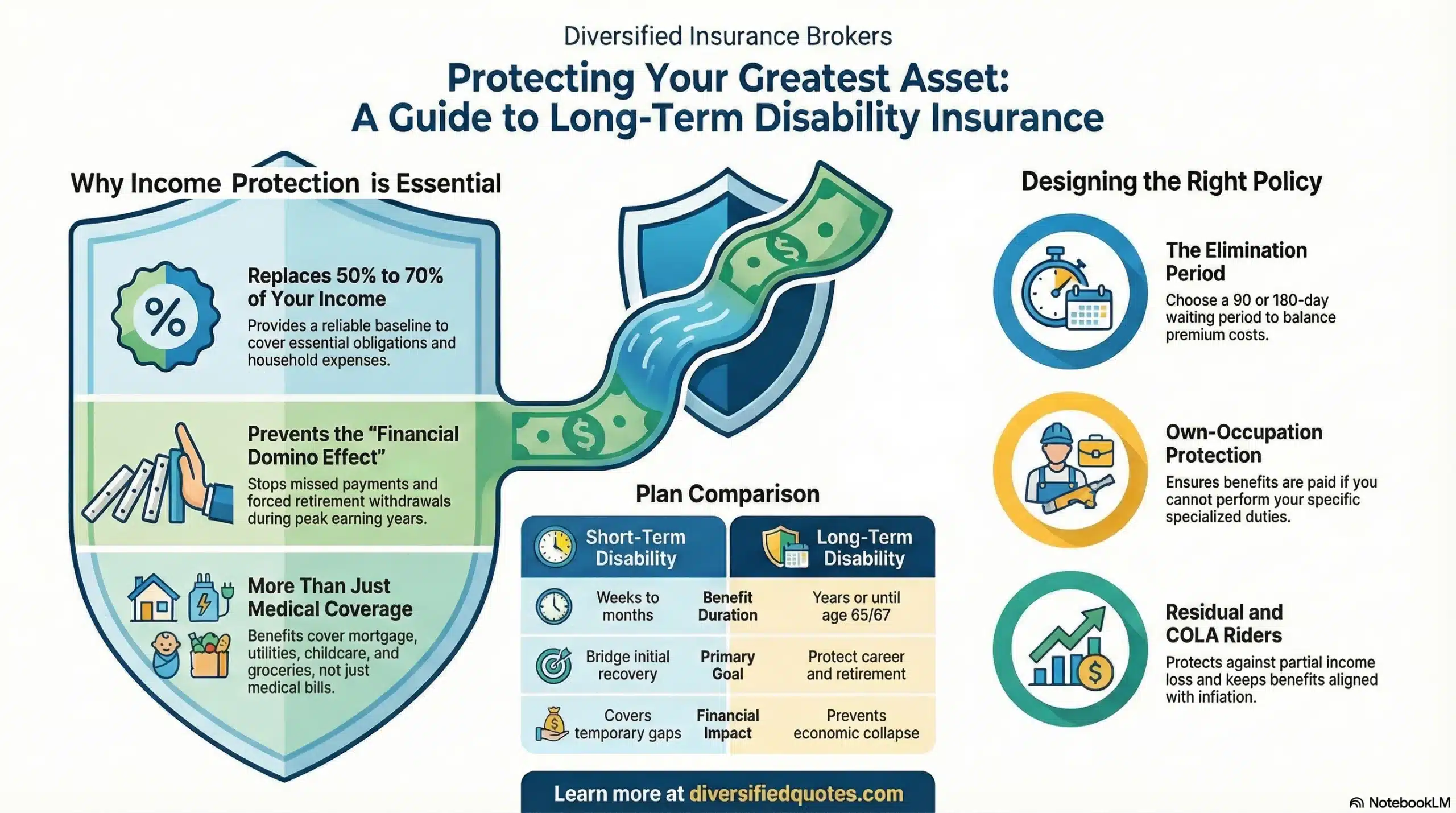
The elimination period for a self-employed bail bondsman should be calibrated against available personal savings that can bridge the income gap without accessing retirement accounts or taking on debt. For bondsmen without short-term disability or significant liquid reserves, shorter elimination periods reduce the financial crisis risk during the initial disability phase. The benefit period should extend to retirement age — long-term disability insurance to age 65 protects against career-ending conditions during peak production years. The residual disability rider is particularly valuable for bail professionals whose disability may reduce production capacity without completely ending it — writing fewer bonds per month while recovering represents a real income loss that residual coverage captures. The full rider framework including the COLA rider for long-duration benefit protection is at disability insurance riders explained. Tax treatment of individually owned disability benefits — generally received income-tax-free when premiums are paid personally after tax — is at are disability insurance payments taxable. The benefit sizing calculation for self-employed bail professionals with variable production income is at how much disability insurance do I need. For an independent evaluation of any existing or proposed policy, get a 2nd opinion on your disability insurance quote covers the review process.
Talk With an Advisor Today
Choose how you’d like to connect—call or message us, then book a time that works for you.
Schedule here:
calendly.com/jason-dibcompanies/diversified-quotes
Licensed in all 50 states • Fiduciary, family-owned since 1980
FAQs: Disability Insurance for Bail Bondsmen
Are bail bondsmen considered high-risk for disability insurance purposes?
It depends significantly on what the bail bondsman actually does. Bail bond agents who primarily write bonds, manage client relationships, conduct court coordination, and handle administrative operations present a more favorable occupational profile for disability carriers than those who also conduct active fugitive recovery or bail enforcement. The financial producer and licensed insurance agent components of bond writing work in the applicant’s favor; the field enforcement components work against it. Accurately describing the actual balance of duties — and working with an independent broker to identify which carriers evaluate that specific profile most favorably — is the most important step in getting coverage at the right class and definition quality for this profession.
What happens to my active bonds if I become disabled and cannot manage them?
Active bonds remain in force during disability — defendants covered by those bonds still have court appearance obligations, and the bondsman’s financial liability on each bond continues regardless of their health status. If defendants fail to appear while the bondsman is disabled, forfeiture proceedings can proceed against bonds that are not actively monitored. This is one of the strongest reasons for bail bondsmen to also carry Business Overhead Expense coverage that can fund the cost of having other agents or staff manage the existing bond portfolio during a disability period. Personal disability income protects household finances; BOE coverage protects the business from deterioration while the owner cannot manage operations.
How is income documented for a self-employed bail bond agent?
Disability insurance carriers require two to three years of tax returns to establish a net income baseline for benefit sizing. For self-employed bail bond agents, this means Schedule C or S-corporation returns that document net income after business expenses — office costs, staff, licensing fees, surety premiums, and other operating costs are deducted from gross premium revenue to produce the net income figure used for benefit calculation. Variable year-to-year income from fluctuating bond volumes is averaged across the documented period. The net income used for benefit calculation may be meaningfully lower than gross premium revenue, which is why structuring both personal LTD and BOE coverage together provides more complete financial protection than personal income replacement alone.
Does a bail bondsman need both personal disability insurance and Business Overhead Expense coverage?
For bail bondsmen with any meaningful bond agency infrastructure — staff, office space, active bond portfolio requiring ongoing management, or a surety company relationship with ongoing compliance requirements — yes. A personal LTD policy replaces household income. It does not fund the cost of having someone else manage active bonds, maintain surety company appointments, or keep the agency’s license and operational status intact. A Business Overhead Expense policy specifically covers documented fixed business costs during a disability period. For bail bond agencies where the owner’s disability could mean active bonds going unmonitored, the BOE layer is not optional — it is the mechanism that keeps the business from accumulating unmanaged forfeiture risk while the owner recovers.
Why is independent broker access especially important for bail bond agent disability coverage?
Bail bond agents fall into an occupational class category that varies significantly across carriers. Some carriers treat bond-writing agents as financial/insurance professionals and apply favorable class assignments when field enforcement is minimal or absent; others apply lower classes based on the criminal justice and enforcement dimension of the work regardless of the actual duty balance. A single-carrier submission applies one underwriting perspective to your application. An independent broker compares multiple carriers’ underwriting guidelines for this specific occupation, identifies which carrier classifies your actual duty profile most favorably, and structures the application to present the most accurate and comprehensive picture of what you actually do. For an occupation where classification ranges can span several class levels depending on the carrier, this comparison makes a meaningful difference in both premium and available definitions.
About the Author:
Jason Stolz, CLTC, CRPC, DIA, CAA and Chief Underwriter at Diversified Insurance Brokers (NPN 20471358), is a senior insurance and retirement professional with more than 25 years of real-world experience helping individuals, families, and business owners protect their income, assets, and long-term financial stability. As a long-time partner of the nationally licensed independent agency Diversified Insurance Brokers, Jason provides trusted guidance across multiple specialties—including fixed and indexed annuities, long-term care planning, personal and business disability insurance, life insurance solutions, Group Health, Travel Medical and Evacuation Insurance, and short-term health coverage. Diversified Insurance Brokers maintains active contracts with over 100 highly rated insurance carriers, ensuring clients have access to a broad and competitive marketplace.
His practical, education-first approach has earned recognition in publications such as VoyageATL, and contributions from his agency featured in Kiplinger and GoBankingRates— highlighting his commitment to financial clarity and client-focused planning. Drawing on deep product knowledge and years of hands-on field experience, Jason helps clients evaluate carriers, compare strategies, and build retirement and protection plans that are both secure and cost-efficient. Visitors who want to explore current annuity rates and compare options across multiple insurers can also use this annuity quote and comparison tool.
Explore More Disability Insurance Options: Browse our complete guide to Disability Insurance for Public Safety, Military & Government — covering firefighters, law enforcement, military, pilots, TSA, SWAT & first responders from 100+ carriers.
Last Reviewed: June 6, 2026 |
Reviewed by: Jason Stolz, CLTC, CRPC, DIA, CAA
Chief Underwriter, Diversified Insurance Brokers, Inc. | NPN: 20471358 | Diversified Insurance Brokers, Inc. — Licensed in all 50 states
Fact Checked by: Tonia Pettitt, CMIP©
Medicare Specialist, Diversified Insurance Brokers, Inc. | NPN: 14374308 | Diversified Insurance Brokers, Inc. — Licensed in all 50 states
Did you find this content helpful? Leave us a Google review — it helps others find trustworthy guidance too.
Editorial Standards: Diversified Insurance Brokers maintains rigorous editorial standards to ensure accuracy, clarity, and independence in all content. Learn more about our editorial standards and commitment to transparency.
