
Disability Insurance for Bailiffs
As an Independent Disability Insurance Broker, we have access to exclusive discounts and negotiated pricing most captive agents can’t offer — see the full breakdown near the end of this page.
Disability Insurance for Bailiffs

Jason Stolz CLTC, CRPC, DIA, CAA
Bailiffs and court security officers maintain the order, safety, and dignity of the judicial process. Positioned at the boundary between the public and the court’s most sensitive proceedings, a bailiff must be physically capable of managing confrontational situations, mentally alert enough to identify emerging threats before they materialize, and present enough — reliably, shift after shift — to fulfill the constitutional requirement that courts operate safely. When illness, injury, or a health condition disrupts either of those capabilities, a bailiff’s ability to perform their role ends immediately. There is no modified duty version of court security, and most courts cannot accommodate a bailiff who cannot meet the full physical and alertness standards the position requires. The disability insurance services available to public safety and court security professionals address this specific income risk, and the broader income protection insurance framework covers how individual policies coordinate with existing government or employer benefits to build complete income protection.
Most bailiffs work as government employees of county, state, or federal court systems — and that government employment comes with some baseline benefit structure. But baseline is rarely adequate. Government disability pension provisions, PSOB program benefits for line-of-duty injuries, and group LTD plans all have meaningful limitations — coverage caps, any-occupation definitions after limited periods, requirements that disabilities be duty-related, and mental health benefit caps that fall well short of what serious occupational stress exposures may require. At Diversified Insurance Brokers, we help bailiffs and court security officers understand what their current coverage actually provides — and where the gaps are — so individual disability insurance fills the real financial exposure rather than creating redundant overlap with existing benefits.
Compare Disability Insurance for Bailiffs
We compare options across 100+ carriers and structure coverage around the specific duties, government benefit structure, and income exposure of court security professionals.
Request Disability Insurance OptionsDisability Insurance for Bailiffs — Coverage Dimensions, Government Benefit Gaps, and Policy Design
| Coverage Dimension | The Bailiff Reality | What Individual Coverage Addresses |
|---|---|---|
| Government pension disability provisions | Federal court bailiffs under FERS receive disability retirement provisions that pay approximately 60% of the high-3 average salary in year one, dropping to 40% thereafter, then shifting to an any-occupation standard; state and county court bailiffs face highly variable pension disability provisions that may be less comprehensive than FERS | Individual policy fills the income gap between government disability provisions and actual monthly financial obligations; own-occupation language provides protection against conditions that prevent court security duties specifically, even when pension systems’ any-occupation standards are not met |
| PSOB program limitations | The federal Public Safety Officers’ Benefits disability program covers line-of-duty injuries for eligible public safety officers — but covers only duty-related disabilities; illness, off-duty injuries, and health conditions unrelated to specific workplace incidents receive no PSOB benefit regardless of how severely they impair court security performance | Individual disability insurance covers disability from any cause — not just line-of-duty events; the health conditions that most commonly disable working adults (cancer, heart disease, back conditions, neurological disorders, mental health) all fall outside PSOB coverage and require individual policy protection |
| Occupational class and definition | Bailiffs fall in a middle occupational class reflecting the security and physical response duties alongside the substantial monitoring, administrative, and procedural components; the class depends on the specific duties described — bailiffs with primarily supervisory or administrative court functions may classify differently than those with active physical security roles | Own-occupation coverage that ties benefits to the ability to perform the material duties of court security specifically — maintaining order, responding to threats, escorting defendants, enforcing courtroom rules — not just “any work”; carrier selection and occupational description accuracy determine the available definition quality |
| Mental health and PTSD coverage | Regular exposure to traumatic testimony, violent defendants, death penalty proceedings, contentious custody hearings, and security threat responses creates meaningful PTSD and occupational stress risk; most group LTD plans cap mental/nervous benefits at 24 months — insufficient for serious stress-related conditions requiring extended recovery | Individual policies with unlimited mental/nervous benefit periods matching the physical disability benefit period provide sustained protection for the occupational stress and PTSD risk that is particularly elevated in court security roles; own-occupation language ensures cognitive alertness and situational judgment impairment triggers benefits |
| Physical injury exposure | Physical confrontations during disturbances, injury during defendant escorts, musculoskeletal conditions from extended standing throughout court sessions, and cumulative physical strain from sustained vigilance postures all contribute to a meaningful physical disability risk profile for court security officers | Coverage for both acute injury from confrontation events and gradual-onset musculoskeletal conditions; residual disability rider for partial recovery phases where reduced capacity or modified duty creates income loss before return to full performance standards |
| Career longevity and pension risk | Bailiffs often depend on reaching full pension eligibility years to maximize retirement benefits; a disability that forces early retirement can reduce lifetime pension income by eliminating years of service credit and triggering actuarially reduced early retirement calculations | To-age-65 benefit period protects against extended disabilities; income replacement during disability prevents draining retirement savings to cover living expenses; disability income allows the bailiff to focus on recovery rather than financial pressure to return before medically cleared |
Government Benefits and the Coverage Gap
The government employment structure that most bailiffs operate within provides some disability protection — but the gaps are real and often larger than the nominal benefit structure suggests. Federal court officers under FERS face the same coverage limitations detailed at disability insurance for airline security personnel: benefits that shift from a job-specific to an any-occupation standard after year one, caps that limit total replacement to well below full income, and coverage that applies only to conditions that meet the agency’s disability determination standards. State and county court bailiffs face an even more variable situation, with pension disability provisions that differ by jurisdiction and are often more limited than federal employee provisions. The PSOB disability benefit program — which provides a one-time payment for public safety officers permanently and totally disabled in the line of duty — addresses catastrophic duty-related disability but is not an income replacement mechanism for the full range of health conditions that can interrupt a bailiff’s career. The parallel situation for other public safety government employees is covered across several occupation-specific pages: law enforcement officers face nearly identical government benefit gap structures, and prison and jail security officers face a directly parallel institutional security benefit environment. The disability insurance by occupation framework covers how occupational class is assigned for security and public safety roles.
Why Own-Occupation Coverage Defines Real-World Claim Outcomes
The disability definition is the most consequential policy feature for a bailiff, and it is the feature most frequently inadequate in government group plans. A bailiff who cannot maintain the physical readiness, reaction capability, and sustained alertness that court security requires — due to a back condition limiting rapid movement, a knee injury preventing physical intervention capability, or a neurological condition affecting situational judgment — is genuinely disabled within their profession. But they may still be capable of other employment: desk work, administrative positions, clerical functions. Under any-occupation language, that remaining capability provides grounds for benefit denial or termination. Under true own-occupation disability insurance, the policy evaluates whether the bailiff can perform the material duties of court security — maintaining order, responding to threats, escorting defendants, managing courtroom access — not whether other types of work remain theoretically possible. This definitional gap between government group coverage and quality individual coverage is the same problem that faces SWAT team members, FBI agents, and detectives whose security-specific physical and cognitive capabilities define their professional function. The disability insurance for high-risk occupations framework covers how physical security and law enforcement occupations are classified and evaluated.
Mental Health, Stress, and the 24-Month Cap Problem
Bailiffs are exposed to a sustained diet of human conflict and institutional stress that most professions never encounter. Traumatic testimony in violent crime proceedings, the psychological weight of death penalty court sessions, contentious child custody disputes with emotionally volatile parties, direct threat exposure from defendants with documented histories of violence, and the accumulated stress of maintaining constant situational vigilance across years of service all create meaningful PTSD and occupational stress risk. These conditions can prevent a bailiff from safely performing court security duties — the sustained alertness, threat assessment, and rapid response capability that the role requires — while leaving the person physically capable of lower-stress work. The coverage problem is that most group LTD plans cap mental and nervous condition benefits at 24 months, which is frequently insufficient for serious PTSD or stress-related conditions requiring extended treatment and recovery. Individual disability policies with unlimited mental/nervous benefit periods provide the sustained protection that occupational stress exposures in court security actually require. The coverage considerations for conditions involving stress and mental health history are at disability insurance with preexisting conditions. Adjacent public safety professions face identical mental health coverage gaps — dispatchers, firefighters, and military and armed forces personnel all carry elevated PTSD risk with the same 24-month group plan cap inadequacy.
Policy Design for Bailiffs and Court Security Officers
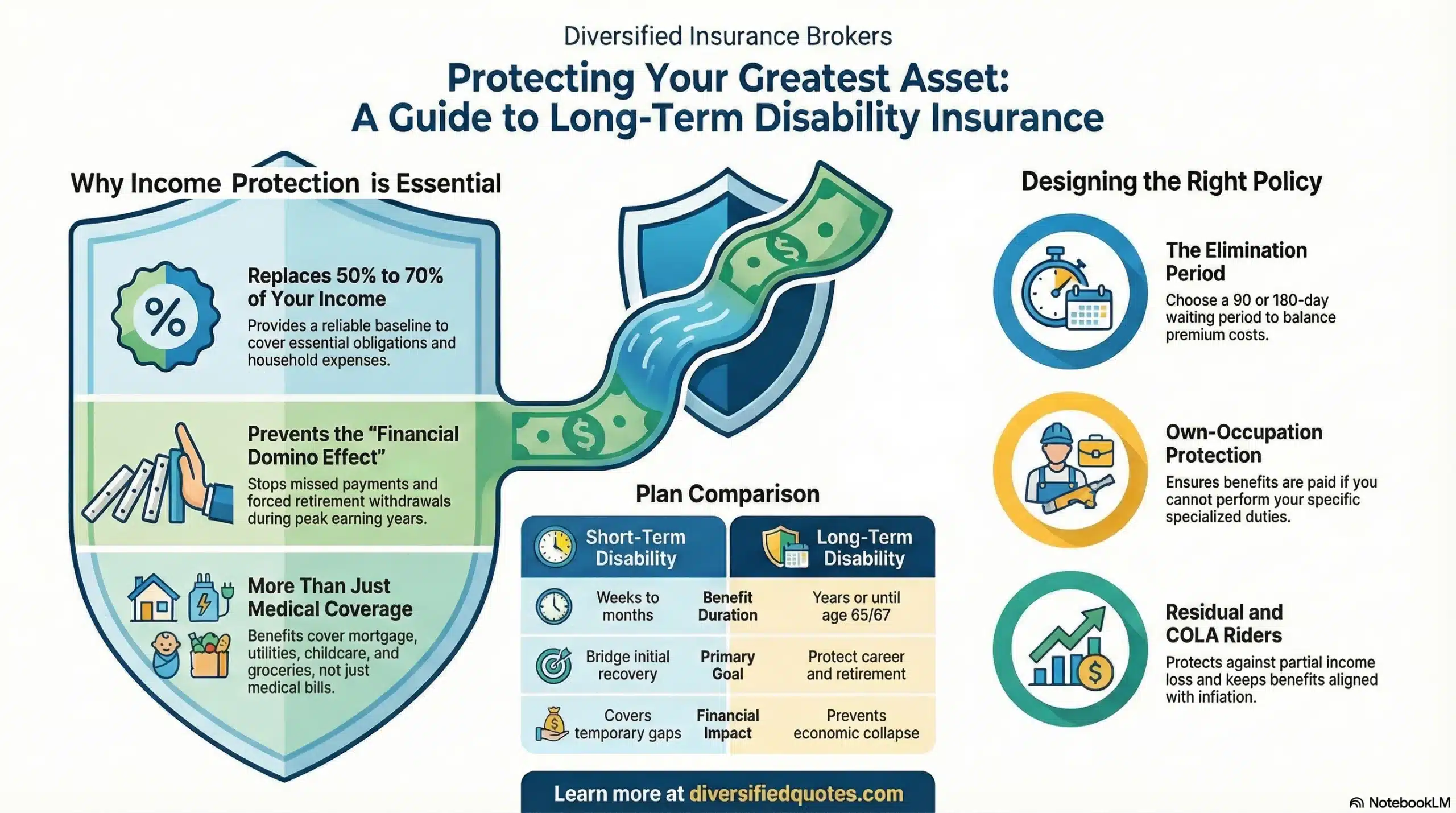
The benefit period for a bailiff’s disability policy should extend to retirement age — long-term disability insurance with a to-age-65 benefit period protects against career-ending conditions during the decades when pension service credits are still accumulating. The elimination period should be calibrated against available bridge resources: a bailiff with meaningful sick leave accruals or short-term disability coverage from the employer may be able to absorb a 90-day elimination period comfortably; one without those resources may need a shorter period to prevent financial hardship during the initial gap. The residual disability rider addresses partial income loss during recovery phases when duty limitations reduce hours or assignment types before a return to full status. The COLA rider protects the purchasing power of long-duration benefits — particularly valuable for bailiffs who become disabled midcareer and may receive benefits for 15-25 years. The full rider framework is at disability insurance riders explained. The benefit sizing framework for government employees who need to model the gap between pension disability provisions and actual income exposure is at how much disability insurance do I need. The tax treatment of benefits from individually owned policies — generally received income-tax-free when premiums are paid personally after tax — is covered at are disability insurance payments taxable. For court-adjacent legal professionals, the parallel coverage planning for disability insurance for court reporters covers the disability risk profile of another constant courtroom presence. For an independent evaluation of any existing disability policy, get a 2nd opinion on your disability insurance quote covers the review process.
Talk With an Advisor Today
Choose how you’d like to connect—call or message us, then book a time that works for you.
Schedule here:
calendly.com/jason-dibcompanies/diversified-quotes
Licensed in all 50 states • Fiduciary, family-owned since 1980
FAQs: Disability Insurance for Bailiffs
Do bailiffs already have disability coverage through their government employer?
Partially — but with significant gaps. Federal court bailiffs under FERS receive disability retirement provisions, but these pay approximately 60% of the high-3 salary in year one before dropping to 40% and shifting to an any-occupation standard after year one. State and county court bailiffs face highly variable pension disability provisions. The PSOB program covers only line-of-duty injuries — illness, off-duty injuries, and health conditions unrelated to specific workplace incidents receive no PSOB benefit. Individual disability insurance fills the income gap, covers all causes of disability, and provides own-occupation protection that follows the bailiff regardless of what other work might theoretically remain possible.
What types of disabilities most commonly affect bailiffs?
Physical injuries from confrontation during disturbances or defendant escorts are the most visible risk, but musculoskeletal conditions from extended standing throughout court sessions — back pain, knee conditions, hip issues — represent the more common long-term disability mechanism. PTSD, anxiety disorders, and stress-related conditions from sustained exposure to traumatic testimony, violent defendants, and security threat environments are a documented and clinically significant risk in court security roles. Vehicle accidents from travel between court facilities add an additional exposure. Illness-related conditions — heart disease, cancer, neurological disorders — represent the majority of disabling events for working adults across all professions and are equally present for bailiffs regardless of the physical security nature of the role.
Does the group LTD provided by a court employer cover mental health and PTSD for the full benefit period?
Most employer group LTD plans cap mental and nervous condition benefits at 24 months — regardless of how severe the condition is or how long recovery requires. For bailiffs with PTSD or serious occupational stress conditions, 24 months is frequently insufficient. Individual disability policies with unlimited mental/nervous benefit periods provide sustained income replacement that matches the benefit period for physical disabilities. Given the elevated PTSD and occupational stress risk in court security roles, the mental health benefit period is one of the most important features to evaluate in any disability policy for this profession.
How does disability insurance interact with a bailiff’s pension if a disability forces early retirement?
A disability that forces early retirement creates a dual financial problem: loss of current income while recovering, and reduced lifetime pension benefits from lower service credits and potentially actuarially reduced early retirement calculations. Individual disability insurance addresses the first problem by replacing income during the disability period, preventing the bailiff from having to drain retirement savings to cover living expenses during recovery or forced early retirement. This can help preserve retirement account balances and prevent the compounding damage of early retirement distribution decisions made under financial pressure. The disability benefit period to age 65 also bridges the gap to standard pension eligibility for bailiffs whose pension may not be fully vested or may be subject to early retirement reductions.
Why does own-occupation coverage matter specifically for court security officers?
A bailiff who cannot maintain the physical readiness, reaction capability, and sustained alertness that court security requires — due to a back condition, knee injury, or stress-related cognitive impairment — is genuinely disabled within their profession, but may still be capable of desk work or administrative employment. Under any-occupation language, that remaining capability provides grounds to deny or terminate benefits. Under own-occupation coverage, the policy evaluates whether the bailiff can perform the material duties of court security specifically. For a role where physical and cognitive readiness are the entire professional function, the own-occupation definition is the feature that determines whether a legitimate career-ending disability produces compensated benefits or a denial.
About the Author:
Jason Stolz, CLTC, CRPC, DIA, CAA and Chief Underwriter at Diversified Insurance Brokers (NPN 20471358), is a senior insurance and retirement professional with more than 25 years of real-world experience helping individuals, families, and business owners protect their income, assets, and long-term financial stability. As a long-time partner of the nationally licensed independent agency Diversified Insurance Brokers, Jason provides trusted guidance across multiple specialties—including fixed and indexed annuities, long-term care planning, personal and business disability insurance, life insurance solutions, Group Health, Travel Medical and Evacuation Insurance, and short-term health coverage. Diversified Insurance Brokers maintains active contracts with over 100 highly rated insurance carriers, ensuring clients have access to a broad and competitive marketplace.
His practical, education-first approach has earned recognition in publications such as VoyageATL, and contributions from his agency featured in Kiplinger and GoBankingRates— highlighting his commitment to financial clarity and client-focused planning. Drawing on deep product knowledge and years of hands-on field experience, Jason helps clients evaluate carriers, compare strategies, and build retirement and protection plans that are both secure and cost-efficient. Visitors who want to explore current annuity rates and compare options across multiple insurers can also use this annuity quote and comparison tool.
Explore More Disability Insurance Options: Browse our complete guide to Disability Insurance for Public Safety, Military & Government — covering firefighters, law enforcement, military, pilots, TSA, SWAT & first responders from 100+ carriers.
Last Reviewed: June 6, 2026 |
Reviewed by: Jason Stolz, CLTC, CRPC, DIA, CAA
Chief Underwriter, Diversified Insurance Brokers, Inc. | NPN: 20471358 | Diversified Insurance Brokers, Inc. — Licensed in all 50 states
Fact Checked by: Tonia Pettitt, CMIP©
Medicare Specialist, Diversified Insurance Brokers, Inc. | NPN: 14374308 | Diversified Insurance Brokers, Inc. — Licensed in all 50 states
Did you find this content helpful? Leave us a Google review — it helps others find trustworthy guidance too.
Editorial Standards: Diversified Insurance Brokers maintains rigorous editorial standards to ensure accuracy, clarity, and independence in all content. Learn more about our editorial standards and commitment to transparency.
