
Burial Insurance for Parents Over 70
Burial Insurance for Parents Over 70

Jason Stolz CLTC, CRPC, DIA, CAA
Burial insurance for parents over 70 sits at the most favorable intersection of accessibility and affordability in the senior final expense market. All three policy structures — level benefit, graded benefit, and guaranteed issue — are broadly available to parents in their 70s. The full carrier field is competitive. Simplified-issue underwriting in the 70s accommodates the health profiles most common at this stage of life, including managed hypertension, stable diabetes, and cardiac history beyond the acute window. Premiums, while higher than in the 50s or 60s, are meaningfully lower than they will be in the 80s for the same coverage — and because burial insurance premiums are permanently locked at issue, the rate a parent qualifies for at age 72 stays at that level for the entire life of the policy, including at age 82 and 92. The single most common regret reported by families who have purchased final expense coverage for a parent is not acting sooner. Waiting from age 70 to age 75 for the same $10,000 policy can cost a family approximately $3,000 more in cumulative premium over the policy’s life — and that difference is locked in permanently at the later application. Our resource on burial insurance for seniors over 70 covers the full landscape from the parent’s perspective, and our resource on burial insurance services covers the complete product landscape across all age tiers.
For most adult children who arrive at this page, the parent is in their 70s and has not yet established dedicated final expense coverage — or had coverage in earlier years that has since lapsed or been cashed out, leaving the family without a plan for the specific costs that arrive in the days immediately following a death. The problem is concrete: funeral homes require payment before services begin, cemetery charges are billed separately and must be arranged quickly, final medical bills arrive before the estate is settled, and family travel and logistics costs land simultaneously with the grief of losing a parent. A standard funeral with burial averages approximately $8,300 before cemetery charges in 2026, with the plot, grave opening and closing, and burial vault typically adding $3,000 to $5,000. Cremation with a memorial service averages approximately $6,280 before additional merchandise and service costs. Burial insurance creates a dedicated, probate-bypassing benefit that pays the named beneficiary directly — providing a specific pool of funds for exactly these costs without requiring estate settlement, liquidation of savings, or adult sibling cost-splitting negotiations during the worst possible week. Our resource on what does burial insurance cover covers the full scope of final expenses the proceeds address, and our resource on burial insurance vs. pre-paid funeral covers the comparison with direct funeral pre-payment that some families consider at this stage.
The adult child is almost always the initiating party in this planning conversation, and that dynamic shapes everything about how the process works. Most parents in their 70s have not prioritized final expense planning independently — not because they don’t care, but because the urgency is not yet felt, the conversation is uncomfortable, and no one in the family has taken the lead. Adult children who do take the lead consistently find that the parent is relieved rather than resistant once the conversation is framed around family protection rather than mortality. The arrangement is carrier-standard and fully supported: the adult child serves as the policy owner and premium payer, the parent is the insured, and the parent’s consent and accurate answers to health questions are required for the application. This means the adult child controls the premium payment process, keeps beneficiary designations current, and ensures the policy stays in force regardless of the parent’s financial management capacity — while the parent’s medical and financial information remains private within the application. Our resource on burial insurance for mom and dad covers the family coordination dynamics in full.
Compare Burial Insurance Rates for Parents Over 70
No medical exam — simplified issue and guaranteed issue options. See real rates by age and state before any application is submitted.
Not sure whether level, graded, or guaranteed issue is right for your parent?
We identify the best available policy type based on your parent’s age and health profile — and compare carriers to find the most competitive rate — before any application is submitted.
Level Benefit vs. Graded Benefit vs. Guaranteed Issue — What Parents in Their 70s Can Expect
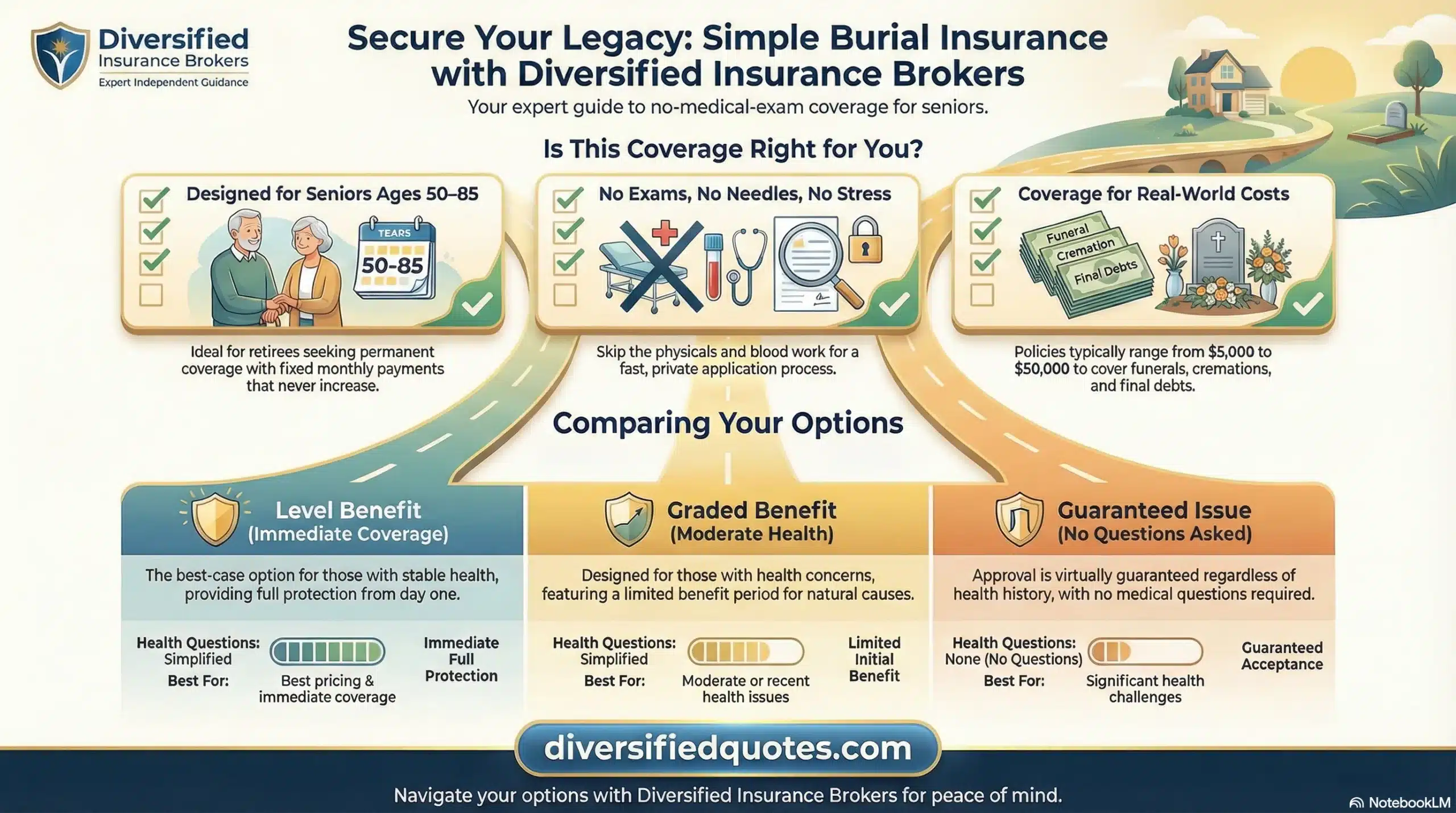
One of the most important decisions in purchasing burial insurance for a parent is understanding which policy structure is appropriate for the parent’s health profile — and why defaulting to guaranteed issue when simplified issue is available is a significant and unnecessary financial mistake. The table below maps all three structures across the dimensions adult children care most about.
| Feature | Level Benefit (Simplified Issue) | Graded Benefit (Simplified Issue) | Guaranteed Issue |
|---|---|---|---|
| Natural-cause death benefit — years 1-2 | Full face amount from day one | Limited — return of premiums plus interest (typically 10%), or 30%/70% of face amount in years 1/2 | Return of premiums plus interest (typically 10%) — no full natural-cause benefit during graded period |
| Natural-cause death benefit — year 3+ | Full face amount (no change) | Full face amount — graded period ends | Full face amount — graded period ends |
| Accidental death benefit | Full face amount from day one | Full face amount from day one at most carriers | Full face amount from day one at most carriers |
| Health questions required | Yes — short questionnaire (typically 8-12 questions), no exam | Yes — questionnaire; graded tier is assigned when health history clears some but not all level-benefit questions | No health questions — automatic approval for age-eligible applicants |
| Premium cost per dollar of coverage | Lowest — most cost-efficient structure in the burial insurance market | Middle tier — higher than level benefit, lower than guaranteed issue at comparable carriers | Highest — 30-50% more than comparable level-benefit simplified issue for the same face amount |
| Approximate monthly cost — $10,000, age 70, female, non-tobacco | ~$50–75 | ~$60–90 | ~$75–110 |
| Approximate monthly cost — $10,000, age 70, male, non-tobacco | ~$55–80 | ~$70–100 | ~$85–120 |
| Carrier availability for parents in their 70s | Broad — most final expense carriers compete in this tier for stable health profiles | Good — most carriers offer a graded tier as an alternative to outright decline for higher-risk simplified-issue applicants | Moderate — GI available at most carriers through age 85; narrower than simplified-issue options |
| Best fit for | Parents with stable, managed chronic conditions and no recent major hospitalizations or acute events — the majority of parents in their 70s | Parents with more complex health profiles who can clear some but not all level-benefit questions; or those within a timing window (e.g., 12-24 months post-cardiac event) | Parents with high-severity health conditions (CHF, dialysis, recent major events) that prevent simplified-issue qualification; or parents who want the simplest possible process |
Premium ranges above are approximate directional benchmarks based on current market research for non-tobacco applicants. Actual premiums vary by carrier, state, specific health profile, exact age, and policy design. These ranges are for planning reference purposes; use the quote tool above for actual carrier-specific rates. GI premiums shown are approximate and carrier-specific; consult current carrier rates before making premium comparisons. The critical planning insight: defaulting to GI when a parent qualifies for simplified-issue level benefit permanently overpays by 30-50% for every year the policy is in force.
Why the 70s Is the Right Decade for This Decision
Three factors make the 70s the most favorable planning window within the senior final expense market for families whose parent has not yet established coverage. The first is carrier competition — in the 70s, the full field of final expense carriers is actively competing for business, which means comparison across 30 or more carriers produces meaningful rate variation for the same profile and the best possible match between a specific health history and specific carrier underwriting guidelines. By the early 80s, that field begins to narrow. By the mid-80s, it narrows substantially. By 86-plus, the accessible carrier field for new applications is a fraction of what it is in the 70s. The second factor is premium level — premiums for a parent in their 70s are significantly lower than for the same parent at 82 or 85. A male who acts at age 70 versus age 75 locks in a lower rate for every year the policy is in force; the cumulative difference in total premiums paid over decades can reach thousands of dollars for the same coverage. The third factor is health qualification access — the simplified-issue health questions that determine level-benefit eligibility are more readily cleared by parents in their 70s than by the same individuals at 80 or 85, when additional health events and functional changes have accumulated over the intervening years. Our resource on burial insurance for seniors over 60 covers the adjacent decade comparison, and our resource on burial insurance for parents over 80 covers what the landscape looks like when the 70s planning window has passed.
The Real Cost of Waiting — What Deferral Does to Premiums
The financial math of deferral is straightforward and should be part of every adult child’s planning conversation with a parent in their 70s. Burial insurance premiums are set at the applicant’s current age and locked permanently at that level. Every year a parent ages without establishing coverage is a year at which the eventual locked-in rate will be higher than it would have been if coverage had been established earlier. Research from the current market shows that waiting just five years — from age 70 to age 75 — can cost a family approximately $3,000 more in cumulative premium over the policy’s lifetime for the same $10,000 face amount. By age 79 versus 70, that premium gap is substantially larger. The deferred premium savings that were supposed to justify waiting do not actually accumulate — because premium payments don’t occur while the parent is uninsured, but the higher locked-in rate upon eventual application offsets those savings within a few years and then compounds them over the remaining life of the policy. The math consistently favors action in the 70s over deferral into the 80s for any parent who will eventually need burial insurance, which is nearly every family. Our resource on burial insurance for seniors over 50 covers the full premium-by-age comparison across the senior market for families whose parent is younger than 70.
How the Application Process Works as an Adult Child
The process for arranging burial insurance for a parent over 70 as an adult child involves four practical steps. The first is establishing insurable interest and obtaining the parent’s informed consent — both are required, and the parent must actively participate in the application even when the adult child is managing all the logistics. Insurable interest between a parent and child is universally recognized and does not require formal documentation; consent means the parent agrees to be the insured and understands the policy will be purchased on their life. The second step is a brief health pre-screen — not a formal medical underwriting exam, but a short conversation about the parent’s current medications, diagnoses, and any recent hospitalizations or major health events. That information determines whether simplified-issue level benefit, graded simplified issue, or guaranteed issue is the appropriate starting point and which specific carriers are most likely to approve the parent’s profile. The third step is carrier selection and application — working with an independent specialist to identify which of the 30-plus carriers in the final expense market are most favorable for the specific combination of age, health conditions, and state of residence. The application itself is typically completed electronically or by phone, with no medical exam required, and decisions are often rendered the same day or within a few days for straightforward applications. The fourth step is policy setup — ensuring the beneficiary designations are correct, the premium payment source is established and sustainable, and all adult children who need to know about the policy are informed of its details. Our resource on best burial insurance for parents over 70 covers the carrier selection framework in detail, and our resource on best-rated burial insurance companies covers the carrier landscape for senior applicants.
What the Carrier Actually Evaluates in a 70s Application
Simplified-issue final expense underwriting for parents in their 70s is built around a short health questionnaire — typically 8 to 12 yes-or-no questions — supplemented by an electronic prescription database check and a Medical Information Bureau records review. No physician records, no lab values, and no in-person examination are required. The health questions are structured to identify the specific conditions and recent events that most affect near-term claim probability: recent hospitalizations (typically the past 12-24 months), home oxygen use, confinement in a care facility, active cancer treatment, recent major cardiac events, dialysis, and significant functional limitations in activities of daily living. A parent in their 70s who can answer “no” to all or most of these questions is likely eligible for simplified-issue level benefit coverage at most of the carrier field. A parent who has experienced some of these events but can answer “no” to the highest-severity questions may qualify for graded simplified issue. A parent whose health profile results in “yes” answers to the most significant questions will qualify for guaranteed issue — which asks no health questions at all. The prescription database check will reflect all current medications regardless of what is stated verbally, which means accuracy in the application is important: inconsistencies between stated answers and the database record can create complications in the application or claims process.
Common Health Profiles in Parents Over 70 and What They Mean for Approval
The health reality of most parents in their 70s includes at least one managed chronic condition, typically multiple, alongside consistent medication use for each. This is the baseline health reality that the simplified-issue final expense product was specifically designed to accommodate — not to exclude. Controlled hypertension managed with one or two blood pressure medications is among the most common profiles in this market and does not prevent level-benefit approval at most carriers. Our resource on burial insurance for people with high blood pressure covers hypertension underwriting in detail. Type 2 diabetes managed with oral medications and without major complications is similarly favorable in the simplified-issue market for parents in their 70s — our resource on burial insurance for people with diabetes covers the full diabetes underwriting framework. Cardiac history — past heart attack, stent, or bypass more than two years ago with stable recovery — is also broadly workable at level-benefit simplified issue for parents in their 70s; our resources on burial insurance for people with heart conditions and burial insurance after a heart attack cover the cardiac-specific underwriting framework.
The co-conditions that most commonly push a 70s application toward graded or GI are recent events within the critical timing windows — a heart attack within the past 12-24 months, a stroke within the past 12 months, a recent hospitalization for a major condition, active cancer treatment, or CHF with recurring hospitalizations. For parents who have experienced these events, graded benefit coverage may be achievable at some carriers, and guaranteed issue is always available within the age eligibility range. Our resources on burial insurance for stroke survivors, burial insurance for cancer survivors, and burial insurance for people with kidney disease cover the specific underwriting dynamics for these common high-risk conditions. Tobacco use in a 70s applicant adds approximately 30-50% to the premium at any policy tier — our resource on burial insurance for smokers covers the tobacco underwriting dynamics. Significant overweight paired with other conditions can trigger build-table evaluations at some carriers — our resource on burial insurance for overweight people covers this dimension.
Sizing the Benefit Correctly on a Parent’s Fixed Income
The right benefit amount for a parent in their 70s is grounded in actual final expense costs rather than face-amount maximums or arbitrary round numbers. Based on 2026 industry data, a funeral with burial averages approximately $8,300 before cemetery charges; cemetery costs for the plot, grave preparation, and burial vault commonly add $3,000 to $5,000. Cremation with a memorial service averages approximately $6,280 before additional costs. Final medical bills, outstanding small debts, family travel and lodging, and estate administrative expenses complete the picture. Most families select $10,000 to $15,000 as the benefit amount — enough to cover the funeral and burial or cremation service, final medical bills, and a reasonable buffer for family logistics, without inflating the face amount beyond what the fixed-income premium can sustainably support. The emphasis on sustainability is important: a burial insurance policy that lapses because the premium becomes unmanageable on a fixed income provides zero benefit and wastes all premiums paid before the lapse. Choosing a face amount where the premium stays comfortably affordable month after month is the most important premium-planning decision for parents on fixed incomes. Our resources on burial insurance calculator, final expense insurance calculator, and monthly cost of a $10,000 burial insurance policy provide current pricing reference points. Our resource on affordable burial insurance for low-income seniors covers benefit-sizing strategies specifically for fixed-income households, and our resource on low cost burial insurance covers policy design approaches to keeping premiums manageable.
Managing the Policy Long-Term After Purchase
Once a burial insurance policy is established for a parent over 70, the adult child’s management responsibilities are minimal but important. Premium payments — typically monthly, quarterly, semi-annually, or annually depending on carrier and preference — must remain current to keep the policy in force. Setting up automatic payment from a stable account (a bank account that will remain active regardless of the parent’s changing financial situation) is the most reliable way to prevent unintentional lapse. Beneficiary designations should be reviewed periodically and updated when family circumstances change — divorces, deaths of named beneficiaries, or changes in the adult child’s situation that affect the intended recipient of the benefit. When multiple siblings are involved as adult children, ensuring all parties know the policy exists, where the policy documents are kept, and what the claims process requires prevents delays at the time of claim when speed matters most. The policy itself is permanent and does not require renewal, re-underwriting, or any health updates after issue — health changes after the policy is in force do not affect the benefit amount, the premium, or the carrier’s obligation to pay. Our resource on whole life burial insurance vs. term covers why permanent whole life — as opposed to term — is the standard product design for final expense coverage.
Talk With an Advisor Today
Choose how you’d like to connect—call or message us, then book a time that works for you.
Schedule here:
calendly.com/jason-dibcompanies/diversified-quotes
Licensed in all 50 states • Fiduciary, family-owned since 1980
FAQs: Burial Insurance for Parents Over 70
Can my parent get burial insurance in their 70s if they have health conditions?
Yes — the simplified-issue final expense market was specifically designed for the health profiles most common in the 70s. Controlled hypertension, managed type 2 diabetes, cardiac history beyond the two-year acute window, stable chronic conditions, and multiple medications are all accommodated across most of the carrier field. The underwriting questions focus on recency and severity of events, not the existence of managed chronic conditions. Most parents in their 70s with stable, consistently managed health profiles qualify for simplified-issue level-benefit coverage. More complex profiles point toward graded simplified issue or guaranteed issue — both of which remain fully accessible for parents in their 70s. A parent being declined by one carrier rarely means coverage is unavailable overall; carrier guidelines vary significantly, and a specialist who knows which carriers are most favorable for specific condition combinations consistently finds viable options.
Is it worth getting burial insurance for a parent at age 73 or 76, or should we wait?
Acting now is financially better than waiting in virtually every scenario. Burial insurance premiums are permanently locked at the applicant’s age at issue — every year of deferral permanently increases the locked-in rate for every year the policy is subsequently in force. Waiting five years from age 70 to age 75 can cost a family approximately $3,000 more in cumulative premium for the same $10,000 policy over its lifetime. Additionally, health events can occur in the intervening years that push a parent from a level-benefit tier into graded or GI — closing off the more cost-efficient options permanently. The 70s decade offers the lowest premiums, broadest carrier access, and most favorable health qualification access within the senior final expense market. The most common regret families express after purchasing is not having acted sooner.
Can I as an adult child own and pay for my parent’s burial insurance policy?
Yes — this is entirely standard and carrier-supported. The adult child serves as the policy owner and premium payer; the parent is the insured. The parent must provide informed consent and accurate answers to any health questions. As owner, the adult child controls the premium payment process, keeps beneficiary designations current, and manages policy documents — ensuring the policy remains in force and can be accessed promptly at claim time. This arrangement is especially useful when the parent’s finances are variable, when multiple siblings need to be coordinated, or when the adult child wants to ensure the coverage stays in place regardless of the parent’s financial management capacity.
What is the difference between a level benefit and a graded benefit policy?
A level benefit policy pays the full face amount for all covered causes of death from the policy effective date — there is no waiting period for natural causes. A graded benefit policy limits the natural-cause payout during the first two to three years, typically paying return of premiums plus interest (often 10%) or a percentage of the face amount (commonly 30% in year one, 70% in year two, 100% from year three). Accidental death is typically covered at the full face amount from day one under both structures. The practical importance is financial: if a parent with a graded policy passes from natural causes in year one, the family receives premiums back plus interest — not the full face amount. Understanding which structure applies before purchasing is essential to having accurate expectations about early-year coverage.
Why is guaranteed issue more expensive than simplified issue when it has no health questions?
Guaranteed issue policies accept all age-eligible applicants regardless of health — which means the carrier cannot select against high-risk profiles the way simplified-issue underwriting does. To offset the elevated average mortality risk in the acceptance pool, GI carriers price higher per dollar of coverage. The premium difference is typically 30-50% more than a comparable simplified-issue level-benefit policy. This means that a parent who qualifies for simplified-issue level benefit but defaults to GI for simplicity pays permanently 30-50% more per month for the same coverage, for every year the policy is in force. The cost difference over a 15-20 year policy lifetime is substantial. GI is the right product when health history genuinely prevents simplified-issue qualification — but using it as a substitute for simplified issue when the parent can qualify is an unnecessary and permanent overpayment.
How much burial insurance should we get for a parent in their 70s?
The right amount is based on realistic final expense costs rather than maximizing coverage. A funeral with burial averages approximately $8,300 before cemetery charges in 2026, with the plot, grave opening, and burial vault commonly adding $3,000 to $5,000. Cremation with a memorial service averages approximately $6,280 before additional costs. Adding final medical bills, small debts, family travel, and estate administrative costs, most families find that $10,000 to $15,000 covers their realistic final expense needs with a reasonable buffer. The premium on this benefit amount should feel sustainable permanently on the parent’s fixed income — a policy that lapses due to premium strain provides zero benefit. Keeping the benefit amount focused on actual final expense needs rather than inflating it is the most important planning decision for fixed-income households.
Will the burial insurance premium increase as my parent gets older after the policy is issued?
No. Burial insurance is permanent whole life coverage with level premiums fixed at the time of issue. Once the policy is in force, the premium never increases due to subsequent birthdays, health changes, new diagnoses, or any other event. The policy cannot be canceled by the carrier due to health deterioration as long as premiums are paid. The benefit amount does not decrease as the parent ages. These guarantees are among the core features of whole life permanent coverage and are why it is the standard product design for final expense planning.
How quickly does burial insurance pay out after a parent passes away?
Final expense burial insurance is designed to pay promptly — typically within days to a few weeks after the beneficiary submits the required claim forms and certified death certificate. The death benefit is paid directly to the named beneficiary, bypassing the estate and probate entirely. This speed distinguishes burial insurance from estate distribution, which can take months. The family can access the funds to pay the funeral home, arrange burial or cremation, and manage immediate costs without waiting for legal processes to resolve — which is exactly what the product is designed to accomplish during the most time-pressured week a family experiences.
About the Author:
Jason Stolz, CLTC, CRPC, DIA, CAA and Chief Underwriter at Diversified Insurance Brokers (NPN 20471358), is a senior insurance and retirement professional with more than 25 years of real-world experience helping individuals, families, and business owners protect their income, assets, and long-term financial stability. As a long-time partner of the nationally licensed independent agency Diversified Insurance Brokers, Jason provides trusted guidance across multiple specialties—including fixed and indexed annuities, long-term care planning, personal and business disability insurance, life insurance solutions, Group Health, Travel Medical and Evacuation Insurance, and short-term health coverage. Diversified Insurance Brokers maintains active contracts with over 100 highly rated insurance carriers, ensuring clients have access to a broad and competitive marketplace.
His practical, education-first approach has earned recognition in publications such as VoyageATL, and contributions from his agency featured in Kiplinger and GoBankingRates— highlighting his commitment to financial clarity and client-focused planning. Drawing on deep product knowledge and years of hands-on field experience, Jason helps clients evaluate carriers, compare strategies, and build retirement and protection plans that are both secure and cost-efficient. Visitors who want to explore current annuity rates and compare options across multiple insurers can also use this annuity quote and comparison tool.
Explore More Burial Insurance Options: Browse our complete guide to Burial Insurance for Seniors — covering burial insurance for seniors over 50, 60, 70, 80 & parents from top carriers from top carriers.
Last Reviewed: June 4, 2026 |
Reviewed by: Jason Stolz, CLTC, CRPC, DIA, CAA
Chief Underwriter, Diversified Insurance Brokers, Inc. | NPN: 20471358 | Diversified Insurance Brokers, Inc. — Licensed in all 50 states
Fact Checked by: Tonia Pettitt, CMIP©
Medicare Specialist, Diversified Insurance Brokers, Inc. | NPN: 14374308 | Diversified Insurance Brokers, Inc. — Licensed in all 50 states
Did you find this content helpful? Leave us a Google review — it helps others find trustworthy guidance too.
Editorial Standards: Diversified Insurance Brokers maintains rigorous editorial standards to ensure accuracy, clarity, and independence in all content. Learn more about our editorial standards and commitment to transparency.
