
Monthly Cost of $10,000 Burial Insurance Policy
Monthly Cost of $10,000 Burial Insurance Policy

Jason Stolz CLTC, CRPC, DIA, CAA
A $10,000 burial insurance policy is one of the most commonly purchased final expense coverage amounts — and for good reason. In most areas of the country, $10,000 sits at or near the cost of a traditional funeral with viewing and burial, which means it covers the core financial obligation most families face without requiring premium payments for significantly more coverage than the situation demands. But “how much does a $10,000 burial insurance policy cost per month?” is not a question with a single answer. The monthly premium for the exact same $10,000 benefit can vary by more than 30% between two carriers for the same applicant, and can vary by two to three times that amount between the best and worst underwriting outcome for the same person depending on health history and which policy tier they qualify for. Age, gender, tobacco use, health history, state of residence, and the specific underwriting path — level/preferred, modified/graded, or guaranteed issue — all combine to produce the monthly price a specific buyer will actually pay. The Compulife calculator embedded below compares $10,000 policy costs across multiple carriers in real time based on your actual inputs. Our resource on burial insurance covers the broader category and how $10,000 policies fit into the final expense planning landscape.
The most important pricing distinction most buyers don’t initially recognize is between simplified issue and guaranteed issue underwriting — because it determines both the monthly cost and the structure of the death benefit. Simplified issue burial insurance asks basic health questions and may check prescription history. When you qualify, you generally receive an immediate full death benefit from day one (subject to the standard two-year contestability period for the face amount), and simplified issue policies typically cost less than guaranteed issue for the same $10,000 benefit. Guaranteed issue burial insurance requires no health questions and cannot decline an applicant within the eligible age range, but it always includes a graded benefit period — typically two years — during which a death from natural causes pays a return of premiums plus interest (commonly 10%) rather than the full $10,000 face amount. Accidental death is typically covered from day one on both policy types. The practical implication is clear: if your health allows you to qualify for simplified issue, the same $10,000 benefit generally costs less with immediate full coverage — making simplified issue the right starting point for any buyer who is eligible. Our resource on final expense whole life insurance covers the structural framework these policies are built on, and our resource on guaranteed issue burial insurance covers the GI tier specifically for buyers whose health situation requires it.
Monthly premiums for a $10,000 burial insurance policy are level and fixed for life at the age of application — the price you pay when you buy the policy is the same price you pay at every subsequent anniversary, regardless of health changes after the policy is issued. This level-premium structure is what makes burial insurance effective for fixed-income retirees: there are no annual rate increases, no surprises, and no re-underwriting that could raise the premium. The flip side of the level-premium design is that waiting to apply locks in a higher age-based rate permanently — every year of delay on a burial insurance application translates directly into a higher fixed monthly premium for the life of the contract. The combination of level premiums locked at age and lifetime coverage creates the planning logic most commonly associated with burial insurance: buy it early, keep it level, let it serve its purpose when needed. Our resource on whole life burial insurance covers how the whole life structure delivers the level-premium, level-benefit design, and our resource on burial insurance quotes covers the multi-carrier comparison process in detail.
Get Your Real $10,000 Burial Insurance Rate
Select $10,000 as your face amount to compare monthly costs across carriers by age, health class, and state.
What a $10,000 Burial Insurance Policy Typically Covers
A $10,000 benefit is calibrated to address the core financial obligations that arrive immediately after a death. A traditional funeral with viewing and burial typically costs in the range of $8,000 to $12,000 when all professional fees, casket, and funeral home charges are included. Cremation services generally run lower — often $1,500 to $5,000 depending on the provider and any associated memorial services — which means $10,000 provides significant cushion for cremation-focused planning. Beyond the funeral itself, final expense funds often address final medical bills, hospice balances, small outstanding debts, and household expenses that continue through the transition period. Many families also use a portion of the benefit to cover death certificates, legal fees for probate initiation, and administrative costs that arise before an estate is settled. The flexibility of a life insurance death benefit — paid to the named beneficiary, typically tax-free, without specification of how it must be used — is what makes $10,000 of burial insurance useful across a variety of actual cost situations rather than being restricted to funeral expenses alone.
Approximate Monthly Cost Ranges for $10,000 Coverage
The table below shows approximate monthly premium ranges for a $10,000 burial insurance policy by age, gender, and underwriting tier. These are directional ranges based on general market pricing patterns — not quotes for any specific applicant. Your actual monthly cost will depend on your state, health history, specific carrier, tobacco use, and which underwriting tier you qualify for. Use the Compulife calculator above for current, carrier-specific pricing based on your actual inputs.
| Age at Application | Female — Simplified Issue (Level Benefit) | Male — Simplified Issue (Level Benefit) | Guaranteed Issue (Either Gender) | Benefit Structure Note |
|---|---|---|---|---|
| Age 50 | ~$20–$35/mo | ~$25–$42/mo | ~$45–$65/mo | Simplified issue: immediate full benefit (subject to contestability). GI: 2-year graded period for natural causes. |
| Age 55 | ~$25–$42/mo | ~$32–$52/mo | ~$52–$75/mo | Most healthy non-tobacco applicants qualify for simplified issue at this age with competitive pricing. |
| Age 60 | ~$32–$52/mo | ~$42–$68/mo | ~$65–$90/mo | Health class impact grows at this age. Medications begin to affect simplified issue eligibility for some applicants. |
| Age 65 | ~$42–$70/mo | ~$55–$90/mo | ~$80–$115/mo | Common application age. Both simplified and GI widely available; the gap between tiers is most visible here. |
| Age 70 | ~$55–$90/mo | ~$70–$115/mo | ~$100–$145/mo | Simplified issue still available for eligible applicants. Carrier selection at this age has an outsized impact on pricing. |
| Age 75 | ~$70–$115/mo | ~$95–$145/mo | ~$130–$190/mo | More applicants require graded or GI at this age. Simplified issue availability narrows by carrier. |
| Age 80 | ~$95–$150/mo | ~$130–$190/mo | ~$170–$260/mo | GI is most common at this age. Simplified issue available at select carriers for clean health histories. |
All ranges are approximate directional guidance based on general market pricing patterns for non-tobacco applicants. Actual monthly premiums vary by carrier, state, health classification, specific medications, and underwriting decision. Tobacco users typically pay 20–60% more than non-tobacco rates at the same age. These ranges are provided for planning context only — use the Compulife calculator above for real carrier-specific pricing based on your age, state, and inputs.
Level, Modified, and Guaranteed Issue — The Three Policy Tiers
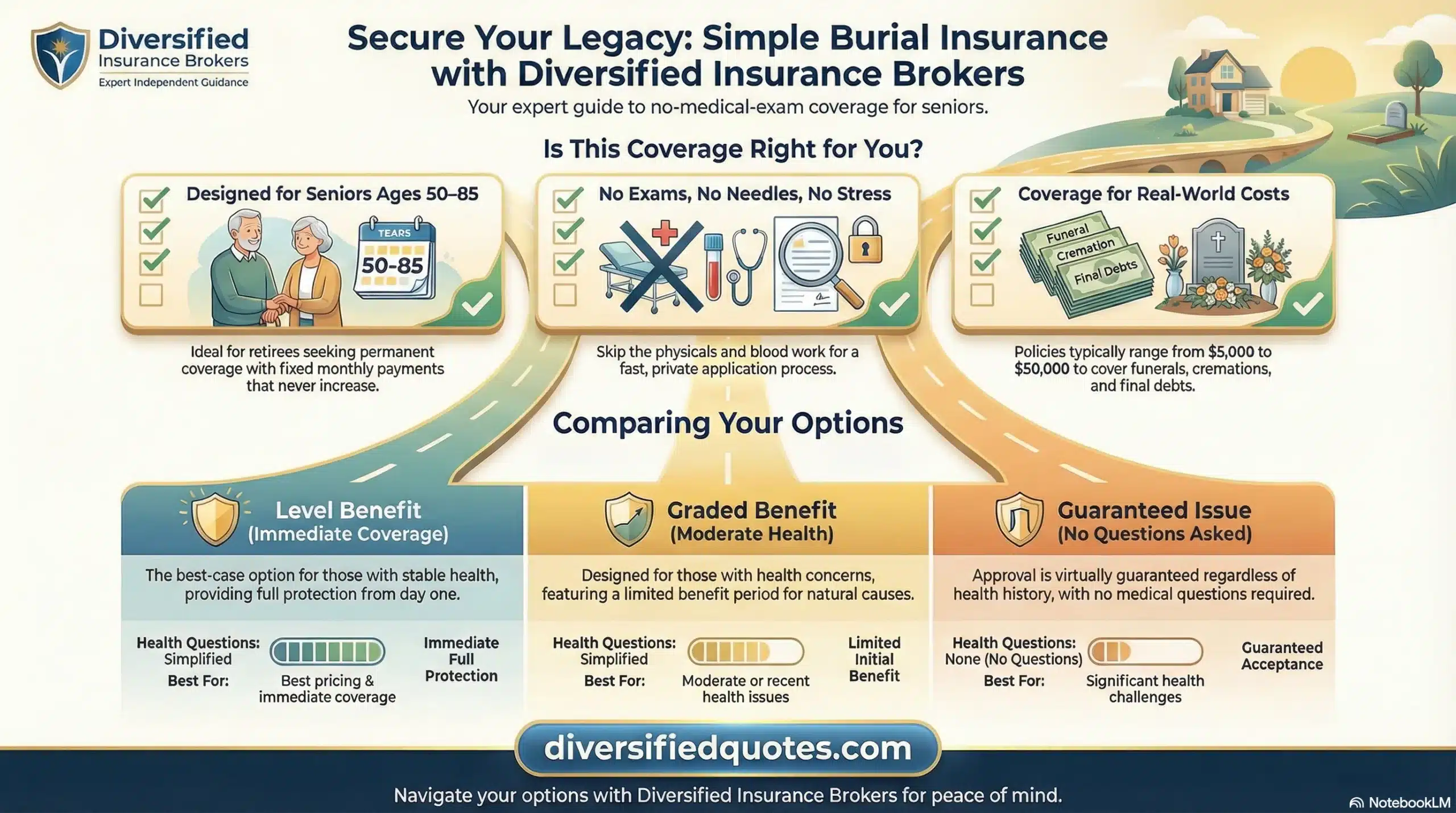
Most burial insurance products fall into one of three underwriting tiers, and which tier an applicant qualifies for determines both the monthly premium and the benefit structure from day one. Understanding all three tiers before shopping prevents the common mistake of comparing premiums across tiers as if they represent the same coverage.
The Level (or Preferred) tier is the best available outcome — the lowest monthly cost for a given age and gender, with an immediate full death benefit for both natural and accidental causes (subject to the standard two-year contestability provision that applies to all life insurance). To qualify, applicants answer basic health questions and may have their prescription history reviewed. Applicants with stable, controlled health histories — managed blood pressure, controlled cholesterol, past surgeries — often still qualify for level tier at many carriers. The key question is not “do I have any health conditions?” but rather “do my specific conditions and medications disqualify me at this specific carrier?” Since different carriers draw different lines on different conditions, being declined at one carrier does not mean level coverage is unavailable — it means the comparison needs to extend to other carriers with different underwriting guidelines. Our resource on burial insurance for people with high blood pressure covers how a common condition that concerns many applicants is actually handled favorably at multiple carriers.
The Modified or Graded tier is available to applicants who have health conditions that disqualify them from full level coverage but are not severe enough to require guaranteed issue. Modified policies ask health questions and a “no” answer on certain questions — typically related to more serious conditions — places the applicant in a graded benefit structure. The graded structure typically pays a limited benefit (often 30-40% of face amount in year one, increasing to a higher percentage in year two) for natural causes during the waiting period, with full accidental death benefit from day one. After the waiting period — typically two years — the full face amount applies for all causes. The Modified tier typically costs more than level but less than guaranteed issue, and it provides a path to coverage without the full price premium of guaranteed issue for applicants who have qualifying health concerns but not absolute disqualifiers.
The Guaranteed Issue tier requires no health questions and cannot decline an applicant within the eligible age range (typically 45–85, varying by carrier). The trade-off for guaranteed approval is a mandatory 2-year waiting period during which a natural cause death pays a return of all premiums paid plus interest (commonly 10%), rather than the full face amount. Accidental death is typically covered at the full face amount from day one. After the two-year period, the full face amount applies for all causes. Guaranteed issue is the right solution when health conditions make level and modified coverage genuinely unavailable — it provides reliable, contractual coverage even when other paths are closed. Our resource on guaranteed issue burial insurance covers this tier specifically for buyers navigating the most complex health situations.
Why the Same $10,000 Policy Costs More at Some Carriers
Carrier pricing for burial insurance is not standardized — two carriers can offer the same $10,000 level benefit to the same applicant at the same age and produce monthly premiums that differ by 30% or more. The reasons are embedded in each carrier’s actuarial assumptions, geographic concentration, underwriting guidelines, and competitive pricing strategy. Some carriers price aggressively for certain age bands. Others price favorably for specific medications or conditions that they underwrite more liberally. Some are stronger in specific states due to product form filings and distribution concentration. This is why using a multi-carrier comparison tool — rather than accepting the first quote presented — is the standard approach for getting genuinely competitive burial insurance pricing. A single-carrier quote is a starting point, not an answer. The Compulife calculator above compares multiple carriers simultaneously so the spread between best and worst pricing is visible before any application is submitted. Our resource on burial insurance quotes covers the multi-carrier comparison process in depth.
Tobacco Use — The Single Biggest Per-Category Price Variable
Tobacco use — including cigarettes, cigars, chewing tobacco, vaping, and nicotine products — creates a distinct rate category at most burial insurance carriers. Tobacco users typically pay 20–60% more than non-tobacco applicants of the same age and gender for the same $10,000 benefit, and the gap widens at older ages. For some applicants, tobacco use also affects which underwriting tier they qualify for, since some carriers include tobacco-related conditions (chronic respiratory issues, cardiovascular effects) in their underwriting questions. The planning implication for current tobacco users is straightforward: quitting can reduce burial insurance premiums if you wait until the carrier’s required non-tobacco period has passed. Most carriers require 12 months of abstinence from all nicotine products before reclassifying an applicant to non-tobacco rates, though some require longer periods and some require confirmation via prescription history review. If tobacco use is part of your situation, starting with a carrier-by-carrier comparison of tobacco-class pricing is essential. Our resource on burial insurance for smokers covers which carriers price most favorably for tobacco users and the timing logic for non-tobacco reclassification.
Health Conditions That Affect $10,000 Burial Insurance Pricing
Not all health conditions affect burial insurance pricing equally. Many conditions that seem significant are well-tolerated by multiple carriers at level rates — controlled high blood pressure, managed type 2 diabetes, past surgeries, and common medications often qualify for level or modified coverage at carriers with appropriate underwriting guidelines. Other conditions are more restrictive — active cancer treatment, certain cardiac histories, recent hospitalizations, and oxygen dependence typically push applicants toward graded or guaranteed issue tiers where premiums are higher for the same $10,000 benefit. The practical implication is that knowing which carriers accept which conditions — before applying — is what separates a buyer who finds competitive simplified issue pricing from one who accepts a guaranteed issue premium unnecessarily. Our resources on burial insurance after a heart attack, burial insurance for overweight people, and burial insurance for high blood pressure cover specific condition categories where carrier matching makes the most meaningful difference in both eligibility and monthly cost.
Choosing the Right Benefit Amount — $10,000 vs. More
A $10,000 benefit is a practical target for many buyers, but the right amount depends on the specific final expenses you are planning to cover and whether you want a cushion beyond the funeral itself. In areas where funeral costs are at or above the national average, $10,000 may be tight when medical bills, administrative costs, and transition-period household expenses are factored in. In areas with lower funeral costs or for families planning cremation, $10,000 can provide meaningful coverage beyond the immediate funeral expense. The practical approach is to run the Compulife calculator at $10,000, $15,000, and $20,000 to see how the premium changes across benefit levels — the incremental premium for an additional $5,000 or $10,000 of coverage is often smaller than buyers expect, and seeing the actual comparison helps set the right amount without overbuying or leaving meaningful gaps. Our resources on burial insurance for seniors over 50, burial insurance for seniors over 80, and burial insurance for mom and dad cover age-specific planning considerations that often inform the benefit amount decision alongside the premium question.
Talk With an Advisor Today
Choose how you’d like to connect—call or message us, then book a time that works for you.
Schedule here:
calendly.com/jason-dibcompanies/diversified-quotes
Licensed in all 50 states • Fiduciary, family-owned since 1980
FAQs: Monthly Cost of a $10,000 Burial Insurance Policy
How much does a $10,000 burial insurance policy typically cost per month?
Monthly premiums for a $10,000 burial insurance policy vary significantly by age, gender, tobacco use, health history, and which underwriting tier the applicant qualifies for. As a directional reference for non-tobacco applicants: someone in their early 50s might see simplified issue pricing in the $20–$42 range per month depending on gender; someone at 65 might see $42–$90 per month for simplified issue; someone at 75 might see $70–$145 per month. Guaranteed issue coverage (no health questions) typically costs 40–80% more than simplified issue for the same $10,000 benefit at comparable ages. These are approximate ranges — your actual premium depends on the specific carrier, state, and your individual profile. Use the Compulife calculator on this page for real current pricing.
What is the difference between simplified issue and guaranteed issue for a $10,000 burial policy?
Simplified issue asks basic health questions and may check prescription history. When you qualify, you typically receive an immediate full $10,000 death benefit from the policy issue date (subject to the standard two-year contestability period), and simplified issue policies generally cost less than guaranteed issue for the same benefit. Guaranteed issue requires no health questions and cannot decline an eligible applicant, but it always includes a graded benefit period — typically two years — during which a natural cause death pays a return of premiums paid plus interest rather than the full $10,000. Accidental death is typically covered at the full amount from day one on both types. The bottom line: start with simplified issue if eligible, because it generally provides more coverage for less premium. Use guaranteed issue when health makes simplified issue genuinely unavailable.
Will my $10,000 burial insurance premium ever increase?
No — whole life burial insurance policies use level premiums that are fixed permanently at the age of application. The monthly premium you pay when you buy the policy is the same premium you will pay at every subsequent payment, regardless of health changes, age increases, or market conditions. The death benefit does not decrease either, as long as premiums are paid on time. This level-premium, level-benefit design is one of the primary reasons burial insurance is effective for fixed-income seniors — there are no surprises and no renewal re-underwriting that could increase the cost.
Does tobacco use significantly affect the monthly cost?
Yes — tobacco use typically increases burial insurance premiums by 20–60% or more compared to non-tobacco rates for the same age, gender, and benefit amount. Most carriers maintain separate tobacco rate tables, and the gap between tobacco and non-tobacco pricing tends to widen at older ages. Tobacco includes cigarettes, cigars, chewing tobacco, vaping, and most nicotine products. If you have quit tobacco, most carriers require 12 months of abstinence from all nicotine products before reclassifying you to non-tobacco rates, with some requiring longer periods. Once you qualify for non-tobacco rates, your premium resets to the lower class — which can produce a meaningful ongoing savings on the same $10,000 benefit.
Does the $10,000 death benefit pay out tax-free?
Generally, yes — life insurance death benefits paid to named beneficiaries are income-tax free under current federal tax law. This applies to burial insurance proceeds the same as any other life insurance death benefit. The beneficiary receives the $10,000 without owing income tax on it. Estate tax considerations can apply in certain high-net-worth situations, but for typical burial insurance amounts, income-tax-free treatment is the expected outcome. Always consult a tax professional for guidance specific to your situation, as tax laws can change.
Can health conditions still allow me to qualify for a $10,000 level benefit at a reasonable price?
Yes — many common health conditions that concern applicants are well-tolerated by multiple burial insurance carriers at simplified issue (level benefit) rates. Controlled high blood pressure, managed type 2 diabetes, high cholesterol, and past surgeries are examples of conditions that do not automatically disqualify a buyer from the level tier at appropriately selected carriers. The key is matching your specific health history to the carriers whose underwriting guidelines align with your profile. Carrier selection matters enormously — a condition that disqualifies you at one carrier may be fully accepted at another. Starting with a multi-carrier comparison and working with a broker who knows each carrier’s underwriting sweet spots is the most effective way to find level coverage at the best available price even when health is less than ideal.
Is $10,000 enough burial insurance coverage or should I buy more?
Whether $10,000 is sufficient depends on your area’s funeral costs and what expenses you are planning to cover. A traditional funeral with viewing and burial typically runs $8,000–$12,000 nationally, so $10,000 is close to the average in most areas. Cremation services typically cost less — often $1,500–$5,000 — which means $10,000 provides a meaningful cushion for cremation-focused planning after other final expenses. For buyers concerned about leaving a tighter margin, comparing $10,000 to $15,000 and $20,000 using the Compulife calculator is a practical approach: the incremental monthly premium for an additional $5,000–$10,000 of coverage is often smaller than buyers expect, and seeing the actual numbers removes the guesswork.
Why does the same $10,000 burial policy cost different amounts at different carriers?
Burial insurance carriers use their own actuarial assumptions, underwriting guidelines, investment strategies, and competitive pricing models — none of which are standardized across the industry. The result is that two carriers can offer the exact same $10,000 level benefit to the same applicant at the same age and produce monthly premiums that differ by 30% or more. Some carriers price aggressively for certain age bands. Others accept specific conditions or medications at more favorable rates. State-level product filings and distribution concentration also affect pricing competitiveness by geography. This is why running a multi-carrier comparison before applying is standard best practice for burial insurance — accepting the first quote presented without comparison is one of the most common and most avoidable ways to overpay for final expense coverage.
About the Author:
Jason Stolz, CLTC, CRPC, DIA, CAA and Chief Underwriter at Diversified Insurance Brokers (NPN 20471358), is a senior insurance and retirement professional with more than 25 years of real-world experience helping individuals, families, and business owners protect their income, assets, and long-term financial stability. As a long-time partner of the nationally licensed independent agency Diversified Insurance Brokers, Jason provides trusted guidance across multiple specialties—including fixed and indexed annuities, long-term care planning, personal and business disability insurance, life insurance solutions, Group Health, Travel Medical and Evacuation Insurance, and short-term health coverage. Diversified Insurance Brokers maintains active contracts with over 100 highly rated insurance carriers, ensuring clients have access to a broad and competitive marketplace.
His practical, education-first approach has earned recognition in publications such as VoyageATL, and contributions from his agency featured in Kiplinger and GoBankingRates— highlighting his commitment to financial clarity and client-focused planning. Drawing on deep product knowledge and years of hands-on field experience, Jason helps clients evaluate carriers, compare strategies, and build retirement and protection plans that are both secure and cost-efficient. Visitors who want to explore current annuity rates and compare options across multiple insurers can also use this annuity quote and comparison tool.
Explore More Burial Insurance Options: Browse our complete guide to Best Burial Insurance — covering top burial insurance options, rates, calculators & how to find the best coverage from top carriers.
Last Reviewed: June 3, 2026 |
Reviewed by: Jason Stolz, CLTC, CRPC, DIA, CAA
Chief Underwriter, Diversified Insurance Brokers, Inc. | NPN: 20471358 | Diversified Insurance Brokers, Inc. — Licensed in all 50 states
Fact Checked by: Tonia Pettitt, CMIP©
Medicare Specialist, Diversified Insurance Brokers, Inc. | NPN: 14374308 | Diversified Insurance Brokers, Inc. — Licensed in all 50 states
Did you find this content helpful? Leave us a Google review — it helps others find trustworthy guidance too.
Editorial Standards: Diversified Insurance Brokers maintains rigorous editorial standards to ensure accuracy, clarity, and independence in all content. Learn more about our editorial standards and commitment to transparency.
