
Burial Insurance for Overweight People
Burial Insurance for Overweight People

Jason Stolz CLTC, CRPC, DIA, CAA
Burial insurance for overweight people is one of the most misunderstood areas of final expense coverage. Many applicants assume that a higher weight automatically means they’ll be declined — or that premiums will be unaffordable. In reality, most carriers do not treat body weight as a deal-breaker. The real underwriting question is whether your weight is connected to serious complications that increase risk, such as uncontrolled diabetes, mobility limitations, advanced heart disease, or recent hospitalizations. At Diversified Insurance Brokers, we help people across the U.S. compare burial insurance options even with higher BMI. Our advisors look at the full picture — age, medications, medical history, and daily functioning — so we can match you with carriers that offer the most reasonable pricing and the best chance of day-one coverage when your health profile allows. This guide explains how burial insurance underwriting works for overweight applicants, what carriers typically care about most, and how to use the burial insurance calculator on this page to compare realistic premium ranges. If you’ve been declined before, or you’re simply trying to find the most forgiving carrier for your profile, this page will help you understand what matters and what doesn’t.
Compare Burial Insurance for Higher BMI Applicants
We’ll match you with carriers that are more flexible for weight, medications, and common conditions like blood pressure or diabetes.
What Does “Overweight” Mean in Burial Insurance Underwriting?
When a burial insurance company evaluates weight, they typically use height-to-weight charts or a BMI-style framework. But here’s what matters: burial insurance underwriting is usually simplified, and many carriers do not require exact BMI calculations to approve a policy. Instead, they are looking for signals that the applicant is stable and able to manage daily life without severe health decline. That’s why two people with the same BMI can receive totally different outcomes. One applicant may be overweight but stable, mobile, and well-managed medically. Another applicant may have weight-related complications that create higher risk. Burial insurance underwriting is designed to be practical and accessible, so your weight alone does not automatically disqualify you. If you’re unsure how weight compares to “traditional” underwriting, it can help to understand how carriers view build in broader underwriting situations. This guide can give helpful context for how carriers evaluate applicants who don’t fit perfectly into standard categories: life insurance for overweight applicants.
Does Being Overweight Automatically Make Burial Insurance Harder to Get?
In most cases, no. Burial insurance exists because many seniors and adults want coverage that does not require medical exams, long underwriting timelines, or heavy documentation. Carriers know that many Americans are overweight, and most companies are prepared to insure higher-weight applicants when there are no major red flags. The bigger issue is not “extra weight.” The bigger issue is whether there are medical complications that indicate higher mortality risk. Carriers often care most about stability and daily functioning. Controlled blood pressure and stable medication use can still fall into a carrier’s acceptable category. But recent heart failure, oxygen use, severe mobility impairment, or uncontrolled diabetes may push the applicant toward graded or guaranteed issue coverage. In other words, weight is not usually the main story. It’s part of the story, but not the deciding factor in many approvals. For a comprehensive overview of how burial insurance for seniors works across different risk profiles, our hub page covers the full landscape.
Burial Insurance Calculator
Compare real-time burial insurance quotes across multiple carriers. Then we’ll help you interpret the results for your health profile.
What Burial Insurance Companies Look at for Overweight Applicants
When carriers evaluate an overweight applicant, the underwriting questions often revolve around how your weight affects overall health and stability. The goal is to determine whether the applicant is likely to remain stable for the long term. Most burial insurance underwriting is designed to be “yes or no” based on a handful of key concerns, not a deep medical deep dive. Carriers often consider mobility first because it’s a practical indicator of health and independence. If an applicant can walk, bathe, dress, and function independently, the case often looks much stronger — even if weight is above average. If an applicant requires full assistance, uses oxygen, or has significant daily limitations, the carrier may treat the application more conservatively.
Next, carriers look at common medical conditions tied to weight: blood pressure, cholesterol, diabetes, and sleep apnea. These conditions are extremely common and frequently insurable. What matters is control and consistency. If you take medication as prescribed, see your doctor regularly, and your condition is stable, many carriers can still offer level benefit burial insurance. Respiratory conditions are also worth noting — many overweight individuals have developed COPD or sleep apnea, and how those conditions are managed significantly affects underwriting outcomes. Our resource on life insurance for people with COPD covers how that specific condition interacts with underwriting at different severity levels. Finally, carriers pay attention to recent hospitalizations, heart events, strokes, and other serious medical events. A recent event can be more impactful than a higher BMI. For example, someone with stable higher BMI may qualify easily, while someone with recent heart attack history may need a more careful carrier match. If this is relevant, you may also want to review burial insurance after a heart attack and our resource on burial insurance for stroke survivors — another common condition among overweight seniors that affects which carriers and coverage tiers are available.
BMI and Health Profile — Expected Coverage Outcomes
The table below maps common combinations of BMI range and associated health conditions to their expected burial insurance coverage tier. This is not a guarantee of any specific outcome — carriers vary significantly in their guidelines — but it provides a realistic expectation framework for most applicants before they begin the comparison process.
| Health Profile Combination | Likely Policy Type | Day-One Coverage Typically Available? | Key Carrier Considerations |
|---|---|---|---|
| High BMI, no significant conditions | Simplified issue — level benefit | Yes — most carriers can approve | Weight alone rarely disqualifies; compare carriers for most competitive rate |
| High BMI + controlled hypertension (medicated) | Simplified issue — level benefit at most carriers | Yes — very common profile, widely insurable | Stability and medication compliance are key; carrier selection matters for best pricing |
| High BMI + Type 2 diabetes (controlled, no major complications) | Simplified issue — level or graded depending on carrier and control | Often yes — carrier selection critical; some carriers more flexible than others | Complications like neuropathy, dialysis, or amputations shift outcome significantly; compare multiple carriers |
| High BMI + sleep apnea (treated with CPAP) | Simplified issue — level benefit at most carriers when treated | Yes — CPAP compliance viewed favorably by underwriters | Untreated sleep apnea triggers more conservative underwriting; treatment is the key variable |
| High BMI + COPD (moderate, no oxygen use) | Simplified issue — graded or level depending on severity and carrier | Possible — depends on frequency of flare-ups and hospitalizations | Oxygen use shifts outcome to guaranteed issue; carrier underwriting tolerance varies significantly |
| High BMI + prior heart conditions (stable, 2+ years out) | Simplified issue — graded or level depending on event type and lookback period | Sometimes — depends heavily on recency and carrier lookback guidelines | Heart attack within 12–24 months often routes to graded or guaranteed issue regardless of BMI |
| High BMI + recent hospitalization (within 12 months) | Graded or guaranteed issue — simplified level benefit unlikely | Unlikely for natural causes — accidental death usually pays full from day 1 | Recent events are the strongest red flags regardless of weight; graded benefit still provides meaningful coverage |
| High BMI + current oxygen use | Guaranteed issue only at most carriers | No — graded benefit period applies for 2 years for natural causes | Oxygen use is one of the most consistent triggers for guaranteed issue; coverage still available — waiting period applies |
The table’s most important column for most readers is the “Day-One Coverage Typically Available?” column — because the difference between level benefit and graded benefit determines how a claim is handled if a death occurs early in the policy period. Our resource on burial insurance with no waiting period covers the specific policy structures that provide immediate full benefit and which health profiles most commonly qualify for them. Our companion resource on burial insurance for people with heart conditions covers the cardiac history underwriting landscape in detail — directly relevant for overweight applicants whose BMI is accompanied by cardiovascular history.
Immediate Coverage vs. Waiting Period Policies (What Overweight Applicants Should Know)
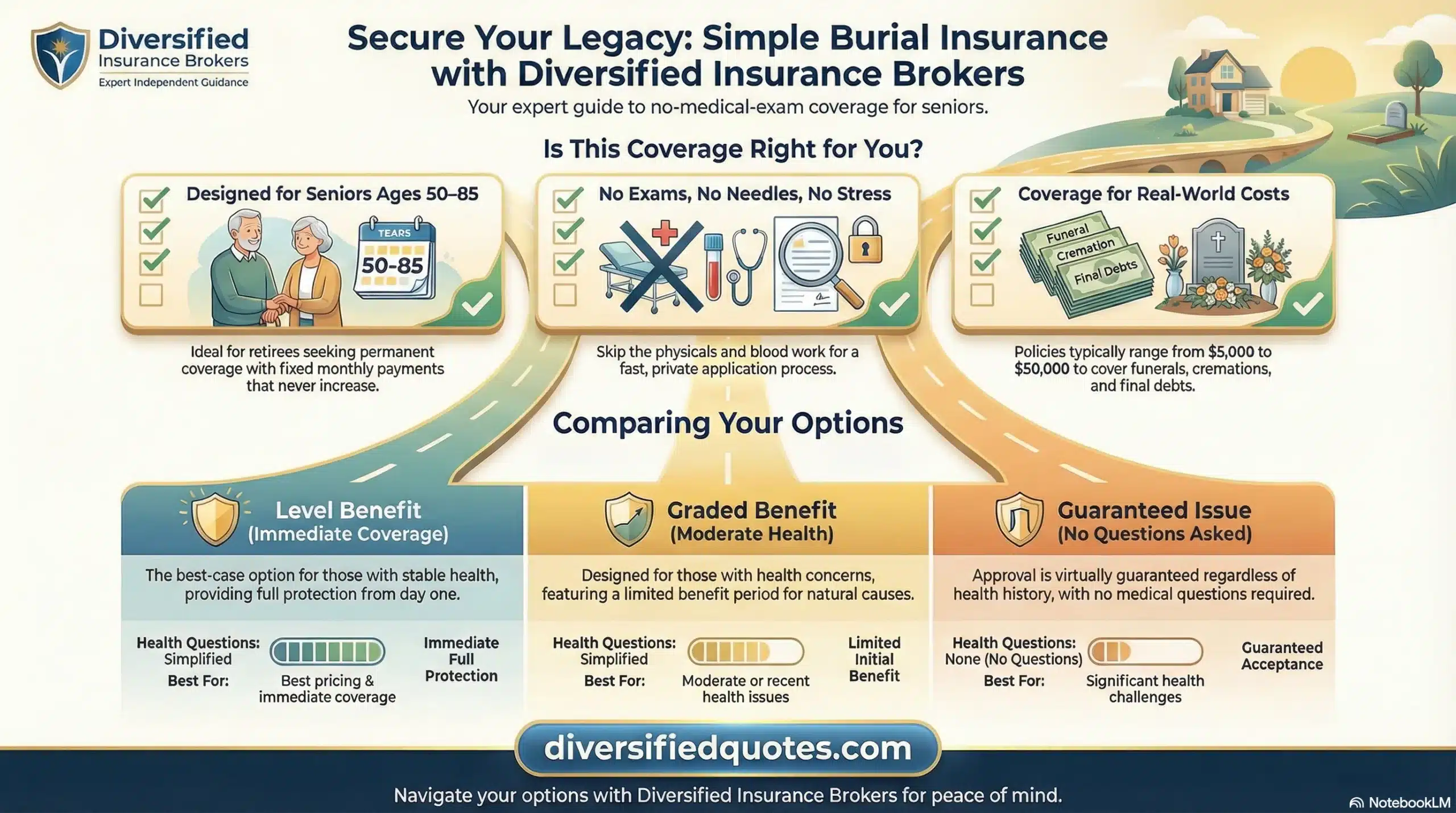
One of the most important parts of burial insurance planning is understanding how the death benefit works in the early years. This matters for everyone, but especially for applicants who may be offered different types of burial insurance depending on health history. A level benefit burial insurance policy typically pays the full death benefit immediately for natural causes of death (assuming the policy is active and premiums are paid). This is often what families want because it provides true day-one protection for final expenses. A graded benefit policy (sometimes called “modified benefit”) usually limits natural death benefits for the first one to two years, often paying a return of premiums plus interest during the early period. After the graded period ends, the full death benefit becomes available. These policies exist to provide coverage when an applicant’s health profile is outside simplified issue guidelines.
The main point is this: overweight applicants often qualify for level benefit coverage, but if there are multiple complications, a graded plan can still be a practical way to secure protection now instead of going without coverage. If you are specifically shopping for day-one protection, this page can help you understand the difference and how to shop appropriately: best burial insurance with immediate coverage.
Common Scenarios for Overweight Burial Insurance Applicants
Many overweight applicants fall into one of a few common categories. These aren’t “medical verdicts,” but they help explain why some people get immediate coverage and others get offered modified benefits.
The first scenario is higher BMI with no major medical issues. This is one of the best cases for simplified issue underwriting. Many carriers can still offer level benefit burial insurance and pricing that remains reasonable. You may pay slightly more than a lower BMI applicant, but approval can still be straightforward.
The second scenario is higher BMI with controlled blood pressure or cholesterol. This profile is very common. The main question carriers typically ask is whether the condition is stable and treated. If it is, many applicants still qualify for immediate coverage. If blood pressure is part of your profile, this guide can help you set expectations: burial insurance for people with high blood pressure.
The third scenario is higher BMI with diabetes. Diabetes underwriting varies by carrier, and it depends heavily on whether it’s controlled and whether complications exist. Some carriers are more flexible than others for diabetes profiles, which is why shopping is important. If diabetes is part of your history, start here: burial insurance for people with diabetes.
The fourth scenario is higher BMI with multiple conditions or recent hospitalizations. This is where many direct-to-consumer companies decline people incorrectly or push them into overpriced options. In these cases, the best strategy is usually to compare both simplified issue and guaranteed issue options, then choose the path that balances affordability with realistic approval odds. Our resource on burial insurance quotes shows how to run that comparison effectively across multiple carriers from a single starting point.
How Much Burial Insurance Should an Overweight Person Buy?
Burial insurance is designed to cover final expenses, not replace decades of income. Most families choose coverage that can reasonably cover funeral costs and the “last mile” expenses that show up after a death. That often includes funeral home costs, burial or cremation expenses, a memorial, travel for family members, and leftover medical bills. The most common burial insurance face amounts are $10,000 to $25,000. Some families choose smaller coverage to keep premiums very affordable, while others choose higher coverage to build in a cushion. If you want to ground your decision in realistic pricing expectations, this page gives a useful benchmark: monthly cost of a $10,000 burial insurance policy. Once you know what $10,000 typically costs at your age, you can decide whether $15,000 or $20,000 still fits your budget. Our resource on how much burial insurance do I need walks through a more complete needs-analysis framework for families who want to match coverage amount precisely to expected final expenses rather than choosing a round number.
One of the best strategies is to pick an amount you can confidently maintain long-term. Burial insurance works best when it is kept in force permanently. Choosing a premium that’s comfortable month after month is often more important than selecting the biggest face amount.
Why Carrier Selection Matters More Than Most People Think
Many people assume that burial insurance is “basically the same everywhere,” but underwriting niches can vary significantly. One carrier may treat a higher BMI applicant as standard, while another carrier might push the same applicant into a more expensive class. Shopping matters because burial insurance is not a one-size-fits-all product. It also matters because burial insurance underwriting is usually based on yes/no health questions. The same medical situation can be interpreted differently depending on how questions are worded. This is why working with an independent agency can help you avoid picking the wrong company and ending up with either a decline or an unnecessary waiting-period policy. If you’re focused on affordability, it can also help to explore cost-focused guidance alongside your quotes: low cost burial insurance is a helpful companion when you’re trying to stay within budget. For veteran parents or overweight individuals who also happen to be veterans, specific burial insurance pathways may be available — our resource on burial insurance for veterans covers the private market options and VA benefit coordination that affects how coverage should be structured for this group.
No Medical Exam Burial Insurance for Overweight People
One reason burial insurance is so popular is that most plans are designed to avoid medical exams. Instead of bloodwork or paramed visits, applicants usually answer a small set of health questions. The goal is to offer coverage quickly while still allowing carriers to manage risk responsibly. For overweight applicants, this is a major advantage. Many people are tired of long underwriting processes, or they’ve had negative experiences with traditional life insurance. Burial insurance is designed to be simple and accessible. If you want a deeper look at how no-exam burial insurance works (and why it can still provide meaningful coverage), this page is a strong next step: burial insurance with no health exam.
Real-World Example: Burial Insurance Approval With Higher BMI
Here’s a typical example of what we see when an overweight applicant has stable health. A 64-year-old applicant with a higher BMI applies for $15,000 of burial insurance. They are taking medication for cholesterol and blood pressure, have no recent hospitalizations, and remain independent with daily activities. In many cases like this, the applicant can still qualify for simplified-issue coverage with level benefits. The premium may be slightly higher than a lower BMI applicant, but the policy provides day-one protection and a predictable permanent death benefit. This is exactly what burial insurance is meant to do: make final expense coverage accessible without overcomplicating the process.
When the profile includes more serious complications, the approach can shift toward guaranteed issue to secure protection immediately, with the possibility of re-shopping later if health stabilizes. For families helping older parents with this process, our resources on best burial insurance for parents over 70 and burial insurance for parents over 80 cover the age-specific underwriting considerations that apply when the overweight applicant is also a senior.
How to Get the Best Burial Insurance Outcome When You’re Overweight
The best strategy for overweight applicants is to focus on what carriers care about most: stability, consistency, and realistic expectations. Applying sooner rather than later is often the simplest way to keep premiums lower because age generally increases pricing faster than weight alone. It also helps to be accurate with medications and health history. Burial insurance underwriting is simplified, but it still relies on truthful answers. The best-case outcome is usually a level benefit policy with predictable pricing, and that starts with correctly matching your profile to carriers that underwrite it favorably. If smoking is also part of the picture alongside higher BMI, underwriting and pricing can shift significantly — our resource on burial insurance for smokers explains what to expect and how to compare the right carriers when both tobacco use and weight are factors. For seniors in the 60–65 age range evaluating their options before costs increase further, our resource on burial insurance for seniors over 60 covers the specific window of underwriting options available at that age that begins to narrow as applicants move into their late 60s and early 70s.
Most importantly, don’t assume your first quote is your best quote. Carrier selection matters. For overweight applicants, it’s common that one carrier can approve with immediate coverage while another offers only graded benefits. That difference is meaningful, and it’s why comparison shopping is so important.
Get Help Finding the Most Lenient Carrier
If you’ve been declined before — or you’re not sure what you qualify for — we’ll shop multiple carriers and explain the best path forward.
Why Families Choose Diversified Insurance Brokers
Burial insurance is a simple product on paper, but approvals and pricing can vary widely based on carrier underwriting. That’s why many families choose to work with a brokerage that compares multiple options instead of relying on a single brand-name company. Diversified Insurance Brokers is a family-owned, fiduciary insurance agency licensed in all 50 states. We help clients compare burial insurance options for real-world situations — higher BMI, common medications, and everyday health conditions — without turning the process into a long, exhausting underwriting project. If you are researching burial insurance for a parent or older family member, you may also want to explore age-based guidance, including best burial insurance for parents over 70.
Related Burial Insurance Pages
Helpful guides that explain pricing, approvals, and how to secure the best coverage for your situation.
Related Health & Approval Topics
Condition-specific guides explaining what carriers look for and how approvals work for the most common health profiles alongside high BMI.
Financial Protection Essentials
Social Security coordination, legal funding access, hospital indemnity guidance, and income protection resources.
Talk With an Advisor Today
Choose how you’d like to connect—call or message us, then book a time that works for you.
Schedule here:
calendly.com/jason-dibcompanies/diversified-quotes
Licensed in all 50 states • Fiduciary, family-owned since 1980
FAQs: Burial Insurance for Overweight People
Can I get day-one burial insurance coverage if I’m overweight?
Yes. Many carriers will still approve level benefit burial insurance for higher BMI ranges, especially when there are no severe complications and your overall health is stable. Weight by itself is rarely the reason a carrier declines immediate coverage or shifts an applicant to a graded benefit policy. What matters far more to underwriters is whether common conditions like hypertension or diabetes are under control, whether there have been recent hospitalizations or cardiac events, and whether the applicant can function independently in daily life. Overweight applicants with no serious accompanying conditions routinely qualify for level benefit simplified issue coverage — meaning the full death benefit is payable from day one once the policy is active and the first premium is paid. If you have stable health overall and your BMI is the primary concern, comparison shopping across multiple carriers is almost always sufficient to identify a competitive level benefit option.
Will my weight automatically make burial insurance expensive?
Not always. Weight alone often causes only a modest price change — or none at all — when blood pressure, blood sugar, and mobility are stable. The bigger premium swings usually come from uncontrolled conditions, recent hospitalizations, oxygen use, or serious cardiac history rather than BMI itself. Different carriers weight these factors differently, which is why two quotes for the same applicant can vary by 20–40% across carriers. The most effective way to manage cost is to identify the carrier whose underwriting guidelines treat your specific combination of factors most favorably — rather than accepting the first quote or defaulting to the most-advertised brand. Working with an independent broker who compares multiple carriers simultaneously is the most direct path to identifying the most affordable option for a specific profile.
Is guaranteed-issue burial insurance my only option if my BMI is high?
No. Guaranteed issue is typically a fallback when simplified underwriting won’t approve — it is not the default option for overweight applicants. Many overweight applicants still qualify for simplified-issue final expense coverage with level benefits, depending on the carrier and health profile. The table on this page maps common BMI and health condition combinations to their likely policy type. For most applicants whose primary concern is high BMI without major accompanying conditions, simplified issue level benefit coverage is accessible at multiple carriers. Guaranteed issue becomes the most appropriate option when health complexity — not weight alone — creates barriers to simplified underwriting approval. Applying to a carrier that is known to be more accommodating of higher BMI without defaulting immediately to guaranteed issue is the strategy that produces better coverage at lower premiums for eligible applicants.
Do I need a medical exam to get burial insurance if I’m obese?
Usually no. Burial insurance is commonly structured as a no-exam product that uses simplified health questions rather than bloodwork or paramed visits. Some applicants may be routed to guaranteed issue if the health answers fall outside a carrier’s guidelines, but even that pathway requires no medical examination. The no-exam structure is one of the primary reasons burial insurance is specifically popular with the senior and higher-BMI demographic — the traditional exam-based underwriting process that creates barriers in conventional life insurance is largely absent from the final expense market. Carriers evaluate risk through the health questions you answer and electronic data checks (prescription history, MIB records) rather than through clinical measurements obtained by a nurse or paramedic.
What matters most to carriers besides BMI?
Carriers evaluating overweight applicants typically care most about stability across several dimensions. Mobility and daily functioning are primary — can the applicant walk, bathe, dress, and manage independently? Current control of common comorbid conditions matters next: is blood pressure managed with consistent medication? Is diabetes controlled without major complications? Is sleep apnea treated (CPAP compliance is viewed favorably)? Whether there have been recent serious events — cardiac episodes, strokes, hospitalizations within the past 12–24 months — is often more decisive than the BMI number itself. Oxygen use is a separate flag that nearly universally routes applicants to guaranteed issue regardless of weight. The practical message is that carriers are assessing current stability and functional independence rather than using BMI as a primary disqualifier.
If I have high blood pressure or diabetes, can I still qualify for level benefit coverage?
Often yes. These conditions are extremely common and most burial insurance carriers are specifically designed to insure applicants who have them. The key variables are whether the conditions are controlled through consistent medication and physician management, and whether major complications have developed. Well-controlled hypertension with stable medication is typically acceptable at most simplified issue carriers. Type 2 diabetes without major complications — no dialysis, no amputation, stable A1C range — qualifies at many carriers for level benefit coverage, though the specific carrier matters significantly for diabetes profiles. The combination of high BMI plus controlled hypertension plus controlled diabetes is a very common profile in the senior burial insurance market and can still qualify for immediate coverage at carriers whose underwriting is favorable to this combination.
How much burial insurance do overweight applicants usually buy?
Most families choose $10,000 to $25,000 to cover funeral and final expenses. The right amount depends on local funeral costs, whether cremation or burial is planned, and whether the family wants a buffer above the basic funeral cost for related expenses like travel, unpaid medical bills, or estate administrative costs. A useful approach is to start with the realistic funeral or cremation cost for your area and add $3,000 to $5,000 for adjacent expenses. The resulting number is typically in the $10,000–$20,000 range for most families. The most important sizing principle is to choose a premium amount that is sustainable on a fixed income long-term — a smaller policy that remains in force permanently provides more certainty than a larger policy that becomes difficult to maintain and risks lapsing.
Can I apply again later if I want more coverage?
Yes. You can apply for additional coverage later, but premiums are based on your age at that time — and current health conditions at the time of the new application. Many people start with a realistic amount now and revisit increases after reviewing budget and eligibility. The practical advantage of buying early is that each year of delay raises the base premium rate. A policy purchased at 67 will cost less per month than the same policy purchased at 72, and the health profile at 67 may allow better underwriting options than the same person’s profile at 72 after additional conditions have developed. Building in a modest buffer at initial purchase — choosing $15,000 rather than $10,000 if the premium is still comfortable — is often more efficient than planning to supplement later.
Is burial insurance available for overweight people nationwide?
Yes. Burial insurance with no medical exam and flexible underwriting for higher BMI is available broadly across the United States. Availability and specific pricing vary by state and carrier — some carriers are not available in certain states, and premium rates differ by state due to regulatory and market factors. Working with an independent broker who has access to multiple carriers across all states ensures that the comparison covers the full range of options available in your specific state rather than being limited to carriers with a narrower geographic footprint.
About the Author:
Jason Stolz, CLTC, CRPC, DIA, CAA and Chief Underwriter at Diversified Insurance Brokers (NPN 20471358), is a senior insurance and retirement professional with more than 25 years of real-world experience helping individuals, families, and business owners protect their income, assets, and long-term financial stability. As a long-time partner of the nationally licensed independent agency Diversified Insurance Brokers, Jason provides trusted guidance across multiple specialties—including fixed and indexed annuities, long-term care planning, personal and business disability insurance, life insurance solutions, Group Health, Travel Medical and Evacuation Insurance, and short-term health coverage. Diversified Insurance Brokers maintains active contracts with over 100 highly rated insurance carriers, ensuring clients have access to a broad and competitive marketplace.
His practical, education-first approach has earned recognition in publications such as VoyageATL, and contributions from his agency featured in Kiplinger and GoBankingRates— highlighting his commitment to financial clarity and client-focused planning. Drawing on deep product knowledge and years of hands-on field experience, Jason helps clients evaluate carriers, compare strategies, and build retirement and protection plans that are both secure and cost-efficient. Visitors who want to explore current annuity rates and compare options across multiple insurers can also use this annuity quote and comparison tool.
Explore More Burial Insurance Options: Browse our complete guide to Burial Insurance for High Risk Conditions — covering burial insurance for diabetes, heart conditions, cancer, stroke & more from top carriers.
Last Reviewed: May 31, 2026 |
Reviewed by: Jason Stolz, CLTC, CRPC, DIA, CAA
Chief Underwriter, Diversified Insurance Brokers, Inc. | NPN: 20471358 | Diversified Insurance Brokers, Inc. — Licensed in all 50 states
Fact Checked by: Tonia Pettitt, CMIP©
Medicare Specialist, Diversified Insurance Brokers, Inc. | NPN: 14374308 | Diversified Insurance Brokers, Inc. — Licensed in all 50 states
Did you find this content helpful? Leave us a Google review — it helps others find trustworthy guidance too.
Editorial Standards: Diversified Insurance Brokers maintains rigorous editorial standards to ensure accuracy, clarity, and independence in all content. Learn more about our editorial standards and commitment to transparency.
