
Burial Insurance for Stroke Survivors
Burial Insurance for Stroke Survivors

Jason Stolz CLTC, CRPC, DIA, CAA
Burial insurance for stroke survivors is available in most cases — the question is which policy type is the right fit given your specific history, how long it has been since your most recent event, and what your recovery and ongoing follow-up look like. Stroke history is one of the most common health profiles in the final expense market, and carriers who specialize in simplified-issue burial insurance have developed underwriting guidelines specifically for it. The outcome range is wide: stroke survivors who are far enough out from their event with stable follow-up, good functional independence, and well-managed risk factors can often qualify for level-benefit coverage that pays the full death benefit from day one. Stroke survivors who are closer to their event, or whose recovery is more recent, frequently qualify for graded-benefit coverage — which provides full natural-cause death benefit after the initial graded period ends. Guaranteed issue coverage exists as a last-resort pathway for those whose health profile makes simplified-issue underwriting unavailable. None of these outcomes means a stroke survivor “can’t get covered.” They mean the available policy type and the associated cost vary based on where in the recovery timeline you are and which carriers are the best fit for your situation. Our resources on burial insurance services and life insurance for stroke cover the full product landscape for stroke survivors across both burial insurance and traditional life insurance underwriting.
The most important variable in stroke underwriting for final expense is timing — specifically, how much time has elapsed since the most recent stroke or TIA. Final expense carriers generally identify two key milestones: the 12-month mark and the 24-month mark post-event. At the 12-month mark, some carriers begin considering simplified-issue applications for stable stroke survivors, though the benefit structure may be graded during this window. At the 24-month mark, more carriers open their level-benefit options to stroke survivors who can demonstrate ongoing stability — no repeat events, consistent follow-up with a physician, and stable management of associated risk factors like blood pressure and cholesterol. The practical implication is that a stroke survivor who is 8 months post-event, a survivor who is 16 months post-event, and a survivor who is 30 months post-event represent meaningfully different underwriting profiles even with identical overall health — because the time variable alone affects which carriers will consider them and which benefit structure those carriers will offer. Understanding where you fall in this timeline is the starting point for identifying the right carrier and policy structure rather than guessing from a general rate comparison.
Beyond timing, underwriters evaluate four practical dimensions for every stroke or TIA application: the type and severity of the event, the recovery stability demonstrated since the event, the degree of functional independence maintained in daily life, and the overall cardiovascular and metabolic risk profile. These dimensions interact — a TIA three years ago in a non-smoker with well-controlled blood pressure and no co-conditions is underwritten very differently from a hemorrhagic stroke eighteen months ago in someone with atrial fibrillation and uncontrolled hypertension. Final expense underwriting doesn’t require medical records or lab work in most cases, but the health questions on simplified-issue applications are designed to capture these dimensions through self-reported answers. Accuracy and completeness in answering those questions is as important as the answers themselves — both because inaccurate applications can create claim complications and because carriers who are given complete, accurate information can make better underwriting decisions than carriers working with incomplete pictures. Our resource on burial insurance with no health exam covers the guaranteed-issue alternative for applicants who prefer not to answer health questions, with a realistic explanation of the cost trade-off that choice involves.
Compare Burial Insurance Rates for Stroke Survivors
Simplified issue — no medical exam. Compare carriers that are stroke-friendly across level, graded, and guaranteed issue options.
Not sure which policy type fits your stroke history?
We’ll match your timeline and recovery profile to the carriers most likely to offer the best structure for your situation.
Request a Quote for Stroke SurvivorsBurial Insurance Policy Types for Stroke Survivors — Level, Graded, and Guaranteed Issue
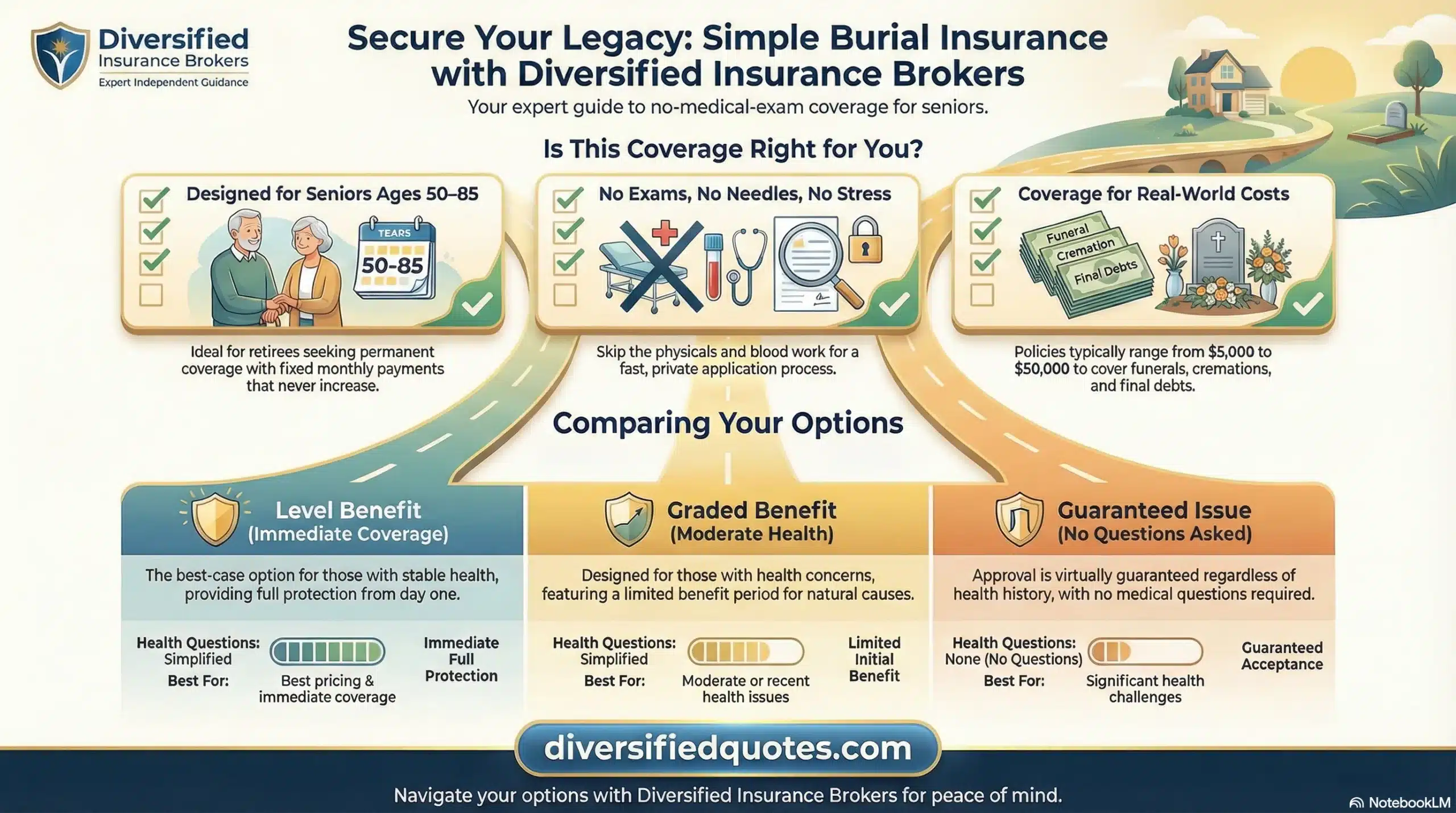
Three policy structures are available to stroke survivors in the final expense market, and the right one depends on where you are in the post-stroke timeline, how well your risk factors are managed, and what benefit amount you need. The table below summarizes the key distinctions across underwriting requirements, benefit timing, cost, and when each structure applies most appropriately.
| Dimension | Level Benefit (Day-One Coverage) | Graded Benefit | Guaranteed Issue |
|---|---|---|---|
| Underwriting Type | Simplified issue — short health questionnaire, no medical exam; carrier evaluates health questions and electronic database checks (prescription history, MIB) | Simplified issue — same application process as level benefit; carrier approves but uses graded structure based on the health profile presented | No health questions, no exam — approval based solely on age eligibility (typically 45–85); stroke history, medications, and co-conditions do not factor into approval |
| Death Benefit from Day One | Yes — full face amount paid for all covered causes of death from policy effective date; both accidental and natural-cause death covered at 100% from day one | Partial for natural causes in first 2 years — typical structure: return of premiums paid plus interest (often 10%) in years 1-2 for natural-cause death; full face amount from year 3 forward; accidental death often covered at 100% from day one | Graded for all natural causes for 2-3 years — typical structure: 30-40% of face amount in year 1, 70% in year 2, 100% in year 3+; or return of premiums plus interest; accidental death typically covered at 100% from day one |
| Typical Post-Stroke Timing for Eligibility | Generally available to stroke survivors who are at least 24+ months post-event with stable recovery — no repeat events, consistent follow-up care, well-managed risk factors; TIA survivors may qualify at shorter intervals depending on carrier | Often available to stroke survivors 12-24 months post-event and sometimes sooner, depending on carrier and recovery profile; the graded structure allows the carrier to approve when timing is closer than level-benefit thresholds | Available regardless of timing — recent strokes, multiple strokes, or strokes with ongoing impairments do not affect GI approval; designed specifically for applicants who cannot qualify for simplified issue |
| Premium Cost | Lowest premium per dollar of coverage — the carrier accepts the risk with full day-one exposure, which it offsets by selecting applicants with more favorable health profiles | Moderate — higher than a level-benefit policy for the same face amount; lower than guaranteed issue because health questions still allow some underwriting selection | Highest premium per dollar of coverage — the carrier accepts all applicants within the age range, which requires pricing in the maximum expected risk across the entire pool; significantly more expensive than simplified-issue options |
| Face Amount Range | Typically $5,000–$30,000+ depending on carrier; most stroke survivors target $10,000–$25,000 for final expense goals | Similar range to level benefit — $5,000–$30,000 typically; carrier-specific maximums apply | Typically $5,000–$25,000 depending on age and carrier; GI products are capped lower than simplified-issue options at most carriers |
| Best Fit for Stroke Survivors | Survivors 24+ months post-stroke with stable recovery, well-managed blood pressure and cholesterol, no recurrent events, and strong functional independence; TIA survivors with a single event and clean recovery may qualify sooner | Survivors within 12-24 months of a stroke or TIA; those with more recent events who want coverage in place now and plan to re-shop for level benefits once the timeline clears; those with moderate co-conditions that close out level-benefit options | Survivors with very recent strokes (within months), multiple strokes, strokes with ongoing significant impairments, or co-conditions that make simplified-issue approval unlikely; the last-resort option when other paths are closed |
Underwriting thresholds, graded benefit structures, face amount limits, and premium rates vary significantly by carrier and state. Benefit structures described above reflect common market patterns and are not a guarantee of any specific carrier’s terms. Verify all benefit details, graded period mechanics, and premium amounts in the actual policy documents before any purchase decision. Working with an independent final expense specialist ensures comparison across multiple carriers whose underwriting guidelines fit your specific post-stroke timeline and health profile.
What Underwriters Actually Evaluate After a Stroke or TIA
Final expense underwriting for stroke survivors focuses on four practical questions, and the answers to these questions determine which carriers will consider the application and what benefit structure they will offer. The first question is timing: how long ago did the most recent stroke or TIA occur? This is the single most influential variable in simplified-issue final expense underwriting, because it serves as a proxy for recovery stability and ongoing risk. The 12-month mark is where many carriers begin to consider simplified-issue applications, and the 24-month mark is where level-benefit options open more broadly. The second question is recovery stability: has there been consistent physician follow-up, no repeat cerebrovascular events, and no hospitalizations related to stroke complications since the original event? A stroke that occurred 18 months ago with three follow-up cardiology visits and a stable neurological picture is evaluated very differently from a stroke that occurred 18 months ago followed by two additional TIAs and an ER visit for blood pressure emergency. The third question is functional independence: is the applicant able to manage daily activities independently, without regular skilled nursing assistance or residence in a care facility? Carriers are looking for evidence that the stroke did not produce lasting impairments that significantly elevate ongoing mortality risk. The fourth question is the overall cardiovascular risk profile: blood pressure control, cholesterol management, tobacco use, diabetes management, and any other conditions that contribute to ongoing cerebrovascular risk. None of these factors is individually disqualifying in most cases — but together they build the underwriting picture that determines which tier of coverage is available.
TIA vs. Ischemic Stroke vs. Hemorrhagic Stroke — Does the Type Matter?
The distinction between different cerebrovascular event types matters in final expense underwriting, though the degree of difference varies by carrier. A transient ischemic attack (TIA) — sometimes called a “mini-stroke” — involves temporary symptoms without permanent brain damage and typically carries the most favorable underwriting treatment among the three categories. A single TIA with a clean recovery, no recurrence, and well-managed risk factors often qualifies for simplified-issue coverage on a shorter post-event timeline than a full stroke. Multiple TIAs, however, carry more underwriting weight than a single isolated event because they suggest a pattern of cumulative cerebrovascular risk rather than a one-time occurrence. An ischemic stroke — caused by a blockage in blood flow to the brain — is the most common type and is typically underwritten based on severity, recovery completeness, and time elapsed since the event. A hemorrhagic stroke — caused by bleeding in the brain — is generally viewed as a higher-risk event in underwriting because of its association with higher acute mortality and potentially more complex recovery. Hemorrhagic stroke survivors may face a longer required post-event window before level-benefit simplified-issue options are available, and some carriers may decline or route to graded benefit even at longer timelines compared to ischemic stroke survivors with similar recovery profiles. When we compare carriers for stroke survivors, understanding which type of event occurred — and conveying that accurately on the application — allows the carrier comparison to be focused on the companies whose underwriting guidelines are most favorable for that specific event type rather than applying generically across all stroke categories.
The 12-Month and 24-Month Milestones — Why Calendar Timing Is Strategic
The timeline since a stroke or TIA functions as a strategic planning variable in burial insurance, not just a static underwriting fact. Knowing where you are relative to the 12-month and 24-month milestones — and knowing which carriers use which thresholds — allows stroke survivors to make informed timing decisions about when to apply and what to expect from each application. A survivor who is 10 months post-stroke applying today will face a different carrier landscape than the same survivor applying at month 13 or month 25. In some cases, waiting a few months to cross a carrier’s specific threshold produces meaningfully better options — a transition from guaranteed issue only to graded benefit simplified issue, or from graded benefit to level benefit — at lower premiums and with better day-one coverage terms. In other cases, a survivor who urgently wants coverage in place for family security reasons may be better served by a graded benefit policy now rather than waiting for level benefit options, particularly because graded benefit policies still provide increasing coverage as the graded period progresses and full natural-cause coverage when the graded period ends. The “apply now or wait” decision is not one-size-fits-all — it depends on the urgency of the family’s planning need, how close the survivor is to a meaningful threshold, and whether the available options now meet the minimum standard of coverage the family needs. Our resource on is guaranteed issue life insurance expensive covers the cost structure of the most expensive option available to stroke survivors, which provides useful benchmark context for evaluating whether a short wait to qualify for simplified issue is financially worthwhile.
How Stroke Co-Conditions Affect the Underwriting Picture
Most stroke survivors have at least one co-condition that contributed to or followed from the cerebrovascular event — high blood pressure, high cholesterol, atrial fibrillation, diabetes, or a combination of these. For burial insurance underwriting purposes, co-conditions don’t automatically block approval, but they do affect carrier selection. A stroke survivor with only well-controlled blood pressure is underwritten differently from a stroke survivor with blood pressure, atrial fibrillation, and type 2 diabetes. Each additional co-condition affects which carriers view the application most favorably and whether level benefit or graded benefit is available at a given post-event timeline. Critically, the control status of co-conditions matters as much as their presence. A blood pressure reading that was borderline at the time of the stroke but is now consistently normal on medication represents a meaningfully better underwriting picture than uncontrolled pressure despite treatment. Being on appropriate medications and demonstrating consistent management actually helps the underwriting outcome for most carriers — it shows that the risk factors contributing to the stroke are being actively addressed. Our resources on burial insurance for people with heart conditions and burial insurance for people with high blood pressure cover the specific underwriting dynamics for the cardiovascular co-conditions that most commonly accompany stroke history.
The Graded Benefit Period — What It Means in Practice
Graded benefit burial insurance is frequently misunderstood as “worse” coverage — but for many stroke survivors, it is the right tool at the right time, providing meaningful protection that improves automatically as the policy ages. A graded benefit policy typically works as follows: during the first two years of the policy, if the insured dies from natural causes, the beneficiary receives a defined percentage of the face amount or a return of premiums paid plus interest, depending on the carrier’s design. After the graded period ends — typically at the end of year two or year three — the full face amount is in force for all causes of death with no further conditions. Accidental death is usually covered at the full face amount from day one even in graded benefit designs. The practical implication for a stroke survivor is this: a $15,000 graded benefit policy purchased today begins providing increasing levels of protection immediately, and once the graded period clears, the full $15,000 is available for the family — all at a lower premium than guaranteed issue and without waiting until the post-stroke timeline permits level benefit approval. For survivors who are 12-20 months post-event, a graded benefit policy now means protection is in place during what might otherwise be an uncovered period while the timeline advances toward level benefit eligibility. Our resource on burial insurance vs. pre-paid funeral covers the structural comparison between these two options that stroke survivors and their families frequently evaluate simultaneously.
Choosing the Right Benefit Amount After a Stroke
The benefit amount for burial insurance should reflect the actual final expense costs the family wants to cover — not the maximum the carrier offers, and not an arbitrary round number. Most families use burial insurance to address a defined set of expenses: funeral service and burial or cremation costs, any outstanding medical bills from a final illness or injury, small debts, and the administrative costs of settling an estate. Targeting a benefit amount that covers these specific needs rather than a generically “large” policy keeps premiums at a manageable level — which matters particularly for stroke survivors who may be on fixed income and comparing options where higher benefit amounts push monthly cost into uncomfortable territory. For most stroke survivors, a $10,000–$20,000 benefit amount provides meaningful final expense coverage without excessive premium. Our resources on monthly cost of a $10,000 burial insurance policy and burial insurance calculator provide the tools to model specific benefit amounts and see real monthly cost ranges before committing to a specific face amount. Our resource on affordable burial insurance for low-income seniors covers the budget-conscious design strategies for seniors managing final expense planning on a fixed income.
Comparing Burial Insurance with Related Condition Profiles
Stroke survivors often have overlapping health profiles with other final expense market segments, and understanding how carriers approach related conditions provides useful comparative context. Stroke and heart conditions frequently co-occur, and our resource on burial insurance for people with heart conditions covers the cardiac underwriting landscape that many stroke survivors also navigate. Kidney disease is another common co-condition in the cardiovascular risk profile, and our resource on burial insurance for people with kidney disease covers how renal complications affect the final expense approval picture. For stroke survivors who also smoke — which is an independent risk factor that affects premium and sometimes policy tier — our resource on burial insurance for smokers covers the pricing and underwriting impact. Our resource on burial insurance for cancer survivors covers the final expense market for another common high-risk health profile that frequently appears alongside stroke history in older applicants. For age-specific context, our resource on best burial insurance for parents over 70 covers the carrier landscape for seniors in the age range where stroke prevalence is highest.
Talk With an Advisor Today
Choose how you’d like to connect—call or message us, then book a time that works for you.
Schedule here:
calendly.com/jason-dibcompanies/diversified-quotes
Licensed in all 50 states • Fiduciary, family-owned since 1980
FAQs: Burial Insurance for Stroke Survivors
Can I qualify for day-one burial insurance coverage after a stroke?
Often yes — but it depends primarily on how long ago your most recent stroke or TIA occurred, how stable your recovery has been, and how well-managed your associated risk factors are. Most carriers use the 24-month mark as the general threshold for considering level-benefit (day-one) simplified-issue coverage for ischemic stroke survivors with stable recovery. TIA survivors with a single event and clean recovery may qualify on a shorter timeline with some carriers. Stroke survivors who are closer to their event can often still obtain simplified-issue coverage but in a graded benefit structure rather than a level benefit structure.
What if my stroke was within the last year?
Many carriers will still approve coverage within the first 12 months, typically using a graded benefit structure that provides partial natural-cause death benefit in the first two years and full coverage from year three onward. Accidental death is usually covered at the full face amount from day one in most graded benefit designs. If simplified-issue options — even graded — are not available for a very recent stroke, guaranteed issue coverage provides a pathway with no health questions required. For survivors close to a 12-month or 24-month milestone, it can be worth comparing what’s available now against what becomes available after crossing the threshold.
How is a TIA treated differently from a full stroke in final expense underwriting?
A transient ischemic attack (TIA) typically receives more favorable underwriting treatment than a full stroke because it involves temporary symptoms without permanent brain damage. A single TIA with a clean, stable recovery and no recurrence often qualifies for simplified-issue coverage on a shorter post-event timeline than a full stroke. Multiple TIAs are treated with more caution because they suggest a pattern of recurring cerebrovascular risk rather than a single isolated event. When answering health questions, be accurate about whether the event was classified as a TIA or a full stroke — the classification affects which carriers and which benefit structures are most appropriate.
What exactly is a graded benefit and how does it work?
A graded benefit burial insurance policy provides the full face amount for all covered causes of death after the initial graded period — typically two years — but limits the natural-cause death benefit during those first two years. The common structures are: return of premiums paid plus interest (often 10%) if natural-cause death occurs in the first two years, with full face amount in force from year three. Or the carrier may pay a defined percentage — such as 30-40% of face amount in year 1, 70% in year 2, 100% in year 3+. Accidental death is typically covered at the full face amount from day one. Once the graded period ends, the policy functions exactly like a level benefit policy going forward.
Do I need a medical exam to get burial insurance after a stroke?
No — burial insurance and final expense coverage is almost universally simplified issue (short health questionnaire, no medical exam) or guaranteed issue (no questions at all). Carriers use health questions, prescription database checks, and MIB record checks rather than medical exams, lab work, or physician records. This makes the application process significantly simpler than traditional life insurance underwriting. Accurate, complete answers to the health questions are important because inaccurate information can create complications at claim time, but no physical examination or blood draw is required for any of the three burial insurance product types available to stroke survivors.
Will my stroke medications affect my premium or approval?
Being on appropriate stroke-related medications — blood pressure medication, statins, anticoagulants, antiplatelet agents — generally does not hurt underwriting outcomes for burial insurance. In many cases, being consistently medicated for stroke risk factors demonstrates that those risks are being actively managed, which is a positive signal in the underwriting picture compared to having the same conditions untreated. The carrier’s prescription database check will see the medications in your record, and the health questions will ask about the underlying conditions. What matters is the overall picture: stable management, consistent follow-up, and no recent escalations — not whether you are taking medications.
Should I apply now or wait until I’m farther out from my stroke?
The answer depends on how close you are to a meaningful underwriting milestone, how urgently you want coverage in place, and what options are available to you now. If you are within a few months of a carrier’s 12-month or 24-month threshold, comparing what’s available now against what becomes available at the milestone can inform a strategic timing decision. If you are still far from a meaningful threshold, a graded benefit policy now provides increasing protection immediately rather than leaving the family uncovered during the wait. There is no universal right answer — but getting quotes now gives you the information needed to make an informed timing decision, and a graded benefit policy purchased today automatically improves as the policy ages toward full coverage regardless of when you purchased it.
How much burial insurance do stroke survivors typically buy?
Most stroke survivors target a benefit amount between $10,000 and $25,000 — enough to cover a funeral service and burial or cremation, any outstanding medical bills from a final illness, small debts, and basic estate settlement costs. This range provides meaningful final expense protection without pushing monthly premiums beyond comfort for seniors on fixed income. The right amount depends on the family’s actual expected final expenses, not a generic large number. Using a burial insurance calculator to model specific benefit amounts at current rates helps set realistic expectations before selecting a face amount and carrier.
About the Author:
Jason Stolz, CLTC, CRPC, DIA, CAA and Chief Underwriter at Diversified Insurance Brokers (NPN 20471358), is a senior insurance and retirement professional with more than 25 years of real-world experience helping individuals, families, and business owners protect their income, assets, and long-term financial stability. As a long-time partner of the nationally licensed independent agency Diversified Insurance Brokers, Jason provides trusted guidance across multiple specialties—including fixed and indexed annuities, long-term care planning, personal and business disability insurance, life insurance solutions, Group Health, Travel Medical and Evacuation Insurance, and short-term health coverage. Diversified Insurance Brokers maintains active contracts with over 100 highly rated insurance carriers, ensuring clients have access to a broad and competitive marketplace.
His practical, education-first approach has earned recognition in publications such as VoyageATL, and contributions from his agency featured in Kiplinger and GoBankingRates— highlighting his commitment to financial clarity and client-focused planning. Drawing on deep product knowledge and years of hands-on field experience, Jason helps clients evaluate carriers, compare strategies, and build retirement and protection plans that are both secure and cost-efficient. Visitors who want to explore current annuity rates and compare options across multiple insurers can also use this annuity quote and comparison tool.
Explore More Burial Insurance Options: Browse our complete guide to Burial Insurance for High Risk Conditions — covering burial insurance for diabetes, heart conditions, cancer, stroke & more from top carriers.
Last Reviewed: June 4, 2026 |
Reviewed by: Jason Stolz, CLTC, CRPC, DIA, CAA
Chief Underwriter, Diversified Insurance Brokers, Inc. | NPN: 20471358 | Diversified Insurance Brokers, Inc. — Licensed in all 50 states
Fact Checked by: Tonia Pettitt, CMIP©
Medicare Specialist, Diversified Insurance Brokers, Inc. | NPN: 14374308 | Diversified Insurance Brokers, Inc. — Licensed in all 50 states
Did you find this content helpful? Leave us a Google review — it helps others find trustworthy guidance too.
Editorial Standards: Diversified Insurance Brokers maintains rigorous editorial standards to ensure accuracy, clarity, and independence in all content. Learn more about our editorial standards and commitment to transparency.
