
Is Guarantee Issue Life Insurance Expensive
Is Guarantee Issue Life Insurance Expensive

Jason Stolz CLTC, CRPC, DIA, CAA
Is guarantee issue life insurance expensive? In most cases — yes, it costs more than standard life insurance options on a per-dollar-of-coverage basis. Guarantee issue life insurance, also called guaranteed acceptance life insurance, allows you to obtain a policy without answering health questions or submitting to a medical exam. That accessibility comes at a price: higher premiums relative to the death benefit, lower maximum coverage amounts, and in most policies a waiting period before full coverage applies to natural causes of death. At Diversified Insurance Brokers, we help you compare guarantee issue policies alongside simplified issue and traditionally underwritten options so you can determine whether the cost makes sense given your health, age, and coverage objectives.
These policies are most often marketed to seniors, individuals with serious health conditions, or those who have been turned down for conventional life insurance. The core tradeoff is straightforward: you receive automatic acceptance and the certainty of coverage — but you pay significantly more per thousand dollars of death benefit than someone who qualifies for underwritten coverage. Understanding why guarantee issue costs more, when it genuinely makes sense despite the cost, and what alternatives may deliver better value for your situation is the foundation of making a good coverage decision.
Explore Your Life Insurance Options
Compare guarantee issue policies, simplified issue, and conventional underwritten coverage — all side by side.
Request Life Insurance ComparisonWhy Guarantee Issue Life Insurance Costs More Than Standard Coverage
The higher cost of guarantee issue life insurance is not arbitrary — it is a direct reflection of the risk the insurer accepts by agreeing to cover anyone who applies within the eligible age range, regardless of health status. When a carrier waives all medical underwriting, it cannot price individual policies based on the actual health risk each applicant represents. Instead, it must price every policy in the pool as if the average applicant carries elevated mortality risk — because a meaningful portion of guaranteed-acceptance applicants do have serious health conditions that would have prevented approval under standard underwriting.
Several structural factors compound the base cost. Most guarantee issue policies are issued to applicants between ages 50 and 85 — an age range where mortality costs are inherently higher than for younger applicants, and where the cost per thousand dollars of coverage rises substantially with each passing decade. The death benefit amounts are also typically limited to a range of $5,000 to $25,000, and sometimes up to $50,000 with select carriers. When the face amount is small, the fixed administrative and operational costs of the policy represent a higher proportion of the total premium, which increases the effective cost per thousand dollars of coverage relative to a larger term policy. For context on how these costs compare across the life insurance market more broadly, our resource on is life insurance expensive provides useful benchmarking across coverage types and age brackets.
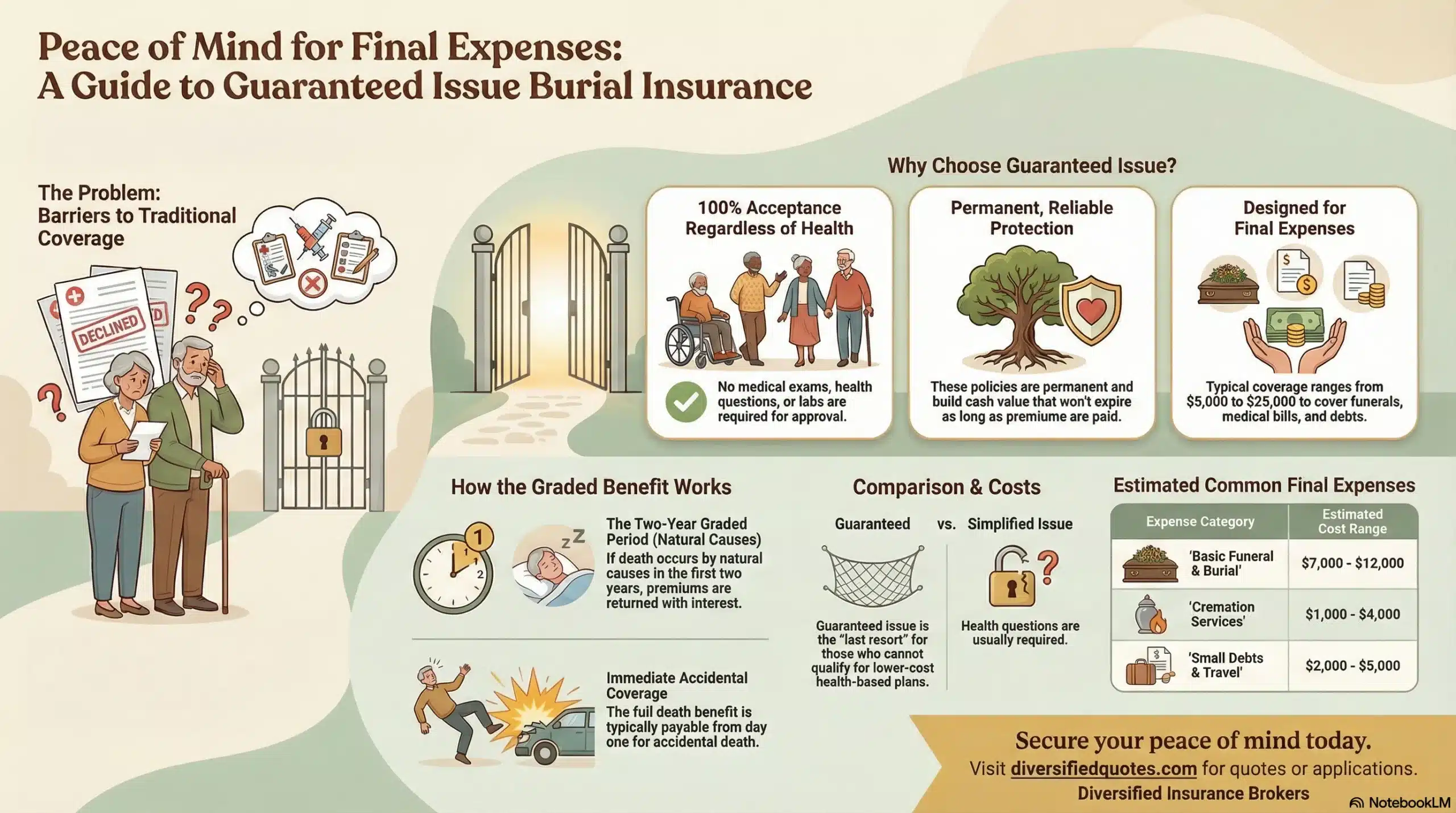
The graded benefit period — also called the waiting period — is one of the most misunderstood features of guarantee issue policies and one that directly affects the effective value of the coverage in the early years. Most guarantee issue policies include a two-to-three year waiting period during which the full death benefit is not paid for death from natural causes. If the insured dies of natural causes during this window, the policy typically returns the premiums paid plus a modest interest credit rather than the full face amount. After the waiting period expires, the full death benefit applies to all causes of death. This structure is how carriers protect themselves against the most severely ill applicants who might purchase coverage knowing death is imminent — but it also means the policy’s full value does not materialize for the first two to three years, which further reduces the effective cost efficiency of the coverage in those early years.
Typical Guarantee Issue Premium Ranges
Exact premiums vary significantly by age, gender, state of residence, carrier, and coverage amount — but general ranges provide useful planning context. A 55-year-old female purchasing a $10,000 guarantee issue whole life policy might pay approximately $40 to $70 per month depending on the carrier and state. A 70-year-old male purchasing the same face amount might pay $90 to $150 or more per month for equivalent coverage. To put that in perspective, a healthy 55-year-old female applying for a term or simplified issue policy with medical questions could potentially qualify for meaningfully larger coverage at a lower monthly premium — meaning the cost per thousand dollars of benefit is substantially lower through underwritten coverage than through guarantee issue.
The cost differential becomes even more pronounced when comparing coverage amounts. A healthy 60-year-old might purchase $100,000 or more of term life coverage for a monthly premium that is similar to or lower than what a guarantee issue applicant pays for $15,000 to $20,000 of permanent coverage. This is the fundamental economics of guarantee issue pricing — the accessibility is real and valuable for those who need it, but the cost efficiency is genuinely lower than any underwritten alternative for people who can qualify. For people exploring whether there is a less expensive path to meaningful coverage, our resource on how to get the best burial insurance rates covers the strategies for reducing cost across the full spectrum of final expense coverage options.
When Guarantee Issue Life Insurance Makes Sense Despite the Cost
Despite the higher per-dollar cost, guarantee issue life insurance is genuinely the right choice in specific circumstances — and recognizing those circumstances clearly is as important as understanding the cost structure. The most straightforward case is when the applicant’s health history makes standard or simplified issue underwriting unavailable. If you have a serious terminal or advanced chronic condition, a recent major medical event, or a combination of conditions that have produced prior declines, guarantee issue may be the only path to any life insurance coverage at all. In that context, comparing guarantee issue to underwritten coverage on a cost-per-thousand basis is not the relevant comparison — the relevant comparison is between guarantee issue coverage and no coverage at all.
Guarantee issue also makes clear sense when the coverage objective is modest and specific — covering funeral and burial costs, settling a small final medical bill, or addressing a defined final expense need that falls within the $5,000 to $25,000 range that guarantee issue policies typically accommodate. The permanent nature of these policies — they do not expire at the end of a term — means the coverage will be in force when it is needed, which matters for applicants who are purchasing specifically to address final expense obligations. Our broader resource on guaranteed issue burial insurance covers how these policies are structured specifically for final expense planning purposes. For seniors who may also be managing caregiving or disability planning alongside life insurance needs, our resource on guaranteed issue life insurance for special needs adults covers how these policies serve households with dependent family members requiring long-term support.
Lifelong coverage certainty is a third scenario where guarantee issue provides value that term insurance cannot. Some applicants want the assurance that their policy will be in force regardless of when death occurs — not a policy that expires at 75 or 80 when the need for final expense coverage becomes most acute. Guarantee issue whole life policies provide permanent coverage with level premiums, which means the monthly cost is locked in at the time of purchase and does not increase with age or health changes. For people with health conditions who are concerned that future deterioration might make coverage harder to obtain, securing permanent coverage now through guarantee issue eliminates that future access risk.
When Guarantee Issue May Not Be the Best Choice
If you are in reasonably good health and can qualify for underwritten coverage — even with some health history that might result in a table rating or simplified issue underwriting — guarantee issue is likely not the best value for your situation. The premium differential between guarantee issue and simplified issue coverage for an applicant who can answer health questions favorably is typically significant enough to make the underwriting process worth engaging. Simplified issue policies — which involve a limited set of health questions but no medical exam — often provide substantially more coverage at the same or lower premium than guarantee issue alternatives, and they do not include the graded benefit waiting period that reduces the value of guarantee issue coverage in the early years.
Guarantee issue is also not the right tool when the coverage objective requires a substantial death benefit. If you have dependents who depend on your income, a mortgage balance that needs to be covered, or legacy goals that require meaningful estate transfer, the coverage amounts available through guarantee issue — typically capped at $25,000 and rarely exceeding $50,000 — will not address those needs. For households with income replacement or debt coverage objectives, our resources on life insurance with pre-existing conditions and best high-risk life insurance companies cover the underwritten pathways that can provide larger coverage amounts even when health history is complex. For applicants whose health conditions specifically affect underwriting, our condition-specific resources on life insurance for diabetics with complications and life insurance for elevated liver enzymes illustrate how carriers evaluate specific health histories and what options remain available through underwritten products.
How to Evaluate Guarantee Issue Cost Against Value
The most practical framework for evaluating whether guarantee issue coverage is worth its cost involves comparing across three dimensions simultaneously: the cost per thousand dollars of coverage, the effective benefit during the waiting period, and the alternatives available given your actual health profile.
Calculating cost per thousand of coverage is the starting comparison. Divide the annual premium by the face amount in thousands — a $1,200 annual premium for $10,000 of coverage produces a cost-per-thousand of $120. Compare that figure across guarantee issue carriers and against simplified issue alternatives to see the relative cost efficiency of each option. Evaluating the graded benefit period honestly requires asking what the policy actually pays if death occurs in year one or year two — and whether that limitation changes the coverage decision for your specific situation. For applicants with serious illness who may have a shorter expected life horizon, the graded benefit limitation is a material factor that can significantly reduce the practical value of the policy. Comparing alternatives means genuinely exploring whether simplified issue or even some underwritten products might approve your application. Many people assume they will be declined without testing that assumption — and a carrier that specializes in complex health histories may offer a better outcome than expected. Our resource on what to do if you are denied life insurance covers what options remain after a decline and how to identify carriers whose underwriting appetite may match your profile better.
For people managing the insurance decision alongside broader financial planning concerns — including whether to liquidate or retain an existing policy — our resources on selling a life insurance policy and are life insurance benefits taxable provide important context for how life insurance assets interact with broader financial and estate planning decisions.
How Diversified Insurance Brokers Helps You Compare Options
At Diversified Insurance Brokers, we review your age, health history, coverage objectives, and budget to determine whether guarantee issue is the most appropriate solution — or whether a simplified issue or underwritten alternative would deliver meaningfully better value. We access more than 100 carriers, which means we can identify whether any underwriting-friendly carrier is likely to offer you a workable outcome before recommending that guarantee issue is the right path. When guarantee issue genuinely is the best available option for your situation, we compare multiple carriers’ guarantee issue products to identify the most competitive premium, the most favorable graded benefit terms, and the coverage amount that most accurately addresses your objective. The goal is never to sell the most accessible policy — it is to find the policy that most efficiently delivers the protection you actually need at a price that will remain sustainable for as long as the coverage is in force.
For applicants exploring coverage options alongside long-term care planning — since many guarantee issue purchasers are also navigating age-related care cost concerns — our resources on burial insurance for people with heart conditions and guaranteed issue long-term care insurance address how these parallel protection needs can be coordinated within a household planning framework.
Related Coverage Resources
Talk With an Advisor Today
Choose how you’d like to connect—call or message us, then book a time that works for you.
Schedule here:
calendly.com/jason-dibcompanies/diversified-quotes
Licensed in all 50 states • Fiduciary, family-owned since 1980
Is Guarantee Issue Life Insurance Expensive — FAQs
Guarantee issue premiums are higher because the insurer accepts applicants without any medical underwriting — meaning it cannot price each policy based on the individual applicant’s actual health risk. Instead, every policy in the pool must be priced to reflect the elevated average mortality risk of a group that includes people with serious health conditions who could not qualify for standard coverage. This adverse selection reality, combined with the older age brackets most guarantee issue policies serve and the small face amounts that create higher administrative cost ratios, produces premiums that are significantly higher per thousand dollars of death benefit than underwritten alternatives. The carrier is essentially charging everyone the price that reflects the riskiest segment of the pool, because that segment is present in meaningful numbers among applicants who have chosen guaranteed acceptance precisely because underwritten coverage was unavailable to them.
Yes — in almost every case, applicants who can qualify for underwritten or simplified issue life insurance will pay lower premiums and receive substantially larger coverage amounts compared to guarantee issue alternatives. Simplified issue policies — which require answers to a limited set of health questions but no medical exam — often provide two to five times the coverage of a guarantee issue policy for a similar or lower monthly premium, with no waiting period before full benefits apply. Fully underwritten policies for healthy applicants can provide ten to twenty times the coverage at lower cost. Even applicants with significant health history who qualify for rated underwritten coverage — policies issued at a premium surcharge above standard — typically receive better value than guarantee issue on a cost-per-thousand-of-coverage basis. The most important practical step for anyone considering guarantee issue is to genuinely test whether simplified issue or underwritten options are actually unavailable to them before defaulting to guaranteed acceptance, because many people assume they will be declined without ever submitting an application to a carrier that specializes in their health profile.
The graded benefit period — often called the waiting period — is a feature in most guarantee issue life insurance policies that limits the death benefit paid if the insured dies from natural causes within the first two to three years after the policy is issued. During this waiting period, most policies return the premiums paid plus a modest interest credit — commonly 10% — rather than the full face amount. After the waiting period expires, the full death benefit applies to all causes of death, including natural causes. Death from accidents is typically covered at the full face amount from the first day of coverage, even during the waiting period, in most guarantee issue contracts. The graded benefit structure is how carriers protect themselves against the most severely ill applicants who might purchase coverage with knowledge that death is imminent — but it also means the policy’s full value is not immediately available, which is an important factor when evaluating whether guarantee issue is the right choice for a specific situation and timeline.
No — guarantee issue policies are not designed for large death benefits and are generally not appropriate when the coverage objective requires substantial face amounts. Most guarantee issue life insurance policies cap coverage at $25,000, and while some carriers offer amounts up to $40,000 or occasionally $50,000, these are still modest relative to the coverage needs of households managing mortgage debt, income replacement for dependents, or meaningful estate transfer goals. Guarantee issue is designed primarily for final expense planning — covering funeral and burial costs, settling small outstanding medical bills, or addressing a modest defined financial obligation — where the coverage amounts available are sufficient. When the goal is larger death benefit coverage, the appropriate path is exploring underwritten options with carriers that have experience evaluating complex health histories, even if those policies come with table ratings or exclusions that reflect elevated risk.
Yes — guarantee issue cost is worth it when the specific circumstances make it the most practical available solution. The clearest case is when health history prevents approval through any underwritten or simplified issue path, making guarantee issue the only coverage option available. In that context, the relevant comparison is not between guarantee issue and underwritten coverage on cost-per-thousand terms — it is between guarantee issue coverage and no coverage at all. A second scenario where the cost is justified is when the coverage need is genuinely limited to final expense amounts — $10,000 to $25,000 — and the applicant wants the certainty of permanent coverage without the risk of a declined application. A third scenario is when the applicant values the simplicity and certainty of guaranteed acceptance enough to pay the premium premium — knowing that the coverage will be in force without conditions, health disclosures, or underwriting uncertainty. For the right applicant in the right circumstances, guarantee issue delivers real and meaningful value despite its higher cost structure.
Simplified issue life insurance involves answering a limited set of health questions — typically five to fifteen questions covering major health conditions, recent hospitalizations, and terminal diagnoses — but does not require a medical exam or laboratory work. Guarantee issue asks no health questions at all and accepts any eligible applicant within the stated age range. The practical difference is meaningful: simplified issue typically offers larger face amounts, lower premiums per thousand of coverage, and no graded benefit waiting period for most conditions. For applicants whose health history allows them to answer simplified issue questions favorably — meaning no recent terminal diagnosis, no active cancer treatment, no confinement in a nursing facility — simplified issue almost always provides better value than guarantee issue. Guarantee issue is the appropriate fallback when the health questions on simplified issue products would produce answers that prevent approval, or when the applicant has conditions that even simplified issue underwriting declines.
In most guarantee issue life insurance contracts, the graded benefit waiting period applies only to death from natural causes — illness, disease, or medical conditions. Death caused by a covered accident is typically paid at the full face amount from the first day the policy is in force, even during the waiting period. This distinction matters for applicants evaluating the practical coverage value in the early years of the policy. While the natural cause waiting period limits the policy’s value for someone with serious illness who dies in year one or two, the accidental death full benefit means the policy is not entirely without value during the waiting period. The specific accident definition and any accident exclusions — such as self-inflicted injury, war, or illegal activity — vary by carrier and should be reviewed in the policy contract rather than assumed to be standard.
Most guarantee issue life insurance policies are available to applicants between ages 50 and 85, though the exact age range varies by carrier. Some carriers offer guarantee issue coverage starting at age 45, and others limit the upper age to 80 or may offer products with different face amount limits at older ages. The most common and widely available age band is 50 to 80 or 50 to 85 depending on the carrier and the specific product. Premiums increase significantly with age within this range — a 75-year-old applicant will pay substantially more for the same face amount than a 55-year-old applicant. Maximum face amounts may also decrease at older ages in some carrier product designs. Confirming the specific age band eligibility and premium schedule for your exact age at the time of application is an important early step when evaluating guarantee issue options.
Some guarantee issue whole life policies do accumulate modest cash value over time, which is a feature of the permanent whole life structure rather than the guarantee issue underwriting approach specifically. The cash value accumulation in these policies is typically modest because the premium structure — which prices for higher mortality risk — leaves less margin for the savings or accumulation component compared to a standard whole life policy for a healthy applicant. Cash value in a guarantee issue policy may become accessible through policy loans or surrender after a defined number of years depending on the contract terms. However, using a guarantee issue policy as a cash value accumulation vehicle is generally not efficient — the combination of higher premiums and modest accumulation rates makes other savings vehicles considerably more effective for people whose primary goal is asset growth. Guarantee issue is most appropriately used as a pure protection tool for its death benefit rather than as a financial product with meaningful accumulation expectations.
An independent broker provides two distinct advantages when evaluating guarantee issue life insurance. The first is the ability to compare guarantee issue products across multiple carriers simultaneously — because premiums, face amounts, waiting period terms, and other contract provisions vary meaningfully across companies that offer these products, and the most competitive option for your specific age and coverage amount may not be the most prominently marketed one. The second and often more important advantage is the ability to first assess whether guarantee issue is actually necessary for your situation — or whether a simplified issue or underwritten product might offer better value if a carrier with the right underwriting appetite for your health profile exists. At Diversified Insurance Brokers, we do not recommend guarantee issue as a default — we evaluate your complete health picture and coverage objective first, identify any underwritten or simplified issue options that might apply, and only confirm guarantee issue as the appropriate recommendation when it genuinely is the best available solution for your specific circumstances. The goal is the most efficient coverage for your situation, not the most accessible product regardless of cost.
About the Author:
Jason Stolz, CLTC, CRPC, DIA, CAA and Chief Underwriter at Diversified Insurance Brokers (NPN 20471358), is a senior insurance and retirement professional with more than 25 years of real-world experience helping individuals, families, and business owners protect their income, assets, and long-term financial stability. As a long-time partner of the nationally licensed independent agency Diversified Insurance Brokers, Jason provides trusted guidance across multiple specialties—including fixed and indexed annuities, long-term care planning, personal and business disability insurance, life insurance solutions, Group Health, Travel Medical and Evacuation Insurance, and short-term health coverage. Diversified Insurance Brokers maintains active contracts with over 100 highly rated insurance carriers, ensuring clients have access to a broad and competitive marketplace.
His practical, education-first approach has earned recognition in publications such as VoyageATL, and contributions from his agency featured in Kiplinger and GoBankingRates— highlighting his commitment to financial clarity and client-focused planning. Drawing on deep product knowledge and years of hands-on field experience, Jason helps clients evaluate carriers, compare strategies, and build retirement and protection plans that are both secure and cost-efficient. Visitors who want to explore current annuity rates and compare options across multiple insurers can also use this annuity quote and comparison tool.
Explore More Life Insurance Options: Browse our complete guide to Guaranteed Issue, No Exam & High-Risk Education — covering guaranteed issue policies, no-exam coverage, and table ratings from 100+ carriers.
Last Reviewed: June 13, 2026 |
Reviewed by: Jason Stolz, CLTC, CRPC, DIA, CAA
Chief Underwriter, Diversified Insurance Brokers, Inc. | NPN: 20471358 | Diversified Insurance Brokers, Inc. — Licensed in all 50 states
Fact Checked by: Tonia Pettitt, CMIP©
Medicare Specialist, Diversified Insurance Brokers, Inc. | NPN: 14374308 | Diversified Insurance Brokers, Inc. — Licensed in all 50 states
Did you find this content helpful? Leave us a Google review — it helps others find trustworthy guidance too.
Editorial Standards: Diversified Insurance Brokers maintains rigorous editorial standards to ensure accuracy, clarity, and independence in all content. Learn more about our editorial standards and commitment to transparency.
