
Is Life Insurance Expensive?
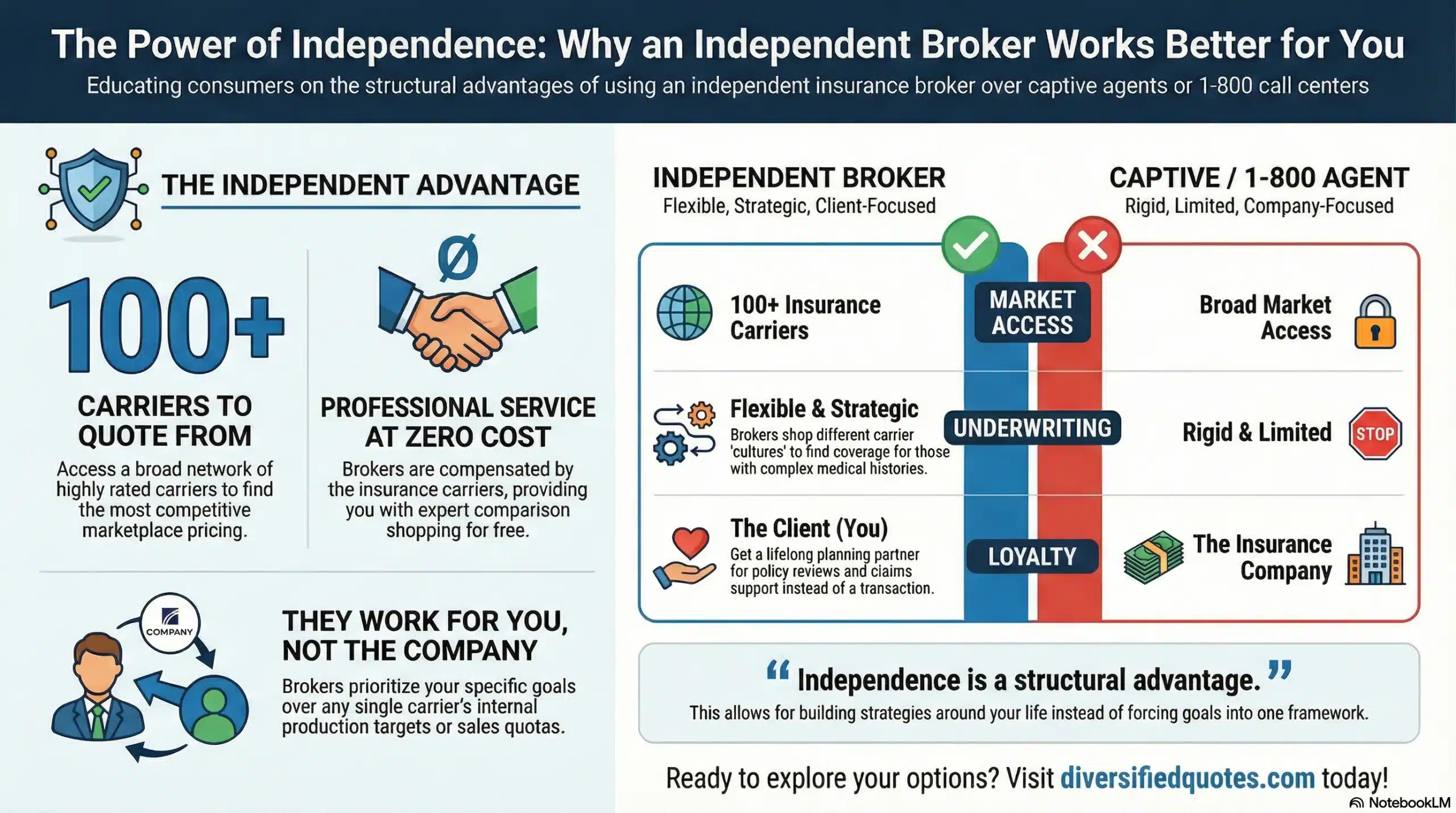
As an Independent Life Insurance Broker, we compare rates across 100+ carriers and prescreen every application before submission.
Is Life Insurance Expensive?

Jason Stolz CLTC, CRPC, DIA, CAA
Is life insurance expensive? For most people, it is surprisingly affordable — especially when the monthly premium is compared to what the policy actually protects. A properly structured term life policy can cover hundreds of thousands or even millions of dollars in death benefit for a cost that, for younger healthy applicants, is often less than a gym membership or a streaming subscription. The disconnect between what people assume life insurance will cost and what it actually costs when properly shopped is one of the most consistent surprises in the advisory process. At Diversified Insurance Brokers, Jason Stolz, CLTC, CRPC, DIA, CAA, compares policies across 100+ top-rated carriers so clients can see real pricing options tailored to their age, health profile, and coverage need — not generic quotes built on average assumptions that may not apply to them at all.
The confusion about life insurance cost comes from how the pricing actually works. Most people encounter life insurance pricing in one of two ways: a generic online quote that does not account for their specific health class or the full carrier market, or a quote from a single captive agent who can only offer one company’s products regardless of whether that company is the most competitive option for that particular applicant. Life insurance pricing is highly individualized — the difference between an average carrier’s rate and the most competitive carrier for a specific health and age profile can be 20%, 30%, or more for the same coverage. That difference is only visible through comparison across the full market, which is what an independent brokerage provides. Many people who assume life insurance will be expensive are relieved when they see what an actual market comparison produces for their specific situation.
See Real-Term Rates Side by Side
Life Insurance Quoter
What Actually Determines the Cost of Life Insurance
Life insurance premiums are based on risk and duration. The carrier is pricing a contractual promise: if the insured passes away during the coverage period, the company will pay a tax-advantaged death benefit to the named beneficiaries. The more likely that promise is to be triggered within the coverage period, and the longer the period over which the carrier must hold the risk, the higher the premium. The variables that determine that probability — and therefore the cost — are specific, measurable, and in some cases actionable.
Age is the most significant single pricing lever and the one that most directly rewards early action. Life insurance premiums typically increase with each year of age because mortality probability increases over time. A 30-year-old and a 40-year-old applying for the same coverage amount with the same health profile will pay meaningfully different premiums for identical policies. This does not mean buying more coverage than is needed — it means that for households where the need for coverage is already clear (children at home, a mortgage, income replacement obligations, business succession needs), delaying the purchase to “think about it” has a real and ongoing cost. How much life insurance you actually need provides the analytical framework for determining the right coverage amount before worrying about premium.
Health and build determine the underwriting classification, which is the single most important variable after age. Carriers assign applicants to underwriting classes — typically labeled preferred plus, preferred, standard plus, standard, and substandard table ratings — based on a comprehensive review of blood pressure, cholesterol, labs, medications, height and weight, family history, and the presence, severity, and control of any medical conditions. The premium difference between preferred plus and standard on the same policy can be 40% to 60%. The premium difference between standard and a substandard table rating can be even larger. What most people do not realize is that different carriers evaluate the same health profile with meaningfully different underwriting philosophies — a condition that results in a table rating at one carrier may qualify for standard or even preferred rates at another carrier that has more favorable underwriting guidelines for that specific condition. This is why shopping across carriers is not just about finding the cheapest headline rate — it is about finding the carrier whose underwriting approach produces the best classification for your specific health history. Our specialty in life insurance with pre-existing conditions reflects exactly that: knowing which carriers favor which health profiles and routing applications accordingly rather than defaulting to whoever offers the best generic price.
Policy type changes the price structure fundamentally. Term life is typically the lowest-cost approach because it provides protection for a defined period — 10, 15, 20, or 30 years — without the accumulation component that increases the cost of permanent coverage. Term is the most appropriate structure when the primary goal is income replacement, mortgage protection, or covering family financial obligations during the working years. Permanent life insurance — whole life, universal life, indexed universal life, guaranteed universal life — costs more because the coverage is designed to remain in force beyond the term window, and some structures include cash value accumulation or flexible funding features that serve broader planning objectives. How whole life insurance works and what guaranteed universal life insurance is cover the two most common permanent structures and what they provide beyond the death benefit. How to buy term life insurance online covers the process for the most straightforward and commonly purchased product category.
Coverage amount and term length jointly determine how much risk the carrier is insuring and for how long. More coverage costs more for a given profile and term. Longer terms cost more for a given coverage amount and profile. The critical planning mistake many families make is mismatching the term length to the actual financial obligation being insured. A 30-year mortgage protection need does not necessarily require a 30-year policy — it requires a term that extends at least until the mortgage is paid off, which may be less. Conversely, a family with young children and 20+ years of income replacement need should not choose a 10-year term because it appears cheaper, only to face the prospect of reapplying at an older age with potentially higher premiums and a different health profile. Matching term length to the actual timeline of the financial obligation is one of the most effective ways to control premium without sacrificing meaningful protection.
Lifestyle and occupation factors round out the major underwriting variables. Tobacco and nicotine use — including cigarettes, cigars, chewing tobacco, vaping, and nicotine patches — are the most significant lifestyle pricing drivers, typically resulting in premiums that are 2x to 3x the non-tobacco rate for the same profile. High-risk occupations and hazardous hobbies can increase premiums or create coverage exclusions, but the magnitude of the impact varies significantly by carrier. A pilot, a roofer, or a recreational skydiver who is declined or quoted an unaffordable rate by one carrier may find a very different result at a carrier that has specific underwriting guidelines for that risk category. Working with an independent broker who knows which carriers treat which occupational and avocational risks most favorably is the most direct path to an affordable outcome for non-standard profiles.
Estimated Monthly Premiums — What Real Coverage Actually Costs
| Age | Coverage Amount | Term | Estimated Monthly (Non-Smoker, Good Health) | What It Protects |
|---|---|---|---|---|
| 25 | $250,000 | 20 years | $14–$18/month | Early family formation, student loan co-signer, beginning income replacement |
| 35 | $500,000 | 20 years | $25–$30/month | Peak income replacement years, mortgage, children through college |
| 45 | $500,000 | 20 years | $45–$55/month | Remaining mortgage, income replacement through retirement transition, business obligations |
| 55 | $250,000 | 15 years | $60–$80/month | Estate liquidity, surviving spouse income, final debt clearance |
Strategies That Actually Reduce Life Insurance Cost
There are two broad ways to reduce life insurance premium without sacrificing meaningful protection: reduce what the carrier perceives as risk, and improve the efficiency of the policy design relative to the actual financial obligation being protected. Some of the most effective strategies are not about negotiating with a carrier — they are about making better design decisions before the application is submitted.
Applying at the right time is the most straightforward cost reduction available. For households where the need for coverage is already clear — children, a mortgage, income replacement obligations, a business — waiting to purchase creates a cost that grows with each passing year. There is no planning benefit to delay when the need is established. Buying earlier locks in a lower premium for the full policy term, which for a 20-year term policy can represent thousands of dollars in total premium savings over the coverage period relative to buying the same policy at a later age.
Matching the term length to the actual financial obligation rather than defaulting to the longest available term is a frequently overlooked premium lever. If the primary obligation is a mortgage that will be paid off in 18 years, a 20-year term covers that need without the additional premium cost of a 30-year term that provides protection for a decade longer than the obligation exists. If children will be financially independent in 22 years, a 25-year term covers that need without the marginal cost of a 30-year term. Proper term alignment — not necessarily the longest or shortest term available, but the term that matches the actual liability timeline — produces the most efficient premium-to-protection ratio.
Shopping underwriting across carriers rather than defaulting to a single company is consistently one of the highest-value actions for applicants whose health profile is anything other than the most favorable classification. The independent brokerage advantage is not just about comparing premium rates — it is about knowing which carrier’s underwriting guidelines are most favorable for a specific combination of age, health conditions, medications, build, family history, and lifestyle factors. That knowledge is accumulated through experience submitting applications across the full carrier market, and it is unavailable to captive agents who can only access one company’s guidelines. For applicants who have been declined, table-rated, or quoted an unexpectedly high premium by one carrier, the most productive next step is submitting to a carrier whose underwriting philosophy is more aligned with that specific profile — not accepting the first result as the market’s answer. For anyone who has received a quote and is uncertain whether it is competitive, getting a second opinion on the life insurance quote is the direct path to confirming whether the rate is genuinely the best available.
Laddering term policies — using two or more term policies with different lengths and coverage amounts instead of one large policy — can reduce total premium when the coverage need decreases over time. A household that needs $1 million of coverage today but expects that need to decline to $500,000 in 15 years (as the mortgage is paid down and savings grow) can purchase a 15-year policy for $500,000 and a 30-year policy for $500,000, rather than a single $1 million 30-year policy. The total premium for the ladder is lower than the single large policy because the shorter-term $500,000 policy carries significantly lower premium than extending the full $1 million to 30 years. As savings grow and debts are paid, some families find they can also explore life insurance alternatives that serve the income protection purpose differently as the financial picture changes.
Life insurance should also be evaluated alongside disability insurance as part of a complete income protection plan, not as a standalone decision. Life insurance protects the household if the insured dies. Disability insurance protects income if the insured cannot work due to illness or injury — an event that is statistically more likely than death during the working years for most demographics. Whether disability insurance is worth it addresses that complementary protection need directly. For new professionals early in their careers, disability insurance for new professionals covers why locking in coverage early — before health changes occur and while occupation class is most favorable — produces the best long-term protection at the lowest sustainable cost.
Get a Personalized Quote
Submit your details once and we’ll compare options across multiple top-rated carriers — matched to your age, health profile, and coverage goal.
Questions? Call 800-533-5969
Talk With an Advisor Today
Choose how you’d like to connect—call or message us, then book a time that works for you.
Schedule here:
calendly.com/jason-dibcompanies/diversified-quotes
Licensed in all 50 states • Fiduciary, family-owned since 1980
Frequently Asked Questions: Is Life Insurance Expensive?
How much does term life insurance actually cost for a healthy person?
For healthy non-smokers, term life insurance is typically far less expensive than most people expect. A 35-year-old in good health can often secure $500,000 of 20-year term coverage for approximately $25 to $30 per month — less than most car insurance payments and a fraction of the income replacement value the policy provides. A 45-year-old in good health can typically secure the same $500,000 of 20-year coverage for $45 to $55 per month. These are real market numbers for favorable health classifications, not best-case scenarios that only apply to perfect health. The range within those estimates — and the potential to come in at the lower end of the range — depends significantly on which carrier’s underwriting guidelines are most favorable for the applicant’s specific health profile and how the application is positioned. An applicant who is quoted $50 per month by one carrier may qualify for $35 per month at a carrier that has more favorable underwriting guidelines for their specific combination of health factors. That difference is only visible through comparison across multiple carriers.
Why did the quote I saw online seem so much higher than what you’re describing?
Online quote tools typically show a range of premiums across carriers for an assumed health classification — often “standard” — rather than the best classification you might actually qualify for with proper underwriting. If your health profile qualifies for preferred or preferred plus classification at the right carrier, the premium can be significantly lower than what a generic online tool estimates for your age and coverage amount. Additionally, online tools often show only a subset of the carrier market rather than the full competitive landscape. The premium difference between the generic online estimate and a real market comparison with proper underwriting can be substantial — particularly for applicants whose health profile is above average, who have specific conditions that some carriers treat more favorably than others, or whose lifestyle or occupation places them in a niche that certain carriers specialize in. A quote from a single carrier or a lead-generation comparison tool is a starting point, not a market answer.
Does having a health condition make life insurance unaffordable?
Not necessarily — and this is one of the most consequential misunderstandings in the life insurance market. Different carriers evaluate the same health conditions with dramatically different underwriting philosophies. A condition that results in a substandard table rating at one carrier — adding a percentage surcharge to the standard premium — may qualify for standard or better rates at a carrier that has specific underwriting guidelines developed for that condition, particularly when the condition is well-controlled, has been stable for a defined period, and has no complications. Common examples include controlled blood pressure and cholesterol, well-managed type 2 diabetes with good A1C, treated sleep apnea, a history of cancer that is in remission, and various cardiac conditions depending on the nature and treatment. “Being told you’re too high risk” by one carrier or one agent is not the same as “being too high risk for the market.” It is often simply the result of applying with a carrier that is not the best fit for that specific health profile. The most effective next step in those situations is working with an independent broker who knows which carriers specialize in which risk categories and can route the application accordingly.
Is whole life insurance or term life insurance more affordable?
Term life insurance is less expensive than whole life insurance for the same death benefit amount, in virtually all cases. The premium difference can be very large — a 40-year-old purchasing $500,000 of 20-year term might pay $35 to $50 per month, while $500,000 of whole life at the same age might cost $300 to $500 per month or more. The reason for the difference is structural: term provides coverage for a defined period with no accumulation component, while whole life provides permanent coverage with guaranteed cash value accumulation, which requires the carrier to hold more reserve. The comparison between term and whole life should not be framed purely as “which is cheaper” but rather “which matches the financial objective.” Term is appropriate when the coverage need has a defined timeline — income replacement during working years, mortgage payoff, raising children. Whole life and other permanent structures are appropriate when the objective includes lifelong death benefit, legacy planning, business succession, or accumulation features. The right policy is the one that solves the actual problem most efficiently — and for pure income replacement during a defined period, term is almost always the more affordable and appropriate tool.
How can I make sure I am getting the best available rate?
The most reliable way to confirm you are getting the best available rate is to work with an independent broker who compares the full carrier market rather than a captive agent who represents one company or an online lead-generation tool that shows a curated subset of options. An independent broker submits your application or preliminary case information to multiple carriers simultaneously, evaluates how each carrier’s underwriting guidelines apply to your specific health and lifestyle profile, and identifies the carrier most likely to produce the best classification — and therefore the best premium — for your situation. Beyond carrier selection, ensuring that the application is presented accurately and completely is equally important: health conditions that are stable, well-controlled, and properly documented often qualify for better underwriting treatment than conditions that are disclosed incompletely or without the supporting context that demonstrates control. For anyone who has already received a quote and is uncertain whether it reflects the best available rate, getting a second opinion from an independent broker who can access different carriers is the fastest way to answer that question concretely rather than speculatively.
About the Author:
Jason Stolz, CLTC, CRPC, DIA, CAA and Chief Underwriter at Diversified Insurance Brokers (NPN 20471358), is a senior insurance and retirement professional with more than 25 years of real-world experience helping individuals, families, and business owners protect their income, assets, and long-term financial stability. As a long-time partner of the nationally licensed independent agency Diversified Insurance Brokers, Jason provides trusted guidance across multiple specialties—including fixed and indexed annuities, long-term care planning, personal and business disability insurance, life insurance solutions, Group Health, Travel Medical and Evacuation Insurance, and short-term health coverage. Diversified Insurance Brokers maintains active contracts with over 100 highly rated insurance carriers, ensuring clients have access to a broad and competitive marketplace.
His practical, education-first approach has earned recognition in publications such as VoyageATL, and contributions from his agency featured in Kiplinger and GoBankingRates— highlighting his commitment to financial clarity and client-focused planning. Drawing on deep product knowledge and years of hands-on field experience, Jason helps clients evaluate carriers, compare strategies, and build retirement and protection plans that are both secure and cost-efficient. Visitors who want to explore current annuity rates and compare options across multiple insurers can also use this annuity quote and comparison tool.
Explore More Life Insurance Options: Browse our complete guide to Life Insurance Buying & Cost Education — covering how to buy, costs, calculators, rates & buying guides from 100+ carriers.
Last Reviewed: June 14, 2026 |
Reviewed by: Jason Stolz, CLTC, CRPC, DIA, CAA
Chief Underwriter, Diversified Insurance Brokers, Inc. | NPN: 20471358 | Diversified Insurance Brokers, Inc. — Licensed in all 50 states
Fact Checked by: Tonia Pettitt, CMIP©
Medicare Specialist, Diversified Insurance Brokers, Inc. | NPN: 14374308 | Diversified Insurance Brokers, Inc. — Licensed in all 50 states
Did you find this content helpful? Leave us a Google review — it helps others find trustworthy guidance too.
Editorial Standards: Diversified Insurance Brokers maintains rigorous editorial standards to ensure accuracy, clarity, and independence in all content. Learn more about our editorial standards and commitment to transparency.
