
Guaranteed Issue Life Insurance for Special Needs Adults
As an Independent Life Insurance Broker, we compare rates across 100+ carriers and prescreen every application before submission.
Guaranteed Issue Life Insurance for Special Needs Adults

Jason Stolz CLTC, CRPC, DIA, CAA
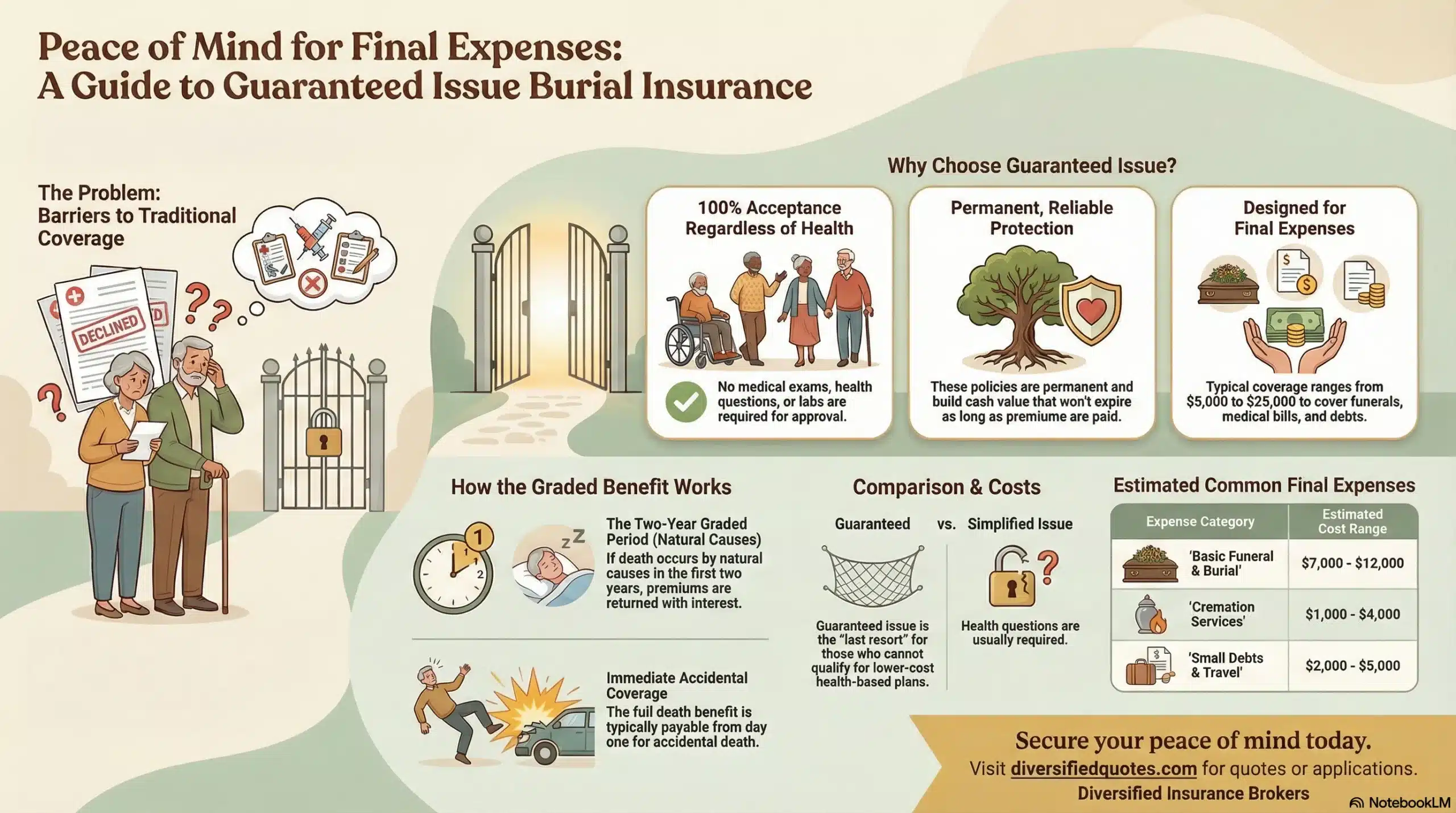
Guaranteed issue life insurance for special needs adults provides the most accessible path to permanent life insurance coverage when traditional underwriting is not possible — no medical examination, no health questionnaire, and no underwriting-based decline. Acceptance is determined by age and state eligibility, making the policy available to adults whose developmental disabilities, physical impairments, cognitive conditions, chronic illnesses, or complex medical histories have resulted in declines from every conventional underwriting process they have encountered. For families who have navigated the insurance market on behalf of an adult with significant care needs and heard “no” repeatedly, the guaranteed issue structure’s certainty of acceptance addresses the fundamental problem: coverage is available when it otherwise would not be.
The purpose of this coverage is specific and practical: funding final expenses — funeral costs, burial or cremation arrangements, memorial services, and small outstanding debts — so that siblings, surviving parents, or other family members do not absorb a sudden financial burden at an already difficult time. These are not wealth-building policies, and they are not designed to replace income or create large estates. They are designed to ensure that when the time comes, the financial logistics of a dignified farewell are handled by the policy rather than by family members who may themselves be managing grief, caregiving responsibilities, and financial constraints simultaneously. Our resource on special needs life insurance covers the complete landscape of life insurance options for special needs individuals and their families, and our resource on what is special needs life insurance and who needs it covers the broader planning framework that places guaranteed issue coverage within a complete special needs financial plan.
Apply for Guaranteed Issue Coverage Today
No medical exam. No health questions. Acceptance guaranteed within eligible ages. Coverage effective on first payment.
Apply Now Call 800-533-5969Coverage availability and graded benefit structures vary by state and carrier. Review your policy for full details.
Guaranteed Issue vs. Simplified Issue vs. Fully Underwritten — What Each Means for Special Needs Adults
Families evaluating life insurance for a special needs adult often encounter three distinct product categories — each with different acceptance criteria, coverage ranges, and pricing. Understanding the differences prevents the common mistake of applying for the wrong product first, generating an unnecessary decline record, and discovering too late that a better-fit option was available from the start.
| Feature | Guaranteed Issue | Simplified Issue | Fully Underwritten |
|---|---|---|---|
| Medical exam required | No — never; acceptance is not based on health | No — but health questionnaire is reviewed | Yes — blood, urine, vitals, and physician statements typically required |
| Health questions asked | None — no health questions of any kind | Yes — a limited set of health questions; specific answers can result in decline | Yes — comprehensive health, medication, and lifestyle questionnaire reviewed in full detail |
| Acceptance guarantee | Yes — if within eligible age range and state, acceptance is guaranteed regardless of health | Not guaranteed — health question answers can produce declines for specific diagnoses or conditions | Not guaranteed — comprehensive evaluation can result in substandard rating, exclusion, or decline |
| Coverage amounts available | Limited — typically $5,000–$25,000; designed for final expense coverage rather than income replacement | Moderate — often $10,000–$100,000+ depending on carrier and age; broader range than GI | Highest — face amounts from $50,000 to millions depending on income, assets, and underwriting class |
| Premium cost per $1,000 of coverage | Highest — no health screening means the carrier assumes maximum risk; cost per $1,000 reflects that elevated risk pool | Moderate — limited health screening allows some risk segmentation; lower cost per $1,000 than GI for approved applicants | Lowest for healthy applicants — complete risk segmentation produces preferred-class pricing for low-risk individuals; unavailable for those who cannot pass underwriting |
| Graded benefit / waiting period | Yes — typically a 2-year graded period during which non-accidental death pays premiums-plus-interest rather than full face amount | Often no graded period — many simplified issue policies begin full coverage at policy effective date for approved applicants | No graded period — full face amount applies from policy effective date for approved applicants |
| Policy type | Permanent whole life — fixed premium, level death benefit, modest cash value accumulation; does not expire as long as premiums are paid | Permanent whole life or term depending on carrier and product | Term or permanent depending on product; widest product selection available |
| Best suited for | Adults with developmental disabilities, cognitive impairments, or complex medical histories that would produce declines under any health-screening process; the guaranteed-acceptance product of last resort that is still a genuine, permanent solution | Adults whose health conditions might qualify them medically but whose history makes full underwriting uncertain; worth exploring before GI when health questions can be answered favorably | Individuals without significant health impairments who can complete the medical evaluation process and qualify for standard or preferred rates; not available for most adults with significant special needs histories |
The table’s most important row for families evaluating coverage for a special needs adult is the acceptance guarantee row — which establishes that guaranteed issue is the only product category where acceptance is genuinely not contingent on health. Simplified issue policies ask health questions and can decline based on the answers; fully underwritten policies evaluate complete health histories and almost certainly decline applicants with the diagnoses and care levels that characterize most special needs adults. Guaranteed issue removes that contingency entirely. Our resource on guaranteed issue life insurance under age 50 covers the specific product landscape for younger special needs adults whose age may qualify them for broader guaranteed issue options than those available for older adults, and our resource on life insurance with a prior decline covers the strategy for families whose previous applications were declined by underwritten or simplified issue carriers.
What Guaranteed Issue Life Insurance Is — The Complete Policy Structure
Guaranteed issue life insurance for special needs adults is a form of permanent whole life insurance — which means the policy does not expire at a defined age, the premium remains fixed at the same amount for the life of the policy, the death benefit does not decrease over time (outside of any loan or surrender provisions), and the policy builds a small amount of cash value that accumulates gradually throughout the policy’s lifetime. These characteristics distinguish guaranteed issue whole life from term insurance, which expires after a defined period, and from policies that may increase premium or reduce benefits as the insured ages.
The permanent nature of the policy is particularly significant for families planning for a special needs adult. The insurance need in this planning context is not temporary — it is not tied to a mortgage payoff timeline, an income replacement horizon, or a specific debt that will eventually be retired. The need for final expense coverage exists indefinitely, which makes the permanent structure’s guaranteed duration appropriate. A policy purchased for a 35-year-old special needs adult will still be in force at age 65, 75, and 85 as long as premiums continue to be paid — providing coverage regardless of how health evolves, which is particularly important because many special needs individuals face health trajectories that make future insurability uncertain or impossible.
The modest cash value that accumulates inside a guaranteed issue whole life policy is a secondary feature rather than a planning objective. For special needs adults and their families, the primary purpose is the death benefit. The cash value can be accessed through policy loans or partial surrenders if a genuine emergency arises, but using the cash value reduces both the death benefit and the policy’s financial standing, which is why it should be reserved for genuine emergencies rather than routine use. Our resource on what is a modified endowment contract covers the technical tax status distinction that applies to cash value life insurance — relevant for families who want to ensure that any cash value access from the policy does not produce unexpected tax consequences.
The Graded Benefit Period — Understanding the Waiting Period
The graded benefit period is the single most important feature for families to understand before purchasing a guaranteed issue policy, because misunderstanding it is the most common source of disappointment when claims are filed during the waiting period. A graded death benefit means that during a defined waiting period — most commonly the first two years after the policy’s effective date — the insurer does not pay the full face amount for non-accidental deaths. Instead, beneficiaries receive a return of all premiums paid plus a defined interest amount (commonly 10% of premiums paid). Accidental death typically is covered at the full face amount from the policy’s effective date, with no graded period restriction.
The graded benefit period exists because guaranteed issue policies accept applicants without any health evaluation — which means the carrier cannot assess whether the applicant is in imminent health danger at the time of acceptance. Without a graded period, the product would be susceptible to adverse selection: individuals in very poor health with short life expectancies would purchase policies knowing that a full death benefit would be paid quickly. The graded period protects the carrier’s actuarial assumptions and allows the product to remain economically viable and broadly available. After the graded period expires — typically after 24 months of continuous coverage — the policy pays the full face amount for any cause of death, and that full benefit protection continues for the life of the policy.
For families applying for guaranteed issue coverage for a special needs adult, the practical implication is to purchase the policy well in advance of any anticipated need — not because death is expected imminently, but because the two-year graded period means the full benefit is most valuable after it has been in force for at least 24 months. Families who delay purchasing until a health crisis has already begun may find that the policy’s full benefit is not available when it is most needed. Our resource on final expense life insurance covers the full landscape of products designed for final expense funding, including both guaranteed issue and simplified issue structures and how the graded period interacts with the coverage planning decision.
Special Needs Trusts — The Beneficiary Designation That Protects Everything
One of the most consequential decisions in guaranteed issue life insurance for special needs adults is not the product selection or the carrier — it is the beneficiary designation. When a special needs adult is the insured (the person whose life is covered), the death benefit paid at their death goes to whoever is named as beneficiary. If the policy is purchased for a caregiver or parent whose death will leave the special needs adult without financial support, the beneficiary designation must be structured to ensure that the death benefit funds are available to serve the special needs adult without disrupting their eligibility for means-tested government benefit programs.
Naming the special needs adult as a direct beneficiary can jeopardize their eligibility for Supplemental Security Income (SSI) and Medicaid — both of which have strict asset limits that could be violated if the special needs individual receives a direct life insurance payment. Naming a Special Needs Trust (SNT) as beneficiary — or naming a trustee of a properly established SNT in their capacity as trustee — routes the death benefit into the trust structure where it can be used to supplement the individual’s government benefits without replacing them. This is why our resource on why a special needs trust is essential reading for any family purchasing life insurance in the special needs planning context. The trust is not just an optional estate planning technique — it is often the mechanism that determines whether the life insurance benefit actually serves its intended purpose or disrupts the financial structure the family has carefully built.
For guaranteed issue policies specifically, the family or caregiver often owns the policy as well as designating the beneficiary — which allows them to make changes to beneficiary designations over time as the family’s situation evolves, maintain premium payment control, and coordinate the coverage with other estate planning decisions. Our resource on survivor benefits for disabled adults covers the full landscape of government benefit programs that interact with life insurance planning for special needs adults, including how benefit eligibility is affected by the structure of insurance ownership and beneficiary designation.
Who Typically Needs Guaranteed Issue Coverage for a Special Needs Adult
The adults most commonly served by guaranteed issue life insurance in the special needs context share a common characteristic: their medical histories make them ineligible for any form of underwritten coverage, and families have often discovered this through multiple prior application attempts. The specific diagnoses and conditions that most frequently lead families to guaranteed issue coverage include intellectual and developmental disabilities (including Down syndrome, autism spectrum disorder, and others), acquired brain injuries, advanced neurological conditions, severe physical disabilities with complex medical histories, individuals with a history of multiple hospitalizations, and adults whose psychiatric history or substance abuse history produces automatic declines under underwritten policies.
Families of adults with multiple sclerosis, epilepsy and seizure disorders, or autoimmune disease sometimes discover through our underwriting prescreening process that simplified issue or even fully underwritten coverage is available for their specific situation — because some carriers have more favorable guidelines for these conditions than others, and what produces a decline at one carrier may produce an approval at another. Our resource on high-risk life insurance covers the full spectrum of impaired-risk placement, and our resource on how to buy life insurance covers the complete evaluation framework for families who are navigating the coverage decision for the first time and need to understand which products are worth exploring before concluding that guaranteed issue is the only option. For many special needs adults, however, guaranteed issue is not simply a fallback — it is the appropriate solution from the beginning because the health picture makes any other path unrealistic.
SSI, Medicaid, and the Policy Ownership Question
Many special needs adults receive means-tested government benefits — Supplemental Security Income (SSI), Medicaid, state-funded support services, or some combination — that are subject to asset and income limits. A common family concern is whether purchasing life insurance on the special needs adult, or having the special needs adult own a life insurance policy, will jeopardize these benefit programs. The answer depends on both the ownership structure and the specific benefit program’s rules.
For SSI specifically, the Social Security Administration has specific rules about which assets are countable for purposes of the $2,000 individual resource limit (approximate as of recent guidance — confirm current limits). Cash value life insurance with a face amount of $1,500 or less is generally excluded from SSI resource counts. Life insurance with higher face amounts may cause the cash value to count as a resource, which could affect eligibility. Importantly, if the insured is the special needs adult themselves and the benefit is paid to a properly structured Special Needs Trust rather than to the individual directly, the death benefit payment typically does not affect the survivor’s SSI eligibility — because the trust holds the funds, not the individual. The relationship between life insurance and Medicaid is similarly complex and state-specific. These rules are not simple, and the family’s configuration matters as much as the product — which is why we consistently recommend coordination with a benefits attorney or special needs financial planner before finalizing any coverage structure for a special needs adult. Our resource on what is special needs life insurance and who needs it covers these benefit coordination considerations in the context of the complete special needs planning framework.
Coverage Amounts, Premium Structure, and Affordability
Guaranteed issue life insurance for special needs adults is available in face amounts typically ranging from $5,000 to $25,000, with some carriers offering amounts slightly below or above that range depending on state and product. These amounts are specifically sized for final expense purposes — funeral services, burial or cremation costs, memorial arrangements, and small outstanding debts — rather than for income replacement, mortgage payoff, or estate creation. The average funeral in the United States costs several thousand dollars or more depending on the services selected; a $10,000 to $20,000 policy can provide meaningful coverage for these costs without requiring a large premium commitment.
Because guaranteed issue policies accept all eligible applicants without health screening, the cost per dollar of coverage is higher than for underwritten alternatives — the carrier prices the elevated aggregate risk of the guaranteed acceptance pool into every policy. However, the modest face amounts mean the absolute monthly premium is often manageable for family caregivers: a $10,000 policy for a 55-year-old special needs adult might cost in the range of $40–$90 per month depending on gender, carrier, and state — amounts that many families find manageable given that the alternative is no coverage at all. The premium is level and guaranteed not to increase — which allows families to incorporate it into fixed budgets without concern about future premium escalation. Our resource on final expense life insurance vs. term life insurance covers the structural comparison between these two approaches to final expense funding — helping families understand why permanent guaranteed issue coverage is usually more appropriate than term for this specific planning objective.
When Simplified Issue Is Worth Exploring First
Guaranteed issue is the right answer when simplified issue has been tried and declined, or when the special needs adult’s health profile makes it obvious that health questions will produce a decline. But for some special needs adults — particularly those whose primary challenges are developmental or intellectual in nature without severe comorbid medical conditions — simplified issue coverage may be available with lower premiums and no graded benefit period. The difference can be significant: a simplified issue policy that approves based on answers to a limited health questionnaire may provide the same $15,000 face amount for 20% less monthly premium with no two-year waiting period — a materially better outcome for the family.
The prescreening process — where we evaluate a simplified issue carrier’s specific health question set against the applicant’s known medical history before any formal application is submitted — protects the family from the MIB record risk of generating an unnecessary decline from a simplified issue carrier. Our resource on burial insurance covers the full spectrum of final expense coverage options including both guaranteed issue and simplified issue products, and our resources on the special needs life insurance service page cover the complete placement process for special needs adults across all available product types.
Secure Permanent Coverage — Guaranteed Acceptance
No medical exam. No health questions. Permanent whole life coverage that does not expire. Apply in minutes with guaranteed acceptance within eligible ages.
Apply NowRelated Special Needs & Final Expense Planning Guides
Explore the complete framework for life insurance, trust planning, and government benefit coordination for special needs adults.
Financial Protection Essentials
Employer health planning, high-risk life insurance guidance, retirement transitions, and long-term care comparison tools.
Talk With an Advisor Today
Choose how you’d like to connect—call or message us, then book a time that works for you.
Schedule here:
calendly.com/jason-dibcompanies/diversified-quotes
Licensed in all 50 states • Fiduciary, family-owned since 1980
FAQs: Guaranteed Issue Life Insurance for Special Needs Adults
What is guaranteed issue life insurance?
Guaranteed issue life insurance is a permanent whole life policy that accepts applicants without any medical examination or health questions. Acceptance is based primarily on age and state eligibility — not health status, diagnosis history, or medical records. Once the applicant is within the eligible age range (commonly 50–80 depending on carrier) and in an eligible state, the policy is issued regardless of what health conditions exist. This is fundamentally different from simplified issue life insurance, which asks limited health questions and can decline based on the answers, and from fully underwritten life insurance, which evaluates complete medical histories and almost certainly declines applicants with significant special needs histories. Guaranteed issue policies are permanent whole life insurance — the premium never changes, the death benefit never decreases (outside of any loan provisions), and the policy does not expire as long as premiums are paid. Our resource on special needs life insurance covers how this product fits within the complete special needs planning framework.
Who qualifies and what ages are eligible?
Eligibility for guaranteed issue life insurance is determined by age and state, not health. Most carriers offer guaranteed issue policies to adults roughly between ages 50 and 80, though specific age bands vary by carrier — some carriers start at age 45, others limit acceptance to age 75. For special needs adults who fall outside the most common age range, there are specialized programs worth evaluating. Our resource on guaranteed issue life insurance under age 50 covers options for younger special needs adults who have not yet reached the typical guaranteed issue age floor. Within the eligible age range, any adult in an eligible state qualifies — including adults with Down syndrome, autism spectrum disorder, intellectual and developmental disabilities, cerebral palsy, acquired brain injuries, advanced neurological conditions, or any other condition that would disqualify them from underwritten coverage. State availability varies by carrier, so confirming that coverage is available in the applicant’s specific state is an early step in the placement process.
How much coverage can we purchase?
Guaranteed issue policies for special needs adults typically offer face amounts ranging from $5,000 to $25,000, with some carriers offering slightly lower minimums or higher maximums depending on their specific program design. These amounts are specifically sized for final expense coverage — funeral services, burial or cremation costs, memorial arrangements, and small outstanding debts — rather than income replacement or estate creation. A $10,000 to $20,000 policy can meaningfully address funeral and final expense costs in most markets without requiring a premium commitment that is difficult to sustain. If the family needs coverage beyond what guaranteed issue can provide, our team can evaluate whether simplified issue products might be available for amounts above the guaranteed issue limit. Our resource on final expense life insurance covers the full range of products available for final expense planning across both guaranteed and non-guaranteed acceptance structures.
Is there a waiting period for the full death benefit?
Yes — most guaranteed issue policies include a graded benefit period, typically the first two years after the policy’s effective date, during which non-accidental deaths do not pay the full face amount. During the graded period, beneficiaries receive a return of all premiums paid plus a defined interest amount — commonly 10% of total premiums paid. Accidental death is typically covered at the full face amount from the policy’s effective date, with no graded period restriction applying to accident-caused deaths. After the graded period expires — typically 24 months after the policy effective date — the policy pays the full face amount for any covered cause of death, and that full benefit protection continues for the life of the policy. The graded period exists because the carrier accepts applicants without health evaluation, which creates adverse selection risk that the graded structure manages. For families, the practical implication is to purchase the policy well in advance rather than waiting until a health crisis has already begun — because the full benefit is most available and most useful after the graded period has been completed.
Will this affect SSI or Medicaid eligibility?
The interaction between guaranteed issue life insurance and government benefit eligibility — particularly SSI and Medicaid — depends on the ownership structure, the beneficiary designation, and the specific benefit program’s rules. For SSI, the Social Security Administration has rules about which assets count toward the $2,000 individual resource limit. A life insurance policy owned by the special needs adult may have its cash value count as a resource if the face amount exceeds $1,500, which could affect SSI eligibility. If a parent, guardian, or trust owns the policy rather than the special needs adult themselves, the ownership structure may avoid this complication entirely. The death benefit paid at the insured’s death is a different matter — if the policy is for a caregiver or parent (whose death leaves the special needs adult without financial support), the death benefit is paid to whoever is named beneficiary. If the special needs adult is named as direct beneficiary, receipt of the funds may affect SSI and Medicaid eligibility. Naming a Special Needs Trust as beneficiary routes the funds into the trust structure, which typically allows the funds to be used to supplement government benefits rather than displace them. Because these rules are complex, state-specific, and frequently updated, coordination with a benefits attorney or special needs financial planner is essential before finalizing any coverage structure. Our resource on survivor benefits for disabled adults covers the benefit coordination context in more detail.
Can we name a Special Needs Trust as beneficiary?
Yes — and for most families, naming a Special Needs Trust (SNT) or its trustee in their fiduciary capacity as beneficiary is the recommended approach rather than naming the special needs individual directly. An SNT is a legal trust structure specifically designed to hold assets for the benefit of a person with disabilities without disqualifying them from means-tested government programs like SSI and Medicaid. When the trust is named as beneficiary of the life insurance policy, the death benefit flows into the trust at the insured’s death, where the trustee can deploy it to supplement the special needs beneficiary’s care and quality of life — for expenses that government benefits don’t cover — without the direct receipt of assets that would trigger benefit disqualification. For families who do not yet have a Special Needs Trust established, the life insurance purchase can proceed while the trust is being established — though the beneficiary designation should be updated to name the trust once it is in place. Our resource on why a special needs trust covers the trust structure and its role in the complete special needs financial plan.
Who should own the policy — the parent/guardian or the insured adult?
For most guaranteed issue policies on special needs adults, the parent, guardian, or trustee owns the policy rather than the insured adult themselves — for several practical reasons. First, ownership by a non-disabled party typically avoids the asset counting issues that can arise when the special needs adult owns a life insurance policy with cash value that may count toward SSI resource limits. Second, the owner controls premium payment, beneficiary designation changes, and any future policy modifications — which are more easily managed by a capable caregiver or guardian than by an individual who may have limited capacity to manage financial decisions independently. Third, policy ownership by a guardian or trustee makes the coverage easier to coordinate with the Special Needs Trust and other estate planning documents. For parents who are purchasing coverage on themselves — so that the special needs adult has financial resources when the parent dies — the coverage and ownership structures are different and require their own analysis. Our advisors review the ownership and beneficiary options for each family’s specific situation to ensure the structure serves the intended planning purpose without creating unintended benefit or tax consequences.
Does the policy build cash value?
Yes — guaranteed issue whole life policies accumulate modest cash value over time as premiums are paid and interest is credited to the policy’s cash accumulation component. The cash value grows slowly and is not the primary reason families purchase this coverage, but it does provide a small emergency reserve that can be accessed through policy loans or partial surrenders if a genuine need arises. A policy loan reduces the outstanding cash value and, if not repaid, also reduces the death benefit by the loan amount plus accrued interest. A partial surrender permanently reduces both the cash value and the death benefit. For most families, the appropriate approach is to treat the cash value as emergency-only access — using it only when no other resource is available and understanding that accessing it reduces the coverage the policy was purchased to provide. For special needs adults whose SSI eligibility may be affected by accessible cash assets, the cash value’s availability as a loanable asset requires consideration in the context of benefit planning — another reason why the ownership structure and access provisions should be reviewed with a benefits professional before any cash value is accessed.
What does it cost compared with other options?
Guaranteed issue life insurance has a higher premium per dollar of coverage than simplified issue or fully underwritten alternatives because the carrier accepts all eligible applicants without health screening — which means the risk pool includes all health profiles, requiring the carrier to price for the aggregate elevated mortality risk. As a practical comparison, a simplified issue carrier that asks health questions and declines applicants with certain serious conditions can price more competitively for the applicants it accepts, because it has screened out the highest-risk portion of the applicant pool. Despite the higher cost per dollar, the absolute monthly premium for guaranteed issue coverage is typically manageable because the available face amounts are modest: a $10,000–$15,000 policy for a 60-year-old special needs adult commonly costs in the range of $50–$110 per month depending on gender, state, and carrier. For families who have been repeatedly declined elsewhere, this cost premium is a reasonable exchange for the certainty of acceptance and the permanent coverage that guaranteed issue provides. When a special needs adult might qualify medically for simplified issue coverage, we evaluate both options to determine whether the simplified issue alternative offers meaningful savings — and often the simplified issue option also has no graded benefit period, which adds further value beyond the premium difference.
How do we apply — can a caregiver apply on behalf of the adult?
Applications for guaranteed issue life insurance on a special needs adult can be completed by a legal representative — a parent, legal guardian, power of attorney holder, or trustee — who has appropriate authorization to apply on behalf of the insured. The representative typically signs the application in their authorized capacity, and the policy is issued to the legal entity or individual with appropriate signing authority. Documentation of the representative’s authority (such as a guardianship order or power of attorney document) may be requested by the carrier at application or at the time of any claim. Applications are typically completed online or by phone and can be processed quickly — often within minutes to a few days depending on the carrier and any documentation requirements. Our advisors guide families through the application requirements and documentation needed for the specific carrier program being pursued, making the process as straightforward as possible for caregivers who may already be managing many other responsibilities simultaneously. Our resource on how to buy life insurance covers the general application process framework for families who are navigating the insurance market for the first time on behalf of a special needs adult.
How fast can coverage start?
Guaranteed issue policies typically offer same-day or next-day approval with coverage effective on the date of the first premium payment. Because there is no medical underwriting to process, the insurer’s review is limited to confirming age eligibility and state availability — both of which can be confirmed almost immediately. The policy is typically issued electronically, and the first premium payment activates coverage. Once coverage is effective, accidental death is covered at the full face amount immediately; non-accidental death coverage begins under the graded benefit structure with the full face amount available after the graded period expires. The speed of guaranteed issue coverage is one of its practical advantages over underwritten alternatives — families do not need to wait weeks or months for medical records to be collected, labs to be processed, or underwriting reviews to be completed. When coverage is genuinely urgent — for example, when a caregiver’s health has deteriorated and the family wants to put coverage in place quickly — the guaranteed issue structure provides the fastest path to actual coverage.
Can funeral homes be assigned as direct payees?
Many carriers allow a funeral assignment, sometimes called a funeral home assignment or irrevocable beneficiary assignment to a funeral home, that directs the death benefit directly to a designated funeral provider up to the amount of contracted funeral expenses. This arrangement ensures that funeral costs are paid directly from the insurance proceeds without the beneficiary having to manage the payment out of personal funds and seek reimbursement — which can be practically difficult in the immediate post-death period when families are managing grief, memorial arrangements, and administrative tasks simultaneously. A funeral assignment typically requires coordination between the family, the funeral home, and the insurance carrier — with specific forms and documentation needed from all three parties. Not all carriers offer this arrangement, and the terms (including whether the assignment is revocable or irrevocable and how excess proceeds are handled) vary by carrier. For families who know in advance which funeral home they prefer to work with, setting up this assignment during the policy’s active period rather than at the time of death is the simplest approach. Our advisors can coordinate this process with the chosen funeral provider and the specific carrier’s requirements when the assignment is desired as part of the overall final expense planning.
About the Author:
Jason Stolz, CLTC, CRPC, DIA, CAA and Chief Underwriter at Diversified Insurance Brokers (NPN 20471358), is a senior insurance and retirement professional with more than 25 years of real-world experience helping individuals, families, and business owners protect their income, assets, and long-term financial stability. As a long-time partner of the nationally licensed independent agency Diversified Insurance Brokers, Jason provides trusted guidance across multiple specialties—including fixed and indexed annuities, long-term care planning, personal and business disability insurance, life insurance solutions, Group Health, Travel Medical and Evacuation Insurance, and short-term health coverage. Diversified Insurance Brokers maintains active contracts with over 100 highly rated insurance carriers, ensuring clients have access to a broad and competitive marketplace.
His practical, education-first approach has earned recognition in publications such as VoyageATL, and contributions from his agency featured in Kiplinger and GoBankingRates— highlighting his commitment to financial clarity and client-focused planning. Drawing on deep product knowledge and years of hands-on field experience, Jason helps clients evaluate carriers, compare strategies, and build retirement and protection plans that are both secure and cost-efficient. Visitors who want to explore current annuity rates and compare options across multiple insurers can also use this annuity quote and comparison tool.
Explore More Life Insurance Options: Browse our complete guide to Guaranteed Issue, No Exam & High-Risk Education — covering guaranteed issue policies, no-exam coverage, and table ratings from 100+ carriers.
Last Reviewed: May 27, 2026 |
Reviewed by: Jason Stolz, CLTC, CRPC, DIA, CAA
Chief Underwriter, Diversified Insurance Brokers, Inc. | NPN: 20471358 | Diversified Insurance Brokers, Inc. — Licensed in all 50 states
Fact Checked by: Tonia Pettitt, CMIP©
Medicare Specialist, Diversified Insurance Brokers, Inc. | NPN: 14374308 | Diversified Insurance Brokers, Inc. — Licensed in all 50 states
Did you find this content helpful? Leave us a Google review — it helps others find trustworthy guidance too.
Editorial Standards: Diversified Insurance Brokers maintains rigorous editorial standards to ensure accuracy, clarity, and independence in all content. Learn more about our editorial standards and commitment to transparency.
