
Life Insurance for Autoimmune Disease
As an Independent Life Insurance Broker, we compare rates across 100+ carriers and prescreen every application before submission.
Life Insurance for Autoimmune Disease

Jason Stolz CLTC, CRPC, DIA, CAA
Life insurance with an autoimmune disease is possible for many applicants — and outcomes are often better than people expect when the case is presented correctly. Autoimmune disease is not a single condition. It is a broad category of more than 80 distinct disorders in which the immune system mistakenly attacks the body’s own healthy tissue. Because these conditions vary enormously in severity, organ involvement, and long-term mortality impact, life insurance carriers do not evaluate them as a single underwriting category. A well-managed autoimmune condition with no organ damage, stable lab markers, and consistent treatment compliance can qualify for traditional fully underwritten coverage with competitive pricing. Severe systemic autoimmune disease with recent hospitalizations, active flares, or progressive organ involvement may result in rated coverage, postponement, or referral to specialty carriers. The difference lies in documentation quality, stability duration, and the underwriting experience of the specific carrier reviewing the file. At Diversified Insurance Brokers, Jason Stolz, CLTC, CRPC, DIA, CAA helps clients navigate autoimmune life insurance underwriting across 100+ A-rated carriers — identifying which carriers evaluate specific conditions most favorably and positioning each case to highlight what actually drives approval outcomes. For a broader framework on what underwriting looks like across complex health histories, our resource on life insurance with pre-existing conditions covers how carriers approach chronic and systemic conditions generally — context that applies directly to autoimmune underwriting.
Get Matched to the Right Carrier for Autoimmune Life Insurance
We compare autoimmune-friendly underwriting approaches across 100+ carriers and position your case to highlight stability, documentation quality, and best-fit carrier alignment.
Request an Autoimmune Case Review Call 800-533-5969See Real-Term Rates Side by Side
Use the quoter below to explore coverage amounts and term lengths as a starting baseline. Then we’ll refine your best options based on your specific autoimmune diagnosis, stability profile, current medications, and carrier matching.
Life Insurance Quoter
Why Autoimmune Underwriting Depends on Control, Not Diagnosis
The single most important concept in autoimmune life insurance underwriting is that carriers evaluate control and stability — not the diagnosis label. The name of the condition matters far less to an underwriter than the answers to these questions: Is the disease stable? Are major organs involved? How long has the current management approach been effective? Have there been recent hospitalizations, medication escalations, or documented flares? Is the physician’s most recent assessment positive about long-term prognosis? A person with lupus that has been in remission for three years, documented by stable labs and a rheumatologist note, will underwrite better at many carriers than a person with Hashimoto’s thyroiditis that is currently uncontrolled with recent thyroid panel abnormalities. The diagnosis sounds scarier in the first case, but the stability picture is far more favorable. This is why prescreening and carrier selection matter more for autoimmune applicants than for almost any other health category. Our resource on how to prescreen a life insurance application covers why an informal carrier inquiry before any formal submission prevents the MIB consequences of avoidable declines — the single most important protective step for any complex health profile.
Autoimmune Disease Life Insurance — Condition-by-Condition Underwriting Reference
The table below maps specific autoimmune conditions to their typical underwriting considerations, coverage paths, and what most improves outcomes. These are general reference points — individual carrier guidelines, full health history, comorbidities, and specific case presentations all affect the actual outcome for any individual application.
General reference only. Actual underwriting outcomes depend on the full health history, specific carrier guidelines, current labs, and individual presentation. Not a guarantee of coverage or rate class.
| Autoimmune Condition | Primary Underwriting Concern | Typical Coverage Path | Stability Window Carriers Prefer | What Most Improves Outcome |
|---|---|---|---|---|
| Lupus (SLE) — No Organ Involvement | Flare frequency; medication burden; joint vs. systemic classification | Traditional coverage often available; table ratings possible depending on activity history | 12–24 months of documented stability preferred; longer for higher coverage amounts | Rheumatologist note confirming “stable,” normal complement levels (C3/C4), no recent ANA escalation |
| Lupus Nephritis (Kidney Involvement) | Kidney function markers; eGFR trend; proteinuria; progression risk | Heavier table ratings or postponement in active phases; specialist underwriting required | 24+ months of stable kidney function; stable eGFR trend over multiple readings | Stable eGFR, minimal proteinuria, no hospitalization; nephrology notes confirming controlled management |
| Rheumatoid Arthritis (RA) | Joint involvement only vs. systemic (cardiovascular, pulmonary); biologic therapy burden | Standard to mild table ratings for well-controlled joint-limited RA; tighter for systemic involvement | 6–12 months stable with current medication regimen | Documented low disease activity score; no cardiovascular or pulmonary complications; consistent rheumatology follow-up |
| Multiple Sclerosis (MS) | Relapse frequency; ambulatory status; cognitive function; MS type (relapsing-remitting vs. progressive) | Table ratings typical; some carriers very restrictive; carrier selection is critical | 12–24 months without relapse; stable MRI findings preferred | Relapsing-remitting vs. progressive classification; ambulatory without assistance; stable neurologist notes |
| Hashimoto’s Thyroiditis | Thyroid function (TSH within normal range); absence of systemic complications | Standard rates often achievable for well-controlled, thyroid-limited disease with normal TSH | TSH within normal range on stable therapy for 6+ months | Normal TSH on current dose; no hypothyroid symptoms; no associated cardiac or metabolic complications |
| Graves’ Disease (Hyperthyroidism) | Cardiac involvement (atrial fibrillation risk); bone density; current treatment method | Standard to mild table ratings for treated, stable disease; tighter if cardiac arrhythmia present | 12 months post-definitive treatment (ablation or surgery) with normal thyroid function | Normal TSH/T4 on stable medication; no atrial fibrillation; no ophthalmologic involvement |
| Crohn’s Disease / Ulcerative Colitis | Recent hospitalization or surgical resection; current remission status; medication burden | Traditional coverage available for maintained remission; table ratings for active disease or post-surgical | 12+ months without hospitalization or surgical intervention; documented remission | No recent resection; controlled on maintenance therapy; GI specialist note confirming remission |
| Psoriatic Arthritis / Ankylosing Spondylitis | Spinal involvement extent; cardiovascular risk; biologic therapy compliance | Standard to mild table ratings when joint-limited and well-managed; closer review for spinal fusions | 6–12 months stable on current biologic or DMARD therapy | No major spinal surgery; no cardiovascular complications; documented low disease activity |
| Sarcoidosis | Pulmonary involvement and severity; cardiac and neurological sarcoidosis risk; steroid dependency | Table ratings typical; cardiac or neurological sarcoidosis significantly worsens outcome; carrier selection critical | 12–24 months of stable pulmonary function; no new organ involvement | Stable PFTs; no cardiac or neurological involvement; low-dose or off corticosteroids; specialist confirmation |
| Vasculitis | Systemic extent; organ (kidney, lung, nerve) involvement; steroid/immunosuppressant burden | Postponement or table ratings during active phase; carrier selection essential; GPA/EGPA harder than limited vasculitis | 24+ months of documented remission; no recurrence; stable organ function | Extended remission without recurrence; no major organ impairment; off high-dose immunosuppressants |
| Myasthenia Gravis | Respiratory muscle involvement; cholinergic crisis history; thymoma status | Table ratings typical; respiratory crisis history significantly worsens outcome; thymoma requires separate evaluation | 12+ months without crisis or hospitalization; stable on maintenance therapy | No thymoma; no respiratory crisis history; stable on pyridostigmine or IVIG without escalation |
The Core Underwriting Factors — What Carriers Actually Evaluate
Stability is the single most important underwriting factor across every autoimmune condition category. Insurance carriers typically prefer to see at least 6–12 months of stable management with no recent medication escalation, hospitalization, or documented flare requiring aggressive intervention. For systemic autoimmune diseases such as lupus or vasculitis, many carriers require longer stability periods — often 18 to 24 months — before offering traditional underwriting at favorable rate classes. When the disease has been quiet for multiple years and lab markers show consistent stability, underwriting outcomes improve significantly. Predictability is what underwriters are really trying to measure — a condition with a documented, stable trajectory is far less concerning than an equally severe condition with recent unpredictability, regardless of which condition technically sounds more serious.
Medication review is central to risk assessment. Many autoimmune conditions are treated with corticosteroids, biologic therapies, immunosuppressants, or disease-modifying drugs. Underwriters evaluate dosage levels, duration of therapy, documented side effects, and physician commentary regarding prognosis. Being on medication is not inherently negative — in fact, consistent compliance with effective therapy demonstrates controlled disease management and shows the insurer that the condition is being actively managed with professional oversight. The concern arises when medication changes are frequent, when high-dose steroids are required long-term due to persistent flare activity, or when biologic escalation has been necessary without corresponding improvement in disease markers. Medication stability supports the stability narrative. Medication volatility undermines it.
Laboratory stability matters throughout the entire application process. Underwriters review inflammatory markers (CRP, ESR), kidney function panels (eGFR, creatinine), liver enzymes, thyroid function (TSH, T4), complete blood counts, and disease-specific markers (ANA, anti-dsDNA for lupus; RF, anti-CCP for RA; ACE for sarcoidosis). Trending stability over time is more important than a single lab value. A single borderline result with surrounding normal values is less concerning than multiple results trending in the wrong direction over the same period. Multiple lab data points across a 12-to-18-month window that show stability or improvement build the strongest possible underwriting narrative.
Organ Involvement — Why It Changes Everything
Organ involvement materially changes underwriting classification for autoimmune conditions. The same diagnosis — lupus, vasculitis, or sarcoidosis — can produce a mild table rating or a postponement depending entirely on whether major organs have been affected. Autoimmune kidney involvement, pulmonary fibrosis, cardiac inflammation, or neurological damage increases long-term mortality assumptions in ways that the disease classification alone does not. An applicant with autoimmune thyroid disease that is fully controlled on medication and shows no systemic impact will underwrite dramatically better than one with active lupus nephritis affecting kidney function — even though both have “autoimmune” conditions. The underwriting narrative is built around the severity and systemic reach of the specific presentation, not simply the condition name.
Cardiac involvement in autoimmune disease deserves particular attention. Systemic autoimmune conditions — especially rheumatoid arthritis, lupus, and vasculitis — are associated with elevated cardiovascular risk through multiple mechanisms including chronic systemic inflammation, accelerated atherosclerosis, and in some cases direct cardiac inflammation (myocarditis, pericarditis). When cardiovascular complications are documented alongside an autoimmune condition, underwriting becomes layered — both the autoimmune profile and the cardiovascular risk are evaluated independently and in combination. Our resource on life insurance after a heart attack covers how cardiovascular history is evaluated in detail — directly relevant for autoimmune applicants where cardiac comorbidity has developed. Pulmonary involvement is similarly significant. Autoimmune-related pulmonary fibrosis, interstitial lung disease (ILD), or pleuritis can materially worsen the underwriting picture for conditions like RA, lupus, myositis, and sarcoidosis. Our resource on life insurance for COPD covers how pulmonary function test results and respiratory impairment are evaluated — the same framework applies when autoimmune-related lung involvement is part of the underwriting picture. For renal complications specifically, our resource on life insurance for kidney disease covers the eGFR-based staging system and how lab trend histories are evaluated for autoimmune kidney involvement including lupus nephritis and IgA nephropathy.
Condition-Specific Underwriting Deep-Dives
Lupus (Systemic Lupus Erythematosus) is one of the most complex autoimmune underwriting scenarios because of its capacity to affect virtually every major organ system. Lupus cases range from mild skin-and-joint involvement with limited systemic impact to severe nephritis, central nervous system involvement, or antiphospholipid syndrome with clotting risk. For skin-and-joint limited lupus with documented stability and consistent rheumatology follow-up, many carriers offer traditional underwriting at table ratings. For lupus nephritis or CNS lupus, the underwriting requires specialist carriers experienced with these presentations. Key markers underwriters focus on include complement levels (C3/C4), anti-dsDNA antibody titers, creatinine and eGFR for kidney function, and the most recent rheumatologist assessment of disease activity. The antiphospholipid antibody (aPL) status — which affects clotting risk — is also specifically reviewed when documented. Stability without hospitalizations or medication escalation for 12 to 24 months is the single most powerful factor in a favorable lupus underwriting outcome.
Rheumatoid Arthritis is one of the autoimmune conditions where favorable underwriting outcomes are most achievable, particularly for joint-limited RA that is well-controlled on current therapy. The primary underwriting concern is whether the RA has systemic involvement — specifically cardiovascular complications (RA significantly elevates cardiovascular risk), interstitial lung disease, or serositis. Well-controlled joint-limited RA with stable inflammation markers (CRP/ESR within acceptable range or at least trending stable), consistent rheumatology follow-up, and no cardiovascular or pulmonary complications can often qualify at standard or mildly substandard rates. Our resource on life insurance for rheumatoid arthritis covers the RA-specific underwriting framework in detail. Our resource on life insurance for arthritis covers the broader joint inflammation landscape including psoriatic arthritis and ankylosing spondylitis — adjacent underwriting profiles that often appear alongside RA in complex cases.
Multiple Sclerosis underwriting is heavily dependent on MS type and trajectory. Relapsing-remitting MS (RRMS) — which accounts for approximately 85% of initial MS diagnoses — underwrites very differently from secondary progressive or primary progressive MS. RRMS applicants who are ambulatory, relapse-free for 12 to 24 months, on stable disease-modifying therapy, and without significant functional limitations are typically the most favorable underwriting profiles. The most important underwriting questions are: how frequently have relapses occurred, what is the current functional status, and what does the neurologist assess about long-term trajectory? Our resource on life insurance for multiple sclerosis covers the MS-specific carrier landscape and how the nuances of relapse history, MRI findings, and current disability level affect which carriers will consider the case and at what classification.
Thyroid autoimmune conditions — Hashimoto’s thyroiditis and Graves’ disease — generally present the most favorable underwriting outcomes within the autoimmune category when properly controlled. Hashimoto’s with a normal TSH on stable levothyroxine dose and no systemic complications typically qualifies at standard or near-standard rates at many carriers. Graves’ disease requires more careful evaluation, particularly around cardiac risk — hyperthyroidism increases atrial fibrillation risk, and the cardiac history must be clean for favorable classification. Post-definitive treatment (radioactive iodine ablation or thyroidectomy) with normal thyroid function for 12 months is typically the strongest profile for Graves’ disease applicants. For both conditions, the supporting documentation is usually straightforward: recent TSH and T4 levels, the treating physician’s current assessment, and a clear medication list showing stable therapy.
Inflammatory bowel disease — Crohn’s disease and ulcerative colitis — can qualify for traditional underwriting when symptoms are controlled on maintenance therapy and no recent hospitalizations or surgical interventions have occurred. The underwriting is more challenging following bowel resections or colostomy, or when biologic escalation has been necessary within the past 12 months. Active disease requiring hospitalization or corticosteroid bursts significantly complicates the picture. Our resource on life insurance for colitis and Crohn’s covers the IBD-specific underwriting framework. For sarcoidosis specifically, our resource on life insurance for sarcoidosis covers how pulmonary function, cardiac sarcoidosis risk, and steroid dependency are evaluated — a particularly nuanced underwriting profile where carrier selection is critical because sarcoidosis expertise varies significantly across insurers.
Comorbidities That Affect Autoimmune Underwriting
Autoimmune conditions rarely present in complete isolation. The most common comorbidities that affect underwriting outcomes for autoimmune applicants are cardiovascular disease, depression, metabolic syndrome (obesity, hypertension, diabetes), and in some cases other autoimmune conditions (autoimmune conditions frequently cluster). Each comorbidity is evaluated both independently and in combination with the autoimmune diagnosis. Depression is particularly common among people living with chronic autoimmune conditions, and it is evaluated as a separate underwriting factor alongside the autoimmune history. Our resource on life insurance for depression covers how mental health history is evaluated in combination with other chronic conditions — the combined profile approach that applies when both are present.
Tobacco use independently worsens autoimmune underwriting. Smoking increases systemic inflammatory load, accelerates cardiovascular risk, and compounds vascular strain — all of which matter more in the context of a systemic inflammatory condition than in standard underwriting. Our resource on life insurance for smokers covers the rate class implications of tobacco use. Some autoimmune patients also use cannabis therapeutically for pain management or inflammation reduction. Our resource on whether marijuana use affects life insurance rate classes covers how carriers evaluate cannabis use — relevant for autoimmune applicants where therapeutic cannabis is part of the management approach. Some applicants with autoimmune conditions may also have substance use history in their background. Our resource on life insurance for drug abuse history covers how prior substance history is evaluated when combined with a complex health profile.
For conditions that carry a neurological dimension — including autoimmune encephalitis, MS-related cognitive changes, or neuropsychiatric lupus — our resource on life insurance for Parkinson’s covers how neurological involvement is evaluated in an underwriting context, even though the conditions are different. The framework for evaluating functional status, cognitive assessment, and disease trajectory applies broadly across neurological involvement. For applicants who have experienced organ transplant as a consequence of autoimmune disease progression — particularly kidney transplant following lupus nephritis or liver transplant following autoimmune hepatitis — our resource on life insurance for organ transplant recipients covers the post-transplant underwriting framework including the stability window, graft function requirements, and immunosuppressive medication considerations.
Table Ratings and Flat Extras — What Autoimmune Applicants Can Expect
Most autoimmune applicants who qualify for fully underwritten coverage will receive some form of table rating — a premium surcharge applied above the standard rate to account for elevated underwriting risk. Table ratings are typically expressed as a percentage of the standard premium (Table 4 = 200% of standard, meaning twice the standard premium). Understanding what table rating a specific profile typically receives — and how much variation exists between carriers — is essential for setting realistic premium expectations before shopping. Our resource on what is a flat extra in life insurance covers both the table rating structure and the flat extra mechanism — an annual per-thousand-dollar surcharge that some carriers use in addition to or instead of table ratings for certain health profiles. The carrier variation for autoimmune cases is significant — the same applicant profile can receive Table 4 at one carrier and Table 8 at another based on each company’s specific underwriting appetite for the condition type. This is precisely why independent broker access across 100+ carriers produces better outcomes than a single-company submission for any complex health profile. For a comprehensive view of how underwriting works across the full spectrum of health conditions, our resource on high-risk life insurance covers the specialty placement approach for applicants where standard carriers are unlikely to provide the best outcome.
No-Exam Options for Autoimmune Applicants
Some autoimmune applicants prefer to explore no-exam or simplified underwriting pathways — either because they want a faster process, because they are concerned about how their condition might interact with a standard exam, or because they want some coverage in place quickly. For younger autoimmune applicants with well-controlled, early-stage conditions, our resource on no-exam life insurance for young adults covers the simplified underwriting pathways and face amount availability. For applicants who understand specific exclusions and coverage limitations they may face, our resource on what deaths are not covered by life insurance covers the standard exclusions that apply across all policies — useful context for anyone evaluating coverage with a complex health history. For autoimmune applicants whose condition is severe enough to prevent current qualification for any fully underwritten product, guaranteed issue burial insurance remains a meaningful final-expense option that requires no medical questions and provides acceptance regardless of health status — with graded benefits in the initial years.
The Documentation Checklist — What to Prepare Before Any Application
Documentation quality is one of the most controllable variables in autoimmune underwriting. The application with organized, current, and explicitly stability-confirming documentation consistently produces better outcomes than the same health profile with incomplete or dated records. Before any formal application is submitted, gather: the most recent specialist note (rheumatology, neurology, gastroenterology, or pulmonology depending on the condition) that explicitly mentions stability, current management plan, and the physician’s assessment of prognosis; a trend history of relevant lab markers covering at least 12 to 18 months with multiple data points; a current medication list showing the complete treatment regimen without recent escalations; any recent imaging reports (MRI, PFTs, cardiac echo) with interpretation; and a clear timeline of any hospitalizations or significant flares from the past three to five years. Avoid applying during an active flare period, immediately following a medication change, or within three to six months of a significant hospitalization. The timing of application matters — a case submitted when the stability picture is at its strongest is more likely to produce a favorable outcome than the same case submitted during a management transition.
Carrier Selection — Why Independent Access Changes Outcomes
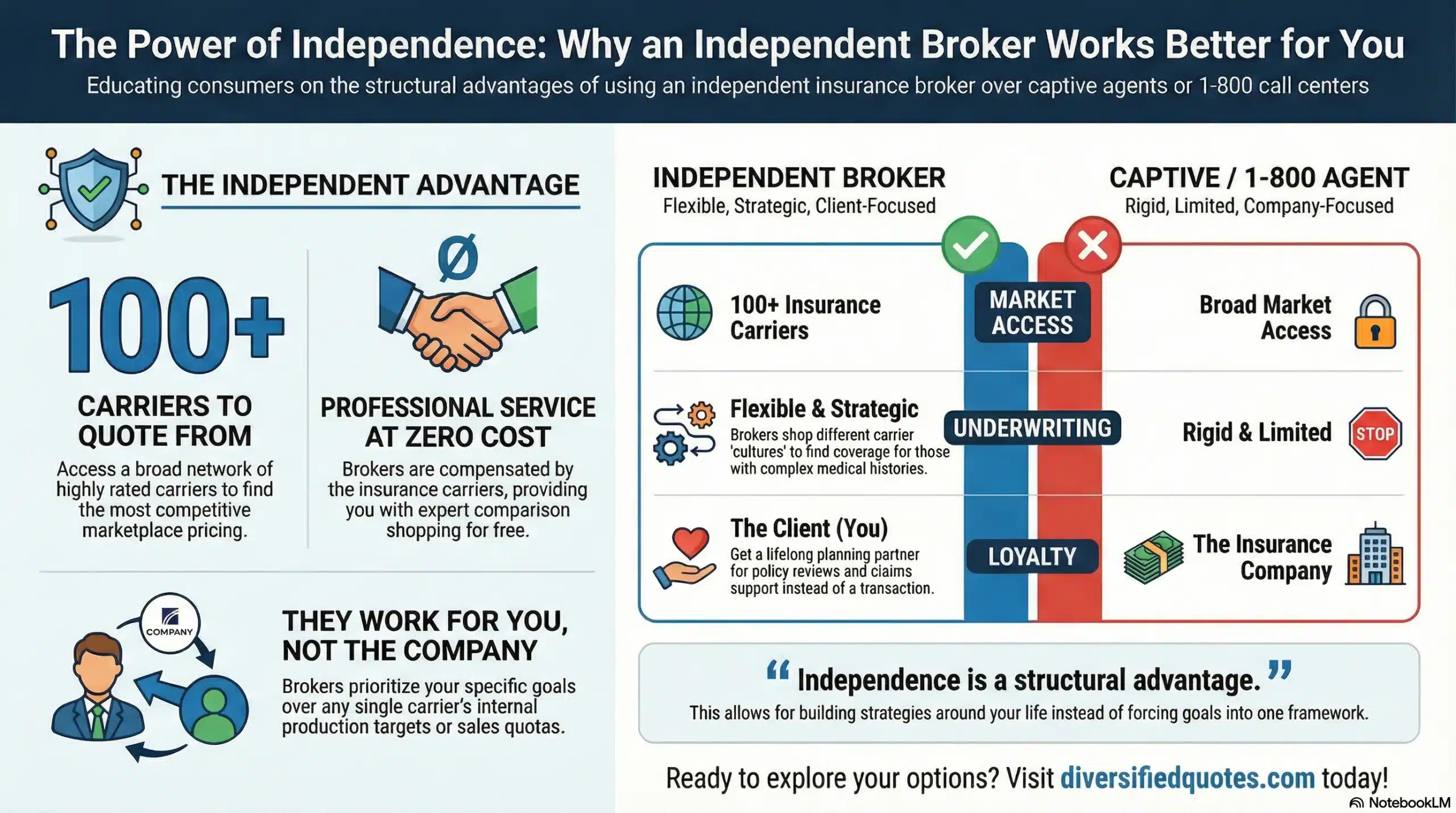
For autoimmune life insurance, carrier selection is the most important decision that affects the final outcome — more important than application wording, documentation packaging, or premium amount targeted. Some carriers evaluate stable autoimmune conditions with nuance and experience; others apply conservative, one-size-fits-all substandard guidelines that produce unnecessary declines or excessive table ratings for profiles that other carriers treat much more favorably. An independent broker who actively shops across 100+ carriers can identify which specific carriers have the most favorable underwriting appetite for a specific autoimmune condition, current stability profile, and medication regimen — and can target those carriers specifically rather than submitting broadly and creating MIB records from unnecessary declines. Reviewing carrier strength and long-term claims-paying ability is also part of the due diligence process — researching carrier stability through resources such as our assessment of whether MassMutual is a strong carrier before committing to permanent coverage ensures confidence in the long-term security of the policy. For the policy that is selected, comprehensive financial planning often integrates both life insurance protection and long-term retirement income security. Many autoimmune patients who are planning for long-term financial stability also review retirement income options through resources like our retirement annuity calculator and current short-term annuity rate options as part of a broader planning review that includes both protection and income considerations. For long-term care coordination — increasingly important for autoimmune conditions that may affect functional status over time — hospital indemnity coverage and related supplemental products can provide additional financial cushioning during hospitalizations. Our resource on hospital indemnity insurance covers how these supplemental products coordinate with the primary life insurance protection layer.
Using a term life insurance calculator helps establish realistic coverage amount targets before the prescreening process begins — so the carrier inquiry is targeted at the right face amount from the start. Term life insurance is frequently the most cost-effective solution for autoimmune applicants once stability is established, providing fixed premiums for defined periods (10, 20, or 30 years) used for income replacement and debt protection. Permanent coverage such as whole life or indexed universal life may also be available depending on underwriting classification and long-term disease trajectory. The right product type depends on the income protection need, budget, and whether permanent accumulation is part of the broader planning objective.
Ready to See Your Autoimmune Life Insurance Options?
We’ll shop 100+ carriers and position your case to highlight stability, documentation quality, and the carrier most likely to approve your specific autoimmune profile at the most favorable rate available.
Start My Confidential Quote Call 800-533-5969Related Pages
Condition-specific underwriting guides and adjacent coverage resources for autoimmune life insurance planning.
Financial Protection Essentials
Retirement planning, annuity options, and supplemental income strategies that complement life insurance protection for autoimmune patients.
Compare Term Life Insurance Lengths
Explore different term periods to find coverage that best matches your timeline and budget.
Talk With an Advisor Today
Choose how you’d like to connect—call or message us, then book a time that works for you.
Schedule here:
calendly.com/jason-dibcompanies/diversified-quotes
Licensed in all 50 states • Fiduciary, family-owned since 1980
Life Insurance for Autoimmune Disease — Frequently Asked Questions
Can you get life insurance with an autoimmune disease?
Yes — many autoimmune conditions qualify for traditional fully underwritten life insurance when the disease is stable, organ involvement is limited or absent, and the management history is well-documented. The outcome depends less on the specific diagnosis name and more on the stability picture: how long the disease has been controlled, whether major organs have been affected, how frequent hospitalizations or medication escalations have been, and what the treating specialist’s most recent assessment shows. Some conditions — like controlled Hashimoto’s thyroiditis or well-managed rheumatoid arthritis without systemic complications — often qualify at standard or near-standard rates. Others — like active lupus nephritis or severe vasculitis — require specialty carrier placement and longer documented stability before favorable rates are achievable. The most important first step for any autoimmune applicant is prescreening before formal application — identifying the right carrier for the specific condition type and stability profile before any MIB record is created by a less suitable carrier.
Will I pay higher premiums with an autoimmune condition?
Possibly — but not always, and the premium difference is often smaller than people expect when the case is positioned correctly. Rate classifications depend on the severity of the specific condition, the current stability picture, organ involvement, and the carrier selected. Mild, well-controlled autoimmune conditions with no systemic complications — such as controlled Hashimoto’s thyroiditis, joint-limited rheumatoid arthritis, or inflammatory bowel disease in long-term remission — may qualify at standard rates or mild table ratings that add a modest premium. More complex systemic conditions with organ involvement, recent flares, or medication escalations typically face higher table ratings. The carrier variation for the same autoimmune profile is substantial — the same applicant can receive Table 4 at one carrier and Table 8 at another, making carrier selection the most impactful premium management tool available for autoimmune applicants.
Does medication affect life insurance approval for autoimmune conditions?
Being on medication does not prevent approval — in fact, consistent medication compliance often helps the underwriting case by demonstrating active, professional disease management. Underwriters review the type of medication, dosage, duration of therapy, documented side effects, and physician commentary about prognosis. Corticosteroids at chronic high doses raise concerns because long-term steroid use has independent health implications. Biologic therapies (TNF inhibitors, IL-17 inhibitors, JAK inhibitors) are evaluated for what they imply about disease severity and for any documented side effects. The concern arises when medications change frequently, when escalations are needed to control persistent flares, or when multiple immunosuppressants are required simultaneously. Stable, unchanged medication regimens over 12+ months — combined with documented disease control on that regimen — support the strongest underwriting narrative.
How long must my autoimmune condition be stable before I can apply?
Most carriers prefer 6–12 months of documented stability before offering traditional underwriting at reasonable rate classes — meaning no recent hospitalizations, no medication escalations, no documented flares requiring aggressive intervention, and consistent specialist follow-up with stable lab markers. For more complex systemic conditions — lupus nephritis, vasculitis, cardiac sarcoidosis — many carriers want 18 to 24 months or longer before considering the case at standard underwriting channels. These are general windows, not absolute rules; some carriers are more flexible and others more conservative. The practical guidance is to apply when the stability picture is strongest, not during an active management period. If you are currently experiencing a flare, recently changed medications, or were hospitalized in the past 6 months, waiting until the situation stabilizes and the stability window is documented will typically produce a materially better underwriting outcome than applying during the transition period.
Are systemic autoimmune diseases harder to insure than localized ones?
Yes, generally — but the distinction is organ involvement rather than the “systemic” label alone. What matters most to underwriters is whether major organs — kidneys, lungs, heart, brain — have been affected and what the long-term mortality implications of that involvement are. Hashimoto’s thyroiditis is technically a systemic autoimmune condition but typically produces very favorable underwriting outcomes because thyroid function can be fully normalized with medication and systemic complications are uncommon. Lupus with nephritis affects the kidneys — a major organ — and produces much more challenging underwriting despite being in the same “autoimmune” category. Similarly, ankylosing spondylitis limited to spinal joints is evaluated very differently from ankylosing spondylitis with aortic root involvement. The underwriting narrative is always built around the severity and systemic reach of the specific presentation, not the broad diagnostic category.
What happens if I was previously declined for life insurance due to autoimmune disease?
A prior decline does not mean coverage is permanently unavailable. Carrier underwriting appetite for autoimmune conditions varies significantly — a carrier that declined your application may have conservative, underdeveloped guidelines for your specific condition, while a different carrier with more experience in autoimmune underwriting may evaluate the same profile favorably. A prior decline creates an MIB record that future underwriters can see, which is why prescreening before any new formal application is critical — to identify the right carrier before another record is added. If your health situation has improved since the decline — longer stability window, better lab markers, specialist confirmation of controlled disease — updated documentation can support a different outcome. If the profile is unchanged, carrier selection based on specific autoimmune experience becomes the primary lever. An independent broker experienced in impaired risk placement can assess whether a second submission attempt at a more appropriate carrier is likely to produce a better result.
Can autoimmune patients get no-exam life insurance?
Some autoimmune applicants can access no-exam or simplified underwriting pathways, particularly for younger applicants with well-controlled, early-stage conditions and clean overall health profiles. Accelerated underwriting programs at some carriers allow standard or near-standard coverage amounts without a paramed exam for profiles that pass electronic health record review — and some autoimmune conditions in remission qualify. However, many complex autoimmune cases — particularly those involving systemic organ involvement, specialty medications, or recent hospitalizations — require full underwriting with attending physician records. For these profiles, the medical exam itself is rarely the challenging part of underwriting; the records review and stability documentation is where the outcome is determined. For autoimmune applicants who cannot qualify for any fully underwritten option, guaranteed issue burial insurance provides meaningful final-expense coverage without medical questions, subject to the standard graded benefit period in the first two years.
How does lupus specifically affect life insurance underwriting?
Lupus (Systemic Lupus Erythematosus) produces a wide range of underwriting outcomes depending on how the disease has progressed and what organs are involved. Skin-and-joint limited lupus with documented stability, normal complement levels (C3/C4), and consistent rheumatology follow-up often qualifies for traditional coverage at table ratings. Lupus nephritis — which affects the kidneys — significantly worsens the underwriting picture because kidney function impairment has direct mortality implications. CNS lupus with neurological involvement or antiphospholipid syndrome with clotting history also represent more challenging underwriting profiles. The most important documents for lupus underwriting are: recent rheumatologist notes confirming current disease activity level and stability assessment; anti-dsDNA antibody titers; complement levels; kidney function panels (eGFR, creatinine, urine protein); and a clear timeline of any hospitalizations or major flares from the past three to five years. Carrier selection is critical for lupus — experience with this specific condition varies widely across insurers.
Does having multiple autoimmune conditions affect my insurability?
Yes. Autoimmune conditions frequently cluster — having one increases the likelihood of developing others — and multiple autoimmune diagnoses create a more complex underwriting profile than a single condition would. Each condition is evaluated for its own severity and stability, and the combined picture is assessed for additive risk. For example, a person with rheumatoid arthritis and Sjögren’s syndrome will have both conditions reviewed independently and together. If both are well-controlled with stable documentation, the combined profile is typically manageable; if one is stable and one is active, the active condition drives the underwriting outcome. The prescreening process is especially important for multi-condition profiles because many carriers’ standard guidelines do not adequately address complex autoimmune combinations — specialty underwriting input or niche carrier placement may be required.
What documentation should I gather before applying?
For the strongest possible autoimmune underwriting outcome, gather: the most recent specialist note (from within 6 to 12 months) that explicitly mentions stability, current disease activity assessment, treatment plan, and prognosis; a trend history of key lab markers covering 12 to 18 months with multiple data points (not a single recent reading); a complete current medication list with dosages and no recent changes; any relevant imaging interpretations (MRI results, pulmonary function tests, echocardiograms) from the past 12 to 24 months; and a clear timeline of hospitalizations or significant flares from the past 3 to 5 years. Organize this documentation before any application is submitted. A well-organized, current, explicitly stability-confirming file consistently produces better outcomes than the same health profile with incomplete or dated documentation — because underwriters are making a stability judgment, and the file that most clearly tells a stability story is the file that most reliably produces a favorable outcome.
Is term or permanent life insurance better for autoimmune applicants?
It depends on the specific goal, timeline, and underwriting classification. Term life insurance provides the largest death benefit for the lowest premium during the highest-obligation years — income replacement, mortgage payoff, and family support during working decades. For autoimmune applicants whose primary need is income protection during working years, term coverage in 10-to-25-year increments is typically the most cost-effective approach. Permanent life insurance — whole life or indexed universal life — may be appropriate when the coverage need is truly long-term (estate planning, permanent income replacement, business succession), when the underwriting classification is stable enough to make permanent coverage accessible at reasonable rates, or when the applicant wants to lock in coverage and premiums before the condition potentially progresses. Some autoimmune applicants start with term coverage when they qualify and convert a portion to permanent coverage later if health and financial goals support it. The right choice depends on the individual situation — not the condition itself.
How does the prescreening process work for autoimmune applicants?
Prescreening is an informal inquiry to a carrier’s underwriting team — before any formal application is submitted — that identifies likely approval probability and anticipated rate class for a specific health profile. For complex autoimmune cases, prescreening is the most important protective step because it prevents creating an MIB record from an avoidable decline at a carrier poorly suited to the specific condition type. An experienced independent broker presents the key health facts — diagnosis, duration, stability record, current medications, organ involvement history, and specialist notes — to multiple carriers in a non-identifying format and receives preliminary underwriting feedback before any formal application is submitted. This process identifies the carrier most likely to offer the best outcome for the specific profile, allows the application to target that carrier first, and prevents the cascade of MIB records that makes subsequent applications harder. For autoimmune applicants specifically, where carrier appetite and experience with specific conditions varies enormously, prescreening is not optional — it is the most impactful step in the entire placement process.
Browse all of our Autoimmune and Neurological Life Insurance Guides
About the Author:
Jason Stolz, CLTC, CRPC, DIA, CAA and Chief Underwriter at Diversified Insurance Brokers (NPN 20471358), is a senior insurance and retirement professional with more than 25 years of real-world experience helping individuals, families, and business owners protect their income, assets, and long-term financial stability. As a long-time partner of the nationally licensed independent agency Diversified Insurance Brokers, Jason provides trusted guidance across multiple specialties—including fixed and indexed annuities, long-term care planning, personal and business disability insurance, life insurance solutions, Group Health, Travel Medical and Evacuation Insurance, and short-term health coverage. Diversified Insurance Brokers maintains active contracts with over 100 highly rated insurance carriers, ensuring clients have access to a broad and competitive marketplace.
His practical, education-first approach has earned recognition in publications such as VoyageATL, and contributions from his agency featured in Kiplinger and GoBankingRates— highlighting his commitment to financial clarity and client-focused planning. Drawing on deep product knowledge and years of hands-on field experience, Jason helps clients evaluate carriers, compare strategies, and build retirement and protection plans that are both secure and cost-efficient. Visitors who want to explore current annuity rates and compare options across multiple insurers can also use this annuity quote and comparison tool.
Explore More Life Insurance Options: Browse our complete guide to High Risk Life Insurance — covering health conditions, guaranteed issue, special needs & underwriting challenges from 100+ carriers.
Last Reviewed: August 22, 2026 |
Reviewed by: Jason Stolz, CLTC, CRPC, DIA, CAA
Chief Underwriter, Diversified Insurance Brokers, Inc. | NPN: 20471358 | Diversified Insurance Brokers, Inc. — Licensed in all 50 states
Fact Checked by: Tonia Pettitt, CMIP©
Medicare Specialist, Diversified Insurance Brokers, Inc. | NPN: 14374308 | Diversified Insurance Brokers, Inc. — Licensed in all 50 states
Did you find this content helpful? Leave us a Google review — it helps others find trustworthy guidance too.
Editorial Standards: Diversified Insurance Brokers maintains rigorous editorial standards to ensure accuracy, clarity, and independence in all content. Learn more about our editorial standards and commitment to transparency.
