
Life Insurance for the Mining Industry
As an Independent Life Insurance Broker, we compare rates across 100+ carriers and prescreen every application before submission.
Life Insurance for the Mining Industry

Jason Stolz CLTC, CRPC, DIA, CAA
Life insurance for mining industry professionals is essential protection for miners, supervisors, equipment operators, engineers, and mining workers who face occupational hazards and income volatility that most civilian workers never encounter. Whether you work in underground coal mining, hard rock mining, salt mining, aggregate extraction, or large-scale surface operations, mining employment often involves heavy equipment, variable environmental conditions, long shifts, and work sites where emergency response may be slower than in typical civilian settings. At Diversified Insurance Brokers, we specialize in helping mining professionals secure reliable life insurance for the mining industry that protects family income, preserves household stability, and stays in place even if you change employers, sites, roles, or transition out of mining later in your career.
Mining is one of those industries where families tend to be “covered just enough” through employer group plans—until a job change, site closure, or life transition exposes the gaps. Employer group life insurance can serve as a helpful baseline benefit, but it is rarely designed to be a complete protection plan. Group mining industry life insurance policies are often limited to one or two times salary, may not be portable between employers, and end the moment employment terminates. If you move between sites, switch companies, transition into a contractor role, retire from mining, or transition into a different industry, the protection may disappear right when your family needs it most. Private individual life insurance is the solution that follows you, not the other way around.
At Diversified Insurance Brokers, we specialize in helping people in higher-risk occupations and hazardous work environments secure private life insurance for mining coverage with a strategy-first approach. We maintain relationships with 75+ top-rated carriers and know exactly how underwriting departments evaluate hazardous work environments, daily job duties, safety procedures, training programs, and medical risk factors that can become more common in physically demanding fields like mining. Our goal is straightforward: get you approved at the best possible rate class while ensuring your coverage actually works for real life in the mining industry. For mining professionals who need additional income protection during working years, we also coordinate life insurance for mining with disability coverage strategies that address occupational injury risk.
Get a mining-friendly life insurance quote today.
Carriers that understand occupational hazards and mining work. Competitive rates.
Why Life Insurance for Mining Industry Workers Is Critical for Family Protection
Mining work carries a distinctive mix of occupational risk and lifestyle impact that makes long-term financial protection planning especially important. Families of mining professionals often depend entirely on a miner’s income to cover housing expenses, debt payments, childcare, education, and long-term savings. If something unexpected happens, the loss is not just emotional—it creates a financial shock that can change the household’s entire trajectory. Life insurance for mining industry workers is the tool that replaces income, eliminates debt, and creates family stability during difficult times.
Another reason life insurance for the mining industry matters is income volatility. Mining wages can be strong and competitive, but schedules are often unpredictable, overtime can change month to month, and operational cycles frequently lead to layoffs or transitions between sites and employers. The right mining industry life insurance plan helps protect your family’s lifestyle even when the industry shifts, contract work ends, or site operations change. It also ensures your protection isn’t tied to a specific employer’s benefits department or dependent on staying in the same job for the next 10–20 years. This independence is critical in mining, where job changes and site transitions are common career moves.
It’s also common for miners to have specialized skill sets that are hard to replace and highly compensated. When a household depends on one primary earner with high-demand trade skills and occupational experience, the financial impact of losing that income can be severe and immediate. Private term life insurance for mining professionals can create a large safety net at a cost that is often far lower than people expect—especially when the policy is structured correctly and matched to carriers that understand occupational underwriting. Many miners are surprised to find they can secure affordable coverage because carriers differentiate between different mining roles and conditions.
See Real-Term Rates Side by Side
Life Insurance Quoter
Who Can Get Life Insurance in the Mining Industry?
Coverage is readily available for a wide range of professionals in mining and related fields. Occupational underwriting for life insurance for mining does not treat every mining job identically. In fact, the details of your specific role and day-to-day exposure often matter more than the broad industry label. Carriers underwriting mining industry life insurance typically evaluate miners based on whether you work underground or surface, whether your job includes explosives or blasting, whether you operate or maintain heavy machinery, how often you travel to remote sites, what your safety record looks like, and what training environment you work in.
Private life insurance for mining coverage is commonly available for underground miners, surface miners, quarry workers, haul-truck operators, heavy equipment operators, maintenance crews, welders, electricians, supervisors, foremen, site managers, safety managers, and professional roles such as mining engineers and geologists. Some carriers may treat contractor work differently than traditional W-2 employment, and some differentiate between small independent operations and large regulated mining sites with formal safety programs and compliance infrastructure. Our job is to understand your exact role, your typical duties, and your work environment, then match you to carriers that underwrite life insurance for the mining industry fairly and competitively.
If your work spans multiple sites or if you transition between different mining job types, we help you position the “highest exposure” aspect correctly so underwriting has accurate context. This prevents the mining life insurance policy from being misclassified, prevents unnecessary delays, and reduces the chance of a rating you shouldn’t have received. Proper positioning is one of the biggest advantages of working with an independent broker familiar with occupational underwriting.
What Insurers Evaluate for Life Insurance in Mining Occupations
Mining is often flagged in underwriting because the work environment can include underground exposure, confined spaces, heavy equipment operation, high noise levels, variable air quality, dust exposure, and potential risk of traumatic injury. That said, life insurance underwriters are not simply “declining miners.” They are evaluating specific risk indicators and comparing your profile to their underwriting guidelines and risk tolerance. When the application file is clean, when your role is positioned accurately, and when your health profile is favorable, many miners qualify at standard rates—and in some cases, near-standard pricing.
Underwriters evaluating life insurance for mining industry applicants typically focus on your occupation classification, your exact job duties, your work setting (underground versus surface operations), whether you handle explosives or participate in blasting, whether you operate or repair heavy equipment, and whether your work involves remote sites with limited emergency response access. They may ask questions about your employer’s safety program, employee training, and whether you have had any recent work-related accidents or injuries. In some cases, they may ask about travel frequency, especially if your mining industry life insurance underwriting involves international assignments or high-risk travel components.
Mining underwriting also overlaps significantly with “general” underwriting factors. Insurers still care about age, overall medical history, blood pressure, cholesterol levels, height and weight, tobacco and nicotine use, prescription medications, and driving record. Occupational risk is just one piece of the underwriting puzzle. This reality is important because some miners assume they will automatically face expensive rates due to job risk, when in reality the bigger pricing factor may be medical history or lifestyle factors. If you have additional medical conditions in addition to mining exposure, understanding how underwriting works is essential. This resource on life insurance with pre-existing conditions can help you anticipate what matters most and how to frame your application properly.
One of the most misunderstood pricing components for hazardous occupations is how some carriers apply extra charges. In certain situations, a carrier may apply a temporary occupational surcharge rather than a permanent table rating, especially when a role is considered higher exposure. This is not always the case, but it is one critical reason carrier selection and broker guidance matter. Some carriers are stricter about occupational risk and apply conservative pricing. Others are more flexible and focus far more on health, lifestyle, and driving record than occupation. This is why shopping your case across multiple carriers familiar with mining underwriting produces better results than applying to a single carrier unfamiliar with the industry.
Why Group Life Insurance Alone Often Falls Short for Mining Families
Group life insurance for mining companies offer through employer plans, union agreements, or industry associations can be valuable as a baseline benefit, but it rarely solves the entire financial protection problem. The first issue is benefit amount. Many group mining industry life insurance plans cap benefits at a fixed amount or a small multiple of salary—often just one to three times annual earnings. That might cover final expenses and provide a small financial buffer, but it frequently does not adequately replace income or eliminate major household debt like mortgages, vehicles, and education loans. The second issue is portability and control. If you leave the employer, the mining life insurance coverage often ends entirely, or becomes prohibitively expensive to convert to individual coverage. The third issue is control and customization. Group life insurance for the mining industry is tied to employment and subject to employer plan changes, benefit reductions, or coverage terminations.
Private individual life insurance for mining professionals gives you complete control. You choose the coverage amount and duration based on your family’s actual needs. You choose the beneficiary structure and how benefits are distributed. You keep the mining industry life insurance policy active even if you change jobs, transfer between sites, become a contractor, or leave mining entirely. And you can coordinate it strategically with your employer coverage so the total protection matches your family’s real financial needs and goals. In mining, where job mobility can be a routine part of the career path and where site operations can change, portability is not a luxury feature. It’s one of the biggest reasons private individual coverage makes practical sense.
If you’re evaluating how group benefits compare to private coverage and want to understand how these different policies work together, this resource can help clarify planning decisions: Group vs. Individual Life Insurance.
Life Insurance Options and Types for Mining Professionals
The best mining industry life insurance policy type depends on your specific goals, your career timeline, your budget, and how long your family needs financial protection. Most miners start with term insurance because it offers high coverage for relatively low cost. Others add permanent coverage for long-term stability and estate planning. Some use a combination of both term and permanent policies to balance short-term needs with lifelong protection.
Term life insurance is often the most cost-effective way to buy substantial protection during your highest earning years and highest responsibility years. Term mining life insurance policies are usually structured for 10, 20, or 30 years and are commonly used to cover mortgage payoff, income replacement, childcare costs, education funding, and debt elimination. If you’re estimating coverage amounts or exploring term pricing for mining work, the term life insurance calculator is a good starting point for rough estimates.
Whole life insurance provides lifetime coverage with fixed premiums and accumulated cash value. For miners who want life insurance for mining that won’t expire at a set date, or who want a policy designed for lifelong protection and financial stability, whole life can be a strong option. Many families use whole life as a “foundation policy” and then layer term coverage on top for larger short-to-mid-term needs. This layering strategy is common among mining families planning for both current income replacement and long-term estate needs.
Universal life insurance can offer flexible premium structures and adjustable death benefits, making it potentially useful for miners whose income varies seasonally or by project, or who want policy flexibility during career transitions between sites. However, mining life insurance structured as universal life must be managed carefully to ensure long-term performance and guaranteed coverage. When considering flexible-premium life insurance for mining options, working with an advisor who understands the product mechanics is important.
Final expense insurance is often used by older workers or retirees who want simpler coverage to address funeral and burial costs. These policies usually have smaller face amounts and easier qualification pathways. Final expense life insurance can be a good fit when the primary goal is to reduce family burden at end-of-life rather than replace long-term income during working years.
How Much Life Insurance Coverage Should Mining Professionals Carry?
A common baseline guideline for life insurance for mining is seven to ten times annual income, but mining families often benefit from a more customized and detailed approach. Mining income can fluctuate significantly due to overtime premiums, shift differentials, seasonal work, and operational cycles. Household expenses can shift based on relocations between sites, seasonal work patterns, and career transitions. Many miners also carry physically demanding workloads that make disability planning just as important as life insurance itself.
Instead of relying only on a simple multiple of income, smart planning often focuses around real, specific needs. How long would your family need income replacement? Is there a mortgage that should be paid off in the event of death? Are there loans, vehicles, credit cards, or other debts that would create hardship? Are you planning to fund education for children? Do you want your spouse to have the financial freedom to make choices—such as reducing work hours or moving closer to family—without financial stress? When you plan around these concrete realities instead of formulas, the right coverage amount becomes clearer and more defensible to your family.
Many mining professionals choose a layered coverage approach for life insurance for mining industry needs: a large term policy to cover income replacement and major debts during active working years, plus a smaller permanent policy for lifelong protection and legacy planning. This strategy can provide strong family protection without overpaying for permanent coverage where term insurance is more efficient and cost-effective.
Common Coverage Challenges with Mining Life Insurance—and How We Solve Them
Mining presents a few recurring challenges that show up consistently in underwriting processes and planning. One is occupational classification accuracy. Some carriers use broad industry categories that don’t differentiate meaningfully between a surface equipment operator and an underground miner—leading to inappropriate ratings for mining life insurance. Another challenge is medical history overlap. Mining work can increase the likelihood of musculoskeletal issues, sleep disturbances, and respiratory exposure documentation over time, which can trigger conservative underwriting. Another is career mobility. Many miners change sites, employers, or roles regularly, and employer group coverage may not follow them.
Our approach is to reduce friction on each of these points. We work to clarify your duties and exposure accurately so you’re classified correctly for life insurance for the mining industry underwriting purposes. We make sure your application aligns with your medical record so the insurer doesn’t interpret the file conservatively or flag issues that don’t reflect your actual risk. We choose carriers whose underwriting philosophy tends to be reasonable and fair for hazardous mining roles. And we structure policies in a way that makes them valuable whether you stay in mining for 20 years, transition between sites and employers, or eventually move into a different trade or leadership role.
If you’ve ever been rated higher than expected on mining life insurance or you were told “your occupation makes you uninsurable,” that is often a carrier selection issue, not a permanent problem. Different insurance companies treat mining differently based on their risk appetite and underwriting guidelines. Finding the right carrier match changes outcomes dramatically.
Policy Riders for Mining Families to Consider
Riders are optional policy features that can add specific protection or flexibility to your mining industry life insurance coverage. They are not always necessary, but in mining, certain riders can be practical and valuable depending on family needs and household financial setup.
An accidental death benefit rider can increase the death benefit if death results from a covered accident. Some families like the added protection given the physical nature of mining work, but the right decision depends on overall cost and whether the base coverage amount is already sufficient for family needs.
A waiver of premium rider can keep a mining life insurance policy in force if the insured becomes disabled and cannot work. Mining is physically demanding, so the logic behind this rider is easy to understand. That said, dedicated disability insurance is often the more comprehensive and flexible solution for replacing income during a disability.
A disability income rider or comprehensive disability coverage solution can help replace income if injury or illness prevents returning to the job site. While this resource focuses on life insurance for mining, many mining families plan life and disability coverage together because the statistical risk of occupational disability is often more likely during working years than the risk of premature death. If disability planning is part of your comprehensive conversation, we incorporate solutions that align with your specific occupational duties and income structure. Our resource on disability insurance covers income protection options in detail.
If you own term insurance and want to keep future options open, understanding conversion can be important. Some term policies include a conversion feature that allows you to convert accumulated term coverage to permanent coverage later without requiring new medical underwriting. If you want to understand how conversion works and why it matters for mining professionals, this page on converting term to permanent life insurance is useful resource.
Why Mining Families Work With Diversified Insurance Brokers
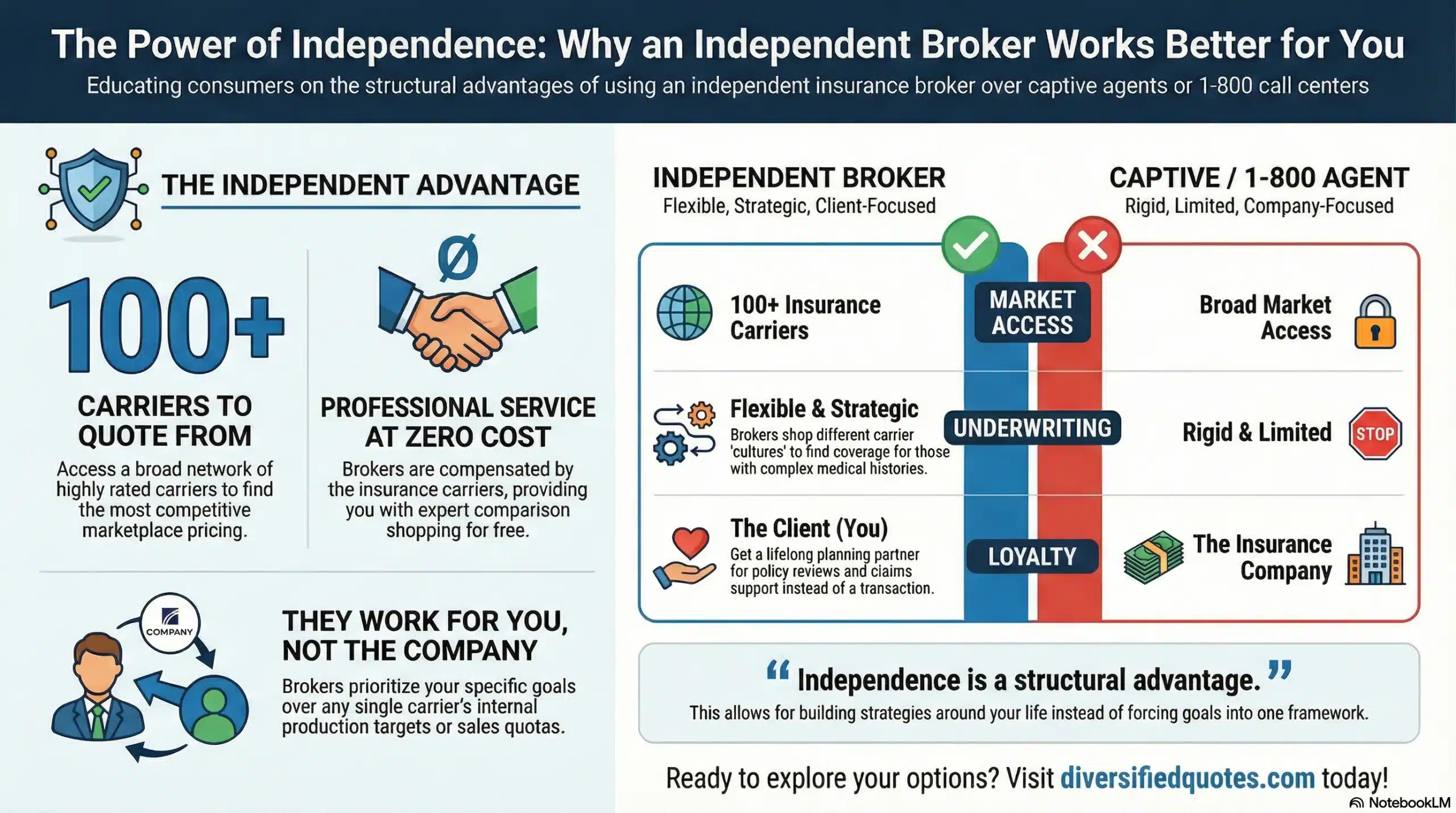
Since 1980, Diversified Insurance Brokers has helped high-risk professionals across many industries—including mining—secure dependable life insurance coverage. Mining is one of those industries where the stakes are real and the consequences of a planning gap can be severe for families. Our advisors are independent, which means we aren’t tied to one carrier’s underwriting rules or constrained by a single company’s appetite. We can shop your mining industry life insurance profile across multiple carriers, identify the best fit, and help you avoid wasted time and applications with the wrong company.
We also bring practical understanding of occupational underwriting. We know which carriers tend to overreact to hazardous job titles and which carriers focus more heavily on health and lifestyle than occupation. We know how to present your work duties accurately so you’re not penalized for risk exposure you don’t actually have. If you’re evaluating whether to work with an independent advisor for life insurance for mining that requires nuanced case handling, this page on choosing the best independent insurance agent can help clarify what to look for.
Mining families also tend to have real-world planning questions that go far beyond “What’s the cheapest mining life insurance policy?” They want to know how coverage fits into their broader financial goals, how it coordinates with employer benefits, how to maintain protection during job transitions, and how to protect against income loss from disability. That’s exactly the kind of comprehensive guidance our team provides.
Get Expert Help Securing Life Insurance for Mining Professionals
Our advisors understand mining industry occupations and will match you with carriers that evaluate mining work fairly and price competitively.
Related Pages for High-Risk Occupations
More resources on occupational underwriting, hazardous work coverage, and life insurance strategies for demanding professions.
Life Insurance for Firefighters
Life Insurance for Paramedics and EMTs
Life Insurance for Military Service Members
Life Insurance With Pre-Existing Conditions
Convert Term to Permanent Life Insurance
Finding the Best Independent Insurance Agent
Group vs. Individual Life Insurance Comparison
Financial Protection Essentials
Comprehensive protection strategies beyond life insurance for mining professionals managing occupational risk.
Compare Term Life Insurance Lengths
Explore different term periods to find coverage that best matches your timeline and budget.
Talk With an Advisor Today
Choose how you’d like to connect—call or message us, then book a time that works for you.
Schedule here:
calendly.com/jason-dibcompanies/diversified-quotes
Licensed in all 50 states • Fiduciary, family-owned since 1980
Frequently Asked Questions About Life Insurance for Mining Industry Professionals
Can miners qualify for affordable life insurance for mining work?
Yes. Many miners qualify for standard rates or near-standard rates depending on job type, work environment, safety practices, and health profile. The key is matching your specific mining role with carriers that understand occupational underwriting and have reasonable guidelines for mining industry professionals. Different carriers treat mining differently, and an independent broker can identify which carriers have the best appetite and most competitive pricing for your specific mining occupation and health situation.
Common mining roles that qualify for standard or favorable rates include supervisors, site managers, engineers, maintenance personnel, and equipment operators at certified facilities with strong safety programs. Underground miners, blasting specialists, and roles at smaller operations may see modest occupational premiums, but the difference is often manageable. The goal is to avoid carriers that apply blanket conservative ratings to all mining roles without differentiating based on specific job duties and work environment. Our resource on high-risk life insurance covers occupational underwriting in detail.
Does working underground affect my eligibility for life insurance for mining?
Underground work can influence underwriting considerations and pricing, but it does not automatically disqualify you from coverage or result in unaffordable rates. Carriers evaluate underground mining based on specific factors: the type of mine, the depth and conditions, whether explosives are used, safety protocols, employer size, and your personal training and experience. A well-trained underground miner at a large, regulated operation with strong safety programs often receives similar pricing to a surface equipment operator, while smaller underground operations may see slightly higher premiums.
Surface workers, supervisors, engineers, and administrative staff in mining often receive standard or near-standard rates without occupational premiums. The critical factor is transparency and accurate positioning. If you work underground, we ensure your application clearly describes the specific operation, safety measures, and your role so the underwriter can classify you fairly based on your actual exposure rather than assumptions about underground mining.
Do employers provide enough life insurance for mining families?
Typically not. Employer group life insurance through mining companies or unions serves as a helpful baseline benefit, but it rarely provides complete family protection. Most group plans cap benefits at a fixed amount or one to three times salary—which can cover final expenses but often does not adequately replace lost income or eliminate household debt. Additionally, group coverage typically ends when you leave the employer, change jobs, transition to contract work, or move between mining sites and operations.
Private individual life insurance for mining professionals complements group coverage by providing portability, flexibility, and the ability to customize coverage amounts to match your family’s actual needs. Many financial advisors recommend using group coverage as one layer (since it’s often subsidized by the employer) and adding private individual coverage for comprehensive protection that stays with you throughout your career transitions.
Can independent contractors and engineers in mining get life insurance for mining?
Yes. Independent contractors, engineers, geologists, and professional roles in mining can all qualify for individual coverage through private carriers. Underwriting may ask additional questions about contract stability and income consistency, but hundreds of mining professionals in contractor and professional roles hold active policies. Some carriers distinguish between W-2 employment and 1099 contractor work, so carrier selection can matter more for contractors than for traditional employees. We work with carriers experienced in underwriting mining professionals in all roles and structures.
For contractors managing variable income or transitioning between projects, policy structures that allow flexible premiums or that coordinate term and permanent coverage can be especially practical. We help design life insurance for mining contractors that works with your actual income patterns and career transitions.
Will my mining occupation raise my life insurance premiums?
Sometimes slightly, but good health, clean safety records, and work at regulated facilities with strong safety programs often offset occupational risk factors. The relationship between occupation and premiums is not one-to-one. A miner with excellent health metrics, no medical issues, good driving record, and work at a large certified operation may receive standard rates despite the hazardous classification. Conversely, a miner with blood pressure concerns, tobacco use, or other medical factors may see bigger premium increases from medical factors than from occupation.
This is why understanding the full underwriting picture matters. Working with an independent broker who can shop carriers with different underwriting philosophies ensures you find a company that weighs occupation appropriately relative to health and lifestyle factors. Some carriers focus heavily on health; others are more conservative about occupation. The right match makes a meaningful difference in pricing.
Do I need a medical exam to apply for life insurance for mining?
Many policies require a brief paramed exam—typically involving height, weight, blood pressure, and blood or urine samples. The exam requirements usually depend on the death benefit amount, your age, and the carrier. Some carriers offer simplified underwriting or no-exam options for policies below certain amounts, which can speed up the application process. No-exam or “accelerated” options typically cost slightly more but can be worth the convenience, especially if you want coverage quickly.
For mining professionals with occupational hazards and health uncertainty, knowing your medical profile upfront helps. If you have concerning health issues or past medical events, being prepared to discuss them openly prevents surprises during underwriting and often produces better outcomes than having issues discovered during the exam.
Can I keep my mining industry life insurance if I change companies or leave mining?
Yes. Individual life insurance for mining is portable and stays active regardless of job or employer changes. This is one of the primary advantages of private individual coverage. You can change mining companies, transition between sites, become a contractor, retire from mining, or move into a completely different industry—and your life insurance remains in force with the same terms and rates. The policy is yours and does not depend on employer sponsorship or employment status.
This portability is why many mining professionals view individual life insurance as essential protection. It creates stability during career transitions and ensures your family’s protection doesn’t depend on continued employment at a specific site or company.
What if I was previously declined for life insurance for mining?
A prior decline does not mean coverage is permanently impossible. Different carriers apply different underwriting guidelines and have different risk appetite for mining occupations. A carrier that declines may have strict occupational guidelines, may have misunderstood your specific role, or may lack experience with mining industry underwriting. Our firm specializes in repositioning cases that other carriers declined, and we often find approval options at competitive rates with carriers that have better appetite for mining professionals.
When we take over a declined case, we analyze why the decline happened, determine whether it was a guideline limitation or a presentation issue, and identify carriers with more reasonable mining guidelines. We’ve successfully placed many mining professionals who were previously declined because we know which carriers evaluate mining fairly. The declined history does need to be disclosed on future applications, which is why getting the right carrier match the first time is important.
How can I coordinate group and individual life insurance for mining?
Many mining professionals use a coordinated strategy: accept the employer group coverage as a baseline (especially if the employer subsidizes premiums) and add individual coverage for gaps. A common approach is using group coverage to protect basic needs and using individual coverage to address larger income replacement, debt elimination, and legacy planning. This layering approach gives you the benefit of employer subsidies while maintaining portability and comprehensive protection.
The key is understanding how much your group plan provides, calculating your family’s actual protection needs, and determining what additional individual coverage makes sense. If your group plan provides one times salary and you need five times salary, individual coverage fills that gap. This comparison resource on group vs. individual insurance provides a framework for making this decision.
Can I add disability coverage alongside life insurance for mining protection?
Yes. Many mining families plan life and disability insurance together because occupational disability risk is often more likely during working years than premature death. Disability insurance replaces income if injury or illness prevents you from working, while life insurance protects your family if you die. Together, they provide comprehensive protection against both major income-loss scenarios. Some policies even include riders that waive premiums during disability, creating integrated protection.
Since mining is physically demanding, understanding disability coverage options is important. Our resource on disability insurance covers occupational disability options and how disability planning complements life insurance for mining professionals.
About the Author:
Jason Stolz, CLTC, CRPC, DIA, CAA and Chief Underwriter at Diversified Insurance Brokers (NPN 20471358), is a senior insurance and retirement professional with more than 25 years of real-world experience helping individuals, families, and business owners protect their income, assets, and long-term financial stability. As a long-time partner of the nationally licensed independent agency Diversified Insurance Brokers, Jason provides trusted guidance across multiple specialties—including fixed and indexed annuities, long-term care planning, personal and business disability insurance, life insurance solutions, Group Health, Travel Medical and Evacuation Insurance, and short-term health coverage. Diversified Insurance Brokers maintains active contracts with over 100 highly rated insurance carriers, ensuring clients have access to a broad and competitive marketplace.
His practical, education-first approach has earned recognition in publications such as VoyageATL, and contributions from his agency featured in Kiplinger and GoBankingRates— highlighting his commitment to financial clarity and client-focused planning. Drawing on deep product knowledge and years of hands-on field experience, Jason helps clients evaluate carriers, compare strategies, and build retirement and protection plans that are both secure and cost-efficient. Visitors who want to explore current annuity rates and compare options across multiple insurers can also use this annuity quote and comparison tool.
Explore More Life Insurance Options: Browse our complete guide to Life Insurance for Life Stage & Situational Needs — covering new parents, single parents, special needs children, and military service from 100+ carriers.
Last Reviewed: June 15, 2026 |
Reviewed by: Jason Stolz, CLTC, CRPC, DIA, CAA
Chief Underwriter, Diversified Insurance Brokers, Inc. | NPN: 20471358 | Diversified Insurance Brokers, Inc. — Licensed in all 50 states
Fact Checked by: Tonia Pettitt, CMIP©
Medicare Specialist, Diversified Insurance Brokers, Inc. | NPN: 14374308 | Diversified Insurance Brokers, Inc. — Licensed in all 50 states
Did you find this content helpful? Leave us a Google review — it helps others find trustworthy guidance too.
Editorial Standards: Diversified Insurance Brokers maintains rigorous editorial standards to ensure accuracy, clarity, and independence in all content. Learn more about our editorial standards and commitment to transparency.
