
Disability Insurance for the Mining Industry
As an Independent Disability Insurance Broker, we have access to exclusive discounts and negotiated pricing most captive agents can’t offer — see the full breakdown near the end of this page.
Disability Insurance for the Mining Industry

Jason Stolz CLTC, CRPC, DIA, CAA
Disability insurance for the mining industry is one of the most essential financial protections available to workers in an occupation that the International Labour Organization has identified as responsible for approximately 8% of fatal workplace accidents globally — despite mining employing only about 1% of the global workforce. In the United States, the Mine Safety and Health Administration reported 2,201 injuries in a single six-month period from October 2024 through April 2025, including 14 fatalities, 1,523 non-fatal injuries resulting in lost time or restricted duty, and 27 permanent disabilities. These statistics reflect not a worst-case scenario but the documented operational reality of an industry where workers descend into confined underground spaces, operate heavy machinery in extreme conditions, handle explosive materials, and are exposed daily to hazardous dusts, gases, chemicals, and physical forces that generate occupational health consequences across careers measured in decades. Mining workers across all categories — underground miners, surface miners, mining engineers, equipment operators, explosives technicians, mine electricians, and mine safety professionals — face a disability risk profile that is among the most serious of any American industry, and the income those careers generate deserves the income protection that disability insurance provides. At Diversified Insurance Brokers, we help mining industry workers and professionals design disability coverage that reflects the genuine hazard profile of their work, the income structure of a demanding career, and the financial planning considerations that make income protection especially critical in high-risk occupations. For foundational disability insurance context, our disability insurance services overview provides essential background, and our resource on disability insurance for high-risk occupations addresses how underwriting approaches occupations with elevated injury and fatality rates.
Protect Your Income in the Mining Industry
Compare disability insurance options designed for mining workers and professionals across all mining sectors and positions.
Request Disability Insurance OptionsQuestions? Call 800-533-5969
The Mining Industry and Its Occupational Health Reality
The mining industry encompasses an extraordinarily wide range of occupations and environments — from coal miners working underground seams thousands of feet below the surface, to surface mine equipment operators in open-pit metal and mineral mines, to mining engineers designing extraction systems, to explosives technicians managing blasting operations, to mine safety professionals monitoring air quality, roof stability, and regulatory compliance. What unites all of these roles is the shared reality of working in an environment where the consequences of equipment failure, geological instability, atmospheric hazard, or operational error can be immediate, severe, and career-ending.
Underground mining carries the most acute risk profile in the industry. Workers in underground coal mines, hard rock metal mines, and non-metal mineral mines navigate confined spaces, work under supported but inherently unstable rock overburden, manage ventilation systems that must continuously remove explosive methane gas and toxic combustion products, and operate heavy equipment in passages with limited clearance and limited escape routes. The physical demands are extreme — sustained heavy labor in awkward confined postures, exposure to noise levels that require hearing protection, exposure to vibration from drilling and cutting equipment, and the physical demands of moving through and working in spaces not designed for ergonomic human movement. These demands generate musculoskeletal conditions, hearing loss, respiratory disease, and traumatic injury at rates that consistently exceed national averages for all industries.
Surface mining, while generally less acutely dangerous than underground operations, presents its own substantial hazard profile. Heavy equipment operators in open-pit mines work with haul trucks, excavators, draglines, and conveyors that represent some of the largest and most powerful machines in any industry. Equipment failures, haul road accidents, unstable highwall faces, and the physical demands of operating heavy equipment across extended shifts on rough terrain generate both acute traumatic injuries and the cumulative musculoskeletal conditions that develop across careers of sustained vibration, repetitive motion, and physical exertion in variable weather conditions.
Specific Hazard Categories and Their Disability Implications
Respiratory diseases from dust exposure are the most prevalent occupational diseases in mining and the ones with the longest latency between exposure and disability onset. Coal workers’ pneumoconiosis — commonly called black lung disease — results from accumulated coal dust exposure and produces progressive fibrosis of the lung tissue that is irreversible and ultimately disabling. The National Institute for Occupational Safety and Health (NIOSH) has documented a resurgence in severe black lung disease among coal miners, with rates at their highest levels in decades — including progressive massive fibrosis, the most severe form, appearing in miners at younger ages than previously observed. Silicosis from crystalline silica dust exposure in hard rock and mineral mining produces similar progressive lung fibrosis. Both conditions develop over years of exposure, may be asymptomatic during active working years, and can produce severe disability during what would otherwise be the most productive years of a miner’s career. A disability policy in place during the exposure years provides income replacement when the disease eventually produces the functional impairment that prevents continued work.
Traumatic injuries from equipment, explosions, and ground failure are the most visible and acute disability events in mining. Cave-ins and roof collapses in underground mines can produce traumatic spinal injuries, crush injuries, and fatalities. Equipment accidents — struck-by incidents from haul trucks, caught-in incidents from moving machinery, and fall incidents from elevated surfaces — generate the acute traumatic injuries that constitute the majority of reported mining injury events. MSHA data consistently shows that the mining injury rate, while improved from historical levels, remains significantly elevated compared to all-industry averages. A single significant traumatic event — a crushing back injury, a leg injury from equipment contact, or an upper extremity injury from machinery — can permanently end a mining career that took years to build.
Noise-induced hearing loss is one of the most prevalent occupational diseases in mining. Drills, blasting, heavy equipment engines, and ventilation systems generate sustained noise exposures that, even with hearing protection, accumulate as occupational hearing damage across mining careers. Significant hearing loss does not merely affect quality of life — it can affect the ability to perform safety-critical mining functions that depend on hearing alarms, communication, and environmental auditory cues. A miner whose hearing loss reaches the threshold that prevents safe participation in mine operations has experienced a genuine occupational functional limitation that disability insurance addresses.
Chemical and toxic substance exposure in mining includes a substantial list of hazardous materials: silica dust, coal dust, diesel exhaust particulate, methane and carbon monoxide gases, explosive detonation byproducts, heavy metals including lead and mercury in certain mine types, arsenic, cadmium, and the various chemical reagents used in mineral processing operations. The American Industrial Hygiene Association has documented the extensive chemical hazard profile of mining across all mine types, noting that workers face simultaneous exposures to multiple hazardous substances throughout their working careers. Chronic disease resulting from long-term chemical exposure — respiratory conditions, neurological conditions, and systemic organ damage — constitutes the occupational disease pathway that develops over years and produces disability that individual disability insurance must address when workers’ compensation and employer coverage fall short.
Musculoskeletal conditions from the physical demands of mining — heavy lifting, awkward confined postures, whole-body vibration from equipment operation, and sustained physical labor under difficult conditions — generate the spinal conditions, joint conditions, and soft tissue injuries that produce the largest volume of mining disability claims after acute traumatic events. A miner whose lumbar disc condition prevents sustained physical work in the demanding positions that underground mining requires has experienced genuine occupational disability even when they retain some capacity for less demanding work.
Income Structure in the Mining Industry
Mining industry compensation varies significantly by role, mine type, and geographic market. Underground miners average approximately $28 to $50 per hour depending on specialization and experience, with experienced underground operators and technicians in high-production unionized operations often earning at the upper end of this range — producing annual incomes of $80,000 to $104,000 or more. Mining and geological engineers earn a median of $101,020 annually according to BLS May 2024 data. Mine managers and senior technical professionals command compensation well above these figures, with coal mine general managers earning $151,600 and metal mine general managers $126,700 or above in industry compensation surveys. Many mining positions also include overtime, shift differentials, hazard pay, and bonuses that significantly increase total annual compensation above base wage figures.
The financial exposure of disability in mining is substantial across all compensation levels. A 35-year-old underground miner earning $90,000 annually who develops progressive pneumoconiosis that prevents continued underground work faces potential income loss that extends across 30 remaining working years — a total exposure that makes disability insurance premium a straightforward investment relative to the risk. The cumulative nature of mining’s most prevalent occupational diseases — developing over years of exposure and reaching disabling severity during peak earning years — means the financial protection need is real and long-duration rather than hypothetical. Our resource on how much disability insurance you need helps translate specific income and financial obligations into appropriate benefit amounts, and our resource on whether disability insurance is worth it provides the value framework for high-risk occupations.
High-Risk Occupation Classification and What It Means for Mining Workers
Disability insurance carriers classify occupations into risk tiers that affect both the premium charged and the policy provisions available. Mining occupations — particularly underground mining roles — are typically classified in lower occupation classes that reflect the documented elevated injury and disease rates of the industry. This classification means higher premiums than professional office occupations, potential limitations on benefit period in some carrier programs, and in some cases restrictions on the disability definition available for purchase.
However, lower occupation class does not mean uninsurable. It means carrier selection is especially important. Different carriers classify specific mining occupation categories differently, offer meaningfully different benefit period options, and underwrite mining risk with varying levels of specialty knowledge. An independent broker with experience placing mining industry applications knows which carriers offer the strongest coverage terms for specific mining positions — whether underground coal, surface metal, quarry operations, or mining engineering — and can identify the optimal program before any application is submitted. Our resource on why working with an independent disability insurance broker matters explains how carrier-specific expertise drives better outcomes for high-risk occupation applicants, and our resource on high-risk disability insurance coverage options covers what is available when both occupation and health history present underwriting complexity.
Workers’ Compensation and Its Limitations
Mining workers are covered by workers’ compensation programs and, in some states and operations, by the Black Lung Benefits Act for coal miners who develop coal workers’ pneumoconiosis. These programs provide important baseline protections — medical treatment coverage and partial income replacement for work-related injuries and diseases — but they are not substitutes for individual disability insurance for several important reasons.
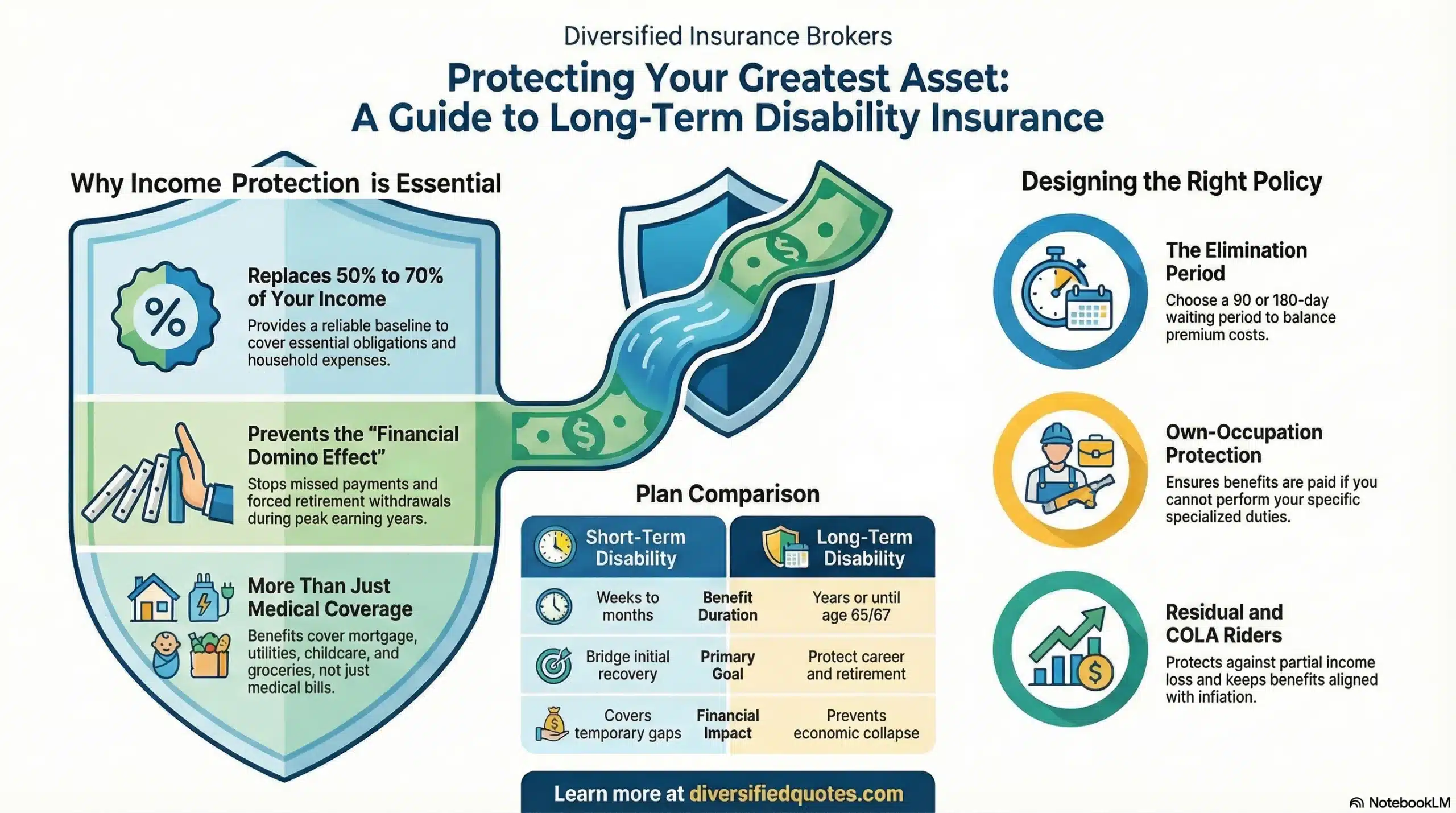
Workers’ compensation income replacement typically covers only a percentage of pre-injury wages — commonly 66% — subject to state-specific maximums that may be well below a miner’s actual earnings. Workers’ compensation benefits are limited in duration and subject to the administrative processes, disputes, and timelines of state workers’ comp systems. Black Lung Benefits Act payments for coal miners are subject to eligibility requirements, proof of disease causation, and benefit levels that often do not replace a meaningful share of actual mining wages. None of these programs address disabilities that are not demonstrably work-related — a miner who develops a disabling health condition that cannot be directly attributed to work exposure, or whose disability arises from a combination of occupational and non-occupational factors, may receive limited or no workers’ compensation or Black Lung benefit support. Individual disability insurance fills these gaps by providing income replacement based on inability to work rather than on the source or cause of the disability, functioning regardless of employer fault, regardless of whether the condition is classified as occupational, and for the full duration of the disability rather than through administrative processes with uncertain outcomes. Our resource on short-term vs. long-term disability insurance explains how both protection layers work together to cover the full spectrum of disability duration.
Own-Occupation Definition and Its Importance for Mining Professionals
For mining workers, the disability definition in their policy determines whether coverage pays in the specific scenarios their occupational risk profile generates. Under a true own-occupation definition, a mining worker is disabled when they cannot perform the material and substantial duties of their specific occupation — even if they could theoretically perform some other type of less demanding work. An underground coal miner whose progressive pneumoconiosis prevents continued underground dust exposure would receive benefits under own-occupation coverage even if they could theoretically perform above-ground administrative work. A mine equipment operator whose back injury prevents sustained operation of heavy vibrating machinery would receive benefits even if they could perform lighter manual work.
Under any-occupation standards — common in lower occupation class policies — the same worker might be denied benefits because they retain capacity for some other type of employment, even at significantly lower income. The own-occupation definition protects the mining career specifically — the income that reflects years of specialized skill development, physical labor in demanding conditions, and exposure to the hazards that justify the premium compensation the industry provides. Our resource on own-occupation disability insurance explains how this critical distinction operates in real claim scenarios. For mining workers with existing coverage who want an independent evaluation, our disability insurance second opinion service provides an unbiased review against the full market of available options.
When to Apply: Earlier Is Always Better in High-Risk Work
For mining industry workers, the timing of a disability insurance application is particularly consequential because the occupational health conditions most likely to generate underwriting complications — respiratory symptoms, musculoskeletal conditions from physical work, hearing loss from noise exposure — accumulate quickly in a demanding mining environment. A miner who applies at age 24, early in their career before any occupational disease processes have generated documented medical history, obtains the most comprehensive coverage at the lowest available lifetime premium. Every year of active mining work increases both the premium at future application age and the probability that documented occupational health history will produce exclusion riders on exactly the conditions most likely to generate a future disability claim.
The future increase option purchased alongside a base policy allows coverage to expand as mining career income grows — through experience, advancement, and increased specialization — without new medical underwriting. This preserves insurability regardless of what occupational health developments occur during active working years. Our resource on disability insurance future insurability riders explains how this protection works, and our resource on how to get the best disability insurance rates explains all the factors that determine coverage quality and cost for high-risk occupation applicants.
Get Disability Insurance Quotes for Mining Industry Workers
We compare options across carriers for mining workers and professionals to find the right combination of coverage, definition strength, and value for your specific role.
Request Disability Insurance OptionsQuestions? Call 800-533-5969
Financial Protection Essentials
Income protection resources and disability insurance planning tools for mining industry workers and high-risk occupation professionals.
Talk With an Advisor Today
Choose how you’d like to connect—call or message us, then book a time that works for you.
Schedule here:
calendly.com/jason-dibcompanies/diversified-quotes
Licensed in all 50 states • Fiduciary, family-owned since 1980
Frequently Asked Questions: Disability Insurance for the Mining Industry
Workers’ compensation provides important baseline coverage for work-related injuries and occupational diseases, but it leaves significant income protection gaps that individual disability insurance must address. Workers’ comp income replacement typically covers only about 66% of pre-injury wages, subject to state-specific maximums that may be well below a miner’s actual earnings. Benefits are limited in duration, subject to administrative processes and dispute timelines, and available only for conditions demonstrably caused by work. A miner who develops a disabling health condition that cannot be directly attributed to work exposure — or whose disability arises from a combination of occupational and non-occupational factors — may receive limited or no workers’ comp support.
Individual disability insurance fills these gaps by providing income replacement based on inability to work regardless of whether the condition is classified as occupational, regardless of employer fault, and for the full duration of the disability rather than through administrative processes with uncertain outcomes. For coal miners specifically, Black Lung Benefits Act payments often fail to replace a meaningful share of actual mining wages and require meeting specific eligibility thresholds. Our resource on whether disability insurance is worth it provides the value framework for evaluating this protection relative to the real financial exposure mining workers face.
Yes — disability insurance is available for mining workers, though the application process is more complex than for lower-risk occupations and not every carrier will write coverage for all mining roles. Mining occupations are typically classified in lower occupation classes that reflect the industry’s documented elevated injury and disease rates, which means higher premiums and in some cases limitations on benefit period or definition options compared to professional office occupations. However, these limitations are navigable with the right carrier selection and independent broker expertise.
Different carriers classify specific mining occupation categories differently — underground coal miners, surface equipment operators, mining engineers, and mine safety professionals may each receive different classifications from different carriers. An independent broker with experience placing mining industry applications can identify which carriers offer the strongest coverage terms for specific roles before any application is submitted, avoiding mismatches that could result in unnecessarily limited coverage or unfavorable terms. Our resource on disability insurance for high-risk occupations explains how underwriting approaches elevated-risk work, and our resource on high-risk disability insurance coverage options covers what is available when both occupation and health history present underwriting complexity.
The most prevalent disability pathways for mining workers fall into three categories. Respiratory disease from dust exposure — coal workers’ pneumoconiosis (black lung disease) in coal miners and silicosis in hard rock and mineral miners — is the most significant long-term occupational disease pathway. Both conditions develop over years of dust exposure, may progress asymptomatically during active working years, and can produce severe functional disability during what should be peak earning years. NIOSH has documented a troubling resurgence in severe black lung disease cases, including progressive massive fibrosis appearing in miners at younger ages than previously observed.
Traumatic injury from equipment accidents, ground failures, and explosives events represents the acute disability pathway — these events can produce immediate, career-ending spinal injuries, crush injuries, and extremity injuries that prevent return to the physical demands of mining work. Musculoskeletal conditions from sustained heavy physical labor, whole-body vibration from equipment operation, and awkward confined work postures represent the chronic cumulative disability pathway that develops across careers of demanding physical mining work. Noise-induced hearing loss from sustained exposure to drilling, blasting, and equipment noise is also a documented occupational disease that can eventually prevent safe participation in mine operations. Each of these pathways produces the same financial consequence: income loss that disability insurance must address.
Yes — disability insurance covers the income consequences of occupational lung disease when that disease produces a qualifying disability under the policy definition, meaning the condition prevents the miner from performing the material and substantial duties of their occupation for the elimination period and beyond. Coal workers’ pneumoconiosis, silicosis, and other occupational respiratory diseases that develop to the point of functional impairment — limiting the physical exertion capacity, oxygen exchange efficiency, or dust exposure tolerance required for continued mining work — constitute covered disabilities under a properly structured policy.
The most critical planning point is that the policy must be in place before the disease is documented. A miner who applies for disability insurance after a pneumoconiosis or silicosis diagnosis has been documented in medical records will face either denial or exclusion riders that eliminate coverage for the specific respiratory condition that is most likely to disable them. This is the strongest argument for mining workers to apply for disability insurance early in their careers — before dust-related respiratory changes have appeared in medical records or pulmonary function test results have begun to show occupational disease patterns. Our resource on disability insurance with preexisting conditions explains how documented health history affects underwriting outcomes for mining workers.
Four provisions are most critical for mining workers. First: an own-occupation or as-strong-as-available disability definition that protects the specific physical demands of the mining role — the underground work, heavy equipment operation, dust exposure environment, or engineering function that generates the income — rather than just a generic ability to work. Second: a benefit amount that reflects actual total compensation including overtime, shift differentials, and hazard pay that are common in mining and often excluded from employer group policy calculations. Third: a benefit period that extends as long as available for the occupation class — a disability at age 38 from traumatic injury or progressive lung disease represents decades of potential income loss that a short benefit period barely addresses.
Fourth: a future increase option that allows coverage to expand as mining career income grows through experience and advancement without new medical underwriting — critical in a profession where cumulative occupational health exposure makes future health history impossible to predict. The residual disability rider is also important for partial disability scenarios — a miner who can perform some but not all of their previous duties due to a respiratory or musculoskeletal condition has experienced real income loss that proportionate benefits address. Our resource on residual disability insurance benefits explained covers how this works in practice.
The optimal time is as early as possible in a mining career — ideally before the first year of active mining work has begun, or at the very latest during the earliest years of employment before occupational dust exposure, noise exposure, and physical demands have generated any documented health history. Mining careers accumulate occupational health history quickly: respiratory symptoms from dust exposure, musculoskeletal complaints from heavy physical work, and hearing changes from noise exposure can all appear in medical records within years of active mining employment. Each documented condition at the time of a later application can produce exclusion riders that limit coverage for the most likely disability scenarios.
A miner who applies at age 22 before their first underground shift obtains the lowest locked-in lifetime premium at the cleanest health history point, with the broadest available coverage terms. A miner who applies at age 42 after 20 years of underground work faces not only significantly higher premiums but potentially a documented health history that limits coverage options substantially. The future increase option purchased with an early policy allows coverage to expand as mining career income grows without new underwriting. Our resource on how to get the best disability insurance rates explains all the factors that determine coverage quality and cost for high-risk occupation applicants.
About the Author:
Jason Stolz, CLTC, CRPC, DIA, CAA and Chief Underwriter at Diversified Insurance Brokers (NPN 20471358), is a senior insurance and retirement professional with more than 25 years of real-world experience helping individuals, families, and business owners protect their income, assets, and long-term financial stability. As a long-time partner of the nationally licensed independent agency Diversified Insurance Brokers, Jason provides trusted guidance across multiple specialties—including fixed and indexed annuities, long-term care planning, personal and business disability insurance, life insurance solutions, Group Health, Travel Medical and Evacuation Insurance, and short-term health coverage. Diversified Insurance Brokers maintains active contracts with over 100 highly rated insurance carriers, ensuring clients have access to a broad and competitive marketplace.
His practical, education-first approach has earned recognition in publications such as VoyageATL, and contributions from his agency featured in Kiplinger and GoBankingRates— highlighting his commitment to financial clarity and client-focused planning. Drawing on deep product knowledge and years of hands-on field experience, Jason helps clients evaluate carriers, compare strategies, and build retirement and protection plans that are both secure and cost-efficient. Visitors who want to explore current annuity rates and compare options across multiple insurers can also use this annuity quote and comparison tool.
Explore More Disability Insurance Options: Browse our complete guide to Disability Insurance for Agriculture, Natural Resources & Outdoor Industries — covering farmers, ranchers, fishermen, foresters, miners, oil & gas workers & outdoor industries from 100+ carriers.
Last Reviewed: May 14, 2026 |
Reviewed by: Jason Stolz, CLTC, CRPC, DIA, CAA
Chief Underwriter, Diversified Insurance Brokers, Inc. | NPN: 20471358 | Diversified Insurance Brokers, Inc. — Licensed in all 50 states
Fact Checked by: Tonia Pettitt, CMIP©
Medicare Specialist, Diversified Insurance Brokers, Inc. | NPN: 14374308 | Diversified Insurance Brokers, Inc. — Licensed in all 50 states
Did you find this content helpful? Leave us a Google review — it helps others find trustworthy guidance too.
Editorial Standards: Diversified Insurance Brokers maintains rigorous editorial standards to ensure accuracy, clarity, and independence in all content. Learn more about our editorial standards and commitment to transparency.
