
Short-Term vs. Long-Term Disability Insurance
As an Independent Disability Insurance Broker, we have access to exclusive discounts and negotiated pricing most captive agents can’t offer — see the full breakdown near the end of this page.
Short-Term vs. Long-Term Disability Insurance

Jason Stolz CLTC, CRPC, DIA, CAA
Disability insurance exists for one simple reason: your income is your most valuable asset. If an illness or injury prevents you from working, your paycheck stops — but your mortgage, utilities, insurance premiums, retirement contributions, and daily living expenses do not. The difference between short-term and long-term disability insurance is not simply a matter of duration — it is a matter of strategy and how the two products work together to cover entirely different phases of a disabling event. Short-term disability is designed to cover temporary interruptions, typically lasting a few weeks to several months. Long-term disability is built to protect your earning power for years — sometimes until retirement age. Understanding how these two forms of coverage coordinate with each other can determine whether a temporary setback becomes a manageable financial inconvenience or a permanent financial crisis that undermines decades of disciplined saving and planning.
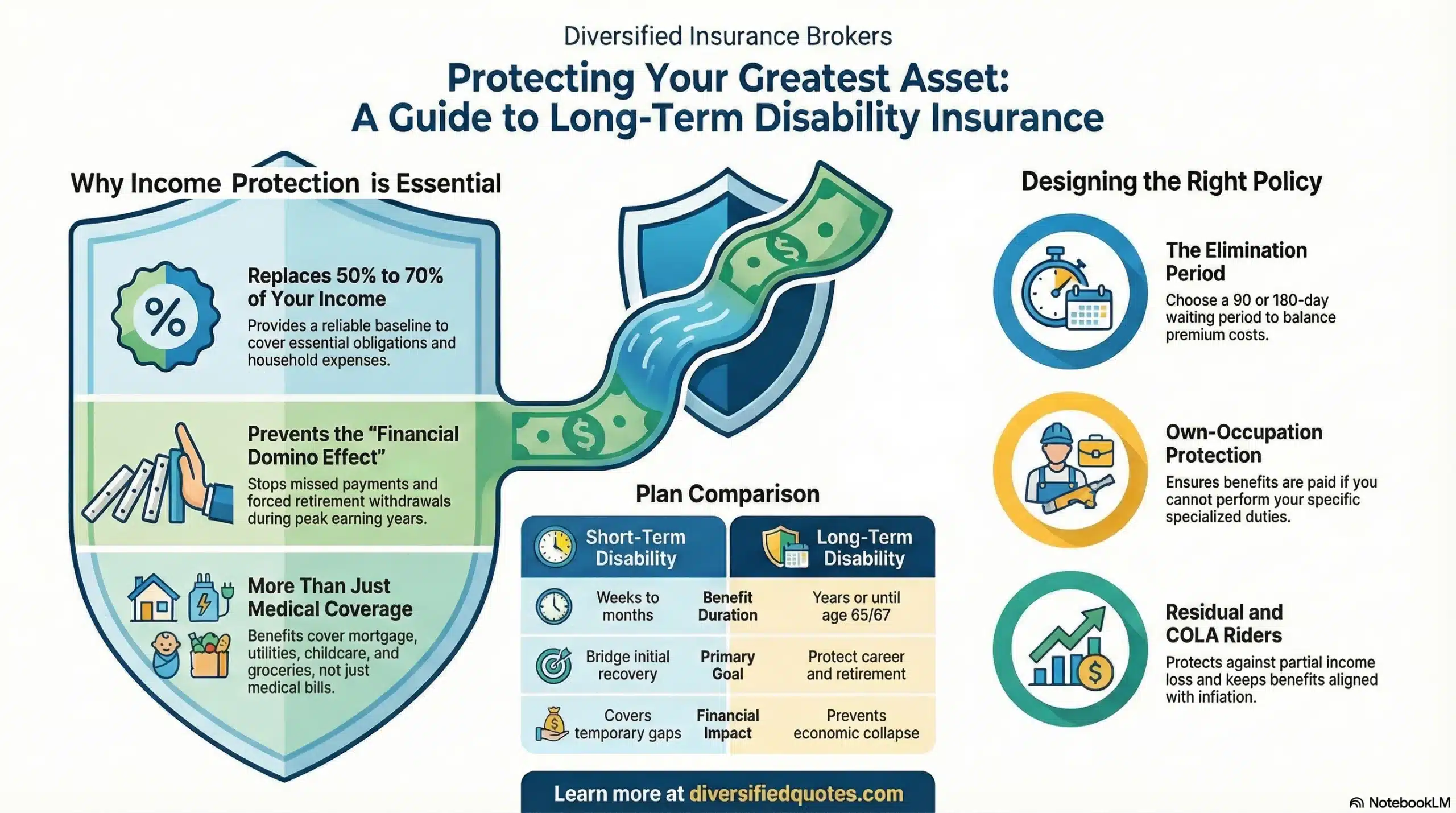
Short-term disability insurance typically begins paying benefits quickly — often after an elimination period of zero to fourteen days — and continues for three to six months, sometimes up to one year depending on the policy design. It is commonly offered through employers as a group benefit, but individual short-term disability policies are available for the self-employed, business owners, and professionals whose employer does not offer this coverage or whose group benefit amount is insufficient relative to their actual income. Long-term disability insurance, by contrast, usually begins after a longer elimination period — commonly ninety, one hundred eighty, or three hundred sixty-five days — and can pay benefits for two years, five years, ten years, or to age sixty-five or sixty-seven depending on the benefit period selected. The longer the benefit period and the shorter the elimination period, the higher the premium — but also the more comprehensive the protection across a wider range of disability scenarios. Here is what many people misunderstand: short-term coverage without long-term coverage leaves a catastrophic gap because the most financially devastating disabilities are precisely those that last beyond the short-term benefit period. Conversely, long-term coverage without short-term coverage may leave the insured responsible for months of household expenses during the elimination period before benefits begin. Coordinating both is consistently the most comprehensive income protection strategy — especially for professionals, business owners, and individuals in physically demanding or high-risk occupations.
Request Disability Income Protection
Submit our disability income form for personalized protection options.
Short-Term vs. Long-Term Disability: Key Differences
| Feature | Short-Term Disability | Long-Term Disability |
|---|---|---|
| Elimination period | 0 to 14 days — benefits begin quickly after the disability event | 90, 180, or 365 days — designed to begin after short-term coverage or savings bridge the gap |
| Benefit duration | 3 to 6 months, sometimes up to 1 year | 2 years, 5 years, 10 years, or to age 65/67 |
| Best for | Temporary setbacks — surgery recovery, pregnancy, short medical events | Extended or permanent disabilities — chronic illness, neurological conditions, spinal injuries, cancer |
| Typical benefit amount | 50–70% of gross income, subject to group plan caps or individual policy limits | 50–70% of gross income, with higher limits available for high earners through specialty carriers |
| Availability | Commonly employer-sponsored group benefit; individual policies available for self-employed | Both group and individual; individual policies carry portability and stronger own-occupation definitions |
| Occupational risk impact | Moderate — group policies may not account for occupation-specific risk factors | Significant — occupational class directly affects eligibility, premium, and policy definitions |
| Own-occupation definition | Less common in short-term policies — typically “unable to perform current job” standard | Available in individual LTD policies — critical for professionals whose skill-specific income is at risk |
| Retirement impact | Minimal if disability is truly short-term; significant if benefits run out before recovery | Retirement contribution riders can continue funding retirement accounts during extended disability |
Why Disability Is a Retirement Planning Issue
One of the most frequently overlooked dimensions of disability insurance planning is its direct intersection with retirement income security. When a disability prevents someone from working, the financial damage extends far beyond the immediate income gap. Every month of disability is also a month in which the employee cannot contribute to a 401(k), IRA, HSA, or other retirement savings vehicle. Over a multi-year disability, these missed contributions — combined with the lost compounding on those contributions — can permanently reduce the retirement income available decades later even if the disabled individual eventually recovers and returns to work. For a professional in their forties who becomes disabled for five years and cannot contribute to retirement accounts during that period, the cumulative impact on projected retirement income can be substantial and largely irreversible.
This is why disability insurance is accurately described as retirement protection in disguise. The long-term disability policy protects the income stream that funds retirement savings during working years — which is structurally more important than any single investment decision made within the retirement account itself, because without the income to fund contributions, the account cannot grow regardless of how well the investments inside it perform. Some long-term disability policies include retirement contribution riders that continue making contributions to the insured’s retirement plan during a disability — preserving the compounding trajectory that self-funding would otherwise permanently interrupt. Annuity vs 401k retirement planning covers how different income vehicles function in retirement and clarifies why protecting the earning ability that funds those vehicles during working years is foundational to any retirement income strategy. What is a QLAC covers a specific longevity planning tool that can coordinate with income protection and deferred retirement income strategy for individuals who have experienced extended disability and are restructuring their retirement timeline around a modified income trajectory. How to transfer an IRA to an annuity covers an option that may become relevant if a disability forces early retirement and the individual needs to convert accumulated IRA assets into a guaranteed income stream to replace the employment income that is no longer available.
Disability Insurance for High-Risk Occupations
For high-risk professionals — including construction workers, pilots, aviation professionals, medical specialists, law enforcement officers, industrial contractors, maritime workers, those in hazardous environments, and many others whose occupations carry elevated injury or illness risk — disability planning becomes both more critical and more complex. Occupational class is one of the most significant underwriting variables in disability insurance, directly influencing eligibility, available benefit amounts, policy definitions, elimination period options, benefit period availability, and premium cost across every carrier and product in the market. Individuals in physically demanding or hazardous occupations may face underwriting restrictions, exclusions for specific body parts or activities related to their occupation, higher premium rates reflecting the elevated risk of disability, or in some cases outright declination from standard individual disability carriers — requiring placement with specialty markets that are designed for non-standard occupational risk profiles.
The self-employed and business owners face an additional layer of complexity because they typically do not have access to employer-sponsored group disability benefits that might otherwise provide a baseline level of income protection. For these individuals, individual disability insurance is the primary or only mechanism for income protection, which makes policy design — benefit amount, elimination period, benefit period, occupation definition, and available riders — even more consequential than it is for W-2 employees who have some group coverage to layer individual coverage on top of. Disability insurance for high-risk occupations covers the occupational class system, the underwriting restrictions that apply to different occupation categories, and the specialty market options that provide coverage for occupations that standard carriers will not insure. Disability insurance for high earners and business owners covers the specialized coverage design considerations that apply when disability coverage needs to protect both personal income and business continuity simultaneously. Life insurance for high-risk occupations covers the complementary life insurance planning that addresses the mortality risk dimension alongside the disability risk dimension for individuals in hazardous roles. Group vs individual life insurance helps high-risk professionals understand how to structure layered protection across multiple financial risks when employer-sponsored group coverage is unavailable or insufficient.
Own Occupation vs. Any Occupation: Why the Definition Determines the Value
Policy definitions are the most technically important element of any disability insurance contract — and the difference between an own-occupation definition and an any-occupation definition can determine whether a policy that appears to provide income protection actually delivers it in the most likely disability scenarios for a specialized professional. Understanding this distinction is not a technicality; it is the core of whether the coverage is actually worth its premium for the specific person buying it.
True own-occupation coverage pays benefits if the insured cannot perform the material and substantial duties of their specific occupation — even if they are able to work in another capacity and earn income elsewhere. For a surgeon who sustains a hand injury that prevents them from performing surgery, own-occupation coverage would continue paying benefits even if that surgeon is able to work as a medical consultant, professor, or in another non-surgical role. Their inability to perform the specific occupational duties for which they were trained and credentialed — surgery — triggers and sustains the disability benefit regardless of what other employment they are capable of. Any-occupation definitions, by contrast, require the insured to be unable to perform any gainful occupation for which they are reasonably suited by education, training, or experience. A surgeon who can teach, consult, or perform administrative medicine may not qualify as disabled under an any-occupation definition even though they can no longer perform the specialized work that produced their actual income. For professionals whose careers depend on specific, highly developed skill sets — surgeons, pilots, dentists, attorneys, architects, and many others — the difference between these two definitions is often the difference between a policy that protects their actual income and one that provides little meaningful protection in the most likely disability scenarios they face. Disability insurance for physicians covers own-occupation definition specifics for medical professionals where this distinction is most consequential. Disability insurance for pilots covers aviation-specific underwriting guidelines and definition considerations for one of the highest-risk and most definition-sensitive occupational categories in individual disability insurance. Disability insurance for dentists covers how own-occupation protection specifically applies to dental professionals whose fine motor skill requirements make this definition critically important to actual coverage effectiveness.
The Illness Reality: Why Workers’ Compensation Is Not Enough
A common misconception in disability planning is that workers’ compensation provides adequate protection for working professionals in hazardous occupations. Workers’ compensation covers only work-related injuries and illnesses that occur in the course of employment — it explicitly excludes the full range of medical conditions, chronic illnesses, and injuries that occur outside of work but that equally prevent the individual from earning income. Statistics consistently demonstrate that the majority of long-term disabilities are caused by illness rather than injury — conditions including cancer, cardiovascular disease, neurological disorders, autoimmune conditions, musculoskeletal disease, and mental health disorders that typically have no relationship to workplace incidents and therefore receive no workers’ compensation coverage.
Even for work-related injuries that do trigger workers’ compensation benefits, those benefits are typically limited to a percentage of wage replacement that may be well below the actual income of a high-earning professional, often do not cover the full duration of an extended disability, and vary significantly by state in terms of benefit amounts, duration limits, and the definition of total disability. Individual disability insurance covers both on-the-job and off-the-job disabilities across the full range of medical conditions that could prevent the insured from working — which is why it provides substantially more comprehensive income protection than workers’ compensation alone, regardless of the insured’s occupational risk profile. Is disability insurance worth it covers the full cost-benefit framework that helps individuals and business owners evaluate whether the premium investment makes sense relative to the income at risk and the inadequacy of alternative income protection mechanisms. Best independent disability insurance broker covers why working with an independent advisor who has access to the full carrier market — rather than a captive agent or single-carrier representative — produces the most competitive and most appropriately structured coverage for complex disability planning situations.
Coordinating Short-Term and Long-Term Disability Coverage
The most comprehensive disability income protection strategy is a coordinated design that uses short-term and long-term coverage together to eliminate the income gap across the full duration of a disability event. The goal is to ensure that no period — from the first day of disability through the end of the benefit period — involves meaningful uncompensated income loss that would force the insured to liquidate savings, miss retirement contributions, or restructure financial obligations in ways that create permanent damage beyond the disability event itself.
Effective coordination starts with understanding the relationship between the short-term disability benefit period and the long-term disability elimination period. If short-term disability pays benefits for six months and the long-term disability elimination period is ninety days, there is a three-month overlap where both policies could theoretically pay — which is generally not how coordination works, but it illustrates the importance of understanding the offset provisions that determine how much the long-term policy pays when other income replacement is also in force. The more common and more effective coordination design matches the short-term benefit period to the long-term elimination period — for example, short-term benefits for six months paired with a one-hundred-eighty-day long-term elimination period — so the transition from short-term to long-term coverage is seamless and the income is protected continuously without an uncompensated gap in between. How to get the best disability insurance rates covers the underwriting and comparison approach that produces the most competitive premium across the carrier market for a given benefit design. Best disability insurance rates covers the current market landscape for individual disability coverage across different occupational classes and income levels.
Disability Insurance for International and High-Risk Specialty Roles
Professionals in international roles, aviation, hazardous environments, or high-mobility careers face an additional layer of planning complexity beyond standard occupational class underwriting. International travel and residency can create policy exclusions, coverage limitations based on geography, or claim complications when disability occurs outside the domestic market. Aviation professionals face some of the most complex underwriting in the disability insurance marketplace — the medically intensive certification requirements of their occupation, the catastrophic consequences of disability on their career, and the specialized nature of the income they are trying to protect all require policy designs that standard domestic carriers are not structured to provide. Life insurance for foreign travel and residency covers how international exposure affects protection coverage structures and what specialty market options exist for globally mobile professionals. Disability insurance for race car drivers and disability insurance for white-collar professionals cover the spectrum of occupational risk profiles from highest-risk to moderate-risk and how coverage design, underwriting, and definition considerations differ across that spectrum. Disability insurance for new professionals covers how early-career professionals should approach disability planning when their income is lower but their future earning capacity — and the risk to that capacity — is at its highest relative level.
Business Overhead, Key Person, and Buy-Sell Disability Applications
Beyond personal income replacement, disability insurance serves several critical business protection functions that are particularly relevant for business owners, self-employed professionals, and partners in professional practices. Business overhead expense disability insurance covers the fixed operating costs of a business — rent, staff salaries, equipment payments, insurance premiums, loan obligations — during a period when the owner is disabled and cannot generate the revenue needed to fund those costs. Without this coverage, a business owner who becomes disabled faces the prospect of watching the business they built dissolve while they recover, because the fixed costs of operating continue regardless of whether the owner-operator is present and productive.
Key person disability insurance protects a business against the revenue disruption caused by the disability of a key employee or principal whose productivity, client relationships, or specialized expertise are central to the business’s revenue generation. When a key person becomes disabled, the business may need to hire replacement staff, absorb lost revenue from disrupted client relationships, or fund training and transition costs — all while continuing to pay the disabled key person’s salary in some cases. Key person disability coverage provides the business with capital to navigate that transition period without financial crisis. Buy-sell disability insurance funds the purchase of a disabled partner’s ownership interest when a disability trigger in the buy-sell agreement is activated, providing the business continuity protection that prevents a disabled partner’s inability to work from creating an ownership and governance crisis simultaneously with the operational disruption. Business overhead disability insurance, disability income insurance for key person employees, and buy-sell disability insurance cover each of these business disability applications in detail. How much health insurance does my business need covers the complementary group health benefit planning that is part of a comprehensive business protection strategy alongside disability insurance.
Legal Scenarios and Layered Financial Protection
High-risk professionals face unique financial exposure not only from injury and illness but from liability, litigation, and income disruption across multiple simultaneous dimensions. In certain legal scenarios, individuals may need to understand financial tools beyond disability insurance that can help maintain stability during extended disputes — options such as advance on a pending lawsuit or broader legal cash advances address specific short-term liquidity needs during legal proceedings that disability insurance does not cover. While these tools are not substitutes for disability income protection, they illustrate how layered financial planning across multiple risk categories — income protection, legal risk, liability, and business continuity — can prevent a single adverse event from escalating into a multi-dimensional financial crisis that would be difficult to recover from even after the original event is resolved.
The bottom line across all of these planning dimensions is straightforward: short-term disability protects immediate cash flow during temporary medical events. Long-term disability protects lifetime earning power during extended or permanent disabilities. Own-occupation definitions ensure that specialized professionals actually receive benefits when they can no longer perform their specific work. High-risk occupations demand specialized underwriting, careful policy design, and access to specialty markets that standard carriers cannot serve. When structured properly and coordinated across short-term, long-term, and business applications, disability insurance safeguards income, retirement contributions, family financial stability, and long-term financial independence in ways that no other financial product can replicate. Without it, a single medical event can undo decades of disciplined saving. Coordinated correctly, it becomes one of the most powerful financial protection tools available — particularly for the professionals whose incomes are most at risk and whose careers are most difficult to resume after a significant disabling event. At what age should you stop buying term life insurance covers the complementary life insurance planning timeline that coordinates with disability coverage reviews as income and family protection needs evolve over a career.
Related Pages to Explore
Talk With an Advisor Today
Choose how you’d like to connect—call or message us, then book a time that works for you.
Schedule here:
calendly.com/jason-dibcompanies/diversified-quotes
Licensed in all 50 states • Fiduciary, family-owned since 1980
Frequently Asked Questions: Short-Term vs. Long-Term Disability Insurance
What is the difference between short-term and long-term disability insurance?
Short-term disability insurance covers temporary income disruptions, typically beginning after a short elimination period of zero to fourteen days and paying benefits for three to six months, sometimes up to one year. It is designed for predictable, recoverable medical events like surgery, pregnancy, or short-term illness. Long-term disability insurance covers extended or permanent income disruption, beginning after a longer elimination period of ninety, one hundred eighty, or three hundred sixty-five days, and paying benefits for two years, five years, ten years, or to age sixty-five or sixty-seven. Together, the two products cover different phases of a disabling event and should be coordinated so the short-term benefit period aligns with the long-term elimination period — eliminating any uncompensated income gap between the two coverage phases.
What does “own occupation” disability insurance mean and why does it matter?
Own-occupation disability insurance pays benefits if the insured cannot perform the material and substantial duties of their specific occupation — even if they can work in another capacity and earn income elsewhere. This is the most favorable definition for specialized professionals because it protects the specific income stream tied to their occupational skill set. Any-occupation definitions, by contrast, require inability to perform any gainful occupation for which the insured is reasonably suited by education, training, or experience. A surgeon who cannot operate but can consult would collect benefits under own-occupation coverage but potentially not under any-occupation coverage — illustrating why the definition is critical for professionals whose careers require specialized, difficult-to-replace skills. Most individual long-term disability policies from specialty carriers offer true own-occupation definitions; most group policies use any-occupation or modified definitions that provide materially weaker protection for high-earning specialists.
Why is disability insurance considered a retirement planning tool?
Disability insurance protects the income that funds retirement savings during working years — which makes it foundational to retirement security in ways that are often underappreciated. When a disability prevents contribution to a 401(k), IRA, or other retirement vehicle, not only are current contributions lost but the compounding on those contributions is permanently foregone. A professional who becomes disabled for five years and cannot contribute to retirement accounts during that period loses both the missed contributions and decades of potential compounding on those amounts — producing a permanently reduced retirement income even if they eventually recover and return to work. Some long-term disability policies include retirement contribution riders that continue funding retirement plan contributions during a disability, directly addressing this retirement impact. This is why disability coverage is accurately described as retirement protection in disguise.
Does workers’ compensation replace the need for individual disability insurance?
No — workers’ compensation covers only work-related injuries and illnesses that occur in the course of employment. The majority of long-term disabilities are caused by illness rather than workplace accidents — conditions including cancer, cardiovascular disease, neurological disorders, and chronic musculoskeletal disease that have no relationship to workplace incidents and receive no workers’ compensation coverage. Even for work-related injuries that do trigger workers’ compensation, benefits are typically limited to a percentage of wage replacement that may be well below a high earner’s actual income, often do not cover the full duration of an extended disability, and vary significantly by state. Individual disability insurance covers both on-the-job and off-the-job disabilities across the full range of medical conditions that could prevent working — providing substantially more comprehensive income protection than workers’ compensation alone for virtually any employed professional.
How does disability insurance work differently for high-risk occupations?
Occupational class is one of the most significant underwriting variables in disability insurance, directly affecting eligibility, available benefit amounts, policy definitions, elimination period options, benefit period availability, and premium cost. High-risk occupations — including construction, aviation, law enforcement, industrial work, and hazardous environments — typically receive lower occupational class ratings that result in higher premiums, restricted definitions, or modified contracts with exclusions related to the occupation-specific risk. Some high-risk occupations may be declined by standard individual disability carriers and require placement with specialty markets that design coverage specifically for non-standard occupational risk profiles. High-risk professionals should work with an independent advisor who has access to specialty carriers and can compare across the full market rather than being limited to a single carrier’s available offerings.
About the Author:
Jason Stolz, CLTC, CRPC, DIA, CAA and Chief Underwriter at Diversified Insurance Brokers (NPN 20471358), is a senior insurance and retirement professional with more than 25 years of real-world experience helping individuals, families, and business owners protect their income, assets, and long-term financial stability. As a long-time partner of the nationally licensed independent agency Diversified Insurance Brokers, Jason provides trusted guidance across multiple specialties—including fixed and indexed annuities, long-term care planning, personal and business disability insurance, life insurance solutions, Group Health, Travel Medical and Evacuation Insurance, and short-term health coverage. Diversified Insurance Brokers maintains active contracts with over 100 highly rated insurance carriers, ensuring clients have access to a broad and competitive marketplace.
His practical, education-first approach has earned recognition in publications such as VoyageATL, and contributions from his agency featured in Kiplinger and GoBankingRates— highlighting his commitment to financial clarity and client-focused planning. Drawing on deep product knowledge and years of hands-on field experience, Jason helps clients evaluate carriers, compare strategies, and build retirement and protection plans that are both secure and cost-efficient. Visitors who want to explore current annuity rates and compare options across multiple insurers can also use this annuity quote and comparison tool.
Browse More Resources: Return to our complete Health Insurance, Dental, Vision & Disability guide — covering short term health, dental, vision, group health & disability.
Last Reviewed: June 16, 2026 |
Reviewed by: Jason Stolz, CLTC, CRPC, DIA, CAA
Chief Underwriter, Diversified Insurance Brokers, Inc. | NPN: 20471358 | Diversified Insurance Brokers, Inc. — Licensed in all 50 states
Fact Checked by: Tonia Pettitt, CMIP©
Medicare Specialist, Diversified Insurance Brokers, Inc. | NPN: 14374308 | Diversified Insurance Brokers, Inc. — Licensed in all 50 states
Did you find this content helpful? Leave us a Google review — it helps others find trustworthy guidance too.
Editorial Standards: Diversified Insurance Brokers maintains rigorous editorial standards to ensure accuracy, clarity, and independence in all content. Learn more about our editorial standards and commitment to transparency.
