
Principal Income Protector Disability Insurance
As an Independent Disability Insurance Broker, we have access to exclusive discounts and negotiated pricing most captive agents can’t offer — see the full breakdown near the end of this page.
Principal Income Protector Disability Insurance
Principal Income Protector is the current individual disability income insurance contract from Principal Life Insurance Company, and it occupies a distinctive position in the market: it is arguably the strongest contract available for stacking, supplementing, and layering coverage rather than for standing alone. Principal built its individual disability business around coordinating with employer group long-term disability, with guaranteed standard issue programs, and with other carriers’ policies, and that orientation shows up throughout the product design.

There is one thing you need to understand before anything else on this page, and no consumer brochure we have seen from this carrier states it plainly. The base Income Protector contract does not include a true own-occupation definition of disability. The standard definition pays when you cannot perform your own occupation and are not working in another occupation. True own-occupation, the version that pays your full benefit while you work in a different field, is available as an optional rider at additional cost. That single fact should reshape how you read every quote you receive, and we lead with it because a proposal that looks competitively priced against another carrier may simply be missing the provision the other quote includes.
Which Principal Contract Are You Actually Being Quoted?
Income Protector replaced an earlier Principal individual disability series, and the transition rolled out state by state rather than all at once. The earlier series has remained in use in the states that had not approved the newer contract, historically including California and New York. State approvals shift over time and we will not state a current count as fact, because that is exactly the kind of detail that goes stale between the writing of a page and the reading of it.
What matters for you is practical. If you live in a state still on the earlier series, the contract you can buy differs from the one described here in several provisions, and feature summaries written about Income Protector will not fully apply. Ask which contract series your quote is written on. Principal also offers a separate retirement-focused disability policy and business-focused coverage such as overhead expense insurance, which solve entirely different problems and are not personal income replacement.
We will confirm which Principal contract is available where you live and price it honestly against the other carriers we represent.
Request Your Disability Insurance Review
Income Protector at a Glance
| Contract Element | What Income Protector Provides | The Detail That Changes the Comparison |
|---|---|---|
| Base Definition of Disability | Own occupation while not working in another occupation | True own-occupation is a separately priced rider, not base coverage. This is the most consequential line in this table. |
| Renewability | Non-cancelable and guaranteed renewable to age 65 | Coverage past that point is generally conditionally renewable on an annual basis, which is a materially weaker promise than the guaranteed period. |
| Elimination Periods | Thirty, sixty, ninety, one hundred eighty, or three hundred sixty-five days | A full menu. Longer waiting periods are the cleanest way to cut premium if reserves genuinely support them. |
| Benefit Periods | Two years, five years, to age 65, or to age 67 | No ten-year option and no to-age-70 option on the published menu, unlike some competitors. |
| Occupation Class | Drives eligibility, pricing, and rider availability | Two people at the same income can price very differently. Our reference on coverage for insurance underwriters shows how office-based roles typically classify. |
| Inflation Protection | Compound cost of living rider, commonly offered at three or six percent | The same erosion problem drives inflation riders on long term care policies, and the reasoning transfers directly. |
| Issuing Company | Principal Life Insurance Company, Des Moines, Iowa | A subsidiary of a publicly traded parent, carrying a superior-category financial strength rating. |
The Definition of Disability Is Sold Separately
Every other provision in a disability contract is downstream of the definition of total disability, because the definition decides whether a claim gets paid at all. On Income Protector, the strongest version of that provision is an optional purchase, and this deserves a full explanation rather than a footnote.
The standard base definition pays benefits when injury or sickness prevents you from performing the substantial and material duties of your own occupation, provided you are not gainfully employed in another occupation. That is a legitimate own-occupation standard for the purpose of qualifying a claim, and it is stronger than an any-occupation definition. What it does not do is let you rebuild a career elsewhere while collecting. Take a different job and the benefit stops.
The optional true own-occupation rider changes that. With it attached, you are considered totally disabled when you cannot perform the duties of your own occupation, and you may work in another occupation and continue collecting the full benefit with no reduction. For medicine and dentistry, a recognized specialty is generally treated as the occupation, so a specialist is measured against the specialty rather than against the broader field.
| Definition Structure | What Happens If You Work Elsewhere | Who Can Live With It |
|---|---|---|
| Base contract, own occupation while not working | Benefits stop. Qualification rests on your own occupation, but continued payment requires that you are not gainfully employed elsewhere. | Buyers near retirement, those with no realistic second career, and budget-constrained buyers who understand exactly what they gave up. |
| With true own-occupation rider | Full benefits continue with no offset, even while gainfully employed in a different occupation or capacity. | Specialists, proceduralists, and anyone whose income depends on a credential that took years to build. |
Here is why this matters commercially rather than just technically. If you request quotes from several carriers and one of them includes true own-occupation in the base contract while Principal quotes without the rider, the Principal number will look better and the coverage will not be equivalent. Add the rider and compare again. That is the only apples-to-apples comparison, and it is the single most common error we see in disability shopping. Our broader explanation of how own-occupation coverage actually functions covers why this provision carries more weight than premium.
Non-Cancelable to Sixty-Five, and What Happens After
Income Protector is issued on a non-cancelable and guaranteed renewable basis, which means that as long as premiums are paid on time, Principal cannot cancel the policy, cannot raise your premium, and cannot change the provisions. That is the strongest guarantee structure sold in this market, and the distinction from a merely guaranteed renewable contract, where premiums can be raised on a class basis, is explained fully in our guide to how the two renewability structures differ.
The nuance worth catching is where that guarantee ends. Published descriptions of this contract place the non-cancelable guarantee to age sixty-five, with coverage past that point generally becoming conditionally renewable on an annual basis. Conditional renewal typically depends on continued full-time work and carries premiums that are not locked. If you plan to practice into your late sixties or beyond, understand that the ironclad portion of the promise ends earlier than the working career you are envisioning. Confirm the exact post-sixty-five terms on your specific contract, because this provision varies and it is not something a summary should settle for you.
Choosing the Elimination Period and Benefit Period
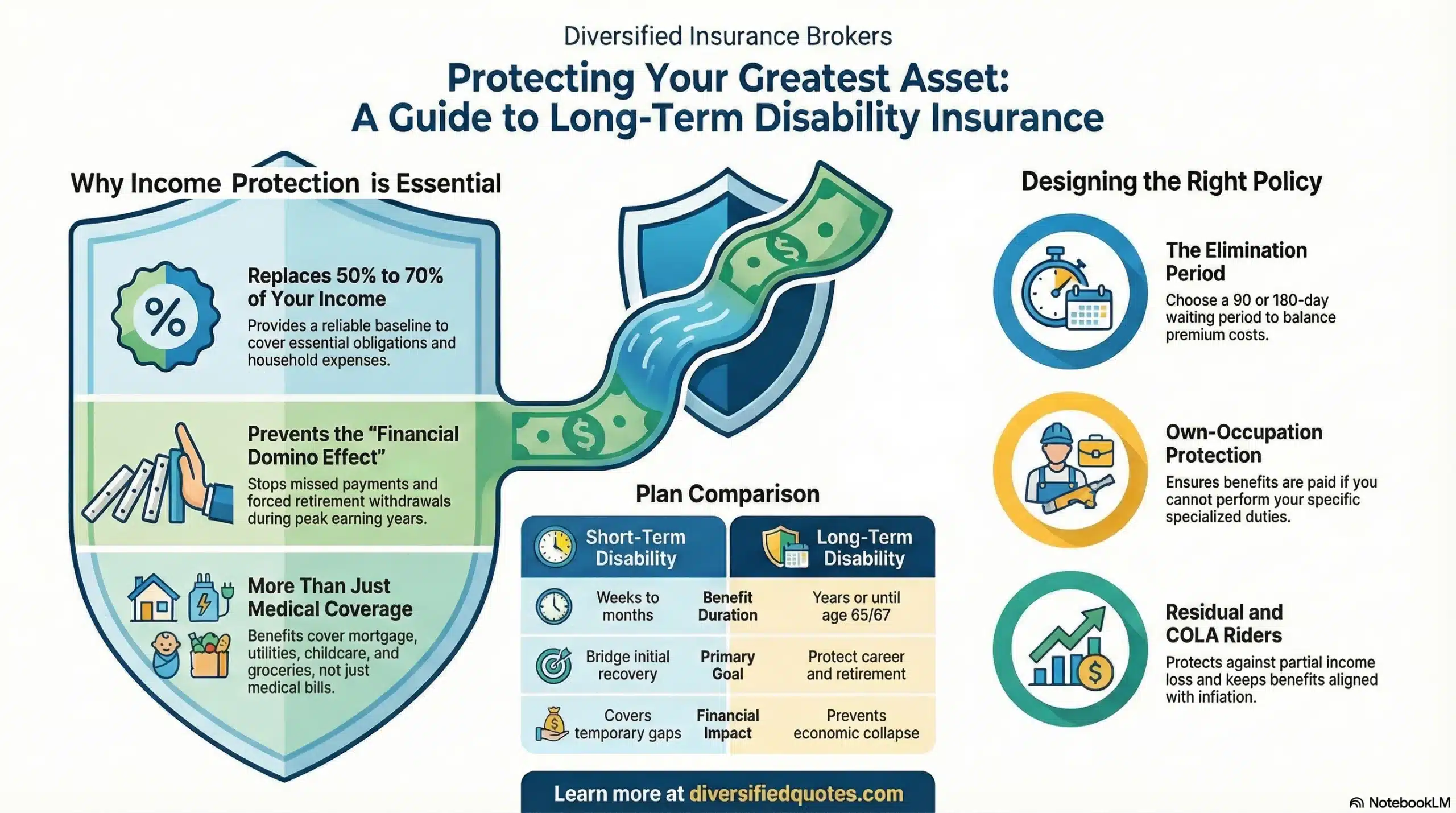
Income Protector offers a full elimination period menu running from thirty days out to a full year. The elimination period functions as a deductible measured in time rather than dollars, and it is the most efficient premium lever available to a buyer with real reserves.
Calculate it rather than guessing. Total what you could genuinely cover from liquid savings without raiding retirement accounts or borrowing, divide by your monthly obligations, and let the resulting number of months guide the election. Most buyers instinctively select the shortest waiting period offered, which means paying the highest premium to insure the portion of the risk they were best positioned to absorb themselves. Our detailed treatment of how to select an elimination period works through that math properly.
The benefit period deserves the opposite instinct. Published options run two years, five years, to age sixty-five, and to age sixty-seven. Shortening the benefit period is the largest single premium lever and also the one that strips away the most protection. A two-year or five-year benefit period covers the disabilities most likely to happen while leaving you exposed to the ones most likely to be financially ruinous. Note also that ten-year and to-age-seventy benefit periods do not appear on this contract’s published menu, so if either is a requirement for you, this may not be your carrier.
Residual Disability: One Rider, and It Is Essential
Total disability is what people picture. Partial disability is what actually happens far more often: reduced hours, narrowed scope, lower procedure or transaction volume, or a return to work that takes a year or more to reach prior earnings. Principal addresses this through a residual disability rider that uses an income-loss test, paying proportional benefits when your loss of income from the disabling condition exceeds a specified threshold of pre-disability earnings.
The structural point buyers miss is that without this rider, the policy only responds when you cannot perform your occupation at all. A physician who can still see patients at sixty percent of prior volume, or a business owner running a diminished practice, receives nothing from a base contract with no residual coverage. That is not a rare scenario; it is the most common one. Our explanation of how residual benefits are calculated covers the mechanics that govern this rider.
Comparative note worth having: some competing carriers offer multiple residual tiers with differing triggers and differing minimum benefit floors during the early months of a claim. Principal’s published structure is a single residual rider. That simplifies the decision, but it also means you cannot buy up to a more generous early-claim structure the way you can elsewhere. If early-claim cash flow is your central concern, that is a specific point to compare.
Comparing riders across carriers is where most of the real difference lives. Let us do that work on your case.
Talk to Our Underwriting Team
Inflation Protection During a Long Claim
A fixed monthly benefit erodes badly across a long claim. Someone disabled in their forties on a to-age-sixty-five benefit period faces a runway of two decades, and the benefit that felt sufficient at issue will not feel sufficient near the end of it. Principal offers a compound cost of living rider, commonly presented at three percent and six percent options, with adjustments applying during an ongoing disability.
One provision here is genuinely worth having and frequently overlooked: on returning to work full time, you keep the increased benefit level without providing evidence of good health. For anyone with an episodic or recurring condition, that matters enormously, because it means a first claim leaves you with more coverage rather than sending you back to underwriting at a worse point in your health history.
The honest counterpoint, and it is a real one, is that inflation riders are expensive. If you are not already purchasing the maximum benefit your income supports, the money spent on a cost of living rider may buy more protection as additional base benefit instead. The rider earns its cost most clearly for younger buyers with long benefit periods and limited assets. For a buyer within a decade of financial independence, it is a much closer call. We work that comparison specifically rather than applying a blanket rule.
Three Different Ways to Increase Coverage Later
Buying early protects insurability but underinsures income, and Principal offers more than one mechanism to solve that. They work differently and are easy to confuse on an illustration.
An automatic annual increase rider raises the maximum monthly benefit on a compound basis each year without medical or financial underwriting, which is the simplest path for someone who wants coverage to track inflation without doing anything. Published descriptions indicate the rider terminates if the policyholder declines two consecutive increases, so passive refusal has a consequence worth knowing about.
A future increase option operates on the traditional model, giving you the right to apply for additional coverage at intervals with insurability already protected, subject to financial justification at the time you exercise it.
The mechanism that genuinely differentiates this carrier is an income-triggered increase feature, which lets you add coverage when your income justifies it rather than waiting for a carrier-set anniversary schedule. For someone whose earnings move in steps rather than smoothly, an early attending physician, a new partner, a practice owner adding a revenue line, that flexibility is worth more than a fixed schedule. Understanding how financial underwriting evaluates income helps explain why income-triggered increases behave differently from date-triggered ones.
Across all three, the same caution applies that applies industry-wide: no evidence of insurability means your health cannot block the increase. It does not mean the increase is at no cost. Each additional layer of benefit carries additional premium, generally based on your age when the increase takes effect.
Catastrophic Disability Coverage
A catastrophic disability rider pays an additional monthly benefit on top of the base benefit when a disability is severe enough to require assistance rather than merely preventing work. Published descriptions of the Principal rider indicate it responds to an inability to perform two or more activities of daily living without assistance, to cognitive impairment, or to presumptive disability.
Those triggers are worth reading carefully, because they are the same triggers used in long-term care insurance rather than the occupational triggers used elsewhere in a disability contract. That makes this rider useful and also makes it easy to over-rely on. It sits inside a disability policy, so it is bounded by that policy’s benefit period and ends when the base coverage does. It is not a substitute for later-life care planning.
Ask specifically whether the catastrophic benefit indexes for inflation, because catastrophic claims run the longest and an unindexed catastrophic benefit loses purchasing power precisely where care costs escalate fastest. Carriers differ on this and it is not a detail any summary should decide for you.
Protecting Retirement Contributions
A long disability damages a balance sheet twice. It stops the income that pays current expenses, and it stops retirement contributions along with any employer match, because neither you nor your employer can contribute against income that no longer exists. Those accumulation years cannot be replayed, and over a long claim the compounding loss often exceeds the lost paychecks.
Principal addresses this through a separate retirement-focused disability policy rather than a rider on the income policy. Benefits are paid into an irrevocable trust established for the insured’s benefit rather than paid to you directly, with investment options inside the trust. Because it is a distinct policy, it is generally available in addition to the issue limits applying to your individual disability coverage, which is a meaningful structural advantage for high earners already at their income-replacement ceiling.
Two honest qualifications. This is not a qualified retirement plan and should not be described as one. And the trust must eventually be converted into something that produces retirement income, which is why the mechanics of converting a lump sum into guaranteed income become relevant at the far end of this planning. Any projection of what the trust might accumulate rests on assumed returns that will not match reality; the guaranteed element is the contribution replacement, not the growth.
Supplementing Employer Group Long-Term Disability
This is where Income Protector is at its most compelling, and it is the scenario the carrier’s own consumer material spends the most energy on. The reasoning is sound, and it rests on tax treatment that most people have backwards.
Group long-term disability through an employer typically replaces a stated percentage of base salary. Three things quietly reduce that. First, the stated percentage usually applies to base salary only, excluding bonus, commission, incentive pay, and often distributions, which for many professionals is a large share of total compensation. Second, when the employer pays the premium and does not include it in your income, the benefits are generally taxable to you, so a benefit advertised at a given percentage arrives materially smaller after federal, state, and payroll taxes. Third, group coverage ends when the employment does.
An individual policy behaves differently on all three counts. It can cover compensation beyond base salary subject to underwriting, benefits are generally received without income tax when you pay the premium personally with after-tax dollars, and the coverage is yours regardless of where you work, what happens to your income, or what happens to your health. Layering an individual policy on top of a group plan therefore raises your effective replacement percentage by considerably more than the added benefit amount alone would suggest, because the added layer arrives untaxed while the group layer does not.
The practical instruction is to read your group certificate before buying anything. Find the stated replacement percentage, what compensation it applies to, who pays the premium, whether any benefit cap applies, and what definition of disability governs after the first two years. Employer benefit design carries wide latitude, as our discussion of employer contribution rules on group plans illustrates. Then insure the gap rather than duplicating coverage you already hold. Tax treatment depends on your circumstances and should be confirmed with your tax advisor rather than taken from any insurance page, including this one.
Discounts, Multi-Life Cases, and Guaranteed Standard Issue
Principal is unusually strong on the group and association side of individual disability, and this is where real money can be saved.
An affiliation discount is commonly available through qualifying employers and associations. A multi-life discount typically applies when several employees of a common employer purchase individual coverage through the same producer, which is a structure worth organizing deliberately rather than stumbling into. For medical and dental residents, fellows, and students, a substantially larger training discount is available, and published descriptions indicate it locks into the policy at issue and remains for the life of the contract rather than phasing out when the resident becomes an attending. If that is accurate, and it is worth confirming on your specific offer, it is one of the most valuable structural discounts in this market for anyone still in training.
Principal also participates in guaranteed standard issue programs funded with this product, under which qualifying members of an employer or association group can obtain coverage with reduced or eliminated medical underwriting. Guaranteed standard issue is not available to an individual applying alone; it requires a qualifying group arrangement. For applicants whose health history complicates individual underwriting, a guaranteed standard issue program is frequently the difference between coverage and no coverage, which is the same logic that makes products like guaranteed issue term life coverage valuable on the life side.
Underwriting, Occupation Class, and Pricing Structure
Income Protector is fully underwritten on health and finances, with premium set at issue based on age, sex, state, occupation class, and risk class, and level for the life of the contract. Financial underwriting determines how much benefit your earned income supports and accounts for other disability coverage you hold, including group coverage, which counts against participation limits.
Occupation class drives pricing, eligibility, and rider availability, sometimes more than income does. Our library organized by disability coverage across occupations shows how specific fields tend to be classified and why two applicants earning identically can receive very different offers.
One pricing dimension deserves specific mention because it affects a large group of buyers. Carriers differ in whether they price disability coverage on sex-distinct rates or on unisex rates, and the difference is substantial, because women file disability claims at higher rates than men and sex-distinct pricing reflects that. Some published reviews describe a pricing advantage for women with this carrier relative to certain competitors, and multi-life case structures can change the rate basis entirely. We flag this as reported rather than verified, and we would treat it as a reason to test the case across carriers rather than a conclusion to rely on. For women in particular, running a genuine multi-carrier comparison is more likely to produce a meaningful premium difference than it is for men.
Principal is also known for coordinating with other carriers’ policies, which matters for high earners assembling coverage from multiple companies to reach a workable total benefit. Not every carrier is comfortable in that role. Issue and participation limits in this market reach well into five figures monthly, but the specific limits vary by contract series and state, so confirm the exact figures applying to your situation rather than working from any published number.
Business Owners Need More Than Personal Income Replacement
If you own the business rather than simply working in it, a personal disability policy solves only part of the exposure. Your income stops, which the policy on this page addresses. But the business also continues generating obligations that do not pause because you are in a hospital bed, and those obligations can consume the personal benefit entirely if nothing else is in place.
Rent, payroll for staff who cannot bill without you, equipment leases, utilities, insurance, and loan service all continue. Overhead expense coverage is a separate policy designed to reimburse those documented business expenses during your disability, and because it reimburses actual expenses rather than replacing income, it is generally underwritten and priced separately from your personal coverage and does not count against your personal benefit limits. For a practice owner, this is frequently the difference between a business that survives an eighteen-month absence and one that closes.
Two adjacent exposures deserve attention at the same time. If the business carries debt personally guaranteed by you, loan protection coverage addresses servicing that debt during a disability. And if you have partners, a disability buyout arrangement funds the purchase of a disabled owner’s interest, which is the disability equivalent of the life insurance most partnerships already carry against death. Partnerships routinely insure the death of an owner and leave the far more likely disability scenario entirely unfunded, which leaves the healthy partners supporting a non-working owner indefinitely or fighting about it.
Principal writes in these business categories alongside its individual coverage, and product availability and structure vary, so treat this as a prompt to have the conversation rather than a specification. The point is that a business owner buying only personal income replacement has addressed roughly half of the actual risk, and the half left uncovered is often the one that ends the enterprise.
Financial Strength
A policy purchased at thirty-five may not be claimed against until sixty, so the financial condition of the issuing company is part of the product. AM Best has affirmed a Financial Strength Rating of A+, in the Superior category, for Principal Life Insurance Company and its affiliate, with a stable outlook. AM Best assesses the group’s balance sheet strength as very strong, its operating performance as strong, and its enterprise risk management as very strong.
That places Principal firmly in the upper tier without being at the absolute apex of the scale, where a small number of carriers hold the highest rating available. For most buyers this distinction is academic; an A+ carrier is a strong custodian of a thirty-year promise. For buyers who treat maximum financial strength as the governing criterion, it is a real if narrow difference. Ratings are reviewed at least annually and can change, so confirm current standing before applying rather than relying on a figure you read anywhere, including here. The same discipline we apply on our highest rated life insurance carriers overview applies to disability carriers.
How to Read a Rider-Built Illustration Without Getting Fooled
Because this contract reaches its strongest form through riders rather than through the base policy, an Income Protector illustration carries more decisions on its face than a comparably priced quote from a carrier that bundles more into the base. That is manageable, but it requires reading the illustration as a specification rather than as a price.
Start at the definition line and confirm whether the own-occupation rider is attached, since this single item can move the premium noticeably and moves the protection more. Then find the residual rider and confirm it is present, because a policy without it does not respond to the most probable claim scenario at all. Then locate the benefit period and the elimination period together and check that the pairing is what you intended rather than a default the software selected. Then confirm which increase mechanism is attached, since the automatic, scheduled, and income-triggered options behave very differently over twenty years. Finally, look for the cost of living rider and decide deliberately whether the money is better spent there or on additional base benefit.
The discipline that matters most is comparing configured quotes rather than headline quotes. Two illustrations from two carriers are only comparable when both are built to the same specification, and the cheaper illustration is very often cheaper because something on this list is missing from it. We build every comparison to matched specifications for exactly this reason, and when a carrier cannot match a specification we say so rather than quietly substituting a weaker provision.
One more habit worth adopting. Ask what the premium looks like at each level of the definition and each level of the residual rider rather than accepting a single configuration. The spread between definition tiers is frequently smaller than buyers expect, which means the downgrade many people make to save money often saves less than they assume while giving up the protection that motivated the purchase. Seeing the actual numbers side by side changes that decision more reliably than any argument does.
Where Income Protector Sits in the Market
Principal competes as one of the major carriers in the professional and medical disability market, and it competes on flexibility, coordination, and price rather than on having the single strongest contract language available. Where competitors lead is in provisions that only matter at claim time: enhanced physician definitions with alternate qualification formulas, multiple residual tiers with more generous early-claim floors, extended recovery provisions, and unlimited duration for mental health conditions. Our review of the leading disability carriers we place business with sets out where each one genuinely leads.
Where Principal leads is architecture. The income-triggered increase feature, the separate retirement protection policy that sits outside standard issue limits, the depth of the training discount, the guaranteed standard issue participation, and a demonstrated willingness to coordinate with other carriers add up to a carrier that is exceptionally good at building a complete package around a person rather than selling a single policy. For a physician stacking coverage across companies, for a group of partners organizing a multi-life case, or for a resident locking in a discount that will follow them for decades, that architecture is worth real money.
The tradeoff is that the base contract is thinner than the top of the market and requires riders to reach parity. That is not a criticism so much as a structural choice, but it does mean a Principal illustration must be read line by line. Understanding what actually happens during a claim tends to clarify which of those lines are worth paying for.
Who Income Protector Fits
It fits people supplementing employer group long-term disability, which is the scenario this carrier has designed around most deliberately. It fits medical and dental residents and fellows, where the training discount is among the strongest available and reportedly persists for the life of the policy. It fits professionals with step-function income growth who benefit from increasing coverage when income justifies it rather than on a fixed schedule. It fits high earners already at their income-replacement ceiling who need the separate retirement protection policy to add coverage beyond standard limits. It fits members of employer or association groups with access to guaranteed standard issue, particularly applicants whose health would complicate individual underwriting. And it fits buyers assembling coverage across multiple carriers who need a company comfortable coordinating with others.
It fits less well in several situations, and we would rather be direct about them. Anyone comparing quotes casually is at real risk of buying a weaker definition than they believe they bought, since true own-occupation is not in the base contract. Buyers who need a ten-year or to-age-seventy benefit period will not find one on the published menu. Those who want to buy up to a richer early-claim residual structure have fewer choices here than with some competitors. Anyone planning to work well past sixty-five should examine the post-sixty-five renewal terms closely before assuming the guarantee follows them. Buyers for whom the very highest financial strength rating is the deciding factor will find carriers rated a notch above. And anyone declining the residual rider to reduce premium should understand they are removing coverage for the most probable claim type entirely. Coordinating this decision with the rest of a protection plan matters as much as the policy itself, which is why we handle it alongside our independent life insurance brokerage practice and think about protection across the whole household rather than one policy at a time.
What to Confirm Before You Apply
Confirm which contract series is available in your state. Confirm whether the true own-occupation rider is attached to your illustration, and get a second illustration with it if it is not. Confirm the post-sixty-five renewal terms. Confirm which residual rider is included and what income-loss threshold triggers it. Confirm whether the catastrophic benefit indexes. Confirm your occupation class and which riders it permits. Confirm every discount you may qualify for, since affiliation, multi-life, and training discounts are frequently missed. And confirm the mental health and substance-related benefit duration, which most contracts limit and few buyers think to ask about.
That verification is the substance of the job. We represent many carriers and gain nothing by steering you toward Principal when another contract fits you better, which happens regularly. Working with an independent disability insurance broker means the comparison is run on your behalf rather than on a single company’s behalf, and it means someone tells you when the cheaper quote is cheaper because it is missing something.
We will price Income Protector with and without the own-occupation rider, against every comparable contract we can access, and show you the difference in plain language.
Start Your Income Protection Review
Financial Protection Essentials
Income protection is the foundation. These resources cover the accumulation, care, and legacy layers that sit on top of it.
Compare Disability Insurance Products
Every carrier writes a different contract. These reviews cover what each one includes in the base policy, what it charges extra for, and who it genuinely fits.
Talk to an Advisor or Request Your Annuity Quote
Ready to explore this annuity in more detail—or compare it with other carriers to see if even higher rates are available? With guaranteed income, principal protection, and long-term growth potential on the line, making the right choice is essential. The experienced advisors at Diversified Insurance Brokers will guide you through the options and design a strategy tailored to your retirement goals.
Schedule here:
calendly.com/jason-dibcompanies/diversified-quotes
Licensed in all 50 states • Fiduciary, family-owned since 1980
Frequently Asked Questions
Does Income Protector include true own-occupation coverage?
Not in the base contract. The standard definition pays when you cannot perform your own occupation and are not working in another occupation, which stops benefits if you take a different job. True own-occupation, which continues paying the full benefit while you work elsewhere, is available as an optional rider for additional premium. This is the most important thing to verify on any Principal illustration, because a quote priced without the rider will appear more competitive than a quote from a carrier that includes the definition in its base contract, while providing meaningfully less protection. Our overview of what each disability rider actually adds explains why this particular one is rarely the right place to economize.
What happens to my coverage after age sixty-five?
Published descriptions of this contract place the non-cancelable guarantee to age sixty-five, with coverage past that point generally continuing on a conditionally renewable annual basis. Conditional renewal typically depends on continuing to work full time, and premiums during that period are not locked the way they are during the guaranteed years. If you expect to practice into your late sixties or beyond, this is a provision to read in the actual contract rather than a summary, and to compare against carriers offering benefit periods that extend further. Ask for the specific language, since renewal terms are one of the areas where contracts differ most and where marketing material is least specific.
Are benefits limited for mental health or substance-related conditions?
Most individual disability contracts limit the benefit duration for these conditions, commonly to twenty-four months, even when the rest of the policy runs to age sixty-five or sixty-seven. Carriers vary considerably: some apply the cap universally, some make it optional with a premium discount attached, some carve out specific conditions, and a small number offer full-duration coverage. This limitation is standard enough that buyers rarely think to ask, and it matters a great deal, because these conditions are among the most common causes of long-duration claims in professional work. Anyone with a documented history involving conditions such as bipolar disorder and related mood conditions should have this provision compared line by line across every carrier under consideration, since the gap between a two-year cap and full-duration coverage can represent decades of benefit.
Will my benefits continue if I move outside the United States?
This varies substantially by carrier and by contract and is one of the most commonly overlooked provisions in individual disability insurance. Many contracts restrict where benefits are payable if you reside outside the United States or Canada, and some limit the duration of foreign payment even during temporary stays. If overseas work, extended travel, or retirement abroad is a realistic possibility, this needs to be read specifically in your policy rather than assumed, and it is worth comparing across carriers because the treatment is not uniform. The same planning care applies to the broader financial picture for Americans living outside the country. Note also that disability benefits replace income and do not pay for medical treatment or evacuation abroad, which requires separate coverage entirely.
Can a claim be challenged based on what I wrote on my application?
Yes, during the contestability window following policy issue. If a claim arises in that period, the carrier may review the application for accuracy, and misstatements regarding medical history, income, occupation, or other coverage in force can jeopardize the claim. The mechanics parallel what we describe regarding the contestability period and how carriers apply it. Disclose completely and accurately, including anything you personally regard as resolved or trivial. Disability claims involve substantially more documentation review than most policyholders anticipate, including tax returns and treatment records, and an omission that spared you an underwriting question at application is the omission a claims examiner will locate later.
Does tobacco or vaping use change my premium?
Yes. Disability carriers underwrite tobacco and nicotine use, including vaping and electronic cigarettes, and it generally moves you into a higher rate class. Carriers differ meaningfully in how they define a cessation period and in whether cigars, occasional use, or nicotine replacement products receive the same treatment as daily cigarette use. Because that treatment is not standardized, nicotine use is one of the circumstances where comparing several carriers produces the widest premium spread, and it is worth doing rather than accepting the first offer. The underwriting patterns we outline regarding vaping and electronic cigarette underwriting carry directly into the disability market. Disclose accurately regardless of the rate consequence.
Is the catastrophic disability rider the same thing as long-term care insurance?
No, though the triggers look similar enough to cause confusion. The catastrophic rider uses activities of daily living and cognitive impairment as qualifying standards, which are the same standards long-term care coverage uses, but it lives inside a disability policy and is therefore bounded by that policy’s benefit period. It ends when the base disability coverage ends, commonly at sixty-five or sixty-seven. Long-term care needs most often arrive after those years, which is exactly the gap this rider does not cover, and the claim process differs as well, as our explanation of filing a long term care claim describes. Treating a catastrophic rider as later-life care planning leaves a hole in the years when care is most likely needed, which is why we review both together through our independent long term care brokerage work.
I own a business. Can I offer this coverage to my employees?
Yes, and this is one of the areas where this carrier is strongest. When several employees of a common employer purchase individual disability coverage through the same producer, a multi-life discount typically applies, and the policies remain individually owned and fully portable, so an employee keeps the coverage after leaving. Larger or qualifying groups may access guaranteed standard issue arrangements with reduced or eliminated medical underwriting, which is often the only realistic path to coverage for employees whose health history would complicate individual applications. Structuring this properly requires coordinating the individual coverage with whatever group disability and group medical benefits you already provide, which is work our independent group health brokerage team handles alongside the individual placements.
About the Author:
Jason Stolz, CLTC, CRPC, DIA, CAA and Chief Underwriter at Diversified Insurance Brokers (NPN 20471358), is a senior insurance and retirement professional with more than 25 years of real-world experience helping individuals, families, and business owners protect their income, assets, and long-term financial stability. As a long-time partner of the nationally licensed independent agency Diversified Insurance Brokers, Jason provides trusted guidance across multiple specialties—including fixed and indexed annuities, long-term care planning, personal and business disability insurance, life insurance solutions, Group Health, Travel Medical and Evacuation Insurance, and short-term health coverage. Diversified Insurance Brokers maintains active contracts with over 100 highly rated insurance carriers, ensuring clients have access to a broad and competitive marketplace.
His practical, education-first approach has earned recognition in publications such as VoyageATL, and contributions from his agency featured in Kiplinger and GoBankingRates— highlighting his commitment to financial clarity and client-focused planning. Drawing on deep product knowledge and years of hands-on field experience, Jason helps clients evaluate carriers, compare strategies, and build retirement and protection plans that are both secure and cost-efficient. Visitors who want to explore current annuity rates and compare options across multiple insurers can also use this annuity quote and comparison tool.
Explore More Disability Insurance Options: Browse our complete guide to Disability Insurance Planning & Education — covering how it works, riders, elimination periods, own occupation, costs & buying guides from 100+ carriers.
Last Reviewed: September 26, 2026 |
Reviewed by: Jason Stolz, CLTC, CRPC, DIA, CAA
Chief Underwriter, Diversified Insurance Brokers, Inc. | NPN: 20471358 | Diversified Insurance Brokers, Inc. — Licensed in all 50 states
Fact Checked by: Tonia Pettitt, CMIP©
Medicare Specialist, Diversified Insurance Brokers, Inc. | NPN: 14374308 | Diversified Insurance Brokers, Inc. — Licensed in all 50 states
Did you find this content helpful? Leave us a Google review — it helps others find trustworthy guidance too.
Editorial Standards: Diversified Insurance Brokers maintains rigorous editorial standards to ensure accuracy, clarity, and independence in all content. Learn more about our editorial standards and commitment to transparency.
