
Lincoln Financial MoneyGuard Hybrid Life-Long Term Care Insurance
As an Independent Long Term Care Insurance Broker, we compare traditional, hybrid, and partnership-qualified policies across dozens of carriers to find the structure that actually fits your situation.
Lincoln Financial MoneyGuard Hybrid Life-Long Term Care Insurance
Many long-term care policies set how benefits will be paid on the day you buy them, years or even decades before anyone knows what kind of care you will need. MoneyGuard Fixed Advantage, issued by Lincoln Financial, lets you make that decision at the time of your first claim. You choose then between reimbursement, which pays up to the full monthly maximum against actual care expenses, and indemnity, which pays a monthly cash benefit with no bills or receipts required. That point-of-claim choice is what sets MoneyGuard apart from the other hybrids we review, and everything else on this page sits on top of it.

Jason Stolz, CLTC, CRPC, DIA, CAA, is Chief Underwriter at Diversified Insurance Brokers, and Lincoln MoneyGuard is one our office places regularly for families who want long-term care protection that also leaves a legacy if care is never needed. As an independent long-term care insurance broker working with Lincoln and more than one hundred other carriers, our office can price MoneyGuard next to competing hybrid and traditional designs and show you where it wins, where it falls short, and whether it deserves a place in your plan.
Want to see what MoneyGuard would cost at your age?
Get My MoneyGuard Quote
MoneyGuard Fixed Advantage Key Specifications
| Specification | MoneyGuard Fixed Advantage |
|---|---|
| Policy Type | Flexible premium universal life insurance with a built-in Long-Term Care Benefits Rider |
| Issuer | The Lincoln National Life Insurance Company, Fort Wayne, Indiana (not offered in New York) |
| Specified Amount | $50,000 minimum and $500,000 maximum at issue |
| LTC Benefit Duration | 3, 4, 5, or 6 years, chosen at issue; see how limited versus lifetime LTC benefits compare |
| Inflation Protection | None, 3% compound, or 5% compound; must be selected at issue |
| Benefit Payment | Chosen at first claim: reimbursement (up to 100% of the monthly maximum) or indemnity (up to 80% of the monthly maximum, no receipts) |
| Premium Options | Single premium or flexible payments for up to 10 years, depending on issue age; learn more about single-pay long-term care insurance |
| Return of Premium | 70% basic return of premium included; optional graded return of premium vesting to 100% after 11 years |
| Residual Death Benefit | The lesser of 5% of the specified amount or $25,000, even after long-term care benefits are paid |
| Included Riders | Terminal Illness Rider, Value Protection Endorsement, Benefit Transfer Rider, and Living Well Endorsement (where approved) |
The Product Behind the Name
MoneyGuard is Lincoln Financial’s family of hybrid life and long-term care policies. Lincoln describes its MoneyGuard solutions as universal and variable universal life insurance policies with a long-term care rider, and it has offered MoneyGuard and the products that preceded it for more than three decades. The version covered on this page, MoneyGuard Fixed Advantage, is the fixed universal life design. Lincoln also offers MoneyGuard Market Advantage, a variable universal life version with investment options that is sold by prospectus and suits a different kind of buyer. You can review Lincoln’s own overview on its Lincoln long-term care planning page.
The idea behind any hybrid is that the same premium does more than one job. Care needs are met through long-term care benefits, a death benefit passes to heirs when no care is used, and a return of premium feature gives back a portion of what you paid if your plans change. Our primer on understanding hybrid long-term care insurance walks through how these policies are put together.
What makes Fixed Advantage different inside that category comes down to a handful of design choices. It splits each premium into a life portion and a long-term care portion, which opens the door to potential tax deductibility of the long-term care share. It postpones the reimbursement-or-indemnity decision until a claim actually happens. It includes a Benefit Transfer Rider that lets a surviving spouse or other beneficiary use death proceeds to strengthen their own MoneyGuard coverage. And it offers an optional graded return of premium that reaches 100% over time. Each of those features is explained below, along with the limits and costs that come with them.
Lincoln positions the policy as a funding source paired with support, and Lincoln Concierge Care Coordination is provided to policyholders at the time of purchase to help families plan for care before a claim and navigate the process once one begins.
The Cost of Waiting Until Care Is Needed
Lincoln’s own framing is a good one: long-term care events happen to a family, not just to one person. When a parent or spouse needs help with daily activities, the financial strain usually lands on savings that were meant for something else, and the practical strain lands on the people closest to them. Federal guidance on how much care you may need puts the odds at close to 70% that a person reaching 65 will need some form of long-term care services and supports during the rest of their life. The same guidance puts the average need at about 3.7 years for women and about 2.2 years for men, with roughly one in five people needing care for more than five years.
Without a plan, the options narrow quickly. Medicare is designed for medical treatment and short-term skilled care, not the ongoing custodial help that makes up most long-term care. Medicaid can pay, but only after assets have been reduced to the program’s limits, and it can restrict where and how care is received. Paying out of pocket works for some households, but a long claim can consume years of retirement savings in a short time.
Traditional long-term care insurance is one answer, and for some families it remains the most efficient one. Our pages on Thrivent long-term care coverage and Mutual of Omaha MutualCare policies review two leading traditional designs. The trade-off with traditional coverage is that premiums are generally not guaranteed and nothing comes back if care is never needed. Hybrids such as MoneyGuard answer those concerns by attaching the long-term care benefit to a life insurance policy, so the premium produces value for someone in the family whether or not care is ever needed.
Building the Benefit Pool
Every MoneyGuard Fixed Advantage policy starts with a specified amount, which is the death benefit you apply for, between $50,000 and $500,000 at issue. That figure drives the long-term care benefit. Your initial maximum monthly benefit is based on the specified amount, and you choose a benefit duration of 3, 4, 5, or 6 years. Multiply the maximum monthly benefit by the number of months in that duration and you have your total long-term care benefit pool, which is the full amount available for care.
When a claim is paid, Lincoln draws from the policy in a set order. Benefits are first paid by accelerating the specified amount, the gross cash value, and the return of premium value until those have been reduced to zero. The policy then continues paying from the extension portion of the rider until the pool is exhausted. Because Lincoln uses a single long-term care rider for both stages, the move from acceleration to extension is seamless from the claimant’s point of view. Every dollar of benefit paid reduces the remaining pool dollar for dollar.
The duration you choose is a floor, not a ceiling. If your care costs less than the maximum monthly benefit in a given month, less is paid out, and the remaining pool lasts longer than the stated duration. A family that uses in-home care part of the week, for example, may stretch a four-year pool well beyond four years.
Inflation protection is the other major decision. You can choose no inflation increase, 3% compound, or 5% compound growth, and the choice must be made at issue because inflation protection cannot be added later. For a buyer in their fifties, who may not file a claim for two decades or more, compound growth can make a large difference to what the policy will buy when care is needed. For a buyer in their late seventies, the added cost may be harder to justify. Jason can run side-by-side illustrations at each inflation setting so the cost of that protection is visible in real numbers.
Reimbursement or Indemnity: The Decision You Make Later
At the time of your first long-term care claim, you choose how benefits will be paid for the life of the policy. Under the reimbursement option, you submit bills or receipts for qualified care, and Lincoln pays up to 100% of the maximum monthly benefit, with direct billing and direct deposit available. Under the indemnity option, Lincoln pays a monthly benefit without bills or receipts. The indemnity monthly amount is 80% of the policy’s maximum monthly benefit, a reduction Lincoln calls the indemnity factor.
| Feature | Reimbursement | Indemnity |
|---|---|---|
| Monthly Benefit | Up to 100% of the maximum monthly benefit | Up to 80% of the maximum monthly benefit |
| Paperwork | Bills or receipts for qualified care | No bills or receipts required |
| Total Benefit Pool | Full pool available | Full pool available |
| Payment Amount Control | Paid based on eligible expenses | Maximum indemnity, a lower amount you select, or an amount capped at the federal per diem limit |
| Tax Reporting | Reported on Form 1099-LTC as reimbursement | Reported on Form 1099-LTC as indemnity; additional filing requirements may apply |
Two points matter most. First, the total benefit pool is the same under either option. Choosing indemnity lowers the monthly payment, not the total dollars available, so an indemnity claim simply draws the pool down more slowly. Second, the choice is irrevocable. Once you choose at your first claim, that method applies for the rest of that claim and any future claims, and it also carries over to nonforfeiture benefits and to any benefits added through the Benefit Transfer Rider.
Indemnity suits families who value simplicity and flexibility, such as those expecting a mix of informal help and paid services, because the money arrives without paperwork. Reimbursement suits those expecting higher-cost professional or facility care, where the extra 20% of monthly capacity may be needed. Under indemnity, you can also elect to receive less than the maximum, or an amount capped at the per diem limit, and adjust that amount at recertification. Because the tax reporting differs, Lincoln recommends discussing the election with a tax advisor before making it.
Not sure whether reimbursement or indemnity would serve your family better?
Talk Through My Options
When Benefits Start: The Chronic Illness Standard
MoneyGuard pays benefits when the insured is chronically ill and receiving qualified long-term care services under a plan of care prescribed by a physician. Lincoln’s definition follows the federal standard for tax-qualified coverage. A person is chronically ill if a licensed health care practitioner has certified, within the preceding 12 months, that they are unable to perform at least two of the six activities of daily living without substantial assistance from another person for a period expected to last at least 90 days. The six activities are bathing, dressing, toileting, continence, eating, and transferring.
A second path to eligibility is cognitive. A person also qualifies if a licensed health care practitioner certifies that they need substantial supervision to protect them from threats to health and safety because of severe cognitive impairment. That matters because conditions such as Alzheimer’s disease can require supervision well before a person loses the physical ability to bathe or dress.
Understanding this standard before you buy keeps expectations realistic. The policy is not designed to pay for help with housekeeping or transportation on their own, and it does not begin paying because of a diagnosis alone. It pays when the functional or cognitive threshold is met and certified. Our guide on how to qualify for LTC insurance separates the health requirements for buying coverage from the requirements for collecting on it, which are often confused.
The reference material we reviewed does not list the elimination period, which is the waiting period between eligibility and the first payment, so that detail should be confirmed in the policy specifications for your state before you apply.
What the Policy Will Pay For
MoneyGuard covers a wide range of qualified long-term care services, subject to the terms of the rider and state variations. Home and community-based services include home health care provided by a licensed home health care agency and adult day care programs run by state-licensed or certified providers. Facility services include assisted living facilities and nursing homes, along with a bed reservation benefit that pays to hold a facility bed for up to 30 days in each calendar year, which can keep a place available during a hospital stay.
Several smaller benefits round out the list. Caregiver training is covered up to a $500 lifetime maximum to train a primary caregiver, and those claims do not reduce the long-term care benefits available. Care planning services from a care planning agency are reimbursed. Hospice care is covered. Respite care, which gives a primary caregiver short-term relief, is covered within stated limits. Alternative care services prescribed in the plan of care by a licensed health care practitioner can be covered, as can non-continual services such as durable medical equipment or home modifications, limited to one claim per year.
That breadth matters because most families use more than one type of care over the course of a claim. One family’s path might begin with a grab bar and a stair lift, move to a few days of adult day care each week, and later require assisted living. A policy that recognizes each of those stages allows the benefit to follow the person rather than forcing a move to the most expensive setting to trigger coverage.
Under the indemnity option, benefits are paid without bills or receipts, which gives your family more latitude in how each monthly payment is used. Under reimbursement, the covered services list defines what can be paid. Either way, Jason can walk your family through how the benefit would apply to the kind of care you expect to want.
Care Outside the United States
Coverage for care received outside the United States varies widely from one policy to the next. MoneyGuard includes an international benefit that pays if the insured is confined to a nursing home or assisted living facility outside the United States, its territories, or its possessions. The international benefit can be paid for up to 36 months, and multiple international claims in the same month count as a single month toward that limit.
This feature matters most for three groups: retirees who plan to spend part or all of retirement overseas, people with family abroad who might move closer to relatives if care becomes necessary, and naturalized citizens who may prefer to receive care in their country of origin. For them, a policy that stops at the border can leave a serious gap.
It is also important to understand the limits. The international benefit applies to nursing home and assisted living confinement rather than to the full list of home and community services available in the United States, and it is capped at 36 months even if your total benefit pool would last longer. Anyone planning to live abroad should review how the benefit would apply in their destination and how claims would be documented. Our overview on whether you can use LTC insurance overseas explains how other carriers handle foreign care and what questions to ask.
The Split Premium and Why It Matters at Tax Time
MoneyGuard Fixed Advantage uses a split premium design. You pay one total premium, but Lincoln divides it into a life premium and a long-term care premium. The ratio between the two is set at issue based on the policy design, issue age, gender, and underwriting class. The life portion goes into the policy’s cash value after the premium load is deducted, while the long-term care portion is kept outside the cash value.
That separation is what creates the potential for tax deductibility. Premiums for qualified long-term care insurance can be deductible as medical expenses within age-based federal limits, and for some business owners they can be deductible through the business, depending on how the business is organized. By separating the long-term care portion, the design makes that portion identifiable. Whether you can benefit depends on your own tax situation, so the details should be reviewed with a tax professional. The general rules are laid out in our article on the tax advantages of long-term care insurance.
On the benefit side, Lincoln states that long-term care benefits under the rider are paid from qualified long-term care insurance and are not taxed as income under Section 104(a)(3) of the Internal Revenue Code. Under general federal rules, indemnity benefits above the per diem limit can become taxable if they exceed actual qualified care costs, which is one reason the indemnity option allows a payment capped at the per diem amount. The death benefit is paid income tax-free to beneficiaries under Section 101(a)(1).
There is one more tax detail worth knowing. In years when a long-term care rider charge is assessed, Lincoln issues a Form 1099-R with distribution code W. That form reflects rider charges paid from the policy under the Pension Protection Act and is not reportable as income by the policy owner. The rider charges reduce the cost basis in the life policy, and generally there would be no taxable gain on surrender unless the policy was funded through a 1035 exchange that carried a gain into it.
Paying for MoneyGuard
You can fund MoneyGuard Fixed Advantage with a single premium or with flexible premiums paid annually, semi-annually, quarterly, or monthly. The longest premium period available depends on your issue age. Applicants ages 40 through 72 can spread payments over as many as 10 years, and the maximum period shortens by one year for each year of issue age after that, down to 2 years at age 80.
| Issue Age | Longest Premium Period Available |
|---|---|
| 40 to 72 | 10 years |
| 73 | 9 years |
| 74 | 8 years |
| 75 | 7 years |
| 76 | 6 years |
| 77 | 5 years |
| 78 | 4 years |
| 79 | 3 years |
| 80 | 2 years |
After the first policy year, you can request one increase in the specified amount per year, with a minimum increase of $25,000, up to attained age 80. An increase requires additional premium to support it. Additional premiums can also be paid on any payment mode, but on their own they do not increase the specified amount or the monthly maximum.
Many buyers fund MoneyGuard by repositioning existing assets. Money held in savings or certificates of deposit is one source, and the cash value of an existing life insurance policy may be moved through a tax-free 1035 exchange. Lincoln will not accept a 1035 exchange from a policy that has an outstanding loan, so any loan on the existing policy has to be addressed first. Our explanation of how 1035 exchanges work covers the mechanics. Before any exchange, the surrender charges, guarantees, and death benefit of the existing contract should be compared with the MoneyGuard illustration, because replacing a policy is not always the better choice.
Getting Your Money Back: The Value Protection Endorsement
Every MoneyGuard Fixed Advantage policy includes the Value Protection Endorsement, which provides two things: a no-lapse guarantee and a return of premium benefit. The no-lapse guarantee keeps the policy from entering the grace period, even if its surrender value is not enough to cover charges, as long as the accumulated premiums you have paid meet Lincoln’s required minimum premium test. In practice, paying the illustrated premium on schedule is what keeps the guarantee in place.
The return of premium benefit comes in two versions, and you choose one at issue. The Basic return of premium is included at no additional cost and returns 70% of premiums paid upon surrender, in every policy year, less loans, withdrawals, and claims. The optional Graded, or vested, return of premium starts at 70% and increases each year until it reaches 100% of premiums paid in year 11 and beyond, again less loans, withdrawals, and claims. The level cannot be changed after issue.
| Policy Year | Basic Return of Premium | Graded Return of Premium |
|---|---|---|
| 1 | 70% | 70% |
| 2 | 70% | 73% |
| 3 | 70% | 76% |
| 4 | 70% | 79% |
| 5 | 70% | 82% |
| 6 | 70% | 85% |
| 7 | 70% | 88% |
| 8 | 70% | 91% |
| 9 | 70% | 94% |
| 10 | 70% | 97% |
| 11 and later | 70% | 100% |
Because of the split premium design, the return of premium calculation combines a life return of premium and a long-term care return of premium so that, at surrender, the total premium paid is used. Graded return of premium adds cost, so the right choice turns on whether you expect to keep the policy for life. A buyer who views MoneyGuard as a permanent part of the plan may prefer the lower cost of the Basic option. A buyer who wants a full exit route once the policy matures may value the Graded option. Our overview of return of premium LTC coverage compares how refund features differ from one carrier to the next.
If You Stop Paying: Lapse and Nonforfeiture Protections
Two provisions protect you if premiums stop. The first is a benefits-after-lapse provision. If the policy lapses for nonpayment of premium while the insured is confined to a nursing home or assisted living facility and receiving benefits under the rider, benefits continue until the earlier of discharge from the facility or the date the benefit limit in effect at lapse is reached. Inflation increases stop after lapse, and if benefits are paid under this provision, no death benefit is paid, including the residual death benefit. This protection applies only to lapse for nonpayment, not to a voluntary surrender.
The second is a nonforfeiture benefit. Once the policy and the rider have been in force for three policy years, a paid-up long-term care benefit becomes available if the rider lapses. That paid-up benefit equals the greater of one month’s maximum monthly benefit in effect when the rider ended or the total of the long-term care premiums and rider charges assessed. It continues until the insured’s death or until the nonforfeiture benefits are exhausted, and inflation increases do not apply to it.
If you fully surrender the policy while nonforfeiture is available, you choose between taking the long-term care return of premium portion as a payout or using it to purchase nonforfeiture benefits. If the rider ends for any other reason, that portion is used to fund nonforfeiture benefits. These provisions do not replace keeping the policy in force, but they mean that several years of premiums are not lost entirely if circumstances change.
Would a MoneyGuard design with graded return of premium fit your plans?
Request a Design Review
What Your Family Receives
If the insured dies without having used the long-term care benefits, the death benefit is paid to beneficiaries income tax-free, and it is free of probate when the beneficiary is not the insured’s estate. The death benefit equals the greatest of four amounts: the specified amount less claims, withdrawals, and indebtedness; the premiums paid less claims, withdrawals, and indebtedness; the minimum required death benefit, less indebtedness; or the residual death benefit. Interest earned on the proceeds between the date of death and the date of payment is taxable to the beneficiary.
If long-term care benefits have been paid, the residual death benefit guarantees that something is still left for heirs. It equals the lesser of 5% of the specified amount or $25,000, adjusted for loans, loan interest, and withdrawals. It is not available if benefits were paid under the benefits-after-lapse provision.
The policy also includes a Terminal Illness Acceleration of Death Benefit Rider at issue. If a physician certifies in writing that the insured’s life expectancy is 12 months or less, the insured can receive a one-time lump sum of 25% to 75% of the current specified amount, less any debt, up to a maximum of $250,000. Lincoln charges a $250 administrative fee when the terminal illness benefit is used.
The terminal illness and long-term care benefits are mutually exclusive. Using the terminal illness rider ends the long-term care rider, and using the long-term care rider ends the terminal illness rider. That makes the choice significant for anyone who is terminally ill and also receiving care, and it is a decision best made after comparing both paths with family members and a tax advisor. Jason can lay out what each path would pay under your policy.
The Benefit Transfer Rider for Couples and Families
The Benefit Transfer Rider is one of the most distinctive features of MoneyGuard Fixed Advantage, and it is included on every policy at no additional cost. It allows a beneficiary to use some or all of the death proceeds from one MoneyGuard policy to enhance their own MoneyGuard policy, provided they are the insured on that policy and their policy also includes the Benefit Transfer Rider. Lincoln states that the benefits purchased will always be greater than the amount transferred.
The clearest example is a married couple who each own MoneyGuard. When the first spouse dies, the survivor can direct the proceeds into their own policy to add long-term care benefits, death benefit, and cash surrender value. The added long-term care benefit increases the total benefit pool, although the maximum monthly benefit does not change, and if the survivor’s base policy has inflation protection, the transferred benefit grows with it. The transfer does not increase the charges on the survivor’s policy.
There are conditions. The insured on the receiving policy must have reached age 50, the transfer must be at least $25,000, and it cannot be applied to a policy that has already exhausted its long-term care benefits. Cash surrender value created by the transfer is treated as paid-up value that is not reduced by policy charges and cannot be accessed through withdrawals, though loans are available against it. If a long-term care claim has already been paid on the receiving policy, the reimbursement or indemnity choice made then also applies to the transferred benefits.
Lincoln also offers a couples discount on the long-term care rider charge, based on marital status at issue, which includes legal marriage, civil unions, domestic partnerships, and common law marriages recognized in the state of issue. For a broader look at how carriers structure coverage for two people, see long-term care insurance for couples.
Support Beyond the Monthly Benefit
A long-term care claim is as much an administrative and emotional event as a financial one, and Lincoln pairs MoneyGuard with services intended to help. Lincoln Concierge Care Coordination is provided to policyholders at purchase and is accessed through the policy details page of the owner’s LincolnFinancial.com account. Lincoln describes tools to explore provider services, understand the current and projected cost of care in your state and metropolitan area, build a written care plan, and find resources on reducing risk and preparing for key family conversations.
Lincoln notes that Concierge Care Coordination includes claims support from Lincoln and services from a third-party vendor, that the vendor does not provide direct care or home services, and that services from providers may carry a cost and may not be reimbursed by the policy. The value is in organization and guidance rather than in additional benefit dollars. Our overview of LTC care coordination benefits explains why these services can make a claim easier for the family members who manage it.
Every policy also receives the Living Well Endorsement at issue, in states where it is approved, at no charge. Lincoln describes it as offering benefits that may include access to certain health and wellness services for the policy owner, insured, beneficiary, and other family members. The specific services available are best reviewed at the time you apply.
Charges, Surrender Periods, and Access to Cash
Because MoneyGuard Fixed Advantage is universal life insurance, its costs appear as specific charges. A premium load, set as a percentage of each premium, is deducted from all premiums paid. Monthly deductions include a cost of insurance charge based on attained age, gender, accumulation value, and death benefit; a monthly administrative fee based on the specified amount, gender, class, and issue age at issue; and the long-term care rider charge. The rider charge is level for 10 years and is based on issue age, gender, class, benefit duration, and inflation option. No cost of insurance or rider charges apply after attained age 121 or once the specified amount and return of premium have been fully accelerated.
Surrender charges apply for the first 15 policy years. They are calculated per thousand dollars of specified amount and stay level within each policy year. That is a long surrender period, and it is one reason MoneyGuard is best funded with money that can stay committed for the long term.
You have limited access to cash value along the way. One partial withdrawal is allowed each year, with a minimum of $500 and a maximum of the surrender value less $500. Withdrawals reduce the specified amount, and surrender charges apply to that reduction during the surrender charge period. Policy loans are also available. A loan does not affect long-term care benefits until a claim begins, but if a loan exists at claim time, part of each claim payment is applied to the loan balance in proportion to the loan’s share of the specified amount. Loans and withdrawals reduce benefits, so they are best reserved for true needs.
Health Questions, Rate Class, and the Application
MoneyGuard is medically underwritten. The premium split between life and long-term care, the cost of insurance, and the rider charge all depend on your issue age, gender, and underwriting class, so your health history directly shapes what the policy costs and what it provides. Two applicants of the same age can receive noticeably different offers based on their medical records, prescriptions, and cognitive and functional status.
That is why preparation matters more than speed. Before an application goes to Lincoln, Jason reviews your medical history, current medications, and any past treatment that an underwriter is likely to ask about. That review helps identify whether MoneyGuard is a realistic fit for your health profile or whether another carrier is likely to treat a particular condition more favorably. It also avoids the setback of a decline on record, which can complicate later applications with other carriers.
Issue ages for Fixed Advantage run from 40 to 80, based on the premium schedule grid, and the earlier you apply, the more premium options remain available. Health can change with age, so buyers who are interested should not wait for a perfect moment. A policy approved in good health today can be worth more than an ideal design that is unavailable later.
Lincoln’s Financial Strength
A hybrid policy is a promise that may need to be kept thirty or forty years from now, so the issuer’s financial strength matters. The Lincoln National Life Insurance Company was established more than a century ago, and its financial strength ratings are A from AM Best, A+ from S&P, A2 from Moody’s, and A+ from Fitch, each with a stable outlook, according to Lincoln Financial’s ratings page. Ratings can change, so they should be confirmed at the time you apply.
Those are strong ratings. They are not the highest in our long-term care series, where several carriers hold A+ or better from AM Best, but they reflect a large, established insurer. As with every carrier, all guarantees, including the no-lapse guarantee and return of premium, are subject to the claims-paying ability of the issuing company.
Lincoln does not solicit business in New York, so MoneyGuard Fixed Advantage is not available to New York residents, and product features and availability vary by state. In some states, coverage may be provided through certificates under a group policy issued to a group life insurance trust. Our office confirms state availability and the correct version of the policy before we prepare an illustration, so the design you review is one that can actually be issued where you live.
MoneyGuard Next to the Other Hybrids We Cover
MoneyGuard is one of several hybrid designs we review, and each has a different center of gravity. Securian SecureCare hybrid coverage is built on whole life insurance and pays cash indemnity benefits. Nationwide CareMatters hybrid coverage also pays cash indemnity benefits and pays the elimination period retroactively once it is satisfied. Our review of OneAmerica Asset Care and Annuity Care highlights an optional continuation rider that can extend benefits for life. Brighthouse SmartCare, built on indexed universal life, offers an Indexed LTC option tied to market index performance.
MoneyGuard’s distinguishing features are the point-of-claim choice between reimbursement and indemnity, the split premium design, the Benefit Transfer Rider for couples, and a graded return of premium that reaches 100%. Its trade-offs are equally clear. The indemnity option pays 80% of the monthly maximum, benefit durations top out at six years, the surrender charge period runs 15 years, and some competitors carry higher financial strength ratings.
None of these policies is best for everyone. A couple who wants to pass unused benefits to the survivor may lean toward MoneyGuard. A buyer who wants lifetime coverage may lean toward OneAmerica. A buyer who wants receipt-free benefits at the full monthly amount may prefer a design that pays full cash indemnity. Pricing the same benefit amount and duration across several carriers is the only reliable way to see which trade-offs are worth it for you.
Is MoneyGuard Right for You?
MoneyGuard Fixed Advantage tends to fit people between 40 and 80 who want their long-term care premium to produce value one way or another, and who like the idea of deciding how benefits are paid when a claim actually arises. It is especially well suited to married couples, because the Benefit Transfer Rider and the couples discount reward buying two policies. It also appeals to people with savings or existing policy values they want to reposition, to those who may spend time abroad, and to buyers who may benefit from the split premium’s potential tax deductibility.
MoneyGuard makes less sense for buyers who want benefits for life or longer than six years, for those who expect to need money from the policy within the first 15 years, and for anyone who wants receipt-free benefits at the full monthly maximum rather than 80% of it. Buyers who place the highest priority on top-tier carrier ratings may also want to compare MoneyGuard with more highly rated insurers before deciding. And New York residents cannot purchase it.
The best way to know is to see it priced for your age, health, and goals next to the alternatives. A comparison built on the same benefit pool and duration shows clearly what MoneyGuard costs relative to other hybrids and to traditional coverage, and what you gain or give up with each.
Working With Our Office
Jason and our office handle MoneyGuard cases from the first question to the delivered policy. We start with your goals: how much care you want to be able to pay for, whether leaving a death benefit matters, how you prefer to pay premiums, and what money you would use. From there, we illustrate MoneyGuard with the benefit durations, inflation options, and return of premium choices that fit your situation, and we show them next to competing hybrid and traditional designs.
Because we are independent, our recommendation follows your needs rather than a company quota. If MoneyGuard is the strongest fit, we will help you apply, prepare you for Lincoln’s underwriting process, and review the policy with you when it is delivered. If a different carrier suits your health or goals better, we will tell you that plainly. We remain available after the sale if your family has questions about benefits or about starting a claim.
To make the first conversation productive, have a list of your doctors and medications, a rough idea of the amount you would like to commit, and the details of any existing life insurance, annuities, or long-term care coverage you already own. Those details let Jason focus on designs that are realistic for your health and budget from the start.
Ready to compare MoneyGuard with the other hybrid policies on the market?
Compare Hybrid Policies
Financial Protection Essentials
More ways to plan for the cost of care and protect what you have built.
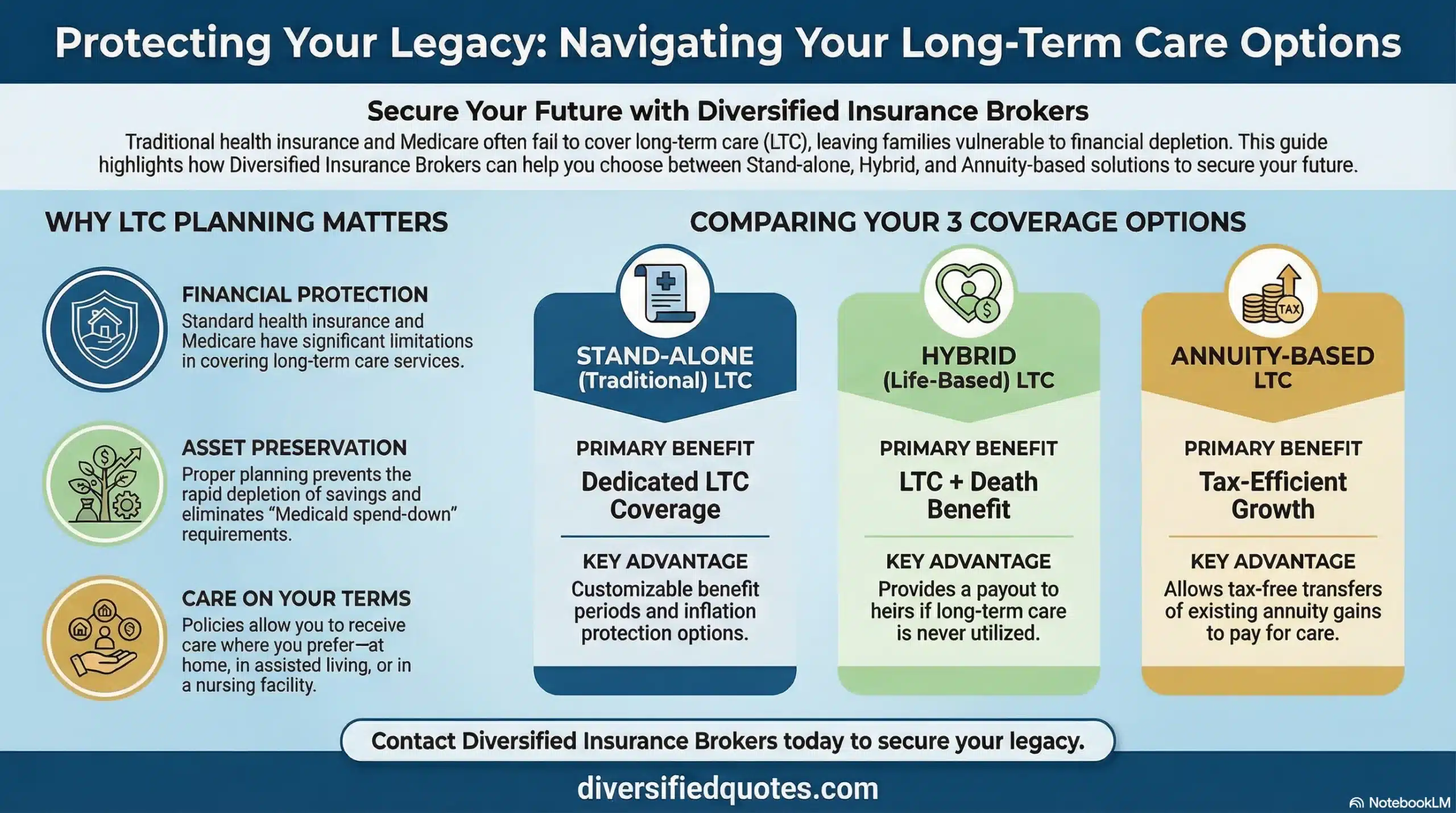
Talk to an Advisor or Request Your Annuity Quote
Ready to explore this annuity in more detail—or compare it with other carriers to see if even higher rates are available? With guaranteed income, principal protection, and long-term growth potential on the line, making the right choice is essential. The experienced advisors at Diversified Insurance Brokers will guide you through the options and design a strategy tailored to your retirement goals.
Schedule here:
calendly.com/jason-dibcompanies/diversified-quotes
Licensed in all 50 states • Fiduciary, family-owned since 1980
Frequently Asked Questions
Do I have to pick reimbursement or indemnity when I buy MoneyGuard?
No. MoneyGuard Fixed Advantage lets you make that choice when you file your first long-term care claim. Reimbursement covers submitted care expenses up to the full monthly maximum, while indemnity pays up to 80% of the monthly maximum with no receipts. The total benefit pool is the same either way, but the choice is permanent once made. Our guide to choosing the right LTC policy covers how payment methods fit into the larger decision.
What happens if my spouse and I both own MoneyGuard?
Couples receive two advantages. A couples discount applies to the long-term care rider charge based on marital status at issue, and the Benefit Transfer Rider lets the surviving spouse use death proceeds from the first policy to add long-term care benefits, death benefit, and cash value to their own policy, subject to Lincoln’s conditions. That works differently from a shared benefit pool, which our page on shared spousal LTC benefits explains.
Is the long-term care part of my premium tax deductible?
It may be. MoneyGuard Fixed Advantage splits each premium into a life portion and a long-term care portion, and the long-term care portion may qualify for a deduction as a medical expense within federal age-based limits, or through a business for some owners. Whether you benefit depends on your income, deductions, and business structure, which a tax professional can review with you. For the benefit side of the tax picture, see how tax-free LTC coverage works.
Can I fund MoneyGuard with money from my IRA or 401(k)?
Not directly. A life insurance policy generally cannot be held inside an IRA, and retirement plan money cannot be exchanged into a life policy the way existing life insurance cash value can. You can withdraw from a retirement account and use the money to pay premiums, but the withdrawal is generally taxable income and may carry a penalty before age 59½. Our guide on using retirement funds for LTC coverage covers the strategies people use.
Will Medicare pay for the care MoneyGuard is designed to cover?
Generally not. Medicare focuses on medical treatment and limited skilled care after a qualifying event, while MoneyGuard is designed for ongoing help with daily activities or supervision for cognitive impairment, which Medicare does not cover on a long-term basis. Most long-term care consists of that kind of custodial help. Our page on whether Medicare and LTC insurance are the same explains the difference.
Can I still buy MoneyGuard in my late seventies?
Possibly. MoneyGuard Fixed Advantage is available up to issue age 80, but the longest premium schedule shrinks as issue age rises, from 10 years through age 72 down to 2 years at age 80. Approval depends on medical underwriting, and health becomes a bigger factor at older ages. Our guide to LTC insurance options for seniors covers alternatives if MoneyGuard is not available to you.
How much does a MoneyGuard policy cost?
There is no single price. Cost depends on your issue age, gender, underwriting class, specified amount, benefit duration, inflation option, return of premium choice, and whether you pay a single premium or spread payments over several years. Married applicants may also receive a couples discount on the rider charge. An illustration built for you is the only reliable way to see the number. Our article on whether LTC insurance is expensive puts that cost in context.
Is MoneyGuard a better choice than saving for care on my own?
It depends on your assets and your tolerance for risk. Self-funding keeps money fully liquid but leaves you exposed to a long or costly claim. MoneyGuard turns a known premium into a larger pool of long-term care benefits, with a death benefit and return of premium if care is never needed, in exchange for surrender charges and less flexibility. Our guide on whether you should buy LTC insurance walks through that comparison.
What happens if I stop paying my MoneyGuard premiums?
It depends on timing. If the policy lapses for nonpayment while you are in a nursing home or assisted living facility and receiving benefits, those benefits continue until discharge or until the benefit limit is reached. Once three policy years have passed, a paid-up nonforfeiture benefit becomes available, equal to the greater of one month’s maximum benefit or the total long-term care charges paid. The no-lapse guarantee depends on required premiums being paid.
About the Author:
Jason Stolz, CLTC, CRPC, DIA, CAA and Chief Underwriter at Diversified Insurance Brokers (NPN 20471358), is a senior insurance and retirement professional with more than 25 years of real-world experience helping individuals, families, and business owners protect their income, assets, and long-term financial stability. As a long-time partner of the nationally licensed independent agency Diversified Insurance Brokers, Jason provides trusted guidance across multiple specialties—including fixed and indexed annuities, long-term care planning, personal and business disability insurance, life insurance solutions, Group Health, Travel Medical and Evacuation Insurance, and short-term health coverage. Diversified Insurance Brokers maintains active contracts with over 100 highly rated insurance carriers, ensuring clients have access to a broad and competitive marketplace.
His practical, education-first approach has earned recognition in publications such as VoyageATL, and contributions from his agency featured in Kiplinger and GoBankingRates— highlighting his commitment to financial clarity and client-focused planning. Drawing on deep product knowledge and years of hands-on field experience, Jason helps clients evaluate carriers, compare strategies, and build retirement and protection plans that are both secure and cost-efficient. Visitors who want to explore current annuity rates and compare options across multiple insurers can also use this annuity quote and comparison tool.
Explore More Long Term Care Insurance Options: Browse our complete guide to Hybrid & Annuity LTC Policies — covering hybrid life insurance, annuities with LTC benefits & linked benefit policies from top carriers.
Last Reviewed: September 29, 2026 |
Reviewed by: Jason Stolz, CLTC, CRPC, DIA, CAA
Chief Underwriter, Diversified Insurance Brokers, Inc. | NPN: 20471358 | Diversified Insurance Brokers, Inc. — Licensed in all 50 states
Fact Checked by: Tonia Pettitt, CMIP©
Medicare Specialist, Diversified Insurance Brokers, Inc. | NPN: 14374308 | Diversified Insurance Brokers, Inc. — Licensed in all 50 states
Did you find this content helpful? Leave us a Google review — it helps others find trustworthy guidance too.
Editorial Standards: Diversified Insurance Brokers maintains rigorous editorial standards to ensure accuracy, clarity, and independence in all content. Learn more about our editorial standards and commitment to transparency.
