
Securian Financial Secure Care Hybrid Life-Long Term Care Insurance
As an Independent Long Term Care Insurance Broker, we compare traditional, hybrid, and partnership-qualified policies across dozens of carriers to find the structure that actually fits your situation.
Securian Financial Secure Care Hybrid Life-Long Term Care Insurance
SecureCare IV, issued by Securian Financial, pays its long-term care benefit in cash, at 100% of the monthly benefit, for qualified care that includes informal care from a family member or friend, and it pays that same full benefit even when the care is received outside the United States. The premiums are guaranteed never to increase, and the benefits are guaranteed never to decrease. Put together, that means a family can decide who provides care and where, without submitting receipts and without worrying that the cost of the policy will climb later. Everything else on this page sits on top of that combination of flexibility and guarantees.

Jason Stolz, CLTC, CRPC, DIA, CAA, is Chief Underwriter at Diversified Insurance Brokers, and Securian’s SecureCare hybrid life and long-term care coverage is one our office places regularly for clients who want long-term care protection with a guaranteed premium and a death benefit for their family. As an independent long-term care insurance broker representing Securian alongside more than one hundred other carriers, our office can show you exactly how SecureCare compares with other hybrid and traditional policies and help you decide whether it is the strongest fit for your situation, rather than assuming one well-known carrier is automatically the right answer.
Considering a hybrid life and long-term care policy and want to see real numbers for your age?
Request Your LTC Quote
SecureCare IV at a Glance
| Feature | Details |
|---|---|
| Policy Type | Nonparticipating whole life insurance with cash indemnity, tax-qualified long-term care benefits |
| Issuer | Minnesota Life Insurance Company (Securian Life Insurance Company in New York) |
| Issue Ages | 40 to 75, depending on the premium payment option |
| Face Amount | $50,000 to $500,000; estimate your need with our long-term care insurance calculator |
| LTC Benefit Period | 4 to 8 years, selected at issue |
| Benefit Payment | Cash indemnity at 100% of the maximum monthly benefit, including for informal care |
| Elimination Period | 90 calendar days from certification, with benefits paid retroactively once satisfied |
| Premium Payment | Single pay, or 5, 7, 10, 15, or 20 years, with no extra charge for monthly, quarterly, or semiannual payment |
| Guarantees | Premiums never increase; benefit amounts are guaranteed; guaranteed minimum death benefit |
| Return of Premium | Three options: Vesting, 75%, or LTC Boost |
| Inflation Protection | Optional 3% or 5%, simple or compound, continuing even after a claim begins |
| Underwriting | Simplified issue; couples rate class available even if only one spouse applies; see our guide to long-term care insurance for couples |
| International | 100% of the maximum monthly benefit for qualified services outside the United States |
What SecureCare IV Actually Is
SecureCare IV is the current version of Securian’s SecureCare hybrid life and long-term care coverage. It is a nonparticipating whole life insurance policy with long-term care benefits built in, issued by Securian Financial, or by Securian Life Insurance Company in New York. The long-term care benefits are designed as tax-qualified coverage and are paid on a cash indemnity basis, which is a meaningful difference from the reimbursement design used by most traditional long-term care policies. Securian also offers SecureCare UL, a separate universal life-based version with its own design, and the two are worth comparing when both are available in your state. You can read Securian’s own overview on its long-term care and chronic illness insurance page.
Securian describes the hybrid concept plainly: a life insurance policy with built-in long-term care benefits. If you become chronically ill, the policy provides a guaranteed benefit to help cover care expenses. If you die before needing care, your family receives a guaranteed death benefit. And if you decide to cancel, you can receive a return of premium under the option you selected. That combination is the heart of the hybrid category, and our guide to understanding hybrid long-term care insurance explains how it works across carriers.
Two long-term care agreements are automatically included with every SecureCare IV policy. The Acceleration for Long-Term Care Agreement lets the policy’s death benefit be paid out for qualified care while you are living. The Extension of Long-Term Care Agreement continues long-term care benefits after the accelerated death benefit has been used, for the benefit period you select at issue. Both are part of the base design rather than optional add-ons, which keeps the core of the policy simple.
Securian is also candid about the trade-off that comes with any hybrid policy. In its own words, hybrid policies typically offer smaller long-term care benefits than a traditional long-term care policy. What they offer instead is certainty: premiums that never increase, benefits that never decrease, and value returned to your family whether or not care is ever needed. That trade-off is worth understanding clearly before you choose, and it is the first comparison worth making when considering hybrid coverage.
Four Ways to Pay for Long-Term Care
Securian’s article on the four ways to pay for long-term care lays out the options clearly, and it is a useful frame for deciding whether SecureCare belongs in your plan. The first way is relying on loved ones. Family caregiving is personal and can be affordable, but it often puts financial strain on caregivers through lost work hours and out-of-pocket costs, adds emotional stress, and may ask family members to provide care they are not trained for.
The second way is paying out of pocket. Self-funding gives you full control over where and how you receive care, but it can force withdrawals from savings or retirement accounts with tax consequences, deplete money you intended to leave to your family, and leave you uncertain whether your funds will last. The third way is traditional long-term care insurance, which typically offers the most care benefit for the premium, but premiums are not guaranteed and can increase over time, and if you never need care, no benefits are paid. We cover two leading traditional options on our pages for Thrivent long-term care insurance and Mutual of Omaha MutualCare coverage.
The fourth way is hybrid life and long-term care insurance, which is where SecureCare sits. Hybrid policies guarantee that premiums will not increase and leave a death benefit for beneficiaries even after care benefits have been used. The trade-offs are shorter payment schedules, which can make the policy more expensive in the short term, and health requirements to qualify. Many families combine two or more of these approaches, for example a hybrid policy for the core risk, family support for lighter care needs, and savings for what is left. Our comparison of hybrid life versus traditional LTC goes deeper on how to weigh the last two options against each other.
The Guarantees
Securian states that SecureCare premiums will never increase and that benefit amounts are guaranteed. For anyone who has watched a parent or friend receive a rate increase notice on a traditional long-term care policy late in life, that guarantee is often the single biggest reason to choose a hybrid. You know at purchase exactly what you will pay and exactly what the policy will provide, and those terms do not change as you age or as the long-term care industry reprices older blocks of traditional coverage.
The death benefit is guaranteed as well. If you never need long-term care, your beneficiaries receive the policy’s death benefit. If you use some of your long-term care benefits, the death benefit is reduced by what was paid, but a guaranteed minimum death benefit remains: 10% of the base face amount or $10,000, whichever is less. That residual is smaller than some competing hybrids offer, which is worth weighing if leaving a legacy matters to you as much as covering care.
The return of premium options, covered in detail below, add a third guarantee: if your plans change and you cancel, you receive back an amount determined by the option you chose. Together, those three guarantees mean the money you put into SecureCare pays for care, passes to your family, or comes back to you, rather than simply being spent.
Want to compare guaranteed hybrid coverage with a traditional policy for your age?
Compare My Options
How the Long-Term Care Benefit Is Built
SecureCare IV starts with a face amount, the policy’s death benefit, which can be set anywhere from $50,000 to $500,000. When you qualify for long-term care benefits, the Acceleration for Long-Term Care Agreement pays that death benefit out to you monthly for qualified care. Once the accelerated death benefit has been used, the Extension of Long-Term Care Agreement continues paying the monthly long-term care benefit for the remainder of the benefit period you selected. Our guide to how accelerated death benefit riders work explains the acceleration concept in more detail.
The benefit period is chosen at issue, from 4 to 8 years, and it is the key lever in the design. A longer benefit period extends the total long-term care protection well beyond the face amount itself, because the extension agreement is doing more of the work, and it costs more as a result. A shorter period keeps the premium lower but leaves you more exposed to a long claim. Understanding how a benefit period actually works is the starting point for choosing well, and the right answer usually depends on your other savings, your family history, and how long you want the policy to carry the cost of care before other resources take over.
The maximum monthly benefit is equal to the policy’s maximum long-term care benefit and is not limited by the IRS per diem limit. In practical terms, the monthly amount you select is the amount the policy pays, even if it is higher than the per diem threshold the IRS uses for tax purposes. That flexibility is valuable, but it has a tax consequence covered in the tax section below. SecureCare IV does not offer an unlimited lifetime benefit period; for buyers who want benefits that can last for life, a design such as OneAmerica’s lifetime continuation option, covered on our OneAmerica Asset Care and Annuity Care page, is worth comparing.
Choosing the Face Amount and Benefit Period
Two numbers drive almost everything about a SecureCare design: the face amount and the benefit period. The face amount sets the size of the death benefit and the foundation of the long-term care benefit. The benefit period determines how long the monthly benefit can continue once care begins, from four to eight years. Together they determine the monthly benefit and the total pool of long-term care protection, and they are the biggest drivers of premium.
A practical way to start is with the cost of care where you expect to receive it, then decide how much of that monthly cost you want the policy to carry and how much you can cover from income, savings, or family support. From there, the benefit period is a question of risk tolerance. A four-year period covers most claims, while an eight-year period protects against the long claims, often involving dementia, that do the most financial damage. Adding inflation protection then keeps the benefit relevant if the claim is decades away.
A useful way to build this part of the plan is to start from the care you would want and work backward to a premium you are comfortable with, rather than starting from a premium and seeing what it buys. Jason walks clients through both views side by side so the trade-off between benefit and cost is visible before any application is submitted.
Cash Indemnity: Benefits Paid in Cash
Most traditional long-term care policies reimburse actual expenses. Each month, bills and receipts are submitted, the insurance company decides what qualifies, and it pays only for covered services up to the monthly limit. SecureCare IV pays on a cash indemnity basis instead. Once you qualify and satisfy the elimination period, the policy pays 100% of the maximum monthly benefit for qualified services, without the month-by-month reimbursement process.
The list of qualified services is broad: adult day care, assisted living, bed reservation, caregiver training, home health care, home modification, hospice, household services, informal care, nursing home care, and respite care. Informal care and household services are the standouts. They reflect how care actually happens for most families, with a spouse, adult child, neighbor, or independent helper doing much of the work at home, often alongside help with cooking, cleaning, and errands. Our overview of what in-home care services include shows how wide that range of needs can be.
Cash indemnity also simplifies the most stressful months of a claim. Families dealing with a new care need are often coordinating doctors, arranging help, and adjusting their own schedules at the same time. Receiving a predictable monthly cash benefit, rather than managing a monthly reimbursement cycle, lets them spend that energy on the person who needs care. Nationwide’s CareMatters II uses a similar cash indemnity design, covered on our Nationwide CareMatters hybrid page, which makes the two worth comparing directly for families who value that flexibility.
Qualifying for Benefits and the Retroactive Elimination Period
To qualify for long-term care benefits, a licensed health care practitioner must certify, within the prior 12 months, that you are chronically ill. That means you are unable to perform at least two activities of daily living for at least 90 days, or you require substantial supervision because of a severe cognitive impairment. The six activities of daily living are bathing, continence, dressing, eating, toileting, and transferring. These are the federal standards used across tax-qualified long-term care coverage.
SecureCare IV then applies a 90-calendar-day elimination period, measured from the date you are certified as chronically ill. Once it is satisfied, benefits are paid retroactively for that period. In practice, the waiting period delays your first payment but does not cost you those months of benefits, which is a genuine advantage over traditional policies that treat the elimination period as a deductible where those days are simply never paid.
Because the period is counted in calendar days from certification, it does not depend on how many days of paid care you receive during those 90 days. That matters most for people who begin with light care at home, where a service-day count could stretch the waiting period for months. Our guide to how LTC elimination periods are satisfied compares the counting methods used across the market.
Premium Payment Options and Issue Ages
SecureCare IV offers six ways to pay, and the issue ages available depend on the option you choose. Shorter payment schedules are available to older applicants, while longer schedules are limited to younger ones.
| Premium Payment Option | Issue Ages |
|---|---|
| Single pay | 40 to 75 |
| 5-pay | 40 to 75 |
| 7-pay | 40 to 73 |
| 10-pay | 40 to 70 |
| 15-pay | 40 to 65 |
| 20-pay | 40 to 60 |
One detail in this design deserves attention. For multi-pay policies, Securian makes every premium mode available with no modal factor, which means paying monthly, quarterly, or semiannually costs the same total per year as paying annually. That is not true of every carrier. On our Mutual of Omaha MutualCare review, for example, paying monthly adds 8% to the annual cost. For clients who prefer monthly budgeting, SecureCare’s approach removes that penalty entirely.
Single pay suits people repositioning savings already set aside for long-term care or emergencies, often money sitting in a savings account or certificate of deposit. Five-pay and seven-pay suit people who want the obligation finished quickly, while ten-, fifteen-, and twenty-pay make the product accessible to younger buyers who would rather pay from income. An optional Premium Waiver for Long-Term Care Agreement can be added to multi-pay policies so that premiums are waived while you are receiving long-term care benefits.
Return of Premium Options
SecureCare IV offers three return of premium options, and the choice determines how much liquidity you keep versus how much long-term care benefit you get for your premium. The Vesting option returns 100% of premium if the policy is canceled, subject to a vesting schedule. The 75% option returns 75% of premium paid if the policy is canceled at any time, with a higher long-term care benefit than the Vesting option in exchange for the lower refund. The LTC Boost option returns the policy’s guaranteed cash value at surrender and maximizes the long-term care benefit for the premium paid.
The right choice depends on how confident you are that the money is committed. If there is a realistic chance you will need the money back in the early years, a stronger refund option protects you. If you are confident the premium is permanently set aside for care and legacy, LTC Boost buys the most protection. Our overview of LTC insurance with return of premium explains how to weigh the added cost of a refund feature against the benefit.
For many clients, this decision is also where the classic objection to long-term care insurance, “What if I pay for years and never use it?”, gets answered. Between the death benefit, the return of premium option, and the long-term care benefit itself, SecureCare is designed so the premium does not simply disappear.
Inflation Protection
An optional Long-Term Care Inflation Protection Agreement increases the monthly long-term care benefit by a set percentage each year, and those increases continue even after a claim has begun. You can choose 3% or 5%, applied as either simple or compound growth. Compound growth builds on each prior year’s increase, while simple growth adds the same dollar amount each year based on the original benefit.
The difference becomes large over time. Using a hypothetical $5,000 monthly benefit to show the arithmetic, after 15 years the benefit would grow to about $7,250 with 3% simple, about $7,790 with 3% compound, about $8,750 with 5% simple, and about $10,395 with 5% compound. For a buyer in their forties or early fifties, whose claim is most likely decades away, compound protection can be the difference between a benefit that keeps pace with care costs and one that covers a shrinking share of them. For buyers in their late sixties or seventies, simple inflation or a larger starting benefit may be the more efficient choice.
Because the increases continue after a claim begins, inflation protection also matters for long claims. Someone who needs care for six or eight years benefits from a monthly amount that keeps rising during the claim itself, not only before it.
International Coverage
SecureCare IV pays 100% of the maximum monthly benefit for all qualified services, including informal care, when received outside the United States, its territories, or possessions. That is among the most generous international provisions we have reviewed. Many long-term care policies limit foreign care to a short period, a percentage of the benefit, or a handful of countries, and some do not address it at all.
For comparison, Nationwide’s CareMatters II provides full international benefits only during its two-year acceleration period, with no international benefits under its extension rider. For clients who travel extensively, spend part of the year abroad, have children living overseas, or may eventually relocate outside the country, SecureCare’s approach removes a significant planning gap. Our overview of using long-term care insurance overseas covers what else to consider when planning for care abroad.
Because informal care is included internationally as well, a family member living abroad could provide care and the full benefit would still be available, which is a meaningful advantage for families spread across countries.
Underwriting and Couples Pricing
SecureCare IV uses simplified issue underwriting with sex-distinct pricing across four rate classes: non-tobacco single, non-tobacco couples, tobacco single, and tobacco couples. Simplified issue generally means a shorter process than full medical underwriting, although applicants still answer health questions and approval is not guaranteed. Answers must be complete and accurate, because a misrepresentation can put a future claim at risk.
The couples class is an unusual feature. A couple’s discount is available through its own underwriting class, and only one spouse needs to apply to receive it. In many other policies, couples discounts require both partners to apply and be approved. For a household where one spouse is uninsurable or simply does not want coverage, SecureCare still allows the applying spouse to benefit from couples pricing.
Jason reviews a client’s health history before any application is submitted, so that the product and rate class you see are ones you are likely to receive, and so that concerns can be addressed before underwriting rather than after a decision comes back.
Planning as a Couple
SecureCare’s couples pricing is one of its most practical features. Because the couples rate class is available even when only one spouse applies, a household can capture couples pricing on one policy without requiring both spouses to buy coverage or qualify. That matters in the common situation where one spouse is already covered, is not insurable, or simply does not want a policy.
When both spouses want coverage, each has a separate policy, and each policy’s benefit period, face amount, and inflation option can be tailored to that person. Couples can choose different designs, for example a longer benefit period for the spouse with a family history of dementia, or a larger benefit for the spouse who is younger and likely to face higher care costs later. Separate policies also mean each spouse’s benefits are protected for that spouse alone.
The other planning question for couples is what happens to the healthy spouse’s finances while the other is receiving care. The death benefit and residual death benefit help protect the survivor, but outside income and savings still matter. Jason reviews both spouses’ needs together so that the long-term care plan and the survivor’s plan fit.
The Death Benefit If You Never Need Care
If long-term care is never needed, your beneficiaries receive the policy’s death benefit, generally income tax-free. Long-term care benefits paid during your lifetime reduce the death benefit, because the first stage of the long-term care benefit is an acceleration of it, but a guaranteed minimum death benefit of 10% of the base face amount or $10,000, whichever is less, remains payable even after benefits are used.
That residual is worth comparing across carriers. Nationwide’s CareMatters II, for example, guarantees a residual death benefit of 20% of the specified amount. If the legacy portion matters to you, the difference between those residuals can be significant on a larger policy, and it belongs in the comparison alongside premium, benefit period, and international coverage.
As with any hybrid policy, SecureCare is designed first as long-term care protection with a death benefit that protects the premium, rather than as a primary life insurance policy for income replacement. If you still have a significant life insurance need, that need should be covered separately.
What to Expect at Claim Time
When a care need arises, the claim process starts with notifying Securian and obtaining certification from a licensed health care practitioner that the insured is chronically ill, meaning unable to perform at least two activities of daily living for at least 90 days or requiring substantial supervision because of a severe cognitive impairment. That certification must have been made within the prior 12 months, so ongoing claims generally involve periodic recertification.
The 90-calendar-day elimination period runs from the date of certification. Once it is satisfied, benefits for that period are paid retroactively, and the monthly cash benefit continues from there for as long as the insured remains eligible and benefits remain under the policy. If premiums are still being paid on a multi-pay policy, the optional premium waiver agreement, if it was added, waives premiums while benefits are being received.
Jason and our office stay involved at claim time. Our office can be your first call when a care need arises, and we help families understand what the policy provides, what documentation will be needed, and how the retroactive elimination period and cash benefit will work in their specific situation, so the family can focus on care rather than paperwork.
Tax Treatment
SecureCare IV’s long-term care benefits are designed as tax-qualified coverage. Cash indemnity benefits for a chronically ill individual are generally received income tax-free up to the greater of the IRS per diem limit for the year or the actual qualified long-term care costs incurred. Because SecureCare’s monthly benefit is not capped at the per diem limit, a benefit above that limit could be partly taxable if it exceeds your actual qualified care costs. For most buyers choosing a benefit in line with local care costs, this will not be an issue, but it is worth understanding before selecting a very large monthly benefit.
The death benefit paid to beneficiaries is generally received income tax-free. As with all tax matters, individual situations vary, and the specifics should be confirmed with a qualified tax professional. Our guide to the tax advantages of hybrid LTC policies explains how these rules generally apply.
Want to see how SecureCare compares with other hybrid policies for your age and health?
Run My Comparison
Financial Strength
Securian Financial holds strong ratings from all four major rating agencies. According to Securian’s financial strength ratings page, Minnesota Life Insurance Company and Securian Life Insurance Company are rated A+ (Superior) by AM Best, AA (Very Strong) by Fitch, Aa3 (Excellent) by Moody’s, and AA- (Very Strong) by S&P, with a Comdex ranking of 95 out of 100. Securian also notes that it has maintained ratings of A or higher for 75 years. Ratings reflect the agencies’ opinions of claims-paying ability and can change, so our office confirms current ratings before finalizing a recommendation.
Securian operates under a mutual holding company structure and is not publicly traded, which it says allows it to focus on the long-term security of its customers rather than short-term shareholder returns. Its history spans nearly a century and a half. For a product whose central promise is that premiums and benefits will not change over decades, the strength and stability of the company behind that promise is not a side detail.
That rating profile is among the strongest of the carriers in our long-term care series, which is one reason SecureCare is a natural candidate for clients who put financial strength near the top of their priorities.
How SecureCare IV Compares With Other Hybrids
We have reviewed several hybrid policies, and a side-by-side view makes the structural differences clear. Each has real strengths, and the right one depends on what you value most.
| Feature | Securian SecureCare IV | Nationwide CareMatters II | OneAmerica Asset Care |
|---|---|---|---|
| Base Policy | Whole life | Universal life | Whole life |
| How Benefits Pay | Cash indemnity, 100% of the monthly benefit | Cash indemnity, 100% of the monthly benefit | Includes a cash benefit option for informal care |
| Benefit Duration | 4 to 8 years | 2 to 8 years | Up to lifetime with continuation rider |
| Minimum Death Benefit | 10% of face or $10,000, whichever is less | 20% of the specified amount | Varies by design |
| Return of Premium | Vesting, 75%, or LTC Boost | Minimum refund or Vested | Single premium with return of premium rider |
| International | 100% of the monthly benefit for all qualified services | 100% during the two-year acceleration period only | Confirm with our office |
| Underwriting | Simplified issue | Underwritten; exam may be required | Medically underwritten |
| Issue Ages | 40 to 75 | 30 to 75 | Generally up to 80 |
The pattern is clear. SecureCare IV stands out for its international coverage, its no-modal-factor premium payments, its couples pricing that requires only one spouse to apply, its three return of premium choices, and the strongest rating profile of the group. Nationwide stands out for a larger residual death benefit and younger issue ages. OneAmerica stands out for its lifetime benefit option. None is universally better, and the right choice depends on which of those features matters most to you, which is why our office prices several options for nearly every client who asks about hybrid coverage.
It also helps to compare hybrids against traditional coverage, not only against each other. Traditional policies such as the Thrivent and MutualCare designs we review often deliver more long-term care benefit for each premium dollar, while hybrids like SecureCare trade some of that leverage for guaranteed premiums, a death benefit, and a return of premium option. Seeing both types priced for the same age and health is usually what makes the right choice clear.
Chronic Illness Riders: A Different Tool
Securian also mentions a second way life insurance can help with care costs: a life insurance policy with an accelerated death benefit or chronic illness rider. These riders allow part of the death benefit to be accessed early if the insured becomes chronically ill, but they work differently from SecureCare. A chronic illness rider on a standard life policy typically has no extension of benefits beyond the death benefit, some designs reduce the death benefit by more than the amount paid out, and the policy is designed mainly as a life insurance policy with a safety valve rather than as dedicated long-term care protection.
For someone whose primary need is life insurance, with care costs as a secondary concern, a chronic illness rider can be a sensible, low-cost addition. For someone whose primary concern is paying for long-term care, a dedicated hybrid like SecureCare, with its extension agreement, cash indemnity benefit, and inflation options, is usually the stronger tool. The distinction matters, and it is worth settling before choosing a product for care costs.
Some households use both: a term or permanent policy for income replacement with a chronic illness rider as a backstop, and a hybrid policy dedicated to long-term care. Looking at both needs together is the best way to avoid paying twice for the same protection or leaving a gap between them.
Important Information About This Policy
SecureCare IV is a nonparticipating whole life insurance policy with long-term care benefits, issued by Minnesota Life Insurance Company, or by Securian Life Insurance Company in New York. Product features and availability may vary by state, and the policy may not be available in all states. All guarantees are backed by the claims-paying ability of the issuing insurance company. Long-term care benefits paid reduce the policy’s death benefit and cash value, and loans or withdrawals, where permitted, also reduce policy values.
Benefits are subject to the policy’s definitions, eligibility requirements, elimination period, limitations, and exclusions, which are described in full in the policy and its agreements. Approval is subject to underwriting. The inflation examples on this page are hypothetical arithmetic, not quotes. This information is educational and is not tax, legal, or investment advice, and you should consult your own tax or legal professional about your situation. Securian’s product materials and state approval documents govern the final terms available to you.
Who Fits SecureCare, and Who Does Not
SecureCare IV tends to fit people who want guaranteed premiums, a cash benefit they can use for informal care and household help, and full coverage if they spend time abroad or relocate. It is a strong match for buyers who put a premium on carrier strength, for couples where only one spouse wants or can get coverage, for buyers who prefer monthly payments without a modal surcharge, and for people who want a choice among several return of premium options.
It is a weaker fit for buyers who want the largest possible long-term care benefit per premium dollar, where a traditional policy may deliver more coverage. It is also limited for people who want benefits that can last for life, since the benefit period tops out at eight years, for anyone under 40, and for buyers who place a high value on a large residual death benefit after care benefits are used. And because it is designed for long-term care first, it is not a substitute for primary life insurance.
How We Help
Jason and our office help clients decide between SecureCare, other hybrid policies, and traditional long-term care insurance from the first conversation. That starts with reviewing your health history, your savings, and your goals, then pricing SecureCare alongside other options so you can see the real trade-offs between guaranteed premiums, total care benefit, legacy, and liquidity for your age and health. We illustrate multiple benefit periods, payment schedules, inflation choices, and return of premium options, because the right combination is rarely obvious until it is side by side.
Because we are independent, we are not obligated to recommend Securian or any other carrier. If a different policy fits your health, your budget, or your goals better, that is the policy we will recommend. Our guide to why an independent LTC broker matters explains why that independence is especially valuable when hybrid designs differ as much as they do.
Ready to find out whether SecureCare is the right long-term care solution for you?
Start My LTC Review
Financial Protection Essentials
Explore self-funding, annuity-based care options, and the estate planning decisions that pair with long-term care coverage.
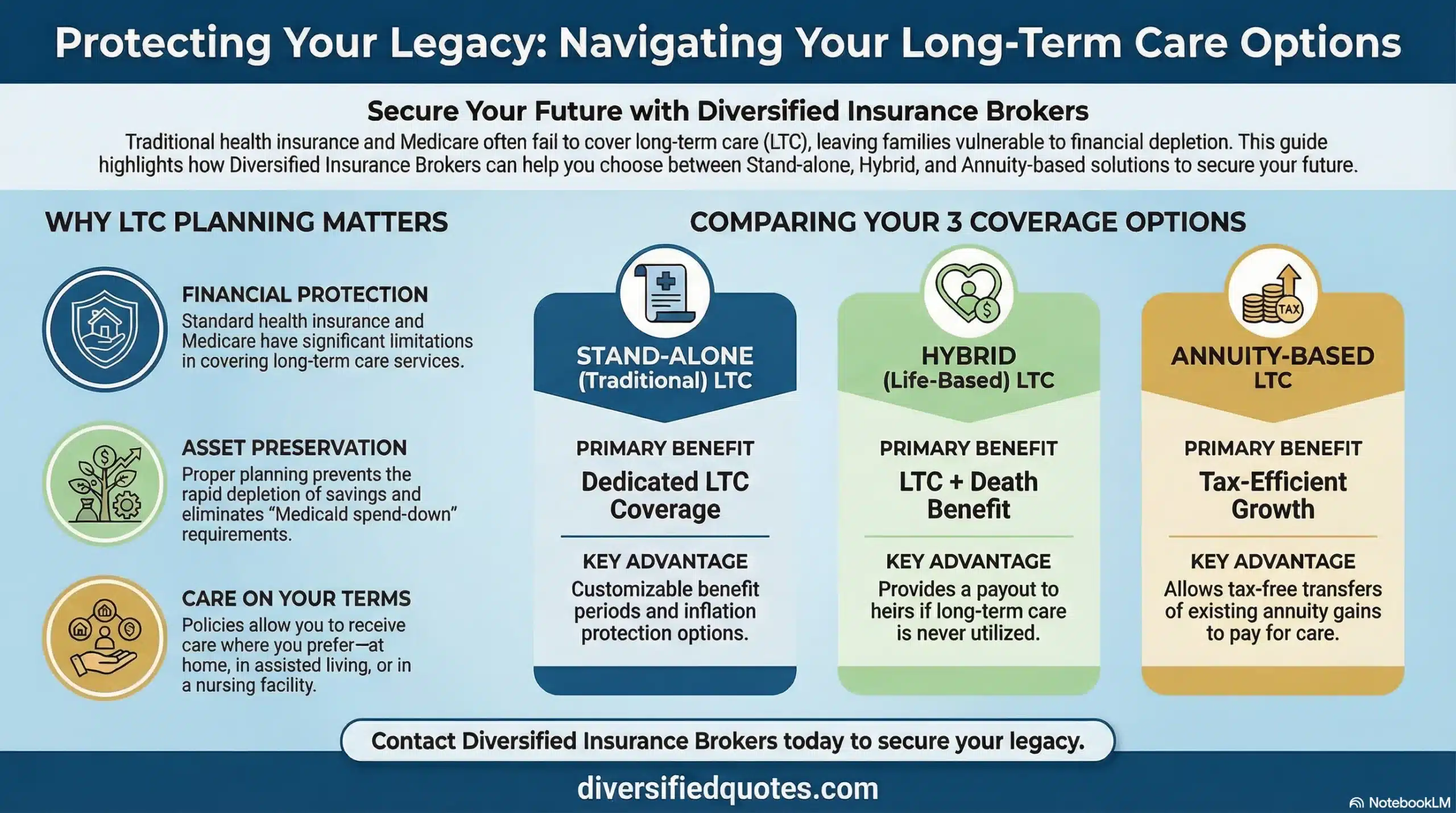
Talk to an Advisor or Request Your Annuity Quote
Ready to explore this annuity in more detail—or compare it with other carriers to see if even higher rates are available? With guaranteed income, principal protection, and long-term growth potential on the line, making the right choice is essential. The experienced advisors at Diversified Insurance Brokers will guide you through the options and design a strategy tailored to your retirement goals.
Schedule here:
calendly.com/jason-dibcompanies/diversified-quotes
Licensed in all 50 states • Fiduciary, family-owned since 1980
Frequently Asked Questions
What kind of policy is Securian SecureCare?
SecureCare IV is a whole life insurance policy with built-in long-term care benefits, often called a hybrid or linked-benefit policy. It pays a monthly cash benefit if you need qualified long-term care, a death benefit to your family if you do not, and a return of premium if you cancel, based on the option you choose. Our overview of hybrid long-term care insurance explains the category.
Can SecureCare premiums ever go up?
No. Securian states that SecureCare premiums will never increase and that benefit amounts are guaranteed. That guarantee is the main difference from traditional long-term care insurance, where premiums can be raised for an entire class of policyholders. Our breakdown of whether long-term care insurance is worth it covers how to weigh that certainty against cost.
Can I use SecureCare to pay a family member for care?
Yes. SecureCare IV pays on a cash indemnity basis, and informal care and household services are among its qualified services, so the benefit can help pay a family member, friend, or independent helper. It also pays 100% of the monthly benefit for qualified services received outside the United States. Our overview of how much long-term care insurance you need helps size the benefit around the care you expect.
Are SecureCare benefits taxable?
Cash indemnity long-term care benefits are generally income tax-free up to the greater of the IRS per diem limit or your actual qualified care costs. Because SecureCare’s monthly benefit is not capped at the per diem limit, amounts above it could be taxable if they exceed actual costs. The death benefit is generally income tax-free. See our overview of whether long-term care benefits are taxable, and confirm your situation with a tax professional.
Doesn’t Medicare cover long-term care?
No. Medicare generally covers only limited, short-term skilled care, not ongoing custodial care such as help with bathing, dressing, or supervision for dementia, which is what most long-term care consists of. Our guide to what Medicare covers for long-term care explains the gap.
Is it hard to qualify for SecureCare?
SecureCare IV uses simplified issue underwriting, which is generally a shorter process than full medical underwriting, but applicants still answer health questions and approval is not guaranteed. Issue ages run from 40 to 75, depending on the payment option. Our guide to LTC insurance with preexisting conditions explains how health history affects your options.
How is SecureCare different from a chronic illness rider?
A chronic illness rider lets you access part of a life insurance death benefit early if you become chronically ill, but it typically does not extend benefits beyond the death benefit and is designed mainly as life insurance. SecureCare is dedicated long-term care coverage with an extension agreement, cash indemnity benefits, and inflation options. Our overview of life insurance with living benefits covers chronic illness riders in more detail.
I already have a SecureCare illustration. Can your office review it?
Yes. Our office can review the design you were shown, including the benefit period, payment schedule, inflation option, and return of premium option, and compare it with other hybrid and traditional carriers on the same benefits. You can request a second opinion on your LTC quote before you apply.
About the Author:
Jason Stolz, CLTC, CRPC, DIA, CAA and Chief Underwriter at Diversified Insurance Brokers (NPN 20471358), is a senior insurance and retirement professional with more than 25 years of real-world experience helping individuals, families, and business owners protect their income, assets, and long-term financial stability. As a long-time partner of the nationally licensed independent agency Diversified Insurance Brokers, Jason provides trusted guidance across multiple specialties—including fixed and indexed annuities, long-term care planning, personal and business disability insurance, life insurance solutions, Group Health, Travel Medical and Evacuation Insurance, and short-term health coverage. Diversified Insurance Brokers maintains active contracts with over 100 highly rated insurance carriers, ensuring clients have access to a broad and competitive marketplace.
His practical, education-first approach has earned recognition in publications such as VoyageATL, and contributions from his agency featured in Kiplinger and GoBankingRates— highlighting his commitment to financial clarity and client-focused planning. Drawing on deep product knowledge and years of hands-on field experience, Jason helps clients evaluate carriers, compare strategies, and build retirement and protection plans that are both secure and cost-efficient. Visitors who want to explore current annuity rates and compare options across multiple insurers can also use this annuity quote and comparison tool.
Explore More Long Term Care Insurance Options: Browse our complete guide to Hybrid & Annuity LTC Policies — covering hybrid life insurance, annuities with LTC benefits & linked benefit policies from top carriers.
Last Reviewed: September 29, 2026 |
Reviewed by: Jason Stolz, CLTC, CRPC, DIA, CAA
Chief Underwriter, Diversified Insurance Brokers, Inc. | NPN: 20471358 | Diversified Insurance Brokers, Inc. — Licensed in all 50 states
Fact Checked by: Tonia Pettitt, CMIP©
Medicare Specialist, Diversified Insurance Brokers, Inc. | NPN: 14374308 | Diversified Insurance Brokers, Inc. — Licensed in all 50 states
Did you find this content helpful? Leave us a Google review — it helps others find trustworthy guidance too.
Editorial Standards: Diversified Insurance Brokers maintains rigorous editorial standards to ensure accuracy, clarity, and independence in all content. Learn more about our editorial standards and commitment to transparency.
