
National Guardian Life Insurance Company Long Term Care Insurance
As an Independent Long Term Care Insurance Broker, we compare traditional, hybrid, and partnership-qualified policies across dozens of carriers to find the structure that actually fits your situation.
As an Independent Life Insurance Broker, we compare rates across 100+ carriers and prescreen every application before submission.
National Guardian Life Insurance Company Long Term Care Insurance
When two people plan for long-term care together, their needs may arrive years apart and last very different lengths of time, yet a standard individual policy treats each person as a separate case. National Guardian Life’s HonestLTC policy lets two partners, married or not, share one joint policy, add a third pool of benefits that either partner can draw on after using up their own, and stop paying the entire joint premium as soon as either partner begins receiving benefits. That joint design is what makes HonestLTC stand out among traditional long-term care policies, and everything else sits on top of it.

Jason Stolz, CLTC, CRPC, DIA, CAA, is Chief Underwriter at Diversified Insurance Brokers, and National Guardian Life’s HonestLTC is one our office places regularly for individuals and couples who want dedicated long-term care coverage rather than a life insurance hybrid. Working as an independent long-term care insurance broker with more than one hundred carriers, our office can price HonestLTC next to other traditional and hybrid designs and help you decide which approach fits your health, your budget, and your family.
Want to see what an HonestLTC policy would cost for you or for you and your partner?
Get My HonestLTC Quote
HonestLTC Coverage Specifications
| Feature | HonestLTC Detail |
|---|---|
| Policy Type | Individually underwritten, tax-qualified, reimbursement long-term care insurance |
| Coverage | Comprehensive: home and community care services plus facility care services |
| Issue Ages | 35 to 79, based on age last birthday |
| Maximum Monthly Benefit | $1,500 to $12,000, in $300 increments (state minimums may vary) |
| Benefit Period | 2, 3, 4, 5, or 6 years |
| Elimination Period | 90 or 180 calendar days, cumulative and satisfied once. |
| Inflation Options | Optional 1%, 2%, 3%, 4%, or 5% compound inflation protection |
| Premium Payment | Lifetime payments or a 10-year payment option |
| Policy Structure | Individual or joint policies; joint policies available to partners living in the same household |
| Discounts | 5% partner discount and 5% association group discount where eligible; see more ways to get the best LTC rates |
| Waiver of Premium | Included in the base policy, including the 10-year payment option |
Who Stands Behind the Policy
National Guardian Life was founded in Madison, Wisconsin, more than a century ago and has long operated as a mutual insurer. Today the insurance company carries the legal name NGL Insurance Company and is ultimately owned by NGL Mutual Holding Company, a structure that keeps the organization owned for the benefit of its policyholders rather than outside shareholders. You will see both names used interchangeably in NGL’s materials, and “NGL” is the brand that appears on HonestLTC documents. You can read NGL’s own overview on its NGL long-term care insurance page.
NGL expanded into long-term care insurance with its EssentialLTC policy. HonestLTC is NGL’s second-generation traditional long-term care product, designed to improve key provisions of the earlier policy while keeping its value-oriented features, and it replaces EssentialLTC for new policies as it is approved state by state.
AM Best rates NGL Insurance Company A (Excellent) for financial strength, with a long-term issuer credit rating of a (Excellent) and a stable outlook, according to AM Best’s NGL company profile. An A rating is AM Best’s third-highest level, and it places NGL among the financially sound insurers in the long-term care market, though several larger carriers hold higher ratings. Because rating agencies revisit their opinions periodically, check the current rating when you are ready to buy.
For a traditional long-term care policy, where premiums are paid for years before most claims occur, the insurer’s stability and its approach to pricing matter as much as the benefit design. NGL’s decision to enter and then re-engineer its long-term care line reflects a sustained commitment to a market that many insurers have exited over the years.
A Traditional Policy in a Hybrid-Heavy Market
Hybrid policies that pair life insurance with long-term care benefits have become a major part of the market. HonestLTC takes the traditional route. Every premium dollar goes toward long-term care protection rather than a death benefit or cash value, which means a traditional policy can often buy more care coverage per premium dollar than a hybrid, particularly at younger ages.
The need for that coverage is well documented. Federal guidance on the likelihood of needing care puts the chance at close to 70% that a person reaching 65 will eventually need long-term care services and supports, and roughly 20% of people will need care that lasts beyond five years. NGL’s own materials describe the situations its policy is designed for, including physical decline with age, a debilitating injury requiring rehabilitation, a progressive illness, severe cognitive impairment such as dementia, chronic conditions, and combinations that call for several types of care each month.
Traditional coverage has trade-offs. Premiums are not guaranteed for the life of the policy, and if care is never needed, there is no death benefit or cash value to return. Buyers who want every dollar working toward care may accept those trade-offs, while buyers who dislike them tend to lean toward a hybrid. Our pages on Thrivent’s long-term care policy and Mutual of Omaha’s MutualCare plans review two other traditional options that are natural comparisons for HonestLTC.
Designing Your Benefit: Monthly Amount, Period, and Pool
Three choices shape the size of an HonestLTC policy. The first is the maximum monthly benefit, which can be set anywhere from $1,500 to $12,000 in $300 increments, subject to state minimums. This is the most the policy will reimburse in a month for covered care. The second is the benefit period, which can be 2, 3, 4, 5, or 6 years. Together, the monthly benefit and the benefit period establish the policy limit, which is the total amount of benefits available.
Because HonestLTC reimburses actual covered expenses, the policy limit is reduced only by the benefits actually paid. In a month when care costs less than the maximum, less of the policy limit is used, and the remaining benefits stay available for later. A family using a few days of home care each week, for example, may draw down the policy limit much more slowly than someone in full-time facility care.
The third choice is inflation protection, covered in more detail below, which increases the maximum monthly benefit and the policy limit each year. Getting the balance right among these three choices is the heart of designing a traditional policy. A larger monthly benefit protects against high-cost facility care, a longer benefit period protects against extended claims, and inflation protection protects against rising costs over time. Each adds premium.
A practical starting point is what care actually costs in the town or region where you plan to live. Jason can help you estimate local costs for home care, assisted living, and nursing facility care, then build a design that covers a realistic share of those costs without paying for more coverage than you need.
Elimination Period Choices and the One-Day-Equals-Seven Rule
HonestLTC offers an elimination period of 90 or 180 calendar days, with some state exceptions. The elimination period is the waiting period after you become eligible for benefits before the policy begins paying, and it works much like a deductible measured in time. A longer elimination period lowers the premium, while a shorter one means benefits begin sooner.
Two features make HonestLTC’s elimination period more forgiving than a strict count of consecutive days. First, it is cumulative and needs to be satisfied only once in your lifetime, so days do not have to be consecutive and a later claim does not require starting over. Second, NGL counts one day of covered care as seven days toward the elimination period. Someone who receives covered home care just one day each week can therefore satisfy a 90-day elimination period in about 13 weeks of calendar time rather than needing 90 separate days of paid care.
For buyers who expect to start with home care, the optional First Day Home and Community Care Services Rider removes the elimination period for home and community care entirely. With that rider, benefits for home and community care services are payable from the first day you qualify, while the elimination period still applies to facility care.
Choosing between 90 and 180 days usually comes down to how much you could comfortably pay from savings before benefits start. Covering six months of care is a significant commitment, so the lower premium of the longer option should be weighed against that potential out-of-pocket cost.
Would a joint HonestLTC policy make sense for you and your partner?
Compare Joint and Individual Pricing
What Qualifies You for Benefits
HonestLTC pays benefits when you are chronically ill as defined in the policy and receiving qualified long-term care services. That definition mirrors the one federal law uses for tax-qualified policies. Within the previous 12 months, a licensed health care practitioner must have certified that you either cannot perform at least two activities of daily living without substantial assistance for a period expected to last at least 90 days because of a loss of functional capacity, or that you require substantial supervision because of a severe cognitive impairment.
The six activities of daily living used in long-term care insurance are bathing, continence, dressing, eating, toileting, and transferring. The cognitive path to benefits is especially important for conditions that affect memory and judgment, since a person can remain physically capable while still needing supervision to stay safe.
Understanding the trigger avoids common misunderstandings. A diagnosis by itself does not open a claim, and help with chores alone does not qualify while a person still handles their own personal care. Benefits flow once a practitioner certifies the functional or cognitive loss and qualified services begin under a plan of care. Care coordination, described below, can help families assemble the documentation a claim requires.
Where Care Can Happen
HonestLTC is a comprehensive policy, which means it covers both home and community care services and facility care services. NGL’s consumer page describes coverage for care in nursing facilities, adult day care centers, and at home. Home and community care allows many people to remain in familiar surroundings for as long as possible, and our overview of what adult day care provides explains one of the community services that can help family caregivers keep working.
When facility care becomes necessary, room and board charges in a nursing facility or assisted living facility are reimbursable once eligibility requirements are met. NGL conditions that reimbursement on the receipt of, and payment for, qualified long-term care services in a nursing facility, assisted living facility, hospice care facility, or memory care facility. The inclusion of memory care facilities is significant for families planning around the possibility of dementia.
The policy also includes an alternate plan of care provision. If you are receiving benefits, continue to meet the eligibility requirements, and you or your representative, your licensed health care practitioner, and NGL agree that an alternative service is cost-effective, appropriate to your needs, provides equal or greater quality of care, and qualifies as a long-term care service, the policy can pay for it. That flexibility allows the coverage to adapt to care approaches that may not exist yet.
Built-In Benefits Beyond the Monthly Maximum
HonestLTC includes several additional benefits in the base policy. Most of them are paid from the policy limit, meaning they reduce the total benefits available, but they address real needs that often arise during a claim.
| Benefit | What It Provides |
|---|---|
| Respite Care | Up to one maximum monthly benefit per calendar year to give a primary caregiver relief; not subject to the elimination period |
| Facility Bed Reservation | Up to one maximum monthly benefit per calendar year to hold a facility bed |
| Emergency Response System | Reimbursement of up to $50 per month |
| Caregiver Training | Lifetime maximum equal to one-sixth of the maximum monthly benefit |
| Care Outside the U.S. | Up to one maximum monthly benefit per calendar year for covered care outside the United States, its territories, and Canada |
| Care Coordination | Available on request once eligible, at no cost, and does not reduce the policy limit |
| Waiver of Premium | Future premiums waived once benefits begin; on a joint policy, the entire joint premium is waived when either partner is on claim |
Care coordination deserves particular mention. Once you meet the eligibility requirements, you may request a care coordinator at any time you are receiving benefits to help identify providers of qualified services in your area, obtain the claim documentation NGL needs, and monitor the services you receive under your provider’s plan of care. Using the service is optional, and it does not reduce your benefits.
The international benefit is limited compared with benefits in the United States, so anyone planning to spend extended time abroad should factor that into their planning. The annual limit applies to care outside the United States, its territories, and Canada, so anyone expecting to receive care in Canada should review how the policy handles it.
Following an HonestLTC Claim Step by Step
A claim starts when a licensed health care practitioner certifies that the insured meets the policy’s definition of chronically ill, either through the loss of two activities of daily living or through severe cognitive impairment, and a plan of care is in place. From that point, the insured or a family member can ask NGL for a care coordinator, who can help identify local providers of covered services and gather the documentation NGL needs to process the claim.
Next comes the elimination period, unless the First Day Home and Community Care Services Rider applies to home care. Each day of covered care counts as seven days toward the 90 or 180 days, and the period only has to be satisfied once. Respite care is not subject to the elimination period, so a family caregiver can get relief even before regular benefits start.
Once benefits begin, NGL reimburses covered expenses up to the maximum monthly benefit, and future premiums are waived. On a joint policy, the whole joint premium stops, even if only one partner is receiving care. Each payment reduces the policy limit, while any inflation rider continues to raise the maximum monthly benefit on each policy anniversary without regard to claims paid. If a partner on a joint policy with the shared rider exhausts their own policy limit, the third pool becomes available.
Claims are often managed by a spouse or adult child during a stressful time. Reviewing this sequence with Jason ahead of time means the relatives who might handle a future claim will already know which forms, certifications, and receipts NGL expects.
Joint Policies for Partners, Married or Not
HonestLTC’s approach to couples is its signature feature. Joint policies and joint premium rates are available to partners who live in the same household, and the partners do not need to be married. NGL also allows related applicants to share a joint policy if they are of the same generation, such as siblings who live together. That flexibility reflects how many households actually plan for care today.
A joint policy brings two built-in advantages. The first is joint waiver of premium: when either partner begins receiving benefits, the premium for the entire joint policy is waived, not just the portion for the partner on claim. For a couple relying on one household budget, that relief can be meaningful at exactly the moment care costs begin.
The second advantage is optional. The Shared Additional Policy Limit Rider creates a third pool of benefits that either or both partners can access if they exhaust their own policy limits. That shared pool also grows with any inflation protection rider on the policy. If one partner dies, NGL states that the surviving partner can choose to keep the third pool of benefits, and the premium will be reduced. Our explanation of how shared care riders work compares this approach with the shared-benefit designs of other carriers.
Individuals are not left out. A 5% partner discount is available to an individual applicant who has an eligible partner who is not applying for coverage, which recognizes that people in a household often support one another before paid care is needed. Jason can price both joint and individual designs for a couple, so you can see which structure delivers more protection for the premium.
Inflation Protection From 1% to 5%
A policy bought in your fifties may not pay a claim for twenty years or more, and care costs are likely to rise during that time. HonestLTC offers optional compound inflation protection at 1%, 2%, 3%, 4%, or 5%. On each policy anniversary, the maximum monthly benefit increases by the chosen percentage of the previous year’s monthly benefit, without regard to claims paid, and the policy limit increases correspondingly, reduced by any claims paid.
Offering five levels of inflation protection gives buyers more control than a simple choice between none and 5%. A 3% compound rider, for example, roughly doubles the monthly benefit over about 24 years, while a 5% rider roughly doubles it in about 14 years. Lower percentages keep premiums more manageable while still providing some growth, which can be a sensible middle ground for buyers who would otherwise skip inflation protection entirely.
The right level depends mainly on age. Younger buyers have more years for inflation to erode a fixed benefit and often benefit most from higher compound rates. Older buyers, whose claims are likely to come sooner, may get more value from a modest inflation rate paired with a bigger initial monthly benefit. Jason can illustrate several inflation levels side by side so you can see how the benefit and the premium change with each.
Paying for Coverage: Lifetime or 10-Year
HonestLTC offers two premium payment options. With lifetime payment, premiums continue each year while the policy is in force, until benefits begin and the waiver of premium applies. With the 10-year payment option, all premiums are compressed into a 10-year window, and once those payments are complete, no more premiums are due. Waiver of premium applies to the 10-year option as well.
The 10-year option costs more each year but can be attractive for buyers who want to finish paying before retirement, while their income is higher, or who want to limit their exposure to future premium changes by completing payments sooner. Lifetime payment keeps the annual cost lower and may suit buyers who prefer to preserve cash flow now.
HonestLTC uses gender-distinct premium rates, with joint rates available for partners. A 5% association group discount is available to eligible applicants in addition to the partner discount described above. On premium changes, NGL’s consumer brochure states that after the first five years from the policy effective date, premiums can be changed only if NGL changes them for everyone in your state with the same policy form. As with all traditional long-term care insurance, premiums are not guaranteed never to change, which is why the lapse protections in the next section are important.
Protection If Premiums Rise or Stop
Two provisions protect the value of the premiums you have paid. The first is the Contingent Benefit Upon Lapse Endorsement, included at no additional charge. If premium rates increase so that your cumulative increase reaches or exceeds a percentage of the initial annual premium set out in a table on the endorsement, and the policy lapses within 120 days of the due date of the increased premium, you can choose either to reduce the monthly benefit amount and benefit period, subject to availability, or to keep a paid-up policy with a shortened benefit period. If the policy lapses for nonpayment during that 120-day window, the paid-up option is provided automatically.
The second is the optional Shortened Benefit Period Nonforfeiture Rider. If the policy has been in force for at least three years and then lapses for nonpayment of premium, coverage continues on a paid-up basis, with benefits equal to the greater of the total premiums paid or one times the monthly benefit amount in effect at the time of lapse.
These provisions answer one of the most common concerns about traditional long-term care insurance: that years of premiums could be lost if a rate increase or a change in circumstances makes the policy unaffordable. They do not preserve the full original benefit, but they ensure that a lapse does not leave you with nothing. Considering whether the nonforfeiture rider is worth its cost is a useful part of the design conversation, especially for buyers with tight budgets.
Want an underwriter’s review of your health history before you apply with NGL?
Request an Underwriting Review
Partnership Qualification and Medicaid Asset Protection
In select states, HonestLTC is available as a long-term care Partnership policy. Partnership programs are joint efforts between states and private insurers designed to encourage people to plan for their own care. A qualified Partnership policy may entitle the insured to an asset disregard, which generally allows a person to keep assets equal to the insurance benefits received under the policy without those assets counting against eligibility for Medicaid.
That protection can be valuable. If a long claim exhausts the policy, a Partnership policyholder who later needs Medicaid may be able to protect savings equal to the benefits the policy paid, rather than spending down nearly all assets first. For middle-income families who want to leave something to heirs even after a long care episode, that feature can make a traditional policy more attractive than it first appears. Our overview of Partnership-qualified LTC insurance explains the program in detail.
Partnership rules differ by state, including the inflation protection required for a policy to qualify at different ages, and not every state participates. Protection can also depend on where you live when you need Medicaid, since states have reciprocity arrangements that recognize one another’s Partnership policies. Our guide to LTC Partnership reciprocity between states covers what happens if you move. Our office confirms whether a proposed HonestLTC design qualifies for Partnership status in your state before you apply.
Underwriting: What NGL Reviews
HonestLTC is fully underwritten, and NGL’s underwriters evaluate functional ability, cognitive ability, and medical history. NGL advises that the underwriting process takes an average of about 35 days. Medical records are requested on every applicant, and a prescription drug history check is run for each application. The additional requirements depend on age.
| Requirement | Age 65 and Under | Age 66 and Over |
|---|---|---|
| Medical Records | Requested on all applicants | Requested on all applicants |
| Prescription History | Checked on all applicants | Checked on all applicants |
| Personal Health Interview | By telephone | Face-to-face exam used instead |
| Face-to-Face LTC Exam | At the underwriter’s discretion | Required |
| Paramedical Exam and Labs | Rare; only when a specific concern arises | Rare; only when a specific concern arises |
On joint applications, NGL may order a face-to-face exam for a partner age 60 to 65 to keep the requirements consistent between partners. Our article on whether LTC insurance requires a medical exam explains how these evaluations work and how to prepare.
HonestLTC uses one main rate class, called Premier. NGL expects roughly 97% of approved applicants to be issued at Premier, and for the remaining higher-risk insurable applicants, underwriters can make a counteroffer at an increased premium. In some cases, NGL may instead limit the benefits available. NGL’s guidelines also identify combinations of conditions, such as diabetes with heart disease or with current smoking, that are generally uninsurable, and applicants previously declined for long-term care insurance are unlikely to qualify.
That is why a pre-application review matters. Jason reviews your health history, medications, and functional status before an application goes to NGL, so you know whether HonestLTC is a realistic fit or whether another carrier is likely to view your history more favorably.
Exclusions and Limitations
Like every long-term care policy, HonestLTC has exclusions, and knowing them in advance prevents surprises at claim time. According to NGL’s consumer brochure, no benefits are paid, and the elimination period is not satisfied, for care or services provided by a member of your immediate family, or provided outside the United States, its territories, or Canada except as described under the coverage outside the United States benefit.
The policy also excludes care for which you have no financial liability or that would be provided at no charge without insurance; care at a government or veterans facility or under a government program where you are not required to pay; and care resulting from alcoholism or drug addiction, mental or nervous disorders as defined in the policy, attempted suicide or intentionally self-inflicted injury, war or active duty in the armed forces, or participation in a felony, riot, or insurrection. Because severe cognitive impairment is one of the policy’s benefit triggers, the exact definitions in the policy should be reviewed for how cognitive conditions are treated.
Two points stand out. First, NGL states that the policy does not contain a pre-existing condition exclusion, so the policy does not carve out coverage for conditions you had before it was issued. Second, the immediate family exclusion matters for families who expect a spouse or adult child to provide hands-on care. HonestLTC reimburses care from qualified providers, and families who want flexibility to pay relatives should compare policies that pay cash benefits.
How HonestLTC Is Taxed
HonestLTC is intended to be a federally tax-qualified long-term care insurance contract under Section 7702B(b) of the Internal Revenue Code. Reimbursements from a tax-qualified policy for qualified care generally do not count as taxable income.
Premiums for tax-qualified long-term care insurance can be treated as medical expenses, up to age-based federal limits, for taxpayers who itemize and whose total medical expenses exceed the applicable threshold. Self-employed individuals and some business owners may have additional options for deducting premiums, depending on how their business is structured. In some states, long-term care premiums may also qualify for state tax deductions or credits. For a fuller walk-through, see our article on the tax benefits of long-term care insurance.
Because deductibility depends on your age, income, deductions, and business structure, the specifics should be reviewed with a tax professional. For many buyers, the combination of tax-free benefits and potentially deductible premiums improves the value of a traditional policy compared with paying for care entirely out of pocket.
Coverage Through an Employer
NGL also offers HonestLTC through employers as worksite coverage in eligible states. The worksite version uses full underwriting and is available to employees ages 18 to 79, a broader range than the individual policy’s issue ages of 35 to 79. Worksite coverage uses unisex rates under a Worksite Premier rate class.
To offer HonestLTC at work, an employer generally must have at least five employees and meet the state’s minimum requirements for the number of employees issued coverage. The partner discount and association discount described above do not apply to worksite coverage.
For business owners, a worksite program can be a meaningful employee benefit that helps younger workers lock in coverage at lower ages, when premiums are typically lower and health is more likely to qualify. It can also give owners and key employees a convenient way to address their own long-term care planning. Our office can explain how a worksite arrangement would work for a business of your size and in your state.
HonestLTC Next to the Hybrids We Review
Because HonestLTC is traditional coverage, the most useful comparison is often with the hybrid policies we review. Securian SecureCare hybrid coverage and Nationwide CareMatters hybrid policy pay cash indemnity benefits, which gives families more flexibility in how money is used. Lincoln MoneyGuard hybrid coverage lets you choose between reimbursement and indemnity when a claim begins. MassMutual CareChoice hybrid policy adds the potential for dividends to grow its benefits. Brighthouse SmartCare hybrid coverage offers index-linked benefit growth, and OneAmerica Asset Care offers a rider that can extend benefits for life.
Hybrids generally lock in their premiums and pay something back, through a death benefit or a surrender value, when care is never needed. HonestLTC does not offer those features, but it concentrates the premium on care. That can translate into a larger monthly benefit, a longer benefit period, or stronger inflation protection for the same outlay, along with joint policy features, a Partnership option in select states, and a home care rider that removes the waiting period.
The right choice depends on what you value most. Buyers who want the most care protection per dollar, or who plan as a couple, often find traditional coverage compelling. Buyers who want guaranteed premiums and a return of value tend to prefer hybrids. Side-by-side illustrations at an identical monthly benefit make that choice far easier to judge.
Questions Couples Should Settle Together
For couples, the design conversation involves a few decisions that individual buyers never face. The first is whether a joint policy or two individual policies makes more sense. Joint policies bring joint waiver of premium and access to the Shared Additional Policy Limit Rider, while individual policies let each partner choose a different monthly benefit, benefit period, or elimination period. Pricing both structures for the same benefits is the only way to see which delivers more protection per dollar.
The second is whether the shared third pool is worth its cost. It protects against the possibility that one partner needs far more care than the other, a real possibility because care needs are unpredictable. It also carries forward after the first death, since NGL states that the surviving partner can keep the third pool at a reduced premium.
The third is how age and health differences affect underwriting. When partners are different ages, the older partner’s requirements, such as a face-to-face exam at 66 and older, can shape the process, and NGL may order a face-to-face exam for a younger partner between 60 and 65 to keep requirements consistent. Each partner’s health history also affects whether both will qualify.
Finally, couples should consider how they would pay for care during the elimination period and whether the 10-year payment option fits their retirement timeline. Talking through these questions together, with illustrations in hand, leads to a design that works for both partners rather than one that fits only the healthier or younger partner.
Who HonestLTC Fits Best
HonestLTC tends to fit buyers between 35 and 79 who want dedicated long-term care coverage and are comfortable with the trade-offs of a traditional policy. It is especially well suited to couples, including unmarried partners and same-generation relatives who share a household, because of joint pricing, joint waiver of premium, and the option of a shared third pool of benefits.
It also appeals to people who expect to begin with home care, thanks to the First Day Home and Community Care Services Rider and the one-day-equals-seven elimination period rule; to buyers in Partnership states who want Medicaid asset protection; and to those who want flexible inflation choices between 1% and 5%. The 10-year payment option suits buyers who want premiums finished before or early in retirement.
It is a weaker fit for people who want guaranteed premiums or value returned if care is never used, for families who plan to pay relatives for hands-on care, and for those who need benefits beyond six years. Buyers with complex health histories should also have their history reviewed first, given NGL’s full underwriting and single primary rate class.
How Our Office Helps With NGL Coverage
Every HonestLTC conversation with our office begins with the care you want to be able to afford and the people you want to protect. Jason considers where you are likely to receive care, what local costs look like, whether you are planning alone or with a partner, and how much premium fits comfortably in your budget over time. From there, we illustrate HonestLTC designs with different monthly benefits, benefit periods, elimination periods, and inflation levels, and we set them beside other traditional and hybrid options.
Because HonestLTC is fully underwritten, we review your health history before you apply, so you are not surprised by a decline or a counteroffer. For couples, we compare joint and individual pricing and explain how the shared pool and joint waiver would work for your household. And in Partnership states, we confirm whether the design you choose qualifies.
As an independent office, we are not tied to NGL or any single carrier. When HonestLTC comes out ahead, we guide the application through NGL’s underwriting and go over the issued policy with you page by page. When a competitor treats your health or your goals better, that is the policy we put in front of you.
Ready to see how HonestLTC stacks up against other carriers for your age and health?
Start My LTC Comparison
Financial Protection Essentials
Resources for building a complete plan for future care costs.
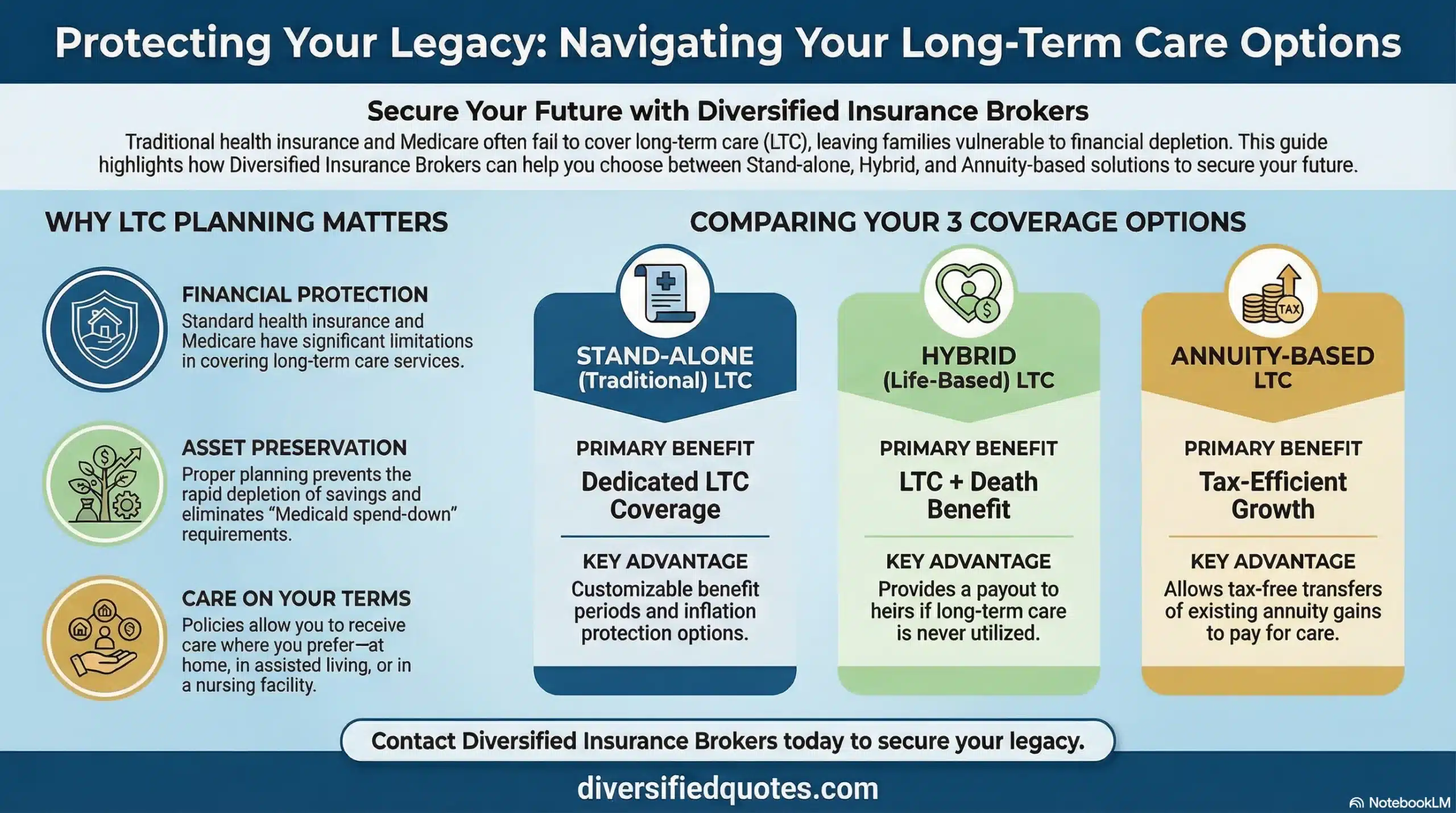
Talk to an Advisor or Request Your Annuity Quote
Ready to explore this annuity in more detail—or compare it with other carriers to see if even higher rates are available? With guaranteed income, principal protection, and long-term growth potential on the line, making the right choice is essential. The experienced advisors at Diversified Insurance Brokers will guide you through the options and design a strategy tailored to your retirement goals.
Schedule here:
calendly.com/jason-dibcompanies/diversified-quotes
Licensed in all 50 states • Fiduciary, family-owned since 1980
Frequently Asked Questions
Can unmarried partners share a joint HonestLTC policy?
Yes. NGL offers joint policies and joint rates to partners who live in the same household, whether or not they are married. Related applicants can also share a joint policy if they are of the same generation, such as siblings living together. A joint policy includes waiver of the entire joint premium when either partner is on claim, and the optional shared rider adds a third pool of benefits. For how other carriers handle two insureds, see long-term care insurance for couples.
Can my HonestLTC premium go up after I buy it?
It can, as with all traditional long-term care insurance. NGL’s consumer brochure states that after the first five years from the policy effective date, premiums can be changed only if NGL changes them for everyone in your state with the same policy form. If an increase makes coverage unaffordable, the contingent benefit upon lapse lets you reduce benefits or keep paid-up coverage. Our article on whether LTC insurance is worth it weighs that risk.
Will HonestLTC pay my daughter or son to take care of me?
Generally not. HonestLTC is a reimbursement policy, and its exclusions include care provided by a member of your immediate family. It reimburses covered services from qualified providers, such as home care agencies, adult day centers, assisted living, and nursing facilities. Families who want to pay relatives may want to compare cash indemnity policies. To see which professional services can be delivered at home, read about what in-home care services include.
Should I choose a 90-day or 180-day elimination period?
A 180-day period lowers the premium but means covering about six months of care yourself, while 90 days costs more but starts benefits sooner. HonestLTC’s rule that one day of covered care counts as seven days helps either choice, and the First Day Home and Community Care Services Rider can remove the wait for home care entirely. The remaining design decisions are laid out in choosing the right LTC policy.
Is the 10-year payment option worth the higher premium?
It depends on your income and timeline. The 10-year option finishes all premium payments within a decade, which appeals to buyers who want coverage paid for before or early in retirement. Lifetime payment keeps the annual cost lower. Waiver of premium applies to both. Illustrating both options for your age shows the total cost difference. Our article on affordable LTC coverage for retirees offers other ways to manage premiums.
Can I still apply for HonestLTC in my seventies?
Yes, HonestLTC is available through issue age 79, based on age last birthday. Applicants 66 and older complete a face-to-face long-term care exam in addition to the medical records and prescription history review that apply to everyone, and approval depends on your health and functional ability. Premiums are higher at older ages. Our guide to getting LTC coverage after 60 explains what to expect.
Is HonestLTC a better choice than a hybrid policy?
Neither is better for everyone. HonestLTC puts every premium dollar toward care and offers joint features, flexible inflation choices, and Partnership qualification in select states, but premiums are not guaranteed and nothing is returned if care is never needed. Hybrids typically guarantee premiums and return value through a death benefit, usually at a higher cost for the same care benefit. Our comparison of hybrid versus traditional LTC walks through the trade-offs.
I was declined for long-term care insurance before. Can I apply with NGL?
You can, but NGL’s underwriting guidelines state that applicants previously declined for long-term care insurance are unlikely to qualify, and a copy of the prior declination letter with the reasons must accompany the application. A review of your health history first can show whether any traditional or hybrid carrier is likely to approve you. Our overview of guaranteed issue LTC options covers alternatives with lighter underwriting.
Does HonestLTC cover memory care for dementia?
Severe cognitive impairment is one of the two ways to qualify for benefits, and room and board in a memory care facility is reimbursable when qualified long-term care services are received there. Because the policy also excludes mental or nervous disorders as it defines them, the outline of coverage should be reviewed to understand how specific cognitive conditions are treated before you apply.
About the Author:
Jason Stolz, CLTC, CRPC, DIA, CAA and Chief Underwriter at Diversified Insurance Brokers (NPN 20471358), is a senior insurance and retirement professional with more than 25 years of real-world experience helping individuals, families, and business owners protect their income, assets, and long-term financial stability. As a long-time partner of the nationally licensed independent agency Diversified Insurance Brokers, Jason provides trusted guidance across multiple specialties—including fixed and indexed annuities, long-term care planning, personal and business disability insurance, life insurance solutions, Group Health, Travel Medical and Evacuation Insurance, and short-term health coverage. Diversified Insurance Brokers maintains active contracts with over 100 highly rated insurance carriers, ensuring clients have access to a broad and competitive marketplace.
His practical, education-first approach has earned recognition in publications such as VoyageATL, and contributions from his agency featured in Kiplinger and GoBankingRates— highlighting his commitment to financial clarity and client-focused planning. Drawing on deep product knowledge and years of hands-on field experience, Jason helps clients evaluate carriers, compare strategies, and build retirement and protection plans that are both secure and cost-efficient. Visitors who want to explore current annuity rates and compare options across multiple insurers can also use this annuity quote and comparison tool.
Explore More Long Term Care Insurance Options: Browse our complete guide to LTC Insurance Costs, Rates & Planning — covering how much it costs, best rates, calculators, planning strategies & is it worth it from top carriers.
Last Reviewed: September 29, 2026 |
Reviewed by: Jason Stolz, CLTC, CRPC, DIA, CAA
Chief Underwriter, Diversified Insurance Brokers, Inc. | NPN: 20471358 | Diversified Insurance Brokers, Inc. — Licensed in all 50 states
Fact Checked by: Tonia Pettitt, CMIP©
Medicare Specialist, Diversified Insurance Brokers, Inc. | NPN: 14374308 | Diversified Insurance Brokers, Inc. — Licensed in all 50 states
Did you find this content helpful? Leave us a Google review — it helps others find trustworthy guidance too.
Editorial Standards: Diversified Insurance Brokers maintains rigorous editorial standards to ensure accuracy, clarity, and independence in all content. Learn more about our editorial standards and commitment to transparency.
