
Can You Still Get Long-Term Care Insurance After Age 60?
Can You Still Get Long-Term Care Insurance After Age 60?
One of the most common questions we hear from adults approaching retirement is simple and urgent: “Can I still get long-term care insurance after I turn 60?” The short answer is yes. The more complete answer is yes — but timing, health, and structure matter more than ever once you enter your 60s. Long-term care insurance is not automatically unavailable after age 60, and many individuals in their early and mid-60s qualify for meaningful coverage (we can even offer Long Term Care after age 80!). However, underwriting becomes more selective, pricing increases with age, and available policy designs begin to narrow. The key difference between planning at 52 and planning at 62 is leverage. The difference between 62 and 72 can be insurability itself.

Request Your Long-Term Care Insurance Review
Learn which long-term care options you still qualify for and compare traditional and hybrid (asset-based) plans side-by-side.
Start Your LTC ReviewTraditional LTC vs. Hybrid LTC vs. Self-Insurance After 60
| Approach | Structure | Premium / Cost | If Care Is Never Needed | Best For |
|---|---|---|---|---|
| Traditional LTC Insurance | Standalone policy that pays a defined daily or monthly benefit for qualifying care — home care, assisted living, memory care, or skilled nursing. Activated when 2 ADLs are impaired or cognitive impairment is confirmed. | Ongoing annual or monthly premiums — may increase over time if the carrier files for a rate increase with state regulators. Typically provides the highest leverage (benefit per premium dollar) among available structures. | No benefit paid — “use it or lose it” design. Premiums paid provide no residual cash value or death benefit if care is never triggered. | Individuals prioritizing maximum care benefit per premium dollar who are comfortable with a use-it-or-lose-it structure and the potential for future rate increases. |
| Hybrid Life / LTC | Permanent life insurance policy with a long-term care acceleration or extension of benefits rider. If care is needed, the LTC benefit is drawn from the death benefit and potentially leveraged beyond it. If care is never needed, the death benefit passes to beneficiaries. | Single premium or limited-pay structure (5-pay, 10-pay) — no indefinite premium obligation. Asset repositioning from existing life insurance or investment funds is common funding approach. | Death benefit passes to named beneficiaries. Residual value remains even if partial LTC benefits are used. Return of premium options available on some products. | Individuals uncomfortable with use-it-or-lose-it premium payments who want a guaranteed value regardless of whether care is needed. Those with existing permanent life insurance or liquid assets to reposition. |
| Hybrid Annuity / LTC | Annuity contract with a long-term care benefit rider. Provides guaranteed accumulation plus leveraged LTC benefits if care is needed. Under Section 7702B and HIPAA, LTC benefits from qualified policies may be received income-tax-free. | Single premium — existing non-qualified annuity or cash assets are repositioned. A 1035 exchange from an existing annuity into a qualified LTC annuity can avoid immediate taxation of accumulated gains. | Accumulated annuity value (plus growth) retained — available as income, death benefit, or further accumulation. LTC leverage provides care benefits significantly above the annuity value if needed. | Individuals with existing non-qualified annuity assets they want to reposition into a tax-advantaged structure that provides both LTC protection and continued accumulation. |
| Shared Benefit (Couples) | Two-person policy where a combined benefit pool can be drawn by either spouse. If one spouse exhausts their individual benefit, they draw from the shared pool. Reduces the risk that one spouse exhausts coverage while the other’s benefit remains unused. | Higher premium than two individual policies — the shared pool provides additional leverage. Often the most cost-efficient structure for couples when one spouse’s needs may be disproportionately large. | Varies by product — some shared benefit designs return premium or pass residual to beneficiaries. Traditional shared benefit designs follow the use-it-or-lose-it structure of traditional LTC insurance. | Married couples with different health histories or risk profiles where one partner may need significantly more care than the other. Maximizes the flexibility of the combined household benefit pool. |
| Partial Self-Insurance | Setting aside dedicated liquid assets for potential care costs without purchasing formal insurance. Relies on investment returns and available liquidity at the time of need. | No premium — but requires sufficient liquid assets that can be dedicated to care costs without disrupting retirement income. Care costs in the $80,000–$120,000+ annual range can deplete even substantial portfolios quickly. | Full asset value retained — no premium cost and no coverage structure. The full care cost burden falls on the portfolio if care is needed. | Individuals with very substantial liquid assets who can genuinely absorb multi-year care costs without disrupting income or legacy goals. Not appropriate as a primary strategy for most retirees without significant liquid net worth. |
How Underwriting Works After Age 60 — What Carriers Evaluate
Your 60s are often the decade when retirement transitions from theory to reality. Income streams become fixed. Portfolios shift from accumulation to distribution. Risk tolerance changes. At the same time, health conditions that were once mild or nonexistent begin to surface more frequently. High blood pressure, controlled diabetes, joint replacements, cardiac procedures, and mobility limitations become more common. Insurers evaluate these factors carefully. If you are unsure how medical history affects eligibility, it may help to review underwriting discussions similar to those outlined for life insurance with pre-existing conditions. While life and long-term care underwriting differ in certain respects, both evaluate stability, management, and overall functional independence. The earlier you explore your options, the more carriers are willing to compete for your business.
Understanding how insurers determine eligibility is critical after age 60. Long-term care policies are primarily concerned with functional capacity. Carriers want to know whether you are fully independent and whether you require assistance with any Activities of Daily Living (ADLs). These six measures — bathing, dressing, eating, toileting, transferring, and continence — form the backbone of both underwriting and future claims eligibility. If you are managing your daily routines without assistance and have not required home health services, physical therapy due to decline, or cognitive supervision, you may still qualify with competitive carriers. Stability is often more important than perfection. Controlled conditions with predictable medication regimens are frequently insurable. Progressive neurological diagnoses, recent falls, memory impairment, or pending surgeries introduce more complexity.
Why This Decision Matters Most in Your 60s
Long-term care is not limited to nursing homes. It includes in-home assistance, adult day programs, assisted living communities, memory care units, and skilled nursing facilities. To better understand the care spectrum, it can be helpful to review how in-home care services compare to structured residential settings such as assisted living communities and skilled nursing facilities. Costs vary widely depending on geography and intensity of care, but even moderate part-time home assistance can exceed tens of thousands annually, and full-time care often surpasses six figures per year.
A major misconception that leads many people to delay planning is the belief that Medicare will absorb most long-term care costs. Medicare may cover short-term skilled rehabilitation after hospitalization, but it does not pay for extended custodial care. Bathing assistance, supervision due to dementia, help with dressing, and long-term residential support are not Medicare benefits. If you are unclear on the distinction, reviewing whether Medicare covers long-term care clarifies what is and is not included. For a broader side-by-side breakdown, comparing Medicare and long-term care insurance explains the structural differences between public health coverage and private long-term care protection.
Traditional vs. Hybrid Designs — Evaluating the Right Structure
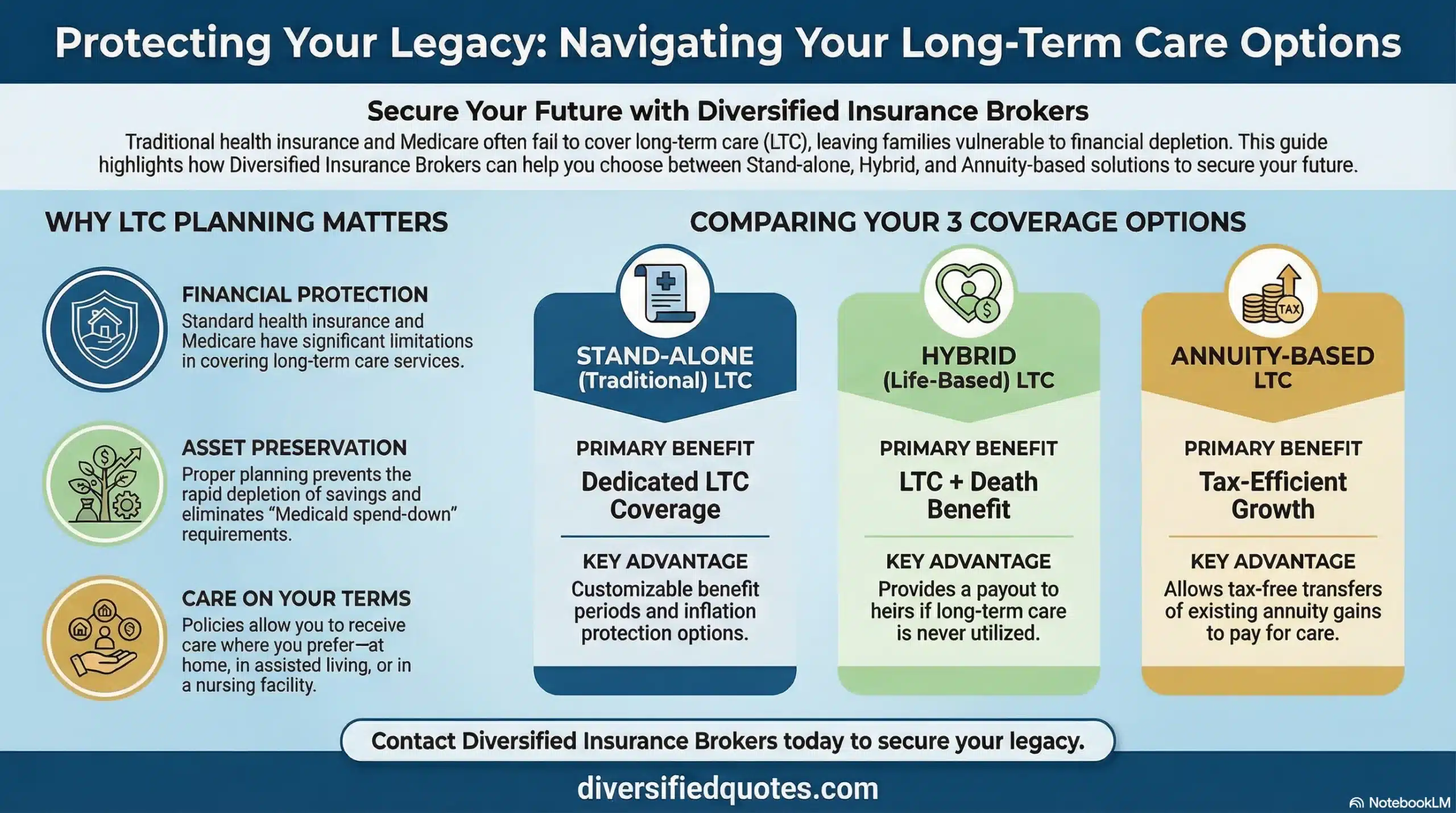
After 60, most applicants evaluate two primary categories of coverage: traditional long-term care insurance and hybrid or asset-based long-term care solutions. Traditional policies are designed solely to pay for qualifying care services. If you become unable to perform two ADLs or experience cognitive impairment, the policy pays a daily or monthly benefit for home care, assisted living, memory care, or nursing facilities. These policies often provide the highest leverage per premium dollar, especially when purchased earlier in the decade. However, they are “use it or lose it” designs, meaning if care is never needed, no benefit is paid.
Hybrid long-term care solutions combine long-term care benefits with either life insurance or annuity components. If care is needed, the policy provides leveraged long-term care benefits. If care is never needed, a death benefit or retained cash value remains. This structure appeals to many individuals in their 60s who are uncomfortable paying indefinite premiums without a guaranteed return component. For a deeper understanding of annuity-based structures, our page on non-qualified long-term care annuities explains how existing assets can sometimes be repositioned to create tax-advantaged care benefits without new ongoing premium obligations.
Couples often explore shared benefit structures to maximize flexibility. With long-term care insurance with shared benefits, one spouse can draw from a combined pool of coverage, reducing the risk that one partner exhausts benefits while the other remains unused. These designs can be especially valuable when health histories differ between spouses. In some cases, adding a return of premium rider provides additional estate protection, ensuring beneficiaries receive value if coverage is never triggered.
Funding Strategies and Tax Efficiency After 60
Funding strategies in your 60s are more diverse than many people realize. Some individuals choose ongoing annual premiums for traditional coverage. Others prefer limited-pay structures — such as 10-pay or single-premium hybrids — to eliminate future payment obligations before retirement income fully stabilizes. Asset repositioning is increasingly common. Under Section 1035 of the Internal Revenue Code, certain life insurance or annuity contracts can sometimes be exchanged into long-term care-focused solutions without immediate tax consequences. Tax efficiency is a meaningful part of the planning conversation, and our overview of the tax advantages of long-term care insurance and hybrid policies outlines how benefits and premiums may be treated under current guidelines.
When Options Become Limited — Understanding the Window
There is a point where options become significantly more restricted. Most carriers impose maximum issue ages, often somewhere between 69 and 75 depending on product type. Approval rates decline as age increases — not solely because of chronological age but because of accumulated medical history. Falls within the past 12 to 24 months, hospitalizations, insulin-dependent diabetes with complications, progressive neurological diagnoses, or cognitive impairment can significantly restrict eligibility. This does not mean that everyone in their late 60s or early 70s is uninsurable, but it does mean that carrier selection becomes more nuanced and timing becomes more urgent. For those wondering whether options exist even further into retirement, our resource on long-term care insurance after age 80 covers what remains available at later ages and what the realistic options look like when planning has been delayed.
The question for most adults in their 60s becomes less about “Can I get coverage?” and more about “What structure aligns with my retirement plan?” If you have substantial liquid assets and minimal concern about asset erosion, you may choose partial self-insurance. If your retirement income relies heavily on annuities, pensions, or structured withdrawals, introducing long-term care protection may prevent forced portfolio liquidation during market volatility. If preserving a legacy for children or charitable organizations matters to you, hybrid designs may align well. For married couples evaluating coverage together, our resource on long-term care insurance for couples covers the specific design options — including shared benefit pools and spousal discount structures — that are available for two-person households. Diversified Insurance Brokers works with a broad range of top-rated carriers nationwide. Because underwriting guidelines differ significantly between companies, one carrier may decline an application that another would consider acceptable. Our role is to pre-screen health history, medications, and functional status before a formal submission, positioning you with insurers most likely to offer approval. Working with an independent long-term care insurance broker who can compare across carriers and evaluate traditional, hybrid, and annuity-based designs ensures you are not limited to one company’s product lineup.
Ready to evaluate your long-term care options while they are still available?
Request Your Personalized LTC Review
Financial Protection Essentials
Explore annuity interest examples and retirement planning insights to understand how different investment sizes can affect income potential.
Talk With an Advisor Today
Choose how you’d like to connect—call or message us, then book a time that works for you.
Schedule here:
calendly.com/jason-dibcompanies/diversified-quotes
Licensed in all 50 states • Fiduciary, family-owned since 1980
What health conditions typically disqualify someone from long-term care insurance after 60?
Long-term care insurance underwriting is primarily concerned with functional independence and the likelihood of needing care in the near term. Conditions that typically result in automatic declination across most carriers include: any existing need for assistance with one or more Activities of Daily Living; diagnosed Alzheimer’s disease, dementia, or cognitive impairment; Parkinson’s disease; multiple sclerosis with functional impairment; a history of stroke with lasting functional deficits; organ transplant recipient status; current use of insulin for type 1 diabetes with complications; current diagnosis of cancer under active treatment; and requirement for oxygen therapy. Conditions that may produce declined applications or rated policies but are not automatic declinations include well-controlled type 2 diabetes, heart conditions with stable management, COPD, history of cancer in remission for a qualifying period, and single joint replacements without complications. Falls within the past 12 to 24 months are a significant concern because they may indicate balance or mobility issues that predict near-term care needs. Because underwriting guidelines vary significantly by carrier, a condition that one carrier declines may be accepted by another at standard or rated rates. Submitting a preliminary health history before a formal application — and selecting the carrier most likely to offer favorable underwriting for that specific profile — is the most important step in the application process after age 60.
How much does long-term care insurance cost at age 62 vs. 68?
Premiums for long-term care insurance increase meaningfully with age because the probability of needing care within the policy period increases and the number of premium-paying years before claims are likely decreases. As a general framework (confirmed figures require individual carrier quotes based on specific health profile): a healthy couple each purchasing traditional long-term care insurance at age 62 might pay combined annual premiums in the range of $3,000 to $5,000 for a moderate benefit structure — daily benefit around $150 to $200 with a 3-year benefit period and a 90-day elimination period. The same coverage profile purchased at age 68 might cost 40% to 60% more annually due to age-based premium tables and the increasing likelihood of health reclassification. For hybrid life/LTC or annuity/LTC structures, the single premium or limited-pay cost also scales with age because the carrier prices the benefit leverage against the mortality and morbidity expectations at the time of issue. The longer the applicant has to wait (for age-related reasons or health-related delays), the less favorable the cost-to-benefit ratio becomes. This is the primary financial argument for evaluating long-term care insurance in the early 60s rather than waiting until the late 60s — even two or three years of additional age can produce meaningful premium differences on both traditional and hybrid products.
Can I use existing assets — like an annuity or life insurance policy — to fund long-term care coverage?
Yes — asset repositioning is one of the most commonly underutilized strategies in long-term care planning for individuals in their 60s. Two primary mechanisms enable tax-efficient repositioning. First, Section 1035 of the Internal Revenue Code allows certain tax-free exchanges between like-or-similar insurance and annuity contracts. An existing non-qualified annuity with significant accumulated gain can often be exchanged into a qualified long-term care annuity without triggering immediate income tax on the gain. The exchanged value then funds the new contract’s LTC benefits, which are received income-tax-free when used for qualifying care under Section 7702B. Second, existing cash-value life insurance policies can be exchanged into hybrid life/LTC policies, again preserving the tax-deferred status of accumulated gains while repositioning the death benefit into a structure that provides leveraged LTC coverage. The practical result: a $200,000 non-qualified annuity with significant gains can be repositioned into a hybrid LTC annuity that provides $400,000 to $600,000 or more in long-term care benefits — without paying current income tax on the repositioned gains. This type of structure requires careful coordination between the insurance design and the tax implications, which is why working with a knowledgeable independent broker and coordinating with a tax advisor is essential before executing any 1035 exchange into a long-term care product.
Does my spouse’s health history affect my ability to get long-term care insurance?
For most long-term care insurance applications, each spouse is underwritten independently — your spouse’s health history does not directly affect your eligibility or premium. Each person’s application stands on its own health profile, functional assessment, and medical history. However, there are practical coordination implications for couples that make the joint application decision consequential even if underwriting is independent. First, some carriers offer spousal or partner discounts that apply when both partners apply simultaneously or when both are ultimately approved — if one partner is declined, the other may lose the discount. Second, shared benefit structures — where both spouses draw from a combined benefit pool — require both partners to be insurable. If one spouse has health conditions that prevent approval, the shared benefit design may not be available regardless of the other spouse’s health. Third, for hybrid life/LTC products with a joint version, both insureds must qualify for the underwriting assessment. The practical implication for couples where health histories differ: it is worth exploring whether both partners can qualify before designing a strategy that depends on both being approved. Pre-application health screening with the carriers most likely to accept each partner’s specific profile is the first step in the couples’ planning process.
How does long-term care insurance coordinate with Medicaid?
Long-term care insurance and Medicaid serve fundamentally different populations and coordinate in ways that matter for planning. Medicaid is a needs-based public program that covers long-term care costs for individuals who have spent down their assets to very low levels — typically $2,000 or less in countable assets in most states, though asset limits and protections vary by state and program rules change periodically. Private long-term care insurance is designed to pay for care before the insured reaches Medicaid eligibility, preserving assets, retirement income, and the choice of providers and settings. The coordination question most commonly arises in two contexts. First, some individuals with modest assets wonder whether they should simply spend down to Medicaid eligibility rather than paying long-term care insurance premiums. The decision depends on the value of what is being preserved — retirement income streams, the family home, savings intended for a surviving spouse, and the choice of care settings are all at risk in a Medicaid spend-down scenario. Second, most states have Long-Term Care Partnership programs that allow individuals who purchase qualifying partnership LTC policies to protect an equivalent amount of assets from Medicaid spend-down requirements — dollar of assets protected for each dollar of benefits paid by the policy. This partnership structure can be a meaningful planning tool for middle-income individuals who want LTC insurance protection with an additional layer of Medicaid asset protection as a backstop. Confirm your state’s specific partnership program rules and asset protection provisions with a qualified LTC planning professional before relying on this feature.
About the Author:
Jason Stolz, CLTC, CRPC, DIA, CAA and Chief Underwriter at Diversified Insurance Brokers (NPN 20471358), is a senior insurance and retirement professional with more than 25 years of real-world experience helping individuals, families, and business owners protect their income, assets, and long-term financial stability. As a long-time partner of the nationally licensed independent agency Diversified Insurance Brokers, Jason provides trusted guidance across multiple specialties—including fixed and indexed annuities, long-term care planning, personal and business disability insurance, life insurance solutions, Group Health, Travel Medical and Evacuation Insurance, and short-term health coverage. Diversified Insurance Brokers maintains active contracts with over 100 highly rated insurance carriers, ensuring clients have access to a broad and competitive marketplace.
His practical, education-first approach has earned recognition in publications such as VoyageATL, and contributions from his agency featured in Kiplinger and GoBankingRates— highlighting his commitment to financial clarity and client-focused planning. Drawing on deep product knowledge and years of hands-on field experience, Jason helps clients evaluate carriers, compare strategies, and build retirement and protection plans that are both secure and cost-efficient. Visitors who want to explore current annuity rates and compare options across multiple insurers can also use this annuity quote and comparison tool.
Explore More Long Term Care Insurance Options: Browse our complete guide to Tax, Medicare & Special Situations — covering tax advantages, Medicare vs LTC, seniors, couples, diabetics & age-specific coverage from top carriers.
Last Reviewed: June 25, 2026 |
Reviewed by: Jason Stolz, CLTC, CRPC, DIA, CAA
Chief Underwriter, Diversified Insurance Brokers, Inc. | NPN: 20471358 | Diversified Insurance Brokers, Inc. — Licensed in all 50 states
Fact Checked by: Tonia Pettitt, CMIP©
Medicare Specialist, Diversified Insurance Brokers, Inc. | NPN: 14374308 | Diversified Insurance Brokers, Inc. — Licensed in all 50 states
Did you find this content helpful? Leave us a Google review — it helps others find trustworthy guidance too.
Editorial Standards: Diversified Insurance Brokers maintains rigorous editorial standards to ensure accuracy, clarity, and independence in all content. Learn more about our editorial standards and commitment to transparency.
