
What is the Interest Rate on a $5 Million Annuity
What is the Interest Rate on a $5 Million Annuity

Jason Stolz CLTC, CRPC, DIA, CAA
When individuals accumulate substantial retirement savings, a common question arises about how those savings can generate income and grow safely over time. One example involves a $5 million annuity. Investors considering allocating this amount to an annuity typically want to understand how annuity interest rates work, how the account might grow over time, and how that balance may eventually translate into retirement income.
Annuities are insurance contracts designed to provide tax-deferred growth and, in many cases, guaranteed or predictable income in retirement. They are frequently used by retirees and individuals approaching retirement who want to protect a portion of their wealth from market volatility while still earning interest. For someone investing $5 million into an annuity, the goal is often to combine stability, growth, and long-term income security.
Unlike many traditional investments, annuities are built around contractual guarantees. The interest credited to the annuity is determined by the structure of the contract and the broader economic environment rather than the investment amount itself. However, while the interest rate does not necessarily increase simply because the investment is larger, the total dollar value of interest earned increases dramatically as the investment grows.
For investors evaluating how to manage large retirement balances, annuities often become part of a broader planning strategy. Many retirees compare annuities with other income-generating approaches, including pensions, bond portfolios, and systematic withdrawals from investment accounts. Some individuals also review strategies such as what to do with retirement savings after retiring to determine how guaranteed income products may fit within their overall financial plan.
Understanding how annuity interest works is an important step in determining whether a $5 million annuity may help provide long-term financial stability.
Ensure you are receiving the absolute top rates
Current Fixed Annuity Rates
Compare today’s best fixed annuity rates from top carriers.
Current Bonus Annuity Rates
See which annuities offer the highest upfront bonus today.
Request an Annuity Quote
Submit our annuity request form to get personalized rate options.
Lifetime Income Calculator
Use our calculator to see how much guaranteed income your annuity can provide.
Compare Multi-Year Guaranteed Annuity Rates
Explore the best annuity rates by term length to find the option that fits your timeline and income strategy.
How Interest Is Credited to a $5 Million Annuity
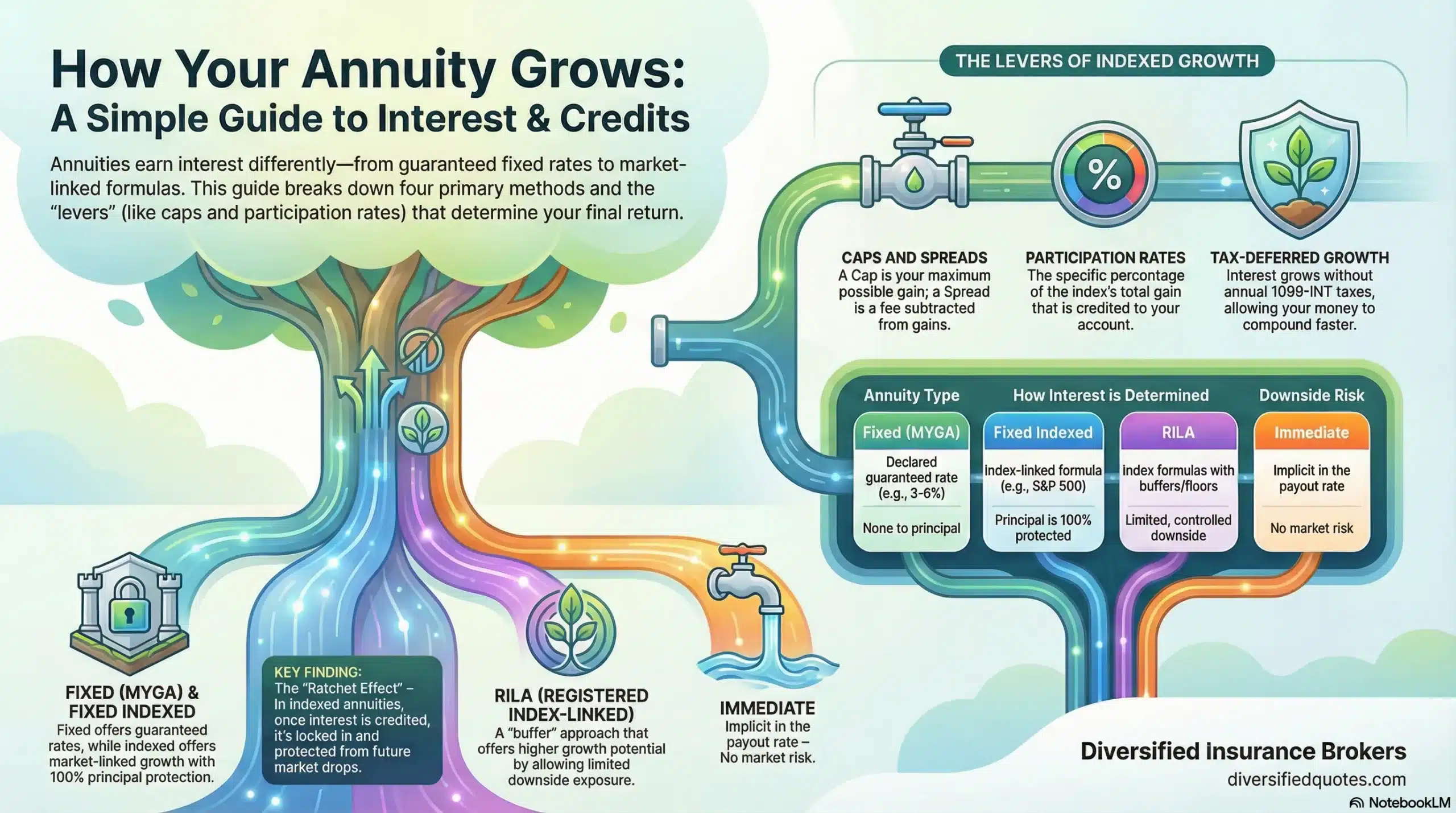
The interest credited to an annuity contract depends primarily on the type of annuity selected and prevailing economic conditions. Fixed annuities generally provide guaranteed interest rates for a defined period. Indexed annuities link interest crediting to the performance of a market index while protecting the principal from market losses.
Insurance companies that issue annuities invest premiums into diversified portfolios that typically include government bonds, corporate bonds, and other income-producing securities. The returns generated by these investments support the interest credited to annuity contracts.
Although the interest rate itself is not determined by the size of the investment, the total interest earned becomes much more significant when the investment is large. Even moderate interest rates applied to a $5 million annuity can produce substantial annual growth.
Investors evaluating large annuity contracts often consider how annuities compare with other retirement income vehicles. Some individuals review examples such as how much an annuity may pay in retirement income in order to understand how accumulated savings can translate into predictable monthly payments.
Others evaluate rollover strategies involving retirement accounts, including topics such as transferring a Solo 401(k) to an annuity or moving a Keogh plan into an annuity as part of long-term retirement planning.
Example Growth of a $5 Million Annuity
The following illustration demonstrates how a $5 million annuity could grow assuming a hypothetical interest rate. These numbers are examples designed to demonstrate compound growth rather than represent current annuity rates.
| Year | Account Value (Example 6%) | Interest Earned |
|---|---|---|
| 1 | $5,300,000 | $300,000 |
| 5 | $6,691,128 | $378,500 |
| 10 | $8,954,243 | $506,812 |
| 15 | $11,982,740 | $678,245 |
| 20 | $16,035,678 | $907,679 |
This example demonstrates how compounding interest can significantly increase the value of an annuity over long periods. Because annuity growth typically occurs on a tax-deferred basis, the full balance continues compounding without annual taxation reducing the growth.
Economic Factors That Influence Annuity Rates
Annuity interest rates are strongly influenced by the bond market. Insurance companies invest annuity premiums primarily in fixed-income securities such as corporate bonds and government debt. When bond yields rise, insurers may be able to offer higher annuity crediting rates. When bond yields fall, annuity rates may decline as well.
The length of the annuity contract also influences the crediting rate. Longer surrender periods often allow insurance companies to invest funds over longer time horizons, which may allow them to offer higher interest rates.
Some annuities include optional features that provide additional guarantees such as lifetime income riders. These features can affect how interest is credited because they introduce additional benefits into the contract. Investors evaluating these features often explore topics such as how annuity income riders work when comparing contract designs.
Tax planning also plays a role in how large annuity investments are managed. Strategies such as Roth conversion planning are sometimes considered alongside annuity strategies when developing a comprehensive retirement income plan.
How a $5 Million Annuity Can Generate Retirement Income
Although interest accumulation is an important feature of annuities, many individuals purchase annuities primarily for income. Once the accumulation phase ends, the annuity can be converted into a stream of payments that may continue for a fixed number of years or for the lifetime of the annuitant.
The income generated by a $5 million annuity depends on several factors including the annuitant’s age, prevailing interest rates, and the payout structure selected. Lifetime income options are particularly valuable because they help address longevity risk, which is the possibility of outliving retirement savings.
Many retirees combine annuity income with Social Security benefits and withdrawals from investment accounts in order to create multiple sources of retirement income. This diversification helps reduce reliance on any single source of income and provides additional financial stability.
For individuals managing large retirement portfolios, annuities often serve as a stabilizing component within a diversified financial plan.
Request a Quote
Related Pages
Talk With an Advisor Today
Choose how you’d like to connect—call or message us, then book a time that works for you.
Schedule here:
calendly.com/jason-dibcompanies/diversified-quotes
Licensed in all 50 states • Fiduciary, family-owned since 1980
Are annuities protected from creditors if someone is ever sued or files for bankruptcy?
It depends heavily on the state, since annuity creditor protection is governed by state law rather than a single federal rule. Many states provide meaningful protection for annuity cash values and income payments from creditor claims, though the specific exemption amount, and whether it’s unlimited or capped, varies considerably from one state to another. Anyone concerned about asset protection as part of their reason for purchasing a large annuity should confirm the specific protections that actually apply in their state rather than assuming a blanket national rule.
Does owning a large annuity affect eligibility for Medicaid long-term care benefits?
It can, and this is an area where timing matters enormously. Medicaid eligibility for long-term care involves a look-back period during which asset transfers, including certain annuity purchases, can be scrutinized and may affect eligibility or trigger a penalty period. Annuities structured specifically to meet Medicaid-compliant requirements exist, but a standard annuity purchased without this specific planning in mind may not automatically qualify. Anyone for whom future Medicaid planning is a realistic consideration should address this before purchasing a large annuity, not after.
What is a QLAC, and how does it affect required minimum distributions?
A Qualified Longevity Annuity Contract, or QLAC, is a specific type of deferred income annuity purchased with qualified retirement funds that allows the value used to buy it to be excluded from required minimum distribution calculations up to a specific limit, until income payments actually begin at a later age. This effectively lets an account owner defer both the income and the associated tax obligation on that portion of their retirement savings well beyond the age RMDs would otherwise apply. There are specific dollar and structural limits on what qualifies as a QLAC, so this requires purchasing a product specifically designed to meet those requirements.
What is a guaranteed minimum withdrawal benefit rider, and how is it different from a death benefit rider?
A guaranteed minimum withdrawal benefit, often called a GMWB, is a living benefit rider that guarantees a certain level of income can be withdrawn annually for life, even if poor investment or crediting performance would otherwise deplete the underlying account value faster than expected. This is fundamentally different from a death benefit rider, which only pays out after the annuitant’s death. A GMWB protects income while the annuitant is alive; a death benefit rider protects what a beneficiary receives afterward. Both can exist on the same contract but serve entirely different purposes and are usually priced separately.
What’s the difference between a deferred income annuity and an immediate annuity?
An immediate annuity begins paying income almost right away, typically within a year of purchase, converting a lump sum directly into a payment stream. A deferred income annuity instead schedules income to begin at a specified future date, sometimes many years after purchase, which generally allows the eventual payment amount to be considerably higher than an immediate annuity funded with the same premium, since the insurer has more time to grow the underlying value and fewer expected total payout years once income begins. The right choice depends heavily on when income is actually needed.
What happens to an inherited annuity if the beneficiary is not the deceased owner’s spouse?
A surviving spouse generally has the option to continue the contract in their own name, stepping into the original owner’s position. A non-spouse beneficiary typically doesn’t have that option and instead must choose among a more limited set of distribution methods, such as taking the full value as a lump sum, spreading distributions out over a period of years, or in some cases taking payments over their own life expectancy, depending on what the specific contract and applicable tax rules allow. The tax treatment and available choices differ meaningfully between spousal and non-spousal beneficiaries, which is worth understanding well before it becomes relevant.
How is each annuitized payment from a non-qualified annuity actually taxed?
Once a non-qualified annuity is annuitized into a stream of payments, each payment is generally split between a return of principal, which isn’t taxed again since it was already after-tax money, and a taxable earnings portion, using a calculation called the exclusion ratio. This ratio is determined at the time annuitization begins and typically stays fixed for the length of the payout period, meaning the taxable and non-taxable portion of each payment usually doesn’t change once it’s been established, even as the total account concept no longer technically exists in the same form.
Do any states charge a tax on annuity premiums at the time of purchase?
Yes, a small number of states impose a premium tax on annuity purchases, generally charged as a percentage of the premium paid, and in some states this is passed through to the buyer either as a separate charge or reflected in the product’s pricing. Not every state has this tax, and among those that do, the rate and how it’s applied can differ. Confirming whether a state-level premium tax applies is a reasonable question to ask before finalizing a large annuity purchase, since it can be an overlooked cost for a buyer who assumes no such tax exists.
About the Author:
Jason Stolz, CLTC, CRPC, DIA, CAA and Chief Underwriter at Diversified Insurance Brokers (NPN 20471358), is a senior insurance and retirement professional with more than 25 years of real-world experience helping individuals, families, and business owners protect their income, assets, and long-term financial stability. As a long-time partner of the nationally licensed independent agency Diversified Insurance Brokers, Jason provides trusted guidance across multiple specialties—including fixed and indexed annuities, long-term care planning, personal and business disability insurance, life insurance solutions, Group Health, Travel Medical and Evacuation Insurance, and short-term health coverage. Diversified Insurance Brokers maintains active contracts with over 100 highly rated insurance carriers, ensuring clients have access to a broad and competitive marketplace.
His practical, education-first approach has earned recognition in publications such as VoyageATL, and contributions from his agency featured in Kiplinger and GoBankingRates— highlighting his commitment to financial clarity and client-focused planning. Drawing on deep product knowledge and years of hands-on field experience, Jason helps clients evaluate carriers, compare strategies, and build retirement and protection plans that are both secure and cost-efficient. Visitors who want to explore current annuity rates and compare options across multiple insurers can also use this annuity quote and comparison tool.
Explore More Annuity Options: Browse our complete guide to How Much Does an Annuity Pay? — covering annuity payout calculators, income amounts & interest rates by investment size from 100+ carriers.
Last Reviewed: September 1, 2026 |
Reviewed by: Jason Stolz, CLTC, CRPC, DIA, CAA
Chief Underwriter, Diversified Insurance Brokers, Inc. | NPN: 20471358 | Diversified Insurance Brokers, Inc. — Licensed in all 50 states
Fact Checked by: Tonia Pettitt, CMIP©
Medicare Specialist, Diversified Insurance Brokers, Inc. | NPN: 14374308 | Diversified Insurance Brokers, Inc. — Licensed in all 50 states
Did you find this content helpful? Leave us a Google review — it helps others find trustworthy guidance too.
Editorial Standards: Diversified Insurance Brokers maintains rigorous editorial standards to ensure accuracy, clarity, and independence in all content. Learn more about our editorial standards and commitment to transparency.
