
What If You’re Denied Life Insurance? Here’s What to Do Next
What If You’re Denied Life Insurance? Here’s What to Do Next
A life insurance denial is one of the most frustrating outcomes in financial planning — not because it reflects something unfixable about the applicant, but because it is so frequently preventable with the right preparation and the right carrier selection. The most important thing to understand after a denial is that it is a carrier-specific determination, not an industry-wide verdict on your insurability. Life insurance underwriting guidelines vary substantially across carriers — one company’s automatic decline category is another company’s standard-rate applicant, depending on how each carrier has built its actuarial models, what its current book of business looks like, and how its underwriters are trained to evaluate specific conditions, occupations, and risk factors. A decline from one carrier, through one channel, with one application structure, does not mean coverage is unavailable in the full market. It means that specific application did not meet that specific carrier’s standards on that specific day. Understanding this distinction is what separates applicants who give up and remain uninsured from those who regroup strategically and ultimately secure the protection their families need.

The practical stakes of navigating post-denial correctly are high. Every subsequent formal application creates a record — in the Medical Information Bureau (MIB) database that carriers consult when evaluating new applications, and on the application itself where applicants are required to disclose prior denials. Reapplying blindly — submitting application after application to different carriers without understanding why the first denial occurred and whether the new carrier’s guidelines are a better fit — compounds the problem by building a trail of denials that makes each subsequent application harder. The correct sequence after a denial is to stop, diagnose, document, and restructure before any new application is submitted. That sequence is not complicated, but it requires working with someone who understands how carrier-specific underwriting guidelines interact with specific applicant profiles — and who has the market access to identify which carriers are realistically appropriate before wasting application capital on another mismatch.
At Diversified Insurance Brokers, we regularly work with clients who arrive after a decline — sometimes one, sometimes multiple — from carriers they approached directly or through agents with limited market access. In a large proportion of those cases, the underlying risk factor that drove the denial is something that other carriers handle more favorably, and a restructured submission to an appropriate carrier produces an approvable outcome. Not in every case — some denials reflect genuinely uninsurable risk profiles that require alternative product strategies rather than another fully underwritten application — but in a significant fraction of cases, the denial was driven primarily by carrier mismatch rather than true uninsurability. This page covers the complete framework for what to do after a life insurance denial: diagnosing the root cause, understanding the MIB, rebuilding the application narrative, identifying the right alternative carriers, and pursuing alternative coverage paths when traditional underwriting is not the right path. For the broader context of how life insurance underwriting works, our resource on how life insurance works covers the foundational framework, and our high-risk life insurance services overview covers our full approach to complex placement cases.
See Real-Term Rates Side by Side
Life Insurance Quoter
Previously Declined? Request a Strategic Case Review
We analyze why the denial occurred, identify carriers with better appetite for your profile, and structure the next submission to avoid repeating the same outcome. Confidential, nationwide, no obligation.
Request a High-Risk Case ReviewWhat a Life Insurance Denial Actually Means — and What It Doesn’t
A life insurance denial is a carrier-specific underwriting determination. It means that a specific carrier’s underwriting department, reviewing the information submitted in a specific application, concluded that the applicant’s risk profile exceeded that carrier’s guidelines for issuing coverage on terms it considers actuarially defensible. It does not mean that all life insurance carriers have evaluated the applicant and reached the same conclusion. It does not mean the applicant’s risk profile is objectively uninsurable in the market. And it does not mean the decision is permanent — circumstances change, underwriting guidelines change, and the quality of the case presentation significantly affects how underwriters interpret the information they receive.
The most important immediate implication of a denial is what it creates going forward. The Medical Information Bureau (MIB) — a data-sharing cooperative used by most major life insurance carriers — receives coded information about the underwriting factors identified during the application process when a carrier submits a file. Future carriers who see the MIB record know that a prior underwriting review occurred and what coded categories were flagged. Additionally, virtually all life insurance applications ask whether the applicant has been declined or had coverage modified in the past. Answering that question inaccurately is material misrepresentation — which can void a policy at claim. Both of these realities mean that after a denial, subsequent applications are more complex than a first application, and the stakes of handling them incorrectly are higher. This is the core argument for working with a specialist who understands both carrier selection and MIB mechanics before submitting any subsequent application.
The Eight Most Common Reasons for Life Insurance Denial
Life insurance denials occur across a range of categories, and understanding which category drove the denial is the essential first step in determining the right path forward. Most denials fall into one of eight primary categories, and each category has a different set of corrective actions, different timing considerations, and different carrier-specific alternative paths. The denial letter and any accompanying underwriting explanation — which applicants have the right to request — typically identify the primary reason, though the language is often general rather than specific. The MIB file, combined with a careful review of the application and any lab results from the paramedical exam, usually provides the complete picture. Our resource on the high-risk life insurance playbook covers the strategic framework for approaching complex underwriting cases including post-denial repositioning.
Common Denial Reasons and the Path Forward
| Denial Category | Common Examples | Root Cause of the Decline | Typical Path Forward |
|---|---|---|---|
| Medical History | Uncontrolled diabetes, heart disease, cancer in active treatment, neurological conditions | Carrier’s guidelines exceed applicant’s health profile; wrong carrier selected | Prescreen at carriers with more favorable guidelines for the specific condition; gather stability documentation; wait if recently diagnosed |
| Lab Results / Paramedical Exam | Elevated liver enzymes, abnormal A1C, unusual protein or blood markers, unexpected findings | Lab abnormality discovered during exam not previously disclosed; or result error / sample issue | Request lab results; verify with physician; if accurate — gather clinical context; if error — correct and resubmit |
| BMI / Build | Weight outside carrier’s height-weight table; extreme underweight or overweight by carrier’s build chart | Carrier’s build table is more restrictive; different carriers use different charts | Identify carriers with more favorable build tables for the specific height-weight profile; or address weight over time |
| Driving Record | DUI, multiple serious violations, reckless driving, suspended license history | Motor vehicle report triggered carrier’s point threshold; DUI typically requires waiting period from date of conviction | Wait for required time since most recent conviction; carriers vary significantly on DUI lookback windows; select appropriate carrier |
| Substance Use History | Prior alcohol use disorder, prior drug use, current tobacco use, medication misuse history | Carrier’s guidelines for recovery period, sobriety documentation, or current use status triggered decline | Document sobriety timeline, treatment completion, support structure; select carriers with favorable recovery underwriting; see life insurance for alcohol use |
| Mental Health History | Recent hospitalization for depression or anxiety, bipolar disorder, history of self-harm or suicide attempt | Carrier’s mental health guidelines flagged instability, recent hospitalization, or high-risk history | Document stability and treatment adherence; wait if recent hospitalization; select carriers with nuanced mental health underwriting |
| Occupation or Avocation | Hazardous occupation, extreme sports or avocations, aviation, commercial diving | Carrier’s guidelines for the specific activity or occupation exceed what was disclosed; wrong carrier selected | Select carriers with favorable appetite for the specific activity; provide accurate activity description; see life insurance for high-risk occupations |
| Financial Underwriting | Face amount not supported by income/assets, insurable interest questions, recent large policy purchases | Financial justification for the requested face amount was insufficient or documentation was incomplete | Provide complete income and asset documentation; size the face amount appropriately; align coverage with insurable interest |
These categories reflect the most common denial triggers across the market. Individual carrier guidelines vary significantly, and the specific reason for any given denial requires review of the denial letter and underwriting explanation. For conditions not listed above — including neurological conditions such as Parkinson’s disease — our resource on life insurance for Parkinson’s covers carrier-specific underwriting considerations for that specific condition.
The MIB — What It Is and Why You Must Request Your Report
The Medical Information Bureau (MIB) is a member-owned nonprofit data exchange cooperative used by most major life and health insurance carriers in the United States and Canada. When a carrier processes a life insurance application, it submits coded information about the underwriting factors identified during the application — including medical conditions, lab findings, driving record issues, and other risk factors — to the MIB database. When a subsequent carrier reviews a new application from the same individual, it queries the MIB to see whether prior applications have flagged specific risk categories. The carrier does not see the full medical record, but it sees the coded categories that were flagged, which signals that certain risk factors were present in a prior underwriting review.
The MIB record can affect subsequent applications in two ways. First, it alerts the new carrier to risk categories that may not have been adequately disclosed in the new application, which can trigger additional scrutiny, information requests, or conservative underwriting decisions. Second, errors in MIB records — incorrect coding, outdated information, or records belonging to a different individual — can create false signals that affect underwriting outcomes. Errors in MIB records are not uncommon, and every declined applicant should request their MIB file to verify that the coded information accurately reflects their actual history. Under the Fair Credit Reporting Act, you have the right to request your MIB record and to dispute any inaccurate information. The MIB provides a consumer disclosure process through which individuals can request a copy of their file. Correcting MIB errors before submitting a new application can prevent those errors from continuing to affect underwriting decisions going forward.
The Difference Between a Decline, a Postpone, and a Counter-Offer
Not all unfavorable underwriting decisions are the same, and the appropriate response differs depending on which type of decision was received. A formal decline means the carrier determined it cannot offer coverage on any terms for the application as submitted. A postpone means the carrier is deferring a decision — typically because of a recent diagnosis, a pending medical procedure, a recent surgery, or a condition that requires additional stabilization before the outcome can be evaluated — and it will reconsider the application after a defined waiting period. A counter-offer or modified offer means the carrier is willing to offer coverage, but not on the terms requested: it may propose a higher rate class, a table rating, a flat extra, or a reduced face amount.
A postpone is not a decline — it is a deferral with a potential path to approval at a future date. If an application was postponed rather than declined, the applicant should confirm the specific waiting period, address whatever led to the postpone (stabilize a condition, complete a treatment, recover from a surgery), and consider the timing of resubmission carefully. A counter-offer with a flat extra or table rating is also not a decline — it is an approved offer on modified terms. The decision of whether to accept a counter-offer or pursue alternative carriers for better terms is a negotiation that an independent broker can help navigate. Our resource on life insurance table ratings explained covers how table ratings are calculated and what they mean for premium cost, and our guide on what is a flat extra in life insurance covers how flat extras work and when accepting one makes sense versus pursuing a different carrier for more favorable terms.
Why the Wrong Carrier Is the Most Common Root Cause
The single most common cause of a preventable life insurance denial is carrier mismatch — the application was submitted to a carrier whose underwriting guidelines were not appropriate for the applicant’s specific risk profile. This happens for several interconnected reasons. Many consumers apply directly through online platforms or call centers that route applications to a small number of carriers without evaluating which carrier is most appropriate for the applicant’s specific situation. Many captive agents represent only one carrier and have no ability to redirect an application to a more favorable alternative. Many independent agents have active appointments with a limited number of carriers and default to their most frequently used carriers regardless of whether those carriers have favorable appetite for the specific risk profile.
The practical consequence is that applicants with medical histories, lifestyle factors, or occupational risks that require carrier-specific knowledge end up in carriers that treat their profile conservatively or decline it entirely — when other carriers in the market would have offered coverage at reasonable terms. The resolution is not simply to apply to a different carrier at random. It is to identify, before any new application is submitted, which specific carriers have demonstrated favorable underwriting for the specific combination of factors in the applicant’s profile. This requires both carrier access — which an independent broker with broad market appointments provides — and specific knowledge of how different carriers currently underwrite the relevant risk categories. Our broader resource on what makes an independent insurance agent genuinely independent covers why carrier breadth matters specifically for complex cases, and our about Diversified Insurance Brokers page covers our carrier access framework.
Why Applying Blindly After a Denial Compounds the Problem
One of the most common and most damaging post-denial mistakes is submitting new applications to multiple carriers without first addressing the root cause of the original denial. Every formal application creates records — in the MIB, in the carrier’s own underwriting records, and in the applicant’s disclosure obligations on future applications. Multiple declines create a compounding record that makes each subsequent application harder, because underwriters seeing a pattern of prior denials treat the file more conservatively than they would treat a first-time applicant. The accumulation of decline records also increases the likelihood that an underwriter will look more deeply for problems than they might on a clean file, which can trigger additional information requests, additional review, and ultimately a more conservative decision.
The correct sequence after a denial is: stop submitting new formal applications. Request the denial letter and MIB report. Review lab results if a paramedical exam was involved. Consult with an independent broker who can evaluate the denial reason and identify appropriate alternative carriers. Then, instead of submitting formal applications immediately, use the informal pre-underwriting inquiry process to gauge carrier appetite before any application is formally filed. Only after that process produces realistic positive signals from appropriate carriers should formal application submissions resume. This sequence — diagnose, document, prescreen, then apply — produces fundamentally better outcomes than blind reapplication because it converts what would otherwise be additional declines into successful placements. Our resource on the life insurance with pre-existing conditions guide covers how the pre-underwriting strategy works for complex health profiles specifically.
The Role of Informal Pre-Underwriting Inquiries
Informal pre-underwriting — sometimes called an informal inquiry, a pre-screen, or a hypothetical case submission — is the process of approaching a carrier’s underwriting team with a case summary before a formal application is submitted, asking how the carrier would likely treat the specific risk profile. The carrier’s response — whether they would likely accept, decline, or rate the case, and at what approximate level — provides critical guidance before any formal application record is created. When the pre-underwriting response is favorable, the formal application can be submitted with realistic confidence in the likely outcome. When the response is unfavorable, the broker can redirect to a different carrier without creating another formal decline record.
Pre-underwriting inquiries are most valuable for applicants with complex medical histories, recent diagnoses or procedures, unusual health combinations, or prior denials that need to be addressed before new submissions. The process requires carrier relationships — the ability to reach underwriting contacts directly with hypothetical case summaries — and knowledge of which carriers are likely to respond favorably to which types of profiles. Independent brokers with active carrier relationships across many companies have access to this pre-underwriting process in ways that direct applicants and limited-market agents do not. This access is often the difference between a managed, strategic repositioning after a denial and a repeated cycle of blind applications and compounding decline records.
Medical Documentation That Changes Underwriting Outcomes
When a denial was driven by a medical history factor, the quality and completeness of the supporting documentation provided with the new application often determines whether the outcome changes at a different carrier or even through an appeal at the original carrier. Underwriters want to see a coherent, consistent medical narrative — one that shows a condition is stable, being actively managed, following a favorable trajectory, and not affecting the applicant’s functional capacity. Documentation that accomplishes this includes physician statements specifically addressing the condition’s current status and prognosis, lab results showing values within acceptable ranges over a sustained period, medication lists demonstrating consistent treatment without recent changes, and any specialist notes confirming stability of a previously concerning finding.
Documentation gaps create underwriting uncertainty, and underwriting uncertainty consistently resolves against the applicant. A physician note that simply confirms a diagnosis without addressing stability, trajectory, and management is less useful than one that specifically states the condition is well-controlled, the patient is compliant with treatment, and the prognosis is favorable. Some conditions benefit from letters from specialists — a cardiologist confirming no restriction on activity and no progressive disease following a prior cardiac event, a psychiatrist confirming sustained stability and no recent hospitalizations for a prior mental health episode, an endocrinologist confirming controlled diabetes with no complications. These supporting documents take the underwriter’s interpretation of a flagged condition from “concerning history with unknown current status” to “resolved or stable condition with confirmed favorable management” — a distinction that often determines the approval or denial outcome at any carrier. For specific condition types, our resources such as life insurance for Parkinson’s and life insurance for alcohol use cover the specific documentation strategies that are most effective for those conditions.
Timing — When Waiting Produces Better Outcomes
Some denials and postpones reflect underwriting decisions that are driven by timing rather than by the permanent characteristics of the applicant’s risk profile. A denial due to a recent cancer diagnosis may produce approval after a defined remission period. A postpone following a recent cardiac event may convert to an approvable file after a stabilization period with documented follow-up. A decline for recently diagnosed diabetes may improve significantly after six to twelve months of documented A1C control on appropriate medication. A denial related to recent DUI may resolve after the specific lookback window required by the target carrier has elapsed. In all of these cases, the correct decision is to wait — not to pursue further applications that will produce the same denial result — and to use the waiting period productively by gathering documentation that will strengthen the subsequent submission.
The waiting period also creates an opportunity to evaluate whether any health improvements are achievable that would improve underwriting outcomes. Weight reduction that moves a build profile from outside a carrier’s build table to within acceptable parameters can eliminate a build-based decline entirely. Blood pressure that is controlled to within normal ranges after an initial period of medication adjustment can move from a rating factor to a standard-rate factor. An applicant who has genuinely stopped using tobacco and can provide documentation of cessation for a meaningful period can qualify for non-tobacco rates after the appropriate waiting period that most carriers require. These improvements are not cosmetic — they reflect genuine reduction in actuarial risk — and they produce better underwriting outcomes when documented properly and submitted to carriers with appropriate guidelines for the specific improvement trajectory.
Requesting Reconsideration — When and How Appeals Work
Most life insurance carriers have a formal reconsideration or appeal process, and it is worth pursuing when the denial appears to be based on incorrect, incomplete, or outdated information rather than on an accurate assessment of a genuinely high-risk profile. The most effective appeals are those supported by new medical documentation that directly addresses the concern identified in the denial — a physician letter clarifying a mischaracterized condition, corrected lab results from a re-test, updated medical records showing resolution of a temporary health event, or documentation from a specialist addressing a finding that was misinterpreted in the original underwriting review.
Appeals are less effective when the denial accurately reflects the carrier’s guidelines and the applicant’s actual risk profile, because providing additional documentation that confirms the original concern will not change the outcome. In those cases — where the denial was a correct application of the carrier’s guidelines to an accurate assessment of the applicant’s profile — the more productive path is to move to a different carrier whose guidelines are more appropriate, rather than investing time in an appeal that is unlikely to succeed. The distinction between “denial based on inaccurate information” (where appeal makes sense) and “denial based on accurate information and conservative carrier guidelines” (where alternative carrier selection makes more sense) is the key judgment call in post-denial strategy, and it requires someone with underwriting knowledge to make accurately.
Alternative Coverage Paths After a Traditional Denial
When traditional fully underwritten life insurance is genuinely unavailable — because the applicant’s risk profile exceeds what any carrier in the market will accept on fully underwritten terms — alternative coverage structures provide meaningful options. These alternatives are not equivalent to traditional coverage in terms of cost efficiency or benefit structure, but they provide real financial protection that is meaningfully better than being completely uninsured. The appropriate alternative depends on the reason for the denial, the applicant’s age, the coverage amount needed, and the budget available for premiums.
Simplified issue life insurance uses a health questionnaire and prescription database check rather than a full paramedical exam and complete medical records review. The underwriting is less rigorous than traditional fully underwritten policies, which means some applicants who cannot qualify through traditional underwriting can qualify through simplified issue. The tradeoff is typically higher premium per dollar of coverage and lower maximum face amounts than traditional policies offer. Our resource on no-exam life insurance covers the full landscape of simplified and accelerated underwriting options. Guaranteed issue life insurance goes a step further — it accepts all applicants within defined age bands without any health questions or medical review. The coverage amounts are typically limited, the premiums are higher than any underwritten policy of equivalent face amount, and most guaranteed issue policies include a graded benefit period during which death from natural causes may not be fully covered. Our resource on guaranteed issue life insurance guide covers how this structure works and for whom it is the appropriate option. Burial and final expense coverage through our burial insurance services represents a practical option for applicants who need coverage for final costs when larger face amount coverage is unavailable.
Let’s Build the Right Strategy for Your Situation
Whether you need a second opinion on an existing decision, a complete case rebuild, or guidance on alternative coverage paths — we evaluate your full profile and match you with the realistic path forward. No guesswork, no blind reapplications.
Start Your Coverage Reassessment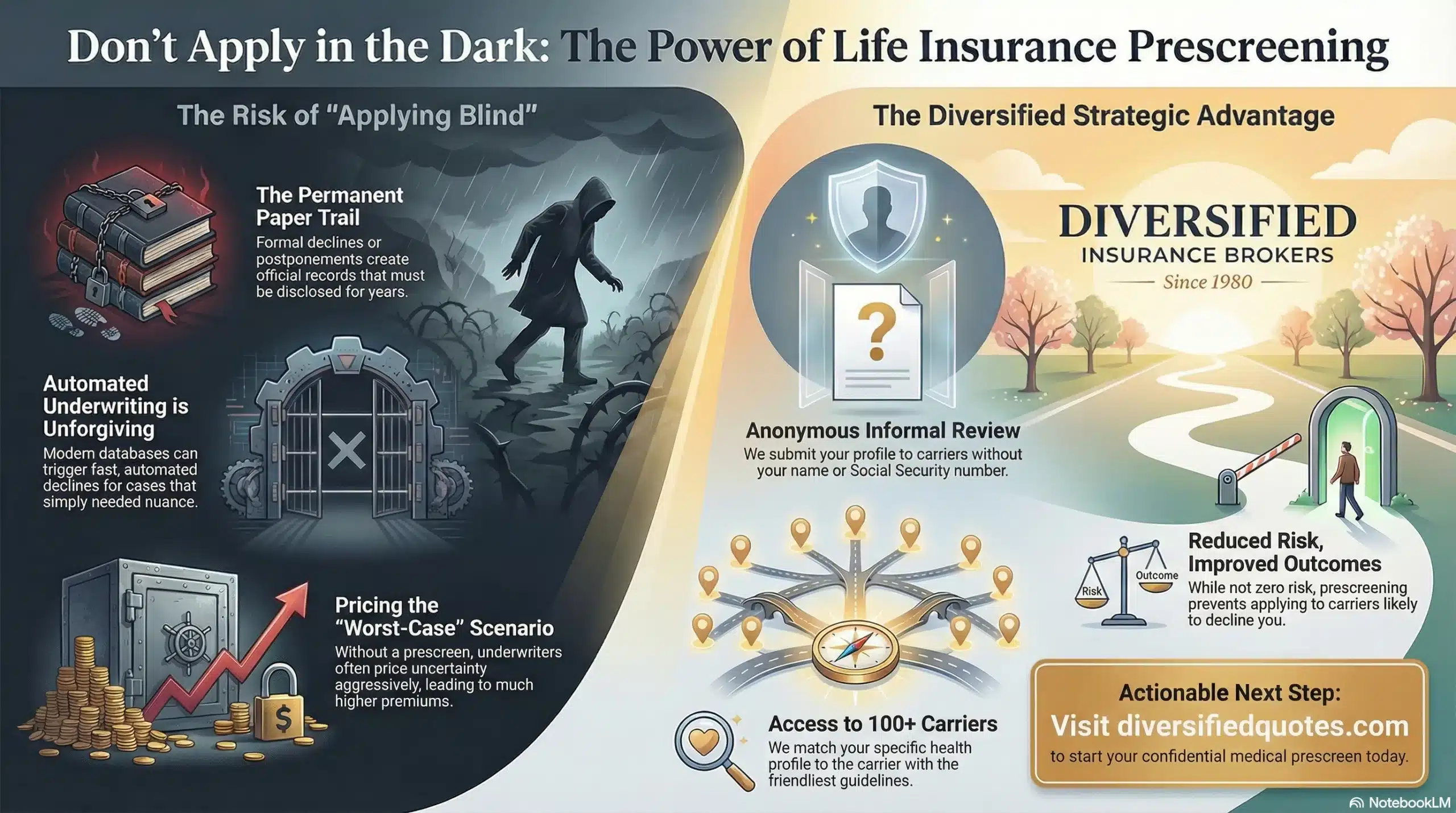
Talk With an Advisor Today
Choose how you’d like to connect—call or message us, then book a time that works for you.
Schedule here:
calendly.com/jason-dibcompanies/diversified-quotes
Licensed in all 50 states • Fiduciary, family-owned since 1980
FAQs: What to Do After Being Denied Life Insurance
Does a life insurance denial mean I’m permanently uninsurable?
No. A denial from one carrier is a carrier-specific underwriting determination — it means that particular company’s guidelines did not accommodate the applicant’s risk profile as submitted. It does not mean every carrier in the market has reached the same conclusion, because underwriting guidelines vary significantly across companies. Many applicants who were denied by one carrier — particularly through direct-to-consumer platforms or captive agents with limited market access — are subsequently approved at other carriers whose guidelines are more appropriate for the specific health history, occupation, or lifestyle factor that drove the original denial. The key is identifying the root cause of the denial and matching the next submission to carriers with favorable appetite for that specific profile.
What is the first thing I should do after being denied?
Stop submitting new applications before identifying the root cause of the denial. Every formal application creates a record in the Medical Information Bureau (MIB) that subsequent carriers consult. Repeated denials compound the problem. The correct first steps are: (1) Request the denial letter and any accompanying underwriting explanation to understand exactly why the application was declined. (2) Request your MIB file to verify the coded information is accurate and correct any errors. (3) Request any lab results from the paramedical exam if one was conducted. (4) Consult with an independent broker who can evaluate the denial reason and prescreen the case informally at appropriate alternative carriers before submitting any new formal application.
What is the MIB and how does it affect future applications?
The Medical Information Bureau (MIB) is a member-owned nonprofit data exchange used by most major life insurance carriers. When carriers process applications, they submit coded information about underwriting risk factors to the MIB database. When you apply at a new carrier, that carrier queries the MIB to see what risk categories were previously flagged. This means prior application records — and any prior declines — are visible in coded form to subsequent carriers. Errors in MIB records can also create false signals that affect underwriting outcomes. Under the Fair Credit Reporting Act, you have the right to request your MIB file and dispute any inaccurate information. Correcting MIB errors before submitting new applications is an important step in the post-denial process.
Can I appeal a life insurance denial?
Yes — most carriers have a reconsideration or appeal process, and it can be worth pursuing when the denial appears to be based on incorrect, incomplete, or outdated information. The most effective appeals are supported by new medical documentation that directly addresses the concern: a physician letter clarifying a mischaracterized condition, corrected lab results, updated records showing resolution of a temporary health event, or specialist documentation addressing a finding that was misinterpreted in the original underwriting review. Appeals are less effective — and rarely successful — when the denial accurately reflects the carrier’s guidelines applied to an accurate assessment of the applicant’s risk profile. In those cases, moving to a more appropriate carrier is the better strategy than investing time in an appeal that is unlikely to change the original outcome.
Do I have to disclose a prior life insurance denial on future applications?
Yes. Virtually all life insurance applications ask whether the applicant has previously been declined, postponed, or had coverage modified. Answering this question inaccurately is material misrepresentation, which can void a policy at claim — meaning the insurer could deny the death benefit to your beneficiaries. You must disclose prior declines truthfully. This is one of the key reasons why preventing unnecessary declines through pre-underwriting and appropriate carrier selection before applications are submitted is so important — each formal decline becomes a permanent disclosure obligation that affects every subsequent application.
How long should I wait before reapplying after a denial?
It depends on the reason for the denial. Some denials can be addressed immediately — if the denial was caused by a carrier mismatch rather than a health issue, applying to an appropriate alternative carrier through a broker with proper pre-underwriting can happen relatively quickly. Health-related denials tied to recent diagnoses, recent surgeries, or unstable conditions typically require six to twenty-four months for the condition to stabilize sufficiently for favorable underwriting. Driving record denials related to DUIs typically require waiting for the specific lookback window required by the target carrier to elapse. Substance use history denials require a documented sobriety period that varies by carrier. The right waiting period is determined by the specific denial reason and the target carrier’s guidelines — not by a universal rule that applies across all situations.
What alternatives exist if I truly can’t qualify for traditional life insurance?
When traditional fully underwritten life insurance is genuinely unavailable, several alternatives provide meaningful coverage. Simplified issue life insurance uses a health questionnaire rather than a full medical review — some applicants who cannot qualify through traditional underwriting can qualify through simplified issue. Guaranteed issue life insurance accepts all applicants within defined age bands without health questions, though coverage amounts are limited, premiums are higher, and most policies include a graded benefit period for natural causes of death. Burial and final expense coverage provides smaller face amounts for final cost coverage when larger policies are unavailable. Each alternative involves tradeoffs in cost and coverage level, but they provide real financial protection that is better than being completely uninsured while waiting for circumstances to potentially improve.
What is the difference between a postpone and a decline?
A postpone means the carrier is deferring a decision — typically because of a recent diagnosis, pending procedure, recent surgery, or condition requiring further stabilization — and will reconsider the application after a defined waiting period. A postpone is not a decline; it is a deferral with a potential path to approval at a future date. A formal decline means the carrier determined it cannot offer coverage on any terms for the application as submitted. The distinction matters because a postpone typically does not carry the same negative signal in MIB records as a formal decline, and the path forward — waiting for the specific condition to stabilize and resubmitting — is more straightforward than after a full decline.
How does an independent broker help after a life insurance denial?
An independent broker with broad carrier access and underwriting knowledge provides several specific capabilities after a denial. They can analyze the denial letter and underwriting explanation to identify the root cause — whether it was carrier mismatch, inaccurate documentation, timing, or a genuinely challenging risk profile. They can access the informal pre-underwriting process at multiple carriers to gauge likely outcomes before any formal application is submitted, preventing additional compounding declines. They can select the carrier or small group of carriers most likely to offer favorable terms for the specific profile. They can structure the case narrative — medical documentation, stability timeline, physician support letters — to present the strongest possible version of the applicant’s actual risk profile. And they can evaluate alternative coverage paths when traditional underwriting is not the right approach.
About the Author:
Jason Stolz, CLTC, CRPC, DIA, CAA and Chief Underwriter at Diversified Insurance Brokers (NPN 20471358), is a senior insurance and retirement professional with more than 25 years of real-world experience helping individuals, families, and business owners protect their income, assets, and long-term financial stability. As a long-time partner of the nationally licensed independent agency Diversified Insurance Brokers, Jason provides trusted guidance across multiple specialties—including fixed and indexed annuities, long-term care planning, personal and business disability insurance, life insurance solutions, Group Health, Travel Medical and Evacuation Insurance, and short-term health coverage. Diversified Insurance Brokers maintains active contracts with over 100 highly rated insurance carriers, ensuring clients have access to a broad and competitive marketplace.
His practical, education-first approach has earned recognition in publications such as VoyageATL, and contributions from his agency featured in Kiplinger and GoBankingRates— highlighting his commitment to financial clarity and client-focused planning. Drawing on deep product knowledge and years of hands-on field experience, Jason helps clients evaluate carriers, compare strategies, and build retirement and protection plans that are both secure and cost-efficient. Visitors who want to explore current annuity rates and compare options across multiple insurers can also use this annuity quote and comparison tool.
Explore More Life Insurance Options: Browse our complete guide to How Life Insurance Works — covering term life, whole life, final expense, annuity alternatives & more from 100+ carriers.
Last Reviewed: June 2, 2026 |
Reviewed by: Jason Stolz, CLTC, CRPC, DIA, CAA
Chief Underwriter, Diversified Insurance Brokers, Inc. | NPN: 20471358 | Diversified Insurance Brokers, Inc. — Licensed in all 50 states
Fact Checked by: Tonia Pettitt, CMIP©
Medicare Specialist, Diversified Insurance Brokers, Inc. | NPN: 14374308 | Diversified Insurance Brokers, Inc. — Licensed in all 50 states
Did you find this content helpful? Leave us a Google review — it helps others find trustworthy guidance too.
Editorial Standards: Diversified Insurance Brokers maintains rigorous editorial standards to ensure accuracy, clarity, and independence in all content. Learn more about our editorial standards and commitment to transparency.
