
How to Choose the Right Annuity Based on Your Retirement Timeline
As an Independent Annuity Broker, we compare rates across 100+ carriers and 1,000 different annuities— not just one company’s product offerings — to find the best fit for your goals.
How to Choose the Right Annuity Based on Your Retirement Timeline
When it comes to retirement planning, timing influences nearly every financial decision you make. The age you retire, when you turn on income, how much market risk you can tolerate, and how much guaranteed income you want all shape the type of annuity strategy that may fit your situation. The annuity you choose should never exist in isolation. It should reflect your retirement horizon, your income start expectations, your need for liquidity, and your overall comfort with market volatility. A well-designed annuity strategy is not about chasing the highest advertised rate or the largest upfront bonus — it is about aligning guarantees, growth potential, and flexibility with the stage of life you are actually in.

Ensure you are receiving the absolute top rates
Current Fixed Annuity Rates
Review competitive fixed annuity rates designed for principal protection and predictable growth.
Current Bonus Annuity Rates
Compare bonus annuity options and evaluate long-term income impact.
Request an Annuity Quote
Receive personalized annuity illustrations tailored to your retirement timeline.
Lifetime Income Calculator
Estimate how much guaranteed income an annuity could provide based on your premium, age, and income start date.
Annuity Type by Retirement Timeline — At a Glance
| Retirement Horizon | Primary Goal | Best-Fit Annuity Structure | Key Features to Evaluate | Common Mistakes at This Stage |
|---|---|---|---|---|
| 0–2 Years (Immediate) | Immediate income certainty; converting existing savings to guaranteed monthly payments; covering essential expenses from day one | SPIA (Single Premium Immediate Annuity); MYGA for the portion not yet needed; short-term FIA if income can begin within 1–2 years | Payout rate at current age; joint life option for married couples; liquidity access for remaining portfolio outside the annuity | Over-annuitizing — committing too much to irrevocable income and leaving too little in liquid reserves for unexpected expenses |
| 2–5 Years (Near-Term) | Principal protection with competitive guaranteed growth; locking in current rates before retirement begins; maintaining defined liquidity window | MYGA (3–5 year term); FIA with short surrender period; FIA with income rider if income activation at year 3–5 is planned | Declared rate vs. renewal rate; surrender schedule alignment with actual retirement date; free withdrawal provisions for annual access needs | Selecting a term that extends past the planned retirement date, creating surrender charge conflict with the actual income need timeline |
| 5–10 Years (Mid-Term) | Balancing principal protection with growth potential; building a future income base via GLWB deferral; positioning for multiple retirement scenarios | FIA with GLWB income rider; MYGA ladder with staggered maturities; combination of MYGA accumulation and FIA income building | Income base roll-up rate; cap rates and participation rates; payout percentage by age at activation; rider fee impact on accumulation value | Adding an income rider without evaluating the fee cost against the benefit — paying for guaranteed income that will not be activated at the planned income start age |
| 10+ Years (Long-Term) | Maximum income base growth during extended deferral; building guaranteed lifetime income for late retirement or longevity protection; tax-deferred compounding on the conservative allocation | FIA with GLWB — income base roll-up for 10+ years before activation; FIA with strong index crediting for accumulation if income rider is not elected | Roll-up rate duration limits; step-up provisions; payout factor at expected activation age; carrier financial strength for very long contract duration | Selecting a product based on the illustration’s best-case scenario rather than the contractual guarantee — understanding what the annuity guarantees vs. what it projects is critical for long horizons |
Understanding Retirement Horizon and Income Timing
Your retirement horizon is the amount of time between today and when you expect to rely on retirement income. But within that simple definition sits a much more complex planning conversation. Some retirees want income immediately when they retire. Others want income later to coordinate with Social Security or pension income. Others want annuities to act as longevity insurance, meaning income may not start until their late 70s or early 80s. Each of these goals can point toward a different annuity design, even if the investor is the same age. For those building a guaranteed income structure without an employer pension, understanding the full range of annuity options for retirees without pensions provides the foundational context for why timeline alignment matters in product selection. And for conservative investors who prioritize principal protection over growth potential, the timeline question also determines how much rate certainty versus index-linked potential is appropriate for each allocation.
Short-Term Retirement Horizon (0–5 Years)
If you are approaching retirement soon, income certainty typically becomes the dominant goal. Investors in this stage are often less concerned about maximizing market-linked upside and more focused on knowing exactly what their retirement income will look like. Multi-year guaranteed annuities (MYGAs) can be attractive in this stage because they provide defined interest rates and principal protection for a specific term — and if the term is selected to align with the retirement date, the full accumulated value becomes available at exactly the moment income is needed. For retirees who need income immediately, single premium immediate annuities (SPIAs) can convert a lump sum premium into guaranteed lifetime income payments, creating a pension-like income stream that cannot be outlived. Understanding how annuities pay income for life clarifies how different income structures — SPIAs, GLWBs, and annuitization — vary in design and how each is most appropriate in different income timing scenarios.
At this stage, liquidity and annuity withdrawal provisions matter significantly. Many near-retirees want penalty-free withdrawal flexibility while still earning competitive rates. Others prioritize maximizing guaranteed income even if liquidity is somewhat reduced. There is no universal answer. The correct choice depends on the retiree’s broader financial plan, emergency savings, and other income sources. One common and effective near-retirement strategy is a laddering approach — dividing the conservative allocation across multiple MYGAs with staggered maturities so that a portion comes available in the near term for income activation or reinvestment while longer-duration contracts capture higher declared rates.
Mid-Term Retirement Horizon (5–10 Years)
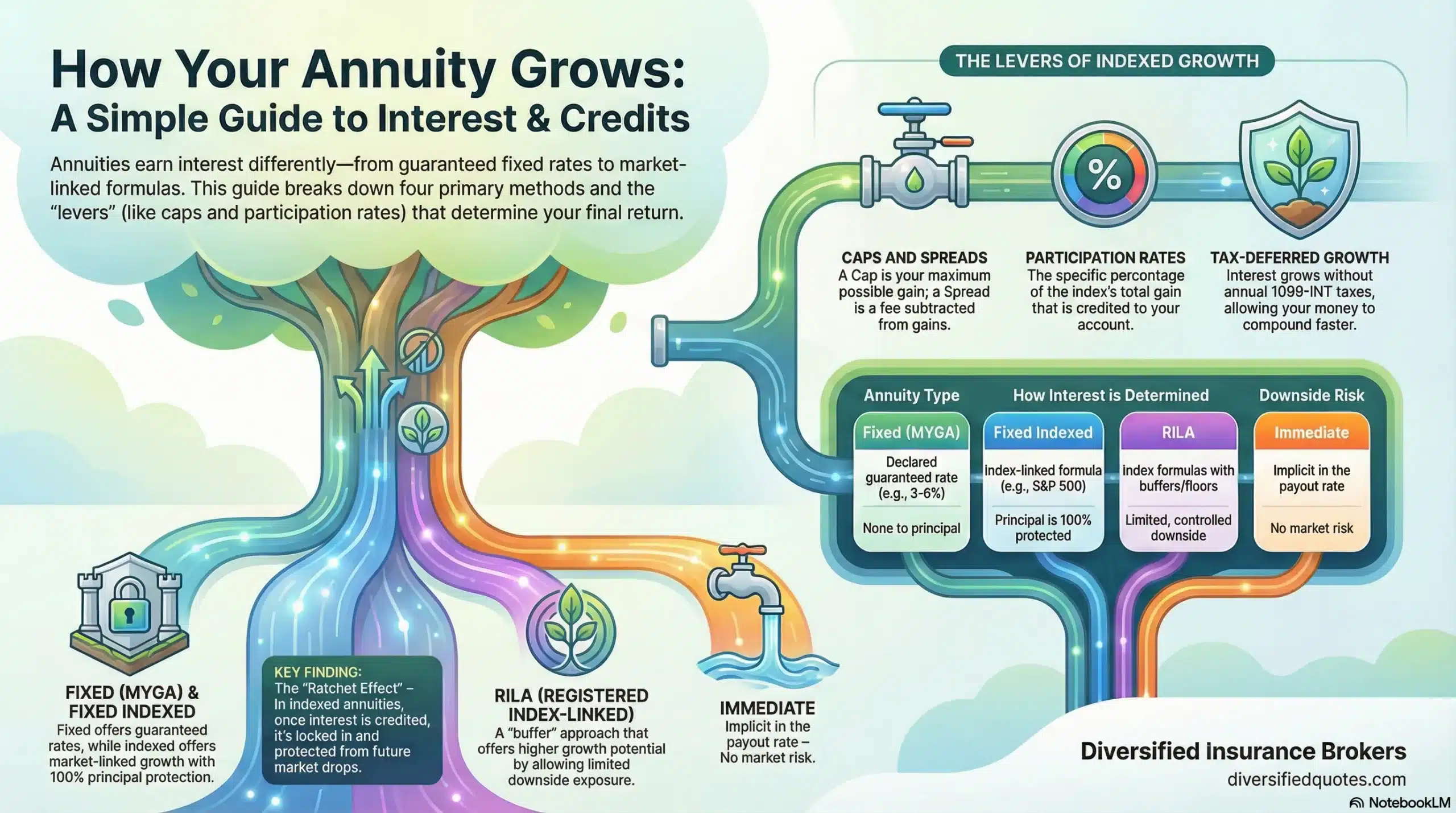
Investors who are still several years away from retirement often want a balance between safety and growth. In this stage, fixed indexed annuities can become more attractive because they offer principal protection with the potential for higher credited interest based on index performance. Indexed annuities do not directly invest in the market. Instead, they use crediting strategies — caps, participation rates, spreads — tied to external indexes to determine interest credits, so the account value cannot lose money due to index performance while still capturing a meaningful portion of index gains in favorable years. Comparing fixed annuities vs. fixed indexed annuities side by side clarifies when the certainty of a declared fixed rate is preferable and when the growth potential of an indexed strategy better serves the mid-term accumulation objective.
Income riders may also become relevant in this stage. A GLWB income rider allows the income base to grow at a defined rate during the deferral period, creating a higher future lifetime income potential than the account value alone would produce. For investors who are not yet ready to turn income on but want to secure future guaranteed income potential, these riders can be valuable planning tools — as long as the rider fee cost is evaluated honestly against the projected benefit. Our resource on how GLWBs work covers roll-up rate mechanics, income base calculations, payout factor structures by age, and how to evaluate whether the income base growth justifies the annual rider cost during the deferral period. For buyers looking specifically at the FIA products with the strongest income rider structures on the market, our guide on the best FIAs with lifetime income riders covers the leading products side by side.
Long-Term Retirement Horizon (10+ Years)
Long-term retirement planning shifts the conversation toward future income building. Investors with long horizons often want growth potential combined with future income guarantees. Indexed annuities with income riders can be particularly powerful for this goal because they can build income bases over extended deferral periods while protecting principal from market losses. The compound effect of a guaranteed roll-up rate applied to the income base for 10 or more years — combined with an increasing payout percentage at older activation ages — can produce significantly higher guaranteed income than would be available from the same premium at a shorter deferral period. For high-income earners or those who have already maximized their qualified retirement contributions, 1035 exchanges from older, underperforming annuities into newer contracts with better crediting terms or income mechanics can be a tax-efficient way to reposition existing annuity value without triggering a taxable event — a particularly relevant option for long-horizon planners who purchased contracts years ago when product structures were less competitive.
One of the biggest mistakes investors make at any stage is choosing an annuity based purely on a single feature — like the highest rate, the highest bonus, or the longest guarantee period — without understanding how that feature interacts with surrender schedules, income rider costs, crediting strategies, or withdrawal provisions. The strongest retirement income plans are built by evaluating multiple annuity structures side by side and understanding how each performs across different retirement scenarios. This is especially important because annuities are designed to be long-term planning tools, not short-term trading vehicles. Understanding whether annuities are worth it for a specific situation requires that honest side-by-side comparison, including the cost of each feature, the liquidity trade-offs, and the realistic income projection under both favorable and conservative scenarios — not just the best-case illustration. For the long-horizon investor evaluating whether annuities represent a good deployment of retirement savings compared to other alternatives, our resource on whether annuities are good investments in retirement covers the comparison framework. And understanding how sequence-of-returns risk affects long-horizon portfolios makes the case for why guaranteed annuity income helps protect the overall portfolio’s sustainability through volatile early retirement years.
At Diversified Insurance Brokers, we work with clients nationwide to match annuity structures to real-world retirement timelines. Some clients are months away from retirement and need income predictability immediately. Others are ten or fifteen years away and want tax-deferred accumulation with downside protection. The right annuity solution depends less on product marketing language and more on how income, guarantees, and liquidity work together inside the contract design — evaluated honestly, across multiple carriers, and aligned with the household’s specific retirement objectives.
Ready to match an annuity strategy to your specific retirement timeline?
Request Your Personalized Annuity Timeline Review
Financial Protection Essentials
Explore annuity interest examples and retirement planning insights to understand how different investment sizes can affect income potential.
Talk With an Advisor Today
Choose how you’d like to connect—call or message us, then book a time that works for you.
Schedule here:
calendly.com/jason-dibcompanies/diversified-quotes
Licensed in all 50 states • Fiduciary, family-owned since 1980
How do I know if my retirement timeline is short enough to justify an immediate annuity?
The decision to purchase a single premium immediate annuity (SPIA) is primarily driven by whether you need income to begin within 12 months and whether you are willing to trade full capital access for a higher guaranteed income rate than deferred structures provide. SPIAs offer the highest income per dollar of premium among all annuity structures because they begin paying immediately — the carrier does not need to reserve for a roll-up period, which means the full premium goes directly toward funding the income stream. The trade-off is reduced or eliminated principal access: once a SPIA is purchased and income begins, the original lump sum is effectively converted to an income stream and is no longer accessible as a pool of capital. Understanding how deferred annuities differ from immediate structures clarifies when deferral is worth the wait — and when starting income immediately is the stronger strategic choice. For retirees who have sufficient liquid assets outside the SPIA to handle emergencies and unexpected expenses, converting a portion of savings into a guaranteed income stream is often the most efficient use of conservative capital. The typical threshold: if you are within 0 to 24 months of needing income and have other liquid assets outside the annuity, a SPIA or near-term income activation on a deferred annuity is worth serious evaluation. If you are 3 to 5 years out, a MYGA — current rates are accessible via our MYGA rate comparison page — or an FIA with income rider building toward a defined activation date typically provides better total value.
Can I use multiple annuity types at the same time?
Yes — and in many cases, using multiple annuity structures simultaneously is the most effective approach for complex retirement income planning. Each annuity type serves a distinct function, and combining them allows each dollar to be deployed in its highest-value use. A common example: a retiree allocates a portion of conservative retirement capital into a 5-year MYGA to lock in a guaranteed rate and preserve principal for a defined period, while simultaneously allocating a separate portion to an FIA with a GLWB rider to build an income base that will activate in 7 to 10 years. The MYGA handles near-term capital preservation; the FIA income rider handles long-term guaranteed income. The two structures operate independently — each with its own surrender schedule, crediting mechanics, and purpose in the portfolio. This kind of parallel structure is also what makes laddering effective: multiple MYGA contracts at different terms create a rolling maturity schedule providing ongoing liquidity access without committing the full allocation to a single term. Checking current annuity rates across both fixed and indexed categories helps identify which terms and structures offer the most competitive terms for each allocation layer before building the combined structure. If an existing contract is underperforming its role in the combined structure, our annuity rescue plan resource covers how to evaluate whether repositioning makes more sense than holding. The critical planning discipline: ensure the combined annuity allocation does not exceed the portion of retirement assets appropriately committed to illiquid or semi-liquid instruments, and that sufficient liquid reserves remain outside the annuity portfolio for near-term cash needs.
How does Social Security timing affect my annuity strategy?
Social Security timing and annuity income timing are deeply interconnected in retirement income planning, and the most efficient strategies coordinate both deliberately. The core principle: Social Security benefits increase by approximately 8% per year of delay between full retirement age and age 70. If you delay Social Security to age 70 to maximize the guaranteed lifetime benefit, you need a bridge income source to fund expenses during the delay period — and that bridge is one of the most compelling use cases for near-term annuity income activation. Understanding how Social Security and annuities work together as a coordinated income system — rather than two separate decisions made in isolation — is the foundation of this planning approach. A MYGA or FIA with an income rider that begins distributing income at your retirement date, while Social Security is delayed for 3 to 7 years, allows you to maximize both income streams simultaneously. Once Social Security starts at 70 with its maximized benefit, the annuity income continues alongside it — and together the two guaranteed income streams often cover essential retirement expenses entirely, which frees the equity and investment portfolio to remain invested for growth rather than being drawn down for living expenses. Building a complete picture of what lifetime income annuities can provide as a floor, alongside maximized Social Security, clarifies how much of the retirement income need is covered by guaranteed sources versus what the investment portfolio must supplement. The annuity’s role in this structure is to bridge the Social Security delay gap while building a long-term guaranteed income floor that coexists with the maximized Social Security benefit.
What happens to my annuity strategy if I retire earlier or later than planned?
Flexibility for retirement timing changes is one of the most important design considerations in annuity selection — and it is often undervalued when the focus is on the best-case scenario. If you retire earlier than planned and need income sooner, the primary risk is a surrender charge on a contract that has not yet completed its surrender period. This is why matching surrender periods to realistic retirement timing ranges — not just the target date — is a critical part of the selection process. Most contracts allow up to 10% annual free withdrawal without surrender charges, which may provide enough liquidity to cover near-term income needs while the surrender period completes. If you retire later than planned, an FIA with a GLWB income rider actually benefits from the delay — each additional year of deferral increases the income base through roll-up credits and increases the payout percentage at the later activation age, producing meaningfully higher guaranteed income when you eventually activate it. This asymmetry — where delayed income activation is rewarded with higher income — makes FIA income riders particularly resilient to late retirement scenarios. For retirees who are uncertain about their retirement date, selecting annuity structures with shorter initial surrender periods, strong free withdrawal provisions, and flexible income activation timing provides maximum optionality. If you are reassessing an existing annuity contract in light of a timeline change, getting a second opinion on your annuity can confirm whether the current contract still serves the revised timeline or whether repositioning into a more appropriate structure is worth the analysis.
How do I evaluate whether an annuity bonus is actually valuable for my timeline?
Annuity bonuses — premium bonuses that add a defined percentage to the account value or income base at contract issue — are one of the most frequently misunderstood features in annuity marketing. The critical evaluation question is not “does this contract have a bonus?” but rather “does the bonus create net value over my actual holding period, or does the carrier recover the bonus cost through lower cap rates, longer surrender periods, or higher rider fees?” Our dedicated resource on whether bonus annuities are right for you covers how to run that net-value analysis honestly. Carriers fund premium bonuses through one of several mechanisms: lower credited rates during the surrender period, higher internal spreads that reduce effective index-linked credits, longer surrender periods that delay full liquidity access, or combinations of all three. A 10% premium bonus on a contract with a 9-year surrender period and 0.5% lower annual cap rates may produce less total accumulation over that period than a no-bonus contract with higher cap rates and a 7-year surrender period. The analysis requires modeling total accumulation — account value — under both structures over the expected holding period, not just comparing day-one values after the bonus is applied. Consider also the tax dimension: understanding how annuity gains are taxed at distribution ensures the net after-tax accumulation comparison between a bonus and no-bonus structure accounts for the full cost-benefit picture, not just the gross credited interest. The full range of annuity benefits — tax deferral, principal protection, lifetime income — should be weighed collectively against the total cost of the contract structure, with the bonus evaluated as one component of that total picture rather than as a standalone reason to select a product.
About the Author:
Jason Stolz, CLTC, CRPC, DIA, CAA and Chief Underwriter at Diversified Insurance Brokers (NPN 20471358), is a senior insurance and retirement professional with more than 25 years of real-world experience helping individuals, families, and business owners protect their income, assets, and long-term financial stability. As a long-time partner of the nationally licensed independent agency Diversified Insurance Brokers, Jason provides trusted guidance across multiple specialties—including fixed and indexed annuities, long-term care planning, personal and business disability insurance, life insurance solutions, Group Health, Travel Medical and Evacuation Insurance, and short-term health coverage. Diversified Insurance Brokers maintains active contracts with over 100 highly rated insurance carriers, ensuring clients have access to a broad and competitive marketplace.
His practical, education-first approach has earned recognition in publications such as VoyageATL, and contributions from his agency featured in Kiplinger and GoBankingRates— highlighting his commitment to financial clarity and client-focused planning. Drawing on deep product knowledge and years of hands-on field experience, Jason helps clients evaluate carriers, compare strategies, and build retirement and protection plans that are both secure and cost-efficient. Visitors who want to explore current annuity rates and compare options across multiple insurers can also use this annuity quote and comparison tool.
Browse More Resources: Return to our complete Fixed Indexed Annuity Products & Education guide — covering FIA products and education from top carriers.
Last Reviewed: June 25, 2026 |
Reviewed by: Jason Stolz, CLTC, CRPC, DIA, CAA
Chief Underwriter, Diversified Insurance Brokers, Inc. | NPN: 20471358 | Diversified Insurance Brokers, Inc. — Licensed in all 50 states
Fact Checked by: Tonia Pettitt, CMIP©
Medicare Specialist, Diversified Insurance Brokers, Inc. | NPN: 14374308 | Diversified Insurance Brokers, Inc. — Licensed in all 50 states
Did you find this content helpful? Leave us a Google review — it helps others find trustworthy guidance too.
Editorial Standards: Diversified Insurance Brokers maintains rigorous editorial standards to ensure accuracy, clarity, and independence in all content. Learn more about our editorial standards and commitment to transparency.
