
How to get the Best Long Term Care Insurance Rates
As an Independent Long Term Care Insurance Broker, we compare traditional, hybrid, and partnership-qualified policies across dozens of carriers to find the structure that actually fits your situation.
How to get the Best Long Term Care Insurance Rates

Jason Stolz CLTC, CRPC, DIA, CAA
Long-term care insurance premiums vary more widely than most applicants expect — and the variation is not random. Two people with nearly identical health profiles applying on the same day can receive quotes that differ by twenty-five percent or more, simply because they applied to different carriers, selected different benefit designs, or were evaluated under different underwriting standards. Getting the best long-term care insurance rates is not about finding a discount or waiting for a sale. It is about understanding the specific levers that drive premium pricing, making intentional design choices that balance protection with affordability, and comparing the market across multiple carriers rather than accepting the first quote presented. Jason Stolz, CLTC, CRPC, DIA, CAA, Chief Underwriter at Diversified Insurance Brokers, has held the CLTC designation for more than twenty-five years and works with clients across all fifty states to design long-term care coverage structures that maximize benefit value per premium dollar, using competitive options from a carrier network of more than 100 providers.
The starting point for any long-term care insurance rate optimization strategy is recognizing that premium is primarily a design outcome, not a fixed market price. The daily or monthly benefit amount you choose, the benefit period length, the inflation protection rider you select, the elimination period you accept, and the health class the carrier assigns you based on medical underwriting — all of these variables combine to produce a premium figure. Change any one of them and the premium changes. This is why the question of how to get the best long-term care insurance rates requires understanding what drives the number before attempting to reduce it. Reducing the premium by eliminating inflation protection, for example, produces a lower quote today at the cost of dramatically reduced purchasing power when claims actually occur twenty or thirty years from now. Understanding how much long-term care insurance costs across different designs and ages provides the baseline needed to evaluate whether any specific quote represents competitive market pricing.
Compare Long-Term Care Insurance Rates Across Multiple Carriers
One carrier’s quote is never the full market picture. Let us show you what competitive LTC insurance pricing looks like for your age, health profile, and coverage goals.
Request Long-Term Care Insurance QuotesThe Single Biggest Rate Factor: Age at Application
Nothing affects long-term care insurance premiums more directly or more permanently than the age at which you apply. Premiums increase with age for two compounding reasons: older applicants have a shorter time horizon before claims are statistically likely, and older applicants present higher underwriting risk because age-related health conditions accumulate. According to price index data from the American Association for Long-Term Care Insurance, a fifty-five-year-old male applying for a policy with $165,000 in initial benefits and three-percent compound inflation protection pays approximately $2,200 annually on average. A fifty-five-year-old female with the same design pays approximately $3,750 annually — significantly more because women statistically use long-term care services for longer periods than men. When the same policy is evaluated at age sixty or sixty-five, premiums rise substantially across both genders.
The financial impact of delaying application is not linear — it compounds. A policy purchased at fifty-five typically produces a lower lifetime premium outlay than the same policy purchased at sixty-five, even though the fifty-five-year-old pays premiums for a decade longer before needing care. The premium increase between fifty-five and sixty-five is large enough that it often overwhelms the actuarial advantage of paying for fewer years. This is why the long-term care insurance industry consistently identifies the ages between fifty and sixty-five as the optimal purchase window. Applications submitted before age fifty benefit from the lowest available premiums and the broadest underwriting acceptance for pre-existing conditions that might otherwise restrict or eliminate coverage options. The resource on whether you can still get long-term care insurance after age sixty addresses the reality for buyers who have passed the optimal window but still have viable options, and our resource on long-term care insurance for seniors covers availability and pricing for older applicants specifically. For buyers already past eighty, our page on long-term care insurance after age eighty addresses the narrow but real options that remain accessible at very advanced ages.
How Health Status Determines Your Rate Class
Long-term care insurance underwriting evaluates the probability that an applicant will eventually require extended care services — and health status is the primary variable in that calculation. Carriers use tiered health classifications — commonly Preferred, Standard, and Substandard or rated — to assign different premium levels based on the applicant’s medical history. Preferred applicants, typically those with no significant health conditions and no family history risk factors, receive the lowest available premiums. Standard applicants pay higher rates to reflect increased care probability. Applicants with certain conditions may receive rated coverage at further premium surcharges, or may be declined entirely.
The conditions that most significantly affect long-term care insurance underwriting include neurological conditions, cardiovascular disease, diabetes with complications, mobility impairments, current use of certain medications that indicate underlying risk, and any history of cognitive decline. Unlike life insurance, where mortality risk is the primary concern, long-term care underwriting focuses specifically on morbidity — the probability and likely duration of future care needs. This means conditions that do not significantly affect life expectancy can still have substantial effects on long-term care underwriting classification. Understanding how to qualify for long-term care insurance and what the health review process involves helps applicants prepare for the application and identify potential concerns before submitting. Our resource on who qualifies for long-term care insurance covers the general health criteria across the market. For applicants with specific health concerns, the page on long-term care insurance with pre-existing conditions identifies what is typically insurable and what is not.
LTC Insurance Rate Factors: What Changes the Premium
| Rate Factor | Lower Premium Design | Higher Premium Design | Trade-Off to Consider |
|---|---|---|---|
| Age at Application | Apply in your 50s | Apply in your 60s or 70s | Earlier application locks lower rate; waiting creates permanent rate penalty |
| Health Classification | Preferred health rating | Standard or rated | Health deterioration can eliminate options; apply while healthy |
| Elimination Period | 90 or 100 days | 0 or 30 days | Longer waiting period = lower premium; need liquid assets to self-fund the gap |
| Benefit Period | 2 or 3 years | 5 years or lifetime | Average care duration is approximately 3 years; lifetime adds significant premium |
| Daily Benefit Amount | Lower daily/monthly benefit | Higher daily/monthly benefit | Must calibrate to actual care costs in your region; under-coverage creates risk |
| Inflation Protection | Simple or no inflation rider | 3% or 5% compound | Skipping inflation protection creates purchasing power erosion over 20–30 years |
| Couple Discount | Both spouses apply together | Single applicant | Spousal discounts of 15–30% available at most carriers; shared care riders add value |
| Policy Type | Traditional standalone LTC | Hybrid life/LTC or annuity/LTC | Hybrids cost more upfront but provide death benefit if LTC never needed |
The Elimination Period: The Most Underused Premium Lever
The elimination period — sometimes called the waiting period — is the number of days of qualifying care you must personally fund before the insurance policy begins paying benefits. It functions similarly to a deductible in structure: the longer the elimination period, the lower the premium, because the insurer is covering a smaller portion of the first phase of any care event. Common elimination period options are zero days, thirty days, sixty days, and ninety days, with some policies offering one hundred days. A ninety-day elimination period is significantly less expensive than a thirty-day elimination period for equivalent coverage, and the difference in premium can be substantial — often enough to fund the elimination period out-of-pocket from savings if care is ever needed.
The practical implication of selecting a longer elimination period is that the policyholder must have liquid personal assets available to cover care costs during the waiting period without relying on the insurance benefit. For buyers with meaningful retirement savings or accessible home equity, a ninety or one hundred-day elimination period represents an intelligent premium reduction strategy rather than a coverage risk. For buyers without significant liquid reserves, a shorter elimination period — at higher premium — may be worth the cost to avoid a cash-flow crisis if care begins. The elimination period decision should be made in the context of the buyer’s broader financial picture, which is exactly the kind of analysis that distinguishes a well-structured policy from a default quote. Our resource on LTC elimination periods explained covers the calculation and design options in detail.
Inflation Protection: The Critical Rider That Most Buyers Get Wrong
Inflation protection is the feature most buyers underestimate — and the feature that has the largest long-term impact on whether a long-term care insurance policy actually pays for care when needed, or falls short by tens of thousands of dollars. According to CareScout’s survey data, national median costs for care include approximately $9,581 per month for a semi-private nursing home room and $10,798 per month for a private room. These are today’s costs. Long-term care costs have historically increased at three to five percent annually. A buyer who purchases a policy with a $150 daily benefit today and no inflation protection will still have a $150 daily benefit in twenty-five years — when the same quality of care may cost $400 or more per day. The protection purchased would cover less than half of the actual expense.
The two primary compound inflation options are three-percent and five-percent annual compound growth. Three-percent compound inflation protection is currently the most widely selected option, primarily because it balances meaningful purchasing power preservation with a premium cost that is significantly lower than five-percent compound. According to long-term care insurance industry data, a policy with $165,000 in initial benefits purchased at age fifty-five grows to approximately $400,500 in total benefits by age eighty-five with three-percent compound inflation, compared to $298,900 with two-percent compound and $679,100 with five-percent compound. For buyers fifty-five and younger, the thirty-year compounding horizon makes inflation protection the single most important feature-to-premium decision in the entire policy design. Skipping inflation protection to reduce the premium is almost always the wrong trade-off for buyers who have many years before expected claims. Our resource on the long-term care insurance with lifetime benefits includes discussion of how inflation protection interacts with unlimited benefit periods. The LTC state partnership program, which requires compound inflation protection as a condition of asset disregard benefits, is covered in our resource on partnership-qualified long-term care insurance.
Benefit Period and Daily Benefit: Calibrating Coverage to Actual Risk
The benefit period — how long the policy will pay benefits — is one of the most consequential design choices in a long-term care insurance policy and one of the primary drivers of premium cost. Benefit period options typically range from two years to five years to unlimited lifetime coverage. The average duration of long-term care needs is approximately three years, based on industry and actuarial research, which makes a three-year benefit period a statistically reasonable baseline for most buyers. However, that average masks significant variation: many care events are short-duration, while others extend for many years — particularly for dementia-related conditions, where care can last a decade or longer. Buyers who are concerned about prolonged care — perhaps because of family history of Alzheimer’s disease or other dementias — have reason to consider longer benefit periods despite the premium increase.
The daily benefit amount — the maximum the policy will pay per day of qualifying care — must be calibrated to actual care costs in the buyer’s region. National averages are useful reference points but can meaningfully understate or overstate costs in any specific geographic area. Our cost of long-term care by state calculator helps buyers identify the realistic daily cost of care in their specific state and region. A policy whose daily benefit covers half of local nursing home costs is not adequate protection — the policyholder would face significant out-of-pocket exposure for every day of care. Calibrating the daily benefit to local costs, rather than selecting a round number, is an important precision adjustment that improves coverage quality without necessarily increasing premium if done alongside strategic elimination period and benefit period decisions.
Spousal Discounts and Shared Care Riders: The Couple Advantage
Married couples applying for long-term care insurance together access structural advantages unavailable to single applicants. The most immediate is the spousal discount — a premium reduction commonly ranging from fifteen to thirty percent per policy when both spouses apply simultaneously with most carriers. This discount is not trivial: on policies costing several thousand dollars annually per person, a twenty-percent spousal discount represents hundreds of dollars in annual savings per policyholder for the life of the policy. The couple discount requires both spouses to apply and be accepted, which makes it important to initiate the application process while both spouses are still medically eligible. Waiting until one spouse develops a health condition that limits their insurability forfeits this discount permanently.
Beyond the discount, married couples have access to shared care riders — a policy feature that allows spouses to draw on each other’s benefit pools if one exhausts their individual coverage before the other needs care. Our resource on shared care riders in LTC and the companion pages on long-term care insurance with shared benefits and long-term care insurance with shared spousal benefits cover the mechanics and value of this feature in detail. The resource specifically focused on long-term care insurance for couples addresses the full range of couple-specific design decisions including how to structure benefit amounts and periods when two policies must work together as a coordinated household plan.
Traditional vs. Hybrid: Two Fundamentally Different Rate Structures
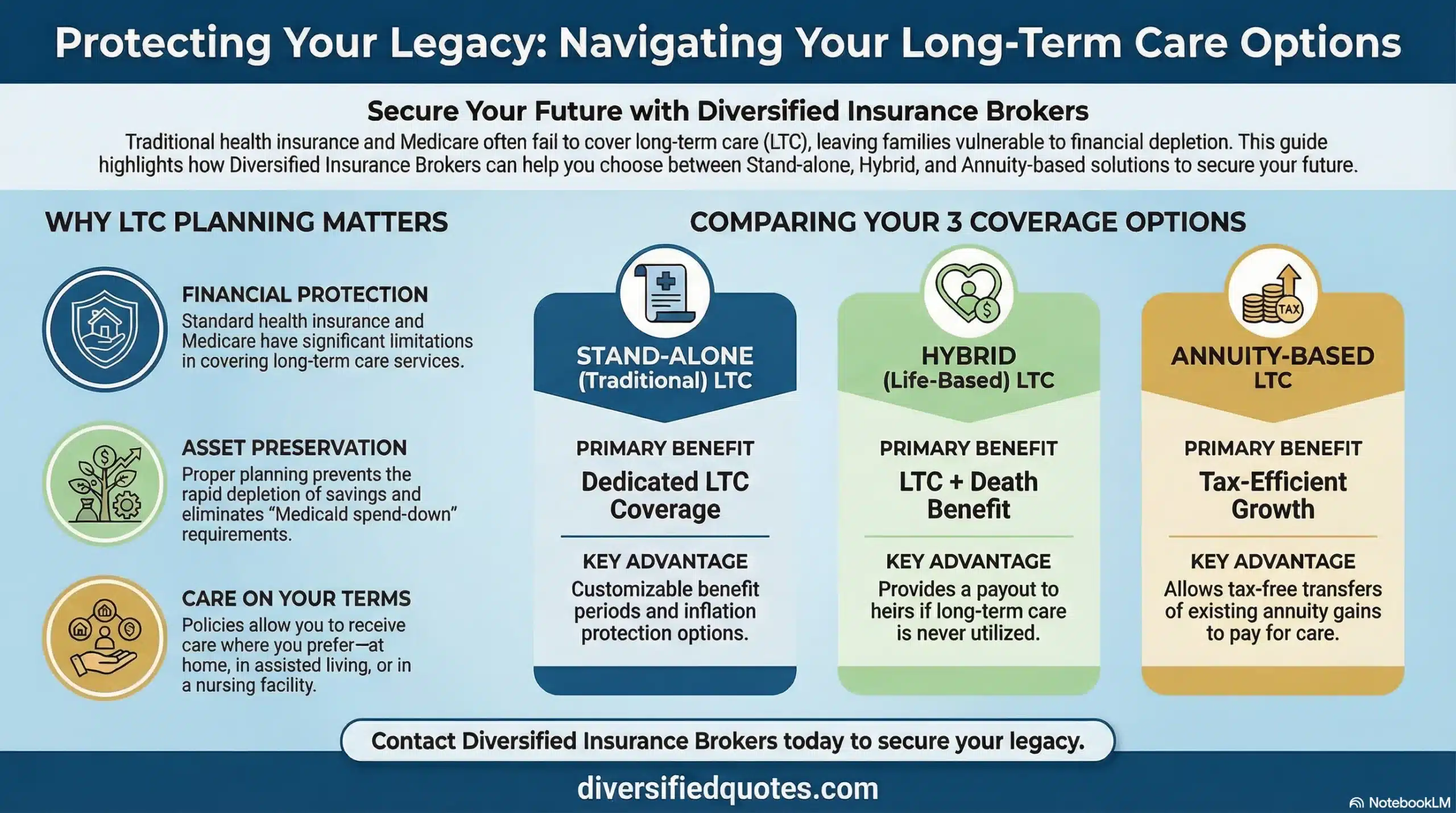
The comparison between traditional standalone long-term care insurance and hybrid life/long-term care insurance involves fundamentally different premium structures, not just different price levels. Traditional standalone LTC policies charge an ongoing annual premium for as long as the policy is maintained — a use-it-or-lose-it structure where premiums paid are not recoverable if the insured dies without needing long-term care. The advantage is that traditional policies typically provide the highest benefit-per-premium-dollar for the LTC protection itself, making them the most cost-efficient structure for buyers who are primarily focused on maximizing the care benefit per dollar spent.
Hybrid policies — which combine life insurance or annuity funding with a long-term care benefit — address the perceived “use it or lose it” objection by ensuring that the premiums are not wasted if care is never needed: a death benefit is paid to beneficiaries if the long-term care benefit is never fully utilized. The premium for a hybrid policy is almost always higher in absolute terms than a comparable traditional standalone policy, because the buyer is paying for both the long-term care benefit and the life insurance or annuity component. However, for buyers who would otherwise be unwilling to pay for traditional LTC coverage precisely because of the use-it-or-lose-it concern, the hybrid structure converts a reluctance to purchase into a willingness — and having some LTC coverage in a hybrid structure is vastly better than having none. Our resource on hybrid life versus traditional long-term care insurance provides the direct comparison, and the resource on understanding hybrid long-term care insurance covers how these structures function in practice. For buyers who prefer to fund LTC coverage through annuity assets rather than ongoing premiums, the non-qualified long-term care annuity represents a separate funding pathway worth evaluating.
The Tax Advantage That Reduces the Net Cost of Coverage
Long-term care insurance premiums for qualified policies are deductible as medical expenses for individuals who itemize, subject to age-based IRS limits that increase with age. For those who do not itemize, the deduction may still be accessible through specific business structures. Self-employed individuals can deduct qualified LTC premiums as a business expense up to the applicable age-based limit without itemizing. C-corporation owners can potentially deduct one hundred percent of LTC premiums paid for themselves and their employees. S-corporation shareholders and partners in partnerships receive favorable but not identical treatment. The result is that the after-tax cost of a qualified long-term care insurance policy is meaningfully less than the gross premium for many buyers — particularly business owners and self-employed individuals who can structure the deduction advantageously. Our resource on the tax advantages of long-term care insurance covers these deductions in detail, and the resource on tax advantages of LTC and hybrid policies addresses how the tax treatment differs between traditional and hybrid structures. The resource on whether you can use qualified funds for long-term care insurance covers additional strategies for funding premium payments in a tax-efficient manner.
Carrier Comparison: Why the Market Matters as Much as Policy Design
Even after optimizing every policy design variable, premium differences between carriers for structurally identical policies can be substantial. Research indicates that similar long-term care insurance policies from different carriers can differ by up to twenty-six percent in annual premium for the same applicant profile and benefit design. That spread represents real money on policies that are maintained for decades: a twenty-five percent difference on a $3,000 annual premium is $750 per year, or $22,500 over thirty years. The carrier pricing differential is not always predictable from carrier size or market share — some of the most competitively priced options come from carriers that are not household names but carry strong financial strength ratings and favorable actuarial assumptions for specific demographic profiles.
Carrier financial strength matters in long-term care insurance more than in almost any other insurance product, because the claims obligation may not arise for thirty years from the date of policy issue. A carrier that is financially strong today but does not remain so cannot honor guarantees decades hence. Independent rating agencies including AM Best evaluate long-term financial strength, and buyers should prioritize carriers rated A- or better when making long-term care insurance purchase decisions. Historical rate increase behavior is also relevant: some carriers have imposed significant premium increases on in-force policies in past years, and understanding a carrier’s rate action history alongside its current pricing provides a more complete picture than current premium alone. Our resource on best long-term care insurance rates provides current market benchmarks. Working with an independent long-term care insurance broker who contracts with multiple carriers and can run simultaneous multi-carrier comparisons is the most direct path to identifying the best available rate for a specific applicant’s health profile, age, and benefit design preferences. For buyers who already have a long-term care policy in force and want to know whether better options are available, a second opinion on an existing LTC insurance quote from an independent broker frequently identifies superior alternatives at lower cost, particularly for buyers whose current policy is with a carrier that has imposed multiple rate increases.
Talk With an Advisor Today
Choose how you’d like to connect—call or message us, then book a time that works for you.
Schedule here:
calendly.com/jason-dibcompanies/diversified-quotes
Licensed in all 50 states • Fiduciary, family-owned since 1980
Frequently Asked Questions: How to Get the Best Long-Term Care Insurance Rates
What is the single most important thing I can do to get lower long-term care insurance rates?
Apply earlier. Age at application is the most powerful premium driver in long-term care insurance, and it permanently affects every premium you will pay for the life of the policy. A policy purchased at fifty-five carries a meaningfully lower annual premium than the equivalent policy purchased at sixty-five, and that difference persists for every year the policy is in force. According to industry price index data from the American Association for Long-Term Care Insurance, a fifty-five-year-old male pays approximately $2,200 annually for a policy with $165,000 in initial benefits and three-percent compound inflation protection. The same policy at sixty-five carries a premium that is substantially higher — and that increase cannot be reversed once coverage is issued. Beyond age, applying while in good health is equally important, because health classification determines which premium tier you receive. Buyers who wait until they are older or have developed health conditions that affect underwriting may find their options narrowed and their premiums elevated beyond what earlier application would have required. The ideal window for most buyers is between age fifty and sixty-five, when premiums are manageable, the range of available carriers is broadest, and preferred health classifications are still attainable.
How does the elimination period affect my long-term care insurance premium?
The elimination period — the number of days you must personally fund care before your insurance benefits begin — functions as the equivalent of a deductible and has a direct and significant effect on premium. Selecting a longer elimination period, such as ninety or one hundred days, produces a meaningfully lower annual premium than a thirty-day or zero-day elimination period for equivalent coverage benefits. The reason is straightforward: a longer elimination period means the insurer is responsible for fewer total days of benefit over the life of the policy, because the policyholder absorbs a larger share of the initial care cost. The practical consideration is whether you have the liquid assets — savings, accessible investments, or available home equity — to fund three months of care costs out-of-pocket before insurance benefits begin. For buyers with adequate liquid reserves, selecting the ninety-day elimination period is almost always the cost-efficient choice. For buyers without significant savings available for this purpose, a shorter elimination period reduces the financial gap but at the cost of a permanently higher annual premium. The ninety-day elimination period is the most commonly selected option in the market and represents the design that most carriers use as their standard pricing baseline.
Is it worth paying extra for inflation protection in a long-term care insurance policy?
For most buyers under age seventy, yes — and skipping inflation protection is one of the most common and costly long-term care insurance mistakes. Long-term care costs have historically increased at three to five percent annually. A policy purchased with a $150 daily benefit today will still have a $150 daily benefit in twenty-five years without inflation protection — at a time when nursing home costs may exceed $400 or more per day nationally. The purchasing power erosion would leave the policyholder covering more than half of actual care costs out-of-pocket despite having insurance. Three-percent compound inflation protection is the most widely selected option currently, producing meaningful benefit growth that substantially closes the gap between today’s benefit amount and future care costs. A policy with $165,000 in initial benefits grows to approximately $400,500 with three-percent compound inflation by age eighty-five for a buyer who purchased at fifty-five. The incremental annual premium cost of adding three-percent compound inflation is real but is substantially smaller than the gap it prevents between insured benefits and actual future care expenses. State long-term care partnership programs, which provide Medicaid asset disregard benefits, specifically require compound inflation protection as a condition of partnership eligibility, providing an additional regulatory incentive for including this feature.
Do married couples get a discount on long-term care insurance?
Yes — most carriers offer spousal discounts ranging from approximately fifteen to thirty percent per policy when both spouses apply together and are each accepted for coverage. This discount is applied to each policy individually, so both spouses benefit from the reduced rate. On policies with annual premiums of several thousand dollars, a twenty-percent spousal discount represents hundreds of dollars in annual savings per person — and that savings compounds over decades of policy ownership. Accessing this discount requires that both spouses apply while both are medically eligible. If one spouse develops a health condition that makes them uninsurable before they apply, the other spouse loses the couple discount permanently. For married couples, this creates an additional incentive to initiate the application process while both are in good health, rather than waiting until one partner has a health change. Beyond the pricing discount, married couples have access to shared care riders that allow spouses to draw on each other’s benefit pools if needed — a structural advantage that provides a combined household benefit larger than either policy could provide individually.
How much can long-term care insurance premiums vary between carriers?
Research indicates that structurally equivalent long-term care insurance policies can differ by up to twenty-six percent in annual premium between carriers for the same applicant profile, benefit design, and health classification. That spread is meaningful on policies that are maintained for decades. A twenty-five percent difference on a $3,000 annual premium represents $750 per year — or $22,500 over thirty years. The premium differential between carriers does not always correlate with carrier size or market share. Some competitive pricing comes from carriers that are not widely recognized consumer brands but carry strong AM Best financial strength ratings. A meaningful comparison requires applying to or requesting quotes from multiple carriers simultaneously, using identical benefit specifications — same daily benefit, same benefit period, same inflation protection, same elimination period, and same health class assumption — so the comparison reflects actual pricing differences rather than design differences. This is why working with an independent broker who can run a genuine multi-carrier comparison produces better outcomes than applying to a single carrier or accepting a single-carrier recommendation from an agent who represents only one company.
Can long-term care insurance premiums increase after I buy my policy?
Yes. Long-term care insurance premiums are not guaranteed level for life — they are subject to rate increases if the carrier receives regulatory approval from state insurance departments. Several carriers have imposed significant premium increases on in-force policies over the years, reflecting claim experience that was higher than original pricing assumptions. This rate action history is one of the most important factors to evaluate when selecting a carrier, alongside current premium levels. Carriers with histories of large or frequent rate increases on existing policyholders represent a different risk profile than carriers whose rate action history is minimal. When comparing carriers, asking specifically about historical rate increases on in-force policies — not just quoting a current premium — provides important information that current pricing alone does not. Most states require carriers to file for rate increases and justify them actuarially, and the approval process provides some regulatory protection, but it does not prevent increases from occurring. Hybrid policies funded with a single premium or a defined-payment period offer a structural advantage here: because the full premium contribution is made upfront or within a fixed payment window, ongoing premium increase risk is eliminated or substantially reduced.
Is a hybrid long-term care policy more cost-effective than a traditional standalone policy?
Not in terms of long-term care benefit per premium dollar — traditional standalone policies typically provide more LTC benefit per dollar spent on premium because the entire premium funds the care benefit without also funding a life insurance or annuity component. However, cost-effectiveness depends on what the buyer values. A hybrid policy that combines life insurance with long-term care coverage ensures that premiums are not “wasted” if the policyholder dies without needing long-term care — a death benefit is paid to beneficiaries. For buyers who are reluctant to purchase traditional standalone LTC coverage because of the use-it-or-lose-it concern, the hybrid structure converts that reluctance into action, and having hybrid coverage is substantially better than having no coverage at all. Hybrid policies funded with a single lump-sum premium also eliminate ongoing premium increase risk, since the full funding obligation is met at purchase. The optimal choice between traditional and hybrid depends on the buyer’s primary concern: maximum LTC benefit per dollar, elimination of ongoing premium risk, legacy planning goals, or the desire to address multiple financial risks in a single contract. A comparison that models both structures for the same buyer at the same age provides the clearest basis for this decision.
Are long-term care insurance premiums tax deductible?
Premiums for qualified long-term care insurance policies are deductible as medical expenses for individuals who itemize deductions, subject to age-based annual limits established by the IRS. These limits increase with age — the IRS publishes updated figures periodically — and the deductible amount cannot exceed the actual premium paid. For taxpayers who do not itemize, federal deductibility through Schedule A is unavailable. However, self-employed individuals can deduct qualified LTC premiums directly as a business expense up to the applicable age-based limit without needing to itemize. C-corporation owners can potentially deduct one hundred percent of qualified LTC premiums paid on behalf of themselves and employees as a business expense. The after-tax cost for business owners and self-employed individuals who structure their LTC premium payment optimally can be significantly lower than the gross premium suggests. Hybrid life/LTC policies have somewhat different tax treatment than standalone traditional policies, and the tax advantages can vary by how the policy is structured and funded. Consulting a tax professional before finalizing a long-term care insurance purchase ensures the premium payment structure captures the maximum available tax benefit.
About the Author:
Jason Stolz, CLTC, CRPC, DIA, CAA and Chief Underwriter at Diversified Insurance Brokers (NPN 20471358), is a senior insurance and retirement professional with more than 25 years of real-world experience helping individuals, families, and business owners protect their income, assets, and long-term financial stability. As a long-time partner of the nationally licensed independent agency Diversified Insurance Brokers, Jason provides trusted guidance across multiple specialties—including fixed and indexed annuities, long-term care planning, personal and business disability insurance, life insurance solutions, Group Health, Travel Medical and Evacuation Insurance, and short-term health coverage. Diversified Insurance Brokers maintains active contracts with over 100 highly rated insurance carriers, ensuring clients have access to a broad and competitive marketplace.
His practical, education-first approach has earned recognition in publications such as VoyageATL, and contributions from his agency featured in Kiplinger and GoBankingRates— highlighting his commitment to financial clarity and client-focused planning. Drawing on deep product knowledge and years of hands-on field experience, Jason helps clients evaluate carriers, compare strategies, and build retirement and protection plans that are both secure and cost-efficient. Visitors who want to explore current annuity rates and compare options across multiple insurers can also use this annuity quote and comparison tool.
Explore More Long Term Care Insurance Options: Browse our complete guide to LTC Insurance Costs, Rates & Planning — covering how much it costs, best rates, calculators, planning strategies & is it worth it from top carriers.
Last Reviewed: August 31, 2026 |
Reviewed by: Jason Stolz, CLTC, CRPC, DIA, CAA
Chief Underwriter, Diversified Insurance Brokers, Inc. | NPN: 20471358 | Diversified Insurance Brokers, Inc. — Licensed in all 50 states
Fact Checked by: Tonia Pettitt, CMIP©
Medicare Specialist, Diversified Insurance Brokers, Inc. | NPN: 14374308 | Diversified Insurance Brokers, Inc. — Licensed in all 50 states
Did you find this content helpful? Leave us a Google review — it helps others find trustworthy guidance too.
Editorial Standards: Diversified Insurance Brokers maintains rigorous editorial standards to ensure accuracy, clarity, and independence in all content. Learn more about our editorial standards and commitment to transparency.
