
Is Long Term Care Insurance Worth It
As an Independent Long Term Care Insurance Broker, we compare traditional, hybrid, and partnership-qualified policies across dozens of carriers to find the structure that actually fits your situation.
Is Long Term Care Insurance Worth It

Jason Stolz CLTC, CRPC, DIA, CAA
Is long-term care insurance worth it? Many retirees and pre-retirees ask this question at some point in their planning process — and the honest answer is that it depends entirely on what risk you are trying to solve and what tools are available to solve it. Long-term care insurance can be one of the most valuable financial protection tools a family can own, or it can be the wrong fit for a specific household’s situation. The difference between those two outcomes is understanding exactly what LTC coverage does, who it serves best, what it costs relative to the alternative of self-funding, and how hybrid designs have expanded the options available beyond traditional standalone policies. At Diversified Insurance Brokers, Jason Stolz, CLTC, CRPC, DIA, CAA, helps clients work through this decision by presenting multiple paths side-by-side — traditional LTC, hybrid life/LTC, annuity-based LTC, and self-funding frameworks — so the trade-offs are visible in plain terms rather than theoretical. The long-term care playbook provides the comprehensive planning framework, and whether to buy long-term care insurance covers the decision framework specifically for households that are still evaluating.
The framing that makes this question most productive is to approach it as a risk management decision rather than a financial product purchase. The question is not “will I use it?” — no one knows the answer to that. The question is “what happens to my retirement plan if I need multi-year care and don’t have coverage?” For a household with $500,000 in retirement savings and a surviving spouse who needs that income to last 25 years, a three-year care event at $8,000 per month can consume $288,000 — more than half the nest egg — before the surviving spouse is positioned to begin rebuilding. For a household with $3 million in liquid assets and no spouse to protect, the same event might be an inconvenience rather than a crisis. The “worth it” question has different answers for those two households, and the answer is determined by the gap between the household’s ability to absorb the cost and the potential magnitude of the risk — not by whether care statistics favor a given individual.
Find Out If LTC Insurance Is Worth It for You
We’ll compare traditional LTC, hybrid options, and self-funding scenarios so you can make a confident decision based on your actual numbers.
Start Your LTC ReviewQuestions? Call 800-533-5969
What Long-Term Care Insurance Actually Covers
Long-term care insurance is designed to pay for services that traditional health insurance and Medicare do not cover for extended periods. Medicare covers skilled nursing facility care for a limited period following a qualifying hospital stay — but not custodial care, which is the ongoing assistance with activities of daily living that constitutes the bulk of long-term care needs. The services LTC insurance is designed to fund include in-home care services, adult day care, assisted living, memory care, skilled nursing facility care, home health care through annuity riders, and other personal care needs depending on the policy. The gap between what Medicare covers and what long-term care actually costs — and how long it can last — is the foundational risk that LTC insurance addresses. Whether Medicare and long-term care insurance are the same and whether Medicare covers nursing home care both address that gap directly.
When purchasing an LTC policy, the primary design decisions are: the daily or monthly benefit amount, the benefit period (how long payments can last — often two, three, five years, or lifetime), the benefit pool (total dollars available), the elimination period (the waiting period between claim eligibility and benefit payment, typically 30, 60, or 90 days), and whether to include inflation protection. These are not passive parameters — each decision produces a meaningfully different cost-to-coverage ratio, and the right combination depends on the household’s risk tolerance, the coverage needed to make a material difference, and the premium that can be sustained long-term. What a long-term care insurance benefit period is, limited-term versus lifetime benefits, and how to choose the right LTC policy all cover the design decisions in detail. It also helps to remember that care often begins at home — part-time support for bathing, dressing, meal preparation, and supervision — well before any nursing facility admission. A policy designed to cover only facility care misses a large portion of the actual care need for most people.
Who Benefits Most from LTC Coverage
LTC insurance provides the clearest value for households with meaningful retirement assets that a multi-year care event could materially damage, a surviving spouse whose financial security depends on those assets lasting, or a legacy goal that would be compromised by a prolonged care draw-down. These are households where the gap between the household’s ability to absorb care costs and the potential magnitude of those costs is large enough that a policy premium is genuinely efficient risk transfer rather than unnecessary overhead. The cost of long-term care varies significantly by geography and care setting — the cost of long-term care by state calculator provides location-specific context for evaluating the actual financial exposure in your area.
LTC coverage also makes strong sense when family support is limited or when the household wants to keep financial and caregiving decisions separate. If adult children live far away, have demanding careers and families, or are not positioned to provide hands-on care, insurance can fund professional services and reduce the burden on family members who might otherwise be pulled into a caregiving role they are ill-equipped for. Even when family support is available and willing, many households specifically prefer to use insurance to preserve the emotional and relational quality of family relationships by keeping money out of the caregiving equation. Long-term care insurance with shared spousal benefits covers the specific design that extends coverage across both spouses in a household and allows benefits to be shared — addressing one of the most common concerns for married couples evaluating LTC coverage.
LTC insurance becomes a less clear value when the household has modest assets and would likely exhaust personal resources and access Medicaid regardless of coverage, when the household has substantial liquid assets and genuine self-funding capacity without putting other financial goals at risk, or when premium costs would strain other financial priorities to the point of becoming counterproductive. Self-insured long-term care covers the framework for evaluating whether self-funding is a genuine strategy or simply an assumption — and what that strategy actually requires in terms of reserved assets to be viable.
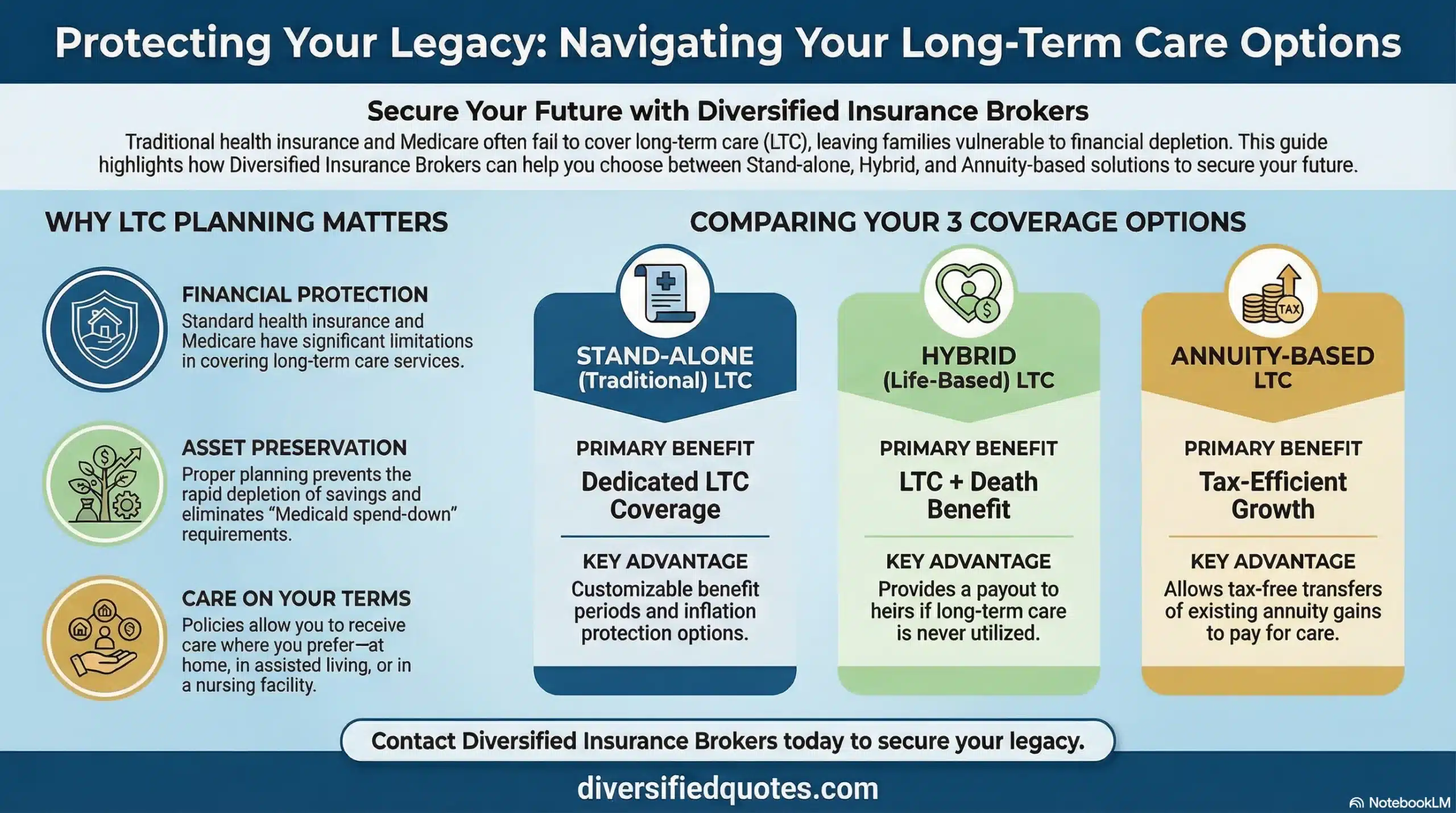
Traditional LTC vs. Hybrid Designs — The Options Have Expanded Significantly
| Structure | How It Works | Best Fit | Key Trade-Off |
|---|---|---|---|
| Traditional Standalone LTC | Annual premiums purchase a defined daily benefit, benefit period, and inflation protection; policy pays when benefit triggers are met; no value if never claimed | Households who want maximum LTC benefit per premium dollar and are comfortable with use-it-or-lose-it design; often the highest benefit-to-premium ratio | Premium rate increases can occur; policy has no residual value if not used; requires health qualification at purchase |
| Hybrid Life/LTC | Life insurance policy with accelerated or extension-of-benefit LTC rider; death benefit paid if care never needed; LTC benefits drawn from and beyond death benefit if care occurs; see hybrid life insurance with LTC benefits | Households who want value in “no claim” scenario; single premium or limited pay funding; asset repositioning from CD, annuity, or savings; see hybrid life vs. traditional LTC comparison | Higher upfront cost than traditional; LTC benefit per dollar of premium may be lower than standalone; requires lump sum or limited-pay commitment |
| Annuity-Based LTC | Fixed annuity with LTC benefit rider or dedicated LTC annuity; accumulation with LTC benefit acceleration if care triggers met; see annuity with long-term care benefits and fixed annuity with LTC benefits | Households repositioning existing annuity or CD assets who want growth plus LTC protection; tax-qualified LTC benefit treatment for qualified contracts | LTC benefit typically limited to a multiple of account value; not a substitute for standalone LTC for high care cost exposure; varies significantly by carrier |
| Guaranteed Issue LTC | LTC coverage available without full medical underwriting for eligible applicants; benefit amounts typically more limited than fully underwritten policies; see guaranteed issue long-term care insurance | Households where health history precludes fully underwritten coverage; partial protection better than no protection; LTC with pre-existing conditions covers full options | Benefits typically lower than fully underwritten; premium may be higher per dollar of benefit; may include waiting periods for pre-existing conditions |
When LTC Insurance Is Worth It — and When It Is Not
The decision to purchase LTC coverage clarifies quickly when framed as a comparison between two outcomes: what the retirement plan looks like if care is needed and insurance covers it, versus what the plan looks like if care is needed and it does not. For households where that comparison reveals a material gap — where a multi-year care event would force the surviving spouse into a significantly reduced lifestyle, require liquidating the home, or eliminate the possibility of leaving anything to heirs — insurance is worth it because it is genuinely solving a meaningful problem. For households where the comparison reveals that the household could absorb even an extended care event without permanently damaging the financial plan, the calculation shifts toward self-funding.
The practical questions that reveal which category a household falls into are: How much do you have in retirement savings, and how long do those savings need to last if one spouse needs care while the other continues living? Could you fund $8,000 to $12,000 per month in care costs for three or more years without permanently reducing your retirement income plan? Do you have a surviving spouse whose financial security depends on preservation of the retirement accounts? Do you have a legacy goal that would survive a prolonged care draw-down? How would a care event interact with your Social Security, pension, and annuity income streams? Long-term care planning strategies covers the full household planning approach that integrates these questions into a coherent analysis rather than evaluating LTC in isolation. Who qualifies for LTC insurance and how to qualify cover the health underwriting requirements that determine whether coverage is available at standard rates, table-rated, or unavailable through traditional underwriting channels.
The age at which LTC insurance is purchased also affects the decision meaningfully. Younger applicants pay lower premiums, face more favorable underwriting prospects, and have more design flexibility than older applicants. Whether you can still get LTC insurance after age 60 and long-term care insurance after age 80 both cover the options available at later entry ages, where traditional underwriting may be more restrictive and alternative designs become more relevant. How to get the best LTC insurance rates covers the factors that influence premium at any age and how carrier selection and plan design affect the ultimate cost.
Tax Advantages, Partnership Programs, and Less-Known LTC Features
Tax-qualified long-term care insurance policies — those meeting IRS standards under the Health Insurance Portability and Accountability Act — receive favorable tax treatment in several ways. Premiums may be deductible as medical expenses above the applicable adjusted gross income threshold for individual taxpayers, subject to age-based per-person limits that increase with age. For self-employed individuals, the deduction is more generous. For businesses purchasing coverage for owner-employees, LTC premiums may be fully deductible as a business expense. Benefits received from a tax-qualified LTC policy are generally excludable from income up to specified limits. Tax advantages of long-term care insurance covers the full deductibility and benefit exclusion framework.
Partnership-qualified LTC programs, available in most states, provide an additional layer of value for policyholders who exhaust policy benefits and subsequently apply for Medicaid: assets equal to the benefits paid by the partnership policy are protected from Medicaid spend-down requirements, allowing the policyholder to retain assets that would otherwise need to be depleted before Medicaid eligibility is established. Partnership-qualified LTC insurance and LTC partnership reciprocity between states cover how these programs work and which states have active partnership programs that provide this additional protection. Shared care riders in LTC cover the design feature that allows married couples to pool their benefit periods, preventing the situation where one spouse exhausts their individual benefit while the other’s remains unused.
Not sure if long-term care insurance is worth it for you?
We’ll review your age, health, savings, retirement income sources, and goals — and show how LTC coverage, self-funding, or a combination can work in your specific situation.
Start Your Long-Term Care ReviewNo pressure — just clear numbers and options based on your situation. Call 800-533-5969
Talk With an Advisor Today
Choose how you’d like to connect—call or message us, then book a time that works for you.
Schedule here:
calendly.com/jason-dibcompanies/diversified-quotes
Licensed in all 50 states • Fiduciary, family-owned since 1980
Frequently Asked Questions: Is Long-Term Care Insurance Worth It?
What is the probability of actually needing long-term care?
The probability of needing some form of long-term care is significant for most Americans who reach retirement age. Broadly cited estimates suggest that approximately 70% of people who reach age 65 will require some form of long-term care services during their lifetime — though the nature of that care ranges from brief assistance during recovery from an illness or injury to multi-year skilled nursing facility placement. The severity distribution matters as much as the headline probability: a large percentage of people who need care require only a relatively short duration of assistance, while a smaller percentage require multi-year intensive care at significant cost. The planning decision is not just about whether you will need care — it is about whether the portion that does require multi-year, high-cost care would create a material financial problem for the household if not covered by insurance. That determination depends on the household’s financial profile, not on population-level statistics.
What happens if I pay LTC premiums for years and never use the benefits?
With a traditional standalone LTC policy, if you never trigger the benefit, the premiums paid represent the cost of the protection you maintained — similar to homeowners insurance or auto insurance. You paid for a risk you were willing to transfer, and the risk did not materialize. The financial return on a traditional LTC policy, measured purely as “dollars of benefit received versus dollars of premium paid,” can be zero or negative if care is never needed. This is the correct framing for anyone evaluating whether to purchase LTC coverage — it is not an investment, and it should not be evaluated as one. It is risk protection. If the risk materializes, the benefit can be substantial. If it does not, the premium represents the cost of the peace of mind and financial protection that existed throughout the coverage period. For households who want value in the “no claim” scenario, hybrid life/LTC designs provide a death benefit or return of premium feature that ensures the household receives value regardless of whether care is needed — though at a higher cost per dollar of LTC benefit than a standalone policy provides.
Can LTC insurance premiums increase after I purchase the policy?
Yes — traditional standalone LTC policies are not guaranteed renewable at a fixed premium. Carriers can apply to state insurance regulators for rate increases, and increases have occurred across the industry as claims experience and low-interest-rate environments affected carrier profitability on earlier policy generations. This is a real and legitimate concern that should be factored into the purchase decision. Rate increases are applied to an entire class of policies and cannot be targeted at individual policyholders, and state regulators must approve them — but they can and do occur. The practical responses to this risk are: purchasing from a financially strong carrier with a history of rate stability; right-sizing the policy so that a partial rate increase does not make the premium unaffordable; building some flexibility into the household budget to absorb modest premium increases; and evaluating hybrid designs, which typically offer a single-pay or limited-pay funding structure that eliminates ongoing premium obligations and therefore eliminates the rate-increase exposure entirely. The trade-off is that hybrid designs typically cost more upfront per dollar of LTC benefit than a traditional policy.
What is a hybrid LTC policy and how does it differ from traditional LTC?
A hybrid LTC policy combines life insurance or an annuity with long-term care benefits in a single contract. The most common design is a life insurance policy with an accelerated death benefit or an extension of benefits rider that allows the death benefit to be drawn upon to pay for qualifying long-term care expenses. If care is needed, the death benefit is reduced or eliminated as LTC benefits are paid. If care is never needed, the full death benefit passes to heirs. If the insured dies without needing care, the death benefit pays out as it would with any life insurance policy. This “benefit in either scenario” design addresses the primary objection to traditional LTC insurance — that premiums are paid for years with no residual value if care is never needed. The trade-off is cost: hybrid designs typically require a lump-sum or limited-pay premium commitment that is higher upfront, and the LTC benefit per dollar of premium is generally lower than a traditional standalone policy provides for the same total expenditure. The right choice between traditional and hybrid depends on the household’s primary objective — maximum LTC coverage per premium dollar, or value in both the care and the no-care scenarios.
At what age should someone buy long-term care insurance?
Earlier is generally better on both cost and underwriting grounds. Premiums are lower at younger ages because the carrier is pricing risk over a longer period before expected claims begin, and the annual premium for a given benefit level purchased at 55 is meaningfully lower than the same benefit purchased at 65. Health underwriting is also more favorable at younger ages — conditions that might preclude traditional underwriting approval at 68 or 70 may be insurable at 57 or 60. The common recommendation is to evaluate LTC coverage seriously in the mid-to-late 50s, when premiums are still relatively affordable, underwriting options are broader, and the planning horizon before care need is likely sufficient to make the investment worthwhile. Waiting until a health event occurs typically eliminates or severely restricts traditional options, shifting the landscape toward guaranteed issue or hybrid designs that carry higher per-benefit costs. That said, coverage purchased at any age before health prevents qualification is better than no coverage — and the right time to evaluate is as soon as the decision is relevant to the household’s planning context.
About the Author:
Jason Stolz, CLTC, CRPC, DIA, CAA and Chief Underwriter at Diversified Insurance Brokers (NPN 20471358), is a senior insurance and retirement professional with more than 25 years of real-world experience helping individuals, families, and business owners protect their income, assets, and long-term financial stability. As a long-time partner of the nationally licensed independent agency Diversified Insurance Brokers, Jason provides trusted guidance across multiple specialties—including fixed and indexed annuities, long-term care planning, personal and business disability insurance, life insurance solutions, Group Health, Travel Medical and Evacuation Insurance, and short-term health coverage. Diversified Insurance Brokers maintains active contracts with over 100 highly rated insurance carriers, ensuring clients have access to a broad and competitive marketplace.
His practical, education-first approach has earned recognition in publications such as VoyageATL, and contributions from his agency featured in Kiplinger and GoBankingRates— highlighting his commitment to financial clarity and client-focused planning. Drawing on deep product knowledge and years of hands-on field experience, Jason helps clients evaluate carriers, compare strategies, and build retirement and protection plans that are both secure and cost-efficient. Visitors who want to explore current annuity rates and compare options across multiple insurers can also use this annuity quote and comparison tool.
Explore More Long Term Care Insurance Options: Browse our complete guide to LTC Insurance Costs, Rates & Planning — covering how much it costs, best rates, calculators, planning strategies & is it worth it from top carriers.
Last Reviewed: June 14, 2026 |
Reviewed by: Jason Stolz, CLTC, CRPC, DIA, CAA
Chief Underwriter, Diversified Insurance Brokers, Inc. | NPN: 20471358 | Diversified Insurance Brokers, Inc. — Licensed in all 50 states
Fact Checked by: Tonia Pettitt, CMIP©
Medicare Specialist, Diversified Insurance Brokers, Inc. | NPN: 14374308 | Diversified Insurance Brokers, Inc. — Licensed in all 50 states
Did you find this content helpful? Leave us a Google review — it helps others find trustworthy guidance too.
Editorial Standards: Diversified Insurance Brokers maintains rigorous editorial standards to ensure accuracy, clarity, and independence in all content. Learn more about our editorial standards and commitment to transparency.
