
How Much Does Long Term Care Insurance Cost
How Much Does Long Term Care Insurance Cost

Jason Stolz CLTC, CRPC, DIA, CAA
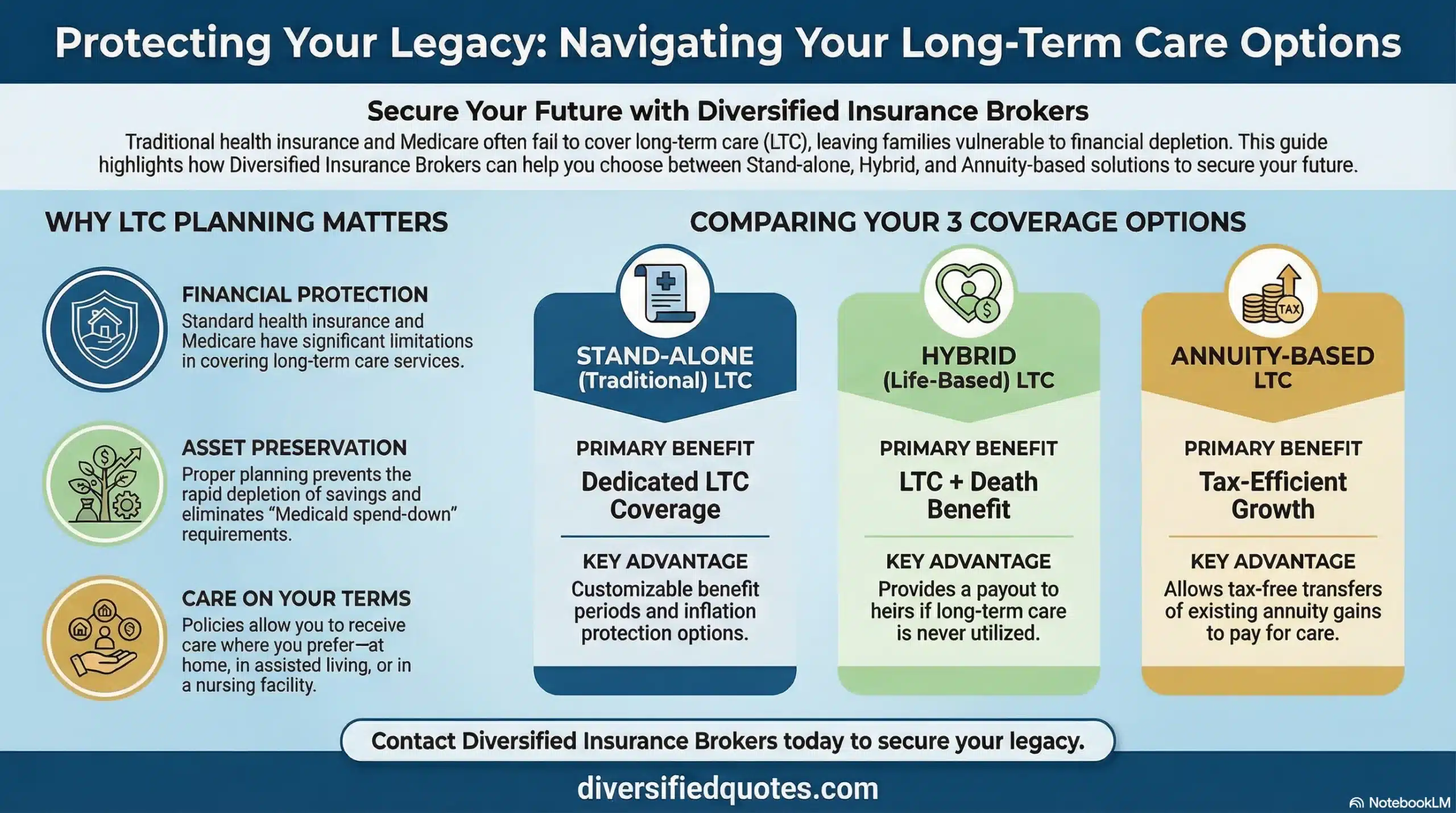
Long-term care insurance costs more than most buyers expect and less than most critics claim — depending entirely on which product type, which coverage design, which carrier, and which purchase age is being evaluated. The two categories that carry the “LTC insurance” label — traditional standalone long-term care insurance and hybrid linked-benefit LTC products (life insurance or annuity with LTC benefits built in) — are priced in fundamentally different ways and serve different planning profiles. Traditional LTC insurance is priced as an ongoing premium paid annually or monthly, with that premium based on the benefit design at the time of purchase. Hybrid LTC products are typically funded with a single premium lump sum or limited-pay structure, with a cost measured in total dollars committed rather than annual outflow. Neither pricing framework is inherently more expensive in absolute terms — the right comparison depends on the household’s assets, planning timeline, income structure, and which risk (premium increase risk vs. lump sum commitment) they are more comfortable bearing. Our resource on hybrid long-term care insurance covers the hybrid product category, and our resource on is long-term care insurance worth it covers the decision framework for evaluating LTC insurance against the alternatives.
Before evaluating what insurance costs, it is worth establishing what care itself costs — because the insurance premium is priced in relation to the risk being transferred, and the risk being transferred is the long-term cost of care. According to CareScout’s Cost of Care Survey, the national median daily rate for skilled nursing care is $315 per day for a semi-private room and $355 per day for a private room — equivalent to roughly $115,000-$130,000 per year. Assisted living median costs run approximately $5,900-$7,000 per month in most markets. Home health aide care typically runs $25-$35 per hour. A three-year care episode in a nursing facility at the national median could cost $350,000-$400,000. These are the dollars the household must absorb from portfolio assets if no LTC coverage is in place — and that absorption happens at the same time retirement income must be maintained, spousal financial stability must be protected, and portfolio markets may be uncooperative. LTC insurance transfers the financial risk of these costs to an insurance carrier for a known, defined premium. Our resource on does Medicare cover long-term care covers what Medicare does and does not pay for in extended care scenarios, and our resource on self-insured long-term care covers the self-funding alternative and the asset levels required to absorb this risk without insurance leverage.
Age at purchase is the single largest driver of traditional LTC insurance premium — larger than health, benefit amount, or carrier selection. According to the American Association for Long-Term Care Insurance (AALTCI) Price Index, a 55-year-old single male purchasing a $165,000 benefit pool policy with 3% compound annual inflation protection pays approximately $2,200 per year. The same policy purchased at age 65 costs approximately $3,280 per year — nearly 50% more for the same coverage. For women — who file approximately two-thirds of all LTC insurance claims and pay significantly higher premiums as a result — the difference is even more pronounced: $3,750 per year at 55 versus $5,290 per year at 65. A couple who both purchase at age 55 with 3% inflation protection pays approximately $5,050 combined annually versus approximately $7,150 combined if both wait until 65. Beyond the premium difference, the bigger risk of waiting is insurability: health conditions that develop with age — diabetes, cardiac conditions, stroke history, cognitive impairment — can make LTC insurance unavailable entirely. Our resource on long-term care insurance for seniors covers coverage options for older buyers where the window may be narrowing, and our resource on how much long-term care insurance do you need covers the coverage sizing framework.
Get a Personalized LTC Cost Estimate
We show how age, benefit design, inflation option, and product type affect your premium — and identify the structure that delivers the strongest protection per dollar at your specific age and health profile.
The Seven Factors That Determine LTC Insurance Cost
Understanding which variables move the premium — and how much — is the foundation for designing coverage that is genuinely affordable without sacrificing meaningful protection. The table below maps each factor against its effect on traditional LTC pricing and hybrid LTC pricing, and the degree of buyer control over each.
| Pricing Factor | Effect on Traditional LTC Premium | Effect on Hybrid LTC Cost | Buyer Control |
|---|---|---|---|
| Age at purchase | Largest single factor — premium increases 40-70%+ between age 55 and 65 for the same benefit design; each year of delay typically adds 4-8% to annual premium | Also significant — single premium and annual premiums for limited-pay designs increase meaningfully with age; younger buyers get more LTC leverage per premium dollar | High — buying earlier is the most effective single action for reducing cost; delay is irreversible |
| Gender | Women pay 50-100% more than men for identical benefits; reflects the reality that women file approximately two-thirds of all LTC insurance claims and have significantly longer average care durations | Women also pay more for hybrid LTC life chassis designs; the premium differential is generally smaller in single-premium hybrid designs than in traditional ongoing-premium designs | None — gender pricing is fixed; couples can use joint underwriting and couples discounts to offset the female premium differential somewhat |
| Health at application | Select health (preferred) can save 15-25%+ versus standard health rating; some conditions result in a decline rather than a rated offer; prior LTC claims or specified diagnoses often result in automatic decline | Health underwriting also applies; poor health can mean a decline for life-based hybrid LTC (similar to traditional LTC underwriting); annuity-based hybrid LTC may have more lenient standards | Moderate — current health is fixed, but timing the application when health is still favorable increases the probability of preferred rates |
| Monthly benefit amount | Direct linear relationship — doubling the monthly benefit roughly doubles the premium; right-sizing the benefit to realistic care costs in the buyer’s market is one of the most effective ways to manage premium | Directly affects LTC pool size and monthly maximum; larger monthly benefits require larger single or limited-pay premiums; buyers can choose benefit tiers that balance pool size against budget | High — the buyer selects the monthly benefit amount; partial self-insurance (selecting a benefit that covers a portion of care costs rather than all) is a legitimate cost management strategy |
| Inflation protection | Largest single design variable after age — 3% compound annual inflation protection adds 60-130% to the level-benefit premium; 5% compound adds 200-300%+ at some ages; without inflation protection, the benefit pool erodes in purchasing power every year from purchase date | Some hybrid LTC designs include automatic benefit increases at no additional charge; others offer inflation protection as an optional rider at additional cost; the structure varies significantly by carrier | High — the buyer selects the inflation option; reducing from 5% to 3% compound, or from compound to simple inflation, significantly lowers premium while still providing meaningful benefit growth |
| Benefit period | Major premium driver — a lifetime (unlimited) benefit period costs 30-50%+ more than a 3-year benefit period for the same monthly maximum; the statistical average LTC need is approximately 3 years; most severe cases and Alzheimer’s diagnoses drive the need for longer benefit periods | Extension of benefits riders in hybrid LTC determine how long LTC benefits continue beyond the base death benefit; longer extension periods increase the premium or require larger single premium deposits | High — selecting a 3-year benefit period instead of lifetime can reduce premium by 30-50%; the statistical probability of needing more than 5 years of formal care is a minority of cases |
| Elimination period | The waiting period before benefits begin — 90 days is the most common election; extending to 180 days can reduce premium 10-15%; shortening to 30 or 0 days adds meaningfully to premium; the elimination period acts as a self-insured deductible | Elimination period applies in many hybrid designs; treatment varies by carrier and product chassis; some hybrid products do not have a traditional elimination period structure in the same form as standalone LTC | High — buyers with sufficient liquid savings to cover 90-180 days of care costs can elect a longer elimination period and reduce ongoing premium; the savings versus the cost of self-covering the elimination period must be evaluated |
Premium data and cost ranges above reflect general market patterns based on AALTCI Price Index data and carrier illustrations. Individual premiums depend on specific health classification, state of residence, selected benefit design, and carrier. Premiums for traditional standalone LTC insurance are not guaranteed and are subject to future rate increases. Hybrid LTC premiums are generally guaranteed for the stated payment structure. Always obtain current carrier-specific illustrations before making any coverage decision.
Traditional LTC Insurance Premium Benchmarks by Age
The AALTCI Price Index provides the most widely cited benchmark for traditional standalone LTC insurance costs. The index surveys leading insurers using a standardized benefit design: $165,000 initial benefit pool, 90-day elimination period, select health classification. These figures represent the starting point for cost conversations — specific designs, carrier selections, and health classifications will produce different numbers, and the range between the lowest and highest carrier for the same benefit design can exceed 90-100% at older ages. Our resource on best long-term care insurance rates and our resource on how to get the best long-term care insurance rates cover the carrier comparison process that identifies where each applicant’s specific profile is most competitively priced. For a level-benefit policy (no inflation protection), a 55-year-old single male pays approximately $950 annually and a 55-year-old single female pays approximately $1,500 annually — with a couple both age 55 paying approximately $2,080 combined. Adding 3% compound inflation protection — the most common option for buyers who want benefits to maintain purchasing power — increases those figures to approximately $2,200 for a single male, $3,750 for a single female, and $5,050 combined for the couple, all age 55. At age 60, the same 3% inflation benefit costs $2,610 for a single male and $4,550 for a single female. At age 65, those figures rise to $3,280 and $5,290 respectively. Our resource on long-term care insurance calculator provides an interactive starting point for estimating costs for your specific situation, and our resource on cost of long-term care by state calculator shows how care costs vary geographically — an important reference for calibrating what benefit amount is appropriate in your market.
Inflation Protection — The Variable That Changes Everything
Inflation protection is the single most consequential design decision in traditional LTC insurance pricing — and the one most frequently misunderstood by first-time buyers. A policy purchased at 55 with a $4,000 monthly benefit and no inflation protection still provides a $4,000 monthly benefit at 75. In a care environment where costs have grown at 4-5% annually for decades, $4,000 per month at 75 covers a dramatically smaller fraction of care costs than it did at 55. The three common options are: no inflation (level benefit), 2-3% simple annual increase, and 2-5% compound annual increase. Compound inflation is far more powerful than simple: at 3% compound, a $4,000/month benefit becomes approximately $7,200/month after 20 years; at 3% simple, it becomes $6,400/month over the same period. But compound inflation adds 60-130% or more to the premium depending on age and gender. The practical question is whether the insurance budget is better spent on a higher level benefit with no inflation, or a lower level benefit with inflation protection that grows toward future care costs. There is no universal right answer — it depends on the buyer’s age, planning horizon, existing assets, and care cost environment. Our resource on what is a long-term care insurance benefit period covers the benefit period element that works in combination with inflation protection to determine total plan value, and our resource on long-term care insurance with lifetime benefits covers the unlimited benefit period option that most significantly affects both protection quality and premium cost.
Hybrid LTC Cost — The Single Premium and Limited-Pay Framework
Hybrid linked-benefit LTC products are not priced as annual premiums in the traditional sense — they are funded with a lump sum or a series of payments over a defined period. A buyer who repositions $100,000 into a hybrid LTC product is not paying $100,000 per year; they are committing $100,000 once, creating a permanent LTC benefit pool and a life insurance death benefit that remain in force without additional premium. The cost comparison between traditional LTC and hybrid LTC therefore requires comparing ongoing annual premiums — which may increase over time — against a single lump sum commitment that produces guaranteed protection with no future premium obligation. For buyers with available lump-sum assets, this trade is often favorable: a $90,000 single premium can create $154,000 in life insurance death benefit and a $463,000 LTC benefit pool in a well-designed hybrid contract. The “cost” of that plan is the $90,000 committed and the reduced liquidity of those dollars — not a $90,000 annual outflow. For limited-pay designs (10-pay or pay-to-65), a defined annual premium is paid for a specific number of years, after which coverage remains in force permanently with no further payments required. This design combines the premium-certainty of hybrid products with the spread-out payment schedule that some buyers prefer over a single lump sum. Our resource on single pay long-term care insurance covers the single premium approach, our resource on hybrid life insurance with long-term care benefits covers the life chassis design, our resource on annuity with long-term care benefits covers the annuity chassis, and our resource on affordable hybrid long-term care policies covers cost-efficient designs for buyers with tighter budget parameters.
The Premium Increase Risk — Why Traditional LTC Costs More Than Illustrated
One of the most significant but underappreciated elements of traditional LTC insurance cost is the risk of future premium increases. Traditional standalone LTC insurance premiums are not guaranteed — carriers can and have raised premiums on existing policyholders, sometimes by 50-100% or more over the lifetime of the policy. One historical analysis found that the average traditional LTC policy experienced premium increases of approximately 112% over 25 years of ownership. These increases are not arbitrary — they reflect the actuarial reality that original LTC pricing in the 1990s and early 2000s significantly underestimated claim duration, interest rate levels, and benefit utilization. The current generation of traditional LTC pricing is more accurate, but the non-guaranteed nature of traditional premiums means that the annual cost shown in the initial illustration is a minimum, not a ceiling. Hybrid LTC products address this risk directly: single premium and limited-pay designs carry guaranteed premium structures — the amount committed is fixed, and no additional payments are required. This premium guarantee is one of the primary reasons many buyers now choose hybrid over traditional LTC. Our resource on long-term care planning strategies covers the full strategic landscape for evaluating LTC options, our resource on long-term care insurance for couples covers the significant premium savings available through joint underwriting and couples discounts, our resource on LTC elimination periods explained covers the elimination period design element that affects both premium and self-insurance planning, our resource on tax advantages of LTC insurance and hybrid policies covers the tax deduction context that can reduce the net cost of traditional LTC premiums, our resource on tax-free long-term care insurance covers the 1035 exchange strategy for hybrid LTC funding, our resources on what are activities of daily living and is long-term care insurance expensive cover complementary education, and our resources on affordable long-term care insurance for retirees, long-term care insurance services, should you buy long-term care insurance, and get a 2nd opinion on your LTC quote complete the planning and comparison toolkit.
Talk With an Advisor Today
Choose how you’d like to connect—call or message us, then book a time that works for you.
Schedule here:
calendly.com/jason-dibcompanies/diversified-quotes
Licensed in all 50 states • Fiduciary, family-owned since 1980
FAQs: How Much Does Long-Term Care Insurance Cost?
What is the average cost of long-term care insurance?
Based on the AALTCI Price Index, a 55-year-old single male purchasing a policy with a $165,000 initial benefit pool and 3% compound inflation protection pays approximately $2,200 per year. A single female the same age pays approximately $3,750 per year — roughly 70% more, reflecting women’s significantly higher claim rates and longer average care durations. A couple where both are age 55 pays approximately $5,050 combined annually for the same coverage design. These are benchmarks for a standardized benefit design; actual premiums vary based on carrier selection, health classification, state of residence, and specific benefit elections. The range between the lowest and highest carrier quote for identical benefits can exceed 90-100% at older purchase ages.
Why does waiting to buy long-term care insurance cost more?
Age is the single largest factor in LTC insurance premium pricing. Each year of delay adds approximately 4-8% to the annual premium for the same benefit design, and the compounding effect over a decade is substantial. A single male who buys at age 55 pays approximately $2,200 per year with 3% inflation protection; waiting until 65 raises that to approximately $3,280 per year — a 49% increase. For women, the increase from age 55 to 65 is from $3,750 to $5,290 per year. Beyond cost, the larger risk of waiting is losing insurability entirely: health conditions that develop with age — cardiac conditions, diabetes, stroke history, cognitive impairment — can make LTC insurance unavailable. Once a carrier declines an application, there is no appeals process or waiting period that restores eligibility.
Can traditional LTC insurance premiums increase after I buy?
Yes — traditional standalone LTC insurance premiums are not guaranteed. Carriers can and have raised premiums on existing policyholders when the claims experience on a policy block exceeds original actuarial projections. One historical analysis found that the average traditional LTC policy experienced premium increases of approximately 112% over 25 years of ownership. This risk is one of the primary reasons many buyers now choose hybrid linked-benefit LTC products, which are funded with single premiums or limited-pay structures that carry guaranteed terms — no future premium increases. If a carrier raises a traditional LTC premium, policyholders can typically choose to pay the higher premium, reduce their benefits to maintain the original premium, or lapse the policy.
How much does inflation protection add to the LTC insurance premium?
Inflation protection is one of the most significant design variables in LTC insurance pricing. Adding 3% compound annual inflation protection to a level-benefit policy can add 60-130% to the annual premium depending on age and gender. For a 55-year-old single male, a level-benefit policy (no inflation) costs approximately $950 per year, while the same policy with 3% compound inflation costs approximately $2,200 per year. Adding 5% compound inflation adds even more. The trade-off is meaningful: without inflation protection, a $4,000/month benefit today covers a much smaller fraction of care costs in 15-20 years when the policy is most likely to be used. Buyers with limited premium budgets often choose a higher-quality level benefit over inflation protection, accepting that the benefit will lose some purchasing power in exchange for maximizing the initial coverage amount.
Is a hybrid LTC policy more expensive than traditional LTC?
The comparison depends on how cost is measured. Hybrid LTC typically requires a larger upfront commitment — a $90,000-$150,000 single premium is common — but carries no ongoing premium and no premium increase risk. Traditional LTC requires a smaller annual premium but is paid every year and can increase. Measured as total premium paid over 20-30 years, hybrid and traditional LTC often come to similar totals — but hybrid provides the additional certainty of guaranteed terms and a death benefit if care is never needed. The right choice depends on whether the buyer has a lump sum available for repositioning versus a preference for spreading costs over time through annual premiums.
How can I reduce my LTC insurance premium without sacrificing meaningful protection?
Several design levers reduce premium without eliminating meaningful protection. Choosing a 3-year benefit period instead of lifetime saves 30-50%. Extending the elimination period from 90 to 180 days saves 10-15% and is appropriate for buyers with 6+ months of liquid savings to cover the initial care period. Reducing inflation protection from 5% compound to 3% compound produces significant savings, as does selecting 2% simple instead of compound inflation. Sizing the monthly benefit to cover a portion of care costs rather than 100% — letting existing income or assets supplement the insurance — reduces the benefit amount and therefore the premium. Buying as a couple rather than individually produces meaningful discounts at most carriers. Buying at a younger age, in better health, and before conditions develop that might trigger a rated or declined offer are the most impactful cost management decisions available.
About the Author:
Jason Stolz, CLTC, CRPC, DIA, CAA and Chief Underwriter at Diversified Insurance Brokers (NPN 20471358), is a senior insurance and retirement professional with more than 25 years of real-world experience helping individuals, families, and business owners protect their income, assets, and long-term financial stability. As a long-time partner of the nationally licensed independent agency Diversified Insurance Brokers, Jason provides trusted guidance across multiple specialties—including fixed and indexed annuities, long-term care planning, personal and business disability insurance, life insurance solutions, Group Health, Travel Medical and Evacuation Insurance, and short-term health coverage. Diversified Insurance Brokers maintains active contracts with over 100 highly rated insurance carriers, ensuring clients have access to a broad and competitive marketplace.
His practical, education-first approach has earned recognition in publications such as VoyageATL, and contributions from his agency featured in Kiplinger and GoBankingRates— highlighting his commitment to financial clarity and client-focused planning. Drawing on deep product knowledge and years of hands-on field experience, Jason helps clients evaluate carriers, compare strategies, and build retirement and protection plans that are both secure and cost-efficient. Visitors who want to explore current annuity rates and compare options across multiple insurers can also use this annuity quote and comparison tool.
Explore More Long Term Care Insurance Options: Browse our complete guide to LTC Insurance Costs, Rates & Planning — covering how much it costs, best rates, calculators, planning strategies & is it worth it from top carriers.
Last Reviewed: August 28, 2026 |
Reviewed by: Jason Stolz, CLTC, CRPC, DIA, CAA
Chief Underwriter, Diversified Insurance Brokers, Inc. | NPN: 20471358 | Diversified Insurance Brokers, Inc. — Licensed in all 50 states
Fact Checked by: Tonia Pettitt, CMIP©
Medicare Specialist, Diversified Insurance Brokers, Inc. | NPN: 14374308 | Diversified Insurance Brokers, Inc. — Licensed in all 50 states
Did you find this content helpful? Leave us a Google review — it helps others find trustworthy guidance too.
Editorial Standards: Diversified Insurance Brokers maintains rigorous editorial standards to ensure accuracy, clarity, and independence in all content. Learn more about our editorial standards and commitment to transparency.
