
Long Term Care Insurance with Lifetime Benefits
As an Independent Long Term Care Insurance Broker, we compare traditional, hybrid, and partnership-qualified policies across dozens of carriers to find the structure that actually fits your situation.
Long Term Care Insurance with Lifetime Benefits

Jason Stolz CLTC, CRPC, DIA, CAA
Long term care insurance with lifetime benefits is designed for one specific fear that many retirees and pre-retirees do not say out loud until they see real numbers: what if care lasts longer than we planned for? Most long term care insurance policies place a time limit on benefits — often two, three, five, or six years. That structure provides very strong protection for many families because a large portion of care events fall within a defined window. But some care situations do not end in a tidy timeframe. A progressive cognitive condition, a long course of Parkinson’s disease, complications after a stroke, or a slow functional decline can stretch care needs well beyond a typical benefit period — and the financial consequences of running out of benefits mid-claim are among the most damaging events a retirement plan can absorb. That is where lifetime benefit designs come in. Instead of solving for the most likely duration only, they solve for the worst reasonable case. They are built to keep paying as long as you remain eligible for benefits under the policy’s trigger definitions and claim requirements. At Diversified Insurance Brokers, Jason Stolz, CLTC, CRPC, DIA, CAA, helps clients compare limited-term benefits versus lifetime benefits so you can decide what level of protection is appropriate for your assets, your income plan, and your family situation.
The data behind this decision is striking. Current care costs show assisted living averaging $71,040 annually, a semi-private nursing home room running $118,500, and a private room reaching $129,575. Approximately 70% of adults turning 65 will need some form of long-term care during their lifetime. About 22% of those adults will require care for more than five years — the group for which a limited benefit period policy exhausts coverage and leaves the family fully exposed. According to the American Association for Long-Term Care Insurance, claimants who break the one-year threshold experience an average of 3.9 years of care. For dementia specifically — which accounts for nearly half of all LTC claims — the average lifetime cost reached $405,262 in 2024, and a man diagnosed at age 65 can expect to live 5.7 more years while a woman can expect 8.0 more years. These are the numbers that make lifetime benefit designs relevant: not for everyone, but specifically for the households where long-duration risk is the one outcome the retirement plan cannot safely absorb on its own.
Compare Lifetime Benefit LTC Options
See how lifetime benefit designs compare to 3–6 year benefit periods — and what it means for your retirement plan.
Request Lifetime LTC QuotesWhat Are Lifetime Benefits in Long Term Care Insurance?
A lifetime benefit rider — or a policy structured with a lifetime benefit period — means your long term care coverage is not constrained by a pre-set duration like three years or five years. Instead, once you qualify for benefits under the policy’s trigger definitions and once the elimination period is satisfied, the plan continues paying as long as you remain eligible and as long as care meets the policy’s covered service and documentation requirements. The clock that families worry about when care extends year after year — wondering when the benefit pool will be exhausted — is removed from the planning equation entirely.
It is helpful to separate three concepts that are frequently confused when evaluating LTC policy design. Eligibility — how you qualify for benefits — is most commonly tied to needing help with at least two Activities of Daily Living (bathing, dressing, eating, toileting, transferring, or continence) or having a qualifying cognitive impairment that requires substantial supervision. Payment structure — how benefits are calculated and delivered — determines whether the policy reimburses actual expenses, pays a fixed indemnity regardless of expenses, or uses a cash benefit design that provides maximum flexibility in how funds are applied. Duration — how long benefits can continue once payment begins — is the dimension that lifetime benefit coverage specifically addresses. Understanding all three dimensions is essential for evaluating whether any specific policy will actually solve the long-duration problem it is being purchased to address, because policies can use “lifetime” language in marketing while having specific claim conditions that limit how long meaningful benefits can realistically continue.
The elimination period — the waiting period before benefits begin — interacts significantly with the lifetime benefit decision in ways that affect both cost and value. Most LTC policies offer elimination periods of 30, 60, 90, or 180 days, with longer elimination periods reducing premium. For households considering lifetime benefit designs, a longer elimination period is often a rational trade-off: self-funding the early phase of care through income or accessible assets while using insurance for the long-duration tail risk the retirement plan cannot absorb. LTC care coordination benefits covers how professional care management during the claim period helps families navigate elimination period mechanics efficiently and prevents the documentation errors that delay benefit payments unnecessarily.
The Risk Most Families Underestimate
Most families plan for long term care using a mental model that looks like this: if care is ever needed, it will probably be a short rehabilitation stay, or maybe a couple of years at most. Sometimes that is accurate. But the scenarios that create the most damage to retirement plans are the ones that last the longest and arrive at the worst possible time — when one spouse is already gone, when the surviving spouse is older and more financially vulnerable, or when adult children are already stretched by work, their own households, and the practical demands of coordinating care from a distance.
The statistics support taking the long-duration risk seriously. While roughly 10% of adults turning 65 will need care for less than a year, approximately 22% will need care for more than five years — the group for which a five-year benefit period policy provides no protection whatsoever after the benefit period expires. LTC insurance industry data compiled over 45 years and 295,000 claims confirms the bimodal distribution: many claims resolve relatively quickly, but the subset that extend past the one-year mark averages 3.9 years in total duration. Dementia-related claims — which represent nearly half of all LTC insurance claims — drive the longest durations and the highest costs, with women particularly affected because they are both more likely to develop dementia and more likely to outlive their spouses, leaving them without an informal caregiver during the most intensive care years.
Extended care also rarely presents as a dramatic event that announces its duration upfront. It often grows gradually — a home care plan that starts at a few hours per week and expands over months to daily assistance, an assisted living placement that transitions to memory care as cognitive impairment progresses, a nursing facility admission following a hospitalization where the person never regains the functional independence that would allow discharge. Families may not recognize they are in a high-duration scenario until two or three years have already passed and the benefit pool — if limited — is beginning to run low. That recognition typically comes at the worst possible moment for decision-making: the insured is further along in their condition, options are narrower, and the financial pressure is most acute. Lifetime benefit coverage addresses this by removing the duration uncertainty from the equation before the claim begins.
Lifetime vs. Limited-Term Benefit Periods: What Each Covers
| Design Feature | Lifetime Benefit Period | 3–5 Year Benefit Period | Why It Matters |
|---|---|---|---|
| Duration of coverage | Continues as long as you remain benefit-eligible; no end date | Coverage ends when benefit period or pooled benefit is exhausted | 22% of care recipients need care beyond 5 years — the group limited-term plans leave exposed |
| Premium cost | Higher than limited-term; insurer bears longer payout risk | Lower per month; defined risk for the insurer produces lower initial premium | Premium difference can be managed through elimination period length and monthly benefit amount |
| Dementia/cognitive claims | Coverage continues through full duration — average 5.7 years for men, 8.0 years for women diagnosed at 65 | May exhaust before claim ends — leaving family fully self-funding at the point of highest need | Dementia is ~50% of all LTC claims and averages $405,262 in lifetime care costs |
| Spouse/family planning | Healthy spouse protected regardless of how long care lasts; no forced spend-down | Healthy spouse’s retirement assets at risk if care extends beyond benefit period | Retirement portfolio preservation is often the primary planning goal for couples |
| Inflation risk | Inflation protection highly recommended; care costs have shown 3–4% annual increases | Inflation protection still important; shorter duration reduces compounding exposure | A benefit purchased at 55 may not pay claims until 75–80; 20 years of inflation matters significantly |
| Planning certainty | Retirement plan can be designed around a defined, covered care scenario at any duration | Retirement plan must account for self-funding after benefits exhaust; duration uncertainty remains | Removing duration uncertainty is the core value proposition of lifetime benefit coverage |
Who Should Consider Lifetime Benefit LTC Coverage?
Lifetime benefit designs are most often considered by households that care deeply about protecting a specific outcome over decades. That does not mean only the wealthiest families. It means families who have something meaningful to protect and who do not want a prolonged long-term care event to permanently rewrite their retirement plan. The right profile is about planning priorities and risk tolerance more than asset level.
Households with significant retirement assets they have spent a lifetime building are among the most natural candidates for lifetime benefit coverage, because the financial downside of a prolonged care event is largest when the assets most at risk are the largest. A retirement portfolio that took 35 years to accumulate can be meaningfully depleted by a single multi-year care situation — particularly when care costs run $118,500 to $129,575 annually for nursing home care. Lifetime benefits create a defined backstop that prevents that erosion regardless of how long care continues.
Couples where one partner wants to protect the other’s lifestyle and housing stability in the event of a long care situation represent the second most common profile. The question that drives this planning is straightforward: if one of us needs care for eight or ten years, what happens to the other one’s standard of living, housing security, and retirement income? Lifetime benefit coverage provides a direct answer that limited-term coverage cannot. Long-term care insurance with shared spousal benefits covers how household benefit pooling strategies work for couples and how they interact with individual lifetime benefit designs in overall planning.
Families with elevated concern about cognitive decline — because of family history, because of a current diagnosis in an early stage, or simply because of the statistical weight of dementia as the most common driver of long-duration LTC claims — often find lifetime benefit coverage specifically compelling for this scenario. Dementia’s trajectory is difficult to predict with precision, the care costs over a dementia claim’s lifetime average $405,262, and the care journey frequently involves multiple settings and escalating intensity over years. A time-limited benefit period cannot address that trajectory reliably. For individuals at or approaching the age where traditional underwriting becomes more selective, long-term care insurance after age 80 and long-term care insurance for seniors cover the specific options available when the planning window has shortened.
Not Sure if Lifetime Benefits Are Worth It?
We’ll show you the premium difference and what you actually gain — so you can decide confidently.
Request a Lifetime vs Limited ComparisonCost Considerations and What Actually Drives Premiums
Lifetime benefit designs carry higher premiums than limited-term benefit periods because the insurer is taking on a longer payout obligation with no defined end date. However, premium is not determined solely by the benefit period choice — it is the product of several interacting variables that can be adjusted to make lifetime benefit coverage more affordable without undermining the core protection it provides.
The monthly benefit amount is the largest single premium driver. A lifetime benefit plan with a moderate monthly benefit of $4,000 can sometimes provide stronger overall protection than a very high monthly benefit of $7,000 paired with a three-year benefit period — particularly when the primary goal is protecting against the long-duration tail rather than covering 100% of current care costs. Accepting some co-insurance at the claim stage while ensuring the coverage never expires is often a more efficient planning trade-off than maximum monthly benefits with a time limit.
The elimination period choice is the most controllable premium lever for lifetime benefit designs. Moving from a 90-day to a 180-day elimination period can produce meaningful premium reductions while still fully addressing the long-duration risk the lifetime benefit is purchased to cover. For households with accessible retirement savings or consistent income that can absorb early care costs, a longer elimination period is typically the most efficient way to reduce the premium cost of a lifetime benefit structure without compromising what makes that structure valuable. The side-by-side comparison of limited-term versus lifetime benefits shows how these levers interact across multiple design combinations so families can see what different trade-offs actually produce in real premium terms.
Inflation protection adds premium but is almost always appropriate in lifetime benefit designs, precisely because coverage may not pay claims until 15 or 20 years after the policy is purchased. Industry data shows care costs have experienced 3–4% annual increases, and compound inflation protection at 3% starting from a $165,000 benefit pool at age 60 grows to approximately $345,500 by age 85 — while the same pool without inflation protection remains at $165,000 regardless of what care costs at the time of claim. For someone purchasing coverage today with care possibly beginning in the 2040s, that difference is not marginal. How to get the best long-term care insurance rates covers how underwriting timing, health classification, and carrier selection interact to determine what any specific applicant can realistically expect to pay for a given benefit design. Health and age at application remain the other primary premium drivers — earlier applications before functional issues begin produce more options and more favorable pricing across all benefit designs including lifetime.
Hybrid and Linked-Benefit Alternatives for Extended Coverage
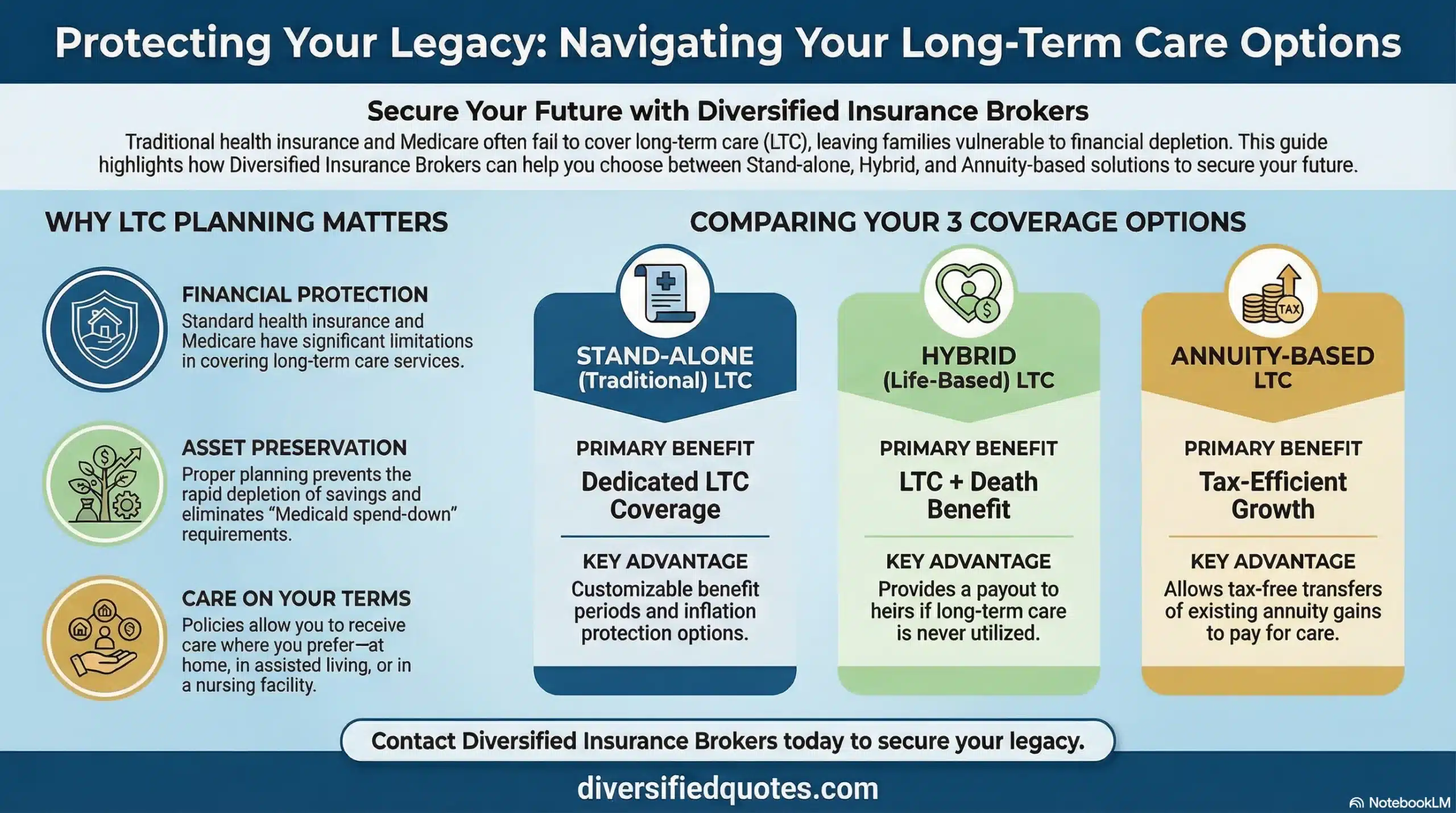
Traditional LTC insurance with a lifetime benefit rider is not the only way to address long-duration care risk. Hybrid life and LTC policies — built on a life insurance or annuity chassis — can provide extended care benefits through acceleration of policy value, benefit multipliers, or rider-based benefit pools, and they address the “use it or lose it” concern that makes traditional LTC premiums emotionally difficult for some families. If care is never needed, beneficiaries receive a death benefit rather than the policyholder having simply paid premiums for coverage that was never triggered.
Hybrid solutions are different tools, not automatically better ones. They can be attractive when someone dislikes the idea of paying premiums for years without any retained residual value, or when a repositioning strategy — moving existing low-yield savings into a structure that generates a defined care benefit pool — fits the household’s planning better than an ongoing premium commitment. But how the hybrid delivers long-duration protection matters in the details: how benefits are triggered, how they are paid, what multipliers apply, and how long meaningful benefits can actually continue under the contract language are the specifics that determine whether the hybrid structure genuinely addresses the long-duration risk or provides a benefit pool that is simply larger than a five-year traditional policy but still ultimately limited. Understanding hybrid long-term care insurance covers the mechanics in depth, and hybrid life insurance with long-term care benefits addresses the life-chassis hybrid specifically. Hybrid long-term care provides the broader category overview for families who want to understand all available hybrid structures before narrowing to specific products. The long-term care playbook provides the overarching strategic framework that helps families position the lifetime benefit question within the full landscape of available coverage approaches.
How Families Decide: A Planning Framework
The lifetime benefit decision becomes considerably clearer when it is anchored in outcomes rather than product features. The most productive planning conversations begin with defining what you are specifically trying to protect — because that answer determines which design elements are non-negotiable and which can be adjusted to manage cost.
If the primary goal is protecting the healthy spouse’s lifestyle and housing stability in the event of a prolonged care situation, lifetime benefits provide a direct answer that no limited-term design can fully replicate. The healthy spouse can make decisions about housing, income, and support based on her own needs rather than around the financial constraint of a care situation that is consuming retirement assets without an end in sight. If the goal is preventing a forced spend-down of retirement savings that was built to support the couple and eventually transfer to heirs, lifetime benefits remove the scenario where extended care depletes the portfolio below the level required to sustain the surviving spouse’s retirement income. If the goal is reducing the logistical and financial burden on adult children who may otherwise be drawn into both care management and financial support, lifetime benefit coverage creates a professional funding and care framework that keeps children in a support role rather than a primary financial provider role.
The funding approach must also fit the household’s actual financial reality, not just the planning goal. A lifetime benefit design with a 90-day elimination period, a $5,000 monthly benefit, and 3% compound inflation protection is an excellent plan if the premium is sustainable — and a plan that lapses because premiums become uncomfortable is one of the most damaging outcomes in LTC planning. Modeling multiple combinations — lifetime benefits with a longer elimination period, lifetime benefits with a moderate monthly benefit alongside a willingness to co-insure a portion of costs, or a hybrid structure that repositions existing assets — typically makes the best realistic choice clear. Long-term care planning strategies covers the full range of planning approaches and how they should be sequenced based on household circumstances. For those who want to confirm eligibility before comparing designs, who qualifies for long-term care insurance covers the underwriting standards that determine which products are available for specific health profiles.
Explore Lifetime Long Term Care Insurance Options
Protect against extended care costs with coverage designed to continue as long as care is needed.
Get a QuoteRelated Long-Term Care Pages
Keep exploring benefit period choices, couples planning, and claim design details.
Talk With an Advisor Today
Choose how you’d like to connect—call or message us, then book a time that works for you.
Schedule here:
calendly.com/jason-dibcompanies/diversified-quotes
Licensed in all 50 states • Fiduciary, family-owned since 1980
Frequently Asked Questions: Long Term Care Insurance with Lifetime Benefits
What does “lifetime benefits” mean in a long term care insurance policy?
A lifetime benefit design means your long term care coverage has no pre-set duration limit. Once you qualify for benefits — by meeting the policy’s ADL or cognitive impairment trigger — and once the elimination period is satisfied, the policy continues paying as long as you remain eligible under the claim requirements. There is no “clock” that runs out after three or five years. This is the core distinction from limited-term benefit period policies, which establish a defined maximum benefit period or pooled benefit amount after which coverage ends regardless of continued care need. Lifetime benefit designs are built specifically for the scenario where care extends far longer than average — the roughly 22% of care recipients who need care for more than five years.
How much more does a lifetime benefit LTC policy cost compared to a 3–5 year benefit period?
The premium difference between lifetime and limited-term benefit designs varies by carrier, benefit amount, elimination period, inflation protection, and the applicant’s age and health at the time of application. As a general reference, industry data shows that at age 65, comparing three leading insurers for a $165,000 initial benefit pool, the lowest annual premium was $7,137 and the highest was $12,250 — a spread of more than $5,000 annually for essentially the same coverage amount, demonstrating why independent carrier comparison matters. Lifetime benefit designs typically cost more than five-year designs for the same monthly benefit amount and inflation provision. However, the premium difference can be managed through adjusting the elimination period — moving from 90 to 180 days can reduce premium meaningfully — or by accepting a moderate monthly benefit amount that still addresses the long-duration risk without maximizing the monthly payout.
Why is inflation protection especially important with lifetime benefit coverage?
Inflation protection is important in any LTC policy, but it is especially critical in lifetime benefit designs because coverage may span decades from purchase to claim. Industry data shows a $165,000 initial benefit pool purchased at age 60 with 3% compound annual inflation grows to approximately $345,500 by age 85 — while the same pool without inflation protection remains at $165,000 regardless of what care costs at the time of claim. Given that assisted living now costs $71,040 annually and private nursing home rooms average $129,575, a benefit that was adequate when purchased in the 2000s or 2010s can be a partial benefit by the time it is needed in the 2030s or 2040s. The lifetime duration of the coverage makes the compounding effect of inflation protection more valuable than in a short-duration design where care costs matter only over a few years.
Who is most likely to need lifetime long term care benefits?
Approximately 22% of adults turning 65 will need long-term care for more than five years, and it is this group for whom lifetime benefits provide protection that limited-term policies cannot. Dementia-related claims are the most common driver of long-duration care needs, accounting for nearly half of all LTC insurance claims and averaging $405,262 in total lifetime care costs. Women are statistically more likely to need long-duration care because they both live longer on average and are more likely to develop dementia. At age 65, a woman diagnosed with dementia can expect to live 8.0 more years on average. Families with a history of cognitive decline or progressive neurological conditions, couples where one partner may survive the other by many years, and households where the retirement plan cannot absorb years of uninsured care costs without significantly impairing the surviving spouse’s standard of living are all natural candidates for lifetime benefit coverage.
Can hybrid LTC policies provide lifetime benefits?
Some hybrid life and LTC policies offer benefit multipliers, extended benefit riders, or benefit pools that can continue for an extended period or indefinitely under specific designs. However, how long meaningful benefits actually continue under a hybrid structure depends heavily on the specific contract details — how benefits are triggered, how they are calculated, what multipliers apply, and whether an extended benefit rider adds true lifetime duration or simply a defined benefit period that is larger than the base policy. The label “lifetime” or “unlimited” in a hybrid context does not always mean the same thing as a traditional LTC policy with a lifetime benefit period. Evaluating the specific contract language — what the policy will actually pay, for how long, under what triggering conditions — is the only reliable way to compare a hybrid structure’s long-duration protection against a traditional lifetime benefit design.
About the Author:
Jason Stolz, CLTC, CRPC, DIA, CAA and Chief Underwriter at Diversified Insurance Brokers (NPN 20471358), is a senior insurance and retirement professional with more than 25 years of real-world experience helping individuals, families, and business owners protect their income, assets, and long-term financial stability. As a long-time partner of the nationally licensed independent agency Diversified Insurance Brokers, Jason provides trusted guidance across multiple specialties—including fixed and indexed annuities, long-term care planning, personal and business disability insurance, life insurance solutions, Group Health, Travel Medical and Evacuation Insurance, and short-term health coverage. Diversified Insurance Brokers maintains active contracts with over 100 highly rated insurance carriers, ensuring clients have access to a broad and competitive marketplace.
His practical, education-first approach has earned recognition in publications such as VoyageATL, and contributions from his agency featured in Kiplinger and GoBankingRates— highlighting his commitment to financial clarity and client-focused planning. Drawing on deep product knowledge and years of hands-on field experience, Jason helps clients evaluate carriers, compare strategies, and build retirement and protection plans that are both secure and cost-efficient. Visitors who want to explore current annuity rates and compare options across multiple insurers can also use this annuity quote and comparison tool.
Explore More Long Term Care Insurance Options: Browse our complete guide to How to Buy, Qualify & Coverage Details — covering how to buy, who qualifies, policy types, shared benefits, partnership plans & more from top carriers.
Last Reviewed: September 29, 2026 |
Reviewed by: Jason Stolz, CLTC, CRPC, DIA, CAA
Chief Underwriter, Diversified Insurance Brokers, Inc. | NPN: 20471358 | Diversified Insurance Brokers, Inc. — Licensed in all 50 states
Fact Checked by: Tonia Pettitt, CMIP©
Medicare Specialist, Diversified Insurance Brokers, Inc. | NPN: 14374308 | Diversified Insurance Brokers, Inc. — Licensed in all 50 states
Did you find this content helpful? Leave us a Google review — it helps others find trustworthy guidance too.
Editorial Standards: Diversified Insurance Brokers maintains rigorous editorial standards to ensure accuracy, clarity, and independence in all content. Learn more about our editorial standards and commitment to transparency.
