
Long Term Care Insurance with Shared Spousal Benefits
As an Independent Long Term Care Insurance Broker, we compare traditional, hybrid, and partnership-qualified policies across dozens of carriers to find the structure that actually fits your situation.
Long Term Care Insurance with Shared Spousal Benefits

Jason Stolz CLTC, CRPC, DIA, CAA
For married couples approaching retirement, long-term care insurance with shared spousal benefits addresses one of the most financially consequential planning uncertainties in retirement: which spouse will need care, when it will begin, and how long it will last. No projection can answer those questions reliably. Nearly 70 percent of adults age 65 and over will require long-term care services at some point in their later years — but the distribution between spouses is unpredictable. One spouse may never need formal care. The other may require multiple years of intensive assistance. Standard individual LTC policies cannot adapt to that outcome — they pay benefits only within each person’s separate benefit pool, leaving the household either over-insured for one spouse or dramatically under-insured for the other. Shared spousal benefit structures were specifically designed to solve this problem. By linking two individual policies together through a shared care rider, couples create a flexible benefit pool that responds to what actually happens rather than what was assumed when the policies were purchased. If one spouse needs extended care and exhausts their individual benefits, the shared structure allows them to draw from the remaining pool in their partner’s policy — protecting the household from extended care costs that exceed either individual policy’s limits.
The financial stakes of getting this wrong are significant and rising. Assisted living costs an average $74,400 annually according to CareScout’s 2025 Cost of Care Survey, while the median price for a semi-private room in a U.S. nursing home in 2025 was more than $9,000 a month, while a private room was more than $10,000 monthly. For a couple where one spouse requires three years of memory care at a nursing facility and the other requires two years of assisted living a decade later, the combined care cost can reach $600,000 or more — a figure that can eliminate a retirement savings portfolio that took a lifetime to build. Shared spousal benefit policies are specifically designed to create a cost-effective combined benefit pool that addresses this multi-claim risk without requiring each spouse to independently purchase a benefit period large enough to cover the worst-case scenario. Our Long-Term Care Insurance services overview provides the foundational context for how LTC insurance works, and our guide on how to find, evaluate, and apply for long-term care insurance covers the step-by-step process of getting coverage in place.
Couples who delay LTC planning often discover that the decision becomes progressively harder to execute well over time. Underwriting for LTC insurance is health-based, and the underwriting standards tighten as age and health complexity increase. Purchasing shared spousal benefit coverage in the 50–65 age window — when both spouses are typically still in good health and premiums are most favorable — is the primary strategy for securing the best combination of benefit design, pricing, and insurability. For couples who are evaluating how LTC protection fits into the broader retirement income and asset protection picture, our resources on what to do with money after retirement and protecting the nest egg provide the coordinating framework. Our dedicated resource on how to buy long-term care insurance as an independent broker covers the full evaluation process from the advisor’s perspective.
Compare Long Term Care Insurance Options for Couples
Review policies with shared spousal benefits and see how couples structure coverage to protect retirement assets. Independent comparison, no obligation.
Request a QuoteThe Real Cost of Long-Term Care in 2026 — Why Shared Benefits Matter for Household Planning
Understanding the financial magnitude of the risk is the foundation of understanding why shared benefit designs matter for couples. Long-term care costs have increased substantially over the past decade and are continuing to rise as demand for care services exceeds the supply of caregivers and facilities. The table below shows current national median costs for the primary care settings covered by LTC insurance, based on 2025–2026 industry data.
| Care Setting | Monthly Cost (National Median) | Annual Cost (Estimated) | 3-Year Total (One Spouse) |
|---|---|---|---|
| Nursing Home — Semi-Private Room | $9,000+ | $108,000+ | $324,000+ |
| Nursing Home — Private Room | $10,000+ | $120,000+ | $360,000+ |
| Assisted Living Facility | $6,000–$6,300 | $70,000–$74,400 | $210,000–$223,200 |
| Memory Care Unit | $6,500–$9,000 | $78,000–$108,000 | $234,000–$324,000 |
| Home Health Aide (Full-Time) | $5,000–$7,000 | $60,000–$84,000 | $180,000–$252,000 |
| Adult Day Care | $1,500–$2,000 | $18,000–$24,000 | $54,000–$72,000 |
Sources: CareScout 2025 Cost of Care Survey; GoodRx 2026 national median estimates. Costs vary significantly by geographic region — urban markets, coastal states, and high-cost-of-living areas frequently exceed these national medians by 20%–50%. Memory care costs are approximate ranges based on industry data. A skilled nursing facility is the highest-cost care setting and is distinct from assisted living in the level of medical oversight provided.
For a couple where both spouses eventually need care, the combined household LTC cost can easily exceed $500,000–$700,000 over the course of their care journeys — even at assisted living rather than nursing home rates. This is the context in which shared benefit designs become critical: structuring coverage as two separate individual policies without a shared care rider means each spouse’s claim is capped independently, and the household cannot redirect unused benefits from one partner’s policy to supplement an extended care need for the other.
How Shared Spousal Benefits Work — The Mechanics of the Shared Care Rider
A shared care rider is an endorsement added to two individual long-term care insurance policies that links the benefit pools together. Each spouse purchases their own individual policy with a specific daily or monthly benefit amount and a defined benefit period. The shared care rider adds a provision that allows one spouse to access benefits from the other spouse’s remaining coverage once the first spouse has exhausted their own individual policy benefits. The mechanics vary by carrier — some create a fully pooled joint benefit period, others maintain separate individual pools with a drawdown provision that allows one-directional access after individual benefits are exhausted.
Consider a concrete example. Both spouses purchase individual policies providing $6,000/month in benefits with a 3-year benefit period — giving each spouse approximately $216,000 in individual coverage. Without a shared care rider, each spouse is capped at their individual policy. If Spouse A requires care for 5 years at $6,000/month (total $360,000), they exhaust their $216,000 in individual benefits and must fund the remaining $144,000 out of pocket. With a shared care rider in place, Spouse A can access Spouse B’s remaining coverage after exhausting their own — provided Spouse B has not used their benefits. If Spouse B never requires care, the household effectively has access to up to $432,000 in combined benefits ($216,000 per policy), of which Spouse A can use $360,000, leaving $72,000 remaining in Spouse B’s policy for their future use. This flexibility — redirecting unused benefits toward the spouse who needs more care — is the core value of the shared care rider. Our dedicated page on shared care riders in LTC covers the mechanics in greater detail, including how different carriers implement the rider and what conditions must be met for cross-policy benefit access.
Three Coverage Structures for Couples — Comparison Table
Couples evaluating long-term care coverage have three primary structural options, each with different cost, flexibility, and risk transfer characteristics. Understanding how they compare directly is essential for making an informed decision.
| Feature | Individual Policies (No Shared Rider) | Shared Care Rider (Linked Policies) | Hybrid / Linked Benefit LTC |
|---|---|---|---|
| Benefit Pool Structure | Separate per spouse | Linked; cross-access after exhaustion | Single or joint benefit account tied to asset |
| If One Spouse Never Claims | Benefits unused; premiums not returned (standard) | Unused benefits available to other spouse | Death benefit returns unused value to estate |
| Premium Type | Ongoing; may increase with rate actions | Ongoing; may increase; shared rider adds cost | Single premium or level-pay; may be guaranteed |
| Spousal Discount Availability | Yes — when both apply simultaneously | Yes — plus shared rider structure benefit | Product-dependent; often yes |
| Extended Care Risk Protection | Limited to individual benefit period each | Strong — benefits flex toward the claiming spouse | Moderate to strong depending on design |
| Premium Cost Relative to Coverage | Lower — no rider premium | Moderate — shared rider adds 10%–15% typically | Higher upfront — asset-based funding required |
| Best Suited For | Budget-constrained couples; symmetrical risk | Most couples; asymmetric care risk households | Couples with lump-sum assets; concern about “use it or lose it” |
For most couples, the shared care rider structure represents the best combination of cost efficiency and benefit flexibility. The rider adds a modest premium — typically 10%–15% above the base policy cost — but provides meaningful protection against the scenario that creates the most household financial risk: one spouse requiring care far beyond their individual policy’s benefit period. For couples who are concerned about paying premiums for a benefit they may never use, a fixed annuity with long-term care benefits provides an asset-based alternative where the LTC benefit is attached to an existing financial asset, and unused benefits return to the estate as a death benefit rather than being forfeited. Our resource on LTC with limited-term benefits vs. lifetime benefits covers the benefit period decision that underlies both individual and shared policy design.
Spousal Discounts — The Pricing Advantage of Applying Together
When both spouses apply for long-term care insurance simultaneously — or within a specified period on coordinated policies — most carriers offer a meaningful spousal or partner discount on premiums. These discounts typically range from 10%–30% per policy, with some carriers offering even deeper discounts. The discount reflects the statistical reality that married individuals tend to have better health outcomes than single individuals of the same age, partly because a healthy spouse often provides informal care and health monitoring that delays or reduces the severity of care needs. The practical implication is direct: a couple who applies together can often secure significantly lower combined premiums than two individuals applying separately, even if the policy designs are identical. The spousal discount is one of the most concrete financial advantages of coordinated LTC planning for couples, and it disappears if one spouse’s health deteriorates before both apply. This is one of the primary reasons that procrastinating on LTC planning — even by a few years — can meaningfully increase the total cost of the same coverage protection.
When One Spouse Cannot Qualify — Planning When Health Is Asymmetric
One of the most common and consequential LTC planning scenarios for couples is asymmetric health: one spouse qualifies for coverage easily, and the other has health complications that make standard LTC underwriting challenging or impossible. This scenario is more common than most couples expect, because LTC underwriting standards have tightened significantly as carriers have adjusted pricing models based on claims experience. Common disqualifying or rating conditions include diabetes with organ involvement, significant cardiovascular history, early cognitive changes, mobility limitations, recent hospitalizations, and certain neurological diagnoses. When one spouse cannot qualify, the other spouse can still — and should still — apply and purchase coverage to protect their own care needs. For the uninsurable spouse, alternative strategies need to be evaluated, including self-insurance through retirement assets, Medicaid planning with an elder law attorney, and hybrid LTC products with more lenient underwriting that may still provide some benefit. Our resources on tax-free long-term care insurance and LTC care coordination benefits provide context on alternative structures available for individuals with complex health histories.
2026 Tax Advantages for Couples — LTC Premium Deductibility
Tax-qualified long-term care insurance premiums may be deducted as medical expenses up to IRS age-based limits. For married couples, the combined deduction could reach up to $12,400 if both spouses are age 70 or older. For married couples filing jointly, each spouse’s premium is evaluated separately using that spouse’s age-based limit — so a couple where both spouses are different ages receives different deduction caps for each. The 2026 deduction limits, per IRS Rev. Proc. 2025-32, are shown in the table below.
| Age at End of Tax Year | 2026 Maximum Deductible Premium Per Person | Change from 2025 |
|---|---|---|
| Age 40 or under | $500 | +3% |
| Age 41–50 | $930 | +3% |
| Age 51–60 | $1,860 | +3% |
| Age 61–70 | $4,960 | +3% |
| Age 71 and older | $6,200 | +3% |
Source: IRS Rev. Proc. 2025-32, section 4.27, per Internal Revenue Code section 213(d)(10). To claim the deduction, total qualified medical expenses must exceed 7.5% of adjusted gross income. For married couples filing jointly, each spouse’s deduction limit is determined by that spouse’s individual age. Consult your tax advisor for application to your specific return.
The tax benefit for couples is additive: both spouses’ premiums are separately eligible for deduction based on their individual ages, creating a combined household deduction that can be substantial. A couple where both spouses are age 65 can each deduct up to $4,960 in LTC premiums — a combined $9,920 deductible — provided total itemized medical expenses exceed 7.5% of their AGI. This benefit compounds with age, and the deduction grows most valuable precisely when LTC insurance premiums are highest (for older applicants) and when retirement income makes the 7.5% AGI threshold more reachable. Coordinating LTC planning with Roth conversion planning and other retirement tax strategies can amplify these benefits further by managing AGI in ways that increase the deductible portion of LTC premiums. For couples who want to understand how LTC costs interact with IRA withdrawals and retirement income planning, our resource on what to do with an IRA after retiring covers the distribution strategy context.
Why Medicare Does Not Solve the LTC Problem for Couples
One of the most common and consequential misconceptions in retirement planning is the assumption that Medicare will cover long-term care costs. Medicare’s coverage is specifically limited to acute medical care — it covers physician services, hospital stays, and medically necessary skilled nursing facility care after a qualifying hospital stay, but only for a limited number of days under strict criteria. Medicare does not cover custodial care — the personal assistance with activities of daily living (bathing, dressing, eating, mobility, continence, toileting) that constitutes the vast majority of long-term care. As soon as care crosses from skilled medical care to custodial personal assistance — which typically happens within days to weeks of a care event — Medicare coverage stops entirely. The care costs shown in the table above are largely not covered by Medicare for the duration of need, which is why privately funded LTC insurance exists as a category. For a current overview of Medicare’s coverage boundaries, our best Medicare rates resource covers the supplement and Advantage landscape that operates on top of Medicare’s base structure — none of which extends to custodial long-term care.
The Caregiver Burden — Why Shared Benefits Protect the Healthy Spouse
One dimension of LTC planning that couples often underestimate is the financial and physical impact on the healthy spouse who becomes an informal caregiver. When one spouse provides care at home — managing medications, assisting with daily activities, coordinating medical appointments, and handling transportation — that caregiving role can reduce or eliminate the healthy spouse’s ability to work, travel, or maintain their own health. Over extended periods, spousal caregiving is associated with significantly elevated rates of caregiver burnout, physical decline, and emotional strain. Beyond the personal toll, it can also create financial risk for the caregiver: reduced earnings, reduced Social Security accumulation for the working spouse, and deferred personal health care due to focus on the care recipient’s needs.
Long-term care insurance with shared spousal benefits addresses this problem in two ways. First, it funds professional care services — home health aides, assisted living, memory care — that reduce the caregiving burden on the healthy spouse, allowing them to remain in a supportive rather than primary-caregiver role. Second, the shared benefit pool means the healthy spouse’s benefit pool is not depleted supporting the ill spouse — it remains available for the healthy spouse’s own potential future care needs. This dual protection — reducing the caregiving burden and preserving the healthy spouse’s own benefit coverage — is the most complete expression of what shared spousal benefit design achieves for couples. Our resource on the income gap in retirement covers the broader context of how household income security is affected when a primary earner or dual-income household faces unexpected care costs or work limitations.
Medicaid as the Last Resort — What the 2026 Numbers Mean for Couple Planning
For couples who do not have LTC insurance when a care event occurs, Medicaid becomes the primary payer for extended care — but accessing Medicaid requires meeting strict asset and income limits that can leave the community spouse (the healthy at-home spouse) with sharply reduced financial resources. Starting in January 2026, a spouse who continues to live at home while their partner receives Medicaid long-term care benefits can retain up to $162,660 in assets, an increase from $157,920 in 2025. This Community Spouse Resource Allowance (CSRA) means a couple with $500,000 in assets must spend down to the CSRA before Medicaid will pay — a spend-down of approximately $337,000 in this scenario. The at-home spouse is also allowed to receive a limited income each month — between $2,643.75 and $4,066.50 in 2026 under the Minimum Monthly Maintenance Needs Allowance (MMMNA) — which may be well below their actual household income needs. LTC insurance funded before a care event begins is specifically designed to prevent this scenario: benefits pay for care costs without triggering Medicaid spend-down, preserving retirement assets for the healthy spouse’s financial security throughout their own retirement.
Coordinating Shared LTC Coverage With Retirement Income Strategy
The most effective approach to long-term care planning for couples integrates LTC insurance into the broader retirement income and asset protection strategy rather than treating it as an isolated insurance product. Key coordination points include: timing LTC premium payments to use pre-retirement income years when cash flow is strongest and Roth conversion planning may be active; structuring LTC benefit amounts to cover the care cost gap not addressed by Social Security income, pension, or annuity income streams; and positioning LTC insurance as the asset-protection layer that allows annuity income and retirement investments to remain intact and generating returns throughout a care event. Our resource on whether annuities are worth it covers how guaranteed income structures interact with long-term care planning, and our annuity rescue plan resource covers repositioning existing annuity assets into structures that are better coordinated with retirement income needs including LTC costs. For couples who have used fixed annuities as their primary retirement accumulation tool, a fixed annuity with long-term care benefits may provide a hybrid solution that serves both functions simultaneously.
Related Long-Term Care Planning Resources
Plan Long-Term Care Protection for Both Spouses
Shared spousal benefit policies allow couples to create flexible coverage designed for real-world care scenarios. Compare options from 100+ carriers — no obligation.
Request a Quote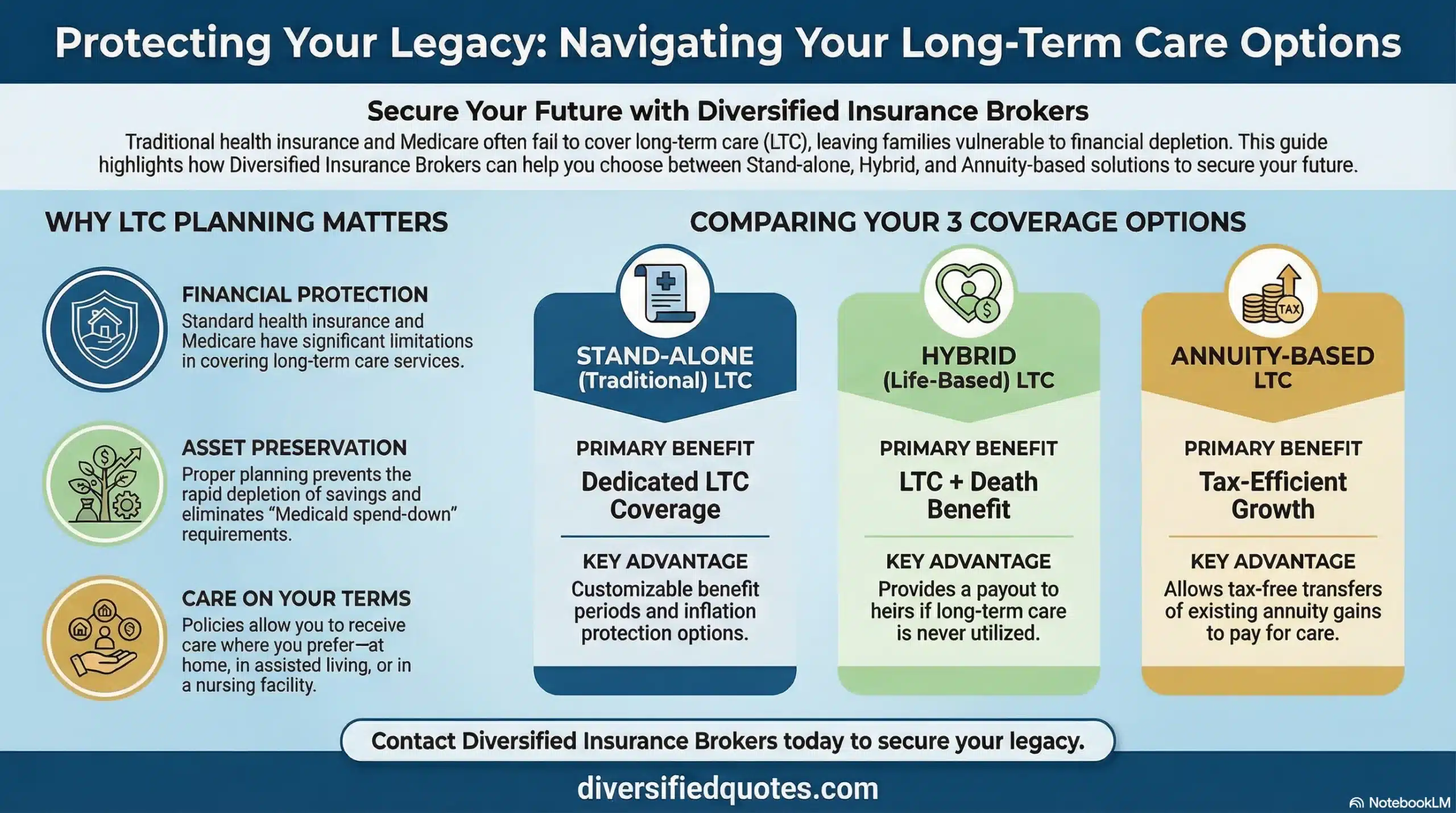
Talk With an Advisor Today
Choose how you’d like to connect—call or message us, then book a time that works for you.
Schedule here:
calendly.com/jason-dibcompanies/diversified-quotes
Licensed in all 50 states • Fiduciary, family-owned since 1980
FAQs: Long-Term Care Insurance With Shared Spousal Benefits
What are shared spousal benefits in long-term care insurance?
Shared spousal benefits — implemented through a shared care rider — link two individual long-term care insurance policies so that unused benefits from one spouse’s policy can be accessed by the other. Each spouse still maintains their own individual policy with their own benefit amount and benefit period. The shared care rider adds a provision that allows one spouse to continue drawing benefits from the other spouse’s remaining coverage once the first spouse has exhausted their own individual policy benefits. This creates a combined household benefit pool that is more flexible than two separate independent policies and provides better protection against extended care scenarios where one spouse needs significantly more care than anticipated.
How much does long-term care insurance cost for couples in 2026?
In 2026, long-term care insurance premiums range from approximately $79 to $533 per month per person depending on age, health, gender, and coverage amount. Industry averages show premiums of approximately $1,700/year for men and $2,675/year for women at standard ages and benefit levels. Couples typically receive a spousal discount of 10%–30% when both apply simultaneously, which meaningfully reduces combined household premiums. Adding a shared care rider typically increases the base premium by approximately 10%–15% per policy. Premiums are age-rated — the earlier in life a couple applies, the lower the annual premium. Waiting until after age 65 or until health issues emerge significantly increases cost or creates insurability challenges.
Do both spouses need to qualify medically for shared spousal benefits?
Yes. Since shared spousal benefit coverage involves two individual policies linked by a shared care rider, both spouses must individually qualify for coverage through the carrier’s medical underwriting process. If one spouse cannot qualify due to health conditions, the other spouse can still apply for individual coverage — but the shared care rider would not be available without both policies in place. When health is asymmetric between spouses, alternative strategies for the uninsurable spouse should be evaluated with an independent LTC planning professional, including hybrid LTC products with more lenient underwriting, self-insurance planning, or Medicaid planning with an elder law attorney.
What happens to the shared benefits if one spouse dies before needing care?
Policy treatment varies by carrier, but many shared care rider structures allow the surviving spouse to retain access to the deceased spouse’s unused benefit pool. This means the surviving spouse’s effective available coverage is not reduced by the partner’s death — the shared benefit that was available during the relationship continues to be accessible for the surviving spouse’s care needs. Specific provisions should be confirmed in the policy contract language before purchasing, as different carriers implement survivorship provisions differently. This aspect of shared care rider design — preservation of the combined benefit pool after one spouse’s death — is one of the most important features to verify when comparing carrier options.
Are long-term care insurance premiums tax deductible for couples in 2026?
Yes, for tax-qualified policies. Each spouse’s LTC premium is separately deductible up to IRS age-based limits. For 2026, the maximum deductible premium per person is $500 (age 40 or under), $930 (ages 41–50), $1,860 (ages 51–60), $4,960 (ages 61–70), and $6,200 (age 71 and older). A couple where both spouses are age 71+ can potentially deduct up to $12,400 combined. To claim the deduction, total qualified medical expenses must exceed 7.5% of adjusted gross income, and you must itemize deductions. Benefits received from a tax-qualified policy are generally income-tax-free. Consult your tax advisor for application to your specific situation.
Does Medicare cover long-term care costs for couples?
No, not for custodial care. Medicare covers medically necessary skilled care — physician services, hospital stays, and limited skilled nursing facility care after a qualifying hospital admission — but it does not cover the custodial personal assistance with daily activities (bathing, dressing, eating, mobility) that constitutes the majority of long-term care need. Medicare coverage for skilled nursing typically ends within weeks of a care event under strict criteria. The ongoing care costs in assisted living, memory care, and long-term home care settings are almost entirely outside Medicare’s scope, which is why privately purchased long-term care insurance exists as a distinct category of coverage.
When is the best time for couples to purchase long-term care insurance?
Most financial advisors and LTC planning professionals recommend evaluating long-term care insurance between ages 50 and 65. This window provides the most favorable combination of factors: lower age-based premiums, better underwriting eligibility before health complications develop, access to the full range of benefit designs and carriers, and enough time for a policy to be in force before potential need arises. Purchasing earlier in this window — at age 50–55 rather than 60–65 — locks in lower premiums and secures coverage before health changes that can limit options or increase pricing. Couples who have been considering LTC planning for years but have not yet acted should be aware that each passing year increases both the premium cost and the risk of an underwriting obstacle emerging.
About the Author:
Jason Stolz, CLTC, CRPC, DIA, CAA and Chief Underwriter at Diversified Insurance Brokers (NPN 20471358), is a senior insurance and retirement professional with more than 25 years of real-world experience helping individuals, families, and business owners protect their income, assets, and long-term financial stability. As a long-time partner of the nationally licensed independent agency Diversified Insurance Brokers, Jason provides trusted guidance across multiple specialties—including fixed and indexed annuities, long-term care planning, personal and business disability insurance, life insurance solutions, Group Health, Travel Medical and Evacuation Insurance, and short-term health coverage. Diversified Insurance Brokers maintains active contracts with over 100 highly rated insurance carriers, ensuring clients have access to a broad and competitive marketplace.
His practical, education-first approach has earned recognition in publications such as VoyageATL, and contributions from his agency featured in Kiplinger and GoBankingRates— highlighting his commitment to financial clarity and client-focused planning. Drawing on deep product knowledge and years of hands-on field experience, Jason helps clients evaluate carriers, compare strategies, and build retirement and protection plans that are both secure and cost-efficient. Visitors who want to explore current annuity rates and compare options across multiple insurers can also use this annuity quote and comparison tool.
Explore More Long Term Care Insurance Options: Browse our complete guide to How to Buy, Qualify & Coverage Details — covering how to buy, who qualifies, policy types, shared benefits, partnership plans & more from top carriers.
Last Reviewed: June 2, 2026 |
Reviewed by: Jason Stolz, CLTC, CRPC, DIA, CAA
Chief Underwriter, Diversified Insurance Brokers, Inc. | NPN: 20471358 | Diversified Insurance Brokers, Inc. — Licensed in all 50 states
Fact Checked by: Tonia Pettitt, CMIP©
Medicare Specialist, Diversified Insurance Brokers, Inc. | NPN: 14374308 | Diversified Insurance Brokers, Inc. — Licensed in all 50 states
Did you find this content helpful? Leave us a Google review — it helps others find trustworthy guidance too.
Editorial Standards: Diversified Insurance Brokers maintains rigorous editorial standards to ensure accuracy, clarity, and independence in all content. Learn more about our editorial standards and commitment to transparency.
