
Shared Care Riders in LTC
As an Independent Long Term Care Insurance Broker, we compare traditional, hybrid, and partnership-qualified policies across dozens of carriers to find the structure that actually fits your situation.
Shared Care Riders in LTC

Jason Stolz CLTC, CRPC, DIA, CAA
For couples buying long-term care insurance, a shared care rider is one of the most practical ways to add flexibility without needing to oversize two separate policies to account for every worst-case scenario. In straightforward terms, a shared care rider links two individual policies together so that if one spouse uses up their own benefits, they can access the other spouse’s unused pool — subject to the contract rules — rather than exhausting coverage and being forced into self-funding at the worst possible time. Because long-term care needs are inherently unpredictable, shared care is commonly used to solve the planning problem that most honestly describes the reality couples face: most do not know which spouse will need care first, how long that care will last, or whether one spouse will need significantly more care than the other. Planning as if the future will be perfectly symmetrical between two spouses is a form of optimism that long-term care statistics do not support, and shared care is specifically designed for the asymmetric outcomes that actually occur.
That uncertainty is exactly why shared care tends to be popular with couples who want meaningful protection but also want to keep premiums reasonable and avoid the trap of paying for coverage that may never be used at the scale purchased. Instead of buying two very large policies “just in case,” shared care creates a household-level safety net that can adapt when reality does not match the original assumptions about who needs care and for how long. At Diversified Insurance Brokers, we help couples compare traditional and hybrid long-term care designs and show how shared care changes cost, benefits, and long-term outcomes so you can determine whether the extra flexibility justifies the additional premium for your specific situation and household risk profile. Long-term care insurance with shared spousal benefits covers the broader landscape of benefit-sharing approaches across different product types and carrier designs. Is long-term care insurance worth it covers the overall cost-benefit evaluation framework that puts shared care decisions in context alongside the full spectrum of long-term care planning options.
See Your Shared Care Options
Compare side-by-side quotes with and without shared care, plus inflation and return-of-premium options.
Request LTC Planning OptionsWhat Is a Shared Care Rider?
A shared care rider is an add-on provision that connects two long-term care insurance policies issued to a couple. Each spouse retains their own individual policy with their own monthly benefit limit and their own starting pool of available benefits. What the rider adds is the ability for the household to share benefits if one spouse has a longer or more expensive care need than the individual policy was sized to address — allowing the spouse with the larger claim to continue receiving benefits by drawing from the partner’s remaining unused pool after their own pool is exhausted. The fundamental shift is from planning each spouse’s coverage as a completely separate island to planning at the household level, where the total available benefit pool can be flexibly allocated based on actual care events rather than predicted symmetrical outcomes.
The best practical way to think about a shared care rider is as flexibility insurance within the long-term care plan. Couples typically purchase coverage with an assumption about how long each spouse might need care — three years, four years, five years — and size their benefit pools accordingly. The problem is that care needs rarely arrive in perfectly predictable or symmetrical patterns. One spouse may never file a claim. Another may have a relatively short claim following a surgery or acute illness and then return to independent living. A third scenario involves a spouse experiencing a progressive cognitive condition that requires years of continuous supervision, far exceeding the duration the policy was originally sized to cover. Shared care helps the coverage adapt to these genuinely unpredictable outcomes rather than locking the household into a plan that made sense based on average assumptions but fails when actual outcomes diverge from those averages in the specific direction that most burdens the household financially.
Most shared care riders are structured around one of two carrier-specific designs. The first and most common is a linked benefit pool design where each spouse can access the other’s unused benefits after their own pool is completely exhausted, subject to the contract’s specific eligibility and consent requirements. The second is a design that creates an additional joint pool — sometimes described as a third pool — that either spouse can access in addition to their individual pools. The specific mechanics vary meaningfully by carrier, and evaluating the rider terms rather than assuming all shared care designs work identically is essential for accurate planning. Key details that differ include whether the accessing spouse must fully exhaust their own pool before shared benefits begin, whether the shared pool has its own limits, whether consent of the partner is required to access shared benefits, and whether a minimum reserve is preserved for the partner who is not on claim.
How Shared Care Works in Real Claim Scenarios
In a typical shared care arrangement, each spouse begins with their own monthly benefit amount and their own total benefit pool — the cumulative dollar amount available over the full benefit period they selected at purchase. When one spouse goes on claim, the policy pays benefits exactly as a standard long-term care policy does — reimbursing or paying for qualifying care expenses up to the monthly benefit limit. If that spouse exhausts their entire benefit pool and still needs care, the shared care rider allows them to continue receiving benefits by drawing from the partner’s remaining unused pool, subject to the contract’s requirements and the partner’s consent in designs that require it.
This mechanism directly addresses what most couples identify as their primary planning fear: what if one of us needs care for significantly longer than we planned? Without shared care, the spouse with the larger claim exhausts their own policy coverage and the household must either self-fund from assets, reduce care quality, or impose on family members to provide uncompensated care — outcomes that create financial and emotional stress precisely when the household is least equipped to manage additional burdens. With shared care, the household has a larger total pool that can be flexibly distributed based on actual need rather than predetermined allocation by policy, which significantly reduces the probability of running out of covered benefits at an inopportune point in a long claim.
Shared care also functions as a buffer against underestimating how care needs escalate over time. Many long-term care events begin with modest home care assistance — a few hours per week of help with bathing, dressing, or household tasks — and gradually intensify as the underlying condition progresses. A claim that begins as minimal home assistance can transition to daily personal care assistance, then to full-time supervision, and eventually to memory care facility placement. This progression compresses more care expenditure into the later phases of the claim, meaning the benefit pool depletes faster in the years when costs are highest. Shared care does not eliminate the need to choose a strong monthly benefit amount and appropriate inflation protection, but it reduces the risk that an escalating care pattern exhausts individual coverage and forces the household into self-funding during the most expensive phase of the care trajectory. Cost of long-term care by state calculator provides state-specific care cost data that helps couples understand the financial scale of the risk they are planning for. Long-term care insurance calculator helps model different benefit configurations to understand how shared care changes the household’s total available benefit capacity.
Shared Care Design Structures: What to Compare
| Feature | Linked Pool Design | Third/Joint Pool Design | No Shared Care (Separate Policies) |
|---|---|---|---|
| How benefits are accessed | After own pool exhausted, accessing spouse draws from partner’s remaining unused pool | Joint pool available to either spouse in addition to individual pools; sequencing varies by carrier | Each spouse limited to their own policy pool; no access to partner’s benefits under any circumstances |
| Household total benefit | Sum of both spouses’ individual pools — distributable based on actual need rather than predetermined split | Sum of both individual pools plus the additional joint pool — higher total household capacity | Fixed amount per spouse; unused benefits of the healthier spouse cannot offset the other’s larger claim |
| Asymmetric claim protection | Strong — one spouse with a long claim can effectively use both spouses’ total pool | Strongest — joint pool plus partner’s unused pool provides maximum runway for high-need spouse | None — asymmetric claims are the primary scenario where separate policies without sharing are most vulnerable |
| Impact on partner’s coverage | Partner’s remaining pool reduces as claiming spouse draws on it; partner still retains their own benefit if they eventually need care | Joint pool draws before individual pool in some designs, preserving more of partner’s individual pool | No impact on partner — but also no benefit from partner’s unused pool regardless of how large it is |
| Feature alignment requirement | Most carriers require matching benefit periods and inflation options; monthly benefit amounts may differ | Same alignment requirements; joint pool amount typically proportional to individual policy amounts | No alignment required — each spouse can choose entirely independent policy structures |
| Premium impact | Typically adds a moderate rider cost above two individual policies without sharing | Higher cost than linked pool design due to the additional joint pool capacity | Lowest rider-related premium — but may require larger individual pools to compensate for lack of sharing |
Who Should Consider a Shared Care Rider?
Shared care is most often a strong fit for couples who want flexibility because they honestly acknowledge that long-term care risk is uncertain — who are not trying to optimize for the lowest possible premium but are trying to build a household plan that still works if one spouse has a longer or more expensive claim than the average scenario assumes. The core planning problem shared care solves is asymmetry: when one spouse needs significantly more care than the other, a plan built around equal individual benefit pools fails precisely at the moment it most needs to succeed. Couples who approach long-term care planning as a household risk management decision rather than two individual insurance purchases tend to find shared care most compelling, because it reflects the economic reality that both spouses share the same household assets and the same overall financial vulnerability to catastrophic care costs.
Shared care also offers a practical benefit for couples trying to balance budget and protection without overbuying two large separate policies. Without shared care, couples sometimes respond to uncertainty by purchasing longer benefit periods for both spouses to ensure adequate coverage in every scenario — a strategy that can be significantly more expensive than shared care and that overbuilds coverage in scenarios where both spouses need care roughly as expected while underdelivering household flexibility in the asymmetric scenarios that most justify the cost of more generous coverage. Shared care lets the household purchase a more balanced structure while retaining the ability to reallocate benefits dynamically when one spouse’s care needs significantly exceed the other’s.
Couples with uneven health risk profiles or family history that suggests elevated risk for one spouse may also find shared care particularly valuable. If one spouse has a family history of Alzheimer’s disease, Parkinson’s disease, or other conditions associated with extended care needs, shared care provides a household-level buffer that can accommodate a substantially larger claim from that spouse without the healthier spouse sacrificing their own eventual coverage. It is important to understand, however, that shared care requires both spouses to qualify medically for coverage — the rider is not a mechanism for loading coverage onto one spouse while the other provides a pool that compensates for higher individual risk. Both must pass underwriting for the linked policies to be issued, which means shared care planning benefits from applying before health conditions worsen enough to affect eligibility. How to qualify for long-term care insurance covers the medical underwriting standards that determine eligibility. Does long-term care insurance require a medical exam covers the underwriting process in detail.
Key Add-Ons to Evaluate Alongside Shared Care
Shared care is most effectively evaluated as part of a complete policy design decision rather than in isolation, because the other features of the underlying policies directly determine how valuable the shared care rider actually is in practice. Inflation protection is the most consequential companion decision. Long-term care is among the most inflation-sensitive categories of healthcare spending — it is labor-intensive, geographically limited in supply, and driven by demographic demand that is structurally increasing as the baby boom generation ages through the high-utilization period. A shared care rider that allows one spouse to access more total benefit capacity provides limited additional protection if the underlying monthly benefit has not kept pace with actual care costs at the time of the claim, which may be fifteen or twenty years after the policy was purchased. Most shared care designs require both spouses to elect matching inflation options, which makes inflation protection a shared decision and reinforces why it should be treated as a core planning choice rather than a cost-reduction lever. Couples who underinvest in inflation protection often discover at claim time that their nominally generous benefit pool does not translate to the care purchasing power they expected.
Return-of-premium and survivorship features are another category that many couples evaluate alongside shared care, because they address the “what happens if we never claim” concern that makes long-term care insurance feel psychologically uncomfortable for some purchasers. A return-of-premium feature can return some or all of the premiums paid if the policy terminates without claims or with claims below the premium threshold, changing the perceived downside risk of purchasing coverage and never using it. Survivorship features can keep the surviving spouse’s coverage in force without additional premiums after the other spouse passes away, which is particularly valuable because the surviving spouse typically has less financial flexibility and less flexibility to re-plan than the couple had together. Long-term care insurance with return of premium covers how these designs are structured and what they actually deliver in different claim and no-claim scenarios. Tax benefits of long-term care insurance covers how premium deductions, benefit taxation, and HSA interactions work for traditional and hybrid LTC policies — a consideration that affects the net cost calculation for many self-employed owners and business-sponsored LTC designs.
Waiver of premium provisions during a claim period are another important rider consideration that becomes particularly relevant in shared care contexts. When one spouse goes on claim, the household simultaneously experiences increased care expenditures, potential income disruption from the claiming spouse’s reduced work capacity, and the emotional and logistical burden of managing care coordination and family dynamics. A premium waiver that suspends the policy premium during an active claim prevents the plan itself from becoming an additional financial burden during the period when it is supposed to provide relief. The specific terms of premium waiver — whether it applies to both spouses’ premiums or only the claiming spouse’s premium, when it activates, and whether it suspends or permanently eliminates the premium obligation — vary by carrier and should be compared as part of the overall policy evaluation. Care coordination services and care navigation support programs are a final category that can meaningfully differentiate otherwise similar policy designs, because identifying qualified care providers, coordinating between healthcare and long-term care systems, managing documentation requirements, and navigating the transition from home care to facility care are administratively complex tasks that most families are not prepared to handle without guidance at the moment they are most emotionally burdened by a family member’s care needs.
Shared Care in Traditional vs. Hybrid Long-Term Care Designs
Traditional long-term care insurance typically offers the most straightforward and well-established shared care rider designs, because traditional policies are built specifically around care benefit delivery and have decades of actuarial development behind their benefit pool, inflation, and sharing mechanics. Traditional Shared Care riders on traditional policies are generally designed around clear benefit periods, defined monthly benefit amounts, and explicit pool-linking or joint-pool provisions that are relatively straightforward to evaluate and compare across carriers. For couples who want a direct, purpose-built mechanism for long-term household care protection, traditional policies with shared care riders provide a clean and transparent structure that is well understood by carriers, advisors, and regulators alike. How to find, evaluate, and apply for long-term care insurance covers the end-to-end process for evaluating and purchasing traditional LTC coverage with or without shared care riders.
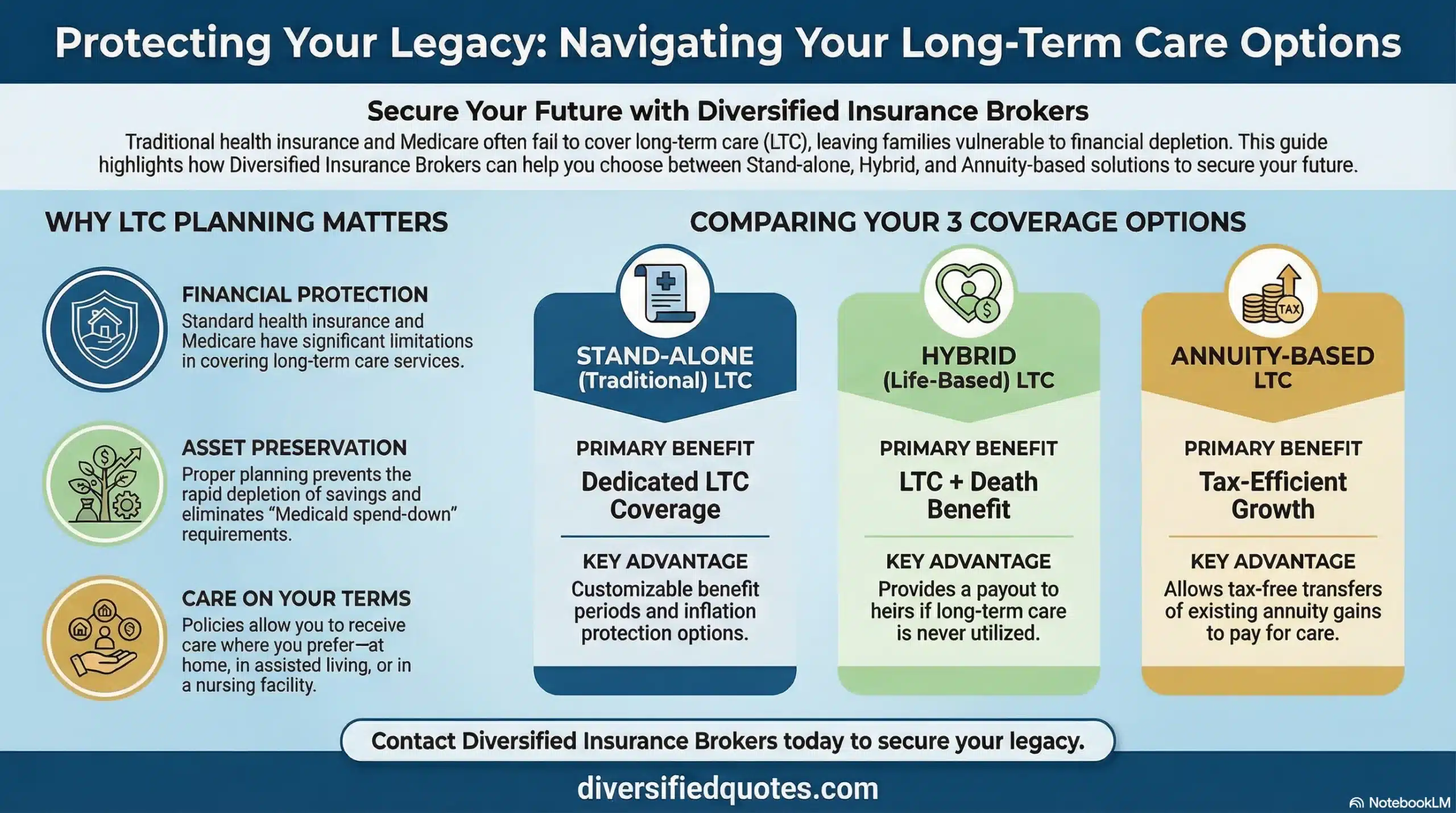
Hybrid long-term care solutions can also incorporate shared or pooled benefit designs, but the structure typically looks meaningfully different from traditional LTC rider mechanics. Hybrid designs tie long-term care benefits to a life insurance or annuity chassis — the LTC benefit is often structured as an acceleration or extension of the death benefit or as a multiplier of the policy’s accumulated value. Shared benefit provisions in hybrid contexts may be implemented through joint ownership structures, pooled benefit riders specific to the hybrid product, or coordinated policy designs that allow benefit reallocation between two separately owned hybrid policies. The flexibility and transparency of sharing provisions can vary significantly across hybrid carrier designs, and couples interested in hybrid approaches should evaluate how benefit sharing specifically works in the products under consideration rather than assuming it operates the same way as traditional shared care. Hybrid long-term care covers the foundational design concepts of hybrid LTC policies. Hybrid life insurance with long-term care benefits covers specifically how life insurance chassis hybrid designs fund and deliver LTC benefits. Hybrid life vs traditional long-term care insurance covers the comprehensive comparison of these two approaches across cost, benefit flexibility, underwriting, and planning objectives. Fixed annuity with long-term care benefits and annuity with long-term care benefits cover how annuity-chassis hybrid designs structure LTC benefit delivery.
Underwriting, Eligibility, and Timing Considerations
Shared care riders are generally available only when both spouses qualify medically for individual long-term care coverage. The underwriting process evaluates health history, current medications, mobility and activities of daily living capacity, cognitive function indicators, and other risk factors that influence claim probability and severity. Because the rider links the two policies and creates mutual benefit pool exposure, the carrier requires both applicants to demonstrate acceptable health status — the shared care rider cannot be used as a mechanism to load more coverage onto one spouse by leveraging the other spouse’s healthy policy as a pool source. Even if one spouse is in excellent health and presents minimal underwriting risk individually, Shared Care eligibility still requires the other spouse to qualify, because an impaired spouse who files a large claim and exhausts their own pool will draw on the healthier spouse’s pool, creating a risk exposure for the carrier that is directly linked to the impaired spouse’s approved insurability.
This requirement has an important timing implication: couples who are considering shared care benefit from applying while both spouses are in acceptable health rather than waiting until one spouse’s health has declined. As health conditions develop, worsen, or accumulate, underwriting becomes more restrictive and more expensive — and some conditions can make one or both spouses ineligible for any traditional long-term care coverage, eliminating shared care as an option entirely. Couples who apply earlier — typically in their fifties or early sixties — generally face better underwriting outcomes, access to more carrier options including those with preferred health pricing tiers, and lower initial premiums that compound into significantly lower lifetime premium payments compared to applying later. Can you still get long-term care insurance after age 60 covers what the underwriting environment looks like for applicants in their sixties and seventies. How to get the best long-term care insurance rates covers the underwriting and comparison approach that produces the most competitive pricing across the carrier market for any given health profile and benefit design. Best independent long-term care insurance broker covers why working with an advisor who has access to the full range of carriers — rather than a single-carrier relationship — produces the most competitive and most appropriately structured shared care designs for any specific couple’s profile.
Partnership Programs, Tax Planning, and Broader Coordination
State Long-Term Care Partnership programs create an important planning consideration for couples evaluating shared care. Partnership programs — available in most states — allow individuals whose Partnership-qualified long-term care policies have paid benefits up to a certain threshold to protect an equivalent amount of assets from Medicaid spend-down requirements if the individual ever needs Medicaid-funded care. This asset protection benefit can be substantial for households with meaningful accumulated savings. Shared care riders can be compatible with Partnership-qualified policies depending on the specific carrier design and state rules, but Partnership qualification requires specific inflation protection standards that vary by age and state — which means the inflation option decision, which is already a required alignment element in most shared care designs, must also be evaluated for Partnership compliance. Partnership-qualified long-term care insurance covers the specific requirements, asset protection benefits, and carrier design elements that determine whether a policy qualifies for Partnership program benefits in each state.
Tax planning considerations interact with shared care decisions in several important ways for business owners, self-employed individuals, and couples who itemize deductions. The premiums paid for qualified long-term care insurance policies may be deductible as medical expenses to the extent they exceed the AGI threshold, subject to age-based eligible premium limits that adjust annually. Business owners who are self-employed may be able to deduct a larger share of their LTC premiums under the self-employed health insurance deduction rules. C-Corporation-sponsored group LTC designs may allow full premium deductibility at the corporate level. The tax treatment of benefits received — which are generally excluded from income up to the greater of the per-diem limit or actual costs incurred — also matters for retirement income planning because the exclusion reduces the effective tax cost of using LTC benefits compared to drawing equivalent amounts from taxable retirement accounts. How shared care benefits are characterized for tax purposes can vary by carrier design and state, which is one reason understanding the complete policy mechanics before purchase is important for tax-sensitive planning situations.
Compare Shared vs Non-Shared Designs
We’ll show shared vs non-shared structures, inflation choices, and return-of-premium options side by side.
Request LTC Planning OptionsCommon Mistakes Couples Make With Shared Care Planning
The most common and consequential mistake couples make when purchasing a shared care rider is choosing a monthly benefit amount that is too low for the care settings they actually want to use. Shared care extends the duration of coverage available to the household by allowing one spouse to draw on the other’s unused pool — but it does not increase the monthly benefit amount, which determines how much of any given month’s care costs the policy actually covers. If the monthly benefit is set at a level that covers only a fraction of local care costs, the household will face large out-of-pocket cost-sharing regardless of how much total pool capacity the shared care rider creates. Couples should determine the monthly benefit based on realistic projections of care costs in their area for the care settings they prefer — home care, assisted living, or memory care facility — and then use shared care to add duration flexibility on top of an adequate benefit level rather than expecting the sharing feature to compensate for a benefit that was undersized at purchase.
Underestimating the importance of inflation protection is the second most common mistake, and it interacts directly with the monthly benefit sizing error described above. Long-term care costs have historically increased faster than general inflation — driven by labor market dynamics for care workers, regulatory requirements, and demographic demand — which means a monthly benefit that seems adequate at purchase can become inadequate in the years or decades before a claim actually occurs. A shared care rider on a policy with insufficient inflation protection creates the illusion of comprehensive household coverage while delivering less real purchasing power than the nominal benefit amounts suggest. Inflation protection should be evaluated as a core planning requirement, not a cost-reduction opportunity.
A third common mistake is planning the shared care design around one spouse’s needs without adequately modeling the impact on the other spouse. In practice, when one spouse goes on claim and draws on the shared pool, the other spouse’s remaining coverage is reduced — sometimes substantially if the claiming spouse has a long or expensive care event. Couples who have not modeled what the healthy spouse’s remaining coverage looks like after a large shared care draw may find that the plan that seemed robust when purchased has left the eventually-claiming healthy spouse with inadequate protection. Evaluating the household coverage picture under multiple scenarios — one short claim, one long claim, two simultaneous claims — rather than only the average scenario helps identify structural vulnerabilities before they become problems during a claim. How to choose the right long-term care insurance policy covers the complete policy evaluation framework for avoiding these planning errors. How to buy long-term care insurance covers the step-by-step purchasing process including benefit sizing, carrier selection, and comparison methodology.
Build a Couple-Based LTC Plan That Stays Flexible
Get a clean comparison of shared care options designed to protect the household, not just one policy.
Request LTC Planning OptionsRelated Long-Term Care Planning Pages
Explore additional long-term care planning topics that pair well with shared care decisions.
Talk With an Advisor Today
Choose how you’d like to connect—call or message us, then book a time that works for you.
Schedule here:
calendly.com/jason-dibcompanies/diversified-quotes
Licensed in all 50 states • Fiduciary, family-owned since 1980
Frequently Asked Questions: Shared Care Riders in Long-Term Care
What exactly does a shared care rider do and how is it different from buying a longer benefit period?
A shared care rider links two individual long-term care policies so that if one spouse exhausts their own benefit pool and still needs care, they can access the other spouse’s unused pool. Buying a longer benefit period on each policy individually increases the pool available to each spouse independently — but unused pool from one spouse still cannot be accessed by the other if the other has a longer or more expensive claim. Shared care solves the asymmetry problem: when one spouse’s claim is much larger than the other’s, the household’s total pool is available to accommodate that imbalance rather than the larger-need spouse running out while the lower-need spouse’s pool sits unused. In many cases, shared care provides comparable or superior household protection at a lower total premium than sizing both individual benefit periods large enough to each independently handle a worst-case scenario.
Do both spouses need to be in good health to qualify for shared care?
Yes — most shared care rider designs require both spouses to qualify medically for individual long-term care coverage, because the rider links the policies and creates mutual benefit pool exposure. The carrier is taking on the risk that the accessing spouse — who has exhausted their own pool — will draw on the partner’s pool, which means the partner’s approved insurability is directly relevant to the underwriting risk. This is not a workaround for one spouse having health conditions that affect insurability; it is a flexibility feature available to couples where both meet the carrier’s standard underwriting criteria. Applying while both spouses are in good health — typically in their fifties or early sixties — provides access to the widest range of shared care options, preferred health pricing tiers, and lower long-term premium costs.
What happens to the healthy spouse’s coverage if the other spouse draws heavily on the shared pool?
When one spouse draws on the partner’s pool through the shared care rider, the partner’s remaining pool balance decreases accordingly — meaning if the partner eventually needs care themselves, they have less coverage remaining than they would have had if no shared drawing had occurred. This is not necessarily a problem if the accessing spouse has the only significant care event in the household, which is a common scenario. But couples should model what the healthy spouse’s remaining coverage looks like under scenarios where both spouses ultimately need care, to confirm the household plan is adequate across multiple claim scenarios rather than only the single-spouse claim scenario. Some designs include minimum reserve provisions that preserve a floor of coverage for the partner regardless of how much the other spouse has accessed.
Does a shared care rider work the same way on hybrid long-term care policies as on traditional LTC?
Not necessarily. Traditional LTC shared care riders operate through clearly defined benefit pool linking and specific eligibility and consent mechanics that have been developed over decades of carrier experience. Hybrid designs — whether life insurance chassis or annuity chassis — may implement shared or pooled benefit provisions differently, because the LTC benefit is tied to the chassis product’s value mechanics rather than a standalone care pool. Joint ownership structures, pooled benefit riders, or coordinated design features can achieve sharing objectives in hybrid contexts, but the specific mechanics vary significantly across carrier designs and may be less transparent or less well-established than traditional shared care provisions. Evaluating how benefit sharing specifically operates in any hybrid product under consideration — rather than assuming it works like a traditional shared care rider — is essential for accurate planning.
How should couples evaluate whether the added cost of shared care is worth it?
The most useful evaluation framework compares the premium difference between a shared care design and the alternative most similar in total household protection — which is typically buying longer benefit periods for both spouses individually to achieve comparable asymmetric claim coverage. If shared care provides equivalent or better household protection for a similar or lower total premium than oversizing both individual benefit periods, it is generally the more efficient approach. If the premium premium for shared care is significant and the couple has strong financial resources to self-fund extended care above the individual policy limits, the case for shared care is weaker. The most common finding in side-by-side comparisons is that shared care provides meaningfully better household flexibility at a modest premium premium over basic individual policies, making it attractive for couples who prioritize household adaptability over the minimal cost of the base design.
About the Author:
Jason Stolz, CLTC, CRPC, DIA, CAA and Chief Underwriter at Diversified Insurance Brokers (NPN 20471358), is a senior insurance and retirement professional with more than 25 years of real-world experience helping individuals, families, and business owners protect their income, assets, and long-term financial stability. As a long-time partner of the nationally licensed independent agency Diversified Insurance Brokers, Jason provides trusted guidance across multiple specialties—including fixed and indexed annuities, long-term care planning, personal and business disability insurance, life insurance solutions, Group Health, Travel Medical and Evacuation Insurance, and short-term health coverage. Diversified Insurance Brokers maintains active contracts with over 100 highly rated insurance carriers, ensuring clients have access to a broad and competitive marketplace.
His practical, education-first approach has earned recognition in publications such as VoyageATL, and contributions from his agency featured in Kiplinger and GoBankingRates— highlighting his commitment to financial clarity and client-focused planning. Drawing on deep product knowledge and years of hands-on field experience, Jason helps clients evaluate carriers, compare strategies, and build retirement and protection plans that are both secure and cost-efficient. Visitors who want to explore current annuity rates and compare options across multiple insurers can also use this annuity quote and comparison tool.
Explore More Long Term Care Insurance Options: Browse our complete guide to How to Buy, Qualify & Coverage Details — covering how to buy, who qualifies, policy types, shared benefits, partnership plans & more from top carriers.
Explore More: Browse our complete Long Term Care Insurance guide — covering traditional LTC, hybrid policies & partnership plans from top carriers from 100+ carriers.
Last Reviewed: June 16, 2026 |
Reviewed by: Jason Stolz, CLTC, CRPC, DIA, CAA
Chief Underwriter, Diversified Insurance Brokers, Inc. | NPN: 20471358 | Diversified Insurance Brokers, Inc. — Licensed in all 50 states
Fact Checked by: Tonia Pettitt, CMIP©
Medicare Specialist, Diversified Insurance Brokers, Inc. | NPN: 14374308 | Diversified Insurance Brokers, Inc. — Licensed in all 50 states
Did you find this content helpful? Leave us a Google review — it helps others find trustworthy guidance too.
Editorial Standards: Diversified Insurance Brokers maintains rigorous editorial standards to ensure accuracy, clarity, and independence in all content. Learn more about our editorial standards and commitment to transparency.
