
Does Long Term Care Insurance Require a Medical Exam
As an Independent Long Term Care Insurance Broker, we compare traditional, hybrid, and partnership-qualified policies across dozens of carriers to find the structure that actually fits your situation.
Does Long Term Care Insurance Require a Medical Exam

Jason Stolz CLTC, CRPC, DIA, CAA
Does long term care insurance require a medical exam? In the large majority of cases, the answer is no. Long term care insurance underwriting does not follow the same process as life insurance, which typically involves blood draws, urine samples, and a physical examination conducted by a mobile paramedical professional. Most long term care insurance applications are evaluated through a combination of detailed health questionnaires, prescription database checks, medical record reviews when warranted, and in some cases a brief telephone interview — all of which can be completed without the applicant ever scheduling a traditional medical appointment. Understanding exactly what long term care insurance underwriting does require, and why it is structured the way it is, helps applicants prepare effectively and set accurate expectations about the application timeline.
The reason does long term care insurance require a medical exam has a different answer than the equivalent question for life insurance comes down to what each product is measuring. Life insurance underwriting evaluates mortality risk — the probability that the insured will die within the policy term, and what that death would cost the carrier. Long term care insurance underwriting evaluates functional health risk — the probability that the insured will eventually need assistance with activities of daily living or will develop cognitive impairment severe enough to require supervised care. These are different actuarial questions, and the information needed to answer them is different. A blood panel and physical exam are well-suited to mortality risk assessment. A health questionnaire, prescription database review, and cognitive interview are well-suited to functional health risk assessment. This is why the two products use different underwriting processes.
At Diversified Insurance Brokers, we help clients navigate the long term care insurance underwriting process from pre-screening through final approval, and we begin every engagement with a realistic picture of what the process involves and what health factors are most likely to affect outcomes. Our resource on how to qualify for long term care insurance covers the eligibility criteria in detail, and our overview of long term care insurance services provides the full context for how underwriting fits within the broader LTC planning process, including one of our absolute favorite Long Term Care policies, issued by Thrivent Financial.
Compare Long Term Care Insurance Options
We’ll match your health profile to carriers with the most favorable underwriting guidelines and help you understand what the application process actually involves.
Request a Long Term Care Insurance QuoteDoes Long Term Care Insurance Require a Medical Exam: The Underwriting Components
The most accurate answer to does long term care insurance require a medical exam is that traditional medical exams — the paramed process familiar from life insurance — are rarely part of long term care underwriting. Instead, carriers use a tiered information-gathering process that includes multiple components, each applied selectively based on the applicant’s age, the information disclosed in the application, and the carrier’s internal guidelines. The table below maps these components against typical applicability and purpose.
| Underwriting Component | What It Evaluates | Always Required? | Typical Applicants | How It Affects the Application |
|---|---|---|---|---|
| Health Questionnaire | Medical history, current medications, physician visits, functional limitations | Yes — all applicants | Every applicant | Foundation of underwriting decision — triggers next steps if needed |
| Prescription Database Review | Medication history to verify and supplement questionnaire disclosures | Usually — most applicants | Most applicants | Verifies questionnaire accuracy; may reveal undisclosed conditions |
| MIB Report Review | Prior insurance application history and disclosed conditions | Usually | Most applicants | Checks for consistency with prior applications; may flag undisclosed history |
| Cognitive Phone Interview | Memory, comprehension, daily functioning, medication awareness | Sometimes — age-dependent | Often age 65+; varies by carrier | Screens for early cognitive impairment; a positive screen can affect approval |
| Attending Physician Statements (APS) | Physician records for specific conditions disclosed in application | Conditionally — complex histories | Applicants with significant health history or unclear conditions | Most impactful step after questionnaire; can confirm favorable or unfavorable picture |
| Traditional Paramedical Exam | Physical measurements, blood work, urinalysis | Rare — uncommon for LTC | Very few cases; some hybrid products | Occasionally required for certain hybrid life/LTC products or unusually complex cases |
The table establishes that does long term care insurance require a medical exam has a reliable answer for most applicants — no — but it also reveals the components that do matter. The health questionnaire, prescription review, and cognitive interview are the three most consequential elements of long term care insurance underwriting, and preparing for each one is the most productive application preparation step. Our resource on how to find, evaluate, and apply for long term care insurance covers the complete application process from first research steps through policy delivery.
Why Long Term Care Insurance Underwriting Differs From Life Insurance
To understand thoroughly why does long term care insurance require a medical exam produces a different answer than the same question about life insurance, it helps to understand the fundamental actuarial difference between the two products. The contrast is illuminating and dispels a common misconception that leads many people to anticipate a more invasive process than actually exists.
Life insurance underwriting is fundamentally a mortality assessment. The carrier is trying to determine: what is the probability that this person dies within the policy period, and what is the severity of that event from a financial standpoint? To answer this question accurately, carriers need information about the health indicators most predictive of near-term mortality risk — cardiac function, metabolic health, kidney function, liver function, cancer markers, and other systemic health parameters. This is exactly what blood work, urinalysis, and a physical exam measure. The life insurance exam exists because the actuarial question it answers requires biological measurement data.
Long term care insurance underwriting is fundamentally a functional health assessment. The carrier is trying to determine: what is the probability that this person will eventually need assistance with activities of daily living or develop cognitive impairment, and when might that need arise? To answer this question accurately, carriers need information about the health indicators most predictive of functional decline — neurological conditions, musculoskeletal limitations, cognitive health, fall risk, and the presence of progressive chronic conditions. A blood panel does not directly answer these questions. A detailed health questionnaire, a medication history, and a cognitive assessment do. This is why does long term care insurance require a medical exam has a different answer — the underwriting question is different, and the tools matched to that question are different.
The MIB Report (Medical Information Bureau) plays a supporting role in both life and long term care insurance underwriting, serving as a database of conditions disclosed in prior insurance applications. For long term care insurance, the MIB review is primarily a consistency check — it helps underwriters verify that the current application’s disclosures are consistent with what the applicant has previously disclosed across their insurance application history. Significant discrepancies between the current application and MIB records can trigger requests for additional information.
The Long Term Care Insurance Health Questionnaire: What It Actually Covers
The health questionnaire is the central instrument in long term care insurance underwriting, and understanding its scope helps answer does long term care insurance require a medical exam by clarifying what information is actually gathered. Long term care insurance health questionnaires are typically more comprehensive than many applicants expect — not because the process is adversarial, but because functional health risk is genuinely multidimensional and the questionnaire is designed to capture the dimensions that matter most to the carrier’s actuarial assessment.
The questionnaire typically covers six primary information domains. Medical history asks about current and past diagnoses across all major disease categories — cardiovascular, neurological, musculoskeletal, respiratory, metabolic, and oncological. The focus is not simply “have you ever been diagnosed with X” but also “when was the diagnosis, what treatment has been provided, and what is the current status?” The trajectory and current stability of conditions matter as much as their presence.
Medication history on the questionnaire asks about all current prescriptions, dosages, and prescribing physicians, as well as medications taken in the recent past. Prescription information is particularly revealing for long term care insurance underwriting because the specific medications someone takes — and the specific conditions those medications indicate — provide a precise picture of what health management the applicant requires. This is also why prescription database reviews complement the questionnaire effectively: they allow underwriters to verify that all relevant medications have been disclosed.
Functional status questions directly address the core long term care insurance eligibility question. Can the applicant currently perform all activities of daily living without assistance? Do they use any assistive devices — walkers, wheelchairs, canes, oxygen equipment, hospital beds? Have they received any assistance with daily activities in the past 12 to 24 months? Do they live independently, or is someone currently providing care assistance? These questions are the most directly relevant to the insurance coverage purpose because they evaluate whether the applicant is already in the functional state that the policy is designed to address. An applicant who already needs assistance with activities of daily living would be filing a claim immediately after purchase, which is why carriers decline these applications regardless of other health factors.
Hospitalization and surgery history captures inpatient admissions, surgical procedures, emergency department visits, and the health events they represent. Recent hospitalizations signal health events that may have consequences for functional status or that represent conditions requiring ongoing monitoring. Cognitive health questions ask about memory concerns, confusion, disorientation, physician-diagnosed cognitive conditions, and any treatment or evaluation for dementia or Alzheimer’s disease. These questions are particularly relevant because cognitive impairment is one of the two primary benefit triggers in most long term care insurance policies, alongside functional impairment.
Prescription Database Reviews in Long Term Care Insurance Underwriting
The prescription database review is the most important secondary underwriting tool after the health questionnaire itself, and it is one reason why does long term care insurance require a medical exam has a consistently negative answer — the prescription review accomplishes much of what a physical exam would accomplish in terms of health status verification, without requiring the applicant to schedule or attend any appointment.
Insurance carriers access national pharmacy databases — primarily through organizations like Milliman IntelliScript or Rx History — that compile prescription records across pharmacies. These databases allow underwriters to see what medications an applicant has had filled in the past 3 to 5 years, providing a medication-based proxy for the applicant’s health history. Specific medications are associated with specific conditions in known and predictable ways, and underwriters are trained to interpret what prescription patterns reveal about overall health status.
Medications that are particularly relevant in long term care insurance underwriting include those for neurological conditions (anticonvulsants, Parkinson’s disease medications, dementia-related medications), those for psychiatric and cognitive health (antipsychotics, certain antidepressants at high doses, benzodiazepines), those for advanced cardiovascular disease (anticoagulants in certain patterns, multiple cardiac medications), and those for conditions affecting mobility (corticosteroids suggesting joint or autoimmune disease, muscle relaxants suggesting severe musculoskeletal conditions). Certain combinations of medications can signal complexity that warrants additional review even when each individual medication would not.
The prescription review also serves a consistency verification function. If an applicant discloses having well-controlled blood pressure on a single medication, but the prescription database shows three different antihypertensive medications plus a recent addition of a diuretic, the underwriter will note the discrepancy between the questionnaire’s characterization and what the prescription record suggests about control quality. Consistent, accurate questionnaire disclosure followed by a prescription record that confirms the same picture is the combination most likely to produce a smooth underwriting process. Our resource on long term care insurance with pre-existing conditions covers how specific conditions are evaluated in detail.
Cognitive Phone Interviews: When and Why They Happen
Among the components of long term care insurance underwriting that applicants most commonly ask about is the cognitive telephone interview. Whether this step is required — and what it involves — is one of the most common questions in the does long term care insurance require a medical exam conversation, and it warrants specific explanation.
Cognitive phone interviews are not universal. Whether one is required depends primarily on the applicant’s age, the specific carrier, and the information disclosed in the health questionnaire. Most carriers do not conduct cognitive interviews for applicants under 60. Between ages 60 and 65, interviews are conducted by some carriers based on specific health history. For applicants 65 and older, cognitive phone interviews are common at most major long term care insurance carriers as a standard part of the underwriting process — not because older applicants are presumed to have cognitive impairment, but because the statistical prevalence of early cognitive changes in older populations makes screening a standard risk management practice.
The interview is typically conducted by a registered nurse or trained underwriting professional hired by the carrier. It lasts 10 to 30 minutes and covers several areas. Medication awareness asks the applicant to name their current medications, dosages, and what conditions they treat — a test of both memory and health self-awareness. Daily functioning questions ask about typical daily routines, cooking, transportation, financial management, and social activities. Brief memory screening may include questions similar to those used in standardized cognitive assessments, such as remembering a short list of words, answering orientation questions (current date, location), and following multi-step instructions. Health history confirmation asks about the conditions and treatments disclosed in the written questionnaire.
The purpose of this interview is not to disqualify applicants — most applicants complete the interview without difficulty and it does not change their underwriting outcome. Its purpose is to identify early cognitive impairment that may not be reflected in the medical record or questionnaire because it has not yet been formally diagnosed. Early Alzheimer’s disease and other dementias often develop before a formal clinical diagnosis is made, and the cognitive interview provides a real-time functional assessment that can identify risk that other underwriting sources cannot. Understanding why the interview exists removes the anxiety many applicants feel about it — it is a brief assessment, not an interrogation, and thorough preparation (reviewing your current medications before the call, for example) makes it straightforward for most applicants.
When Attending Physician Statements Are Requested
The attending physician statement (APS) is the underwriting tool that comes closest to providing the same kind of specific health information that a medical exam might produce — and it is requested when the health questionnaire, prescription review, or cognitive interview reveals information complex enough to warrant deeper review. Does long term care insurance require a medical exam is further clarified by understanding that the APS is the carrier’s alternative to examination: rather than having the applicant physically examined, the carrier reviews the records from the physicians who have already examined and managed the applicant.
An APS request asks the treating physician — usually a primary care physician or a relevant specialist — to provide chart notes, diagnostic results, treatment records, and physician assessments covering the condition in question. The attending physician’s record is often the most detailed, accurate, and complete source of health information available in any insurance underwriting process. A well-maintained primary care chart documents the full trajectory of a condition: initial presentation, diagnostic workup, treatment history, response to treatment, current status, and the physician’s clinical assessment of prognosis and functional impact.
APS requests add time to the underwriting process — typically 2 to 6 weeks depending on the physician’s response time — which is one reason why long term care insurance underwriting timelines vary. Simple, clean applications with straightforward health histories and no significant conditions may complete underwriting in 2 to 3 weeks. Applications with complex histories that require multiple APS records may take 6 to 10 weeks or more. Our resource on how to buy long term care insurance covers how to prepare the application for a smooth, efficient process that minimizes the likelihood of extended APS delays.
Health Conditions That Most Affect Long Term Care Insurance Approval
Understanding that does long term care insurance require a medical exam is largely negative does not mean that health history is irrelevant — it means that health history is evaluated through the questionnaire, prescription review, and physician records rather than through a physical examination. The conditions that most significantly affect long term care insurance eligibility are those that either currently impair functional independence or substantially increase the near-term probability of functional impairment or cognitive decline.
Conditions that generally produce automatic declines in traditional long term care insurance underwriting are those where the benefit trigger has effectively already been met. Diagnosed Alzheimer’s disease or other dementia, Parkinson’s disease with significant functional impairment, current use of assistive devices such as a wheelchair for ambulation, current receipt of any long term care services, and AIDS or HIV are among the conditions that most carriers decline regardless of clinical presentation. These are cases where the policyholder would effectively be filing a claim at or near policy inception.
Conditions that create significant underwriting challenges but do not automatically disqualify include progressive neurological conditions in early stages, history of stroke with significant residual deficits, multiple sclerosis with functional impairment, severe chronic obstructive pulmonary disease requiring supplemental oxygen, and chronic kidney disease approaching dialysis. These conditions require careful carrier matching because some carriers have developed guidelines that accommodate specific presentations while others decline broadly. Our resource on long term care insurance with pre-existing conditions covers the most common challenging conditions and how carriers approach them.
Conditions that many applicants fear will prevent coverage but often do not include well-controlled diabetes without complications, treated depression or anxiety, controlled hypertension, history of successfully treated cancer in remission for a defined period, managed arthritis without severe mobility limitation, and controlled cardiac conditions. Our resource on long term care insurance for diabetics covers one of the most commonly misunderstood conditions in this context. The consistent theme across most manageable conditions is that stability, treatment compliance, and absence of functional impairment are the factors that most support favorable underwriting outcomes.
Hybrid Long Term Care Products and Medical Exam Requirements
The does long term care insurance require a medical exam question has a somewhat different answer for hybrid long term care products — insurance structures that combine life insurance or annuity accumulation with long term care benefit provisions — than it does for traditional standalone LTC policies. Understanding this distinction is relevant for applicants evaluating the full spectrum of long term care funding options.
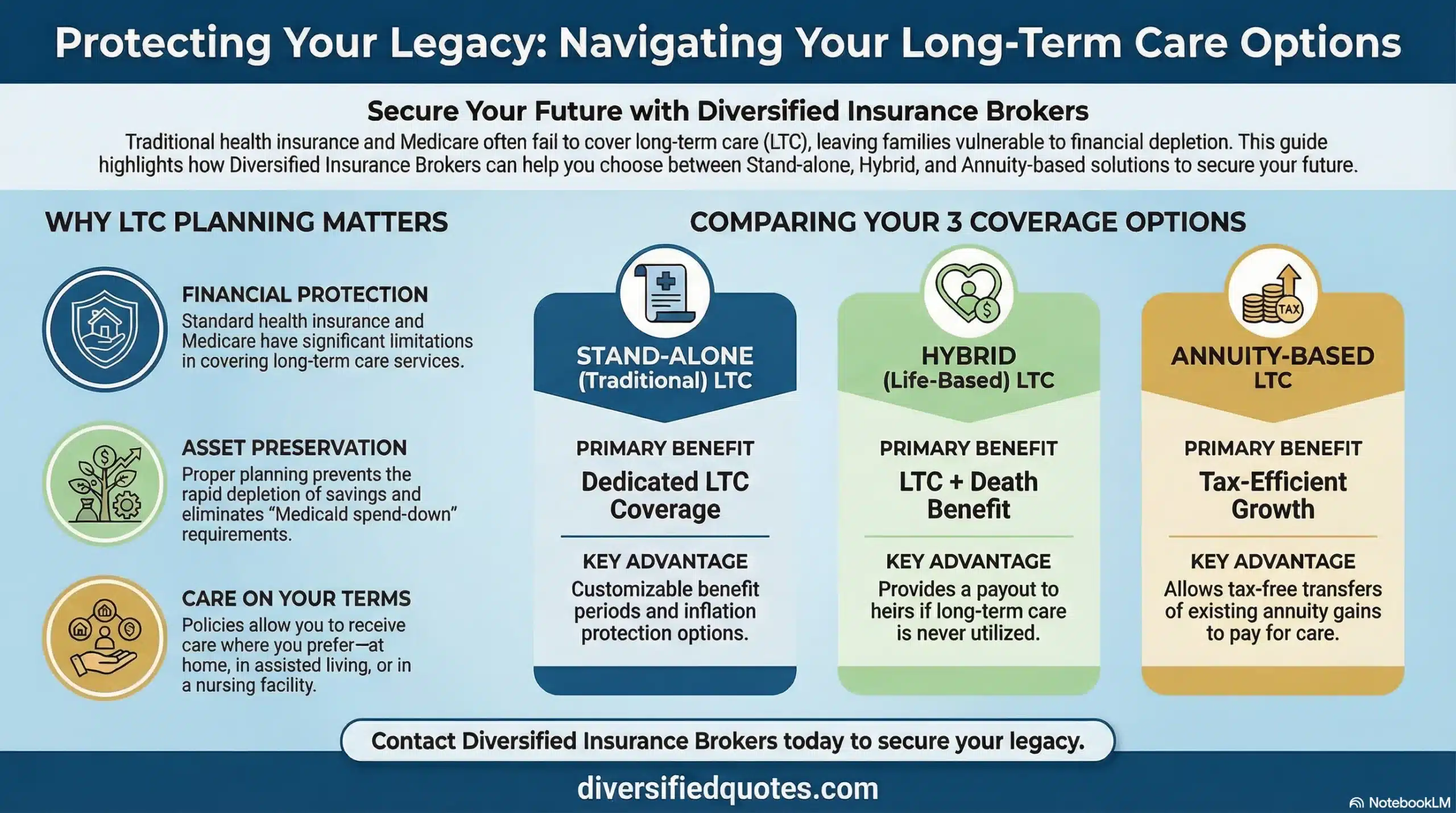
Hybrid life insurance with long term care benefits, which combines a permanent life insurance chassis with an attached long term care rider, typically undergoes life insurance underwriting rather than standalone LTC underwriting. Because the life insurance component involves mortality risk assessment, these products may require a paramedical exam, blood work, or other physical examination elements depending on the premium size and the carrier’s guidelines. An applicant purchasing a $200,000 single-premium hybrid life/LTC policy may encounter exam requirements that would not apply to a traditional standalone LTC application. Our resource on hybrid life insurance with long term care benefits covers the underwriting differences in detail.
Annuity-based long term care structures — such as PPA-compliant annuities with LTC benefit riders — typically use simplified underwriting focused on functional independence, similar to traditional LTC underwriting. These products generally require a health questionnaire and may require a cognitive assessment, but do not typically require a paramedical exam. The availability of annuity-based LTC solutions extends to older age bands than traditional standalone LTC policies, making them particularly relevant for applicants who may have missed the optimal window for traditional coverage. Our resource on annuities with long term care benefits covers these structures comprehensively, and our resource on long term care insurance after age 80 covers the specific landscape for older applicants where hybrid and annuity-based options are often the primary available choices.
For applicants whose health history makes traditional underwriting challenging but who still need long term care protection, understanding all available product structures — including guaranteed issue long term care insurance options — helps identify the path to meaningful coverage even when traditional full-underwriting policies are inaccessible. Our resource on short-term care insurance alternatives covers options that bridge the gap when traditional long term care coverage is unavailable.
Why Timing Matters More Than Exam Requirements
Once the does long term care insurance require a medical exam question is answered — largely no — the next most important planning insight is that the timing of application matters far more for long term care insurance outcomes than virtually any other factor, including the specific underwriting process involved. Long term care insurance is a health-underwritten product, which means it must be purchased while the applicant is healthy enough to qualify. This window is not permanent, and the factors that close it develop gradually and sometimes without obvious warning.
The optimal timing window for most individuals is between ages 50 and 59, and many planning professionals recommend beginning the long term care insurance evaluation process by the mid-50s. During this age range, approval rates are highest, premium rates are lowest (because the premium is based on age at issue and remains level), and applicants have the broadest choice of product structures and benefit configurations. Our resource on whether to buy long term care insurance covers the timing and decision framework in comprehensive detail, and our cost of long term care by state calculator provides the financial context for understanding what LTC events actually cost in different geographic markets.
For applicants who have passed the optimal window, options still exist but narrow progressively. Between ages 60 and 65, traditional standalone LTC policies are available with somewhat higher premiums and more thorough underwriting. Between 65 and 75, the carrier pool narrows, premiums increase substantially, and underwriting scrutiny is highest. Above 75, standalone traditional LTC coverage becomes difficult to obtain at most carriers, and hybrid or annuity-based solutions become the primary options. Our resource on whether you can still get long term care insurance after age 60 covers this progression explicitly.
Pre-Screening Before Applying for Long Term Care Insurance
Because does long term care insurance require a medical exam has a largely negative answer but the health questionnaire and prescription review are consequential, pre-screening before formally submitting an application is one of the most valuable preparation steps an applicant can take. Pre-screening is an informal evaluation of an applicant’s health history against carrier guidelines before any formal application is submitted or any adverse underwriting record is created.
The value of pre-screening is that it prevents the scenario where an applicant discovers their health history is problematic only after a formal application has been declined. A declined application creates an adverse action record in the MIB database that subsequent carriers can access, raising questions about why coverage was declined and potentially triggering additional scrutiny. Pre-screening identifies health history issues, determines which carriers have guidelines most receptive to specific health profiles, and allows the application to be directed to the carrier most likely to produce a favorable outcome on the first submission.
An independent long term care insurance broker with access to multiple carriers can complete pre-screening informally by reviewing the applicant’s health history against each carrier’s published underwriting guidelines and underwriting experience with similar cases. This process is not a guarantee — formal underwriting can always produce a different outcome than pre-screening suggests — but it substantially reduces the probability of first-application declines and the adverse record they create. Our resource on why to work with an independent long term care insurance broker covers the full value of this pre-screening and multi-carrier access advantage.
Step-by-Step: What to Expect During Long Term Care Insurance Underwriting
With the does long term care insurance require a medical exam question answered and the components of the process mapped, a sequential overview of what actually happens from application submission to underwriting decision helps applicants prepare practically rather than abstractly.
The process typically begins with a conversation with an independent broker who reviews your health history, identifies the most appropriate carriers and products, and helps complete the formal application. The application includes the health questionnaire — the longest and most detailed part of the process — and authorizes the carrier to conduct prescription database checks, MIB record reviews, and, if warranted, requests for attending physician statements. The authorization also covers the cognitive phone interview if that step is part of the carrier’s standard process for your age group.
After submission, the carrier’s underwriting team reviews the questionnaire and initiates database reviews. If the questionnaire and databases produce a clear picture without complexity, underwriting may complete within 2 to 4 weeks. If the prescription review reveals conditions not fully addressed in the questionnaire, the underwriter may contact the applicant for clarification or request an APS. If a cognitive interview is part of the standard process, the carrier schedules it by phone, typically within 1 to 2 weeks of application receipt.
The underwriting decision is one of four outcomes: standard approval (coverage issued at the standard rate), preferred approval (coverage issued at a lower rate class for excellent health profiles), modified approval (coverage issued with specific benefit modifications or exclusions for certain conditions), or decline (coverage not offered). Understanding each possible outcome before applying helps set expectations and allows for appropriate planning around each scenario. Our resource on who qualifies for long term care insurance covers the qualification framework in detail.
Long Term Care Insurance Policy Features Worth Understanding During the Application Process
The does long term care insurance require a medical exam conversation often opens the door to questions about what the policy actually provides once the underwriting process is complete. Understanding the core benefit structures helps applicants make informed coverage selections rather than accepting default configurations that may not align with their planning goals.
The benefit period — how long the policy pays benefits once a claim begins — is one of the most consequential design choices. Our resource on what a long term care insurance benefit period is covers the range of options and how to think about the appropriate duration for specific planning scenarios. The elimination period — the number of days of qualifying care required before benefits begin — functions like a deductible and affects both premium and benefit design. Our resource on LTC elimination periods explained covers the elimination period mechanics thoroughly.
Inflation protection — the feature that causes benefits to increase over time to offset rising care costs — is one of the most important long-term value considerations in any long term care insurance policy. Our resource on long term care planning strategies covers how inflation protection choices affect the long-run value of coverage. For couples evaluating joint coverage, our resources on shared benefit long term care insurance and long term care insurance for couples cover the pooled and shared benefit options that can provide greater flexibility than individual policies for household-level planning.
Tax advantages are another dimension worth evaluating during the application process. Many long term care insurance premiums are deductible as medical expenses for individuals who itemize, and qualifying LTC benefits received from tax-qualified policies are generally income-tax-free. Our resource on the tax benefits of long term care insurance covers the tax treatment in detail, and our resource on whether long term care benefits are taxable addresses the benefit taxation question specifically.
Start the Long Term Care Insurance Process Today
No medical exam required for most applicants. We’ll review your health profile, pre-screen against carrier guidelines, and walk you through every step of the process.
Request a Long Term Care Insurance QuoteRelated Long Term Care Insurance Pages
Explore underwriting, qualification, policy design, and planning resources for long term care insurance decisions.
Financial Protection Essentials
Coordinate long term care coverage with Medicare, Social Security, annuity income, and comprehensive retirement protection planning.
Talk With an Advisor Today
Choose how you’d like to connect—call or message us, then book a time that works for you.
Schedule here:
calendly.com/jason-dibcompanies/diversified-quotes
Licensed in all 50 states • Fiduciary, family-owned since 1980
Frequently Asked Questions: Does Long Term Care Insurance Require a Medical Exam?
Does long term care insurance require a medical exam?
No. In the large majority of cases, long term care insurance does not require a traditional medical exam — the paramedical process involving blood draws, urinalysis, and physical measurements familiar from life insurance. Long term care insurance underwriting relies primarily on a detailed health questionnaire, prescription database review, MIB record check, and sometimes a brief cognitive phone interview for applicants 65 and older. These tools are sufficient for the actuarial question long term care underwriting is trying to answer, which is about functional health risk rather than mortality risk.
The exception is certain hybrid life insurance with long term care benefit products, which may require medical exam components because they include a life insurance chassis subject to mortality underwriting. If you are considering a hybrid product, confirming the underwriting requirements for that specific product is important. Our resource on hybrid life insurance with long term care benefits covers the underwriting differences between hybrid and traditional standalone LTC products.
What information does long term care insurance underwriting actually review?
Long term care insurance underwriting reviews: the detailed health questionnaire covering medical history, current medications, functional status, and recent physician interactions; prescription database records confirming medication history; MIB records from prior insurance applications; attending physician records when the questionnaire or prescription review reveals complex health history; and for applicants typically 65 or older, a cognitive phone interview assessing memory, daily functioning, and medication awareness. The combination of these tools allows carriers to make accurate underwriting assessments without a physical examination in most cases.
What is the cognitive phone interview and what should I expect?
The cognitive phone interview is a brief telephone assessment — typically 10 to 30 minutes — conducted by a nurse or trained underwriting professional. It covers medication awareness (naming current medications and their purposes), daily functioning questions (cooking, driving, managing finances, social activities), brief memory screening (recalling a short word list, answering orientation questions), and health history confirmation. The purpose is to identify early cognitive impairment that may not yet appear in medical records. Most applicants find it straightforward when they prepare by reviewing their current medications before the call. It is not designed to disqualify applicants but to ensure the underwriting picture is complete.
What health conditions can prevent me from getting long term care insurance?
Conditions that typically result in automatic declines include: current Alzheimer’s disease or dementia diagnosis, Parkinson’s disease with significant functional impairment, current receipt of any long term care services or assistance with activities of daily living, current use of a wheelchair for ambulation, and AIDS or HIV. These are cases where the benefit trigger has essentially already been met. Conditions that create challenges but do not automatically prevent approval — including many chronic conditions managed with appropriate treatment — may still qualify with the right carrier. Our resource on long term care insurance with pre-existing conditions covers the most common challenging health scenarios.
When is the best time to apply for long term care insurance?
The optimal application window is between ages 50 and 59 for most people. During these years, approval rates are highest, premiums are lowest (because premiums are based on issue age and remain level), and applicants have the broadest product and benefit choices. Waiting until later years progressively narrows options, increases premiums, and raises the probability that developing health conditions will affect eligibility. The most important planning insight is that long term care insurance must be purchased while you are healthy enough to qualify — it cannot be obtained reactively once care is needed. Our resource on whether to buy long term care insurance covers the timing and decision framework comprehensively.
Why do insurers ask about prescription medications in the LTC application?
Prescription medications are one of the most precise indicators of current health status available in underwriting. The specific medications someone takes reveal the conditions being managed, the severity level warranting pharmacologic treatment, and in combination, the overall health complexity picture. Long term care insurance carriers use both the questionnaire-disclosed medication list and independent prescription database reviews to construct an accurate health profile. Certain medications — particularly those for neurological conditions, severe psychiatric conditions, and advanced cardiovascular disease — are specifically relevant because the conditions they indicate can directly affect functional health and long term care risk assessment.
How long does long term care insurance underwriting take?
Timeline varies based on application complexity. Simple applications with straightforward health histories, no significant conditions, and no additional records needed can complete underwriting in 2 to 4 weeks. Applications requiring attending physician statements from one or more physicians typically take 4 to 8 weeks depending on physician response time. Applications requiring multiple APS records or involving complex health histories can take 8 to 12 weeks or more. Working with an independent broker who pre-screens cases before submission and can help expedite APS requests when needed is the most effective way to minimize unnecessary delays.
Is there long term care insurance available if I can’t qualify for traditional underwriting?
Yes. For applicants whose health history makes traditional fully underwritten long term care insurance inaccessible, several alternatives exist. Annuity-based long term care structures — including PPA-compliant annuities with LTC benefit provisions — use simplified underwriting that may accommodate health profiles that traditional policies decline. Hybrid life insurance with LTC benefits may offer a different underwriting pathway for certain conditions. For older applicants, the annuity-based strategies discussed in our resource on long term care insurance after age 80 often remain available into the mid-to-late 80s for functionally independent individuals. Our resource on guaranteed issue long term care insurance covers options available without health underwriting for specific situations.
About the Author:
Jason Stolz, CLTC, CRPC, DIA, CAA and Chief Underwriter at Diversified Insurance Brokers (NPN 20471358), is a senior insurance and retirement professional with more than 25 years of real-world experience helping individuals, families, and business owners protect their income, assets, and long-term financial stability. As a long-time partner of the nationally licensed independent agency Diversified Insurance Brokers, Jason provides trusted guidance across multiple specialties—including fixed and indexed annuities, long-term care planning, personal and business disability insurance, life insurance solutions, Group Health, Travel Medical and Evacuation Insurance, and short-term health coverage. Diversified Insurance Brokers maintains active contracts with over 100 highly rated insurance carriers, ensuring clients have access to a broad and competitive marketplace.
His practical, education-first approach has earned recognition in publications such as VoyageATL, and contributions from his agency featured in Kiplinger and GoBankingRates— highlighting his commitment to financial clarity and client-focused planning. Drawing on deep product knowledge and years of hands-on field experience, Jason helps clients evaluate carriers, compare strategies, and build retirement and protection plans that are both secure and cost-efficient. Visitors who want to explore current annuity rates and compare options across multiple insurers can also use this annuity quote and comparison tool.
Explore More Long Term Care Insurance Options: Browse our complete guide to How to Buy, Qualify & Coverage Details — covering how to buy, who qualifies, policy types, shared benefits, partnership plans & more from top carriers.
Last Reviewed: September 23, 2026 |
Reviewed by: Jason Stolz, CLTC, CRPC, DIA, CAA
Chief Underwriter, Diversified Insurance Brokers, Inc. | NPN: 20471358 | Diversified Insurance Brokers, Inc. — Licensed in all 50 states
Fact Checked by: Tonia Pettitt, CMIP©
Medicare Specialist, Diversified Insurance Brokers, Inc. | NPN: 14374308 | Diversified Insurance Brokers, Inc. — Licensed in all 50 states
Did you find this content helpful? Leave us a Google review — it helps others find trustworthy guidance too.
Editorial Standards: Diversified Insurance Brokers maintains rigorous editorial standards to ensure accuracy, clarity, and independence in all content. Learn more about our editorial standards and commitment to transparency.
