
Are Long Term Care Benefits Taxable
Are Long Term Care Benefits Taxable

Jason Stolz CLTC, CRPC
The short answer to whether long-term care benefits are taxable is one that surprises most people asking the question for the first time: no, in most real-world situations, long-term care benefits are not taxable income. Benefits paid under a tax-qualified long-term care insurance policy — whether traditional standalone coverage, a hybrid life/LTC policy, or an annuity-based LTC design — are generally excluded from gross income under the Internal Revenue Code when paid for qualified long-term care services. This favorable tax treatment is not an obscure loophole or a temporary provision. It reflects Congress’s deliberate policy decision that benefits intended to pay for genuine care needs should not be treated as taxable income, just as reimbursements for medical expenses are generally not taxable.
The more nuanced answer — the one that actually matters for planning — addresses the conditions under which this favorable treatment applies, the scenarios where a portion of benefits could become taxable, how different policy structures handle this differently, and how the tax-free nature of LTC benefits interacts with retirement income in ways that make LTC coverage a genuine tax management tool in addition to a care funding mechanism. At Diversified Insurance Brokers, we help clients understand how long-term care coverage interacts with retirement income, portfolio withdrawals, and tax exposure — because the tax dimension of LTC planning is often the most underappreciated and the most consequential for households where care funding intersects with ongoing retirement income management. We work with long-term care insurance options across traditional, hybrid, and annuity-based designs, and we help clients evaluate which structure produces the best combination of benefit flexibility and tax efficiency for their specific situation.
Confirm Whether Your LTC Benefits Will Be Tax-Free
We’ll review how your policy pays benefits, whether it’s tax-qualified, and how a hybrid design may change outcomes for your specific retirement income situation.
Request Long-Term Care OptionsQuestions? Call 800-533-5969
The Tax Framework: Why Most LTC Benefits Are Excluded From Income
The tax treatment of long-term care insurance benefits flows from two interlocking provisions of the Internal Revenue Code: the definition of a tax-qualified long-term care insurance contract under IRC Section 7702B, and the income exclusion for amounts received under a qualified long-term care insurance contract under IRC Section 104 and related provisions. Understanding both provisions explains both why the tax-free treatment exists and what conditions must be met for it to apply.
IRC Section 7702B defines a tax-qualified long-term care insurance contract as one that meets specific requirements: it must only pay for qualified long-term care services, it must not pay for services covered by Medicare, it must be guaranteed renewable, it must meet certain consumer protection requirements, and it must not have a cash surrender value. Modern long-term care insurance policies sold by major carriers are designed to meet these requirements, which is why the primary reason people buy long-term care insurance includes this favorable tax treatment as part of the value proposition.
When a policy meets these qualified requirements, benefits paid under it for qualified long-term care services are excluded from gross income under IRC Section 104 — treated similarly to how medical reimbursements are excluded from income. The IRS has long recognized that reimbursements for genuine medical and care needs are not income in the economic sense — they offset expenses rather than adding to the recipient’s wealth — and qualified LTC benefits receive the same exclusion treatment.
Qualified long-term care services are defined as necessary diagnostic, preventive, therapeutic, curing, treating, mitigating, and rehabilitative services, and maintenance or personal care services required by a chronically ill individual. A chronically ill individual is defined as someone who has been certified by a licensed health care practitioner as being unable to perform at least two activities of daily living (ADLs) for a period expected to last at least 90 days, or as requiring substantial supervision due to severe cognitive impairment. These eligibility triggers are the same criteria that govern benefit access in most qualified long-term care policies — which is why the tax treatment and the policy benefit trigger are aligned rather than in tension.
LTC Benefit Types and Tax Treatment at a Glance
| Benefit Type | How Benefits Are Paid | Typically Tax-Free? | Key Tax Consideration |
|---|---|---|---|
| Reimbursement (Traditional LTC) | Pays actual qualified care costs up to daily/monthly maximum | Yes | Tied to actual expenses; documentation required; rarely triggers per-diem concern |
| Indemnity / Cash Benefit | Pays fixed daily or monthly amount once qualified, regardless of actual bill | Usually — see note | Amount above IRS per-diem limit may be taxable if actual care expenses are lower |
| Hybrid Life + LTC Rider | LTC benefit drawn from life insurance death benefit or rider | Yes (for qualified care) | Benefits reduce remaining death benefit; unused portion passes to beneficiaries |
| Annuity + LTC Rider | LTC benefit drawn from annuity contract value or separate benefit pool | Yes (for qualified care) | Reduces contract value; gains that would otherwise be taxable may pass tax-free when used for care |
| Non-Qualified Policy | Older or legacy policy not meeting current federal tax-qualified standards | Varies | Benefits may be treated differently; review policy terms before assuming tax-free treatment |
Reimbursement Benefits vs. Indemnity Benefits: How Payment Structure Affects Tax Treatment
Long-term care policies pay benefits through one of two primary mechanisms, and while both are generally tax-free, the mechanics differ in ways that matter for planning and documentation.
Reimbursement benefits pay based on actual qualified expenses incurred. The policyholder or care recipient submits documentation of covered care costs — invoices from home health agencies, assisted living facility bills, skilled nursing facility charges, adult daycare fees — and the insurance company reimburses up to the policy’s monthly or daily benefit maximum. Because reimbursement benefits are tied to actual qualified expenses and never exceed those expenses, the income exclusion applies cleanly: the benefits represent reimbursement for care costs incurred, not income added to the recipient’s wealth. From a tax documentation standpoint, reimbursement policies are the simplest because the documentation submitted for reimbursement simultaneously establishes that the benefits are tied to actual qualified expenses.
Indemnity benefits (sometimes called “cash benefits”) pay a defined amount daily or monthly once the policyholder qualifies for benefits, regardless of whether actual expenses equal the benefit amount. This payment structure is attractive for many policyholders and families because real-world care arrangements often don’t generate neat invoices — informal care arrangements, family caregiver time, and blended care settings may not produce the documentation that a reimbursement model requires. Indemnity benefits provide flexibility to use funds however care is being arranged.
Indemnity benefits are also generally tax-free, but the IRS imposes a per-diem limit — an annual amount per day of coverage — above which benefits can become taxable unless actual qualified expenses equal or exceed the benefit amount. The IRS adjusts this per-diem limit periodically for inflation. For most policyholders receiving indemnity benefits for genuine care needs, the actual cost of care exceeds the per-diem limit — which means the tax-free exclusion applies fully even for policies paying above the per-diem threshold, because the expenses substantiate the benefit. The situation where benefits become partially taxable is when the indemnity payment exceeds both the per-diem limit and the actual qualified care expenses — which is more likely in very early or very mild care situations where benefits are being paid but care costs are minimal.
For practical planning purposes, policyholders receiving indemnity benefits should maintain documentation of actual care costs and care arrangements — not for submission to the insurer, but to substantiate the expense level if the per-diem limit is an issue. This is a manageable documentation requirement, not a significant burden. Our resource on tax benefits of long-term care insurance explains the full benefit exclusion framework, and our resource on tax-free long-term care insurance covers how the exclusion is applied in practice.
Hybrid Life/LTC Policies: Tax Treatment of Accelerated and Extension Benefits
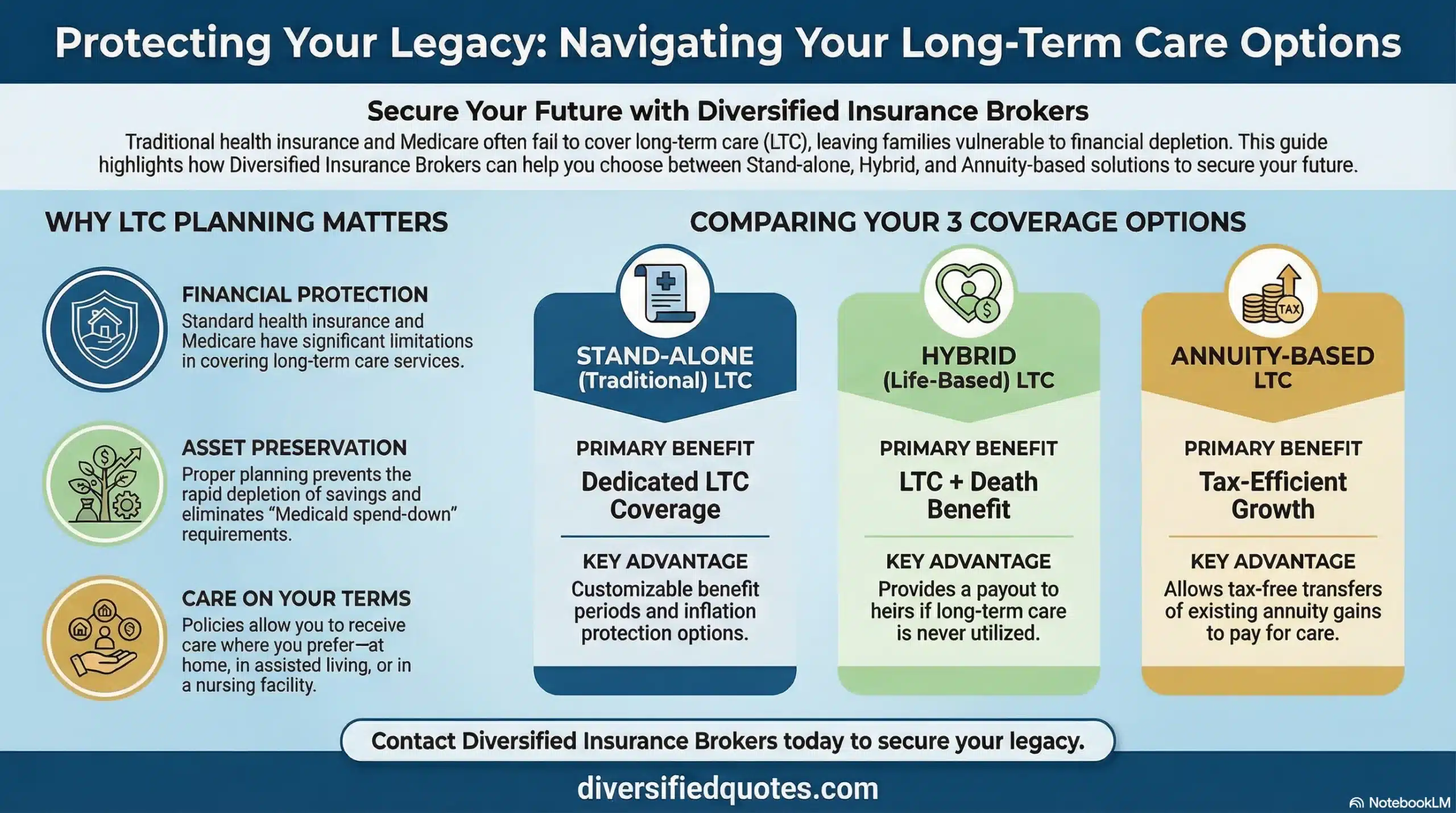
Hybrid life insurance policies with long-term care riders represent an increasingly popular approach to LTC planning that combines death benefit protection with LTC benefit access. These policies are sometimes described as “linked benefit” designs because the life insurance death benefit and the long-term care benefits are linked — using LTC benefits reduces the remaining death benefit, and unused LTC benefits remain as death benefit. Understanding the tax treatment of LTC benefits received from these hybrid designs requires understanding which legal provision governs the specific rider structure.
Most hybrid life/LTC riders fall into one of two categories: extension of benefits riders that qualify under IRC Section 7702B (the same provision that governs standalone LTC insurance), or accelerated death benefit riders that qualify under IRC Section 101(g) (the provision that governs accelerated death benefits for terminal or chronic illness). Both provide favorable tax treatment for benefits paid for qualifying care, but the mechanics and documentation requirements differ. Our resource on hybrid life insurance with long-term care benefits explains the structural differences between these rider types.
Under Section 7702B riders, the LTC benefits are subject to the same per-diem limit framework as standalone LTC policies — benefits are tax-free up to the per-diem limit, and above that limit are tax-free to the extent they match actual qualified expenses. Under Section 101(g) accelerated death benefit riders for chronic illness, the tax treatment is generally favorable for qualifying conditions (chronic illness, as defined by the two-ADL or cognitive impairment standard) but the specific rules and limits differ from the 7702B framework. Our resource on accelerated death benefit riders and our resource on life insurance with chronic illness riders explain these structures in detail.
The practical planning implication is that hybrid life/LTC policies designed and marketed by major carriers are structured to provide tax-favorable LTC benefits — the policy design reflects the regulatory and tax framework under which the benefits will be paid. The tax outcome for the policyholder is generally the same as for standalone LTC insurance when benefits are used for qualifying care: tax-free. The hybrid structure addresses a different planning preference — keeping the benefit pool available for heirs if care is never needed — rather than a different tax outcome. Our resource on tax advantages of LTC and hybrid policies provides a comprehensive comparison of the tax treatment across these structures.
Annuity-Based LTC Benefits and the Pension Protection Act
Annuity-based long-term care designs represent a third structural approach that has grown significantly since the Pension Protection Act of 2006 (PPA) took effect for long-term care purposes in 2010. The PPA created a specific and powerful tax benefit for owners of non-qualified annuities with significant built-in gains who want to reposition those gains into long-term care protection: a properly structured 1035 exchange from a non-qualified annuity into a qualifying LTC annuity or policy converts annuity gains — which would otherwise be fully taxable as ordinary income when withdrawn — into LTC benefits that are received completely income-tax-free.
This is one of the most significant planning opportunities in retirement tax management for households with older non-qualified annuities that have accumulated substantial gains. Without the PPA structure, those gains will be taxed as ordinary income whenever they are withdrawn — whether for living expenses, healthcare costs, or long-term care. With a properly structured 1035 exchange into a qualifying LTC product, those same gains are permanently eliminated as a tax liability when converted into tax-free LTC benefits. Our resource on annuities with long-term care benefits explains how these hybrid annuity/LTC structures work, and our resource on what a PPA annuity is covers the 1035 exchange mechanics and tax elimination in detail.
The tax treatment of LTC benefits from a qualifying annuity-based LTC product mirrors the treatment of benefits from traditional and hybrid LTC policies: benefits paid for qualified long-term care services are excluded from income under the qualified LTC insurance provisions, even when those benefits ultimately derive from what would otherwise have been taxable annuity gains. This is the distinctive planning power of the PPA structure — it converts a deferred tax liability into a tax-free care benefit in a single transaction, rather than simply deferring the tax further. Our resource on LTC annuities explains the available product structures.
LTC Premium Deductibility: The Secondary Tax Advantage
While the tax-free treatment of LTC benefits is the primary and most significant tax advantage of long-term care insurance, premium deductibility provides a secondary advantage for some policyholders and is worth understanding — particularly for self-employed individuals and business owners for whom the deduction rules are more favorable than for employees.
Premiums paid for a tax-qualified long-term care insurance policy may be deductible as medical expenses under IRC Section 213, subject to age-based limits that the IRS adjusts annually. These age-based limits cap the deductible premium amount based on the policyholder’s age at the end of the tax year — younger policyholders have lower deductible limits, older policyholders have higher limits. For 2024 and 2025, these annual limits range from approximately $480 for policyholders age 40 or younger to approximately $5,880 for those age 71 or older.
The deductibility is also subject to the overall medical expense deduction rules: medical expenses (including LTC premiums up to the age-based limit) are deductible only to the extent they exceed 7.5% of adjusted gross income (AGI). For most retirees, this threshold means that routine premium payments — in the absence of significant other medical expenses — do not cross the AGI threshold to generate a deduction. The premium deduction is therefore most valuable in years when total medical expenses are high (due to significant healthcare costs in addition to LTC premiums) or when the policyholder’s AGI is relatively low.
Self-employed individuals — sole proprietors, partners, S-corporation shareholders who own more than 2% — have more favorable treatment: they may deduct 100% of qualified LTC insurance premiums (up to the age-based annual limit) as a business deduction, without the 7.5% AGI threshold that limits deductibility for other individuals. This makes LTC insurance premium planning especially valuable for business owners who can structure coverage and deductions within a business context. Our resource on group long-term care insurance covers how employer-sponsored and business-owner LTC structures can optimize both coverage and deductibility.
For C corporations, the treatment is even more favorable: premiums paid by a C corporation for long-term care coverage for employees (including owner-employees) are deductible as a business expense without the age-based premium limits that apply to individual deductions, and the premiums are generally not treated as taxable income to the employee. This creates a genuine tax arbitrage opportunity for business owners who can provide LTC coverage through a corporate structure. The combination of corporate deductibility and tax-free benefits when care is needed makes LTC insurance one of the most tax-efficient employee benefits available from a corporation.
LTC Benefits as a Retirement Income Tax Management Tool
The most underappreciated dimension of long-term care insurance’s tax treatment is how it interacts with retirement income during a care event. When care needs appear in retirement — and approximately 70% of people over 65 will need some form of long-term care — the financial pressure often produces a predictable and costly behavioral pattern: the family withdraws from the most accessible account to pay care costs, without considering the tax consequences of that withdrawal in the context of their broader retirement income picture.
For most retirees, the most accessible account is the largest account: the pre-tax IRA or 401(k) rollover that holds decades of accumulated retirement savings. Every dollar withdrawn from a pre-tax IRA to pay for long-term care is a dollar of ordinary taxable income in the year withdrawn — stacking on top of Social Security income, pension income, and any other retirement distributions already occurring. A retiree who needs $6,000 per month for skilled nursing care who withdraws $6,000 per month from a pre-tax IRA to cover it is generating $72,000 per year in additional ordinary income — income that may push the household into a higher tax bracket, cause more of their Social Security benefits to become taxable, and trigger higher Medicare premium surcharges through IRMAA.
Long-term care insurance benefits replace this taxable withdrawal with a tax-free payment. The $6,000 per month in care costs is covered by a tax-free LTC benefit rather than a taxable IRA distribution — the net income to the household is the same in terms of care funding, but the tax cost is dramatically different. The IRA stays intact, earning compound growth on assets that don’t need to be withdrawn, and the household’s taxable income is lower — which means lower bracket exposure, lower Social Security taxability, and lower IRMAA Medicare premiums. Over a multi-year care event, this tax preservation effect can be worth tens of thousands of dollars in avoided taxes. Our resource on RMDs after SECURE 2.0 explains the broader context of retirement income tax management that makes this benefit coordination so valuable.
The LTC Partnership Program: Additional Asset Protection Beyond Tax Benefits
The Long-Term Care Insurance Partnership program — established under the Deficit Reduction Act of 2005 and operating in most states — provides an additional layer of protection for policyholders of qualifying partnership-certified LTC policies that goes beyond the tax treatment of benefits. Under the partnership program, every dollar of LTC benefits paid by a qualifying partnership policy generates one dollar of asset protection for Medicaid eligibility purposes — meaning that if LTC insurance benefits are eventually exhausted and the individual requires Medicaid-funded care, they can protect assets equal to the total benefits paid without those assets counting against Medicaid’s asset limits.
This asset protection feature makes partnership-qualified LTC policies particularly valuable for middle-class retirees who want to balance the cost of LTC coverage against self-insurance. Rather than needing to either purchase enough coverage to fund the full potential care cost or accept total asset exposure to Medicaid spend-down, a partnership policy provides a middle path: purchase a policy with meaningful benefits, receive tax-free benefits when care is needed, and protect a dollar of assets for every dollar the policy pays — with self-insurance covering anything beyond the policy’s benefits without the penalty of Medicaid asset spend-down on the protected amount. Our resource on partnership-qualified long-term care insurance explains the program requirements and state-specific variations, and our resource on LTC partnership reciprocity addresses how partnership protections transfer across state lines for retirees who move in retirement.
When LTC Benefits Are Not Tax-Free: The Real Exceptions
The conditions under which LTC benefits become taxable are narrower than most people fear and are generally avoidable with proper planning and documentation. Understanding them specifically — rather than vaguely worrying about them — allows policyholders to claim the full tax-free benefit they are entitled to without unnecessary confusion.
The first exception is indemnity benefits exceeding the IRS per-diem limit when actual qualified expenses are less than the benefit amount. As described above, this applies when a cash-payment policy pays above the per-diem threshold and the policyholder cannot document that actual care costs match the benefit received. The solution is maintaining documentation of care arrangements and costs during a claim period — not the same as submitting invoices for reimbursement, but maintaining records that can substantiate the expense level if needed.
The second exception applies to policies that are not tax-qualified under Section 7702B. Older long-term care policies — particularly those purchased before 1997 when the tax-qualified LTC framework was established — may not meet the qualified standards, and benefits from those policies may be treated differently. Anyone with older coverage should confirm whether their policy is tax-qualified, because the treatment can differ significantly. Our resource on how to choose the right LTC insurance policy covers the qualified policy standards and what to look for when reviewing existing coverage.
The third exception is theoretical rather than practically common: a benefit that is paid in circumstances that don’t meet the “qualified long-term care services” definition could potentially be taxable. In practice, legitimate claims for care that genuinely meets the chronic illness or ADL impairment standard are covered by the exclusion. The scenario where this issue arises is most likely when a policy design or claim triggering process is unusual or nonstandard — which is one reason working with reputable, established carriers that design and administer policies within the regulatory framework matters.
Get Help Reviewing Long-Term Care Options
We compare traditional and hybrid LTC policies from top-rated carriers and explain how benefits are treated — so you can plan confidently knowing the tax outcome when care is needed.
Request Long-Term Care OptionsQuestions? Call 800-533-5969
Financial Planning Essentials
Core resources for long-term care planning, tax advantages, hybrid policy options, and retirement income protection.
Related Pages
More Financial Protection Resources
Core strategies to protect retirement income, prepare for healthcare costs, and build long-term financial stability.
Talk With an Advisor Today
Choose how you’d like to connect—call or message us, then book a time that works for you.
Schedule here:
calendly.com/jason-dibcompanies/diversified-quotes
Licensed in all 50 states • Fiduciary, family-owned since 1980
FAQs: Are Long-Term Care Benefits Taxable?
Are long-term care insurance benefits taxable?
No — in most real-world situations, benefits from a tax-qualified long-term care insurance policy are not taxable income. The Internal Revenue Code excludes qualified long-term care benefits from gross income when the policy meets the requirements of IRC Section 7702B and the benefits are paid for qualified long-term care services. This favorable treatment applies whether the benefits are structured as reimbursements for actual care costs or as indemnity (cash) payments for a defined daily or monthly amount, though the per-diem limit rules apply to indemnity benefits paid above the IRS annual threshold.
The practical significance is that LTC insurance benefits replace care expenditures without adding to the recipient’s taxable income — unlike, for example, taking an IRA distribution to pay for care, which would be fully taxable as ordinary income. This makes properly structured LTC insurance one of the more tax-efficient tools available for funding care costs in retirement. Our resource on tax benefits of long-term care insurance explains the full framework.
Are hybrid long-term care policy benefits taxable?
No — hybrid life insurance policies with long-term care riders also provide tax-free benefits when used for qualifying care. The specific IRC provision governing the tax treatment depends on how the rider is structured: riders that qualify under IRC Section 7702B follow the same framework as standalone qualified LTC policies, while riders structured as accelerated death benefits for chronic illness fall under IRC Section 101(g) — which also generally provides favorable tax treatment for qualifying conditions.
Both structures are designed by major carriers to provide tax-free LTC benefits when the policyholder qualifies for benefits based on the chronic illness or ADL impairment standard. The hybrid structure addresses a different planning preference — retaining value for heirs if care is never needed, or preventing the “use it or lose it” characteristic of standalone LTC insurance — rather than producing a different tax outcome. Our resource on hybrid life insurance with LTC benefits explains the structural options, and our resource on tax advantages of LTC and hybrid policies compares the tax treatment across structures.
Can LTC benefits ever be taxable?
Yes, in specific circumstances. The most practical scenario is when indemnity (cash) benefits exceed the IRS per-diem limit and the actual qualified care expenses do not equal or exceed the benefit amount. The IRS sets an annual per-diem threshold — adjusted periodically for inflation — above which indemnity LTC benefits can be partially taxable unless the policyholder documents that actual qualified care costs match or exceed the benefit received. For most policyholders with genuine care needs, actual costs exceed the per-diem limit, making the full benefit tax-free. But for situations where benefits are being paid but actual care costs are modest, the per-diem limit can create partial taxability.
A second scenario is policies that are not tax-qualified under Section 7702B — particularly older contracts purchased before 1997 that may not meet the qualified framework established when that framework was created. Benefits from non-qualified policies may be treated as taxable income. Anyone with older LTC coverage should confirm whether their policy carries qualified status. Our resource on how to choose the right LTC insurance policy covers what the qualified status requirements mean in practice.
Are long-term care premiums tax-deductible?
Premiums for tax-qualified LTC insurance may be deductible as medical expenses under IRC Section 213, subject to age-based annual limits that the IRS adjusts periodically. For 2024 and 2025, these limits range from approximately $480 for policyholders age 40 and under to approximately $5,880 for policyholders age 71 and older. However, medical expense deductions apply only to the extent total qualifying medical expenses exceed 7.5% of adjusted gross income — a threshold that many retirees with moderate medical expenses may not reach in a typical year. Premium deductibility is therefore most useful when total medical expenses in a given year are high, or when the policyholder has relatively low AGI.
Self-employed individuals have more favorable treatment: they may deduct qualified LTC premiums up to the age-based limit as a business deduction without the 7.5% AGI threshold. C corporations can deduct LTC premiums for employees without the age-based limits that apply to individual deductions. For most households, the primary tax advantage of LTC insurance is the tax-free nature of benefits when care is needed — the premium deduction is a secondary benefit worth claiming when available, but it is not the primary driver of the insurance’s value. Our resource on group long-term care insurance covers the business and employer-sponsored deductibility structures.
Are accelerated death benefits for long-term care taxable?
No — accelerated death benefits paid for qualifying long-term care or chronic illness are generally tax-free under IRC Section 101(g). When a life insurance policy pays an accelerated death benefit because the insured qualifies as chronically ill — defined as being unable to perform at least two activities of daily living or requiring substantial supervision due to cognitive impairment — the benefit is excluded from gross income, similar to how a disability income benefit is excluded under the chronic illness accelerated benefit provision. This favorable treatment applies to both standalone life insurance accelerated benefit riders and to the LTC rider components of hybrid life/LTC policies structured under Section 101(g).
The per-diem limit rules that apply to Section 7702B qualified LTC policies also apply to Section 101(g) accelerated benefits: benefits received in excess of the per-diem limit may be partially taxable unless actual qualified expenses equal or exceed the benefit amount. For most policyholders receiving accelerated benefits for genuine care needs, this threshold is not an issue. Our resources on accelerated death benefit riders and life insurance with chronic illness riders explain the structural and eligibility differences between these rider types.
How do LTC benefits interact with retirement income taxes?
LTC benefits interact with retirement income taxes in a way that makes them one of the most effective tax management tools available during a care event — a dimension that is widely underappreciated. When care needs appear in retirement, the default behavior for most families is to withdraw from the most accessible retirement account — typically a pre-tax IRA or 401(k) rollover — to pay care costs. Every dollar withdrawn for care from a pre-tax IRA is a dollar of ordinary taxable income in the year withdrawn, stacking on top of Social Security, pension, and other retirement income. Large IRA withdrawals can push the household into a higher tax bracket, cause more Social Security income to become taxable, and trigger higher Medicare premiums through IRMAA surcharges.
Tax-free LTC insurance benefits replace these taxable IRA withdrawals with income-excluded care payments. The care costs are covered without generating taxable income — which means lower bracket exposure, lower Social Security taxability, and lower IRMAA Medicare premiums during the care period. Over a multi-year care event, this tax preservation effect can represent tens of thousands of dollars in avoided taxes, and it preserves the IRA balance for continued compound growth rather than drawing it down at a potentially unfavorable tax cost. This “shock absorber” function — protecting the retirement income structure during a care event — is often more valuable than the direct care reimbursement for households with significant pre-tax retirement accounts.
Browse Tax, Medicare & Special Situations
About the Author:
Jason Stolz, CLTC, CRPC, DIA, CAA and Chief Underwriter at Diversified Insurance Brokers (NPN 20471358), is a senior insurance and retirement professional with more than 25 years of real-world experience helping individuals, families, and business owners protect their income, assets, and long-term financial stability. As a long-time partner of the nationally licensed independent agency Diversified Insurance Brokers, Jason provides trusted guidance across multiple specialties—including fixed and indexed annuities, long-term care planning, personal and business disability insurance, life insurance solutions, Group Health, Travel Medical and Evacuation Insurance, and short-term health coverage. Diversified Insurance Brokers maintains active contracts with over 100 highly rated insurance carriers, ensuring clients have access to a broad and competitive marketplace.
His practical, education-first approach has earned recognition in publications such as VoyageATL, and contributions from his agency featured in Kiplinger and GoBankingRates— highlighting his commitment to financial clarity and client-focused planning. Drawing on deep product knowledge and years of hands-on field experience, Jason helps clients evaluate carriers, compare strategies, and build retirement and protection plans that are both secure and cost-efficient. Visitors who want to explore current annuity rates and compare options across multiple insurers can also use this annuity quote and comparison tool.
Explore All Long Term Care Insurance Options: Browse our complete Long Term Care Insurance guide — covering hybrid policies, traditional LTC, costs, tax advantages & partnership plans from top carriers.
Last Reviewed: May 21, 2026 |
Reviewed by: Jason Stolz, CLTC, CRPC, DIA, CAA
Chief Underwriter, Diversified Insurance Brokers, Inc. | NPN: 20471358 | Diversified Insurance Brokers, Inc. — Licensed in all 50 states
Fact Checked by: Tonia Pettitt, CMIP©
Medicare Specialist, Diversified Insurance Brokers, Inc. | NPN: 14374308 | Diversified Insurance Brokers, Inc. — Licensed in all 50 states
Did you find this content helpful? Leave us a Google review — it helps others find trustworthy guidance too.
Editorial Standards: Diversified Insurance Brokers maintains rigorous editorial standards to ensure accuracy, clarity, and independence in all content. Learn more about our editorial standards and commitment to transparency.
