
Disability Insurance for Golf Club Pros
As an Independent Disability Insurance Broker, we have access to exclusive discounts and negotiated pricing most captive agents can’t offer — see the full breakdown near the end of this page.
Disability Insurance for Golf Club Pros

Jason Stolz CLTC, CRPC, DIA, CAA
Professional golfers employed at golf clubs — PGA-certified head golf professionals, assistant golf professionals, teaching professionals, and director of golf positions — carry an occupational disability risk profile that is as specific to their profession as any manual craft or clinical specialty: the repetitive physical mechanics of the golf swing, repeated dozens to hundreds of times per day in the course of instructing students and demonstrating technique, produce the documented elbow, wrist, shoulder, and back conditions that occupational medicine research has specifically associated with repetitive upper-extremity loading in sports and teaching contexts. Golfer’s elbow — medial epicondylitis, the tendon inflammation condition named for the grip-and-swing motion that produces it — is a documented overuse injury arising from repetitive gripping and wrist flexion, conditions that legal and occupational medicine sources specifically describe as classic mechanisms for this condition in golf professionals who perform repeated demonstrations and swing corrections with students throughout the instructional day. A PGA head golf professional whose elbow, wrist, or shoulder condition prevents the sustained demonstration and physical instruction that students require has experienced a genuine occupational disability — one that eliminates the teaching function that generates lesson income even when the ability to walk the course, manage the pro shop, or perform administrative golf operations remains intact. The income range for golf professionals spans considerably depending on employment structure and club type: Glassdoor data documents the average salary for a PGA head golf professional at approximately $126,858 annually, while broader golf professional salary surveys document ranges from entry-level assistant positions in the $30,000 to $50,000 range through head professionals at private country clubs earning well into six figures. The majority of teaching professionals — those whose income derives primarily from individual and group golf lessons — operate as self-employed independent teaching professionals who receive no employer benefit baseline and for whom disability insurance is the entire income protection system when an injury or illness prevents teaching.
At Diversified Insurance Brokers, Jason Stolz, CLTC, CRPC, DIA, CAA works with golf professionals across the full employment and income structure of the industry — PGA head golf professionals at private country clubs and resort courses who may receive W-2 compensation with some group benefit access but whose lesson income and total compensation package requires individual supplemental coverage, assistant golf professionals building careers at mid-tier facilities, teaching professionals who operate independent lesson businesses as independent contractors on club premises with their own overhead and zero employer benefit structure, and 1099-earning teaching pros whose entire income flows from per-lesson fees that stop completely if injury prevents instruction. The own-occupation definition is the most consequential policy feature for any golf professional — the physical teaching functions that generate lesson income require specific protection, not just generic inability to perform any work — and the business overhead expense dimension is relevant for teaching professionals who have built dedicated lesson studios, invested in launch monitors and swing analysis technology, and carry the fixed monthly costs of a professional teaching operation.
Compare Disability Coverage for Golf Professionals
We review coverage options across 100+ carriers and identify the own-occupation policy structure, income documentation approach, and rider combination that fits your specific golf professional role and income level.
Request Disability Insurance OptionsGolf Professional Disability Risk — Repetitive Strain, Teaching Income, and the Employment Structure Gap
| Risk Category | Occupational Context | Resulting Disability Risk | Coverage Status | Income Protection Gap |
|---|---|---|---|---|
| Elbow RSI — golfer’s elbow / medial epicondylitis | Golfer’s elbow is a documented overuse injury from repetitive gripping and wrist flexion — the exact mechanics of golf instruction; teaching professionals may demonstrate swing components dozens to hundreds of times daily, creating sustained elbow and forearm tendon loading that produces medial epicondylitis at rates associated with the repeated swing motion; occupational medicine research identifies this as a classic occupational mechanism in professionals performing repetitive gripping tasks | Elbow tendinopathy severe enough to prevent the grip, swing, and demonstration mechanics that golf instruction requires — eliminating lesson income even when walking, administrative, and non-teaching functions remain possible | Workers’ comp for employed professionals at acute incident threshold; gradual RSI disputed; self-employed teaching pros entirely unprotected; individual DI covers qualifying RSI disability | Full gap for self-employed teaching professionals; own-occupation individual DI covering the golf instruction function specifically is the only protection for teaching income loss from RSI |
| Shoulder, wrist, and back conditions from instruction demands | Golf instruction involves the full kinetic chain of the swing — shoulder rotation, wrist hinge and release, spinal rotation under load — repeated across a full instructional day; back conditions from sustained rotational loading are documented in golf professionals at elevated rates; wrist conditions from repeated demonstration of grip and release mechanics add to the upper-extremity RSI profile; shoulder conditions from sustained rotational instruction demands round out the musculoskeletal risk pattern | Back disc conditions, shoulder tendinopathy, wrist tendinitis, or any combination preventing the physical demonstration and corrective instruction that golf teaching requires — eliminating the lesson revenue stream while administrative club operations may continue | Same workers’ comp limitations for gradual conditions; self-employed entirely unprotected; individual DI covers all qualifying musculoskeletal causes | Teaching income gap; own-occupation policy covering golf instruction specifically pays benefits when instruction is prevented regardless of other golf-adjacent work capacity |
| Cart and course accident risk | Golf professionals spend significant time on course — accompanying students for playing lessons, course management, tournament oversight, and routine course operations; golf cart rollover and collision incidents represent an acute physical injury risk documented in golf course accident statistics; course infrastructure including slopes, wet conditions, and equipment creates fall and impact hazards during active professional duties | Acute fractures, head injuries, or spinal trauma from cart rollover or course accident requiring recovery period during which all lesson income stops; any physical trauma preventing club grip or swing demonstration | Workers’ comp for employed professionals at documented incident; self-employed teaching pros entirely unprotected for their own injuries; individual DI or accident-only coverage fills this gap | Full gap for self-employed; individual DI covers qualifying disability from acute physical accidents on course or in teaching facility |
| Illness-based disability (dominant probability) | Cancer, cardiac events, neurological conditions independent of golf instruction activity that prevent sustained teaching; approximately 90% of long-term disabling conditions are illness-based regardless of occupational physical risk profile | Extended inability to teach, demonstrate, and conduct golf instruction — eliminating lesson income for the full duration of illness treatment and recovery while fixed professional overhead continues | Not covered by workers’ comp; self-employed teaching pros entirely unprotected; group plans limited for employed professionals | Complete gap for self-employed; individual DI to age 65 is the only income floor for the dominant disability probability category |
| Teaching studio overhead — BOE exposure | Teaching professionals who operate dedicated lesson studios with launch monitors, swing analysis software, video systems, and facility costs carry fixed monthly overhead that continues during disability; some professionals lease studio space or indoor facility time on a committed basis; professional technology investments including simulator equipment represent business infrastructure with ongoing costs | Business overhead accumulating against zero lesson revenue during disability — studio lease, equipment subscriptions, technology costs, and professional membership fees continuing while no lessons are delivered | No automatic BOE coverage; personal DI addresses personal income only; BOE disability coverage specifically addresses teaching studio overhead | Second layer gap for teaching pros with studio overhead; BOE alongside personal DI creates complete protection for both household and teaching business |
The table establishes that the golf professional’s disability risk is concentrated at the intersection of the specific physical demands of teaching — the repetitive demonstration that produces documented upper-extremity RSI in sport-instruction professionals — and the self-employment income structure that makes individual disability insurance the only protection available when any disability eliminates the teaching function. The own-occupation definition is the critical policy feature: it must encompass the physical golf instruction functions — demonstration, swing correction, hands-on technical guidance — that generate lesson income, not merely the ability to perform generic work. Why golf professionals prioritize income protection is answered by any honest accounting of what happens when a chronic elbow or shoulder condition makes sustained golf instruction impossible: lesson revenue stops completely, professional overhead continues, and no automatic protection mechanism exists for a self-employed teaching professional.
The Own-Occupation Standard — Protecting Teaching Income Specifically
The disability definition is particularly consequential for golf professionals because the specific income premium of golf instruction derives from the physical ability to demonstrate, correct, and guide the golf swing — a function that requires fully functional elbow, wrist, shoulder, and back mechanics. A head golf professional who develops a chronic elbow condition that prevents sustained instruction and demonstration but who could theoretically manage pro shop operations, schedule tee times, or perform administrative club functions has lost the teaching income stream specifically — not all employment capacity. An any-occupation policy would deny this professional’s disability claim on the grounds that administrative golf operations are still possible. An own-occupation policy that specifically covers the inability to perform the material and substantial duties of golf instruction pays benefits when the teaching function is prevented, regardless of whether other golf-related employment is theoretically available.
For head golf professionals whose total compensation package includes both base salary and lesson income — a common structure at private clubs — the disability insurance architecture needs to address both income streams. The base salary component may have some group plan coverage through the club’s employer benefits; the lesson income component, whether earned as a W-2 employee or as an independent contractor splitting lesson fees with the club, requires individual coverage that accurately reflects the total teaching income rather than just the base salary portion. Self-employed teaching professionals who earn entirely from per-session lesson fees need individual disability insurance sized to their total documented lesson income, with no group plan baseline to supplement. The residual disability benefit addresses the partial recovery scenario — a golf pro who can teach limited lessons at reduced frequency during rehabilitation from an elbow or shoulder condition — paying proportionally based on actual income reduction rather than requiring total inability to teach as the only benefit trigger. Accident-only disability income insurance provides a lower-cost entry point for golf professionals who want targeted protection for acute physical injury scenarios — cart accidents, course falls, acute swing-related injuries — while building toward comprehensive illness-inclusive coverage. How short-term and long-term disability structures interact maps the coverage architecture from the first day of a qualifying disability through the full recovery or long-term benefit period.
Teaching Studio Operations, Business Overhead, and Policy Design
Golf teaching professionals who have built dedicated lesson studios — indoor golf simulators, launch monitor systems, video swing analysis platforms, putting studio equipment — carry fixed monthly overhead obligations that continue during disability regardless of whether any lessons are being delivered. A teaching professional who leases indoor studio space, subscribes to a swing analysis platform, and maintains professional equipment under financing faces the same two-layer disability exposure as any professional service business owner: personal income loss and simultaneous unmet overhead obligations. Business overhead expense disability coverage specifically addresses the studio’s fixed operating costs during the teaching professional’s qualifying disability, preserving the professional infrastructure during recovery. The BOE structure is sized to actual documented monthly fixed overhead rather than to lesson revenue, covering what the operation costs to maintain rather than what it generates.
Golf professionals receive middle-range occupational class assignments from most disability insurance carriers — reflecting the mixed physical instruction and professional advisory character of the work, with the swing demonstration component carrying the physical activity weighting and the administrative, club management, and professional functions contributing the more favorable professional weighting. How much disability income a golf professional needs depends on documented total compensation — base salary plus documented lesson income averaged across Schedule C or W-2 records — and household financial obligations during a disability period. The elimination period reflects actual personal reserves. The rider landscape for golf professionals includes the future increase option for early-career teaching pros whose income is building toward a full lesson book, the cost of living adjustment rider for permanent disability scenarios, and the residual disability provision for the partial teaching capacity recovery scenarios most realistic for golf instruction RSI. Coverage for golf professionals with prior elbow, shoulder, or back histories from instruction or playing work is available through independent broker comparison. Specialty and modified options address professionals whose documented history creates standard underwriting complexity. No-exam coverage provides streamlined approval for healthy golf professionals. Getting the best available rates means comparing across the full carrier market through an independent broker who knows which carriers’ guidelines are most favorable for golf instruction occupations. Why early-career golf professionals need coverage before RSI histories develop is answered by the nature of the risk: the elbow and shoulder conditions associated with sustained instruction work accumulate with years of teaching — the most favorable underwriting terms are available before any instruction-related health history has been documented. Whether disability insurance is worth the cost for a golf teaching professional is answered by calculating how many lesson sessions the annual premium represents versus how many months of lessons the policy protects. Whether disability benefits are taxable for a self-employed teaching professional: personally purchased individual policies paid with after-tax income generally produce tax-free disability benefits — the full monthly benefit reaches the household during a disability period when no lessons are being delivered. Guarantee issue options provide a last-resort access point for professionals whose health history creates standard underwriting challenges. Early-career coverage for new golf professionals entering the PGA associate program or their first teaching position should be established before any instruction-related health history develops. A second opinion on any disability insurance proposal for a golf professional confirms whether the own-occupation definition encompasses the physical teaching functions and whether the income documentation approach accurately captures total compensation before any premium commitment is made.
Get Your Golf Professional Coverage Review
We compare own-occupation definitions for teaching income, income documentation approaches for lesson and salary structures, and studio overhead coverage across 100+ carriers.
Request Disability Insurance Options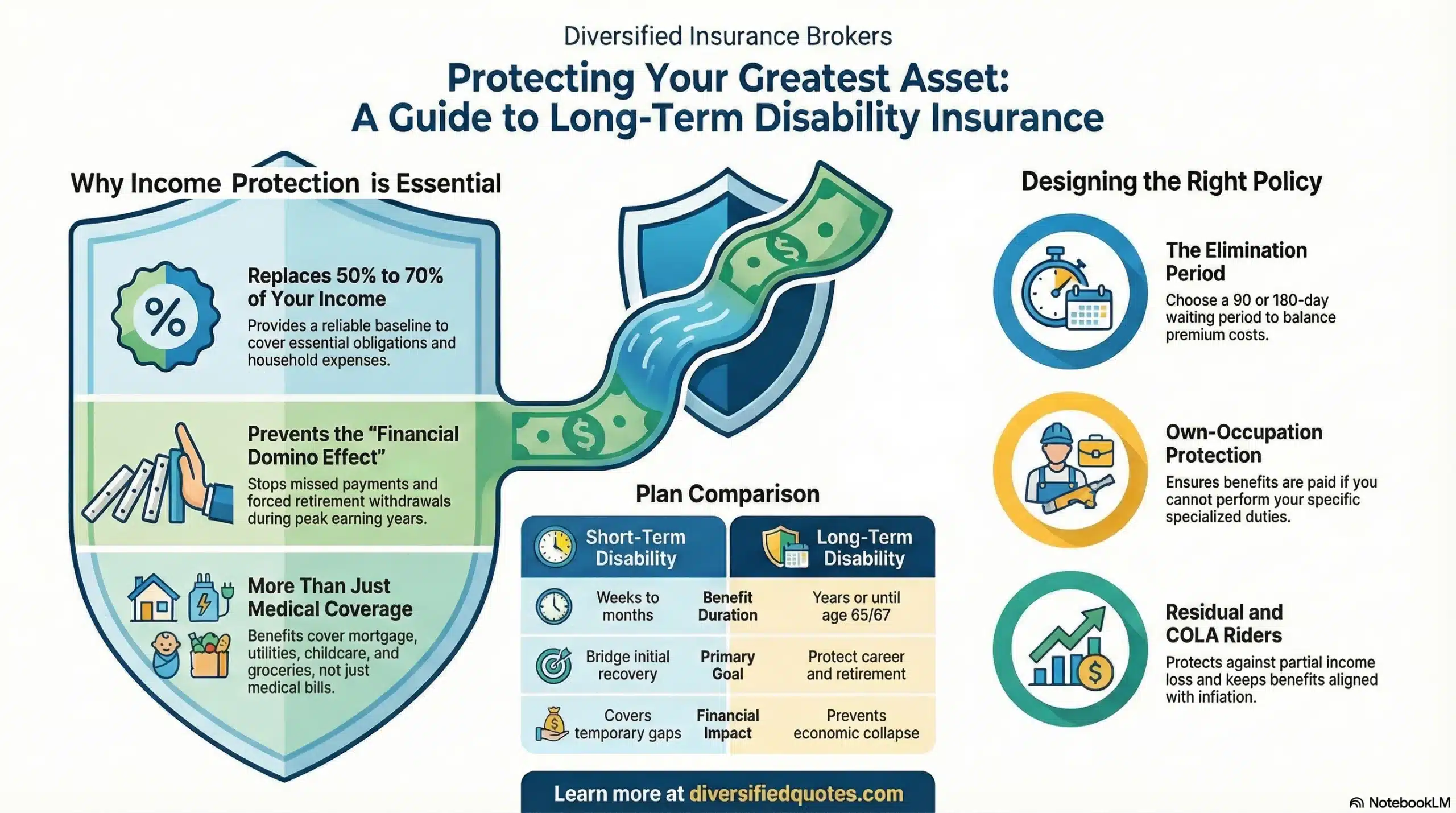
Talk With an Advisor Today
Choose how you’d like to connect—call or message us, then book a time that works for you.
Schedule here:
calendly.com/jason-dibcompanies/diversified-quotes
Licensed in all 50 states • Fiduciary, family-owned since 1980
FAQs: Disability Insurance for Golf Club Professionals
I teach golf lessons as a self-employed teaching professional — what happens to my income if I injure my elbow or shoulder?
For a self-employed teaching professional whose income derives entirely from per-lesson fees, an elbow or shoulder injury that prevents sustained instruction and demonstration produces complete and immediate income loss — every lesson that cannot be delivered is revenue that does not exist, with no employer sick pay, no group disability plan activating, and no workers’ compensation coverage for your own injuries as a self-employed professional. The household financial obligations — mortgage, utilities, professional overhead, technology subscriptions — continue without interruption while the lesson income stops completely from the first day the injury prevents teaching.
Individual disability insurance purchased personally is the only income protection mechanism available for a self-employed teaching professional. For a qualifying elbow or shoulder injury preventing golf instruction, the policy pays the agreed monthly benefit — typically 60 percent of documented average lesson income — for each month of qualifying disability after the elimination period is satisfied. The own-occupation definition must specifically encompass the physical golf instruction functions — demonstration, swing correction, grip and stance guidance — that generate lesson income, not merely generic inability to perform any work. A policy that covers only total inability to perform any employment would not protect a teaching professional who cannot demonstrate swing mechanics but could theoretically perform sedentary administrative work. A second opinion on any disability insurance proposal from a golf teaching professional specifically confirms the own-occupation language encompasses the physical teaching functions before any premium commitment is made.
My income includes both a base salary from the club and lesson income — how does that affect my disability insurance?
The combination of base salary and lesson income in a golf professional’s total compensation package creates a specific documentation situation for disability insurance: both income streams should be captured in the benefit calculation to reflect actual total compensation, but they may be documented differently and may have different protection sources. Base salary from a club employer, reported on a W-2, may have some group LTD coverage through the club’s employee benefits — though most club-provided group plans carry the same structural limitations as any employer group plan, including 24-month own-to-any occupation transitions and benefit ceilings. Lesson income, whether also W-2 from the club or 1099 from lesson fees collected independently, may or may not fall within the group plan’s benefit calculation depending on how the club structures the lesson revenue relationship.
For most golf professionals, the appropriate disability insurance architecture pairs whatever group plan access exists through the club employment as an immediate baseline — with enrollment at the maximum available benefit — with individually purchased supplemental coverage that fills the definition gap, the benefit ceiling gap, and specifically captures the lesson income component in the benefit basis. A disability insurance policy sized only to base salary leaves the lesson income entirely unprotected during a disability period — a meaningful underinsurance situation when lesson income represents a significant portion of total annual compensation for an active teaching professional. Documenting total compensation including lesson income accurately — whether from club W-2 records, 1099 forms, or Schedule C — produces the most complete and favorable income basis for the supplemental individual policy. Whether disability benefits are taxable depends on how premiums are paid: personally purchased individual coverage paid with after-tax income generally produces tax-free benefits.
I have a prior elbow or wrist condition from teaching — will that affect my disability insurance options?
Yes — documented prior elbow, wrist, or shoulder conditions create underwriting scrutiny and may produce partial exclusion riders for those specific documented conditions. For most documented prior conditions that are currently stable — a prior golfer’s elbow episode that was treated and has fully resolved with documented return to full teaching function — the standard underwriting outcome is a partial exclusion rider for that specific documented condition, providing full coverage for all other disability causes while limiting coverage specifically attributable to the excluded condition. For a golf teaching professional, a bilateral elbow or wrist exclusion rider limits coverage precisely where the occupation’s most characteristic RSI risk is concentrated — a meaningful gap.
This reinforces the timing argument for early purchase: the elbow and shoulder conditions associated with sustained golf instruction work are documented overuse injuries that accumulate with years of teaching — the most favorable underwriting terms, including comprehensive bilateral upper-extremity coverage without exclusion riders, are available at career start before any instruction-related health history has developed. A newly PGA-certified teaching professional beginning their first lesson book position can secure comprehensive own-occupation coverage including full elbow, wrist, and shoulder coverage without exclusion riders that the mid-career route cannot replicate once instruction-related health records exist. Coverage for golf professionals with prior upper-extremity conditions is available through independent broker comparison across carriers whose guidelines for sports instruction RSI histories vary — some carriers take a narrower, condition-specific view that produces less restrictive exclusions than others for the same documented history.
My lesson income varies significantly by season — how does disability insurance handle that?
Golf instruction income follows the seasonal pattern of the game itself — peak demand in spring, summer, and early fall; lower volume in winter months in most markets; and year-to-year variability based on lesson book development and club membership. Disability insurance carriers address this income variability through the multi-year averaging approach applied to all self-employment income: a two to three year average of documented net earned teaching income from Schedule C records or club-provided W-2 and 1099 documentation smooths seasonal and year-to-year variability rather than penalizing a winter quarter or rewarding an exceptional summer season.
The practical documentation approach for golf teaching professionals is capturing all lesson income — individual lessons, group clinics, playing lessons, junior programs, package lesson fees — consistently and completely across multiple years of records. Teaching professionals who receive any portion of their lesson income through club-administered lesson accounts should obtain documentation of total lesson volume and fees from the club’s records in addition to what appears on their own tax returns. The residual disability benefit provision is particularly valuable for golf professionals because realistic disability scenarios — an elbow condition allowing some lessons at reduced frequency during rehabilitation — produce income reduction rather than complete cessation, and a residual benefit pays proportionally based on actual income reduction. This provision addresses the most realistic golf teaching disability trajectory: a professional who can instruct limited sessions per week during recovery but cannot maintain a full lesson book is receiving partial disability income replacement proportional to their actual teaching capacity reduction.
I’m a new PGA associate or teaching professional just starting out — when should I get disability insurance?
The beginning of a golf teaching career is the optimal time to establish disability insurance — and the RSI risk profile of golf instruction makes the timing argument more specific here than in many professional occupations. Golfer’s elbow and the broader upper-extremity overuse injury pattern associated with sustained swing instruction accumulate with years of teaching exposure — the documented occupational mechanism produces progressive tendon loading that builds with the volume and duration of instruction. A new PGA associate or teaching professional beginning their first full-time instruction position has arms and elbows that have not yet accumulated the sustained instructional loading that produces the RSI health records that generate exclusion riders at underwriting.
Establishing disability insurance — with comprehensive bilateral elbow, wrist, and shoulder coverage and an unlimited illness benefit — at the beginning of the teaching career captures the clean underwriting terms that become progressively less available as instructional years accumulate. Premium rates are also age-rated: a 24-year-old PGA associate locks in a substantially lower annual premium than the same coverage would cost at 34, after ten years of active instruction. The future increase option allows benefit increases as teaching income grows from a developing lesson book toward a full professional schedule — without new medical underwriting that any health events in the interim might complicate. Why early-career golf professionals need income protection before RSI histories develop is answered directly: the physical demands of golf instruction begin accumulating with the first full lesson book, and the window to purchase comprehensive coverage before those demands produce health documentation is early — closing progressively with each teaching year that adds to the occupational health record.
Do I need business overhead expense coverage as a golf teaching professional with a studio?
Whether BOE coverage makes sense depends on whether your teaching operation has fixed overhead obligations that continue regardless of whether you are actively delivering lessons. A teaching professional who conducts lessons on an outdoor range with no facility lease, no equipment financing, and only nominal professional memberships has very limited fixed overhead — personal disability income coverage alone may be adequate. A teaching professional who leases indoor studio space or a simulator bay, finances launch monitor and swing analysis technology, subscribes to video analysis platforms, and carries professional equipment under financing commitments carries meaningful fixed monthly overhead that continues during disability regardless of lesson delivery.
For teaching professionals with dedicated studio infrastructure, a disability that prevents instruction for three to six months creates both personal income loss and simultaneous unmet overhead obligations — studio lease, technology subscriptions, equipment payments — accumulating against zero lesson revenue. Without BOE coverage, a recoverable elbow rehabilitation period can become a financially damaging event that threatens the studio’s viability even when the teaching professional ultimately makes a full recovery. BOE disability coverage pays the documented fixed monthly overhead of the teaching studio during the qualifying disability period, preserving the professional infrastructure and client relationships built through the teaching career. The BOE benefit amount is sized to actual documented monthly fixed overhead — studio lease, equipment subscriptions, technology costs — rather than to lesson revenue, covering what the operation costs to maintain rather than what it generates. Together, personal disability income and BOE coverage create the complete protection architecture for any golf teaching professional whose operation has built meaningful fixed infrastructure.
About the Author:
Jason Stolz, CLTC, CRPC, DIA, CAA and Chief Underwriter at Diversified Insurance Brokers (NPN 20471358), is a senior insurance and retirement professional with more than 25 years of real-world experience helping individuals, families, and business owners protect their income, assets, and long-term financial stability. As a long-time partner of the nationally licensed independent agency Diversified Insurance Brokers, Jason provides trusted guidance across multiple specialties—including fixed and indexed annuities, long-term care planning, personal and business disability insurance, life insurance solutions, Group Health, Travel Medical and Evacuation Insurance, and short-term health coverage. Diversified Insurance Brokers maintains active contracts with over 100 highly rated insurance carriers, ensuring clients have access to a broad and competitive marketplace.
His practical, education-first approach has earned recognition in publications such as VoyageATL, and contributions from his agency featured in Kiplinger and GoBankingRates— highlighting his commitment to financial clarity and client-focused planning. Drawing on deep product knowledge and years of hands-on field experience, Jason helps clients evaluate carriers, compare strategies, and build retirement and protection plans that are both secure and cost-efficient. Visitors who want to explore current annuity rates and compare options across multiple insurers can also use this annuity quote and comparison tool.
Explore More Disability Insurance Options: Browse our complete guide to Disability Insurance for Agriculture, Natural Resources & Outdoor Industries — covering farmers, ranchers, fishermen, foresters, miners, oil & gas workers & outdoor industries from 100+ carriers.
Last Reviewed: June 8, 2026 |
Reviewed by: Jason Stolz, CLTC, CRPC, DIA, CAA
Chief Underwriter, Diversified Insurance Brokers, Inc. | NPN: 20471358 | Diversified Insurance Brokers, Inc. — Licensed in all 50 states
Fact Checked by: Tonia Pettitt, CMIP©
Medicare Specialist, Diversified Insurance Brokers, Inc. | NPN: 14374308 | Diversified Insurance Brokers, Inc. — Licensed in all 50 states
Did you find this content helpful? Leave us a Google review — it helps others find trustworthy guidance too.
Editorial Standards: Diversified Insurance Brokers maintains rigorous editorial standards to ensure accuracy, clarity, and independence in all content. Learn more about our editorial standards and commitment to transparency.
