
LTC Partnership Reciprocity
As an Independent Long Term Care Insurance Broker, we compare traditional, hybrid, and partnership-qualified policies across dozens of carriers to find the structure that actually fits your situation.
LTC Partnership Reciprocity

Jason Stolz CLTC, CRPC, DIA, CAA
LTC Partnership reciprocity is one of the most practically valuable but least understood features of long-term care planning for retirees who move — which is most of them. The concept is straightforward in principle and consequential in practice: when you purchase a Partnership-qualified long-term care insurance policy in one state, the asset protection that policy earns through paid benefits may be recognized by another state when you later apply for Medicaid long-term care assistance. That recognition — called reciprocity — means the asset disregard your policy built up during a claim follows you across state lines rather than evaporating because your zip code changed. For households that are protecting meaningful accumulated savings from the potential of a catastrophic, multi-year care event, the difference between having that asset disregard recognized and not having it recognized can be the difference between preserving the household’s financial foundation and losing it to Medicaid spend-down requirements.
The planning importance of reciprocity has grown as retirement mobility has increased. Retirees routinely move to be closer to children and grandchildren, to access better climate, to reduce state income taxes, or to transition into continuing care communities that may be located in different states. Long-term care planning executed entirely in the context of one state — with no consideration of where the insured might actually live when care is needed — creates a planning gap that reciprocity is specifically designed to close. As of 2025, Partnership programs are available in more than 40 states plus the District of Columbia, and most participating states have joined the National Reciprocity Agreement framework established under the federal Deficit Reduction Act of 2005. That broad participation makes reciprocity a realistic planning asset for most households — but “most” is not “all,” and the details of how any specific state implements reciprocity, what it requires, and what it doesn’t cover vary enough that verification for both the current state and likely destination states is an essential planning step, not a bureaucratic formality.
This page covers the complete framework for LTC Partnership reciprocity: what Partnership policies are, how the dollar-for-dollar asset disregard mechanism works, what reciprocity specifically does and doesn’t guarantee, how to design a policy with mobility in mind, and what documentation habits support the ability to actually use the asset disregard when it matters most. For the foundational overview of Partnership-qualified LTC insurance and how it differs from standard long-term care contracts, our resource on Partnership-qualified long-term care insurance covers that context. For the complete framework of how LTC planning fits into retirement asset protection, our long-term care planning strategies resource covers the full spectrum of planning approaches available across the carrier market.
Get a Partnership-Eligible LTC Comparison
We verify carrier filings, confirm inflation requirements, and structure coverage with retirement mobility in mind. Confidential, nationwide comparison.
Request an LTC ComparisonWhat Is an LTC Partnership Policy? — The Foundation
A long-term care Partnership policy is a state-approved long-term care insurance contract that meets specific consumer-protection requirements defined through a partnership between the federal government, state Medicaid programs, and private insurance carriers. The defining feature that distinguishes a Partnership-qualified policy from a standard long-term care policy is the Medicaid-linked asset disregard provision: for every dollar of benefits the Partnership policy pays in long-term care claims, the policyholder earns a corresponding dollar of asset protection that can be applied if they later need to qualify for Medicaid long-term care assistance. This mechanism is called dollar-for-dollar asset disregard, and it is the specific provision that makes Partnership policies valuable for households who have accumulated enough assets that standard Medicaid spend-down requirements would be financially devastating.
Partnership policies function as private long-term care insurance first — they pay for qualified long-term care services in home settings, adult day care, assisted living facilities, memory care units, and nursing homes, subject to the coverage design and daily or monthly benefit limits established in the contract. The Medicaid dimension only becomes relevant if the policyholder exhausts their private insurance benefits and needs continued care — at which point the asset disregard earned through the insurance claims can protect a meaningful amount of savings from the spend-down calculations that standard Medicaid requires. Not every carrier files Partnership-qualified versions of their long-term care policies in every state, and not every long-term care policy design meets the specific eligibility requirements for Partnership status. Verifying that a specific policy is genuinely Partnership-qualified — not simply a standard long-term care policy — is a critical step in ensuring the planning objective is actually achieved.
The Dollar-for-Dollar Asset Disregard Mechanism — How It Works
The dollar-for-dollar model is the standard under which most states with Partnership programs operate following the federal Deficit Reduction Act of 2005. The mechanism is direct: as the Partnership-qualified policy pays long-term care benefits during a claim, each dollar paid creates one dollar of Medicaid asset disregard. If the policy pays $300,000 in benefits before being exhausted, the policyholder has earned $300,000 in Medicaid asset disregard — meaning they can retain $300,000 in countable assets above Medicaid’s normal asset threshold when applying for Medicaid long-term care assistance. Without a Partnership policy, the standard Medicaid asset threshold for a single person is typically approximately $2,000 in countable assets in most states — a devastating financial requirement for households with meaningful accumulated savings. With a $300,000 Partnership disregard, that same person could retain $302,000 in countable assets before Medicaid assistance begins. For a household with $400,000 in savings and a Partnership policy that paid $350,000 in benefits, nearly the full asset base could be preserved.
The asset disregard applies at two stages that both matter for financial planning. The first is Medicaid eligibility determination — the calculation that determines whether the household qualifies for Medicaid long-term care assistance at the time of application. The second is Medicaid estate recovery — the process through which states may seek reimbursement from a deceased Medicaid recipient’s estate for care costs the state paid. In most states with Partnership programs, the asset disregard protects assets from estate recovery as well as from eligibility spend-down, which means the planning benefit extends through death rather than terminating at the point of Medicaid approval. This estate recovery protection is one of the most significant financial planning dimensions of Partnership coverage for households that want to preserve some assets for heirs, a surviving spouse, or household stability beyond the individual’s own lifetime.
Partnership vs. Non-Partnership — The Asset Protection Difference
| Planning Scenario | Without Partnership Policy | With Partnership Policy ($300,000 in benefits paid) |
|---|---|---|
| Medicaid countable asset limit (single person, typical) | ~$2,000 (varies by state) | ~$302,000 ($2,000 + $300,000 Partnership disregard) |
| Household with $400,000 in savings — assets protected at Medicaid application | Must spend down to ~$2,000 — loses ~$398,000 | Keeps ~$302,000 — loses only ~$98,000 to spend-down |
| Estate recovery (after death) | State may recover Medicaid costs from estate — remaining assets at risk | Partnership disregard protects assets from estate recovery in most Partnership states |
| Spousal asset protection (married, one spouse needing care) | Medicaid spousal impoverishment rules apply — community spouse protections are limited | Partnership disregard adds to assets the healthy spouse can retain beyond standard spousal allowances |
| Planning flexibility if care ends before benefits exhausted | No residual asset protection from Medicaid perspective | Asset disregard earned from benefits paid remains, even if care ends before full policy exhaustion |
| Cross-state recognition (if relocating) | No Medicaid asset disregard exists to recognize in the new state | Asset disregard recognized by reciprocal states under the National Reciprocity Agreement |
Dollar amounts are illustrative, based on a $300,000 Partnership policy benefit payout. Actual Medicaid asset thresholds, spousal allowances, and estate recovery rules vary by state and change over time. These figures are designed to illustrate the relative planning impact of Partnership coverage rather than state-specific dollar guarantees. Consult your state’s Medicaid agency or a planning professional for current state-specific thresholds.
How Reciprocity Works — The Three Dimensions of Policy Portability
Understanding LTC Partnership reciprocity requires separating three distinct dimensions of how a long-term care policy and its associated benefits “travel” when the insured relocates. These three dimensions are often conflated, and conflating them leads to both overconfidence and underconfidence about what the policy does and doesn’t provide across state lines. Keeping them distinct is the most practical way to understand what reciprocity actually means for a real household’s planning.
The first dimension is private policy benefits. The coverage provided by the long-term care insurance contract — the daily or monthly benefit limits, the care settings covered, the inflation adjustment provisions, the elimination period, and the benefit triggers required to access coverage — is defined by the insurance contract and travels wherever the insured lives. A policy that covers home care, assisted living, and nursing home care nationwide will continue to cover those services after a move. This is not reciprocity — this is the standard nationwide portability of private insurance contracts. The insured’s contract doesn’t become invalid because they moved to a different state. Provider availability, care coordination preferences, and local care costs will differ by location, but the contract’s benefit structure remains what was purchased. Our resource on LTC elimination periods explained covers one of the most consequential benefit design features that affects how and when private benefits begin paying — a consideration that matters regardless of which state the insured eventually receives care in.
The second dimension is claims administration logistics. How claims are filed, documented, assessed, and processed can feel different in a new state — not because the contract changed, but because care coordinators, claim intake processes, and provider relationships vary geographically. This is not reciprocity either — it is simply the practical reality of managing a claim in a location where the insured may not have previously established provider relationships. Most carriers with nationwide books of business have care coordination resources that function across states, and claim documentation requirements remain consistent with what the contract requires regardless of geography.
The third dimension is the Medicaid asset disregard — and this is what reciprocity specifically refers to. The Partnership feature of the policy — the mechanism through which dollar-for-dollar asset disregard is earned as benefits are paid — is a state-level program. When the insured moves to a new state and eventually applies for Medicaid in that new state, the question is whether the new state’s Medicaid program will recognize the asset disregard earned through the Partnership policy issued in the old state. Reciprocity is the agreement between participating states that they will recognize each other’s Partnership disregard. It is specifically and exclusively about the Medicaid dimension of the Partnership program — not about whether the private insurance policy pays, and not about how claims are processed.
The National Reciprocity Agreement — How Most States Are Connected
The National Reciprocity Agreement was established as part of the framework created by the federal Deficit Reduction Act of 2005, which authorized states to create Partnership programs under a federal framework for the first time since the original four states established their pilot programs in the late 1980s and early 1990s. The DRA framework included provisions for reciprocity — the recognition of Partnership asset disregard across participating states — as a structural feature of how the expanded program was designed. The goal was to ensure that the asset protection benefit of purchasing a Partnership policy was not tied to remaining in the state where it was purchased, which would have significantly limited the planning value for a mobile retired population.
As of 2025, Partnership programs are available in more than 40 states plus the District of Columbia, and most participating states have adopted reciprocity provisions consistent with the National Reciprocity Agreement framework. The Agreement requires that participating states honor the Medicaid asset disregard earned by a Partnership policyholder from any other participating state, and that this recognition apply regardless of when the Partnership policy was purchased — including policies purchased under the original four-state programs that predate the DRA framework. This retroactive recognition is particularly important for policyholders who purchased coverage years or decades ago under one of the original programs and who may now be moving to a newer Partnership state. The Agreement also includes a protection for individuals who are already receiving Medicaid with Partnership asset protection in a reciprocal state: if that state subsequently decides to opt out of reciprocity, the protection cannot be revoked from someone who has already been approved under the reciprocal framework.
The practical implication is that for most households planning retirement mobility across major retirement destination states, Partnership reciprocity is available — but “most” requires verification. States can change their reciprocity participation, and the specific rules for how reciprocity is implemented in administrative Medicaid processes can vary. The planning discipline is to verify the current reciprocity status of both the state where coverage will be purchased and the state or states where care may eventually be needed — at the time of purchase and again if a move occurs before a claim begins.
What Reciprocity Does and Does Not Guarantee
Reciprocity is a meaningful planning benefit, but it operates within a framework of Medicaid rules that each state administers independently. Understanding precisely what reciprocity covers — and where Medicaid’s state-specific rules still apply — prevents two common planning errors: assuming reciprocity eliminates all cross-state Medicaid complexity, and assuming reciprocity is so limited that it provides no real planning value for a mobile retiree.
What reciprocity does: it causes the receiving state’s Medicaid program to recognize the asset disregard earned through benefits paid under a Partnership-qualified policy issued in another participating state. If an insured moves from one reciprocal state to another and later applies for Medicaid in the receiving state, the receiving state treats the Partnership disregard as if it were earned under a Partnership policy issued in that state. The amount disregarded is generally the dollar amount of benefits paid by the original Partnership policy — consistent with the dollar-for-dollar model applied in most states.
What reciprocity does not do: it does not guarantee Medicaid eligibility in the receiving state, regardless of the asset position. The insured must still meet all of the receiving state’s Medicaid eligibility requirements — including income rules, residency requirements, functional and medical eligibility criteria, and administrative application processes. It does not override the receiving state’s spousal impoverishment rules, income treatment provisions, or estate recovery procedures beyond the specific asset disregard. It does not guarantee that the receiving state applies reciprocity in exactly the same way the issuing state would have, because administrative implementation varies. And it does not mean the private insurance policy itself is subject to the receiving state’s LTC laws — the contract remains governed by the laws of the state in which it was issued.
Partnership Eligibility Requirements — What Makes a Policy Qualify
Not every long-term care insurance policy is Partnership-qualified, and not every carrier files Partnership versions of their products in every state. Partnership qualification is a specific certification that requires both the carrier’s filing and the policy design to meet state-defined consumer-protection standards. The most significant of these standards are the inflation protection requirement, the benefit trigger standards (consistent with federal tax-qualified LTC policy requirements), guaranteed renewability, and disclosure requirements that clearly identify the policy as Partnership-qualified. A policy that lacks any of these elements — or that is issued by a carrier that has not filed a Partnership-approved product in the specific state — cannot earn Medicaid asset disregard regardless of how high its benefits may be or how good its coverage design is.
The inflation protection requirement is the most planning-significant eligibility criterion because it directly affects both policy cost and long-term benefit adequacy. Under the DRA framework, Partnership policies must include inflation protection for policyholders below certain age thresholds at the time of purchase. For buyers under age 61, compound inflation protection is generally required. For buyers between ages 61 and 76, some form of inflation protection is typically required, though the specific type (compound, simple, or other) may vary by state. For buyers age 76 and older, inflation protection may not be required for Partnership qualification, though it may still be advisable from a long-term planning perspective. These thresholds are important because they connect the inflation protection decision to Partnership eligibility — choosing a policy without required inflation protection to reduce premium cost may result in a policy that is ineligible for Partnership status, undermining the core planning objective. Our who qualifies for long-term care insurance resource covers the underwriting dimension of LTC qualification, and our affordable LTC insurance for retirees guide covers how to balance the cost of required inflation protection with overall policy affordability.
Spousal Protection and the Partnership Advantage
For married couples, the Partnership asset disregard creates a specific planning advantage that extends beyond the individual policyholder to protect the financial security of the healthy spouse. When one spouse needs long-term care and the other does not, Medicaid’s “spousal impoverishment” rules are designed to prevent the community spouse (the healthy spouse not receiving care) from being impoverished by the care costs of the institutionalized spouse. These rules allow the community spouse to retain a protected minimum of assets called the Community Spouse Resource Allowance — but that allowance has limits, and it may be insufficient to maintain the community spouse’s lifestyle and financial stability for many additional years of independent living.
The Partnership asset disregard adds to the community spouse’s protected asset position by allowing the Medicaid-applying spouse to retain assets equal to the policy’s paid benefits above the normal Medicaid threshold. In practical terms, a Partnership policy that paid $350,000 in benefits before exhaustion allows the couple to retain an additional $350,000 in assets that would otherwise have been subject to spend-down — directly protecting the community spouse’s financial foundation during what may be many years of surviving the institutionalized spouse. This spousal protection dimension of Partnership planning is one of the most compelling arguments for Partnership-qualified policies for married couples with accumulated savings. Our resource on LTC insurance with shared spousal benefits covers how benefit sharing and other couple-specific design features interact with Partnership planning objectives.
Designing a Policy With Mobility in Mind
The most effective way to “design for reciprocity” is to build a strong private long-term care plan first — one that would perform well regardless of which state the insured eventually receives care in — and then verify Partnership qualification and reciprocity availability in the current state and likely destination states. Reciprocity amplifies the value of a strong private plan; it does not rescue a weak one. The private policy’s benefit levels, benefit period, care settings covered, and inflation protection are the primary determinants of real-world planning value. Reciprocity is the secondary planning layer that protects the Medicaid transition if a long claim exhausts the private benefits.
Several specific design decisions affect how well a policy functions for a mobile retiree. Home care coverage should be included broadly, because most people prefer to receive care at home when possible and home care needs differ from facility needs in how they interact with benefit calculations. The elimination period — the waiting period before private benefits begin — should be calibrated to the household’s realistic ability to cover initial care costs from savings or other resources. Calendar-day elimination periods (which count all days in the waiting period, including days when care is not received) can be easier to satisfy than service-day elimination periods (which count only days when qualifying services are actually received) when care starts intermittently. Our resource on LTC elimination periods explained covers this distinction in detail for households evaluating how the elimination period affects both benefit timing and out-of-pocket cost during the initial care phase. The monthly benefit level and benefit period determine the total size of the potential benefit pool — and the benefit pool size is what ultimately determines how large the Partnership asset disregard can become. A policy with a $3,000 monthly benefit and a 4-year benefit period creates a total potential benefit pool of approximately $144,000. A policy with the same monthly benefit and a 6-year benefit period creates a pool of approximately $216,000 — generating up to $72,000 more in potential Partnership asset disregard if the claim runs to exhaustion.
Traditional LTC vs. Hybrid Life/LTC — Reciprocity Compatibility
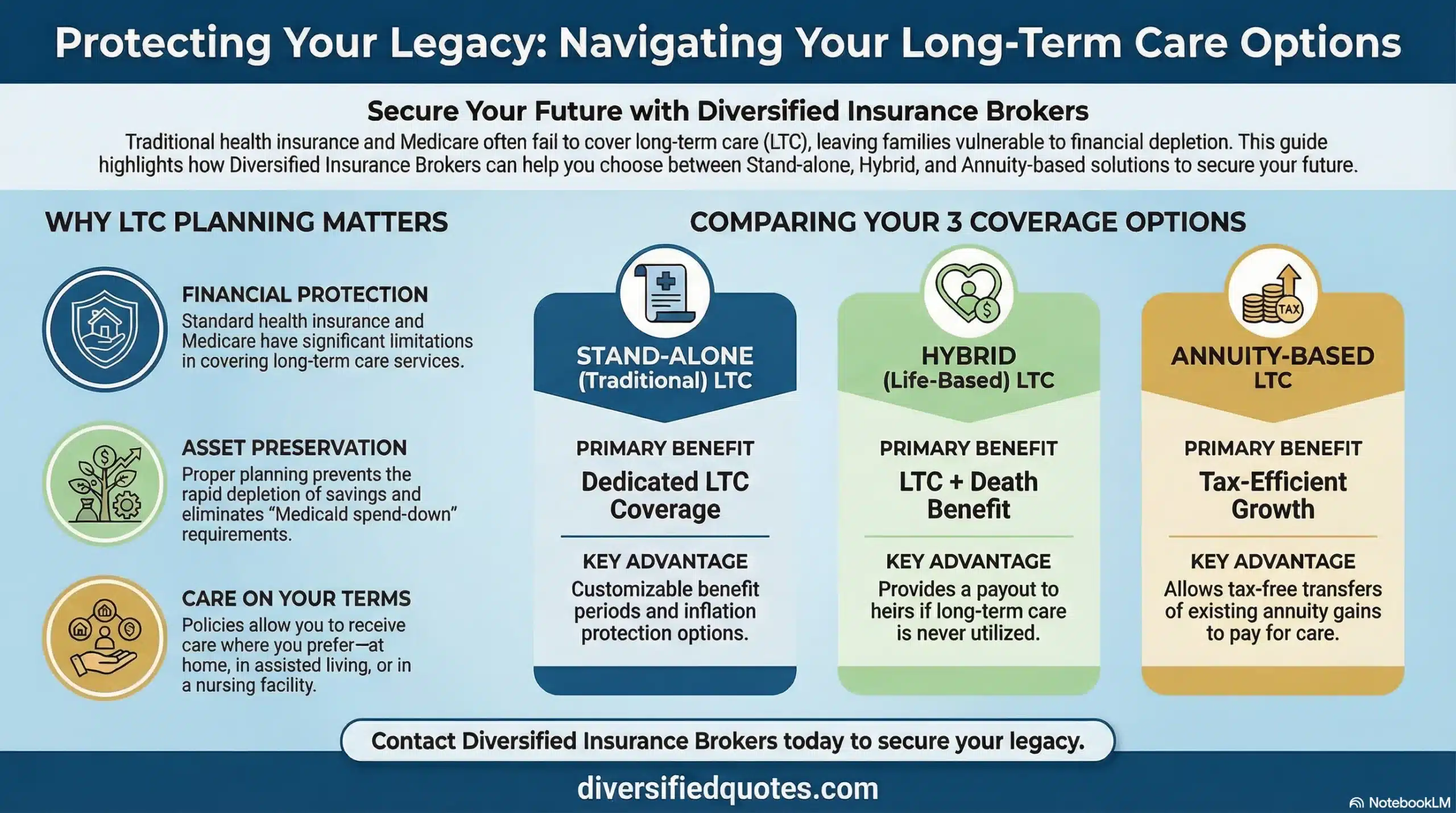
Partnership eligibility has historically been most clearly associated with stand-alone (traditional) long-term care insurance policies — the policies that are designed specifically and exclusively for long-term care coverage. Stand-alone LTC policies are the category in which state Partnership filings are most consistently available and most clearly defined. Hybrid life/LTC policies — products that combine life insurance with long-term care acceleration benefits, or annuities with long-term care riders — may also qualify for Partnership status in certain states and under certain carrier filings, but this varies significantly by state, by carrier, and by the specific product design. Not all carriers file hybrid products as Partnership-qualified, and not all states have established clear frameworks for Partnership certification of hybrid designs.
The planning implication is not that hybrid products are inferior for LTC planning overall — they have genuine planning advantages in certain households, particularly those who want asset preservation regardless of whether care is ever needed and those who prefer a guaranteed premium structure. Our resource on hybrid life vs. traditional long-term care insurance covers the complete comparison between these two planning approaches. The implication is that if Partnership reciprocity is a specific planning objective — if the household anticipates mobility in retirement and specifically wants the Medicaid asset disregard to follow them — confirming Partnership eligibility of the specific product in the specific state at the time of purchase is essential, regardless of whether the product is traditional or hybrid. The non-qualified long-term care annuity resource covers how annuity-based LTC funding works for households evaluating that approach alongside traditional and hybrid options.
Documentation Habits That Support Future Reciprocity Claims
When reciprocity is part of a household’s planning foundation, documentation becomes a long-term administrative responsibility that starts at policy purchase and continues through any moves and ultimately through any Medicaid application. The asset disregard is real and potentially valuable, but it is not automatic — it requires the Medicaid agency in the receiving state to have the information needed to recognize the disregard, and that information must come from documented records that the applicant preserves and presents. Three categories of documentation are most essential: the Partnership certification documentation from the original policy issuance, the claims documentation showing benefits paid, and any records that support the move and residency history connecting the original policy state to the receiving state.
The Partnership certification documentation — which may be a specific form or disclosure that the carrier provides at policy issuance — is what establishes that the policy was qualified in the issuing state. Keep this document with the original policy declarations page and store it in a location where family members can access it if the policyholder is incapacitated when care needs arise. The claims documentation — Explanation of Benefits statements, carrier benefit payment records, and cumulative claims history — is what establishes the amount of asset disregard earned through benefits paid. The dollar-for-dollar calculation relies on accurate records of actual benefits paid; estimated or reconstructed figures are much harder to document in an administrative Medicaid process. Finally, conducting a “policy review” after any significant relocation — confirming that Partnership status was maintained under the new state’s reciprocity framework and that the coverage design still aligns with local care costs in the new location — is a practical habit that prevents surprises when care needs actually arise. Our long-term care insurance services overview covers how we support clients through policy reviews and planning adjustments over time, not just at initial purchase.
Common Misunderstandings About Reciprocity
Three misunderstandings appear consistently in conversations about LTC Partnership reciprocity, and each is consequential enough that addressing them directly is worth the space. The first misunderstanding is confusing reciprocity (Medicaid asset disregard recognition) with private policy portability (the insurance contract continuing to pay benefits after a move). These are separate concepts. The private policy continues to provide coverage nationwide because it is a contract with the insurer — no state-level agreement is needed for the insurance benefits to remain in force. Reciprocity is exclusively about the Medicaid dimension: whether the new state will recognize the asset disregard that was earned through the Partnership-qualified policy’s benefit payments. Clients who understand this distinction avoid both assuming the policy will fail after a move (the private coverage remains intact) and assuming reciprocity guarantees Medicaid eligibility (it addresses only the asset side of the Medicaid test).
The second misunderstanding is assuming that the receiving state will process the Medicaid application identically to how the issuing state would have processed it. Medicaid is administered at the state level, and each state has its own procedures, income rules, estate recovery approach, and administrative requirements. Reciprocity standardizes the recognition of the asset disregard — it does not standardize every aspect of the Medicaid process. Income rules, functional eligibility criteria, administrative documentation requirements, and timing of benefit access will still reflect the receiving state’s rules. Planning that accounts for these state-specific variables produces better outcomes than planning that treats reciprocity as a comprehensive harmonization of Medicaid across states.
The third misunderstanding is assuming that reciprocity participation is permanent and universal. States can opt out of the National Reciprocity Agreement, and the specific rules for how reciprocity is implemented can change. This is why verification at both the time of policy purchase and the time of any relocation is an important planning discipline rather than a one-time event. The protection provided once an individual is already receiving Medicaid with Partnership asset disregard in a reciprocal state is stronger — the Agreement generally prevents the state from revoking protection already granted if it subsequently opts out — but the prospective protection for future applicants depends on the state’s continued participation at the time of application.
Related Long-Term Care Resources
Talk With an Advisor Today
Choose how you’d like to connect—call or message us, then book a time that works for you.
Schedule here:
calendly.com/jason-dibcompanies/diversified-quotes
Licensed in all 50 states • Fiduciary, family-owned since 1980
FAQs: LTC Partnership Reciprocity
What is LTC Partnership reciprocity?
LTC Partnership reciprocity is the arrangement through which most states with Partnership programs agree to recognize the Medicaid asset disregard earned under a Partnership-qualified policy issued in another participating state. If you purchased a Partnership policy in your current state and later move to a reciprocal state, the dollar-for-dollar asset protection you earned through your policy’s benefit payments can be applied when you apply for Medicaid long-term care assistance in the new state — as long as you meet the receiving state’s Medicaid eligibility requirements. Reciprocity is specifically about the Medicaid asset disregard dimension of Partnership coverage; the private insurance benefits in the policy travel nationwide regardless of reciprocity because they are defined by the insurance contract.
How does the dollar-for-dollar asset disregard work?
Under the dollar-for-dollar model used by most Partnership states, every dollar of benefits your Partnership-qualified policy pays in long-term care claims creates one dollar of Medicaid asset disregard. If your policy pays $300,000 in benefits before being exhausted, you can retain $300,000 in countable assets above Medicaid’s normal asset threshold when applying for Medicaid assistance. Without a Partnership policy, Medicaid typically requires spending down to approximately $2,000 in countable assets for a single person. The Partnership disregard can therefore allow a household to retain hundreds of thousands of dollars in assets while still qualifying for Medicaid long-term care assistance after private insurance benefits are exhausted. The disregard applies at both Medicaid eligibility determination and, in most Partnership states, Medicaid estate recovery after death.
Do all states honor LTC Partnership reciprocity?
Most states that have Partnership programs participate in the National Reciprocity Agreement framework and honor Partnership asset disregard from other participating states. As of 2025, Partnership programs are available in more than 40 states plus DC, and most participate in reciprocity. However, not all states participate equally, and participation can change. A small number of states have not adopted Partnership programs or have not fully implemented reciprocity provisions. This is why verification is important: confirm the reciprocity status of both your current state (where the policy will be purchased) and any likely destination states at the time of purchase, and confirm again if you relocate before a claim begins.
Does reciprocity mean I automatically qualify for Medicaid if I move?
No. Reciprocity specifically recognizes the Partnership asset disregard in the receiving state — it does not grant automatic Medicaid eligibility. You must still meet the receiving state’s full Medicaid eligibility requirements, including residency, income rules, functional and medical eligibility criteria, and administrative application requirements. Medicaid is administered at the state level and each state has its own rules. Reciprocity standardizes how the Partnership asset disregard is treated in the asset calculation — everything else in the Medicaid eligibility process follows the receiving state’s rules.
Is inflation protection required for Partnership eligibility?
Yes, in most states — and the specific requirement depends on age at the time of purchase. Under the DRA framework, buyers under age 61 typically need compound inflation protection for Partnership qualification. Buyers between ages 61 and 76 typically need some form of inflation protection, though the specific type may vary by state. Buyers age 76 and older may not be required to include inflation protection for Partnership qualification, though it may still be advisable for maintaining benefit adequacy over time. Choosing a policy without the required inflation protection to reduce premium cost may result in a policy that does not qualify for Partnership status — undermining the core planning objective of earning Medicaid asset disregard through benefits paid.
Will my private LTC policy still pay benefits after I move to a new state?
Yes. The private insurance benefits — the care settings covered, benefit limits, elimination period, and coverage triggers — are defined by the insurance contract and are not dependent on state Partnership program participation. Your policy continues to cover qualified long-term care services nationwide after a move, subject to the contract’s terms. Provider availability, care coordination logistics, and local care costs will differ by location, but the contract’s benefit structure remains unchanged. Reciprocity is only about the Medicaid asset disregard dimension — not about whether the insurance policy itself pays after a move.
Can hybrid life/LTC policies qualify for Partnership status?
Sometimes — it depends on the state and the specific carrier filing. Partnership eligibility for hybrid life/LTC policies varies significantly by state and carrier. Stand-alone (traditional) LTC policies are the category in which Partnership filings are most consistently available and most clearly defined. Hybrid products may qualify for Partnership status in certain states when specific carriers file for that designation, but this is not universal. If Partnership reciprocity is a specific planning objective, confirming that the specific product under consideration is actually filed as Partnership-qualified in your state — at the time of purchase — is essential regardless of whether the product is traditional or hybrid.
About the Author:
Jason Stolz, CLTC, CRPC, DIA, CAA and Chief Underwriter at Diversified Insurance Brokers (NPN 20471358), is a senior insurance and retirement professional with more than 25 years of real-world experience helping individuals, families, and business owners protect their income, assets, and long-term financial stability. As a long-time partner of the nationally licensed independent agency Diversified Insurance Brokers, Jason provides trusted guidance across multiple specialties—including fixed and indexed annuities, long-term care planning, personal and business disability insurance, life insurance solutions, Group Health, Travel Medical and Evacuation Insurance, and short-term health coverage. Diversified Insurance Brokers maintains active contracts with over 100 highly rated insurance carriers, ensuring clients have access to a broad and competitive marketplace.
His practical, education-first approach has earned recognition in publications such as VoyageATL, and contributions from his agency featured in Kiplinger and GoBankingRates— highlighting his commitment to financial clarity and client-focused planning. Drawing on deep product knowledge and years of hands-on field experience, Jason helps clients evaluate carriers, compare strategies, and build retirement and protection plans that are both secure and cost-efficient. Visitors who want to explore current annuity rates and compare options across multiple insurers can also use this annuity quote and comparison tool.
Explore More Long Term Care Insurance Options: Browse our complete guide to How to Buy, Qualify & Coverage Details — covering how to buy, who qualifies, policy types, shared benefits, partnership plans & more from top carriers.
Explore More: Browse our complete Long Term Care Insurance guide — covering traditional LTC, hybrid policies & partnership plans from top carriers from 100+ carriers.
Last Reviewed: July 12, 2026 |
Reviewed by: Jason Stolz, CLTC, CRPC, DIA, CAA
Chief Underwriter, Diversified Insurance Brokers, Inc. | NPN: 20471358 | Diversified Insurance Brokers, Inc. — Licensed in all 50 states
Fact Checked by: Tonia Pettitt, CMIP©
Medicare Specialist, Diversified Insurance Brokers, Inc. | NPN: 14374308 | Diversified Insurance Brokers, Inc. — Licensed in all 50 states
Did you find this content helpful? Leave us a Google review — it helps others find trustworthy guidance too.
Editorial Standards: Diversified Insurance Brokers maintains rigorous editorial standards to ensure accuracy, clarity, and independence in all content. Learn more about our editorial standards and commitment to transparency.
