
Hybrid Life Insurance with Long Term Care Benefits
As an Independent Long Term Care Insurance Broker, we compare traditional, hybrid, and partnership-qualified policies across dozens of carriers to find the structure that actually fits your situation.
As an Independent Life Insurance Broker, we compare rates across 100+ carriers and prescreen every application before submission.
Hybrid Life Insurance with Long Term Care Benefits

Jason Stolz CLTC, CRPC, DIA, CAA
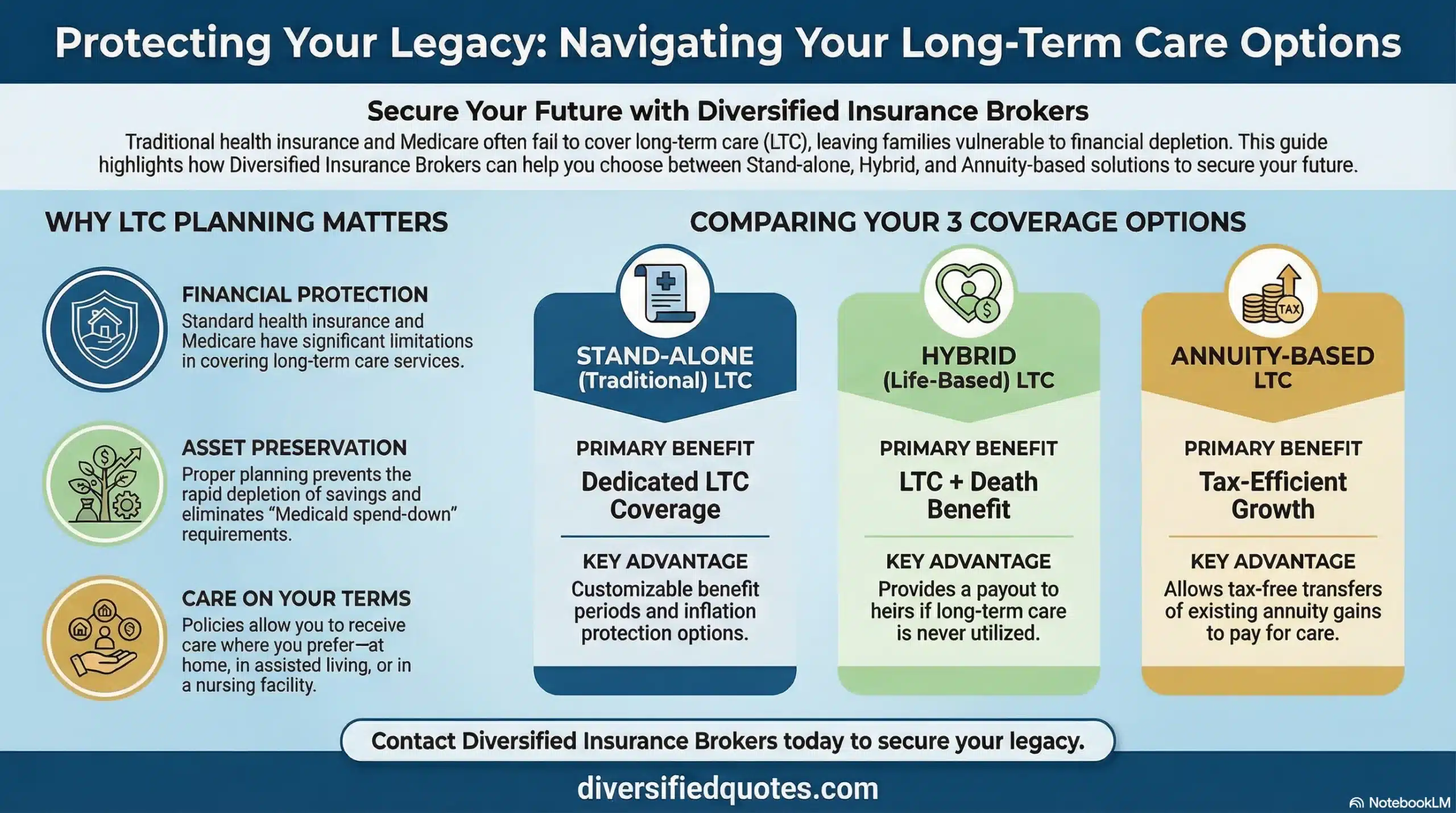
Hybrid life insurance with long-term care benefits is a permanent life insurance policy — built on a universal life or whole life chassis — that is specifically engineered to provide long-term care coverage while the insured is living, alongside a life insurance death benefit for beneficiaries when the insured dies. The “hybrid” designation reflects the dual-purpose design: the policy creates a pool of value that can be accessed as long-term care benefits when qualifying care is needed, or paid as a tax-free life insurance death benefit when care is not needed. This is not a term life policy with an LTC rider added as a patch. It is a product specifically designed from the ground up to serve both roles, with the LTC benefit as the primary planning objective and the life insurance death benefit as the preservation-of-value guarantee. That design distinction matters because it shapes how the policy is priced, how underwriting is structured, how benefits are calculated, and what the illustration actually shows. Our resource on hybrid long-term care insurance overview covers the full hybrid LTC landscape including both the life insurance and annuity chassis options. This page focuses specifically on the mechanics, design distinctions, and planning applications of the life insurance chassis.
The most important thing to understand about the life insurance chassis is the role of the death benefit in creating the LTC benefit pool. In a linked-benefit design — the dominant structure in the current hybrid LTC market — the policy’s death benefit is the foundation from which LTC benefits are drawn. When the insured qualifies for LTC benefits (by meeting the ADL or cognitive impairment trigger), the policy begins accelerating the death benefit to fund care — paying a defined monthly amount, which reduces the remaining death benefit by that amount. What creates the large LTC pools visible in carrier illustrations is not just the death benefit itself, but the extension of benefits rider — an additional coverage layer that provides LTC benefits beyond the base death benefit for as long as the benefit period extends. The combination of base death benefit acceleration and extension of benefits is what converts a $100,000 premium into a $600,000+ LTC benefit pool in well-designed contracts. Without the extension rider, a $100,000 death benefit provides exactly $100,000 of LTC coverage at the acceleration rate — meaningful, but far less leveraged than the full linked-benefit design. Our resources on understanding hybrid long-term care insurance and hybrid life vs. traditional LTC insurance cover the comparison landscape for buyers evaluating all options.
Within the life insurance chassis category, the single most consequential design difference between carrier products is the benefit payment method — reimbursement versus indemnity. A reimbursement-based hybrid LTC policy requires the insured to document actual care costs by submitting invoices or bills and receive reimbursement up to the monthly maximum for costs that qualify under the policy’s covered services definition. An indemnity-based hybrid LTC policy pays a fixed monthly amount directly to the insured once the qualifying trigger is met — no receipts, no invoices, no documentation of specific care costs required after claim approval. The indemnity structure is more flexible for families using informal caregivers, mixing care settings, or using some care dollars for expenses adjacent to formal care. The reimbursement structure is more predictable for carriers and may produce different pricing dynamics, but requires more administrative engagement from the claimant. This distinction — which carrier products are indemnity and which are reimbursement — is one of the most frequently undisclosed details in hybrid LTC comparison conversations, and it has real consequences for how families experience a claim. Our resource on LTC care coordination benefits covers the care management support that many hybrid policies provide alongside the monthly benefit.
Get a Hybrid Life/LTC Quote
We compare reimbursement and indemnity designs, single-pay and limited-pay funding options, and extension of benefits structures across multiple carriers — showing you the net LTC pool, death benefit, and premium side by side.
Reimbursement vs. Indemnity — How Benefit Payments Work in Practice
The benefit payment method determines how the insured receives care dollars once a claim is approved. This is one of the most consequential product design differences in the hybrid life/LTC category and is frequently underemphasized in initial sales conversations.
| Feature | Reimbursement Benefit Structure | Indemnity (Cash) Benefit Structure |
|---|---|---|
| How benefits are paid | Insured or care provider submits documentation of actual care costs incurred; carrier reimburses eligible expenses up to the monthly maximum after review; unused allowance typically does not carry forward | Carrier pays a fixed monthly benefit directly to the insured once the qualifying trigger is met and the claim is approved; no receipts or invoices required after claim approval; benefit paid regardless of actual costs incurred |
| Documentation required after claim approval | Yes — invoices, bills, and provider documentation required for each claim submission; care must be provided by licensed or qualifying providers for most eligible expenses | Minimal — claim approval requires meeting the qualifying trigger (ADL/cognitive impairment); once approved, monthly benefit is paid without ongoing documentation of specific care costs |
| Informal caregiver flexibility | Limited — reimbursement typically applies to licensed care providers and formal care services; family members or informal caregivers may not qualify for reimbursement in many policy designs | High — because benefits are paid as cash regardless of how they are spent, indemnity benefits can be used to compensate family caregivers, pay home modifications, supplement formal care, or cover costs adjacent to direct care |
| Tax treatment | Reimbursement for actual qualified LTC expenses under a 7702B contract is generally income-tax free regardless of the amount, because the benefit offsets actual qualified care costs | Indemnity benefits are generally tax-free up to the IRS per diem limit ($430/day for 2026, or approximately $13,000/month); amounts above the per diem limit may be taxable unless they offset actual qualified LTC costs; for most users, benefits remain within the tax-free threshold |
| Benefit pool usage rate | Benefits are used only when qualified care costs exist and are documented; a month with low or no documented care costs uses little or none of the monthly allowance; the total benefit pool may last longer than the stated benefit period if care costs are below the monthly maximum | The full monthly benefit is paid each month regardless of actual care costs; benefit pool is consumed at a defined rate; a stated 6-year benefit period with $6,000/month pays $6,000 every qualifying month whether actual care cost $2,000 or $9,000 |
| Notable carrier examples | John Hancock Life Care (UL with LTC rider) uses reimbursement; Pacific Life Premier Care uses reimbursement with care management support; OneAmerica Asset-Care (life chassis) uses reimbursement | Nationwide CareMatters II uses indemnity (cash pay); Securian SecureCare IV uses indemnity; Brighthouse SmartCare uses indemnity — these are among the most cited carriers for informal caregiver and home care flexibility |
| Best fit | Buyers who anticipate using formal care services (licensed home health aides, adult day care, assisted living, skilled nursing) and who are comfortable with a documentation-based claims process; buyers who want potential for benefit pool to last longer if care costs are modest | Buyers who want maximum flexibility — particularly for home care, family caregiver arrangements, or mixed care settings; buyers who prefer the simplicity of a defined monthly benefit without ongoing documentation; buyers who want certainty that benefits will pay regardless of how care is structured |
Product designs, benefit structures, and claim administration practices vary by carrier and are subject to state regulatory requirements. Some carriers offer choice of reimbursement or indemnity at time of claim or policy issue. Confirm benefit payment method in the specific policy contract before purchase. Tax treatment of LTC benefits depends on policy qualification under IRC 7702B and specific benefit amounts relative to the IRS per diem limit. Consult a qualified tax professional for tax-specific questions.
See Real-Term Rates Side by Side
Life Insurance Quoter
The Three Structural Types Within Life-Based Hybrid LTC
Not all life-based LTC products are built the same way, and the structural differences affect how much LTC coverage the policy actually provides relative to the premium paid. The first and least leveraged type is the accelerated death benefit (ADB) rider attached to a standard life insurance policy. In this design, the primary purpose of the policy is life insurance; the LTC rider allows some or all of the death benefit to be accessed for care, but there is no extension of benefits beyond the base death benefit. If a $200,000 policy allows 2% per month to be accelerated for LTC, the maximum monthly benefit is $4,000 and the total LTC pool is $200,000. The policy was designed as a life insurance policy; the LTC access is an add-on. The second and most common type for dedicated hybrid LTC planning is the linked-benefit life insurance policy — a permanent life insurance product specifically designed to provide substantial LTC leverage through an extension of benefits rider. In this design, the base death benefit funds the first phase of LTC claims, and the extension of benefits rider provides an additional pool of LTC coverage beyond the death benefit, dramatically amplifying the total coverage available. This is the structure underlying Lincoln MoneyGuard, Nationwide CareMatters II, and other dedicated hybrid LTC products. The third type is the life insurance policy with a chronic illness rider — different from an LTC rider in an important way: chronic illness riders typically require that the qualifying impairment be deemed permanent, whereas LTC riders under IRC 7702B cover both temporary and permanent qualifying conditions. Our resource on what are activities of daily living covers the ADL trigger framework that determines when each type activates.
Extension of Benefits — How the Large LTC Pools Are Built
The extension of benefits rider is the mechanism that creates the substantial LTC pools visible in hybrid life/LTC illustrations, and understanding it is essential for evaluating any comparison across carriers. Without an extension of benefits rider, the total LTC pool in a linked-benefit policy is capped at the death benefit — $200,000 of LTC coverage from a $200,000 death benefit. With an extension of benefits rider, the policy continues paying LTC benefits after the base death benefit is fully accelerated, for as long as the chosen benefit period extends. This creates the arithmetic that produces impressive illustration numbers: a $100,000 single premium funding a $200,000 death benefit, with a six-year extension of benefits rider at $6,000 per month, produces a total LTC pool of $200,000 (base) + additional coverage from the extension rider — potentially $432,000 in total LTC benefit at $6,000/month for 72 months, all funded from a $100,000 premium. The total available LTC coverage — multiple times the original premium — is the leverage ratio that makes hybrid LTC financially compelling for buyers repositioning lump sums. Our resource on what is a long-term care insurance benefit period covers the benefit period options available in extension of benefits rider designs, and our resource on limited-term vs. lifetime benefits covers the tradeoff between defined benefit periods and lifetime coverage. Our resource on long-term care insurance with lifetime benefits covers the unlimited benefit option available in some carrier designs. Most designs also preserve a residual death benefit — often 10% of the base policy — that goes to beneficiaries even if the full LTC benefit pool is used, ensuring that the “use it or lose it” concern is truly eliminated.
Premium Structures — Single Pay, Limited Pay, and the Funding Decision
Hybrid life/LTC policies are available in three premium funding structures, each serving a different planning profile. The single premium design — the most common for dedicated hybrid LTC planning — accepts a lump sum at policy issue and provides full LTC benefit coverage from day one. Single premium designs are ideal for buyers repositioning an existing asset: a maturing CD, a non-qualified annuity through a 1035 exchange, an IRA through the controlled distribution strategy, or liquid savings earmarked for protection planning. The entire premium is committed at once, the LTC pool is established immediately, and no additional payments are required. The limited-pay design — typically 10-pay or pay-to-age-65 — spreads the premium over a defined number of years. Each year’s payment is guaranteed not to increase, and when the pay period ends, the full LTC coverage remains in force without additional premium. This design fits buyers who prefer to commit a defined annual amount rather than a single large lump sum, or who want to use income rather than accumulated assets to fund the plan. The ongoing premium design — structured similarly to a traditional life insurance policy — is less common for dedicated hybrid LTC products but exists in certain carrier offerings where life insurance is the primary objective and LTC access is secondary. Our resource on single pay long-term care insurance covers the single premium approach in full detail, and our resource on affordable hybrid long-term care policies covers cost-efficient design options for buyers working within a budget constraint.
Tax Advantages — The 1035 Exchange, Pension Protection Act, and 7702B Treatment
The tax framework for hybrid life/LTC policies is one of the most compelling aspects of the product category, particularly for buyers repositioning existing assets with accumulated gain. The Pension Protection Act of 2006 authorized tax-free 1035 exchanges from existing life insurance cash value or non-qualified annuities directly into qualified LTC or hybrid LTC policies. This means a buyer who holds a non-qualified annuity with $50,000 of accumulated gain — gain that would be taxable as ordinary income if the annuity were surrendered — can 1035 exchange that annuity into a hybrid life/LTC policy without triggering any immediate tax. The gain is preserved inside the new policy and receives the tax treatment of the hybrid LTC contract going forward. For buyers with existing life insurance cash value that is no longer needed for its original purpose, the same 1035 exchange logic applies. Our resource on can you use qualified funds for long-term care insurance covers the IRA and qualified plan repositioning pathway, which is more complex and requires a specific multi-step strategy. Once the hybrid LTC policy is funded and LTC benefits are eventually paid, those benefits are generally income-tax free under IRC 7702B as long as the policy qualifies as a tax-qualified LTC insurance contract. For 2026, the IRS per diem limit for tax-free indemnity-style benefits is $430 per day. Death benefits paid to beneficiaries from the life insurance component remain income-tax free in the same way as any life insurance death benefit. Our resources on tax advantages of LTC insurance and hybrid policies, are long-term care benefits taxable, and tax-free long-term care insurance cover the tax treatment framework in full. Our resource on partnership qualified long-term care insurance covers the additional Medicaid asset protection benefit available through LTC Partnership programs in qualifying states.
Underwriting and Who Can Qualify
Life-based hybrid LTC policies require health underwriting — a qualification process that assesses the applicant’s health history and current status to determine eligibility and terms. Underwriting for life-based hybrid LTC products is generally comparable to traditional standalone LTC underwriting in terms of the conditions that are evaluated. Serious chronic conditions, recent hospitalizations, cognitive diagnoses, and functional limitations can result in a decline or rated offer. The optimal underwriting window is typically ages 50-70, before age-related health changes narrow the qualifying population. A person who delays hybrid LTC planning until their mid-70s when health conditions have developed may find that the life insurance chassis is no longer available to them and that the annuity chassis — which generally has less stringent underwriting — becomes the viable alternative. Our resource on how to qualify for long-term care insurance covers the underwriting process in detail, and our resource on long-term care insurance with preexisting conditions covers specific condition scenarios. For couples planning together, our resources on long-term care insurance for couples and shared care riders in LTC and our resource on long-term care insurance with shared spousal benefits cover the joint underwriting and pooled benefit structures available for married couples. Our resource on John Hancock Life Care hybrid life and LTC covers one of the market’s major reimbursement-based products in detail. Our resource on does Medicare cover long-term care covers the coverage gap that makes private LTC planning necessary, our resource on is long-term care insurance worth it covers the planning decision framework, our resource on long-term care insurance with return of premium covers the ROP feature available in some hybrid designs, and our resources on LTC elimination periods explained, long-term care insurance services, long-term care insurance calculator, and get a 2nd opinion on your LTC quote complete the planning support toolkit.
Talk With an Advisor Today
Choose how you’d like to connect—call or message us, then book a time that works for you.
Schedule here:
calendly.com/jason-dibcompanies/diversified-quotes
Licensed in all 50 states • Fiduciary, family-owned since 1980
FAQs: Hybrid Life Insurance With Long-Term Care Benefits
What happens to the death benefit when long-term care benefits are paid?
In an acceleration design, each dollar of LTC benefit paid reduces the remaining death benefit by a corresponding amount. A $200,000 death benefit that has paid $100,000 in LTC benefits has a remaining death benefit of $100,000. When an extension of benefits rider is included, the policy continues paying LTC benefits after the base death benefit is fully accelerated — the extension rider provides a separate pool of coverage beyond the death benefit. Most hybrid life/LTC contracts also preserve a residual death benefit, often 10% of the original base policy, that goes to beneficiaries even if the entire LTC benefit pool is exhausted. This ensures that the “use it or lose it” concern is truly eliminated — there is always some remaining death benefit for beneficiaries.
What is the difference between a reimbursement and an indemnity hybrid LTC policy?
Reimbursement-based policies require the insured to submit documentation of actual care costs and receive reimbursement for eligible expenses up to the monthly maximum. Indemnity-based policies pay a fixed monthly benefit directly to the insured once the qualifying trigger is met — no receipts or ongoing documentation of specific care costs required after claim approval. Indemnity benefits can be used for informal caregivers, home modifications, or any care-related costs, including family members providing care. Reimbursement benefits are more appropriate when care is delivered by licensed providers with formal documentation. Nationwide CareMatters II and Securian SecureCare IV are prominent indemnity carriers. John Hancock Life Care and Pacific Life Premier Care use reimbursement structures.
Can I use an existing life insurance policy or annuity to fund a hybrid LTC policy tax-free?
Yes — through a Section 1035 exchange. The Pension Protection Act of 2006 authorized tax-free 1035 exchanges from existing life insurance cash value or non-qualified annuities directly into qualified hybrid LTC policies. If you hold a non-qualified annuity with accumulated gain that would be taxable as ordinary income upon surrender, you can 1035 exchange it into a hybrid LTC policy without triggering tax. The gain is preserved inside the new policy and receives the favorable tax treatment of the qualified LTC contract. This is one of the most powerful planning strategies for buyers who already hold existing insurance or annuity assets that are no longer needed for their original purpose.
Are premiums guaranteed on hybrid life/LTC policies?
In most hybrid life/LTC designs — particularly single premium and limited-pay structures — premiums are guaranteed not to increase as long as the required payments are made and the policy is not modified. This is one of the most significant advantages over traditional standalone LTC insurance, where premiums are not guaranteed and carriers have historically raised them 50-150% or more on certain policy blocks. Single premium hybrid policies require no ongoing payment at all after the initial lump sum. Limited-pay policies (10-pay, pay-to-65) have a defined payment period with a guaranteed fixed payment, after which no further premiums are required and coverage remains in full force. Always confirm premium guarantees in the specific carrier illustration and policy contract before purchase.
What is an extension of benefits rider and why does it matter?
An extension of benefits rider is the mechanism that creates the large LTC pools in hybrid life/LTC illustrations — and the feature that distinguishes a true dedicated hybrid LTC product from a simple life insurance policy with an LTC acceleration rider. Without an extension rider, the total LTC coverage available equals the death benefit only. With an extension rider, the policy continues paying LTC benefits after the base death benefit is fully accelerated, for as long as the chosen benefit period extends. This extension is what converts a $100,000 premium into $400,000-$600,000+ of LTC benefit pool in well-designed contracts. The length of the benefit period (2 years, 3 years, 6 years, lifetime) is set at policy issue and determines how long benefits continue beyond the death benefit exhaustion point.
Are hybrid life/LTC benefits taxable when received?
Generally no — LTC benefits from a qualified hybrid life/LTC policy under IRC 7702B are income-tax free. For 2026, indemnity-style benefits are tax-free up to the IRS per diem limit of $430/day ($13,000/month approximately); amounts above this limit may be taxable unless they offset actual qualified LTC costs. Reimbursement benefits for actual qualified care costs are generally tax-free regardless of amount, since they offset documented care expenses. The death benefit paid to beneficiaries if care is never needed is income-tax free in the same manner as any life insurance death benefit. Premiums paid for hybrid life/LTC policies are generally not tax-deductible — unlike traditional standalone LTC premiums, which may be partially deductible as a medical expense under IRC 7702B age-based limits.
About the Author:
Jason Stolz, CLTC, CRPC, DIA, CAA and Chief Underwriter at Diversified Insurance Brokers (NPN 20471358), is a senior insurance and retirement professional with more than 25 years of real-world experience helping individuals, families, and business owners protect their income, assets, and long-term financial stability. As a long-time partner of the nationally licensed independent agency Diversified Insurance Brokers, Jason provides trusted guidance across multiple specialties—including fixed and indexed annuities, long-term care planning, personal and business disability insurance, life insurance solutions, Group Health, Travel Medical and Evacuation Insurance, and short-term health coverage. Diversified Insurance Brokers maintains active contracts with over 100 highly rated insurance carriers, ensuring clients have access to a broad and competitive marketplace.
His practical, education-first approach has earned recognition in publications such as VoyageATL, and contributions from his agency featured in Kiplinger and GoBankingRates— highlighting his commitment to financial clarity and client-focused planning. Drawing on deep product knowledge and years of hands-on field experience, Jason helps clients evaluate carriers, compare strategies, and build retirement and protection plans that are both secure and cost-efficient. Visitors who want to explore current annuity rates and compare options across multiple insurers can also use this annuity quote and comparison tool.
Explore More Life Insurance Options: Browse our complete guide to How Life Insurance Works — covering term life, whole life, final expense, annuity alternatives & more from 100+ carriers.
Explore More Long Term Care Insurance Options: Browse our complete guide to Hybrid & Annuity LTC Policies — covering hybrid life insurance, annuities with LTC benefits & linked benefit policies from top carriers.
Last Reviewed: July 25, 2026 |
Reviewed by: Jason Stolz, CLTC, CRPC, DIA, CAA
Chief Underwriter, Diversified Insurance Brokers, Inc. | NPN: 20471358 | Diversified Insurance Brokers, Inc. — Licensed in all 50 states
Fact Checked by: Tonia Pettitt, CMIP©
Medicare Specialist, Diversified Insurance Brokers, Inc. | NPN: 14374308 | Diversified Insurance Brokers, Inc. — Licensed in all 50 states
Did you find this content helpful? Leave us a Google review — it helps others find trustworthy guidance too.
Editorial Standards: Diversified Insurance Brokers maintains rigorous editorial standards to ensure accuracy, clarity, and independence in all content. Learn more about our editorial standards and commitment to transparency.
