
John Hancock Life Care Hybrid Life and LTC
John Hancock Life Care Hybrid Life and LTC

Jason Stolz CLTC, CRPC, DIA, CAA
John Hancock LifeCare is a hybrid indexed universal life insurance policy with built-in long-term care benefits — and as of February 2026, it received meaningful enhancements that make it more accessible than ever before. In the announcement, John Hancock described a fully digital application process with streamlined underwriting that allows many customers to receive instant underwriting decisions and have policies issued in fewer than seven days. For a product category that historically required extensive medical underwriting and months of paperwork, that speed-to-coverage represents a meaningful shift in accessibility. The underlying product structure remains as before: LifeCare combines an indexed universal life insurance chassis with a qualified long-term care rider that can accelerate the death benefit to cover qualifying care expenses — creating a single policy that serves both as a legacy asset for the family if care is never needed and as a funded care benefit if it is. John Hancock’s parent company, Manulife Financial, is one of the largest insurance and financial services organizations in the world, and John Hancock holds an AM Best Financial Strength Rating of A+ (Superior) — providing the financial backing that long-term policy commitments spanning decades require.
The planning problem LifeCare addresses is one that creates significant anxiety for most pre-retirees who think carefully about it: the possibility of a long-term care event consuming a large portion of the retirement assets their family was counting on. The average cost of a private room in a skilled nursing facility exceeds $100,000 per year nationally, and the cost of meaningful home health care or assisted living is not far behind. An extended care event — lasting three, four, five years or more, which is not uncommon — can represent a claim against retirement assets of $300,000 to $500,000 or more in the years immediately before or during which those assets were expected to fund retirement income. Traditional long-term care insurance addresses this directly but asks the insured to accept that the premium dollars are “gone” if care is never needed. LifeCare’s hybrid structure addresses the “use-it-or-lose-it” objection by building the LTC benefit on top of a life insurance chassis that pays a death benefit to beneficiaries if care is never required. The same premium dollars serve two planning purposes simultaneously, and neither outcome is a total loss for the household.
The indexed universal life structure that underlies LifeCare is the second dimension that distinguishes it from asset-based hybrid products. Unlike whole life chassis hybrids — which provide guaranteed cash value growth and a fixed death benefit but no market-linked upside — LifeCare’s IUL structure links interest crediting to an external market index (typically the S&P 500 or other indexes), with a floor of zero protecting against negative index performance. In years when the index performs positively, the policy’s cash value and potentially the death benefit and associated LTC benefit pool can grow beyond what a fixed-rate design would have produced. In years when the index is flat or negative, the policy credits zero — no gain, but no loss. This structure appeals to clients who want the principal protection and tax efficiency of a life insurance chassis combined with the potential for meaningful growth in the policy’s underlying benefit pool over the years before a care claim might occur. For a full understanding of the LTC planning framework within which LifeCare fits, our comprehensive resource on the long-term care playbook covers every major LTC planning strategy — traditional, hybrid life, and annuity-based — in a single decision framework. Our resource on are long-term care benefits taxable covers the tax treatment that applies to LifeCare’s qualifying LTC benefit payments under IRC Section 7702B. And our resource on how much does long-term care insurance cost provides the cost context for evaluating LifeCare’s premium relative to the care cost risk it addresses.
See Real-Term Rates Side by Side
Life Insurance Quoter
Request a LifeCare Illustration
We’ll build a side-by-side comparison of John Hancock LifeCare against other hybrid LTC designs based on your age, premium, and planning objectives.
Request Your Hybrid LTC IllustrationThe Two LifeCare Rider Options — Standard vs. Inflation Rider
The single most important design decision in a LifeCare policy is whether to include the standard Long-Term Care Rider or the Long-Term Care Inflation Rider. These two options create structurally different policies, and the right choice depends primarily on how important inflation protection is relative to the initial monthly benefit amount and the death benefit structure that funds the LTC benefit pool.
| Feature | LifeCare LTC Rider (Standard) | LifeCare LTC Inflation Rider |
|---|---|---|
| LTC Benefit Pool at Issue | Equal to the full death benefit face amount — 100% of the death benefit is the LTC benefit pool | 50% of the death benefit face amount at issue — lower starting benefit pool for same premium |
| Inflation Growth on LTC Pool | No automatic annual LTC pool inflation growth (policy cash value and death benefit may grow with index credits) | 5% compound annual growth on the LTC benefit balance from issue — designed to address rising care costs over time |
| Death Benefit Impact When LTC Used | Each dollar of LTC benefits accelerates a dollar of death benefit — death benefit reduces as care is paid; remaining death benefit passes to beneficiaries | LTC payments accelerate the death benefit until it reaches $0.00; inflation-grown LTC benefit pool provides extended benefits after death benefit is exhausted |
| Benefit Period Options | 2, 4, or 6 years | 2, 4, or 6 years |
| Elimination Period | 90 days | 90 days |
| Best For | Clients who prioritize maximum initial LTC benefit pool size and legacy death benefit; those purchasing closer to retirement age when LTC need may be nearer-term | Clients who prioritize long-term purchasing power of LTC benefits; those purchasing at younger ages where the 20-30 year compounding of 5% annual growth produces a significantly larger LTC pool when care is eventually needed |
| LTC Benefit Growth After Age 85 | LTC benefit growth from index crediting continues subject to policy performance | Note: John Hancock does not provide LTC benefit pool growth after age 85 — the 5% compound inflation growth applies up to age 85 only |
The comparison above reflects general product design characteristics of John Hancock LifeCare riders based on publicly available product information current as of early 2026. Specific benefit amounts, crediting rates, policy values, and available features vary by state, age at issue, premium amount, benefit period selected, and individual underwriting. Product features are subject to change. Always review the current policy illustration specific to your age, state, and design with a licensed insurance professional before making any policy decision. Past index performance does not guarantee future interest crediting. All guarantees are subject to the financial strength of John Hancock Life Insurance Company.
How LifeCare’s LTC Benefits Are Triggered and Paid
Long-term care benefits under LifeCare are activated when the insured meets the policy’s benefit trigger criteria — the same two-tier trigger system used across the qualified LTC insurance market under IRC Section 7702B. A benefit claim qualifies when the insured is either unable to perform two or more of the six Activities of Daily Living (ADLs) without substantial assistance — the ADLs being bathing, continence, dressing, eating, toileting, and transferring — or when the insured has a severe cognitive impairment (such as Alzheimer’s disease or other dementia) that requires substantial supervision. A 90-day elimination period applies, during which the insured must continuously meet the benefit trigger criteria before the first benefit payment is made. The elimination period functions like a deductible measured in time rather than dollars — it is the period of qualifying care that the household covers from other resources before the policy’s benefit payments begin.
Once the elimination period is satisfied, LifeCare’s benefit delivery offers a meaningful flexibility advantage relative to many competing products: the insured can choose at the time of claim whether to receive benefits on a cash indemnity basis or a reimbursement basis. Reimbursement-style benefits require documented, eligible care expenses and pay out the covered expense up to the monthly benefit maximum. Cash indemnity benefits pay the full approved monthly benefit regardless of exactly how much was spent on paid care — giving the family flexibility to compensate family caregivers, pay for informal care arrangements, or allocate the benefit in whatever way best serves the care needs of the moment. The practical difference becomes significant when the care situation evolves: early-stage care is often a mix of paid professional assistance and unpaid family support, and cash indemnity benefits provide the family with resources to manage that mix without requiring detailed expense documentation for every dollar received.
The International LTC Coverage Advantage — A Unique LifeCare Feature
One of the most distinctive features of John Hancock LifeCare — and one that separates it from virtually every other hybrid LTC product in the U.S. market — is its provision allowing the full long-term care benefit to be used for qualifying care received outside the United States. Most traditional long-term care insurance policies and hybrid LTC products restrict benefits to care received in licensed U.S. facilities or by U.S.-licensed providers, leaving retirees who choose to retire abroad, who have family caregivers in other countries, or who receive care while traveling internationally without access to the LTC benefit they purchased. LifeCare’s international coverage provision allows the full monthly benefit to be paid regardless of where qualifying care is received, subject to the policy’s claim requirements. For the growing segment of retirees who maintain international connections — whether through family ties to another country, plans to retire partly or fully abroad, or extended travel as a lifestyle — this feature eliminates the coverage gap that would otherwise exist between their LTC plan and their actual care scenario. Our dedicated resource on can you use long-term care insurance overseas covers this specific feature in depth and explains why it matters for international retirement planning.
Premium Funding Options — Single Pay, 5-Pay, 10-Pay, and 15-Pay
LifeCare offers four distinct premium funding structures that allow the policy to be tailored to the insured’s retirement timeline and cash flow preferences. A single-pay design deposits the entire premium in one lump sum at policy issue, immediately establishing the full death benefit and LTC benefit pool while eliminating any future premium payment obligation. Many clients who reposition assets from low-yielding savings accounts, CDs, or inherited liquid accounts choose the single-pay design for exactly this reason: it converts a parked asset into a funded LTC benefit pool and life insurance death benefit in a single transaction. The 5-pay, 10-pay, and 15-pay designs spread the premium obligation over the corresponding number of years, reducing the annual cash commitment and making the policy more accessible for clients who prefer not to deploy a large lump sum but still want to complete the premium obligation before retirement income becomes more fixed.
Premium funding strategy connects directly to how the policy fits within the household’s overall retirement planning. Single-pay designs repositioning existing assets are straightforward to integrate — the asset moves from one column of the balance sheet (liquid savings) to another (insurance contract with LTC and death benefit). Scheduled premium designs require ongoing cash flow commitment and should be evaluated in the context of the household’s retirement income plan to ensure the premium obligation can be comfortably maintained through the payment period. For the broader LTC planning context within which premium funding decisions are made — including how hybrid products compare to traditional LTC insurance and annuity-based LTC strategies — our resource on tax advantages of long-term care insurance and hybrid policies covers how different product structures interact with federal and state tax treatment. Our resource on single-pay long-term care insurance specifically covers the single-premium design that many LifeCare purchasers use. Our resource on limited-term vs. lifetime LTC benefit designs covers the benefit period decision that determines how many years of benefit the policy provides during a care event.
John Hancock Vitality PLUS — Rewarding Healthy Behaviors
John Hancock’s Vitality program — offered as the Vitality PLUS healthy engagement benefit rider on LifeCare — is a distinctive feature that allows the policy’s death benefit and associated LTC benefit to increase over time based on the insured engaging in documented healthy behaviors. The Vitality program tracks activities through a connected wearable device or health app: steps taken, gym visits, health screenings, preventive care visits, and similar wellness activities generate Vitality points that accumulate into an annual Vitality status. A higher Vitality status — Bronze, Silver, Gold, or Platinum — corresponds to a higher healthy engagement benefit that increases the death benefit and LTC benefit beyond the original policy design. For policyholders who maintain an active, health-conscious lifestyle, the Vitality rider creates a path to continuously improving policy benefits without increasing the premium, effectively rewarding the health practices that reduce the probability of a long-term care event while simultaneously increasing the benefit available if one occurs. This alignment — better health produces better benefits — is an unusual and genuinely appealing design feature in the hybrid LTC market.
How LifeCare Compares to Asset-Based Hybrid LTC Alternatives
The hybrid long-term care market offers meaningfully different product architectures, and the most useful comparison for any LifeCare evaluation is how it benchmarks against the asset-based whole life chassis alternatives — primarily OneAmerica (State Life) Asset Care and Nationwide CareMatters Together. These products are built on a whole life insurance foundation rather than an IUL foundation, which produces a different set of trade-offs. The whole life chassis provides guaranteed, predictable cash value growth, a guaranteed minimum death benefit, and an LTC benefit pool that is not subject to any market-related variability in its growth. In exchange for that guaranteed growth certainty, the whole life chassis typically does not offer the indexed upside potential that LifeCare’s IUL structure can produce in strong market years. In a direct comparison using the same premium, a whole life chassis hybrid may produce a larger guaranteed LTC benefit pool relative to premium than LifeCare — because the whole life structure is designed specifically to maximize the benefit pool rather than balance it against IUL growth potential. LifeCare, by contrast, is designed to provide the benefit pool alongside meaningful life insurance death benefit and the possibility of benefit growth through indexed interest crediting.
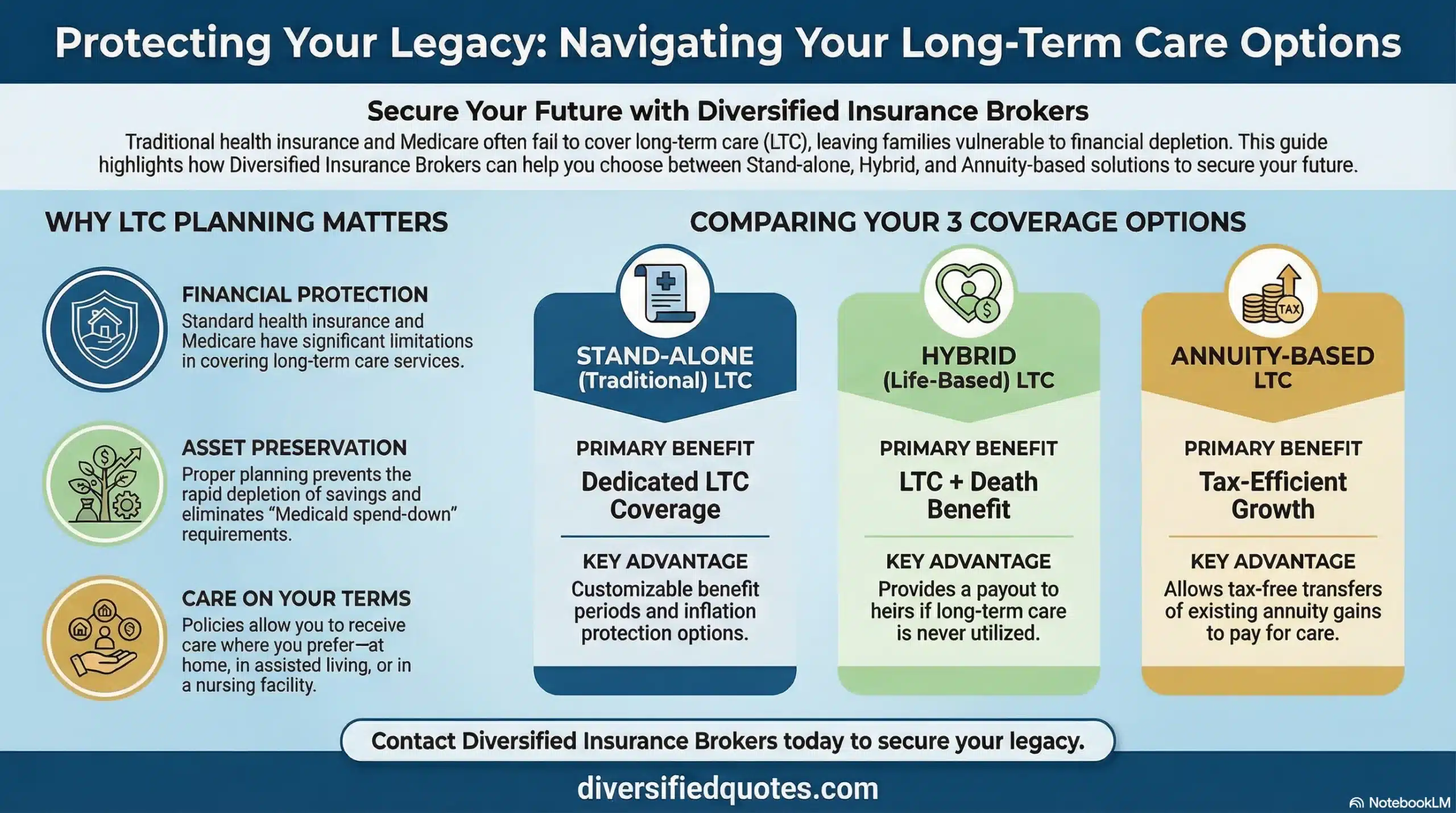
The right choice between these architectures depends on the planning priority. A client who is primarily concerned about maximizing the guaranteed LTC benefit pool per dollar of premium — and for whom the legacy death benefit and indexed growth upside are secondary — often finds the asset-based whole life chassis more compelling. A client who prioritizes the death benefit as a primary objective and wants LTC coverage built on top of that foundation — while also wanting the possibility of growth from indexed crediting — often finds LifeCare’s structure more natural. Our resource on hybrid life insurance with long-term care benefits covers the full category including multiple carrier designs, and our resource on affordable hybrid long-term care policies covers the cost comparison framework across carriers. Our resource on non-qualified long-term care annuities covers the annuity-based LTC alternative for clients whose assets are currently in annuity vehicles. For seniors evaluating long-term care planning at advanced ages, our resource on long-term care insurance after age 80 covers the options that remain available later in life when hybrid products may no longer be available or cost-effective. Our comprehensive long-term care insurance services overview covers the full product landscape in a single resource.
Talk With an Advisor Today
Choose how you’d like to connect—call or message us, then book a time that works for you.
Schedule here:
calendly.com/jason-dibcompanies/diversified-quotes
Licensed in all 50 states • Fiduciary, family-owned since 1980
FAQs: John Hancock LifeCare Hybrid Life and LTC
What is John Hancock LifeCare?
John Hancock LifeCare is a hybrid indexed universal life insurance policy with a built-in qualified long-term care rider. It is designed to address two major retirement planning risks simultaneously: the potential need for long-term care and the desire to leave a meaningful legacy to beneficiaries. If qualifying long-term care is needed, the policy accelerates the death benefit to fund care expenses — and depending on the benefit period and rider design, may extend benefits beyond the death benefit through a continuation of benefits structure. If care is never needed, the death benefit passes to beneficiaries. John Hancock announced meaningful enhancements to LifeCare in February 2026, including a fully digital application process and streamlined underwriting with instant decisions possible and policies issued in under seven days in many cases.
What is the difference between the standard LTC rider and the LTC Inflation rider?
The standard Long-Term Care Rider establishes an LTC benefit pool equal to 100% of the death benefit face amount — providing the largest initial benefit pool for the premium paid. It does not include automatic annual inflation growth on the LTC benefit pool (though the policy’s death benefit and cash value may grow through indexed interest crediting). The Long-Term Care Inflation Rider establishes an LTC benefit pool equal to 50% of the death benefit at issue — a smaller initial pool — but compounds that pool at 5% annually, significantly increasing the LTC benefit available at the time care is eventually needed. An important limitation: John Hancock’s LTC benefit pool growth under the inflation rider stops after age 85. The standard rider is generally better for those purchasing closer to retirement age; the inflation rider provides more value for those purchasing at younger ages where decades of 5% compound growth produce a meaningfully larger benefit pool when care is eventually needed.
Can LifeCare LTC benefits be used for care received outside the United States?
Yes — this is one of LifeCare’s most distinctive and valuable features. John Hancock LifeCare allows 100% of the LTC benefit to be used for qualifying care received outside the United States, making it one of the only hybrid LTC products in the U.S. market to provide full international coverage. Most traditional LTC insurance and other hybrid products restrict benefits to care received in licensed U.S. facilities or by U.S.-licensed providers. LifeCare’s international provision is particularly valuable for retirees who plan to retire abroad, have family caregivers in other countries, or spend significant time internationally during retirement. Subject to benefit trigger qualification and policy terms, the full monthly benefit is available regardless of where the qualifying care is received.
How do I qualify to receive LTC benefits under LifeCare?
LTC benefit eligibility under LifeCare follows the standard two-tier trigger system used across qualified LTC insurance under IRC Section 7702B: the insured must either be unable to perform two or more of the six Activities of Daily Living (bathing, continence, dressing, eating, toileting, transferring) without substantial assistance, or have a severe cognitive impairment (such as Alzheimer’s disease) requiring substantial supervision. A 90-day elimination period applies, during which the insured must continuously meet the benefit trigger criteria before the first benefit payment is made. The elimination period is not a deductible in dollars — it is a waiting period measured in time during which the qualifying condition must be continuously present before benefits begin.
What premium payment options does LifeCare offer?
LifeCare offers four premium payment options: single pay (full premium deposited once at policy issue, no future premium obligation), 5-pay, 10-pay, and 15-pay. The single-pay design is often used when repositioning a lump sum of liquid assets — a CD, savings account, inherited cash, or other low-yield asset — into a funded LTC benefit pool and life insurance death benefit in a single transaction. The multi-pay designs spread the premium obligation over years, reducing the annual cash commitment and accommodating clients who prefer not to deploy a large lump sum but still want to complete the funding obligation before retirement income becomes more fixed. The “pay it off before retirement” approach is a common strategic framing for the 5-pay and 10-pay options.
Can I choose how LTC benefits are paid — cash indemnity or reimbursement?
Yes — LifeCare offers the flexibility to choose at the time of a qualified claim whether benefits are paid on a cash indemnity basis or a reimbursement basis. Reimbursement-style benefits require documented eligible care expenses and pay the covered expense up to the monthly benefit maximum. Cash indemnity benefits pay the full approved monthly benefit regardless of exactly how much was spent on formal paid care — giving the family flexibility to compensate family caregivers, pay for informal care, or allocate benefit dollars across a mix of paid and unpaid support. This flexibility is particularly valuable because real-world care rarely fits cleanly into one category: early-stage care is often a blend of professional and family support, and cash indemnity benefits allow the family to manage that mix without requiring detailed expense documentation for every dollar received.
How does LifeCare compare to asset-based whole life hybrid LTC products?
LifeCare uses an indexed universal life insurance chassis, while asset-based competitors like OneAmerica Asset Care and Nationwide CareMatters Together use a whole life chassis. The key difference is in how the policy values grow: the IUL chassis in LifeCare links interest crediting to market indexes (with a floor of zero protecting against losses), providing potential for meaningful benefit growth in strong market years but with non-guaranteed crediting. The whole life chassis provides guaranteed, predictable cash value growth with no market variability but no market upside either. In a direct comparison using the same premium, a whole life chassis hybrid may produce a larger guaranteed LTC benefit pool relative to premium — because the whole life structure is optimized for benefit pool maximization. LifeCare is generally more appropriate for clients who value the life insurance death benefit alongside LTC protection, and who are comfortable with the indexed growth mechanism in the underlying IUL structure.
What are the tax advantages of John Hancock LifeCare?
LifeCare provides multiple potential tax advantages. LTC benefit payments from a qualified LTC rider under IRC Section 7702B may be received income-tax-free as per-diem benefits, subject to IRS daily limit caps — this is the same tax treatment available to traditional LTC insurance benefits. The life insurance death benefit paid to beneficiaries is generally income-tax-free under IRC Section 101(a). Policy cash value grows tax-deferred inside the IUL chassis, with no current-year income tax on credited interest as long as the funds remain in the policy. For single-premium funding, if the policy is classified as a Modified Endowment Contract (MEC) — which single-premium life insurance policies typically are — withdrawals and loans may be subject to tax and penalty rules different from non-MEC policies; however, LTC benefit payments under a qualified LTC rider from a MEC may still qualify for the per-diem tax-free treatment. Consult a qualified tax advisor for guidance specific to your funding structure and tax situation.
About the Author:
Jason Stolz, CLTC, CRPC, DIA, CAA and Chief Underwriter at Diversified Insurance Brokers (NPN 20471358), is a senior insurance and retirement professional with more than 25 years of real-world experience helping individuals, families, and business owners protect their income, assets, and long-term financial stability. As a long-time partner of the nationally licensed independent agency Diversified Insurance Brokers, Jason provides trusted guidance across multiple specialties—including fixed and indexed annuities, long-term care planning, personal and business disability insurance, life insurance solutions, Group Health, Travel Medical and Evacuation Insurance, and short-term health coverage. Diversified Insurance Brokers maintains active contracts with over 100 highly rated insurance carriers, ensuring clients have access to a broad and competitive marketplace.
His practical, education-first approach has earned recognition in publications such as VoyageATL, and contributions from his agency featured in Kiplinger and GoBankingRates— highlighting his commitment to financial clarity and client-focused planning. Drawing on deep product knowledge and years of hands-on field experience, Jason helps clients evaluate carriers, compare strategies, and build retirement and protection plans that are both secure and cost-efficient. Visitors who want to explore current annuity rates and compare options across multiple insurers can also use this annuity quote and comparison tool.
Explore More: Browse our complete Long Term Care Insurance guide — covering traditional LTC, hybrid policies & partnership plans from top carriers from 100+ carriers.
Last Reviewed: July 2, 2026 |
Reviewed by: Jason Stolz, CLTC, CRPC, DIA, CAA
Chief Underwriter, Diversified Insurance Brokers, Inc. | NPN: 20471358 | Diversified Insurance Brokers, Inc. — Licensed in all 50 states
Fact Checked by: Tonia Pettitt, CMIP©
Medicare Specialist, Diversified Insurance Brokers, Inc. | NPN: 14374308 | Diversified Insurance Brokers, Inc. — Licensed in all 50 states
Did you find this content helpful? Leave us a Google review — it helps others find trustworthy guidance too.
Editorial Standards: Diversified Insurance Brokers maintains rigorous editorial standards to ensure accuracy, clarity, and independence in all content. Learn more about our editorial standards and commitment to transparency.
