
How Does a Long Term Care Insurance Claim Work
As an Independent Long Term Care Insurance Broker, we compare traditional, hybrid, and partnership-qualified policies across dozens of carriers to find the structure that actually fits your situation.
How Does a Long Term Care Insurance Claim Work

Jason Stolz CLTC, CRPC, DIA, CAA
A long-term care insurance policy can sit unused for decades, and then one day a family needs it — usually in the middle of a health crisis, when a parent can no longer manage on their own and nobody in the family has ever filed a claim before. That is the hardest possible moment to learn how the process works, and it is exactly when getting it right matters most. At Diversified Insurance Brokers, we have guided families through long-term care claims from the first assessment to the first reimbursement, and we can tell you precisely how the process works, where it gets delayed or denied, and what separates a smooth claim from a stalled one. Here is the reassuring part: a legitimate claim on a well-written policy, properly documented, is designed to pay. But a long-term care claim is genuinely different from any other insurance claim, with its own triggers, its own assessment, its own kind of waiting period, and its own ongoing requirements — and understanding those differences before you need them, or having someone in your corner who does, is the difference between benefits that flow smoothly and a family fighting paperwork while also managing a health crisis.
The reason this page exists is that long-term care claims trip up families in ways that other claims do not. The benefits are not triggered by a diagnosis or a hospital stay; they are triggered by a specific, measurable loss of function. The waiting period is not counted the way people assume. The care must be delivered in specific ways by specific providers, or it will not count. And the claim is not a one-time event but an ongoing relationship with the insurer that continues for as long as care is needed. Knowing all of this in advance is what lets a family activate a policy calmly and correctly rather than discovering the rules the hard way.
Facing a long-term care claim for yourself or a loved one, or want to understand the process before you need it? We can help.
Talk to Us About a Claim
| Claim Stage | What Happens | What Determines the Outcome |
|---|---|---|
| Benefit Trigger | Loss of 2 of 6 activities of daily living, or severe cognitive impairment. | Whether the loss of function meets your policy’s defined threshold. |
| Open the Claim | You notify the insurer and request the claim packet — early. | Filing promptly, because the waiting period rarely counts before you file. |
| Assessment | A nurse or social worker assesses the condition; a plan of care is written. | Consistent medical documentation of the functional loss. |
| Elimination Period | A waiting period during which you pay out of pocket. | How your policy counts the days — calendar vs. service days. |
| Approval & Payment | Benefits begin — usually reimbursement against submitted invoices. | Licensed providers and covered services per your policy. |
| Ongoing Claim | Recurring invoices and periodic re-certification of eligibility. | Staying organized and keeping documentation current. |
The rest of this page walks through each of those stages in detail — how benefits are triggered, how and when to open a claim, the assessment and plan of care that determine eligibility, how the elimination period actually works and why the counting method matters so much, how benefits are paid, and the ongoing requirements that keep a claim active. Our focus is traditional long-term care insurance, though we note along the way where hybrid and rider-based coverage works differently, and throughout, our aim is that you can activate a policy with confidence rather than confusion at the moment a family needs it most.
What Actually Triggers a Long-Term Care Claim
This is the foundation of everything, and it is where long-term care insurance differs most from what people expect. A long-term care claim is not triggered by a diagnosis, a hospital stay, or a doctor simply saying that care is needed. It is triggered by a specific, measurable loss of function, defined precisely in your policy, and meeting that definition is the threshold you must cross before anything else happens.
There are two benefit triggers, and satisfying either one qualifies you. The first is the loss of the ability to perform at least two of the six activities of daily living without substantial assistance. The six activities of daily living are bathing, dressing, eating, toileting, transferring (moving in and out of a bed or chair), and continence. Needing help with two or more of these is the most common way a claim is triggered, and the precise language matters — most policies require that you need “substantial assistance,” so being merely slower or less steady may not qualify, while genuinely needing another person’s hands-on help does. Because the exact number of ADLs and the exact wording can vary between policies, the specifics of your own contract govern, and it is worth confirming them rather than assuming.
The second trigger is severe cognitive impairment — a condition such as Alzheimer’s disease or another form of dementia that requires substantial supervision to protect the person’s health and safety. This trigger exists because someone with significant cognitive decline may be physically capable of performing the activities of daily living but cannot safely be left to do so, and long-term care policies recognize that the need for supervision is just as real as the need for physical assistance.
Understanding your triggers precisely is not academic — it is the single most important thing to get right, because the entire claim rests on demonstrating that the threshold has been met. This is also, unfortunately, one of the places where claims run into friction: insurers sometimes challenge whether a condition truly meets the threshold, especially when documentation is vague or when a person’s limitations fluctuate day to day. A person with early dementia may have an unusually clear morning during an assessment and appear more capable than they typically are, and someone with a physical limitation may be able to manage on a good day. Building a clear, consistent picture of the functional loss — one that reflects the person’s genuine typical condition rather than their best moment — is exactly what makes the difference, and it is a central part of what we help families do.
Step One: Open the Claim Early — Before the Clock Starts
Once you believe a benefit trigger has been met, the first practical step is to contact the insurer and open the claim, requesting the claim packet and beginning the formal process. This sounds obvious, but there is a critical timing trap buried in it that costs families real money, and it is worth stating plainly.
In most policies, the elimination period does not begin counting until you have formally opened the claim. If a family pays for care for months before notifying the insurer — which happens constantly, because families naturally start arranging care during a crisis and think about the insurance later — those earlier days of care often do not count toward the waiting period. The result is that the family self-funds care for far longer than necessary, because the clock they thought was running had not actually started. Opening the claim promptly, even before you have every document assembled, is what starts that clock and protects the family financially.
The practical instruction is therefore the same one we give for every kind of claim, and it is even more important here: file early. The moment it becomes clear that a benefit trigger has been met and care is going to be needed, notify the insurer and open the claim. You lose nothing by opening a claim promptly, and you can lose months of benefits by waiting. With a traditional policy, the policyholder or a family member contacts the carrier directly, or — far better during a health crisis — works through the broker who arranged the coverage, who can initiate and manage the process on the family’s behalf. This is one of the genuine advantages of having bought the policy through an independent broker rather than direct: at the hardest possible moment, you are not deciphering an insurance company’s claims department alone. Our overview of working with an independent long-term care broker covers how that support works in practice.
Step Two: The Assessment and the Plan of Care
After the claim is opened, the insurer needs to confirm two things: that a benefit trigger has genuinely been met, and what care is actually needed. This is done through an assessment and a plan of care, and understanding both helps a family prepare rather than be caught off guard.
Most insurers conduct their own assessment, typically sending a nurse or a nurse-and-social-worker team to evaluate the person’s condition in their home or care setting. This assessor completes the company’s specific evaluation form, documenting the person’s ability to perform each activity of daily living and screening for cognitive impairment. This is a normal and expected part of the process, not an adversarial one — but it is consequential, because the assessor’s findings weigh heavily in the eligibility decision. This is precisely why consistent medical documentation matters so much: a strong file that establishes long-standing patterns — physician notes, records of the condition’s progression, and for cognitive cases, documentation of behaviors like wandering, confusion, or impaired judgment — supports the assessment and counters the risk that a single good day paints a misleadingly capable picture.
The plan of care is the other essential document. Typically written by a physician or care professional, it sets out the person’s condition and the specific services recommended to meet their needs — whether that is in-home care, assisted living, memory care, or nursing home care. The plan of care serves two purposes: it confirms to the insurer that the care being provided is appropriate to the condition, and it establishes the framework for what the policy will pay for. A well-constructed plan of care that clearly connects the person’s functional losses to the services being delivered is a cornerstone of a smooth claim.
Several forms accompany these. A physician’s certification of the benefit trigger, provider statements confirming that each care provider is qualified and appropriately licensed, and an authorization allowing the insurer to obtain the medical records it needs to process the claim. The insurer will often follow up with a phone interview to review the packet. Incomplete or inconsistent paperwork at this stage is the single most common cause of delay — a missing provider license, an unsigned form, or a plan of care that does not match the documented condition all send the process back for correction, and every round of correction extends the time before benefits begin. Assembling a complete, consistent packet the first time is the most effective thing anyone can do to keep a claim moving, and it is a core part of the help we provide.
Don’t navigate the assessment and plan of care alone. We know what your carrier needs to approve a claim quickly.
Get Help With Understanding the Claims Process
The Elimination Period: A Deductible Measured in Days
Nearly every traditional long-term care policy has an elimination period, and it is one of the two most misunderstood features of the entire process. The elimination period is a waiting period — a specified number of days, often thirty, sixty, or ninety — during which you must be eligible for benefits and receiving care, but during which you pay for that care out of your own pocket before the insurer begins to pay. It functions like a deductible, except that it is measured in days rather than dollars.
The critical detail almost nobody understands until they are in it is how the days are counted, because policies do this in two very different ways, and the difference can add months to the gap you must self-fund. Our full explanation of how LTC elimination periods work covers this in depth, but the essence is this.
Under a calendar-day method, once your benefits are triggered and the claim is open, every calendar day counts toward the elimination period regardless of whether you received paid care that day. A ninety-day calendar elimination period is satisfied in ninety days. Under a service-day method, only the days you actually receive (and pay for) covered care count toward the elimination period. If you receive care just a few days a week, a ninety-service-day elimination period can stretch across many calendar months before it is satisfied. Two policies both advertising a “ninety-day elimination period” can therefore produce dramatically different real-world waiting periods depending on which method they use and how often care is received. This is exactly the kind of contract detail that seems like fine print at purchase and becomes intensely important at claim time.
Two more points matter here. First, because you pay out of pocket during the elimination period, a family needs to be prepared to fund that gap — which is another reason opening the claim early is so important, since the clock generally will not start until the claim is open. Second, some policies waive the elimination period entirely for certain types of care, most often in-home care, which is a genuinely valuable feature worth knowing whether your policy includes. Keeping careful invoices and records of care from day one is essential, because those records are what prove the elimination period was satisfied, and gaps in documentation can jeopardize the ability to count those early days.
Step Three: How Benefits Are Paid
Once the benefit trigger is confirmed and the elimination period is satisfied, benefits begin. How they are paid depends on your policy’s structure, and understanding the model your policy uses tells you what to expect and what records you need to keep.
Most traditional long-term care policies pay on a reimbursement basis: you (or your care provider) submit invoices for covered care, and the insurer reimburses those costs up to your policy’s daily or monthly benefit maximum. Under this model, ongoing submission of invoices — often monthly — is a routine part of maintaining the claim, and you are reimbursed for actual expenses rather than receiving a flat sum. Some policies, and many newer or hybrid designs, instead pay on an indemnity or cash basis, providing a set benefit amount once you qualify regardless of the exact cost of care, which offers more flexibility in how the money is used. Knowing which model your policy uses shapes the entire administrative rhythm of the claim.
Two features shape how much and how long benefits last. Your policy’s daily or monthly maximum caps what the policy pays in a given period, and if the cost of care exceeds that maximum, the family covers the difference — which is why matching the benefit to the real cost of care in your area matters, and why our cost of long-term care by state calculator is a useful reference. Your policy’s benefit period and total benefit pool determine how long benefits can continue — some policies pay for a set number of years, others until a total dollar pool is exhausted. And if your policy includes an inflation protection feature, your benefit maximum will have grown over the years since you bought the policy, which is enormously valuable given how much the cost of care rises over time — a policy bought decades ago without inflation protection may pay a daily maximum that has been badly eroded by rising care costs, while one with inflation protection keeps pace.
What benefits actually cover is defined by your policy, but a comprehensive policy typically pays for care across settings: in-home care, assisted living, memory care, and nursing home care. The one universal requirement is that care must be delivered by providers your policy recognizes — which is the subject of the next essential point.
The Licensed-Provider Requirement That Trips Families Up
Here is a trap that catches well-meaning families constantly, and it is worth its own section because it is both common and entirely avoidable. Long-term care policies generally require that covered care be delivered by licensed or certified providers — a licensed home care agency, a certified home health aide, a licensed assisted living facility, or a licensed nursing home, depending on the setting and your policy’s terms.
The problem arises when a family, trying to save money or keep care within the family, hires a private caregiver, an independent contractor, or a family member to provide the care. If the policy requires an approved, licensed provider, care delivered by an unlicensed individual will generally not be covered — even though the person genuinely needs care and is genuinely receiving it. Families discover this after the fact, having paid out of pocket for months for care that the policy will not reimburse because of who delivered it.
Some policies do allow for care from independent or family caregivers under specific conditions, and some pay on a cash basis that offers this flexibility, but you cannot assume it — the requirement varies by policy and must be confirmed. There is also a documentation dimension: even when a licensed provider delivers the care, the care logs need to detail the specific assistance provided rather than using generic checkboxes, because vague records can cause a claim to be questioned or a reimbursement to be denied. The lesson is simple and important: before arranging care, confirm exactly what kind of provider your policy requires and what documentation it demands, so the care you pay for is care the policy will actually cover. This is precisely the kind of thing we help families verify at the outset, before costly mistakes are made.
Step Four: Keeping the Claim Active Over Time
A long-term care claim is not a one-time event, and this is the second widely misunderstood feature of the process. Long-term care needs continue for months or years, and the claim continues alongside them — which means ongoing administration and periodic re-verification of eligibility for as long as benefits are paid.
On a reimbursement policy, the recurring task is submitting invoices, typically monthly, for the care received. Staying organized about this is what keeps benefits flowing smoothly; disorganized or late invoice submission is a common and avoidable cause of payment delays. Beyond invoicing, the insurer will periodically re-certify eligibility — confirming that the person continues to meet the benefit trigger and that the care being provided remains appropriate. This may involve updated physician certifications, periodic reassessments, or updated plans of care, and it exists because a person’s condition can change and the insurer is verifying that the qualifying need persists.
For most long-term care claims, the need only deepens over time, so re-certification is usually a formality — but it still requires attention, because a lapse in documentation or a missed reassessment can interrupt benefits even when the underlying need is unchanged. This ongoing management is genuinely demanding for a family that is simultaneously coordinating a loved one’s care, and it is one of the reasons that care coordination benefits — a feature many policies include that provides access to a professional care coordinator — are so valuable. A care coordinator can help manage both the care itself and the documentation the claim requires, easing a burden that would otherwise fall entirely on the family. Where a family is managing this alone, staying organized, keeping copies of everything submitted, and responding promptly to every request from the insurer are what keep an approved claim paying without interruption.
How Hybrid and Rider-Based Coverage Differs
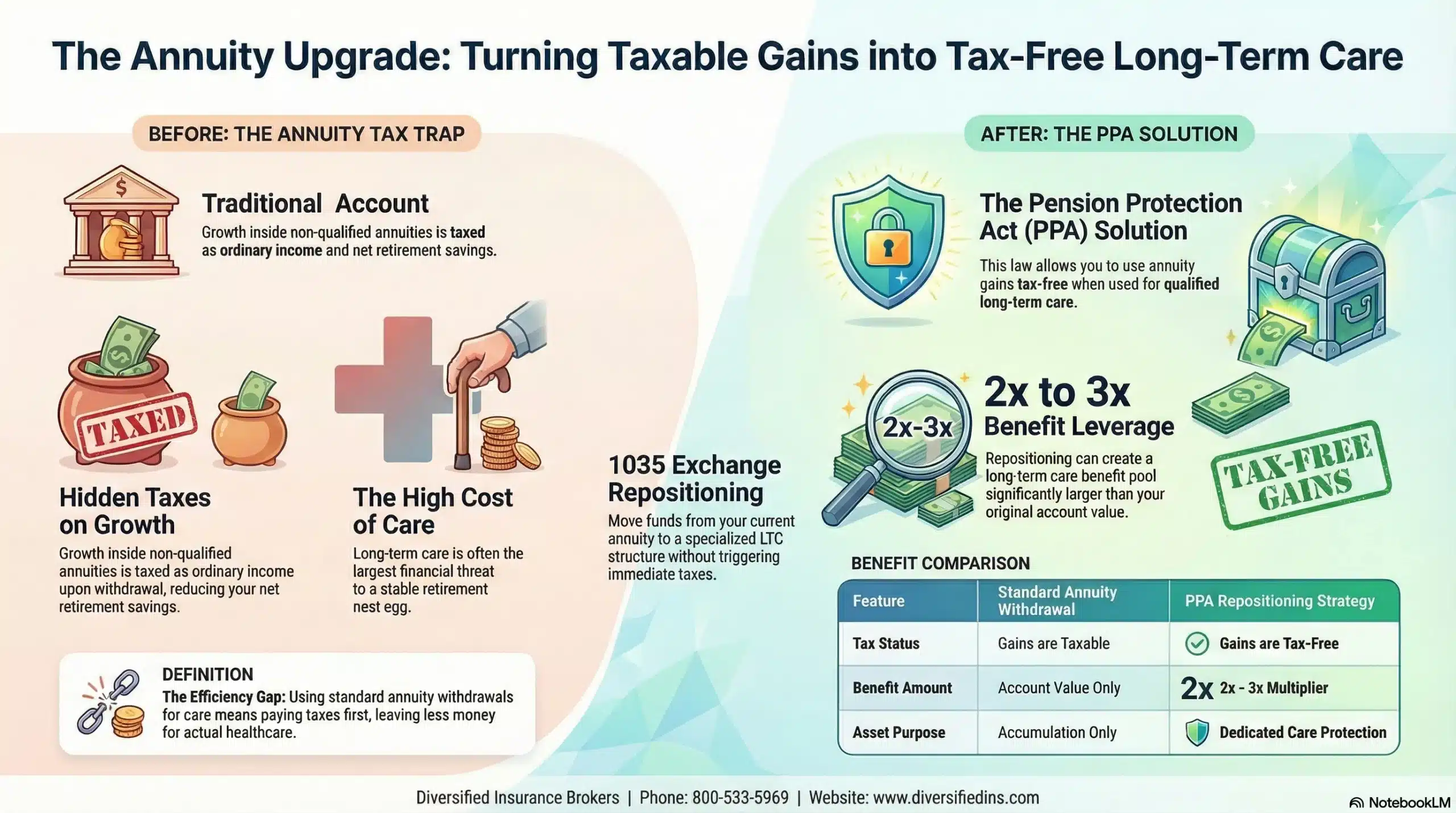
Not all long-term care coverage is a standalone traditional policy, and the claim process differs somewhat for the alternatives, so it is worth a brief note. Hybrid life insurance policies with long-term care benefits and annuities with long-term care benefits use the same fundamental benefit triggers — the loss of two activities of daily living or severe cognitive impairment — but the mechanics of how benefits are drawn and paid can differ from a traditional policy.
With a hybrid life-and-long-term-care policy, long-term care benefits are typically drawn against the policy’s death benefit: as you use long-term care benefits, they reduce the amount that would otherwise pass to your beneficiaries, and many such policies pay on an indemnity basis that offers more flexibility than traditional reimbursement. Annuity-based long-term care coverage works differently again, accessing the annuity’s value to fund care. The comparison of hybrid versus traditional long-term care insurance covers these structural differences in depth. The through-line is that while the trigger is broadly the same, the payment structure, the documentation, and the effect on other benefits vary by product — so understanding which kind of coverage you actually hold is the starting point for knowing how its claim will work.
Why the Claim Is Where Your Policy Is Really Tested
Everything about a long-term care policy that seemed abstract at purchase becomes concrete and consequential at claim time, and the claim is where a family discovers whether the right coverage was chosen. This is the honest reason the details matter so much at purchase: the features that feel like fine print are exactly the features that determine the claim.
The benefit triggers decide whether the situation qualifies. The elimination period and its counting method decide how long the family self-funds before benefits begin. The daily or monthly maximum decides how much of the cost the policy actually covers. The benefit period decides how long benefits last. The inflation protection decides whether a policy bought years ago still pays a meaningful amount today. The provider requirements decide whether the care a family arranges will actually be reimbursed. None of these matter until a claim — and then all of them matter completely, and there is nothing anyone can do at that point to change them.
That is the entire case for getting the coverage right at purchase, and it is why long-term care planning deserves genuine care rather than a quick decision on price. A policy chosen well pays smoothly and meaningfully when a family needs it; a policy chosen carelessly reveals its gaps at the worst possible moment, when a loved one needs care and the family has no ability to go back and buy a better contract. Our guidance on choosing the right long-term care policy and on how much coverage you need is built around making those decisions well, before a claim ever tests them.
How We Help — Before and During a Claim
A long-term care claim is where an independent broker’s value becomes concrete, and our involvement runs in both directions in time. Before a claim ever arises — ideally at purchase — we help you own a policy that will actually serve your family when tested: the right benefit triggers and definitions, an elimination period and counting method you understand, inflation protection that keeps the benefit meaningful, a daily maximum matched to real care costs, and provider terms that fit how your family is likely to arrange care. Much of what determines a smooth claim is decided long before the claim exists, and getting that right is the most valuable thing we do.
When a claim actually arrives, we help the family navigate it. We help you open the claim promptly so the elimination clock starts as early as possible, we help you understand the assessment and prepare for it, we help ensure the plan of care and provider documentation are complete and consistent so the packet does not bounce back, we help you understand exactly how your elimination period is counted so the family can plan for the self-funded gap, and we help you confirm that the care being arranged will actually be covered before costly mistakes are made. At a moment when a family is already stretched thin caring for a loved one, having someone who knows the process and works on the family’s behalf rather than the insurer’s is a genuine relief.
Because we are independent and represent many carriers, that support is genuine rather than conflicted. If you already have a policy and want to understand how a claim on it would actually work — or whether the coverage you own will serve your family well when the time comes — our second-opinion review will tell you honestly, including when what you have is genuinely strong and you should simply hold onto it. And if you are still planning your long-term care coverage and want it built right the first time so the claim is never the moment your family discovers a gap, that is exactly what our broader long-term care planning guidance is for. The claim is not the time to learn your policy — it is the time to be grateful it was chosen well.
Whether a family is facing a claim now or you want coverage that will serve you when tested, we’re in your corner.
Get Your Long-Term Care Review
Financial Protection Essentials
Explore carrier reviews and coverage options across our other product lines.
Talk With an Advisor Today
Choose how you’d like to connect—call or message us, then book a time that works for you.
Schedule here:
calendly.com/jason-dibcompanies/diversified-quotes
Licensed in all 50 states • Fiduciary, family-owned since 1980
What triggers long-term care insurance benefits?
A long-term care claim is triggered not by a diagnosis or a hospital stay but by a specific, measurable loss of function defined in your policy. There are two benefit triggers, and satisfying either one qualifies you. The first is the loss of the ability to perform at least two of the six activities of daily living without substantial assistance — the six are bathing, dressing, eating, toileting, transferring in and out of a bed or chair, and continence. The precise language matters: most policies require that you need “substantial assistance,” so being merely slower or less steady may not qualify, while genuinely needing another person’s hands-on help does. The second trigger is severe cognitive impairment, such as Alzheimer’s disease or another dementia, that requires substantial supervision to protect the person’s health and safety — this exists because someone with significant cognitive decline may be physically able to perform the activities of daily living but cannot safely be left to do so. Because the exact number of ADLs and the exact wording can vary between policies, your own contract governs, and it is worth confirming the specifics. This is also where claims often meet friction: insurers sometimes challenge whether a condition truly meets the threshold, especially when documentation is vague or limitations fluctuate day to day — a person with early dementia may have an unusually clear morning during an assessment. Building a clear, consistent picture of the genuine typical condition, supported by strong medical documentation, is what makes the difference.
How do I start a long-term care insurance claim?
Once you believe a benefit trigger has been met, you contact the insurer to open the claim and request the claim packet. There is a critical timing trap buried in this step that costs families real money, so it is worth stating plainly: in most policies, the elimination period does not begin counting until you have formally opened the claim. If a family pays for care for months before notifying the insurer — which happens constantly, because families naturally arrange care during a crisis and think about the insurance later — those earlier days of care often do not count toward the waiting period, and the family ends up self-funding care for far longer than necessary. Opening the claim promptly, even before you have every document assembled, is what starts that clock and protects the family financially. The practical instruction is therefore to file early: the moment it becomes clear a benefit trigger has been met and care will be needed, notify the insurer. You lose nothing by opening a claim promptly and can lose months of benefits by waiting. With a traditional policy, the policyholder or a family member contacts the carrier directly, or — far better during a health crisis — works through the broker who arranged the coverage, who can initiate and manage the process on the family’s behalf. This is one of the genuine advantages of buying through an independent long-term care broker: at the hardest moment, you are not deciphering an insurance company’s claims department alone.
What is the assessment, and what is a plan of care?
After the claim is opened, the insurer confirms two things: that a benefit trigger has genuinely been met, and what care is actually needed. It does this through an assessment and a plan of care. Most insurers conduct their own assessment, typically sending a nurse or a nurse-and-social-worker team to evaluate the person’s condition in their home or care setting, completing the company’s specific evaluation form documenting each activity of daily living and screening for cognitive impairment. This is a normal, expected part of the process, not an adversarial one — but it is consequential, because the assessor’s findings weigh heavily in the eligibility decision. This is why consistent medical documentation matters so much: a strong file establishing long-standing patterns, including for cognitive cases documentation of behaviors like wandering, confusion, or impaired judgment, supports the assessment and counters the risk that a single good day paints a misleadingly capable picture. The plan of care, typically written by a physician or care professional, sets out the person’s condition and the specific services recommended to meet their needs, whether in-home care, assisted living, memory care, or nursing home care. It confirms to the insurer that the care being provided is appropriate and establishes what the policy will pay for. Several forms accompany these — a physician’s certification, provider statements confirming proper licensure, and a records authorization — and incomplete or inconsistent paperwork here is the single most common cause of delay. Assembling a complete, consistent packet the first time is the most effective way to keep a claim moving.
How does the elimination period work on a long-term care policy?
The elimination period is a waiting period — a specified number of days, often thirty, sixty, or ninety — during which you must be eligible for benefits and receiving care but pay for that care out of your own pocket before the insurer begins to pay. It functions like a deductible, except measured in days rather than dollars. The detail almost nobody understands until they are in it is how the days are counted, because policies do this in two very different ways. Under a calendar-day method, once benefits are triggered and the claim is open, every calendar day counts regardless of whether you received paid care that day, so a ninety-day calendar elimination period is satisfied in ninety days. Under a service-day method, only the days you actually receive and pay for covered care count — so if you receive care just a few days a week, a ninety-service-day elimination period can stretch across many calendar months before it is satisfied. Two policies both advertising a “ninety-day elimination period” can therefore produce dramatically different real-world waiting periods. Because you pay out of pocket during this time, a family needs to be prepared to fund the gap, which is another reason opening the claim early matters — the clock generally will not start until the claim is open. Some policies waive the elimination period for certain care, most often in-home care, which is a valuable feature worth confirming. Keeping careful invoices from day one is essential, because those records prove the elimination period was satisfied. Our full explanation of LTC elimination periods covers this in depth.
Does my policy cover care from a family member or private caregiver?
Usually not, unless your policy specifically allows it — and this is a trap that catches well-meaning families constantly. Long-term care policies generally require that covered care be delivered by licensed or certified providers: a licensed home care agency, a certified home health aide, a licensed assisted living facility, or a licensed nursing home, depending on the setting and your policy’s terms. The problem arises when a family, trying to save money or keep care within the family, hires a private caregiver, an independent contractor, or a family member to provide the care. If the policy requires an approved, licensed provider, care delivered by an unlicensed individual will generally not be covered — even though the person genuinely needs care and is genuinely receiving it. Families discover this after the fact, having paid out of pocket for months for care the policy will not reimburse because of who delivered it. Some policies do allow care from independent or family caregivers under specific conditions, and some pay on a cash basis that offers this flexibility, but you cannot assume it — the requirement varies by policy and must be confirmed. There is also a documentation dimension: even when a licensed provider delivers the care, the care logs need to detail the specific assistance provided rather than using generic checkboxes, because vague records can cause a claim to be questioned. The lesson is simple: before arranging care, confirm exactly what kind of provider your policy requires and what documentation it demands, so the care you pay for is care the policy will actually cover.
How are long-term care benefits paid, and how long do they last?
Most traditional long-term care policies pay on a reimbursement basis: you or your care provider submit invoices for covered care, often monthly, and the insurer reimburses those costs up to your policy’s daily or monthly benefit maximum. Some policies, and many newer or hybrid designs, instead pay on an indemnity or cash basis, providing a set benefit amount once you qualify regardless of the exact cost of care, which offers more flexibility in how the money is used. Knowing which model your policy uses shapes the administrative rhythm of the claim. Two features determine how much and how long benefits last. Your daily or monthly maximum caps what the policy pays in a given period; if the cost of care exceeds the maximum, the family covers the difference, which is why matching the benefit to real care costs in your area matters. Your benefit period and total benefit pool determine how long benefits can continue — some policies pay for a set number of years, others until a total dollar pool is exhausted. If your policy includes inflation protection, your benefit maximum will have grown over the years since you bought the policy, which is enormously valuable given how much care costs rise — a policy bought decades ago without inflation protection may pay a daily maximum badly eroded by rising costs. A comprehensive policy typically covers care across settings: in-home care, assisted living, memory care, and nursing home care, provided it is delivered by providers your policy recognizes.
Is a long-term care claim a one-time event, or ongoing?
It is ongoing, and this is one of the most misunderstood features of the process. Long-term care needs continue for months or years, and the claim continues alongside them, which means ongoing administration and periodic re-verification of eligibility for as long as benefits are paid. On a reimbursement policy, the recurring task is submitting invoices, typically monthly, for the care received — staying organized about this is what keeps benefits flowing smoothly, while disorganized or late invoice submission is a common and avoidable cause of payment delays. Beyond invoicing, the insurer will periodically re-certify eligibility, confirming that the person continues to meet the benefit trigger and that the care remains appropriate. This may involve updated physician certifications, periodic reassessments, or updated plans of care, and it exists because a person’s condition can change and the insurer is verifying the qualifying need persists. For most long-term care claims the need only deepens over time, so re-certification is usually a formality — but it still requires attention, because a lapse in documentation or a missed reassessment can interrupt benefits even when the underlying need is unchanged. This ongoing management is genuinely demanding for a family simultaneously coordinating a loved one’s care, which is why care coordination benefits — a feature many policies include providing access to a professional care coordinator — are so valuable. Where a family manages this alone, staying organized, keeping copies of everything submitted, and responding promptly to every request are what keep an approved claim paying without interruption.
About the Author:
Jason Stolz, CLTC, CRPC, DIA, CAA and Chief Underwriter at Diversified Insurance Brokers (NPN 20471358), is a senior insurance and retirement professional with more than 25 years of real-world experience helping individuals, families, and business owners protect their income, assets, and long-term financial stability. As a long-time partner of the nationally licensed independent agency Diversified Insurance Brokers, Jason provides trusted guidance across multiple specialties—including fixed and indexed annuities, long-term care planning, personal and business disability insurance, life insurance solutions, Group Health, Travel Medical and Evacuation Insurance, and short-term health coverage. Diversified Insurance Brokers maintains active contracts with over 100 highly rated insurance carriers, ensuring clients have access to a broad and competitive marketplace.
His practical, education-first approach has earned recognition in publications such as VoyageATL, and contributions from his agency featured in Kiplinger and GoBankingRates— highlighting his commitment to financial clarity and client-focused planning. Drawing on deep product knowledge and years of hands-on field experience, Jason helps clients evaluate carriers, compare strategies, and build retirement and protection plans that are both secure and cost-efficient. Visitors who want to explore current annuity rates and compare options across multiple insurers can also use this annuity quote and comparison tool.
Explore More Long Term Care Insurance Options: Browse our complete guide to LTC Insurance Costs, Rates & Planning — covering how much it costs, best rates, calculators, planning strategies & is it worth it from top carriers.
Last Reviewed: July 30, 2026 |
Reviewed by: Jason Stolz, CLTC, CRPC, DIA, CAA
Chief Underwriter, Diversified Insurance Brokers, Inc. | NPN: 20471358 | Diversified Insurance Brokers, Inc. — Licensed in all 50 states
Fact Checked by: Tonia Pettitt, CMIP©
Medicare Specialist, Diversified Insurance Brokers, Inc. | NPN: 14374308 | Diversified Insurance Brokers, Inc. — Licensed in all 50 states
Did you find this content helpful? Leave us a Google review — it helps others find trustworthy guidance too.
Editorial Standards: Diversified Insurance Brokers maintains rigorous editorial standards to ensure accuracy, clarity, and independence in all content. Learn more about our editorial standards and commitment to transparency.
