
Jumbo Life Insurance
As an Independent Life Insurance Broker, we compare rates across 100+ carriers and prescreen every application before submission.
Jumbo Life Insurance

Jason Stolz CLTC, CRPC, DIA, CAA
Jumbo life insurance is coverage with a very large death benefit — the kind of policy used when someone needs to insure millions, tens of millions, or in rare cases far more, on a single life. At Diversified Insurance Brokers, we specialize in structuring and placing large-face-amount cases that require expertise most agents simply do not have. Jumbo cases are a different discipline from ordinary life insurance. They involve a second layer of underwriting — financial underwriting — that must justify why such a large amount is warranted; they run up against carrier retention limits, autobind limits, and the industry jumbo limit that govern how much any one company can issue; and they often require coordinating reinsurance or spreading coverage across multiple carriers to place the full amount. None of that is visible to a consumer shopping from a quote engine, and getting it wrong can mean a rejected application, a worse rate, or coverage that cannot be fully placed. This is precisely the territory where an experienced, independent brokerage earns its keep, because success on a jumbo case depends far more on how the case is designed and navigated than on any single carrier’s advertised rate.
Need a large death benefit and want it structured correctly the first time?
Contact Us About a Jumbo Case
There is no rigid, universal dollar figure at which coverage becomes “jumbo,” and definitions vary across the industry — but in practice the term refers to death benefits large enough that they trigger heightened financial scrutiny and bump into the capacity limits of individual carriers, typically well into the millions and often much higher. These policies are built for high-net-worth individuals and families, business owners, and executives whose protection needs — driven by estate liquidity, business succession, key-person risk, or wealth transfer — far exceed the face amounts a typical policy provides. A jumbo policy can be structured as term coverage for a defined need or, more commonly for permanent needs, as permanent life insurance such as guaranteed or indexed universal life that stays in force for life and can build cash value. What unites all jumbo cases is that the size of the death benefit changes everything about how the case must be handled — from the documentation required to justify it, to which carriers can accommodate it, to how long placement takes. Understanding those mechanics is the difference between a case that gets placed cleanly at the best available terms and one that stalls, and our guidance on how much life insurance you need is the starting point for sizing the coverage correctly.
See Real-Term Rates Side by Side
Life Insurance Quoter
What Makes a Case “Jumbo” — and Why It’s Different
The word jumbo has both a plain meaning and a precise technical one, and both matter. In everyday terms, jumbo simply means a large amount of coverage. But in the contract language of reinsurance agreements, jumbo has a specific definition tied to how insurers manage risk, and that technical meaning is what actually shapes how a large case gets handled. No insurance company keeps the full risk of a very large policy on its own books. Each carrier has a retention limit — the maximum amount of risk it will keep on any one life — and it transfers, or cedes, coverage above that limit to reinsurance companies. Carriers also have an autobind limit, the amount they can approve and automatically bind with their reinsurance partners without sending the case out for individual review. And the industry recognizes a jumbo limit, which is the total amount of coverage in force and applied for across all carriers on a single individual’s life. That last concept is critical and often misunderstood: the jumbo limit counts not just the new policy you are applying for, but every existing policy already on that person’s life with every company, added together. When the combined total approaches or exceeds the jumbo threshold, the case can no longer be automatically bound and must instead be individually underwritten by the reinsurers. A figure commonly cited in the U.S. market for the jumbo limit is in the range of $65 million, but this varies by carrier and reinsurance treaty and can change over time, so it should be treated as a general industry reference point rather than a fixed rule. The practical takeaway is that a jumbo case operates under a set of capacity constraints that ordinary policies never encounter — and navigating those constraints is a specialized skill.
The Two Layers of Jumbo Underwriting
| Underwriting Layer | What It Evaluates | Why It Matters on a Jumbo Case |
|---|---|---|
| Medical Underwriting | Health, history, exam results, labs, and family history — the same factors as any policy, but scrutinized more closely. | At large amounts, carriers and reinsurers examine health in greater depth; matching the case to the right carrier is decisive. See underwriting with health issues. |
| Financial Underwriting | Whether the amount applied for is financially justified — via income, net worth, business value, or a defined obligation. | Unique to large cases. The carrier must see a legitimate need for the death benefit; unsupported amounts are cut or declined. |
| Retention & Autobind | How much the direct carrier keeps and how much it can automatically cede to reinsurers without individual review. | Determines whether a case can be bound quickly or must go out to reinsurers, affecting speed and outcome. |
| Facultative Reinsurance | Full individual review by reinsurers when a case exceeds autobind or jumbo limits. | Can produce multiple, differing offers on one case; requires an advocate to negotiate the best result. |
| Carrier Layering | Spreading the total coverage across more than one carrier when no single one can hold it all. | Lets the full amount be placed while keeping each carrier within its limits; requires careful sequencing. |
What Real Jumbo Capacity Looks Like at a Major Carrier
Abstract explanations of jumbo underwriting only go so far — seeing how a real, major carrier actually structures its capacity makes the mechanics concrete. John Hancock, one of the more active carriers in the large-case market, publishes its own retention and jumbo limits, and they illustrate the pattern well: capacity is substantial, but it isn’t flat across every age, and it isn’t unlimited even at a single carrier’s highest tier.
| Issue Age | Products Eligible | Jumbo Limit (Total Inforce + Pending, All Companies) |
|---|---|---|
| 0–80 | All products — individual and survivorship | $65,000,000 |
| 81–85 | Permanent products only — individual and survivorship | $50,000,000 |
| 86–90 | Permanent products only — individual and survivorship | Not available beyond retention capacity |
That “Jumbo Limit” figure is worth understanding precisely, because it’s not simply the most a carrier will issue on one policy — it’s a ceiling on the total amount of coverage, across every company, that a carrier will even consider once combined inforce coverage and pending applications reach that level. A case exceeding it isn’t automatically declined, but it does require the carrier to have available internal retention or facultative reinsurance capacity specifically set aside for that situation, which is a materially higher bar than a routine large application.
The age-banding tells its own story. At John Hancock, permanent coverage stays available up through age 90, but the eligible face amount drops in stages as age increases, and by the mid-80s, jumbo-level capacity narrows to permanent products only — term coverage at genuinely jumbo amounts becomes considerably harder to place as age climbs, well before the point where coverage disappears entirely. This is a real, published illustration of a pattern that holds across most carriers active in the large-case market: age doesn’t just affect your rate at the jumbo level, it affects which products and how much face amount are even on the table.
Underneath the jumbo limit sits a second, related concept worth understanding: retention. A carrier’s retention limit is the amount of risk it’s willing to hold on its own books, on a single life, without buying facultative reinsurance to share that risk with a reinsurer. Retention limits also decline by age band at most carriers, for the same underlying reason jumbo limits do — mortality risk on very large face amounts becomes harder to absorb internally as the insured gets older. This is exactly why working with a broker who understands how retention and jumbo limits interact across multiple carriers matters more at this end of the market than almost anywhere else — the right carrier for a $40 million case at age 65 may not be the right carrier for the same amount at age 82, and knowing which companies still have room to work with at a specific age and face amount is a genuinely specialized piece of knowledge.
Financial Underwriting — Justifying the Death Benefit
The single biggest difference between a jumbo case and an ordinary one is financial underwriting. On a modest policy, an insurer rarely questions why you want the coverage. On a jumbo case, the carrier will require you to justify the amount — to demonstrate that a death benefit of that size is financially reasonable given your actual circumstances. This exists to prevent over-insurance and to confirm there is a genuine economic loss the policy is designed to offset. How the amount is justified depends on the purpose. For income replacement on a high earner, insurers apply human-life-value principles, generally allowing a multiple of annual income that decreases with age, since the coverage is meant to replace future earnings. For wealth and estate purposes, justification rests on net worth and, frequently, on a projected estate-tax liability — using life insurance to provide the liquidity an estate will need is a well-established purpose, and our overview of life insurance in modern estate planning explains it in depth. For business coverage, the justification is the value of the insured’s stake or role — a business valuation supporting a buy-sell agreement, or the demonstrated financial impact of losing a critical person in a key-person arrangement. Loan-related coverage is justified by the debt itself, often documented through a collateral assignment. In every case, the documentation matters enormously: tax returns, financial statements, business valuations, and estate projections must be assembled and presented so the underwriter sees a clear, supportable need. A poorly documented jumbo application is one of the most common reasons a large case is cut down or delayed, which is why the preparation and presentation of the financial story is a core part of what we do — assembling and framing the justification before the case is ever submitted.
Common Reasons People Buy Jumbo Life Insurance
Jumbo coverage is not bought for its own sake; it is bought to solve a large, specific financial problem, and understanding the common purposes clarifies who needs it. Estate liquidity is among the most frequent: families with substantial but illiquid wealth — a business, real estate, farmland, concentrated holdings — use a large death benefit to provide the cash an estate needs to cover settlement costs and any applicable taxes without a forced sale of assets, often with the policy owned by an irrevocable life insurance trust (ILIT) so the proceeds can generally be kept outside the taxable estate. Whether estate taxes apply, and at what level, depends on the federal estate-tax exemption and any state estate taxes, which are set by law and change over time, so this planning should always be done with current figures alongside a qualified estate attorney and tax advisor. Business succession is another major driver — funding a buy-sell agreement for a valuable company, or protecting against the loss of an owner or key executive whose death would financially damage the enterprise, as our resources on life insurance for business owners and funding buy-sell agreements describe. High-income earners use jumbo coverage for income replacement at a scale ordinary policies cannot reach, ensuring a family can maintain a substantial lifestyle. And wealth-transfer and legacy goals — passing a large, tax-advantaged sum to heirs or charity — round out the picture, an application explored in our overview of life insurance strategies the wealthy use. For clients funding very large premiums, premium financing is sometimes used to fund the policy through a lending arrangement, a sophisticated strategy with its own trade-offs that must be evaluated carefully.
Why Working With Us Matters on a Jumbo Case
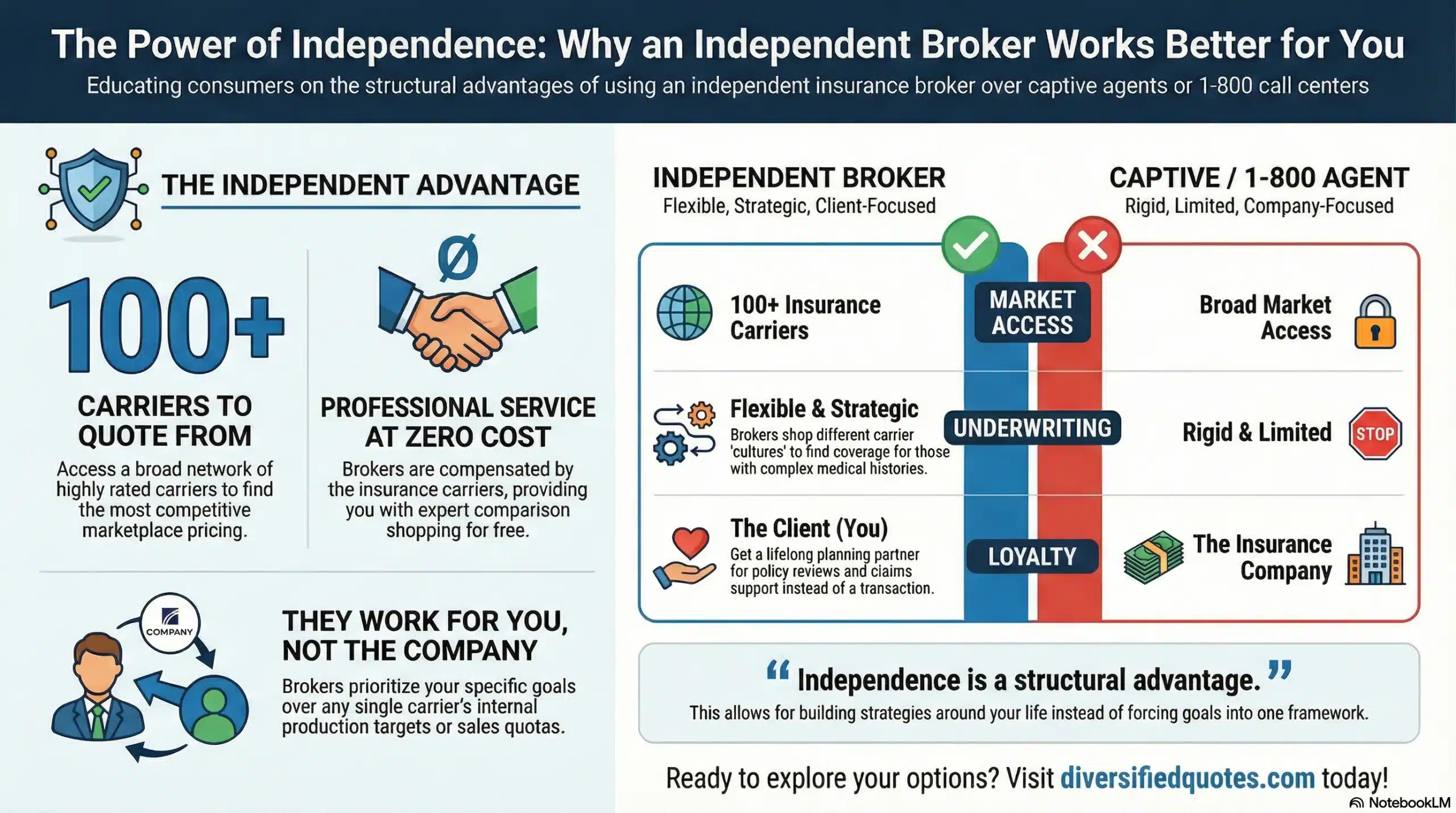
On an ordinary policy, the difference between a good agent and a great one is modest. On a jumbo case, it is enormous — the outcome can hinge entirely on how the case is designed and navigated, and that is where an experienced independent brokerage changes the result. Because we are independent and represent many carriers rather than being captive to one, we can identify which insurers have the retention and reinsurance capacity to handle your amount, and which underwrite your specific health and financial profile most favorably — then place the case there, or across several carriers if layering is needed to fit the full amount within each company’s limits. We understand the mechanics that trip up generalist agents: the jumbo limit that counts all in-force and applied-for coverage together, the autobind thresholds that determine whether a case binds quickly or goes to reinsurers, and the facultative process that can produce multiple differing offers on the same case, where having an advocate to negotiate matters. We also know how to protect your record while shopping a large case — using informal or trial inquiries to gauge carrier appetite before a formal application is submitted, so a difficult case is not marked by a decline that follows you to the next carrier, an approach reflected in our emphasis on careful pre-screening of every application. And we assemble the financial-underwriting documentation — the tax returns, valuations, and estate projections — into a clear justification that gives the underwriter what they need to approve the full amount. This combination of market access, technical knowledge, and case advocacy is exactly why jumbo cases should be handled by specialists, and it is the heart of why working with an independent broker produces materially better outcomes on large cases. Our obligation runs to you, not to any carrier, and we are compensated the same regardless of where your case is placed — so our only incentive is to structure the coverage that genuinely serves you best.
Ready to put decades of large-case expertise to work for you?
Contact Us for a Jumbo Life Insurance Consultation
Financial Protection Essentials
Explore disability coverage and specialty protection options across a range of caregiving, service, and professional occupations.
Talk With an Advisor Today
Choose how you’d like to connect—call or message us, then book a time that works for you.
Schedule here:
calendly.com/jason-dibcompanies/diversified-quotes
Licensed in all 50 states • Fiduciary, family-owned since 1980
What is considered jumbo life insurance?
Jumbo life insurance refers to policies with very large death benefits — large enough to trigger heightened financial scrutiny and to approach the capacity limits of individual insurance carriers. There is no single universal dollar figure that defines “jumbo,” and definitions vary across the industry, but in practice the term describes coverage well into the millions and often much higher, up to tens of millions or, in rare cases, far more on a single life. What really distinguishes a jumbo case is not a specific number but the way it must be handled. Two things change once coverage reaches this scale. First, the insurer requires financial underwriting to justify the amount — you must demonstrate that a death benefit of that size is financially reasonable given your income, net worth, business value, or a defined obligation. Second, the case runs into the structural limits that govern how much any one carrier can issue: retention limits, autobind limits, and the industry jumbo limit, which counts all coverage in force and applied for across every carrier on your life. When a case exceeds those thresholds, it must be individually reviewed by reinsurers or spread across multiple carriers. So rather than asking “what dollar amount is jumbo,” the more useful question is whether the amount is large enough to require financial justification and to bump into carrier capacity — because that is what determines how the case has to be structured. Our guidance on how much life insurance you need helps establish the right amount for your situation.
How much coverage can I actually get on one person?
You can obtain very large amounts of coverage on a single life — well into the tens of millions and, for the right case, beyond — but how much, and how it is placed, depends on both your financial justification and the industry’s capacity limits. Two constraints govern the ceiling. The first is financial underwriting: the insurer will only issue an amount you can justify, so the coverage available to you is ultimately tied to your income, net worth, business value, or the specific obligation the policy addresses. The second is capacity: no single carrier keeps the full risk of a large policy, so insurers rely on reinsurance to issue big amounts, and the industry recognizes a jumbo limit — the total coverage in force and applied for across all carriers on one life — that is commonly cited around $65 million in the U.S. market, though this varies by carrier and reinsurance treaty and can change over time. When a desired amount exceeds what one carrier can hold or approaches the jumbo limit, the coverage can be layered across multiple carriers so that each stays within its limits while the full amount still gets placed. This is a routine strategy on large cases, but it requires careful sequencing, because a late-arriving application can be rejected if aggregate coverage has already consumed the available capacity. Practically, this means the answer to “how much can I get” is best determined by an experienced broker who can assess your justification, identify the carriers with capacity for your profile, and design a placement — single-carrier or layered — that secures the full amount. It is exactly the kind of question a quote engine cannot answer.
What is financial underwriting and why does it matter for large policies?
Financial underwriting is the process by which an insurer confirms that the amount of coverage you are applying for is financially justified — and it is the defining feature of jumbo cases. On a small policy, the carrier rarely questions why you want the coverage. On a large one, you must demonstrate a genuine economic reason for a death benefit of that size, because insurers will not knowingly over-insure a life. How you justify the amount depends on its purpose. For income replacement, insurers apply human-life-value principles, generally permitting a multiple of your annual income that decreases as you age, since the benefit is meant to replace future earnings. For estate and wealth purposes, justification rests on your net worth and often on a projected estate-tax liability the policy is designed to cover. For business coverage, it is the value of your ownership stake supporting a buy-sell agreement, or the financial impact of losing a key person. For loan-related coverage, it is the size of the debt. In each case, the underwriter needs documentation — tax returns, financial statements, business valuations, estate projections — that clearly supports the requested amount. This is where large cases most often go wrong: a poorly documented or over-reaching application gets cut down or declined, not because the coverage was unreasonable, but because the justification was not presented properly. Assembling and framing that financial story before submission is a core part of placing a jumbo case well, and it ties directly into the estate-planning and business purposes these policies typically serve.
What type of policy is used for jumbo coverage — term or permanent?
Both are used, and the right choice depends entirely on the purpose the coverage serves. For a large but temporary need — replacing a high income during working years, or covering a substantial business loan with a defined payoff period — term life insurance can provide a very large death benefit at the lowest cost for the duration of that need. For permanent needs that will exist whenever death occurs — estate liquidity, lifelong wealth transfer, funding an ILIT, or business succession for a company you intend to hold long-term — permanent life insurance is generally the appropriate structure, because the coverage does not expire and can build cash value. Within the permanent category, guaranteed universal life is frequently used for large estate-liquidity cases because it can provide a guaranteed death benefit to a chosen age with efficient premiums, and our overview of guaranteed universal life insurance explains how it works; indexed universal life is used when cash-value growth potential is also a goal. For coverage on two spouses aimed at estate liquidity, a survivorship policy that pays after both have died is a common and cost-effective structure. Many large cases also combine approaches — a permanent base for the enduring need layered with term for a temporary one. The key principle is the same as with any life insurance: start with the purpose and the time horizon, then choose the structure that fits, rather than defaulting to a product first. An experienced broker will match the policy type and carrier to both your financial justification and your long-term objective.
Why should I use a specialist broker for a jumbo case instead of buying online?
Because on a jumbo case, how the case is designed and navigated matters more than any advertised rate, and the pitfalls that sink large cases are invisible to a consumer buying online. A quote engine cannot tell you which carriers have the retention and reinsurance capacity to hold your amount, cannot assemble the financial-underwriting justification a large death benefit requires, cannot layer coverage across multiple carriers when one cannot hold it all, and cannot advocate for you when a case goes to the reinsurers and comes back with multiple differing offers. An experienced independent brokerage does all of that. Because we represent many carriers, we can identify the ones whose underwriting — both medical and financial — treats your specific profile most favorably, and place the case there or across several carriers as needed. We understand the jumbo limit that counts all your in-force and applied-for coverage together, the autobind thresholds that decide whether a case binds quickly or goes out for individual review, and the facultative reinsurance process where advocacy changes the outcome. Critically, we know how to protect your insurability while shopping a large case, using informal inquiries to gauge carrier appetite before a formal application is filed, so a challenging case is not marked by an avoidable decline that follows you elsewhere — an approach central to our careful pre-screening process. And our independence means our duty is to you: we are compensated the same regardless of where the case lands, so our only incentive is the structure that serves you best. If you already have a large policy or a quote in hand, our second-opinion review can confirm whether it is truly the best available structure and price.
About the Author:
Jason Stolz, CLTC, CRPC, DIA, CAA and Chief Underwriter at Diversified Insurance Brokers (NPN 20471358), is a senior insurance and retirement professional with more than 25 years of real-world experience helping individuals, families, and business owners protect their income, assets, and long-term financial stability. As a long-time partner of the nationally licensed independent agency Diversified Insurance Brokers, Jason provides trusted guidance across multiple specialties—including fixed and indexed annuities, long-term care planning, personal and business disability insurance, life insurance solutions, Group Health, Travel Medical and Evacuation Insurance, and short-term health coverage. Diversified Insurance Brokers maintains active contracts with over 100 highly rated insurance carriers, ensuring clients have access to a broad and competitive marketplace.
His practical, education-first approach has earned recognition in publications such as VoyageATL, and contributions from his agency featured in Kiplinger and GoBankingRates— highlighting his commitment to financial clarity and client-focused planning. Drawing on deep product knowledge and years of hands-on field experience, Jason helps clients evaluate carriers, compare strategies, and build retirement and protection plans that are both secure and cost-efficient. Visitors who want to explore current annuity rates and compare options across multiple insurers can also use this annuity quote and comparison tool.
Explore More Life Insurance Options: Browse our complete guide to How Life Insurance Works — covering term life, whole life, final expense, annuity alternatives & more from 100+ carriers.
Last Reviewed: September 1, 2026 |
Reviewed by: Jason Stolz, CLTC, CRPC, DIA, CAA
Chief Underwriter, Diversified Insurance Brokers, Inc. | NPN: 20471358 | Diversified Insurance Brokers, Inc. — Licensed in all 50 states
Fact Checked by: Tonia Pettitt, CMIP©
Medicare Specialist, Diversified Insurance Brokers, Inc. | NPN: 14374308 | Diversified Insurance Brokers, Inc. — Licensed in all 50 states
Did you find this content helpful? Leave us a Google review — it helps others find trustworthy guidance too.
Editorial Standards: Diversified Insurance Brokers maintains rigorous editorial standards to ensure accuracy, clarity, and independence in all content. Learn more about our editorial standards and commitment to transparency.
