
Disability Insurance for Postal Workers and Mail Carriers
As an Independent Disability Insurance Broker, we have access to exclusive discounts and negotiated pricing most captive agents can’t offer — see the full breakdown near the end of this page.
Disability Insurance for Postal Workers and Mail Carriers

Jason Stolz CLTC, CRPC, DIA, CAA
Disability insurance for postal workers and mail carriers is an essential and widely misunderstood income protection planning area for one of the largest employer populations in the United States — a workforce whose daily occupational demands produce injury rates that place them among the most frequently injured workers in the federal employment system, and whose institutional benefit structure, while meaningful, leaves significant income protection gaps that individual disability insurance specifically addresses. Whether you serve as a career USPS letter carrier delivering mail on a walking or park-and-loop route, work as a city carrier assistant or rural carrier associate in a non-career position, operate as a mail handler or postal clerk in a processing and distribution facility, drive a USPS delivery vehicle as part of a motorized carrier route, or serve in any of the other roles that make the United States Postal Service the largest daily delivery network in the world — your income depends on your physical capacity to perform demanding repetitive work in conditions that produce the highest workers’ compensation claim volumes of any single employer in the federal government.
USPS employees accounted for approximately 42% of the $2.92 billion in Federal Employees’ Compensation Act benefits paid in a single recent year — approximately $1.22 billion in workers’ compensation costs from an agency that employs roughly one-third of the federal civilian workforce. USPS sustains an average of 34,000 injuries annually across its career and non-career workforce. The USPS Office of Inspector General has documented that 54% of the 299,198 total industrial accidents at USPS between 2017 and 2021 could have been prevented by proper safety and health training — reflecting not fringe risk but a systematic and persistent occupational injury burden that defines the physical reality of postal work. For postal workers who sustain disabling injuries or illnesses, understanding exactly what FECA provides — and precisely where it falls short — is the essential foundation for any meaningful income protection planning.
At Diversified Insurance Brokers, we help USPS career employees, city carrier assistants, rural carriers, mail handlers, postal clerks, and postal workers across all USPS employment categories structure disability insurance coverage that fills the specific gaps in FECA coverage and provides the income protection that the federal workers’ compensation system alone does not deliver.
Protect Your Postal Worker Income
Compare disability insurance options designed for USPS letter carriers, mail handlers, postal clerks, and all postal service employees managing the gaps in FECA coverage.
Request Disability Insurance OptionsUnderstanding FECA — What Federal Workers’ Compensation Provides for Postal Workers
All USPS employees — both career and non-career — are covered under the Federal Employees’ Compensation Act, administered by the Department of Labor’s Office of Workers’ Compensation Programs. FECA provides medical treatment coverage, wage-loss compensation, vocational rehabilitation services, and death benefits for federal employees who sustain work-related injuries or occupational diseases. For postal workers, FECA is the exclusive workers’ compensation system — USPS employees are not covered by any state workers’ compensation program, and their only institutional protection for work-related injury or illness flows through the DOL OWCP system.
The wage-loss compensation structure under FECA provides either 75% of pay continuation for workers with dependents or 66.67% for workers without dependents during periods of total disability from work-related injuries. This wage replacement is generally not taxable — a meaningful benefit compared to many private-sector workers’ compensation systems. For work-related traumatic injuries, postal workers file a CA-1 claim with OWCP through the ECOMP electronic filing system. For occupational diseases and conditions that develop over time — repetitive stress injuries, cumulative back conditions, carpal tunnel syndrome — postal workers file a CA-2 occupational disease claim, which requires medical documentation establishing a causal connection between specific job duties and the diagnosed condition.
FECA is a meaningful benefit that provides more generous medical coverage than most state workers’ compensation systems and wage-loss protection that begins relatively quickly for approved work-related claims. For postal workers who sustain clear work-related traumatic injuries and whose OWCP claims are approved without dispute, FECA provides genuine and reasonably comprehensive protection for the immediate injury and recovery period. The government employee FECA framework for postal workers parallels the institutional benefit structure facing other federal employees, including game wardens and other federal employees managing the gap between government injury coverage and complete income protection.
The Critical Gaps in FECA Coverage for Postal Workers
Understanding what FECA does not cover is as important as understanding what it provides — because the gaps in FECA protection are precisely where individual disability insurance fills a genuine and consequential need for postal workers and their households.
FECA covers only work-related injuries and occupational diseases. A letter carrier who develops a serious cardiovascular condition, is injured in an off-duty accident, receives a serious illness diagnosis, or develops a disabling condition that is not directly attributable to specific postal work duties receives no FECA benefit whatsoever. The postal worker’s household income stops completely on the day that condition prevents working, with no institutional bridge of any kind. Individual disability insurance covers disability from any cause — work-related or not, acute injury or gradually developing illness — providing income replacement regardless of where or how the disabling condition developed.
FECA coverage also ends at maximum medical improvement — the point where OWCP determines the injured worker’s condition cannot improve further — which may occur substantially before the postal worker has regained the physical capacity for the sustained repetitive work that their postal duties require. A letter carrier whose back injury reaches maximum medical improvement with permanent functional limitations that prevent sustained walking and lifting may see FECA benefits conclude at a point where return to full carrier duties is still medically impossible, leaving a coverage gap between FECA termination and any other available income source. The maximum medical improvement endpoint problem facing postal workers under FECA parallels that facing other federally employed physical workers, including construction workers and heavy labor employees managing the endpoint of institutional injury coverage.
For USPS non-career employees — city carrier assistants, rural carrier associates, postal support employees, and other non-career classifications — FECA coverage applies for work-related injuries, but these workers typically do not have access to FERS retirement disability provisions that career employees receive after completing their minimum service requirements. The absence of FERS disability retirement as a backstop makes FECA the only institutional income protection for non-career postal workers, making the FECA coverage gaps even more consequential for this population. Individual disability insurance fills the same role for non-career postal workers that it fills for other self-employed and non-benefit workers, including independent contractors managing income protection without employer-provided benefits.
The Occupational Injury Profile of Postal Work
The documented injury profile of USPS employees reflects the physical demands of a workforce that delivers to approximately 132 million delivery points annually and handles the full range of package and mail volumes that American commerce generates. The 34,000 average annual injuries across the USPS workforce — combined with the $1.22 billion in annual FECA costs attributed to postal workers — document an injury burden that is institutional in scale rather than incidental.
Back and musculoskeletal injuries from heavy lifting and repetitive mail handling are the most prevalent and most financially consequential disability category for postal workers. Letter carriers regularly carry mail satchels and package loads that can weigh 35 pounds or more, manage increasingly heavy package delivery volumes as e-commerce has grown, and perform the sustained bending, reaching, and lifting that residential and business delivery routes require across full 8-hour shifts in all weather conditions. Mail handlers and postal clerks in processing and distribution facilities face sustained repetitive manual sorting, pushing heavy mail containers, and machine-feed operations that produce the same cumulative spinal and upper extremity loading that creates disability-producing musculoskeletal conditions in other sustained heavy repetitive labor contexts. The back injury and musculoskeletal disability risk profile of postal workers parallels that documented for other sustained repetitive heavy outdoor labor occupations, including agricultural and outdoor manual workers managing cumulative musculoskeletal disability risk from sustained physical labor.
Slip, trip, and fall injuries are the second major disability category — letter carriers navigate hazardous conditions including wet and icy sidewalks, uneven pavement, poorly maintained steps, and debris-covered approaches on every route, in every weather condition, across an entire career. A letter carrier who slips on icy steps, trips on uneven pavement, or falls while navigating a poorly lit property access path can sustain fractures, head injuries, and spinal trauma that require months of recovery and may produce permanent functional limitations. The slip and fall injury profile of letter carriers mirrors that documented in other sustained outdoor service work occupations, including outdoor service and maintenance workers managing hazardous surface and weather-related injury risk.
Dog bites represent a specifically postal-profession hazard documented at extraordinary scale — over 5,300 letter carriers were subjected to dog attacks in a single recent year. Dog bites can produce serious soft tissue injuries, nerve damage, infection requiring hospitalization, and psychological trauma that constitutes genuine occupational disability for carriers who develop documented fear responses from serious attacks. Vehicle accidents involving USPS delivery trucks — on busy urban routes, on rural roads, and in the mixed traffic conditions that characterize most carrier routes — produce serious orthopedic injuries, traumatic brain injuries, and spinal trauma for postal vehicle operators. Heat-related illness from sustained outdoor work in extreme summer conditions, and cold-exposure injuries from winter route work, round out the occupational injury profile of the most active outdoor postal positions. The vehicle accident and outdoor environmental hazard disability risks facing postal workers parallel those documented in other delivery and service vehicle operations, including dock workers and transportation sector employees managing vehicle and loading-related occupational injury risk.
Repetitive Stress and Cumulative Injury — The Occupational Disease Dimension
Beyond acute traumatic injuries, postal workers face significant occupational disease disability risk from the cumulative effects of sustained repetitive work over a career. The CA-2 occupational disease claim pathway under FECA specifically acknowledges that conditions developing over time from occupational exposure — rather than from a single identifiable incident — are compensable work-related injuries. For postal workers, this pathway covers conditions including carpal tunnel syndrome from sustained mail sorting and handling, lumbar degenerative disc disease from cumulative carrier load-bearing, rotator cuff conditions from sustained mail satchel carrying and reaching, and other repetitive strain conditions that develop progressively over a postal career.
Successfully establishing a CA-2 claim requires medical documentation that specifically connects the diagnosed condition to the postal work duties — documentation that is more complex and more frequently disputed than traumatic injury claims. Many postal workers who develop genuine occupational disease conditions from cumulative career exposure face OWCP claim denials or extended disputes during which their income protection depends entirely on other sources. Individual disability insurance that covers any cause of disability — including gradually developing musculoskeletal and occupational disease conditions — provides income replacement during OWCP dispute periods and for conditions that are not work-related even when they are career-limiting. The cumulative injury and occupational disease disability risk facing postal workers parallels that documented in other sustained repetitive labor contexts, including drywall installers and other sustained repetitive labor tradespeople managing cumulative occupational disease disability risk.
Case Study: City Letter Carrier Earning $62,000 Per Year
Consider a career city letter carrier with 11 years of service earning $62,000 annually. During a winter route, this carrier slips on an icy residential walkway and sustains a serious lumbar fracture requiring surgical treatment and eight months of rehabilitation during which the sustained walking, lifting, and carrying of carrier duties are medically prohibited. The injury is work-related and a CA-1 traumatic injury claim is filed with OWCP.
| Scenario | FECA Only | FECA + Individual DI Supplement |
|---|---|---|
| Monthly Wage Replacement | ~$3,875 (75% of pay with dependents) | ~$3,875 FECA + $1,200–$1,550 individual supplement |
| FECA Coverage of Off-Duty Illness | $0 — FECA covers work-related injuries only | Individual policy covers any cause of disability |
| 8-Month Total Replacement | ~$31,000 | ~$40,600–$44,400 |
| Coverage if Claim is Disputed | Delayed or suspended pending OWCP review | Individual policy provides income during OWCP dispute period |
Slip and fall injuries on icy residential surfaces are among the most predictable and most frequently occurring disabling events in letter carrier work — the combination of sustained outdoor weather exposure and variable property maintenance across hundreds of delivery stops per shift creates persistent slip hazard risk across the entire winter delivery season. Disability insurance for postal workers ensures that even with FECA providing a meaningful wage replacement foundation, the 25% income gap and the non-work-related coverage gap do not produce a household financial crisis during what may be a months-long recovery period.
The FERS Disability Retirement Backstop — and Its Specific Limitations for Postal Workers
Career USPS employees who complete the minimum five-year federal service requirement are covered under FERS, which includes disability retirement provisions for career-ending disability events. FERS disability retirement provides 60% of the High-3 average salary in the first year and 40% in subsequent years, calculated on base salary — the same framework that affects all federal employees. For postal workers, this means that overtime pay and any other supplemental compensation are excluded from the FERS disability retirement calculation, and the benefits are taxable as ordinary income rather than being received tax-free as individual disability insurance benefits would be.
The FERS disability retirement qualification process requires the employing agency — USPS — to certify that it cannot reasonably accommodate the condition and has considered the worker for reassignment to any vacant position at the same grade or pay level within the commuting area. For USPS workers with physical limitations, this reassignment consideration often involves sedentary clerical or administrative postal positions — meaning that a letter carrier whose back injury prevents walking routes may be reassigned to a postal facility desk position rather than qualifying for FERS disability retirement. Individual disability insurance with an own-occupation definition protects the carrier’s income from the inability to perform carrier duties specifically, regardless of whether a desk reassignment is theoretically available. The FERS own-occupation gap for postal workers parallels that documented for other federal employees, including federal dispatchers and public service employees managing the own-occupation conversion risk in FERS disability retirement.
Key Policy Features for Postal Worker Disability Insurance
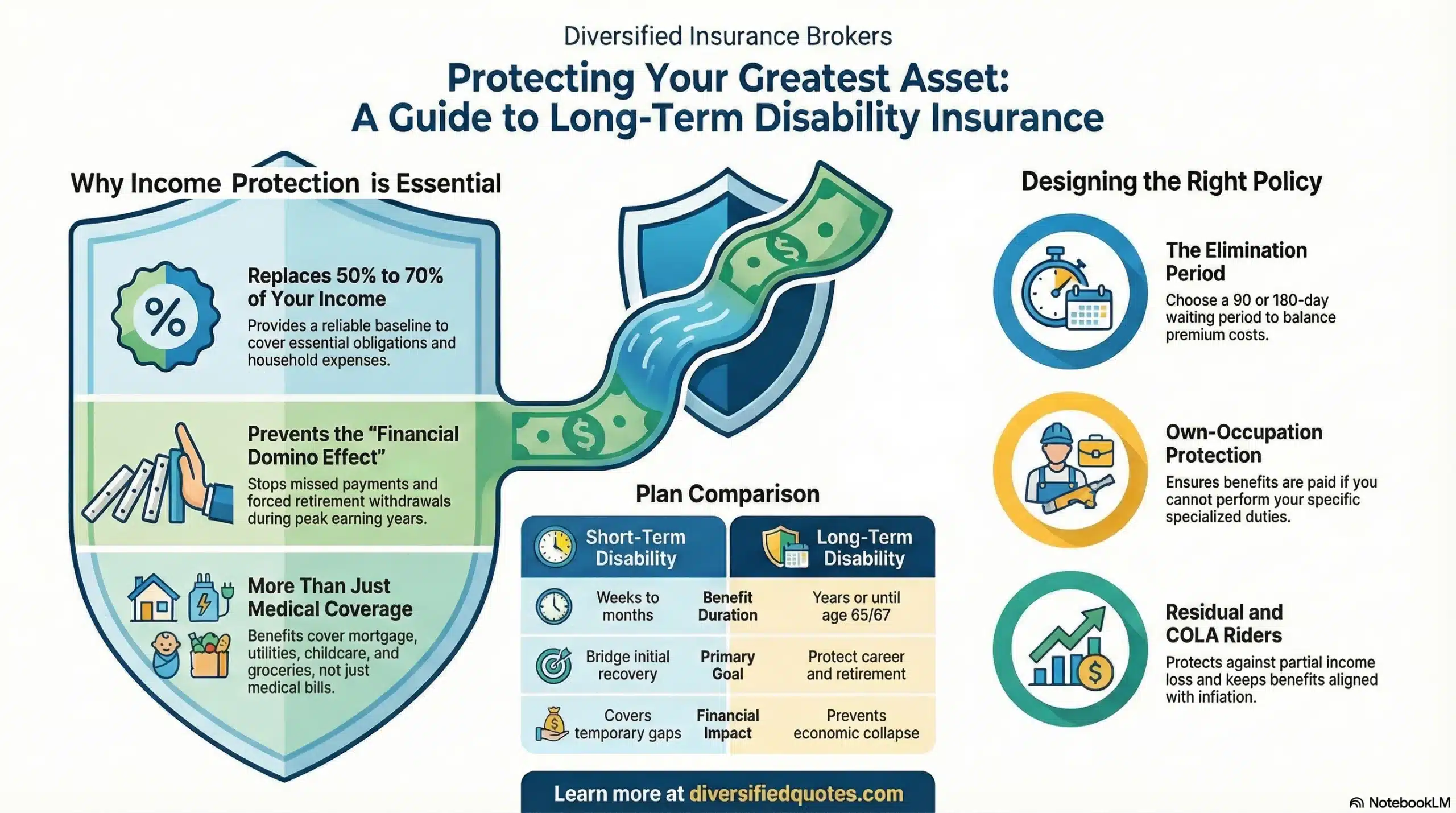
Disability insurance for postal workers should be structured with specific policy provisions that address the physical labor demands of postal work, the FECA coordination requirements, and the specific disability conditions most likely to affect a working postal employee. The own-occupation definition is foundational — ensuring that a letter carrier who cannot perform the sustained walking, lifting, and carrying of carrier duties receives disability benefits regardless of whether they could theoretically perform less physically demanding desk work. Our comprehensive resource on own-occupation disability insurance explained covers how this definition protects postal worker income from the conditions most likely to end an active carrier or handler career.
A residual disability rider is particularly important for postal workers whose musculoskeletal conditions may reduce physical capacity without eliminating it entirely — a carrier who can manage lighter routes or reduced hours but cannot sustain full-load carrier duties earns reduced income without being totally disabled. Our resource on how residual disability insurance benefits work explains how partial disability coverage supports postal workers through graduated return-to-duty. The elimination period should account for FECA wage replacement availability for work-related events and available sick leave — our guide on how disability insurance elimination periods work provides the complete framework. A cost-of-living adjustment rider preserves real benefit value across extended disability periods from progressive musculoskeletal conditions — our resource on disability income insurance with a COLA rider explains this protection. For postal workers exploring short-term coverage alongside long-term disability insurance, our guide on how to buy short-term disability insurance covers the complete income protection picture.
Why Postal Workers Need an Independent Disability Insurance Broker
Disability insurance for postal workers requires understanding the FECA coordination framework, the FERS disability retirement provisions for career employees, the occupational classification considerations for heavy manual carrier and handler work, and the specific income documentation requirements for USPS W-2 income including overtime. A general insurance agent unfamiliar with the federal employee disability benefit structure or the physical demands of postal work will not structure coverage that accurately addresses what a postal worker’s institutional benefits leave open.
At Diversified Insurance Brokers, we work with career and non-career USPS employees across all postal work classifications — letter carriers, mail handlers, postal clerks, rural carriers, and vehicle operators — to structure individual disability insurance that fills the specific gaps in FECA and FERS coverage, covers total postal income including overtime, provides own-occupation protection for physical postal duties, and activates for non-work-related conditions that FECA entirely excludes. Our dedicated resource on why independent disability insurance brokers matter explains the full value of this approach. And our resource on whether disability insurance is worth the investment provides the foundational financial case that applies with particular force to postal workers in a profession that generates the largest single volume of workers’ compensation claims in the entire federal government.
Final Thoughts on Disability Insurance for Postal Workers and Mail Carriers
Postal workers and mail carriers deliver to over 132 million addresses daily through rain, snow, heat, and ice — sustaining the delivery network that American commerce and personal communication depend on through the full range of weather and terrain conditions that make their work consistently hazardous. The 34,000 average annual injuries and $1.22 billion in annual FECA costs that their workforce generates are not failures of a dangerous profession — they are the documented consequence of sustained physical labor conducted at enormous scale in variable conditions across millions of delivery stops per day.
FECA provides a meaningful foundation for work-related injury protection. What it does not provide is coverage for off-duty illness and injury, long-term own-occupation income protection after OWCP benefits conclude, income replacement for non-work-related disabling conditions, and the tax-free benefit advantage that individual disability insurance delivers alongside institutional coverage. Disability insurance for postal workers — structured to fill these specific gaps, calibrated to total postal compensation including overtime, and built with own-occupation definitions that protect carrier and handler work specifically — provides the complete income protection that every postal employee deserves for the physically demanding public service they perform every day.
Related Pages
Talk With an Advisor Today
Choose how you’d like to connect—call or message us, then book a time that works for you.
Schedule here:
calendly.com/jason-dibcompanies/diversified-quotes
Licensed in all 50 states • Fiduciary, family-owned since 1980
Disability Insurance for Postal Workers and Mail Carriers FAQs
Yes — all USPS employees, both career and non-career, are covered under the Federal Employees’ Compensation Act, administered by the Department of Labor’s Office of Workers’ Compensation Programs. FECA is the exclusive workers’ compensation system for postal workers — they are not covered by any state workers’ compensation program. FECA provides medical treatment coverage, wage-loss compensation of 75% of pay for workers with dependents or 66.67% for those without, vocational rehabilitation services, and death benefits for work-related injuries and occupational diseases. In a recent reporting year, USPS employees accounted for approximately 42% of all FECA benefits paid across the entire federal workforce — approximately $1.22 billion — reflecting the extraordinary injury volume that postal work generates relative to other federal employment categories. For postal workers with approved work-related injury claims, FECA provides reasonably comprehensive protection for the immediate injury and recovery period. The gaps in FECA coverage — for non-work-related conditions, for conditions that develop gradually without a single identifiable incident, and for income beyond the 25% wage replacement gap — are where individual disability insurance provides genuine additional protection. For context on FECA coverage as part of a federal employee disability planning framework, see our page on disability insurance for federal and public sector custodial and maintenance workers managing FECA coverage gaps.
FECA has several specific and consequential coverage limitations that leave meaningful income protection gaps for postal workers. Most critically, FECA covers only work-related injuries and occupational diseases — any condition that is not directly caused by or aggravated by specific postal work duties receives no FECA benefit. A letter carrier who develops serious cardiovascular disease, receives a cancer diagnosis, is injured in an off-duty accident, or develops a disability from any condition not attributable to postal work receives zero FECA wage replacement. FECA also ends at maximum medical improvement — when OWCP determines no further medical improvement is expected — which may occur before the postal worker has regained the physical capacity for the sustained carrying, walking, and lifting of active carrier duties, leaving a coverage gap between FECA termination and any other income source. FECA provides 75% or 66.67% wage replacement, leaving 25% to 33% of postal income unprotected even for approved work-related claims with dependents. And FECA benefits can be delayed or disputed during OWCP claim review periods — during which the postal worker’s income protection depends on available sick leave and any individual coverage in place. Individual disability insurance covers any cause of disability, for the full benefit period, without maximum medical improvement cutoffs, and provides income replacement during OWCP dispute periods when FECA benefits are pending.
USPS sustains an average of 34,000 injuries annually across its workforce, and the injury profile reflects the specific physical demands and environmental hazards of postal work. Back and musculoskeletal injuries from heavy mail satchel and package carrying, sustained walking, repetitive bending and reaching, and cumulative physical loading are the most prevalent and most financially consequential disability category — lumbar disc herniations, lumbar strain, and degenerative spinal conditions from years of carrier load-bearing are the most common long-term disability drivers. Slip, trip, and fall injuries on hazardous surfaces — icy sidewalks, uneven pavement, poorly maintained steps, wet surfaces in rain and snow — produce fractures, head injuries, and spinal trauma requiring extended recovery. Dog bites and animal attacks affect over 5,300 letter carriers annually, producing soft tissue injuries, nerve damage, and psychological trauma. Vehicle accidents involving USPS delivery trucks produce orthopedic injuries, traumatic brain injuries, and spinal damage for postal vehicle operators. Repetitive strain conditions — carpal tunnel syndrome from mail sorting and handling, rotator cuff conditions from mail satchel carrying — develop as occupational diseases over careers of sustained repetitive postal work. Heat stroke from sustained outdoor summer work and cold exposure injuries from winter routes add to the environmental hazard profile for outdoor postal positions.
Own-occupation disability insurance pays benefits when a disabling condition prevents performing the specific duties of a letter carrier’s role — sustained walking of delivery routes, carrying heavy mail satchels and packages, navigating residential and business properties in all weather conditions, and the full physical demands of active carrier work — regardless of whether the carrier could theoretically perform other less physically demanding work such as sedentary postal clerk or administrative duties. Any-occupation coverage only pays if the postal worker cannot perform virtually any gainful employment. This distinction is specifically consequential for letter carriers because the FERS disability retirement framework itself requires USPS to consider reassignment to sedentary postal positions before qualifying an employee for disability retirement — potentially denying FERS disability retirement to a carrier who is genuinely physically unable to perform carrier duties but can theoretically perform desk work. An individual own-occupation disability policy protects carrier-specific physical income regardless of whether a desk reassignment is theoretically available, providing the income protection that FERS alone does not guarantee for carriers with physical but not total functional disability. For context on the own-occupation distinction for physically demanding federal and public service occupations, see our page on disability insurance for physical trade and service workers managing own-occupation coverage needs.
Non-career USPS employees — city carrier assistants, rural carrier associates, postal support employees, and other non-career classifications — face a more acute disability insurance need than career employees in several respects. Non-career postal workers are covered under FECA for work-related injuries, which provides meaningful protection for the immediate injury period. However, non-career employees typically do not have access to FERS disability retirement provisions, which require a minimum five-year service requirement that most non-career employees have not completed or may not reach given the conditional nature of their employment. The absence of FERS disability retirement as a backstop means that FECA is the only institutional income protection for non-career postal workers — and when FECA ends at maximum medical improvement, when a condition is not work-related, or when a claim is disputed, there is no secondary institutional income source of any kind. Individual disability insurance is therefore not merely supplemental for non-career postal employees — it may be the only income protection available beyond the FECA work-related injury coverage and whatever personal savings the worker has accumulated. The planning need for non-career postal employees parallels that for other workers without employer-provided long-term disability protection.
Overtime pay represents a meaningful component of total annual compensation for many USPS career employees who regularly work extended shifts, holiday service periods, and peak package volume seasons. FECA wage replacement is calculated on regular pay rates, explicitly excluding overtime — meaning a letter carrier whose total annual income includes significant overtime earnings has a meaningful income gap even when FECA is paying at the 75% replacement rate. FERS disability retirement similarly calculates benefits on the High-3 average base salary, excluding overtime from the calculation. Individual disability insurance carriers document total W-2 compensation including verified overtime earnings when determining the insurable income base, allowing a supplemental policy to be structured that covers total postal compensation rather than base pay alone. For a carrier whose overtime regularly represents 15% to 25% of total annual earnings, the difference between FECA-only income replacement and FECA plus individually supplemented coverage that includes overtime can represent thousands of dollars per year during an extended disability period. Working with an independent broker who understands how to document USPS overtime earnings in disability insurance underwriting is important for securing a benefit amount that reflects genuine total earning capacity.
OWCP claim disputes and denials are a significant practical concern for postal workers — the USPS OIG has documented substantial claim processing delays, and many occupational disease claims in particular are disputed on the grounds of insufficient medical evidence establishing the work-related causal connection. When an OWCP claim is disputed, FECA wage replacement may be delayed or suspended pending appeal review — during which the postal worker’s income depends on available sick leave, annual leave, and any individual disability insurance in place. Individual disability insurance provides income replacement during OWCP dispute periods for claims that are ultimately approved, and provides coverage for conditions that OWCP denies as not work-related even when those conditions are genuinely disabling. For postal workers whose injury or condition involves the borderline work-relatedness that generates OWCP disputes — gradual onset back conditions, stress-related conditions, conditions with mixed work and non-work causation — individual disability insurance provides income replacement regardless of the OWCP adjudication outcome. This OWCP dispute bridging function is one of the most practically important reasons for postal workers to carry individual disability insurance alongside their FECA coverage. For context on OWCP claim disputes and income protection, see our page on disability insurance for federal employees managing institutional benefit disputes and coverage gaps.
Elimination period selection for postal workers should account for FECA wage replacement availability for work-related injuries, available sick leave and annual leave balances, and the nature of the disability — whether it is work-related and therefore eligible for FECA, or non-work-related and requiring other income bridging. For work-related injuries where FECA activates relatively quickly after the CA-1 or CA-2 claim is filed and approved, a 90-day elimination period on an individual supplemental policy may be financially manageable — using sick leave and any continuation pay during the initial period, then FECA income during the remaining waiting period before individual benefits activate. For non-work-related conditions that receive no FECA benefit, the elimination period decision depends entirely on available personal savings. Postal workers with limited sick leave accrual or limited savings reserves should evaluate 30 or 60-day elimination periods to ensure faster benefit access when a non-work-related disability occurs. The key consideration is matching the elimination period to the financial reality of a disability scenario that FECA doesn’t cover — where the financial urgency begins on day one with no institutional bridge income available.
The best time is as early as possible in a postal career — ideally within the first year or two of service, before any occupational health conditions from carrier physical demands, cumulative musculoskeletal loading, or injury history have accumulated in the medical record. Disability insurance premiums are based in part on age and health status at the time of application, and younger postal workers in excellent health secure the most comprehensive coverage at the most favorable rates. Back conditions from carrier load-bearing, shoulder and wrist conditions from sustained mail handling, and any injury history from dog bites, slip and fall incidents, or vehicle accidents can result in exclusion riders or restricted policy terms if documented at application. The non-cancelable and guaranteed renewable provision locks in the early-career health rating for the policy’s entire duration, regardless of what occupational health developments occur during subsequent years of postal service. A future increase option rider secured early also allows benefit amounts to grow with postal pay increases — including career step increases and cost-of-living adjustments — without requiring new medical underwriting when health may have changed from years of physically demanding postal work. For context on early career disability insurance application timing for physically demanding government employment, see our page on disability insurance for government and public sector employees managing early career coverage decisions.
An independent broker accesses multiple disability insurance carriers and compares occupational class assignments, own-occupation definition language, FECA and FERS coordination approaches, overtime income documentation methods, residual disability rider terms, and premium structures across the full marketplace. For postal workers whose institutional protection involves FECA for work-related events, FERS disability retirement for career employees, and sick leave as the only initial bridge for non-work-related conditions, the differences between carriers in how they handle federal employee benefit coordination, physical labor occupational classifications, and overtime documentation produce meaningfully different real-world coverage outcomes. At Diversified Insurance Brokers, we evaluate the full competitive landscape for every postal worker we work with — career and non-career, carrier and handler, city and rural — and structure individual disability insurance that accurately fills the specific gaps in what FECA and FERS leave uncovered, calibrated to total postal compensation and built with the own-occupation and residual disability provisions that postal work physical demands require.
About the Author:
Jason Stolz, CLTC, CRPC, DIA, CAA and Chief Underwriter at Diversified Insurance Brokers (NPN 20471358), is a senior insurance and retirement professional with more than 25 years of real-world experience helping individuals, families, and business owners protect their income, assets, and long-term financial stability. As a long-time partner of the nationally licensed independent agency Diversified Insurance Brokers, Jason provides trusted guidance across multiple specialties—including fixed and indexed annuities, long-term care planning, personal and business disability insurance, life insurance solutions, Group Health, Travel Medical and Evacuation Insurance, and short-term health coverage. Diversified Insurance Brokers maintains active contracts with over 100 highly rated insurance carriers, ensuring clients have access to a broad and competitive marketplace.
His practical, education-first approach has earned recognition in publications such as VoyageATL, and contributions from his agency featured in Kiplinger and GoBankingRates— highlighting his commitment to financial clarity and client-focused planning. Drawing on deep product knowledge and years of hands-on field experience, Jason helps clients evaluate carriers, compare strategies, and build retirement and protection plans that are both secure and cost-efficient. Visitors who want to explore current annuity rates and compare options across multiple insurers can also use this annuity quote and comparison tool.
Explore More Disability Insurance Options: Browse our complete guide to Disability Insurance for Public Safety, Military & Government — covering firefighters, law enforcement, military, pilots, TSA, SWAT & first responders from 100+ carriers.
Last Reviewed: June 8, 2026 |
Reviewed by: Jason Stolz, CLTC, CRPC, DIA, CAA
Chief Underwriter, Diversified Insurance Brokers, Inc. | NPN: 20471358 | Diversified Insurance Brokers, Inc. — Licensed in all 50 states
Fact Checked by: Tonia Pettitt, CMIP©
Medicare Specialist, Diversified Insurance Brokers, Inc. | NPN: 14374308 | Diversified Insurance Brokers, Inc. — Licensed in all 50 states
Did you find this content helpful? Leave us a Google review — it helps others find trustworthy guidance too.
Editorial Standards: Diversified Insurance Brokers maintains rigorous editorial standards to ensure accuracy, clarity, and independence in all content. Learn more about our editorial standards and commitment to transparency.
