
Disability Insurance for Dry Wall Installers
As an Independent Disability Insurance Broker, we have access to exclusive discounts and negotiated pricing most captive agents can’t offer — see the full breakdown near the end of this page.
Disability Insurance for Dry Wall Installers

Jason Stolz CLTC, CRPC, DIA, CAA
Disability insurance for drywall installers is one of the most critical and most underutilized forms of income protection in the construction trades. Whether you hang drywall panels as part of a large commercial crew, operate as a self-employed drywall contractor taking residential projects, specialize in taping and finishing, or focus on drywall sanding and texture work, your ability to earn depends entirely on your physical capacity to perform demanding manual labor in an environment that carries documented, serious occupational hazards every single day.
Drywall installation is physically intensive work. Each standard sheet of drywall weighs between 50 and 120 pounds. Installers lift, position, and fasten these panels repeatedly across full working days, often overhead, often on stilts or scaffolding, and often in confined spaces with poor air circulation. The combination of heavy lifting, overhead work, repetitive motion, fall hazard exposure, and daily inhalation of drywall dust — which contains crystalline silica classified as a known human carcinogen — creates an occupational risk profile that makes disability insurance for drywall installers not merely advisable but genuinely essential.
At Diversified Insurance Brokers, we work with drywall installers, drywall contractors, and construction trade professionals to structure disability insurance coverage that reflects the real physical demands and genuine health risks of drywall work. A properly designed policy protects against acute injuries, chronic musculoskeletal conditions, and the long-term respiratory consequences of dust exposure — and it does so in a way that is built around how drywall professionals actually earn and the specific conditions most likely to interrupt that income.
Protect Your Income as a Drywall Installer
Compare disability insurance options designed for drywall installers, drywall contractors, tapers, finishers, and construction trade professionals.
What Drywall Installation Work Actually Involves
Disability insurance for drywall installers begins with a clear understanding of the physical demands of the trade — because those demands directly define what types of conditions are most likely to end or interrupt a drywall career. Drywall installation is not a single task. It is a sequence of physically demanding operations performed under construction site conditions that change with every project.
Hanging drywall panels requires lifting and positioning sheets weighing 50 to 120 pounds repeatedly across a work shift, often overhead for ceiling installation, often while standing on stilts or scaffolding that raise workers 24 to 40 inches above the floor. Fastening panels requires sustained overhead arm and shoulder work with screw guns and drills. Taping and mudding — the process of filling seams and fastener heads with joint compound — requires sustained fine-motor arm and wrist work across large surface areas. Sanding and finishing — the process of smoothing dried joint compound to a paintable surface — generates intense dust clouds of gypsum, talc, mica, and crystalline silica that fill the work area regardless of ventilation quality.
Each phase of drywall work carries its own specific disability risk profile, and a comprehensive disability insurance strategy for drywall professionals must account for all of them. The construction trade context is familiar across many physically demanding occupations, and the income protection principles that apply to drywall installers are closely aligned with those that govern other high-demand construction trades. The same disability planning framework serves professionals in adjacent trades, such as bricklayers and brick masons in physical construction roles, where heavy material handling and sustained physical exertion define both the career and the disability risk profile.
Silica Dust and Silicosis — The Most Serious Long-Term Disability Risk for Drywall Workers
Of all the occupational hazards facing drywall installers, none carries more serious long-term consequences than crystalline silica exposure from drywall joint compound dust. Crystalline silica — present in the talc, mica, and gypsum compounds used in drywall finishing products — is classified as a known human carcinogen by the International Agency for Research on Cancer and as a carcinogen by the National Toxicology Program. For drywall workers who sand joint compound regularly, exposure levels can reach ten times the OSHA permissible exposure limit, making silica exposure one of the most acute and well-documented occupational hazards in the construction industry.
When crystalline silica dust particles are inhaled, they become permanently embedded in lung tissue. The body’s immune response triggers inflammation and scarring — a process called fibrosis — that progressively destroys lung tissue over time. The resulting disease is silicosis, an incurable, progressive, and potentially fatal respiratory condition. Silicosis has no treatment that reverses the lung damage; medical management can only slow progression and manage symptoms. Chronic silicosis typically develops after ten to thirty years of regular low-level silica exposure, meaning drywall workers who begin their careers in their twenties may not develop symptoms until their forties or fifties — by which point significant and permanent lung damage has already occurred.
Beyond silicosis itself, crystalline silica exposure is associated with substantially elevated lung cancer risk. OSHA and the International Agency for Research on Cancer have both classified crystalline silica as carcinogenic to humans. Studies of construction workers with silica exposure consistently demonstrate elevated rates of lung cancer compared to non-exposed populations. Silica exposure also increases susceptibility to tuberculosis and other infectious respiratory diseases by compromising the immune system’s ability to protect lung tissue.
The implications for disability insurance for drywall installers are profound. A drywall worker who develops silicosis or a silica-related respiratory condition after years of occupational dust exposure is facing a disabling illness that is directly traceable to their work — and for which individual disability insurance is the primary financial protection available. Workers’ compensation covers only work-related injuries with clear event triggers; the gradual development of an occupational lung disease over decades of cumulative exposure is precisely the type of disability that requires individual income replacement coverage to be financially managed. The same long-term occupational disease risk that creates financial vulnerability for drywall workers is documented across other construction trades with dust exposure, including chimney sweepers and workers in confined dusty environments.
Falls, Fractures, and Acute Injury Risks in Drywall Installation
Falls are the leading cause of fatal and serious injury in the construction industry, and drywall installers face significant fall exposure in the course of normal work operations. Installing drywall on stilts — the spring-loaded leg extensions that raise workers to ceiling height — creates a fall hazard that is inherent to the profession. Scaffolding used for commercial ceiling work, ladders used for upper wall sections, and uneven debris-strewn construction site floors all contribute to a daily fall risk environment that drywall installers navigate every shift.
A serious fall from drywall stilts can produce fractures, spinal injuries, traumatic brain injuries, and internal injuries that require extended recovery periods — or that produce permanent functional limitations ending a drywall career entirely. A drywall installer who fractures both wrists in a stilt fall, or who sustains a lumbar spine compression fracture from a scaffold fall, faces a recovery measured in months under the best circumstances and a permanent career-ending disability in more serious scenarios. The financial consequences of that injury, without disability insurance replacing lost income during recovery, can be devastating within weeks for a self-employed installer whose paycheck depends entirely on showing up and working.
Beyond stilt and scaffold falls, drywall installers face acute injury risk from heavy panel handling. Dropping a 100-pound sheet of drywall, losing control of a panel during lifting or positioning, or sustaining a crushing or pinning injury from unsecured material can all produce acute trauma requiring immediate medical attention and extended time away from the physical demands of the trade. For self-employed drywall contractors who are the sole income source for their households, these acute injury scenarios make disability insurance for drywall installers a financial necessity rather than an optional protection. The acute fall and trauma risk that drywall installers face in daily operations is comparable to other height-exposed trades, such as window cleaners working at height on commercial structures.
Musculoskeletal Conditions — The Cumulative Career Burden for Drywall Installers
Drywall installation is among the most musculoskeletally demanding construction trades. The sustained overhead work required for ceiling installation places extraordinary strain on the shoulder rotator cuff, cervical spine, and upper back. Studies of construction workers consistently identify overhead work as a primary risk factor for rotator cuff tears, shoulder impingement syndrome, and cervical disc herniation. A drywall installer who performs ceiling work across multiple projects per week, over years or decades of the trade, accumulates a shoulder and cervical spine injury risk that is not merely occupational — it is nearly inevitable at sufficient exposure levels.
Lower back injury is the most prevalent musculoskeletal disability across construction trades, and drywall installation is no exception. The combination of heavy panel lifting, sustained awkward body postures when working in corners and tight spaces, and repetitive bending, reaching, and twisting motions across full working days creates lumbar spine loading that produces herniated discs, spinal stenosis, and degenerative disc disease at rates well above the general population. Back injuries serious enough to prevent the physical demands of drywall installation — lifting 50 to 120-pound panels, working on stilts, bending and stretching across large wall and ceiling surfaces — are a leading cause of premature career exit in the drywall trade.
Repetitive strain conditions of the hand, wrist, and forearm are documented occupational outcomes for drywall tapers and finishers who perform sustained screwing, mudding, and sanding operations across long working days. Carpal tunnel syndrome, tendinitis, and trigger finger develop from the sustained grip forces and repetitive wrist motions of taping and finishing work, and when severe, can prevent the fine motor operations that skilled finishing requires. A residual disability rider is particularly valuable for drywall professionals whose conditions may reduce work capacity without eliminating it entirely — supplementing reduced earnings during a graduated return to the trade. Our dedicated resource on how residual disability insurance benefits work explains exactly how this coverage functions for workers rebuilding capacity after injury.
Workers’ Compensation vs. Individual Disability Insurance for Drywall Workers
Many drywall installers assume that workers’ compensation insurance provides adequate income protection if they are injured on the job. This assumption leaves significant and consequential gaps that only become visible when a disability actually occurs. Understanding the difference between workers’ compensation and individual disability insurance for drywall installers is one of the most important financial education points in the construction trade.
Workers’ compensation covers injuries that are directly and demonstrably work-related — a fall from stilts on a job site, a panel handling injury during installation, a tool-related laceration. For these acute work-related events, workers’ compensation provides medical treatment coverage and approximately two-thirds of pre-injury wages during recovery. However, workers’ compensation has critical limitations that create immediate financial exposure for drywall professionals.
Workers’ compensation does not cover non-work-related disabilities. A drywall installer who suffers a heart attack, develops cancer, is injured in an automobile accident off-duty, or becomes disabled from any condition not directly connected to a specific workplace event receives zero workers’ compensation benefits — regardless of how long their career has exposed them to the physical demands that may have contributed to the condition. Individual disability insurance covers disability from any cause — work-related or not — providing income replacement whenever a qualifying disabling condition prevents the drywall installer from working, regardless of where or how it originated. The coverage gap that workers’ compensation leaves for non-occupational conditions is the same gap that affects construction professionals across all trades, including boilermakers and heavy trade workers relying on workers’ comp alone.
Workers’ compensation also does not cover the gradual development of occupational diseases. Silicosis — the most serious long-term disability risk for drywall workers — develops over decades of cumulative silica dust exposure, not from a single identifiable work event. Connecting a silicosis diagnosis to a specific employer or specific work event for workers’ compensation purposes is often legally complex, contested, and uncertain. Individual disability insurance, by contrast, covers disability from any medical condition that meets the policy’s definition of disability — including occupational respiratory diseases — without requiring proof of a single causative work event.
Case Study: Drywall Installer Earning $72,000 Per Year
Consider a self-employed drywall contractor earning $72,000 annually across residential and light commercial installation projects. After twelve years in the trade, this installer develops a serious rotator cuff tear in the dominant shoulder from sustained overhead ceiling work, requiring surgical repair and eight months of physical therapy during which overhead drywall installation is not medically feasible.
| Scenario | Without Disability Insurance | With Disability Insurance |
|---|---|---|
| Monthly Income During Recovery | $0 | $3,000–$4,000 |
| 8-Month Total Income | $0 | $24,000–$32,000 |
| Client and Project Pipeline | Lost to competitors during extended absence | Financial stability allows planned return without desperation |
| Financial Outcome | Savings depleted, mortgage at risk, forced return too soon | Full recovery supported, return on medical timeline |
Rotator cuff injuries in drywall installers are not unusual — overhead installation work is one of the most well-documented risk factors for rotator cuff pathology in occupational medicine. Disability insurance for drywall installers ensures that when this predictable occupational injury occurs, it does not simultaneously produce a financial emergency that forces premature return to work and risks re-injury or a worse long-term outcome.
Disability Insurance for Self-Employed Drywall Contractors
The majority of drywall installers operate as independent contractors or self-employed sole proprietors — taking jobs through general contractors, building their own client relationships, and running their own small businesses without the employee benefit structure that provides at least baseline protection to salaried workers. This employment structure creates a financial vulnerability that is unique to self-employed tradespeople: when a disability strikes, income stops immediately and completely, with no employer sick pay, no group disability plan, and no paid leave of any kind to bridge the gap.
Individual disability insurance purchased through an independent broker is the only meaningful income replacement tool available to self-employed drywall contractors facing a disabling condition. Social Security Disability Insurance exists as a government backstop, but qualifying for SSDI requires demonstrating total inability to perform any substantial gainful activity — a very high bar — and the application and approval process typically takes many months to years, during which time no income replacement is provided. For a drywall installer whose household financial obligations depend on regular project income, SSDI is not a functional substitute for individual disability insurance.
Self-employed drywall contractors should also consider business overhead expense coverage alongside personal income replacement disability insurance. Equipment payments, vehicle costs, tool maintenance expenses, and project-related fixed costs all continue during a disability regardless of whether the contractor is working. A business overhead expense policy covers these fixed costs during a disability period, preventing a temporary health event from forcing permanent business closure due to inability to meet ongoing obligations. Understanding the full range of policy structures available begins with working with an experienced broker — our resource on own-occupation disability insurance explained is an essential starting point for any self-employed trade professional evaluating their options.
Key Policy Features for Drywall Installer Disability Insurance
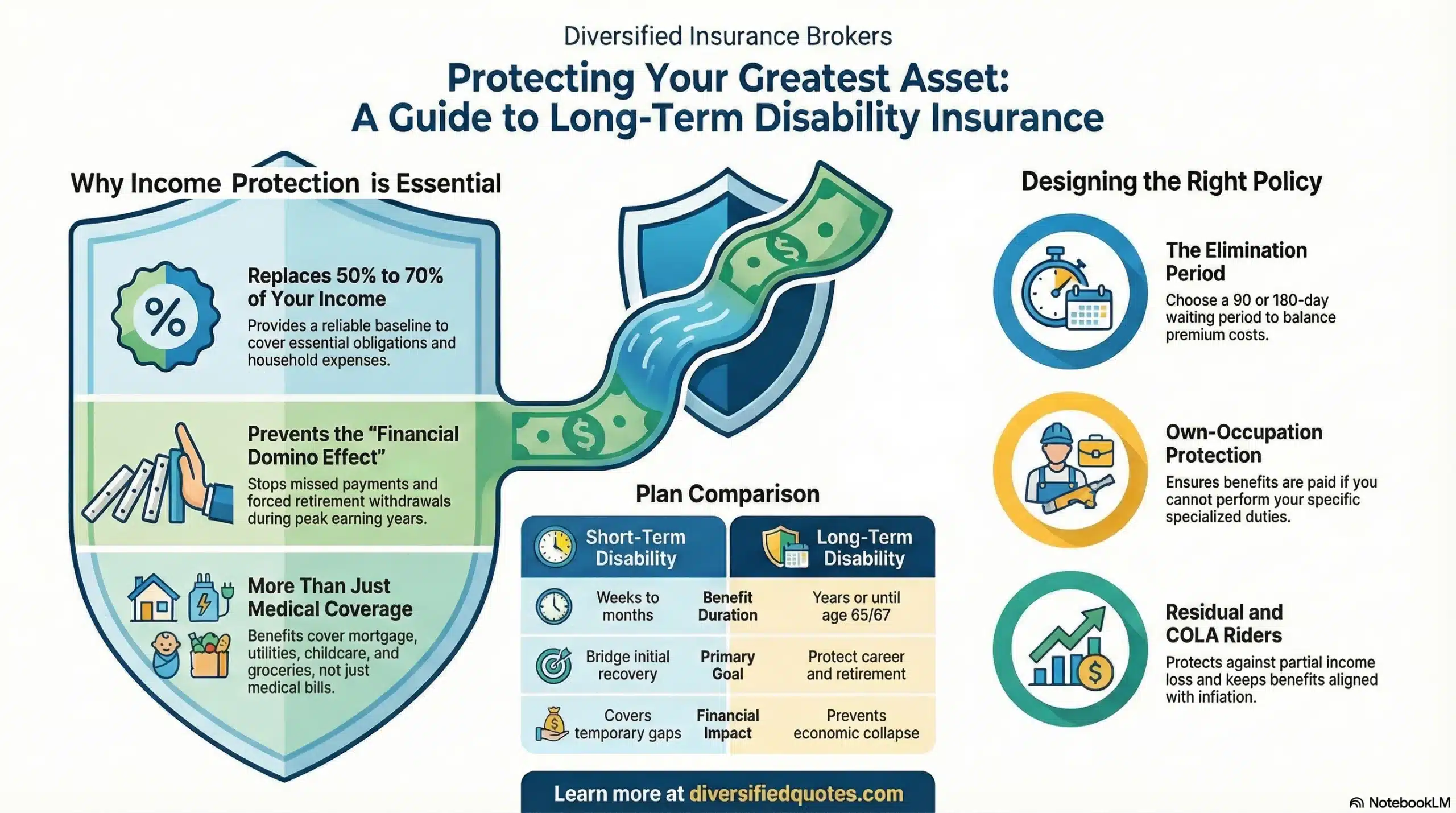
Disability insurance for drywall installers should be structured with specific policy provisions that address the realities of physical trade work. The definition of disability in the policy is foundational — and for a drywall installer, the own-occupation definition is the standard that provides genuine protection. Own-occupation disability insurance pays benefits when a condition prevents the installer from performing the specific duties of drywall installation — lifting heavy panels, working on stilts, performing overhead work — regardless of whether the insured could theoretically perform lighter or different work. An any-occupation definition would deny benefits to a drywall installer who can no longer perform trade work but could technically perform a desk job.
An elimination period — the waiting time before benefits begin — should be calibrated to the contractor’s available financial reserves. Self-employed drywall installers with limited emergency savings and immediate financial obligations should consider a 30 or 60-day elimination period that provides faster benefit access at a higher premium cost. Those with stronger financial cushions can comfortably accept a 90-day elimination period to reduce premiums. Our guide on how elimination periods work walks through how to match your waiting period to your actual financial situation.
A cost-of-living adjustment rider is particularly valuable for drywall professionals who may experience a long-term disability from a gradually developing occupational respiratory disease. Without COLA protection, a monthly benefit adequate at the onset of a silicosis-related disability loses real purchasing power over the extended period that a progressive respiratory condition may produce. Our resource on disability income insurance with a COLA rider explains how this inflation protection works during an extended claim.
Income Documentation for Self-Employed Drywall Contractors
Disability insurance carriers base benefit amounts on verified earned income — typically using two to three years of federal tax returns. For self-employed drywall contractors, Schedule C net profit is the primary income figure used in underwriting. This creates an important planning consideration: contractors who aggressively deduct business expenses — tools, vehicle costs, materials, subcontractor payments — reduce their reported net profit, which simultaneously reduces the income available to insure and the maximum monthly benefit available under a disability policy.
For drywall contractors whose annual income fluctuates with construction market conditions, project volume, and seasonal demand patterns, presenting income documentation effectively to underwriters requires experience with how carriers evaluate variable self-employment earnings. A weighted average of recent income years, documentation of business revenue alongside net profit, and employer-generated W-2 income for contractors who occasionally work as employees all play roles in maximizing the insurable benefit amount. This is precisely where working with an independent broker who understands construction trade self-employment income structures produces materially better coverage outcomes. The same income documentation challenges apply broadly to other self-employed construction trade professionals, including construction superintendents and independent contractors navigating the same self-employment income underwriting landscape.
Why Drywall Installers Need an Independent Disability Insurance Broker
Disability insurance for drywall installers is a high-risk occupational placement that requires carrier expertise beyond what a general insurance agent can provide. The physical labor occupational classification that drywall installation receives reflects the genuine hazard profile of the trade, and not all carriers write policies for this occupational class at competitive terms. Some carriers impose exclusion riders on musculoskeletal conditions — the most likely disabling conditions for a drywall installer — that effectively eliminate the most relevant coverage. Others offer genuinely comprehensive protection at occupationally appropriate rates.
At Diversified Insurance Brokers, we have access to carriers across the full range of occupational classifications and the experience to identify which carriers write drywall and construction trade disability policies with the most favorable terms, strongest own-occupation definitions, and most complete coverage for the conditions most likely to disable a working drywall installer. We structure coverage based on how drywall professionals actually earn their income and what specific conditions would genuinely interrupt that earning capacity — ensuring that every policy we recommend will actually perform when it needs to. For a full explanation of how independent broker access produces better outcomes than single-carrier applications, our resource on why independent disability insurance brokers matter covers the complete picture.
Final Thoughts on Disability Insurance for Drywall Installers
Drywall installers perform physically demanding, skilled work that is essential to every construction and renovation project in the country. The occupational hazards of the trade — from the immediate fall and acute injury risks of stilt and scaffold work, to the cumulative musculoskeletal damage of years of heavy panel handling and overhead installation, to the long-term respiratory consequences of crystalline silica dust exposure — are real, well-documented, and capable of ending a drywall career permanently at any point.
Disability insurance for drywall installers is the financial tool that ensures a career-ending health event does not simultaneously become a personal financial catastrophe. A well-structured policy — built around an own-occupation definition, appropriate benefit amount, residual disability coverage, and provisions for the long-term nature of occupational respiratory disease — provides the income replacement that allows a drywall professional to recover from a position of financial stability. At Diversified Insurance Brokers, we are committed to helping every drywall installer and contractor secure that protection at the best available terms.
Related Pages
Talk With an Advisor Today
Choose how you’d like to connect—call or message us, then book a time that works for you.
Schedule here:
calendly.com/jason-dibcompanies/diversified-quotes
Licensed in all 50 states • Fiduciary, family-owned since 1980
Disability Insurance for Drywall Installers FAQs
Yes, drywall installers and drywall contractors can obtain individual disability insurance. The occupation is classified in the lower physical labor occupational tiers — reflecting the significant fall exposure, heavy panel handling, overhead work demands, and dust inhalation risks of the trade — which affects premium costs and the specific policy features available. Disability insurance for drywall installers is obtainable from carriers that write physical and construction trade occupational classes, and the income protection it provides is directly relevant to the real disability risks of the profession. Self-employed drywall contractors face an additional income documentation challenge in underwriting, making an experienced independent broker particularly important for securing coverage that accurately reflects earning capacity and responds effectively to the most likely disability scenarios.
Silicosis is an incurable, progressive lung disease caused by inhaling crystalline silica particles, which become permanently embedded in lung tissue and trigger fibrosis — scarring that progressively destroys the lung’s ability to extract oxygen from air. There is no cure for silicosis. Once lung scarring develops, it worsens over time even after silica exposure stops. Drywall workers who sand joint compound are among the most seriously exposed silica dust workers in any trade — NIOSH documented exposure levels up to ten times the OSHA permissible exposure limit in drywall sanding operations. Chronic silicosis typically develops after ten to thirty years of occupational exposure, meaning career drywall workers may not receive a diagnosis until they are in their forties or fifties. Crystalline silica is also classified as a known human carcinogen by the International Agency for Research on Cancer, with elevated lung cancer risk documented in silica-exposed workers. Individual disability insurance covers disability from any cause, including silicosis and silica-related illness, when the condition meets the policy’s definition of disability. For context on similar long-term dust exposure risks, see our page on disability insurance for chimney sweepers.
No, and the gaps in workers’ compensation coverage are significant for drywall installers. Workers’ compensation covers injuries that are directly and demonstrably work-related — a specific fall event, a tool injury, an acute panel handling accident. It does not cover non-work-related disabilities of any kind. A drywall installer who develops cancer, suffers a heart attack, is injured in an off-duty accident, or becomes disabled from any condition not connected to a specific workplace event receives zero workers’ compensation benefits. Workers’ compensation also struggles to cover gradually developing occupational diseases like silicosis, where the disabling condition results from cumulative exposure over decades rather than a single identifiable work event. Individual disability insurance covers disability from any cause — filling the significant non-occupational and occupational disease gaps that workers’ compensation leaves open for drywall professionals.
The most prevalent disabling conditions for drywall installers fall into three categories. Acute injuries from falls — off stilts, from scaffolding, or on debris-strewn construction floors — can produce fractures, spinal injuries, and traumatic brain injuries requiring extended recovery or producing permanent limitations. Musculoskeletal conditions from sustained physical demands are the most prevalent chronic disability risk: rotator cuff tears from overhead ceiling work, lower back injuries from heavy panel lifting and awkward postures, and repetitive strain conditions including carpal tunnel syndrome and tendinitis from taping and finishing work. Long-term respiratory disease from crystalline silica dust inhalation — including silicosis and lung cancer — represents the most serious potential long-term disability outcome for career drywall professionals with sustained sanding and finishing exposure. Our resource on residual disability insurance benefits explained covers how partial disability protection works for conditions that reduce but do not eliminate work capacity.
Own-occupation disability insurance pays benefits when a condition prevents a drywall installer from performing the specific duties of their trade — lifting heavy panels, working on stilts, performing overhead installation — regardless of whether they could theoretically perform other types of lighter work. Any-occupation coverage only pays if the insured cannot perform virtually any gainful employment. For a drywall installer whose rotator cuff injury prevents overhead work but who could technically perform a desk job, an any-occupation policy would deny benefits. An own-occupation policy would recognize the genuine inability to perform drywall installation duties and pay accordingly. Understanding this difference thoroughly before purchasing is essential — our page on own-occupation disability insurance explained covers how this definition protects trade professionals in practice.
Residual disability coverage pays proportional benefits when a disability reduces earning capacity without eliminating the ability to work entirely. For a drywall installer recovering from a shoulder injury, back surgery, or other physical condition, return to full trade work typically happens gradually — lighter tasks first, shorter working days, restrictions on overhead or heavy lifting before full medical clearance. During this transition, income is reduced but not eliminated. Without a residual disability rider, a total-disability-only policy pays nothing during the partial recovery period. A residual rider supplements reduced earnings proportionally throughout the return-to-work arc, providing financial support from the onset of disability through to full return to unrestricted drywall work. For trade professionals who often rebuild work capacity over weeks or months rather than returning all at once, this rider is essential to preventing a coverage gap precisely when financial support is still needed.
The elimination period is the waiting time between the onset of disability and when benefits begin. Self-employed drywall contractors with no employer sick pay, no partner income safety net, and limited emergency savings should seriously consider a 30 or 60-day elimination period that provides faster benefit access — even at a higher premium cost. For a sole contractor whose project income stops immediately when they cannot work, and who has ongoing vehicle, equipment, and business costs accumulating during the disability, a shorter waiting period before benefits begin can be critical financial protection. Contractors with stronger financial reserves may comfortably accept a 90-day elimination period to reduce premiums. Our full guide on how disability insurance elimination periods work helps you evaluate which waiting period fits your specific financial situation.
Yes. Individual disability insurance covers disability from any cause — including occupational lung diseases such as silicosis — when the condition meets the policy’s definition of disability. A drywall worker who develops silicosis to the point that the condition prevents them from performing their trade duties qualifies for disability benefits under a well-structured individual policy. The critical planning implication is timing: applying for disability insurance before a silicosis diagnosis has appeared in the medical record is essential. Once silicosis is diagnosed, underwriters may impose exclusion riders or more restrictive policy terms. Because silicosis typically develops after a decade or more of exposure — and because a drywall worker in good health today may be developing the early stages of the disease without any current symptoms — applying for comprehensive coverage as early as possible in a drywall career is the most important timing decision any drywall professional can make regarding disability insurance.
Yes. Self-employed drywall contractors who have ongoing fixed business costs — vehicle payments, tool financing, equipment maintenance, fuel, insurance, and project-related fixed expenses — should strongly consider business overhead expense coverage alongside personal income replacement disability insurance. These fixed costs continue during a disability regardless of whether the contractor is working, creating a financial burden on top of the loss of personal income. Business overhead expense insurance covers these fixed business costs during a disability period, preventing a temporary health event from forcing permanent business closure due to inability to meet ongoing obligations. Personal disability income insurance and business overhead expense coverage address two distinct financial needs and are most effective when structured together for any self-employed contractor whose personal finances and business finances are interconnected.
Disability insurance carriers base benefit amounts on verified earned income using federal tax returns. For self-employed drywall contractors, Schedule C net profit is the primary figure used. Contractors who aggressively deduct business expenses reduce their net profit, which simultaneously reduces the insurable income base. For contractors with fluctuating annual income based on construction market conditions and project volume, a weighted average of recent income years may produce a more favorable underwriting outcome than a single-year snapshot. Working with an independent broker who understands how to present construction trade self-employment income documentation to underwriters in the most accurate and favorable light is essential for securing a benefit amount that reflects actual earning capacity. For more context, see our page on disability insurance for construction workers and independent contractors.
The best time is as early as possible in a drywall career — before occupational health conditions from physical demands or dust exposure have accumulated in the medical record. This timing principle is especially critical for drywall installers because the most serious long-term disability risk — silicosis from crystalline silica exposure — develops gradually over a career with no symptoms in the early stages. A drywall installer in their twenties or early thirties who appears completely healthy today may be accumulating silica-related lung damage that will not produce a diagnosable condition for another decade or more. Applying for disability insurance while young and healthy secures comprehensive coverage without exclusion riders that would eliminate the most relevant long-term conditions. The coverage secured early in the career is the coverage that will be in force when occupational health consequences eventually emerge. Our dedicated resource on why working with an independent disability broker matters explains how to navigate this process effectively.
About the Author:
Jason Stolz, CLTC, CRPC, DIA, CAA and Chief Underwriter at Diversified Insurance Brokers (NPN 20471358), is a senior insurance and retirement professional with more than 25 years of real-world experience helping individuals, families, and business owners protect their income, assets, and long-term financial stability. As a long-time partner of the nationally licensed independent agency Diversified Insurance Brokers, Jason provides trusted guidance across multiple specialties—including fixed and indexed annuities, long-term care planning, personal and business disability insurance, life insurance solutions, Group Health, Travel Medical and Evacuation Insurance, and short-term health coverage. Diversified Insurance Brokers maintains active contracts with over 100 highly rated insurance carriers, ensuring clients have access to a broad and competitive marketplace.
His practical, education-first approach has earned recognition in publications such as VoyageATL, and contributions from his agency featured in Kiplinger and GoBankingRates— highlighting his commitment to financial clarity and client-focused planning. Drawing on deep product knowledge and years of hands-on field experience, Jason helps clients evaluate carriers, compare strategies, and build retirement and protection plans that are both secure and cost-efficient. Visitors who want to explore current annuity rates and compare options across multiple insurers can also use this annuity quote and comparison tool.
Explore More Disability Insurance Options: Browse our complete guide to Disability Insurance for Trades, Construction & Industrial — covering contractors, electricians, plumbers, welders, roofers, machinists & skilled trades from 100+ carriers.
Last Reviewed: June 7, 2026 |
Reviewed by: Jason Stolz, CLTC, CRPC, DIA, CAA
Chief Underwriter, Diversified Insurance Brokers, Inc. | NPN: 20471358 | Diversified Insurance Brokers, Inc. — Licensed in all 50 states
Fact Checked by: Tonia Pettitt, CMIP©
Medicare Specialist, Diversified Insurance Brokers, Inc. | NPN: 14374308 | Diversified Insurance Brokers, Inc. — Licensed in all 50 states
Did you find this content helpful? Leave us a Google review — it helps others find trustworthy guidance too.
Editorial Standards: Diversified Insurance Brokers maintains rigorous editorial standards to ensure accuracy, clarity, and independence in all content. Learn more about our editorial standards and commitment to transparency.
