
Disability Insurance for Chimney Sweepers
As an Independent Disability Insurance Broker, we have access to exclusive discounts and negotiated pricing most captive agents can’t offer — see the full breakdown near the end of this page.
Disability Insurance for Chimney Sweepers

Jason Stolz CLTC, CRPC, DIA, CAA
Chimney sweepers carry one of the most extensively documented occupational cancer risk profiles in the history of occupational medicine — a distinction dating to 1775, when the first recorded description of occupational cancer in the medical literature documented elevated scrotal cancer incidence among chimney sweeps, establishing the profession as the original case study in occupational carcinogen exposure. Modern peer-reviewed research has confirmed and extended this historical finding: a Swedish cohort study of more than 6,300 chimney sweeps followed for nearly five decades documented a standardized incidence ratio of 1.30 — meaning 30 percent more total cancer cases than expected in the general male population — with significantly elevated incidence specifically documented for cancers of the esophagus, liver, lung, bladder, colon, and pleura. Beyond the cancer risk, chimney sweeps face the full physical hazard suite of roof and elevated-surface work: occupational safety research specifically identifies falls from portable ladders and roof surfaces as a significant injury source, with individual sweeps typically working alone and bearing personal responsibility for safety assessment on each job site. Industry safety publications identify respiratory hazards from creosote, soot, polycyclic aromatic hydrocarbons, silica, and carbon monoxide as the occupational health signature of the profession, alongside burn risk from residual heat in recently used chimneys and chemical exposure from organic solvents used in commercial kitchen duct cleaning. The overwhelming majority of professional chimney sweeps operate as self-employed sole proprietors or small LLC operators who carry no employer benefit baseline, no workers’ compensation for their own injuries, and no income protection of any kind other than what they individually purchase — making self-employed income protection the only financial floor available when a fall injury, respiratory condition, or illness eliminates the ability to work.
At Diversified Insurance Brokers, Jason Stolz, CLTC, CRPC, DIA, CAA works with professional chimney sweeps and chimney service business owners across the full range of industry structures — sole-proprietor sweeps working individual residential service routes, small chimney service companies with a few employees and trucks, and dual-trade operators who combine chimney sweeping with fireplace installation or masonry work. The coverage architecture for a sole-proprietor chimney sweep is primarily personal disability income protection sized to documented Schedule C income, while a chimney service business owner with meaningful overhead — vehicles, equipment, employee wages, insurance costs — adds the business overhead expense disability coverage layer that protects the business during the owner’s disability. The underwriting complexity of the chimney sweep’s documented cancer risk profile makes the question of what coverage is available for this specific self-employed trade important to assess through an independent broker with access to the full carrier market rather than a single company’s guidelines.
Compare Disability Coverage for Chimney Sweepers
We review coverage options across 100+ carriers and identify the policy structure that fits your chimney service income, business structure, and occupational risk profile.
Request Disability Insurance OptionsChimney Sweep Disability Risk — Documented Hazards, Cancer Risk, and the Self-Employment Gap
| Risk Category | Research and Work Context | Resulting Disability Risk | Coverage Status | Income Protection Gap |
|---|---|---|---|---|
| Occupational cancer from chemical exposure | Peer-reviewed Swedish cohort research (n=6,320; followed 1958–2006) documents a 30% excess cancer incidence among chimney sweeps vs. general population; significantly elevated incidence for esophageal, liver, lung, bladder, colon, and pleural cancers; exposure to PAHs in soot, creosote, silica in mortar dust, carbon particles, and organic solvents is the documented mechanism; this is one of the most extensively studied occupational cancer risk profiles in the medical literature | Cancer diagnosis requiring extended treatment and recovery — one of the leading causes of long-term disability across all occupations, with the chimney sweep’s elevated incidence adding statistical weight to an already high population-level risk | Workers’ comp does not cover illness-based cancer disability; self-employed sweeps carry zero employer benefits; individual DI is the only income floor available | Complete gap; individual DI to age 65 covers qualifying illness-based disability including the elevated cancer risk documented for this occupation |
| Falls from roofs and ladders | Occupational health research on chimney sweeps specifically identifies falls from portable ladders and roof surfaces as a significant injury source; sweeps typically work alone with personal responsibility for their own safety assessment; elevated surfaces are a constant feature of residential service work; OSHA documents falls as the leading cause of fatal injuries in construction and building services | Spinal fractures, TBI, and extremity injuries from roof or ladder falls — injuries that can produce extended recovery or permanent disability preventing the physical demands of chimney service work | Self-employed sweeps carry no workers’ comp for their own falls; zero employer benefits; complete gap | Full gap; individual DI covers qualifying disability from acute fall injuries regardless of self-employment structure |
| Respiratory conditions from soot and chemical exposure | Industry safety research documents chimney sweeps at increased risk of asthma, bronchitis, and COPD from sustained inhalation of soot particles, creosote vapors, silica dust released from mortar scraping, PAH-laden particles, and organic solvent vapors; research identifies eye and respiratory tract problems as occupational symptoms that specifically improve when sweeps shift away from soot-heavy black chimney work | Occupational asthma, COPD, or chronic bronchitis severe enough to prevent sustained chimney sweep work in the dusty, chemical-dense work environment — a respiratory disability directly tied to the specific exposures of the trade | Gradual respiratory conditions outside workers’ comp incident framework; self-employed sweeps entirely unprotected | Full gap; individual DI covers qualifying respiratory disability regardless of gradual onset or occupational cause |
| Musculoskeletal strain from physical demands | Industry safety publications document chimney sweep work as involving heavy lifting of equipment, ladder carrying and climbing, awkward postures in confined flue access and rooftop positions, and the ergonomic strain of working at difficult angles — the physical demand profile of a physically intensive service trade | Chronic back conditions, shoulder injuries, and knee degeneration from the cumulative physical demands of sustained chimney service work — progressive musculoskeletal conditions that may eventually prevent continued trade work | Cumulative conditions disputed in workers’ comp as lacking datable incident; self-employed unprotected | Significant gap; individual DI covers disability from any qualifying cause without incident documentation requirement |
| Carbon monoxide and burn risk | Industry safety guidance specifically identifies carbon monoxide poisoning risk from inadequate ventilation during chimney work, and burn risk from residual heat in chimneys used shortly before sweep arrival — both acute hazards requiring specific precautions that a solo sweep working independently must personally manage | CO poisoning producing neurological sequelae or cardiac effects; burn injuries to hands and forearms from hot masonry or metal components — acute disability-producing events specific to the chimney service work environment | Self-employed sweeps carry no workers’ comp; zero employer coverage | Full gap; individual DI covers qualifying disability from acute CO exposure or burn injuries regardless of self-employment |
The table establishes the chimney sweep’s disability risk as simultaneously physical — falls, burns, CO exposure, musculoskeletal demands — and occupational-illness based, with the latter category anchored by some of the most extensively documented occupational carcinogen research in the medical literature. The cancer risk dimension specifically underscores why income protection matters urgently for chimney sweeps: the illness-based disability that affects approximately 90 percent of all long-term disability cases is compounded here by documented elevated cancer incidence from the trade’s specific chemical exposures — a population-level risk that workers’ compensation does not address at all, and that only individual disability insurance to age 65 can protect against financially.
The Cancer and Respiratory Risk — What Five Decades of Research Documents
The occupational cancer risk of chimney sweeping is not anecdotal or theoretical — it is one of the most extensively studied occupational health topics in medical history, beginning with the first documented description of occupational cancer in 1775 and continuing through peer-reviewed cohort research published in the American Journal of Public Health. The Swedish chimney sweep cohort study — the largest and most methodologically rigorous study of its kind — followed more than 6,300 chimney sweep trade union members from 1958 through 2006, observing 813 primary cancers against 626 expected in a comparable general male population, producing a standardized incidence ratio of 1.30. The specific cancers showing significantly elevated incidence — esophagus, liver, lung, bladder, colon, and pleura — map directly to the chemical exposure profile of chimney sweep work: polycyclic aromatic hydrocarbons in soot and creosote are established carcinogens affecting multiple organ systems, silica released from mortar creates lung cancer and respiratory disease risk, and the organic solvents used in commercial kitchen duct cleaning add further chemical carcinogen exposure to the occupational profile.
Industry safety resources document the specific respiratory hazard categories that drive both the short-term symptomatic complaints and the long-term disease risk: PAH-laden black soot, creosote vapors, silica dust from mortar, carbon particles, combustion gases, and chemical solvent vapors collectively create a respiratory exposure that research associates with elevated asthma, bronchitis, and COPD incidence alongside the cancer risk. For the chimney sweep’s disability insurance planning, this documented illness risk creates the most important planning imperative: the illness-based disability that represents approximately 90 percent of all long-term disabling conditions is specifically elevated above the general population rate for this trade. Long-term disability income coverage to age 65 specifically addresses this scenario — providing income replacement across a cancer treatment and recovery timeline that workers’ compensation covers zero of, for a self-employed sweep with no employer benefit baseline. Short-term disability coverage addresses the immediate income gap following acute disability events or the early stages of a qualifying illness before long-term protection activates.
Fall Risk — The Physical Accident Pathway
Alongside the documented illness risk, chimney sweeps face the elevated fall risk that accompanies any trade requiring regular work at height on residential roof surfaces. Occupational health research on chimney sweeps specifically identifies falls from portable ladders as a significant injury source, with individual sweeps typically working alone and bearing personal responsibility for their own hazard assessment at each job site. The time pressure that industry research identifies as a risk factor in chimney service work — sweeps often scheduling multiple jobs per day with limited setup time — compounds the fall risk by limiting the thoroughness of each site assessment. Falls from roof surfaces and ladders in the six to twenty-foot range produce the fractures, spinal injuries, and head injuries that regularly result in weeks to months of disability even when non-fatal.
A solo self-employed chimney sweep who falls from a roof on a Tuesday morning has no workers’ compensation claim to file, no employer to report an incident to, and no group disability plan to activate — only the individual disability policy they purchased and maintain, or nothing. Accident-only disability income insurance provides an accessible lower-cost entry point for sweeps who want targeted protection for the acute physical accident scenarios their trade creates, as a starting point or complement to comprehensive illness-inclusive coverage. Understanding how short-term and long-term disability structures interact is important for chimney sweeps whose disability scenarios range from the recoverable fracture requiring several weeks of healing to the back injury requiring surgery and extended recovery that prevents a return to roof-level service work. An own-occupation policy that specifically covers chimney service work — including the roof access, physical lifting, and manual service demands that define the trade — pays benefits when disability prevents that specific work regardless of whether other sedentary employment might theoretically be possible.
Business Overhead and Income Documentation for Chimney Service Operators
Self-employed chimney sweeps whose operations have grown beyond solo service work — adding trucks, professional equipment, vacuum systems, employee labor, and the overhead costs of a small service business — face the same two-layer disability exposure as any service trade business owner. Personal disability income insurance addresses the owner’s earned income from the business. The business overhead expense disability structure addresses the business’s fixed operating costs: vehicle payments, equipment financing, liability insurance, professional memberships, advertising commitments, and any employee wages — all of which continue during a disability regardless of whether the owner is actively sweeping chimneys. For a chimney service operator with one or two service vehicles and employed technicians, a disability that eliminates the owner’s ability to work creates both personal income loss and unmet overhead obligations that, uncovered, can threaten the business’s survival during a recovery period.
Income documentation for a chimney sweep’s disability insurance application uses Schedule C from federal tax returns, capturing net earned income from chimney service work as the benefit calculation basis. The seasonal nature of chimney service demand — higher in fall and winter, lower in summer — means two to three year income averaging appropriately smooths the variability that any single-year figure would overstate or understate. Coverage for independent chimney service contractors and income protection for 1099-earning service professionals follow the same Schedule C documentation framework. How much personal disability income a chimney sweep needs depends on documented average annual service income and household financial obligations during a disability period. The elimination period should reflect actual personal reserves. The future increase option is valuable for new sweeps building their service businesses. Cost of living adjustment protects purchasing power across extended illness-based disability periods. Coverage for sweeps with prior respiratory or health histories is available through independent broker comparison. Specialty and modified options address sweeps whose documented history creates underwriting complexity. No-exam coverage provides streamlined approval for healthy sweeps. Getting the best available rates in a higher-risk trade means applying before health histories from occupational exposures develop and comparing across carriers whose guidelines for the chimney service trade vary. Why new chimney sweeps need income protection at career start is answered directly by the occupational cancer research: the documented elevated cancer incidence from this trade’s chemical exposures has a cumulative dose-response relationship with years of exposure, making the earlier the coverage is established — before any exposure-related health history develops — the broader and more comprehensive the available protection terms. Whether coverage is worth the cost for a chimney sweep is answered by comparing the cost of the policy against what several months of service income the household would lose without it. Residual disability coverage addresses partial recovery scenarios where a sweep can handle some but not all scheduled jobs during recovery. Guarantee issue options provide access for sweeps whose documented health history creates standard underwriting challenges. Coverage for newly established chimney service professionals should be prioritized from career start before the occupational exposure record accumulates.
Get Your Chimney Service Coverage Review
We compare coverage options across 100+ carriers and identify the personal income and business overhead structure that fits your chimney service operation and risk profile.
Request Disability Insurance Options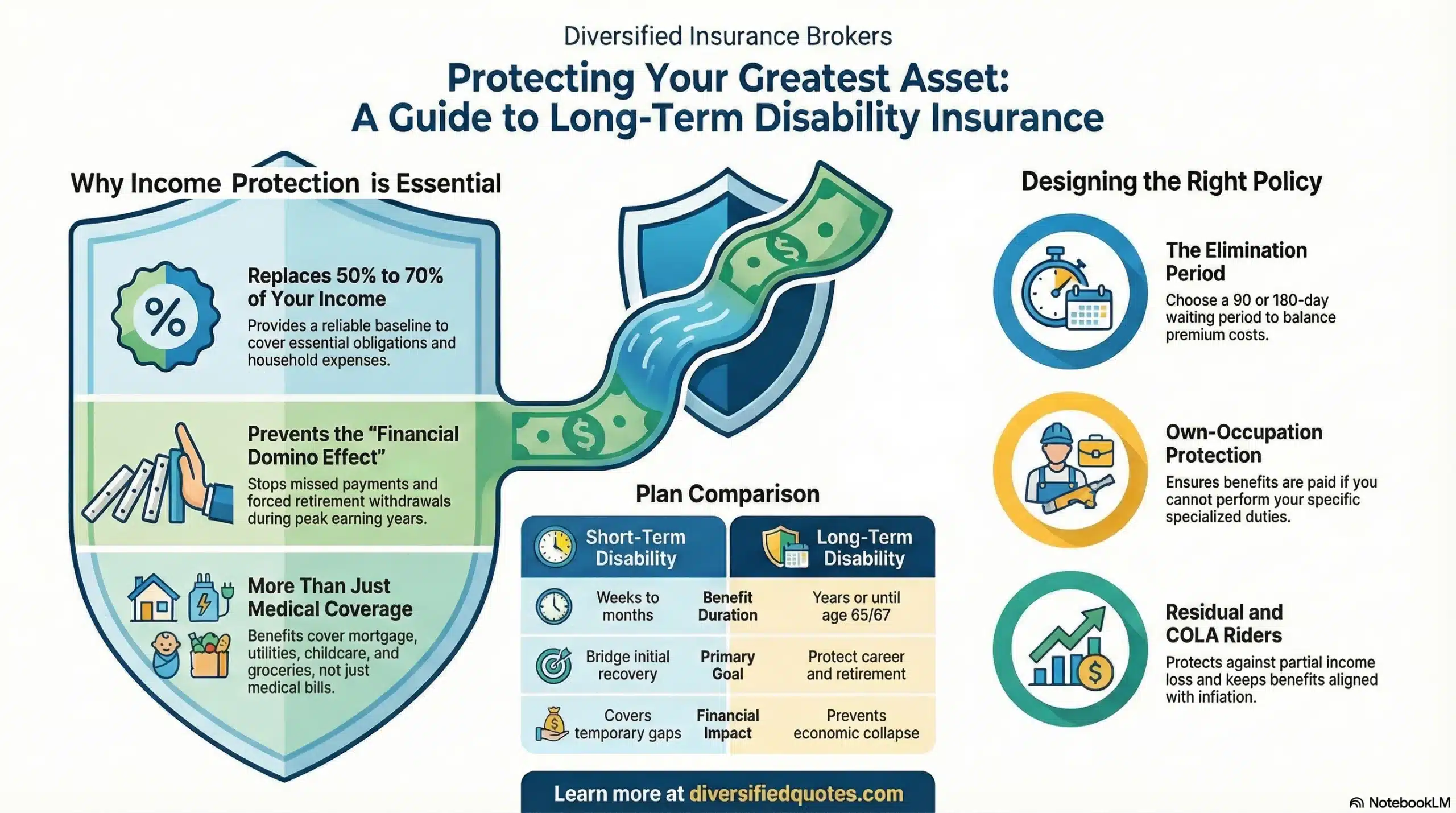
Talk With an Advisor Today
Choose how you’d like to connect—call or message us, then book a time that works for you.
Schedule here:
calendly.com/jason-dibcompanies/diversified-quotes
Licensed in all 50 states • Fiduciary, family-owned since 1980
FAQs: Disability Insurance for Chimney Sweepers
Will the documented cancer risk of chimney sweeping make it impossible to get disability insurance?
No — the documented elevated cancer risk of the chimney sweep trade creates underwriting scrutiny and may affect available occupational class and premium rates, but it does not automatically prevent individual disability insurance coverage. Disability insurance underwriters evaluate applicants based on current health status, not occupational statistical risk alone. A chimney sweep who is currently healthy — no documented cancer diagnosis, no respiratory condition, normal relevant health parameters — can apply for and obtain individual disability insurance despite working in an occupation with a documented elevated cancer risk profile. The underwriting evaluation considers the person’s actual current health rather than blanket exclusions based on occupational category.
The practical implication for chimney sweeps is timing: applying for disability insurance while genuinely healthy — before any respiratory symptoms, cancer diagnosis, or occupationally related health history develops in the medical record — produces the most comprehensive available coverage at the most favorable terms. Once an occupationally related respiratory condition or cancer diagnosis is documented, coverage may still be available but with partial exclusion riders or, in more complex cases, through specialty and modified market options. Coverage options for high-risk occupation applicants with health challenges exist specifically for this scenario. The occupational class assigned to chimney sweep work — reflecting the physical demands and elevated hazard profile — produces higher premiums per dollar of benefit than white-collar professional occupations, but meaningful and comprehensive coverage is available for the healthy applicant. A second opinion from an independent broker who has placed coverage for high-risk trade occupations confirms the specific available terms for a chimney sweep’s profile before any formal application is submitted.
I work alone on residential roofs — what happens if I fall and can’t work for several months?
For a self-employed chimney sweep who works alone, a fall injury that prevents working for several months produces complete income loss with nothing to replace it — no workers’ compensation claim to file, no employer disability plan to activate, no sick leave accrual to draw from. Every service call that cannot be completed during the recovery period is income that does not exist, and the household financial obligations — mortgage, vehicle, utilities, insurance — continue without interruption. This is the most direct and immediate disability scenario for a solo sweep, and it is entirely unaddressed by any automatic protection mechanism that comes with self-employed trade work.
Individual disability insurance purchased personally is the only income floor available. For a fall injury producing a three-month recovery, the policy pays the agreed monthly benefit — typically 60 percent of average documented Schedule C income — for each month of qualifying disability after the elimination period has been satisfied. For a more serious fall injury producing spinal damage or a longer recovery, the long-term disability policy provides income replacement through the full recovery period to age 65 if the qualifying disability persists. Accident-only disability income insurance provides an affordable entry point for sweeps on tight budgets who want immediate coverage for fall and acute injury scenarios while a more comprehensive policy application proceeds. Whether disability benefits from a fall injury are taxable: premiums paid personally with after-tax income generally produce tax-free benefits — the full monthly benefit reaches the household without income tax reduction during the recovery period.
I have a small chimney service company with two trucks and one employee — what coverage do I need?
As a chimney service business owner with employees, vehicles, and meaningful overhead, your disability exposure has two distinct layers that require two coordinated coverage responses. The first layer is personal disability income — replacing your own earned income from the business when a qualifying disability prevents you from working. Sized to your documented net earned income from the business, this policy addresses your household financial obligations during the disability period. The second layer is business overhead expense disability coverage — addressing the company’s fixed operating costs during your disability: truck payments, equipment financing, liability insurance premiums, fuel accounts, employee wages, and any other fixed costs that continue whether you are actively sweeping or not.
A disability that keeps you away from the business for three or four months creates both personal income loss and simultaneous unmet overhead obligations. Without business overhead expense coverage, the truck payments, insurance premiums, and employee wages accumulate against zero service revenue during your recovery — potentially threatening the business’s survival during a disability that would otherwise be recoverable. BOE disability coverage specifically pays the documented fixed monthly overhead of your chimney service business during the disability period, preserving the operation and the client relationships that represent your years of business building. The BOE benefit amount is sized to actual documented monthly overhead costs — a fixed number based on the specific obligations of your operation rather than a percentage of revenue. Together, personal disability income and BOE coverage create the complete protection architecture for a chimney service business owner: personal income floor and business continuity floor, each addressing the distinct financial layer that a disability simultaneously threatens.
My chimney service income varies significantly by season — how does that affect my disability benefit sizing?
The seasonal variability of chimney service income — higher in fall and winter heating season, lower in late spring and summer — is addressed through the multi-year averaging approach that disability insurance carriers use for all self-employed service professional income. Most carriers use a two to three year average of documented net earned income from Schedule C records to establish the income basis for the benefit calculation, smoothing seasonal and year-to-year variability in a way that reflects sustainable average service income rather than penalizing a slow summer quarter or rewarding an exceptional fall season.
The practical documentation approach for chimney sweeps is consistent, complete Schedule C filing across multiple years — capturing all residential service fees, commercial duct cleaning fees, inspection fees, chimney cap and liner installation revenue, and any other earned chimney service income as the basis for the benefit calculation. For chimney sweeps who also perform related services — fireplace installation, masonry repair, dryer vent cleaning — those income streams should also be captured in the documentation to produce the most complete and accurate income basis. The residual disability benefit provision is valuable for chimney sweeps because realistic recovery scenarios — a back injury allowing some light service work but not full roof access — produce income reduction rather than complete cessation. A residual benefit pays proportionally based on actual income reduction from partial disability, matching the realistic partial-recovery trajectory of many acute trade injuries rather than forcing total disability as the only benefit trigger.
I have a prior respiratory condition from my sweeping work — can I still get disability insurance?
Yes — though the underwriting outcome depends on the severity, current clinical status, and documentation of the prior respiratory condition. For most documented prior respiratory conditions that are currently stable — mild managed asthma with documented stability, a treated bronchitis episode that resolved, a monitored condition with normal current lung function — the standard underwriting outcome is a partial exclusion rider for that specific documented respiratory condition, providing full coverage for all other disability causes: fall injuries, cancer from other causes, musculoskeletal conditions, illness-based disability outside the excluded respiratory area, and all other qualifying events.
The challenge for chimney sweeps is that the respiratory system is precisely the organ most likely to produce the occupationally related disability pathway documented in the trade’s health research. An exclusion for a prior respiratory condition may limit coverage in the area where occupational exposure most specifically concentrates the risk. This reinforces the case for early purchase while respiratory health is genuinely good — before the occupational exposures of chimney service work have had time to produce the documented respiratory sequelae. Coverage for chimney sweeps with prior respiratory conditions is available through independent broker comparison across carriers whose guidelines for respiratory histories in high-risk trade occupations vary meaningfully. Specialty and modified market options address sweeps whose documented history creates standard underwriting complexity. Guarantee issue disability insurance provides a last-resort access point when standard underwriting produces terms that are too restrictive to provide meaningful protection.
I’m just starting out as a chimney sweep — when should I get disability insurance?
The beginning of a chimney sweep career is the most strategically important time to establish disability insurance — and the occupational cancer research specifically cited for this trade makes the timing argument more urgent here than in most other occupations. The peer-reviewed research documenting elevated cancer incidence in chimney sweeps indicates a cumulative exposure-response relationship — the cancer risk increases with years of employment. A new sweep whose lungs and respiratory system have not yet accumulated years of PAH, creosote, and silica exposure can purchase comprehensive disability insurance — including full coverage for respiratory conditions, cancer, and all other qualifying causes — before any occupationally related health history has had time to develop. Premium rates are also age-rated, meaning earlier purchase locks in lower annual rates for the full policy duration.
Every year of chimney service work is a year during which the occupational health record potentially builds from documented exposure to carcinogens and respiratory hazards; the window to purchase comprehensive coverage without respiratory and cancer-related exclusion riders closes as that exposure record accumulates. Why young chimney sweeps need income protection from career start is answered directly by the Swedish cohort research: the elevated cancer incidence from this trade’s specific chemical exposures is not a theoretical future risk — it is a documented reality confirmed across nearly five decades of population-level follow-up. Starting coverage before any exposure-related health event occurs is when the most comprehensive protection is available at the lowest available premium. The future increase option allows benefit increases as chimney service income grows without new medical underwriting, preserving the favorable early-career health-based terms through the full income trajectory of the service business.
About the Author:
Jason Stolz, CLTC, CRPC, DIA, CAA and Chief Underwriter at Diversified Insurance Brokers (NPN 20471358), is a senior insurance and retirement professional with more than 25 years of real-world experience helping individuals, families, and business owners protect their income, assets, and long-term financial stability. As a long-time partner of the nationally licensed independent agency Diversified Insurance Brokers, Jason provides trusted guidance across multiple specialties—including fixed and indexed annuities, long-term care planning, personal and business disability insurance, life insurance solutions, Group Health, Travel Medical and Evacuation Insurance, and short-term health coverage. Diversified Insurance Brokers maintains active contracts with over 100 highly rated insurance carriers, ensuring clients have access to a broad and competitive marketplace.
His practical, education-first approach has earned recognition in publications such as VoyageATL, and contributions from his agency featured in Kiplinger and GoBankingRates— highlighting his commitment to financial clarity and client-focused planning. Drawing on deep product knowledge and years of hands-on field experience, Jason helps clients evaluate carriers, compare strategies, and build retirement and protection plans that are both secure and cost-efficient. Visitors who want to explore current annuity rates and compare options across multiple insurers can also use this annuity quote and comparison tool.
Explore More Disability Insurance Options: Browse our complete guide to Disability Insurance for Trades, Construction & Industrial — covering contractors, electricians, plumbers, welders, roofers, machinists & skilled trades from 100+ carriers.
Last Reviewed: June 8, 2026 |
Reviewed by: Jason Stolz, CLTC, CRPC, DIA, CAA
Chief Underwriter, Diversified Insurance Brokers, Inc. | NPN: 20471358 | Diversified Insurance Brokers, Inc. — Licensed in all 50 states
Fact Checked by: Tonia Pettitt, CMIP©
Medicare Specialist, Diversified Insurance Brokers, Inc. | NPN: 14374308 | Diversified Insurance Brokers, Inc. — Licensed in all 50 states
Did you find this content helpful? Leave us a Google review — it helps others find trustworthy guidance too.
Editorial Standards: Diversified Insurance Brokers maintains rigorous editorial standards to ensure accuracy, clarity, and independence in all content. Learn more about our editorial standards and commitment to transparency.
