
Disability Insurance for Butchers
As an Independent Disability Insurance Broker, we have access to exclusive discounts and negotiated pricing most captive agents can’t offer — see the full breakdown near the end of this page.
Disability Insurance for Butchers

Jason Stolz CLTC, CRPC, DIA, CAA
Butchers and meat cutters work with one of the most consistently documented injury profiles in the American workforce — a combination of sharp-blade contact risk, high-repetition upper limb loading, cold temperature exposure, and sustained standing that OSHA has specifically identified as producing musculoskeletal injury rates significantly above national averages in meatpacking and butchery environments. Yet the financial protection gap for most butchers is just as significant as the occupational hazard itself. Whether working in a grocery store meat department, a specialty butcher shop, or a wholesale meat processing operation, a butcher’s income depends entirely on the physical capacity to cut, trim, bone, and package — and that capacity can be eliminated just as effectively by a carpal tunnel surgery, a back condition, or a serious illness as by a blade contact injury. Disability insurance is not a supplemental consideration for butchers — it is the foundational income protection structure that addresses the gap their occupational risk and employment structure create.
At Diversified Insurance Brokers, Jason Stolz, CLTC, CRPC, DIA, CAA works with butchers, meat cutters, and specialty shop owners to build income protection structures that reflect the realities of the trade — the physical demands, the workers’ compensation limitations, the self-employment and ownership structures that many experienced butchers operate within, and the policy design decisions that determine whether a disability insurance policy actually pays when a claim occurs. Understanding what disability insurance does for a butcher begins with understanding precisely what it is designed to replace: the earned income that stops flowing the moment the hands, wrists, back, or overall health prevents the butcher from doing the work.
Compare Disability Insurance for Butchers
We review coverage options across 100+ carriers and identify the policy structure that fits your trade income, employment structure, and occupational risk profile.
Request Disability Insurance OptionsButcher and Meat Cutter — Occupational Hazards, Disability Risk, and the Income Protection Gap
| Hazard Category | Primary Source | Resulting Disability Risk | Workers’ Comp Coverage | DI Coverage Gap |
|---|---|---|---|---|
| Knife and blade lacerations | Boning knives, cleavers, band saws, slicers; daily contact with sharp-edged tools under force | Hand and finger lacerations; tendon damage; permanent grip strength loss | Covers employees for acute work injuries; owner-operators excluded unless specifically elected | Full gap for self-employed and shop owners; partial gap for employees without group LTD |
| Repetitive upper limb strain | High-frequency cutting, boning, and trimming movements repeated thousands of times per shift | Carpal tunnel syndrome, tendinitis, rotator cuff injury, De Quervain’s tenosynovitis | Acute work incidents covered; cumulative and chronic conditions frequently disputed or denied | Significant gap for chronic MSDs; individual DI covers disability from any qualifying cause |
| Cold temperature and dexterity loss | Sustained work in refrigerated environments at or below 40°F; cold meat contact compounding grip demand | Raynaud’s phenomenon; peripheral neuropathy; accelerated onset of hand and wrist conditions | Occupational disease covered for employees; gradual-onset cold-related conditions frequently disputed | Illness-based cold-exposure conditions fully outside workers’ comp for owner-operators |
| Back and lower extremity strain | Extended standing at cutting stations; heavy primal cut and carcass handling; awkward postures during boning | Herniated disc, chronic lumbar syndrome, hip impingement, knee conditions from prolonged standing | Acute incident-based back injuries covered for employees; degenerative or illness-based spinal conditions not covered | Full gap for degenerative spinal and lower extremity conditions for all workers |
| Zoonotic pathogen and biological exposure | Daily contact with animal tissue, blood, and byproducts; potential exposure to zoonotic pathogens through skin and blade contact | Infection-related illness; immune conditions; chronic disease following occupational exposure | Occupational disease provisions apply for documented workplace exposure; illness-based outcomes limited | Significant gap when resulting illness is chronic or disability-producing rather than acute |
| Illness-based disability (non-occupational) | Cancer, cardiac conditions, neurological disorders, and other serious health events unrelated to specific workplace exposure | Extended inability to perform cutting, boning, and production work | Not covered — workers’ compensation does not apply to non-occupational illness | Approximately 90% of long-term disabilities are illness-based; complete gap for all workers |
The table documents the full scope of the disability exposure picture for butchers — one that extends well beyond the knife contact injuries that most people associate with the trade. Disability insurance by occupation recognizes that the combination of acute injury risk, cumulative musculoskeletal loading, and environmental hazards in butchery creates a disability risk profile that is meaningfully elevated compared to sedentary occupations — and that this elevation in risk, combined with the income dependency on physical capacity, makes individual disability coverage one of the highest-priority financial decisions a butcher can make.
The Physical Demands of Butchery and Their Disability Implications
The Bureau of Labor Statistics Occupational Outlook Handbook characterizes butchery as physically demanding work involving exposure to repetitive motions, dangerous equipment, and cold temperatures — a description that captures the three primary disability pathways the trade generates. Understanding each pathway in detail establishes why the disability risk for a working butcher is not a remote or theoretical concern but an ongoing occupational reality that manifests in documented injury claims across the industry every day.
The knife and blade contact risk is the most immediately visible hazard of butchery and the one most people understand intuitively. Butchers use boning knives, breaking knives, cleavers, band saws, and mechanical slicers under conditions that combine speed, repetition, force application, and the movement of animal tissue that does not always behave predictably under the blade. OSHA’s meatpacking hazards documentation identifies laceration injuries as the primary acute injury category in meat cutting environments, with finger and hand injuries from handheld tools representing the most common specific injury type. A laceration serious enough to damage a tendon, sever a nerve, or produce grip strength loss is not a minor injury for a butcher — it is a direct disruption to the physical capacity the occupation requires, potentially producing weeks of disability recovery, surgical intervention, and in more serious cases, permanent functional limitation that prevents the return to full production work. Long-term disability insurance is specifically designed for the recovery scenarios that extend beyond weeks into months and years — the ones that exhaust savings, accumulate medical costs, and eliminate income far longer than any acute injury plan anticipates.
The repetitive strain pathway is less dramatic but occupationally more pervasive. A butcher performing boning operations, trimming cuts, or portioning product in a grocery store meat department performs thousands of high-force wrist, forearm, and shoulder movements per shift — the precise mechanical pattern that occupational health research associates most strongly with work-related musculoskeletal disorders. OSHA specifically documented that meatpacking workers have significantly higher rates of musculoskeletal injuries compared to national averages, and the repetitive cutting motion under cold conditions — which reduces dexterity and requires additional grip force to compensate — compounds the cumulative loading on the upper extremity structures that butchering depends upon. Carpal tunnel syndrome, tendinitis, rotator cuff damage, and similar conditions do not typically present as a single event; they develop gradually, worsen progressively, and reach a threshold at which continued work produces further damage and surgical intervention becomes the only realistic path forward. The recovery period following carpal tunnel release surgery, rotator cuff repair, or tendon surgery is measured in weeks to months of restricted or eliminated work capacity — a timeline that short-term disability insurance addresses directly by replacing income during the recovery period before long-term coverage would activate.
The cold temperature dimension of butchery creates a physiological disability pathway that is frequently overlooked in financial planning discussions because it develops slowly and its connection to future disability is not immediately obvious. Sustained work in refrigerated meat departments and processing environments at temperatures at or below 40 degrees Fahrenheit, combined with handling cold meat tissue that draws additional heat from the hands, reduces manual dexterity and forces the muscular system to exert greater grip force to maintain control of tools and product. Over time, cold exposure in these environments has been associated with the development of Raynaud’s phenomenon — a condition affecting blood flow to the extremities — and with the acceleration of cumulative hand and wrist conditions that would otherwise develop more slowly in a temperate environment. A butcher who develops significant Raynaud’s or cold-related peripheral neuropathy severe enough to impair hand function faces a disability that is entirely illness-based under the workers’ compensation framework, generating zero workers’ comp benefit despite arising from conditions inherent to the trade.
Workers’ Compensation and the Butcher — The Coverage That Falls Short
Workers’ compensation provides the baseline income protection for butchers employed at grocery stores, supermarkets, wholesale meat operations, and processing facilities — covering approximately two-thirds of wages up to state maximums for work-related injuries and occupational diseases. For an employed butcher who sustains a documented acute knife injury during a shift, workers’ comp activates as designed and provides the wage replacement and medical coverage its structure intends. But the coverage picture changes sharply — and the gap becomes substantial — in three circumstances that are common in the butchery trade: self-employment, business ownership, and illness-based disability.
Butchers who own their own shop, operate as sole proprietors, or work as self-employed meat cutters are not employees of their own operations under the workers’ compensation framework. Unless the owner has specifically and deliberately elected to include themselves in their own workers’ comp coverage — an optional step that most small-shop owners never take because the system does not require it — the person whose disability would eliminate the business’s revenue has no workers’ comp protection whatsoever. A shop owner who suffers a severe hand injury, develops disabling carpal tunnel syndrome, or is diagnosed with a serious illness has no workers’ comp floor to stand on. Understanding why butchers buy disability insurance begins with this structural reality: the most experienced, highest-earning person in the operation is often the least protected by the systems workers typically rely on.
The second gap is structural and applies to all workers regardless of ownership: workers’ compensation covers only work-related injuries and occupational diseases. It does not cover disability arising from illness — the heart attack, the cancer diagnosis, the neurological condition, the autoimmune disease — that develops independently of any specific workplace incident. Bureau of Labor Statistics data confirms that musculoskeletal disorders alone account for approximately 33 percent of all workplace injuries and illnesses resulting in lost work time, but the remaining two-thirds of disabling conditions arise from health events that workers’ comp structurally cannot address. Since approximately 90 percent of long-term disabling conditions are illness-based rather than traumatic-injury-based, workers’ comp — even when it applies — covers a minority of the actual disability risk any butcher faces. Whether disability insurance is worth it for a working butcher is answered most accurately by calculating what six months, twelve months, or two years of eliminated income would cost against the premium of a policy designed to replace it.
Own-Occupation Coverage — The Policy Definition That Determines Real-World Outcomes
The disability definition in any policy is the contractual language that determines whether a benefit gets paid when a claim occurs — and for a skilled manual trade like butchery, the difference between an own-occupation definition and an any-occupation definition is the difference between a policy that actually protects the career and one that requires near-total incapacity before paying anything. Most butchers who evaluate disability insurance for the first time do not ask this question because they assume all disability policies work the same way. They do not.
A true own-occupation disability insurance policy pays benefits when the insured cannot perform the material and substantial duties of their specific occupation — even if they are capable of working in some other capacity. For a butcher, this means a bilateral wrist condition severe enough to prevent the sustained knife work, boning, and trimming the trade requires generates benefit payments — even if the insured could theoretically work a sedentary retail job. The policy recognizes that a butcher’s income derives from a specific set of physical skills and that losing those skills is a genuine economic disability regardless of what other work might theoretically be possible. Without this definition, a butcher who can no longer work their trade but is theoretically capable of working at a desk faces the most financially damaging scenario a disability policy can produce: a disability that eliminates trade income but generates no benefit because the any-occupation standard is not met.
Understanding how short-term and long-term disability coverage work together is equally important for butchers evaluating their complete income protection architecture. Short-term disability addresses the recoverable injuries — the acute laceration recovery, the post-surgical rehabilitation period, the temporary illness that sidelines production for weeks — while long-term coverage addresses the scenarios where the disability proves extended or permanent. A butcher with only one layer of coverage has gaps at one end or the other of the disability timeline.
Business Overhead Expense Coverage for Butcher Shop Owners
Butchers who own their own shop face a two-layer financial exposure when disability strikes — the personal income loss from not being able to work, and the continuation of business overhead obligations that do not pause because the owner is injured or ill. Shop rent, equipment maintenance and leasing costs, employee wages, utility bills, refrigeration and cold storage costs, supply and inventory commitments, and business insurance premiums all continue whether the owner-butcher is at the cutting block or in a hospital bed. A personal disability income policy addresses the first layer. Business overhead expense disability insurance addresses the second.
The BOE structure pays a monthly benefit calibrated to the actual fixed operating costs of the business during the owner’s qualifying disability — not to replace personal income, but to fund the continuation of the shop infrastructure while the owner cannot work. For a butcher who has built a customer base, established supplier relationships, and invested in equipment and buildout, the ability to keep the shop operational during a disability period means the business can resume when the owner recovers. Without BOE coverage, a shop owner facing a six-month or twelve-month disability watches overhead accumulate against zero revenue until the business collapses — transforming a recoverable disability into a permanent one from a business continuity standpoint.
Occupational Class, Income Documentation, and What Butchers Can Obtain
Butchery occupies the middle tiers of most disability insurance carriers’ occupational class schedules — a classification reflecting the physical demands, blade contact risk, repetitive loading, and cold environment exposure of the trade compared to sedentary professional occupations. This classification affects the premium rate per dollar of benefit, the available monthly benefit maximum, and the benefit period options available at some carriers. Middle-tier classification does not prevent a butcher from obtaining meaningful individual disability coverage — it calibrates the cost and terms of that coverage relative to the actuarial risk the carrier is underwriting.
For butchers who are employed rather than self-employed, income documentation is straightforward — W-2 earnings and pay stubs establish the income basis for underwriting. For 1099-earning butchers and shop owners, the income documentation process uses tax returns and business financials to establish the net earned income basis from which the maximum approvable monthly benefit is calculated. The carrier typically approves coverage for approximately 60 to 70 percent of documented net earned income — meaning the documented income level directly determines the protection ceiling. How much disability insurance a butcher needs depends on both personal income replacement requirements and, for shop owners, the overhead obligations that BOE coverage must also address.
Policy Design Decisions That Matter Most for Butchers
Beyond occupational class and benefit amount, the policy design decisions a butcher makes at application time determine whether the coverage performs as expected when a claim occurs. The elimination period — the waiting period between disability onset and first benefit payment — is one of the most consequential decisions. Common options are 30, 60, 90, and 180 days. A butcher with modest liquid reserves who faces a sudden disabling injury or illness may find a shorter elimination period essential, while one with adequate savings to cover several months of expenses may find the premium savings from a 90-day elimination period worthwhile. Disability insurance elimination periods explained covers how this decision interacts with financial reserves and the overall coverage design.
The benefit period — how long the policy pays benefits during a qualifying disability — should extend to age 65 for most butchers in active careers. A two-year benefit period addresses the recoverable injury scenarios that most people think of first, but leaves a complete gap for the chronic musculoskeletal condition, the serious illness, or the permanent hand impairment that removes a butcher from the trade for years rather than months. The riders available on an individual disability policy add meaningful flexibility — the future insurability option allows benefit increases as income grows without new medical underwriting, protecting the ability to add coverage as a butcher’s career and earnings advance. The cost of living adjustment rider protects the real purchasing power of a disability benefit during a long-term claim — ensuring that the income floor the policy provides does not erode from inflation over a multi-year disability period.
Pre-Existing Conditions and Coverage Options for Butchers With Prior Injuries
Butchers who approach the disability insurance market with an existing injury history — a prior wrist surgery, a documented shoulder condition, a prior hand injury — will find that outcomes vary significantly depending on which carrier reviews the application. Some carriers will exclude the specific pre-existing condition while providing full coverage for all other causes of disability, offering meaningful protection even if the most occupationally likely injury pathway is excluded. Others may provide coverage after a waiting period, and some carriers specialize in impaired-risk disability applications that a direct-channel general carrier would decline entirely.
Disability insurance with pre-existing conditions is available through independent broker channels that access the full range of carrier guidelines simultaneously rather than submitting to a single carrier and accepting whatever comes back as representative of the market. No-exam disability insurance options may provide a practical starting point for butchers whose health history makes the traditional fully underwritten process uncertain — providing benefit amounts through simplified underwriting without full paramedical examination, at higher premium cost and lower benefit ceiling than fully underwritten coverage. Working with an independent disability insurance broker who accesses the full market is the structure that produces the most complete picture of what is available for any specific butcher’s occupational history and health profile.
Get Your Butcher Disability Insurance Review
We compare occupational class assignments, benefit structures, and BOE options across 100+ carriers to identify the coverage architecture that fits your trade income and business obligations.
Request Disability Insurance Options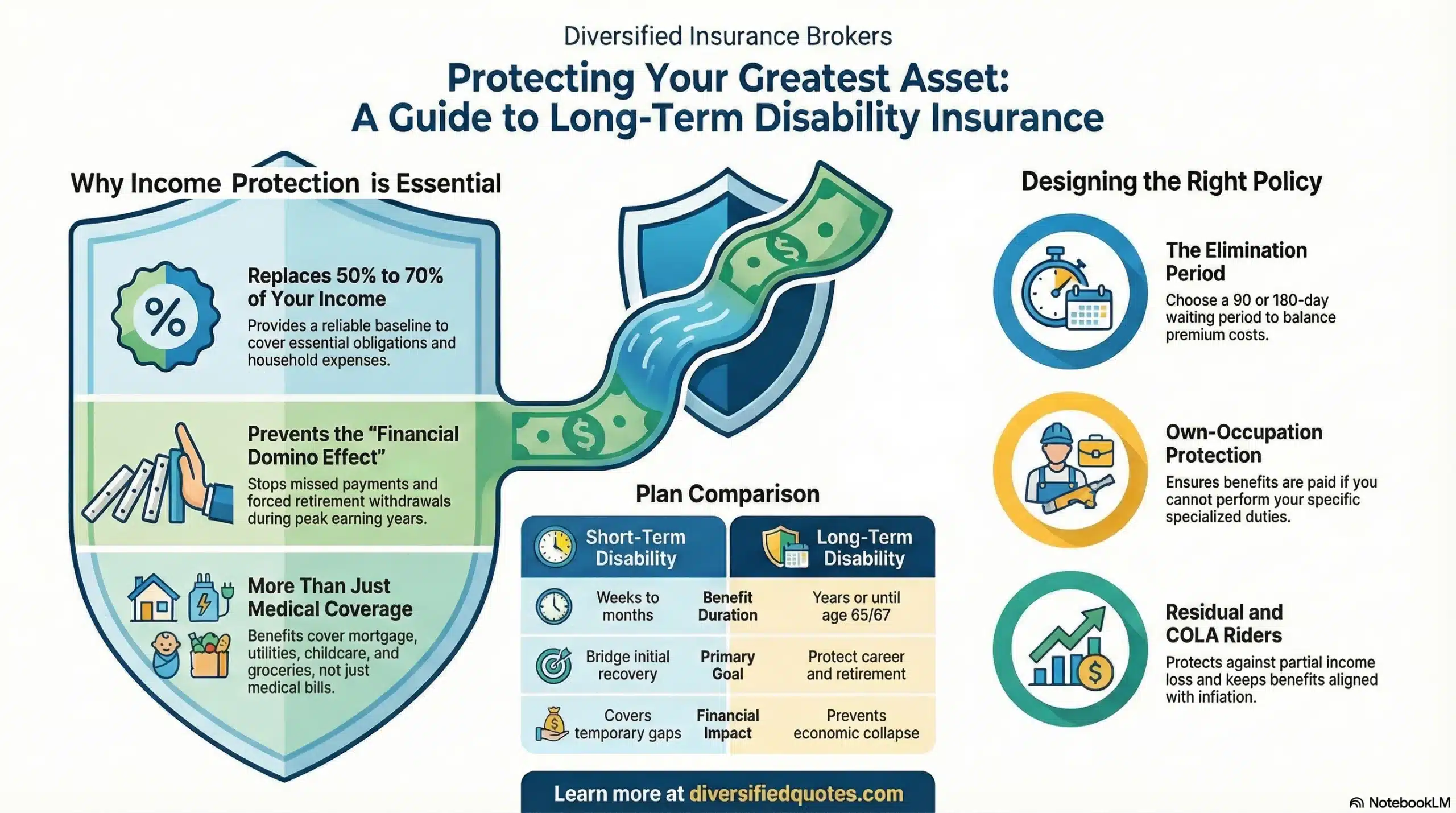
Talk With an Advisor Today
Choose how you’d like to connect—call or message us, then book a time that works for you.
Schedule here:
calendly.com/jason-dibcompanies/diversified-quotes
Licensed in all 50 states • Fiduciary, family-owned since 1980
FAQs: Disability Insurance for Butchers
What occupational class does butchery receive for disability insurance, and what does it mean for coverage?
Butchery is typically assigned to the middle tiers of most disability insurance carriers’ occupational class schedules — a classification that reflects the documented physical demands, blade contact risk, repetitive upper limb loading, cold environment exposure, and musculoskeletal injury probability of the trade relative to sedentary professional occupations. The specific class assigned can vary between carriers, which is one of the most important reasons to compare multiple carriers rather than applying to a single one: occupational class assignments differ across the market, and those differences translate directly into different premium rates and maximum benefit amounts for the same coverage terms.
The practical effects of middle-tier classification are threefold: the premium per dollar of monthly benefit is higher than for top-tier white-collar occupations, the maximum approvable monthly benefit may be lower at some carriers, and the benefit period options available may be more limited at certain carriers. None of these effects prevent a butcher from obtaining meaningful, comprehensive individual disability protection — they calibrate the cost and terms to the occupational risk the carrier is underwriting. A residual disability benefit provision is particularly worth requesting in a butcher’s policy, because partial disability — reduced production capacity from a partial recovery — is a realistic outcome for the hand and wrist conditions the trade most commonly produces.
Are disability insurance benefits taxable for a butcher?
The tax treatment of disability insurance benefits for a butcher depends on how the premiums are paid. When an individual pays disability insurance premiums with after-tax dollars — the standard case for self-employed butchers, shop owners, and sole proprietors purchasing individual coverage — the monthly benefits received during a qualifying disability are generally received income-tax-free. This is a meaningful financial advantage: whether disability insurance payments are taxable directly affects how much of each monthly benefit actually reaches the butcher’s household budget, and the after-tax premium structure that most individual policies use produces the most favorable tax treatment at claim time.
For butchers who are employees and whose employer pays some or all of disability insurance premiums, the tax treatment differs: employer-paid premiums typically are not included in the employee’s taxable income at the time of payment, but the resulting monthly benefits received during a disability claim are generally taxable as ordinary income. This means the effective purchasing power of an employer-funded benefit is lower than the face amount suggests, because a portion goes to taxes. Self-employed butchers who deduct disability insurance premiums as a business expense should confirm the specific tax treatment with a tax professional, as the deduction may affect benefit taxability. The distinction matters when calculating how much monthly benefit is actually needed to replace take-home income during a disability period.
I have a prior wrist injury — can I still get disability insurance as a butcher?
Yes — disability insurance is available to butchers with prior injury histories, though the underwriting outcome varies significantly depending on which carrier reviews the application, how the prior injury is documented, and how long ago it occurred. The most common outcome for a prior wrist injury in a butcher’s disability insurance application is a partial exclusion rider: the carrier offers coverage with an exclusion for disability arising from that specific condition, while providing full coverage for all other disabling causes. This structure still provides meaningful protection — a butcher with a wrist exclusion is still covered for back conditions, serious illness, cancer, cardiac events, the other hand, and all non-excluded causes of disability that represent the majority of long-term disability probability.
Some carriers may offer full coverage with a rated premium after a waiting period from the prior injury, and carriers that specialize in high-risk and impaired-risk disability insurance may produce better terms than a standard general-market carrier for the same history. The critical mistake is applying to a single carrier and accepting a declined or heavily restricted outcome as representative of what the full market offers. An independent broker who knows which carriers are most receptive to prior hand and wrist histories in the food service trades will produce a materially different result than submitting blind to a carrier whose guidelines are simply more conservative for that history.
Does cold temperature exposure in butchery create a specific disability insurance consideration?
Cold temperature exposure is a meaningful occupational factor in butchery disability that affects both the physical disability risk itself and the underwriting evaluation. On the physical side, sustained work in refrigerated meat departments at temperatures at or below 40 degrees Fahrenheit impairs dexterity, increases the muscular force required to maintain grip on tools and product, and has been associated in occupational health research with the acceleration of upper limb musculoskeletal conditions — because cold muscles and tendons are less forgiving of the repetitive loading patterns that butchering involves. The combination of cold and high-repetition cutting creates a more demanding musculoskeletal environment than either factor alone would produce.
From a disability insurance underwriting standpoint, cold environment work is factored into the occupational classification that carriers assign to butchery — it contributes to the middle-tier placement that reflects the occupational hazard profile of the trade. Butchers who develop cold-related conditions — Raynaud’s phenomenon, peripheral neuropathy, or cold-aggravated wrist or hand conditions — face a disability risk that may fall entirely outside the workers’ compensation system as an illness-based condition, even though its origins are clearly occupational. Individual disability insurance covers disability from any qualifying cause regardless of whether it arose from a specific workplace incident, making it the structure that protects against these gradual-onset occupational conditions that workers’ comp systematically misses. Reviewing the specific disability insurance options for butchers’ occupation type gives the most accurate picture of how these factors are treated across the carrier market.
I own a butcher shop — do I need both personal disability insurance and business overhead coverage?
For a butcher shop owner, having only one layer of disability protection typically means being underprotected on one dimension of the financial exposure that a disability creates. Personal disability income insurance replaces the owner’s earned income during a qualifying disability — covering personal living expenses, mortgage or rent, personal insurance premiums, and other household obligations. Business overhead expense insurance covers the fixed and semi-fixed costs of operating the shop — rent, equipment, employee wages, utilities, refrigeration costs, supply commitments — that continue whether the owner is working or not. These are two distinct financial obligations, and a single policy structure cannot fully address both.
The appropriate level of BOE coverage is determined by the actual monthly overhead obligations of the specific shop, not by a general formula. A small operation with minimal fixed costs has different BOE needs than a shop with commercial space, specialized equipment, and two or three employees on payroll. Key person disability insurance is a third consideration for butcher shop owners who have a key employee — a highly skilled cutter or manager — whose disability would also represent a significant business disruption beyond the owner’s own absence. Having all three coverage layers evaluated together, with benefit amounts coordinated to the actual financial structure of the operation, produces the most complete income and business protection picture for a butcher shop owner.
I received a disability insurance quote that seemed too expensive — is there a better option?
A single disability insurance quote from a single carrier is not a market comparison — it is one carrier’s pricing for one occupational class assignment on one product structure. Disability insurance premiums for middle-tier occupational classifications like butchery vary meaningfully across carriers for identical benefit amounts and policy terms, and the occupational class one carrier assigns to butchery may differ from another’s assignment, producing different base rates for the same applicant. Accepting the first quote as representative of the full market is one of the most common and costly mistakes tradespeople make when evaluating disability coverage.
The most effective approach is requesting a parallel comparison across multiple carriers through an independent broker who works with the full range of disability insurance providers. Premium differences between carriers for the same coverage terms can be meaningful enough to change the coverage decision entirely. Beyond pricing, the policy terms worth comparing include the disability definition — own-occupation versus modified definitions — the residual benefit structure, the available riders, and the benefit period options. A second opinion on your disability insurance quote costs nothing and frequently reveals either more competitive pricing for the same coverage or better coverage terms for the same premium. For butchers who found their first quote expensive, the right response is comparison rather than declining coverage — the gap between insured and uninsured is far more costly than the premium difference between carriers.
About the Author:
Jason Stolz, CLTC, CRPC, DIA, CAA and Chief Underwriter at Diversified Insurance Brokers (NPN 20471358), is a senior insurance and retirement professional with more than 25 years of real-world experience helping individuals, families, and business owners protect their income, assets, and long-term financial stability. As a long-time partner of the nationally licensed independent agency Diversified Insurance Brokers, Jason provides trusted guidance across multiple specialties—including fixed and indexed annuities, long-term care planning, personal and business disability insurance, life insurance solutions, Group Health, Travel Medical and Evacuation Insurance, and short-term health coverage. Diversified Insurance Brokers maintains active contracts with over 100 highly rated insurance carriers, ensuring clients have access to a broad and competitive marketplace.
His practical, education-first approach has earned recognition in publications such as VoyageATL, and contributions from his agency featured in Kiplinger and GoBankingRates— highlighting his commitment to financial clarity and client-focused planning. Drawing on deep product knowledge and years of hands-on field experience, Jason helps clients evaluate carriers, compare strategies, and build retirement and protection plans that are both secure and cost-efficient. Visitors who want to explore current annuity rates and compare options across multiple insurers can also use this annuity quote and comparison tool.
Explore More Disability Insurance Options: Browse our complete guide to Disability Insurance for Food, Hospitality, Arts & Entertainment — covering chefs, musicians, actors, bartenders, hospitality workers & entertainment professionals from 100+ carriers.
Last Reviewed: June 7, 2026 |
Reviewed by: Jason Stolz, CLTC, CRPC, DIA, CAA
Chief Underwriter, Diversified Insurance Brokers, Inc. | NPN: 20471358 | Diversified Insurance Brokers, Inc. — Licensed in all 50 states
Fact Checked by: Tonia Pettitt, CMIP©
Medicare Specialist, Diversified Insurance Brokers, Inc. | NPN: 14374308 | Diversified Insurance Brokers, Inc. — Licensed in all 50 states
Did you find this content helpful? Leave us a Google review — it helps others find trustworthy guidance too.
Editorial Standards: Diversified Insurance Brokers maintains rigorous editorial standards to ensure accuracy, clarity, and independence in all content. Learn more about our editorial standards and commitment to transparency.
