
Disability Insurance for Bartenders
As an Independent Disability Insurance Broker, we have access to exclusive discounts and negotiated pricing most captive agents can’t offer — see the full breakdown near the end of this page.
Disability Insurance for Bartenders

Jason Stolz CLTC, CRPC, DIA, CAA
Disability insurance for bartenders addresses a financial exposure that most service professionals never fully account for until an injury or illness makes it impossible to ignore. Bartending is a profession where earnings are almost entirely dependent on physical presence and active performance — you earn when you work, and when you cannot work, the income stops. Unlike a salaried employee whose paycheck continues through short-term medical leave or whose employer provides group disability coverage, most bartenders have no income replacement mechanism beyond their personal savings. According to Bureau of Labor Statistics data, approximately 660,000 bartenders are employed in the United States with a median annual wage of approximately $32,000 including tips — and fewer than 30% of food service and drinking place employers offer any health or supplemental benefits to their employees, with group disability coverage being even rarer than health insurance. The gap between what most bartenders have in terms of income protection and what they actually need is wide, and the consequences of a disability that interrupts earning power without any coverage in place can be financially devastating.
The income structure of bartending makes this gap more dangerous than it might initially appear. A bartender’s total compensation consists of a base hourly wage — frequently at or near the tipped minimum wage established by their state — supplemented by tips that in many venues constitute the majority of actual take-home pay. Tips fluctuate based on shift volume, location, seasonality, and customer traffic, but for many experienced bartenders in high-volume or upscale environments, tip income far exceeds the base wage component. If a wrist injury, back problem, illness, or other disabling condition prevents a bartender from working their shifts, both income streams disappear simultaneously and immediately. There is no partial paycheck from an employer, no sick leave accrual sufficient to bridge a meaningful recovery period, and no automatic income replacement from any standard employment benefit. The financial impact of even a four to six-month disability — an entirely plausible outcome from a serious back injury, hand surgery, or significant illness — is the complete elimination of income during that entire window.
Individual disability insurance fills this gap with a contractual income replacement benefit: a monthly payment that begins after a defined waiting period and continues for the duration of the disability up to the benefit period selected. For bartenders specifically, structuring that policy correctly requires understanding how tip income is documented and counted for insurance purposes, what occupational classification applies to the profession and how it affects premiums, why own-occupation definitions matter even in a service industry context, and how partial disability coverage protects income in scenarios where you can return to some shifts but not full capacity. This page covers all of these considerations. Our disability insurance services overview covers the full individual DI product landscape, and our resource on why working with an independent disability insurance broker matters explains why carrier comparison through an independent broker consistently produces better outcomes than going to a single carrier directly.
Protect Your Bartending Income
Compare disability insurance options designed for service professionals and tip-based income careers — across 100+ top-rated carriers.
Request Disability Insurance QuoteOr call: 800-533-5969
Why Bartenders Face Exceptional Income Vulnerability
The financial vulnerability of bartenders in the event of a disabling injury or illness is compounded by several structural features of service industry employment that do not affect office workers, salaried professionals, or workers in industries with robust employer benefit programs. First, there is the shift-dependency of income: a bartender earns by working shifts, and missed shifts are missed earnings with no compensation mechanism. Second, there is the tip-income component: tips are the highest-earning portion of most bartenders’ compensation, and they are entirely dependent on physical presence behind the bar — they cannot be “banked” or deferred during a recovery period. Third, there is the absence of employer-provided income protection: the same BLS and KFF survey data that documents bartender earnings confirms that group disability coverage from hospitality employers is genuinely rare, meaning the vast majority of bartenders have no group coverage backstop to fall back on when injury or illness strikes.
The combination of these three structural features means that a bartender without individual disability insurance is one injury or illness away from zero income — not reduced income, not delayed income, but zero income — for as long as the disabling condition persists. This is not a theoretical risk. It is a predictable consequence of a profession with physically demanding job requirements, elevated occupational injury rates relative to sedentary work, and a historical absence of employer-provided income protection. Workers’ compensation provides some coverage for on-the-job injuries, but it is narrowly defined, covers only job-related causes, and does not account for the full value of tip income in most calculations. The individual disability insurance policy is the only product that fills the complete income replacement gap for a bartender who becomes disabled from any cause — job-related or otherwise, injury or illness — and cannot work their shifts.
The Physical Demands That Create Real Disability Risk
Bartending is physically demanding in ways that accumulate over a career and create both sudden-onset and gradual-onset disability scenarios. A typical bartending shift requires standing for six to ten consecutive hours without meaningful opportunity to rest seated. Standing on hard surfaces for extended periods contributes to foot problems, joint stress, varicose veins, and lower back fatigue that compounds over months and years of regular service. The repetitive hand and wrist motions involved in mixing drinks, opening bottles, operating taps, cutting garnishes, and handling glassware throughout a shift create chronic stress on the small joints, tendons, and soft tissue of the hands, wrists, and forearms — conditions like tendinitis, carpal tunnel syndrome, and trigger finger are disproportionately common in service professionals with high repetitive hand movement demands.
Lifting represents another persistent physical demand. Kegs weigh substantially more than most objects lifted in office environments; cases of liquor and beer are routinely moved, stacked, and loaded; ice bins are heavy. Improper lifting mechanics during a busy shift — common when speed is prioritized — contribute to back and shoulder injuries that can range from acute strains requiring weeks of recovery to more serious disc or rotator cuff injuries requiring surgery and extended rehabilitation. Slip-and-fall risks are endemic to bar environments: wet floors from spilled beverages, ice, condensation, and washing are present throughout every shift, and the fast-paced movement required during busy service creates frequent exposure to slip events. Cuts from glassware — breakage is routine in bar environments — create hand injuries ranging from minor lacerations to tendon damage requiring surgical repair. The cumulative picture is a work environment with elevated injury risk across multiple categories, making the income protection function of disability insurance not a speculative hedge but a practical necessity for any bartender planning their financial stability over a working career.
Disability Coverage Comparison — What Each Scenario Looks Like
| Scenario | Without DI Coverage | With Short-Term DI Only | With Long-Term DI Policy |
|---|---|---|---|
| Wrist injury requiring 3-month recovery | Zero income for full 3 months; depletes savings or creates debt | Benefit begins after elimination period; partial income replacement through recovery | Full policy coverage kicks in; income replacement continues through recovery period |
| Back surgery with 12-month rehabilitation | One full year of zero income; financial crisis likely without substantial savings | Short-term benefit may expire during recovery; leaves gap before long-term DI kicks in | Income replacement continues through full rehabilitation; financial stability maintained |
| Chronic illness preventing full return (partial disability) | Any reduction in hours or shifts produces direct income drop with no offset | May not cover partial disability; depends on policy terms | Residual/partial disability benefit supplements reduced earnings during partial return to work |
| Long-term disability preventing any bartending | Permanent income loss from bartending; total financial disruption | Short-term benefit expires; no ongoing income protection | Monthly benefit continues for full benefit period — potentially to age 65 — providing multi-year income stability |
Income replacement amounts, benefit periods, elimination periods, and partial disability provisions vary significantly by policy and carrier. The above scenarios are illustrative of structural differences between coverage options and are not guarantees of specific outcomes. Disability insurance policies have definitions, exclusions, and conditions that govern benefit eligibility. Always review the complete policy document before purchasing. Individual premiums and eligibility depend on age, health, occupation class, income documentation, and state of residence.
How Bartenders Are Classified for Disability Insurance Underwriting
Occupational classification is one of the most important factors in disability insurance pricing and availability for bartenders. Disability insurance carriers assign each occupation to a class — typically on a scale from 1 to 5 or 1 to 6, with class 1 representing the most favorable (generally professional and executive white-collar occupations) and the highest class representing heavy manual labor with the most physical risk. Premium rates increase as occupational class increases, and some policy features — particularly own-occupation definitions and longer benefit periods — may be restricted or unavailable at higher occupational classes. Bartenders typically fall in occupational class 3 or 4 depending on the carrier — reflecting the mix of moderate physical demands, service-industry environment, and income structure that characterizes the profession. This is meaningfully different from both class 1-2 professionals (physicians, attorneys, engineers) and from high-risk manual labor classes (construction workers, roofers), and it means disability insurance is available for bartenders but at different pricing and with different feature options than what a white-collar professional might receive.
The practical implication of the occupational class for bartenders is that premiums will be moderate to moderately high relative to the income being insured, and the available features — particularly the definition of disability — may vary across carriers. Some carriers will offer own-occupation coverage for a bartender (meaning you are considered disabled if you cannot perform the specific duties of your bartending job, even if you could theoretically perform other work), while others will offer any-occupation coverage (meaning you must be unable to perform any gainful occupation). Own-occupation coverage is more protective for bartenders because a wrist injury or back problem may prevent bartending specifically while leaving some other form of work theoretically possible — any-occupation coverage could require you to take a substantially different and lower-income job while the insurer denies your claim. Understanding which definition applies in the specific policy being considered is one of the most critical evaluation points in the coverage selection process. Our resource on how much disability insurance do I need covers the income replacement framework for calculating the right benefit amount.
Tip Income and Disability Insurance — What Gets Counted
For bartenders whose total compensation includes substantial tip income, the question of how tip income is treated in disability insurance calculations is critical — because the benefit you receive in the event of a claim is generally based on your documented pre-disability income, not on your self-reported sense of what you typically earn. Most individual disability insurance policies require income documentation — tax returns, W-2 forms, and in some cases bank statements — to establish the income baseline against which the benefit amount is calculated. For tip income to count toward the income baseline, it generally needs to be reported and documented. Unreported or under-reported tip income that does not appear on tax returns typically cannot be counted for disability insurance income calculation purposes, which can result in a benefit that is substantially lower than the bartender’s actual typical earnings.
This documentation requirement is not a barrier to getting disability insurance — it is a planning consideration that underscores the importance of accurately reporting tip income on tax returns and maintaining income records that accurately reflect total compensation. A bartender who reports all tip income and can document two years of tax returns showing total compensation from wages and tips is in a strong position to insure their full documented income. A bartender who has under-reported tips may find that the insurable income — and therefore the available benefit — is limited to the reported (lower) amount. Accurate income documentation protects both access to appropriate coverage and the benefit level available in the event of a claim. Our resource on disability insurance for the self-employed covers the income documentation requirements that parallel what tip-based workers face, including how carriers evaluate variable income histories for coverage purposes.
Workers’ Compensation vs. Individual Disability Insurance — Understanding the Gap
Workers’ compensation insurance — which employers are required to carry in most states — covers employees for injuries and illnesses that are directly caused by or occur in the course of employment. For bartenders, this means a slip-and-fall in the bar during a shift, a cut from glassware while working, or a lifting injury while moving kegs might be covered under workers’ compensation. However, workers’ compensation has important limitations that individual disability insurance addresses. First, workers’ compensation does not cover disabilities that occur outside of work — an off-shift car accident, a cancer diagnosis, or a cardiac event has nothing to do with the workplace and is excluded from workers’ compensation entirely. Second, workers’ compensation replaces a percentage of wages, but the calculation is based on the average weekly wage reported for payroll purposes — meaning tip income that is not fully reflected in employer payroll records may be undercounted or excluded from the workers’ compensation benefit calculation. Third, workers’ compensation disputes and claim denials are common, and the benefit is subject to the insurance carrier’s assessment of whether the injury is work-related and how long the disability is expected to last.
Individual disability insurance fills the gaps that workers’ compensation leaves open: it covers disabilities from any cause, not just workplace events; it covers both injury and illness; it uses documented income including tips as the benefit calculation basis; and it provides a contractual benefit that the insurer cannot reduce or dispute based on a claim that the disability is not work-related. The two coverages are complementary rather than redundant — a bartender with workers’ compensation coverage through their employer and an individual disability policy has the most complete protection, with workers’ compensation addressing job-related events and the individual DI policy covering everything else. Our resource on short-term vs. long-term disability insurance covers the structural distinction between these two policy types and when each is appropriate.
Key Policy Features Bartenders Should Prioritize
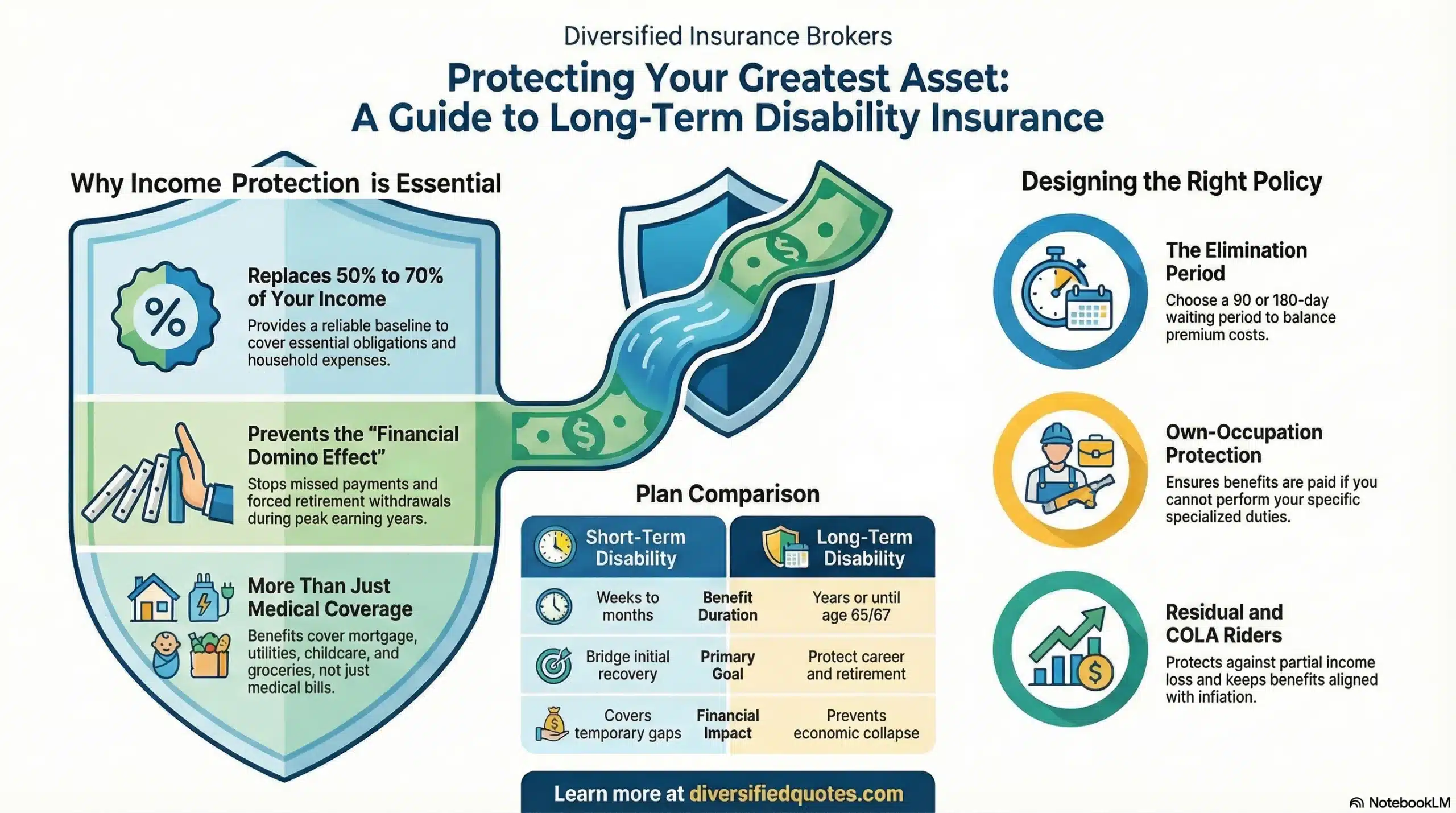
The elimination period is the number of days of disability that must pass before the policy begins paying benefits — essentially the waiting period during which you fund your own recovery from savings. Common elimination periods are 30, 60, 90, or 180 days. A longer elimination period reduces the premium but requires more personal savings to bridge the gap before benefits begin. For bartenders with limited savings, a shorter elimination period provides earlier protection but costs more monthly. The elimination period should be calibrated to the realistic amount of liquid savings available to cover immediate living expenses without income — and for bartenders with minimal savings, a 30- or 60-day elimination period is often worth the premium difference over a 90-day period that might require three months of zero income before a single benefit dollar arrives.
The benefit period defines how long the policy will pay benefits if disability continues — options range from two-year benefit periods to benefit periods extending to age 65. A two-year or five-year benefit period costs less but stops paying benefits if the disability persists beyond that window. A to-age-65 benefit period is more expensive but ensures coverage through the entirety of a working career. For a bartender whose disability results from a serious spinal injury or a chronic condition that prevents return to the profession, a short benefit period can leave years or decades of working life without income protection. The residual disability or partial disability provision is critical for tip-income workers specifically: it allows a bartender who can return to some shifts but not full capacity to receive a partial benefit that supplements reduced earnings. Without this feature, a partial recovery that allows you to work three shifts per week instead of five would produce no benefit — the policy would treat you as not disabled — even though your income has dropped substantially. Our resource on second-opinion disability insurance quote review provides independent policy comparison for bartenders who have already received a quote and want to verify its competitiveness and completeness. Our best independent disability insurance broker resource covers how independent broker representation produces better outcomes for service professionals.
When to Apply — Timing Matters for Bartenders
The best time to apply for disability insurance is while healthy and actively working, because disability insurance underwriting evaluates your current health at the time of application and establishes coverage before any health events occur. A bartender who applies after a back injury has already happened may find that the back condition is excluded from coverage — an exclusion rider that carves out the specific pre-existing condition — or may face a premium increase or outright declination depending on the severity of the condition. A bartender who applies before any meaningful health events have occurred has access to the most comprehensive coverage at the most competitive premiums. Age also matters: premiums are lower when you are younger, and locking in coverage at a lower age locks in lower rates for the duration of the policy in many non-cancellable and guaranteed renewable designs. The practical advice is straightforward: do not wait until you have already experienced the health event that makes disability insurance feel necessary. Apply while the need feels theoretical and coverage is easiest to obtain. Our resource on disability insurance for chefs and bakers, disability insurance for barbers and stylists, and disability insurance for repairmen cover similar occupation-specific planning considerations for other service-based and hands-on professions that face comparable income vulnerability. Our resource on disability insurance for alarm installers, disability insurance for ambulance drivers, disability insurance for property managers, disability insurance for announcers, and disability insurance for aquatic therapists cover similar planning frameworks for other physical and service-oriented occupations.
For financial context beyond disability coverage, our resource on how much income an annuity can provide covers how annuity-based income strategies can supplement or complement disability planning within a broader financial plan, and our resource on medically underwritten annuities covers specific annuity structures relevant to consumers with health histories. For long-term financial planning context beyond income protection, our resources on Medicare premium trends, long-term care insurance benefit periods, and how modified adjusted gross income affects Social Security and Medicare address the broader retirement income landscape that intersects with income protection planning for bartenders planning their full financial picture.
Talk With an Advisor Today
Choose how you’d like to connect—call or message us, then book a time that works for you.
Schedule here:
calendly.com/jason-dibcompanies/diversified-quotes
Licensed in all 50 states • Fiduciary, family-owned since 1980
FAQs: Disability Insurance for Bartenders
Do bartenders qualify for individual disability insurance?
Yes — bartenders can qualify for individual disability insurance, though the terms, premium levels, and available features depend on the carrier’s occupational classification for the profession. Bartenders typically fall in occupational class 3 or 4 depending on the carrier, reflecting the moderate-to-physical demands of the work. This means coverage is available, premiums are moderate to moderately high relative to lower-risk occupations, and some policy features — particularly own-occupation definitions and longer benefit periods — may vary by carrier and class assignment. An independent broker with access to multiple carriers can identify which companies offer the best combination of features and pricing for bartenders in your state. Applying while healthy and actively employed produces the most favorable outcomes.
Can tip income be included in disability insurance income calculations?
Yes — tip income that is documented on tax returns can generally be counted toward the income baseline used to calculate the disability benefit amount. Disability insurance carriers typically require income documentation — tax returns, W-2 forms, or equivalent records — to establish the pre-disability income level that determines the benefit. Tip income that is reported on taxes and appears in documented records can be included; undocumented or unreported tip income typically cannot be counted. This makes accurate tax reporting of tips not just a legal obligation but a practical financial planning step that directly affects the amount of disability coverage available and the benefit that would be received in the event of a claim.
What are the biggest disability risks for bartenders?
The primary disability risks for bartenders include back and shoulder injuries from lifting kegs, cases, and ice; repetitive strain injuries of the hands and wrists (tendinitis, carpal tunnel syndrome) from the constant repetitive motions of mixing, shaking, pouring, and handling glassware; slips, trips, and falls in wet bar environments; cuts from glassware breakage; and fatigue-related injuries from extended standing and late-night scheduling. Chronic conditions — including those that develop gradually from the cumulative physical demands of bartending — are also a significant disability risk. Because both sudden-onset injuries and gradual-onset conditions can result in the inability to work shifts, disability insurance coverage addressing both injury and illness is important for complete protection.
Is disability insurance important for part-time bartenders?
Yes — disability insurance is relevant for part-time bartenders if the income from bartending represents a meaningful portion of total household income or supports essential expenses. The income replacement benefit amount will be based on documented earned income, so a part-time bartender with lower total income will have a smaller insurable income base and correspondingly lower benefit amounts. However, even partial income replacement for a part-time bartender can make a meaningful difference during a recovery period that would otherwise produce zero income from that source. The key evaluation is whether the bartending income — even at part-time levels — is important enough to protect that the premium cost is justified by the protection provided.
Does workers’ compensation cover bartenders for disability?
Workers’ compensation covers employees for injuries and illnesses that occur in the course of employment — meaning on-the-job events while at work. For bartenders, this includes injuries that happen during a shift (a slip and fall, a lifting injury while moving kegs, a cut from glassware). Workers’ compensation does not cover disabilities that arise outside of work — an off-shift illness, an off-hours accident, or a medical condition unrelated to the workplace. Additionally, workers’ compensation benefit calculations may not fully account for tip income that is not reflected in employer payroll records. Individual disability insurance fills the gaps workers’ compensation leaves open, covering disabilities from any cause regardless of whether they occurred on the job.
What is residual or partial disability coverage, and why does it matter for bartenders?
Residual or partial disability coverage provides a benefit when a disability reduces your income but does not completely prevent you from working. For bartenders, this provision is especially valuable because many disability scenarios result in a partial rather than total return to work — you might be able to work three shifts per week instead of five, or shorter shifts with modified duties, resulting in substantially lower earnings even though you are technically “working.” Without residual disability coverage, a policy may deny a claim when partial work is possible, leaving the income gap unaddressed. With this provision, the policy pays a partial benefit proportional to the income reduction, supplementing the reduced earnings and providing meaningful financial support during a gradual recovery rather than requiring total disability before any benefit is paid.
What elimination period should a bartender choose?
The elimination period — the waiting period before the policy begins paying benefits — should be calibrated to the amount of liquid savings available to cover living expenses during that window with zero income. Common options are 30, 60, 90, and 180 days. A shorter elimination period (30 or 60 days) costs more in premium but begins paying benefits sooner — important for bartenders with limited savings who cannot sustain multiple months without income. A longer elimination period (90 or 180 days) reduces the premium but requires more savings to bridge the gap. For most service-industry workers without substantial emergency reserves, a 30- or 60-day elimination period is often the more practical choice, even at the higher premium, because the alternative is months without any income before the first benefit payment arrives.
When is the best time for a bartender to apply for disability insurance?
The best time to apply for disability insurance is while you are healthy, actively working, and have had no significant recent injuries or medical diagnoses. Disability insurance underwriting evaluates your current health at the time of application, and any existing health conditions can result in exclusion riders, premium increases, or declinations depending on their nature and severity. A bartender who applies before experiencing back problems, wrist injuries, or other conditions common in the profession has access to the most comprehensive coverage at the most favorable premiums. Waiting until after a health event has occurred frequently results in that specific condition being excluded from coverage — precisely the coverage you may need most. Applying young and healthy locks in coverage that remains in force through future health changes, protecting income throughout a full working career.
About the Author:
Jason Stolz, CLTC, CRPC, DIA, CAA and Chief Underwriter at Diversified Insurance Brokers (NPN 20471358), is a senior insurance and retirement professional with more than 25 years of real-world experience helping individuals, families, and business owners protect their income, assets, and long-term financial stability. As a long-time partner of the nationally licensed independent agency Diversified Insurance Brokers, Jason provides trusted guidance across multiple specialties—including fixed and indexed annuities, long-term care planning, personal and business disability insurance, life insurance solutions, Group Health, Travel Medical and Evacuation Insurance, and short-term health coverage. Diversified Insurance Brokers maintains active contracts with over 100 highly rated insurance carriers, ensuring clients have access to a broad and competitive marketplace.
His practical, education-first approach has earned recognition in publications such as VoyageATL, and contributions from his agency featured in Kiplinger and GoBankingRates— highlighting his commitment to financial clarity and client-focused planning. Drawing on deep product knowledge and years of hands-on field experience, Jason helps clients evaluate carriers, compare strategies, and build retirement and protection plans that are both secure and cost-efficient. Visitors who want to explore current annuity rates and compare options across multiple insurers can also use this annuity quote and comparison tool.
Explore More Disability Insurance Options: Browse our complete guide to Disability Insurance for Food, Hospitality, Arts & Entertainment — covering chefs, musicians, actors, bartenders, hospitality workers & entertainment professionals from 100+ carriers.
Last Reviewed: June 3, 2026 |
Reviewed by: Jason Stolz, CLTC, CRPC, DIA, CAA
Chief Underwriter, Diversified Insurance Brokers, Inc. | NPN: 20471358 | Diversified Insurance Brokers, Inc. — Licensed in all 50 states
Fact Checked by: Tonia Pettitt, CMIP©
Medicare Specialist, Diversified Insurance Brokers, Inc. | NPN: 14374308 | Diversified Insurance Brokers, Inc. — Licensed in all 50 states
Did you find this content helpful? Leave us a Google review — it helps others find trustworthy guidance too.
Editorial Standards: Diversified Insurance Brokers maintains rigorous editorial standards to ensure accuracy, clarity, and independence in all content. Learn more about our editorial standards and commitment to transparency.
