
Disability Insurance for Professional Bowlers
As an Independent Disability Insurance Broker, we have access to exclusive discounts and negotiated pricing most captive agents can’t offer — see the full breakdown near the end of this page.
Disability Insurance for Professional Bowlers

Jason Stolz CLTC, CRPC, DIA, CAA
Professional bowlers occupy a distinctive professional category in the sports and entertainment landscape: fully self-employed independent contractors who earn through performance-based prize money, sponsorship deals, coaching income, appearances, and pro shop operations — with none of the guaranteed salary structures that team sports athletes receive and with a documented occupational injury profile driven by the most specific and repetitive upper-extremity loading in professional sports. Medical and orthopedic research specifically documents that bowlers are prone to bowling-related injuries from the repetitive motion of rolling a heavy bowling ball, with common injuries including wrist tendinitis, sprains of the wrist ligaments, carpal tunnel syndrome, and what orthopedic sources call “bowler’s elbow” — epicondylitis arising from the constant wrist motion that puts strain on the elbow tendons — alongside shoulder tendinitis from the sustained ball-swing mechanics and knee conditions from the approach slide. A PBA Tour bowler delivering 200 to 300 competitive frames per day across a tournament week, plus hundreds of additional practice frames, generates the sustained upper-extremity repetitive loading that produces these overuse conditions at documented rates across the competitive bowling population. Professional bowling income varies dramatically by performance level and career phase: industry sources document that PBA members with active tour participation typically earn $45,000 to $50,000 annually from prize money alone, while top-10 players earn $100,000 to $300,000 combined from prizes and sponsorships, and elite players like Jason Belmonte clear $200,000 or more — with most professionals supplementing tournament income through coaching, pro shop work, and appearances. The Professional Bowlers Association specifically does not pay its members salaries — pro bowlers are independent contractors who qualify for events, pay entry fees, and compete for prize funds, making self-employed professional disability insurance the entire income protection system with no employer baseline of any kind. Understanding how disability insurance applies to performance-based athletic professions requires specific attention to the income instability dimension that makes many standard carriers treat professional sports as challenging to underwrite through conventional channels.
At Diversified Insurance Brokers, Jason Stolz, CLTC, CRPC, DIA, CAA works with professional bowlers across the full career and income structure of the professional game — full-time PBA Tour competitors whose income depends on tournament performance and sponsorship relationships, regional tour professionals building toward tour exemption, semi-professional bowlers who supplement competitive bowling income with coaching and pro shop employment, and bowling industry professionals who have transitioned from competitive play to coaching, instruction, or equipment work. The income documentation complexity of independent contractor bowling income that combines tournament prize distributions, 1099 sponsorship fees, coaching fees, and appearance income requires the same complete multi-source Schedule C documentation approach as any diversified self-employment income — and the 1099 income documentation framework applies to all non-prize bowling income streams as the foundation of the benefit calculation.
Compare Disability Coverage for Professional Bowlers
We review coverage options across 100+ carriers — identifying which carriers cover professional bowling occupations, how variable tournament income is documented, and which policy structure fits your specific career income and injury profile.
Request Disability Insurance OptionsProfessional Bowler Disability Risk — Documented Overuse Injuries, Income Structure, and the Coverage Challenge
| Risk Category | Medical and Occupational Context | Resulting Disability Risk | Coverage Status | Income Protection Gap |
|---|---|---|---|---|
| Bowler’s elbow — epicondylitis from repetitive delivery | Premier Orthopaedics specifically documents “bowler’s elbow” — epicondylitis — as a common injury among professional bowlers from the constant wrist motion that puts strain on elbow tendons; orthopedic sources describe this as arising from overuse and repetitive motions, specifically the swing and release; Georgia Hand, Shoulder & Elbow documents that bowlers are prone to overuse injuries from rolling a heavy bowling ball, with bowler’s elbow similar to tennis elbow involving irritation of medial elbow tendons; treatment typically requires rest — which for a professional bowler means no tournament participation and no prize earnings | Elbow tendinopathy severe enough to prevent tournament-level ball delivery and practice — eliminating all prize income, sponsorship performance requirements, and coaching demonstrations during recovery; a professional bowler cannot compete or maintain sponsor obligations while treating bowler’s elbow | No workers’ comp — pro bowlers are independent contractors with no employer; individual DI or accident-only coverage is the only income protection available | Complete gap; own-occupation individual DI covering competitive bowling delivery specifically is the only protection for tournament income loss from elbow conditions |
| Wrist tendinitis, sprains, and carpal tunnel | Georgia Hand, Shoulder & Elbow documents wrist tendinitis from the swinging and twisting motion of bowling delivery as one of the most common bowler injuries; Premier Orthopaedics additionally documents wrist sprains from stretching or tearing of wrist ligaments from improper technique or using a ball that is too heavy, and carpal tunnel syndrome from swelling or repetitive strain — all arising from the repetitive delivery mechanics that a professional bowler performs hundreds to thousands of times weekly during tournament competition and practice | Wrist conditions preventing the precise grip, swing, and release mechanics that professional bowling performance requires — eliminating competitive delivery capacity entirely even when general physical function is unaffected | No workers’ comp; no employer benefits; individual DI covering professional bowling delivery specifically is the entire income protection available | Full gap; own-occupation coverage encompassing competitive bowling delivery and wrist-specific function is essential for protecting tournament income |
| Shoulder tendinitis from sustained ball-swing mechanics | Premier Orthopaedics documents shoulder tendinitis as one of the four most common bowling injuries; the pendulum swing and controlled shoulder rotation required for professional bowling delivery creates sustained rotator cuff and shoulder tendon loading across thousands of repetitions per week at the professional practice and competition level; shoulder conditions are specifically documented as the injury requiring the most extended recovery time among bowling-related overuse conditions | Shoulder tendinopathy or rotator cuff damage requiring extended rest and rehabilitation — eliminating competitive bowling delivery and coaching demonstration capacity for extended recovery periods that substantially impact tournament income | No workers’ comp; no employer benefits; individual DI or accident-only coverage is the entire income protection system | Full gap; shoulder conditions producing the longest documented bowling recovery timelines specifically require comprehensive individual DI with residual benefits for partial return to competition |
| Knee and approach slide injury | The bowling approach slide — a controlled sliding delivery technique that loads the lead knee through a controlled deceleration and plant — creates repetitive patellofemoral and ligament loading across thousands of deliveries per week at the professional competition and practice level; knee conditions from the approach mechanics and the sustained standing and movement of tournament competition are documented in sports medicine literature on bowling-related injuries | Patellofemoral syndrome, patellar tendinopathy, or knee ligament conditions preventing the controlled approach and slide mechanics that professional bowling delivery requires — a condition that eliminates competitive bowling even when upper extremity function is entirely unaffected | No workers’ comp or employer benefits; individual DI covering the complete bowling performance function — including approach mechanics — provides the income floor | Full gap; own-occupation coverage encompassing the complete physical bowling performance function is required for comprehensive income protection |
| Income instability and the underwriting challenge | Industry sources specifically document that PBA bowlers are independent contractors who compete for prize funds without guaranteed salaries; income varies dramatically with performance, tour exemption status, sponsorship relationships, and participation in high-purse major events; most pros supplement tournament income with coaching, pro shop work, and appearances to produce sustainable total annual income; this income instability profile creates specific underwriting complexity at standard carriers who may classify professional sports income as high-instability | Not a disability risk itself — but an underwriting and documentation challenge requiring specific income documentation strategy to maximize the approvable benefit amount from the total multi-stream income the professional bowler generates | Standard carriers vary in how they treat professional sports income; independent broker who knows which carriers are favorable for bowling occupations is essential; accident-only and specialty market options available when standard coverage is limited | Planning gap addressed through complete multi-source income documentation, appropriate carrier selection, and supplemental accident-only coverage where comprehensive individual DI is limited by the income structure |
The table documents what makes professional bowling disability planning specifically complex: a profession with documented overuse injury conditions in the wrist, elbow, shoulder, and knee from the highly repetitive athletic mechanics of the sport combined with an income structure — performance-based independent contractor prize earnings — that some standard disability insurance carriers find difficult to underwrite through conventional channels. Why professional bowlers prioritize income protection is answered by the combination of documented injury probability from sustained competitive repetition and the complete absence of any employer benefit baseline — when a bowler’s elbow or wrist condition prevents competition, every tournament week without prize earnings is a financial impact that no automatic protection mechanism exists to absorb.
The Overuse Injury Reality — What Orthopedic Research Documents for Competitive Bowlers
The orthopedic injury documentation for competitive and professional bowlers is specific and well-established in sports medicine and hand surgery literature. Georgia Hand, Shoulder & Elbow specifically documents that bowlers are prone to bowling-related injuries from the repetitive motion of rolling a heavy bowling ball, with the resulting overuse conditions affecting tendons, ligaments, and muscles of the wrist and forearm. Premier Orthopaedics documents shoulder tendinitis as one of the four most common bowling injuries alongside wrist tendinitis, wrist sprains, and bowler’s elbow. The biomechanical mechanism is straightforward: a professional bowler who delivers a 14 to 16 pound ball through a controlled pendulum swing with specific wrist positioning, hooking release, and shoulder rotation — performed 200 to 300 times in competitive frames plus hundreds of practice repetitions per day across a tournament week — creates sustained repetitive loading on wrist extensors and flexors, medial elbow tendons, rotator cuff tendons, and lead knee structures that produces overuse conditions at documented rates in the competitive bowling population.
The disability insurance planning implication is specific: these overuse conditions are not freak accidents but predictable occupational consequences of sustained professional competition at the highest level — conditions that, when they reach the severity requiring rest and treatment, eliminate tournament participation and prize earnings entirely. Treatment for bowler’s elbow, wrist tendinitis, and shoulder tendinitis all typically require rest as the primary intervention — which for a professional bowler means no competitive deliveries, no practice, potentially no coaching demonstrations, and no tournament prize earnings during the recovery period. Own-occupation disability coverage that specifically encompasses competitive bowling delivery — the wrist, elbow, shoulder, and knee functions that professional bowling performance requires — is the policy feature that makes disability insurance genuinely protective for a bowler’s career income rather than a theoretical benefit that fails at the most characteristic disability scenario the profession produces. Residual disability coverage is particularly important for professional bowlers because realistic recovery scenarios involve partial return to competition at reduced volume — competing in some events but not achieving full tournament schedule during rehabilitation — producing income reduction rather than complete income cessation. The same own-occupation and residual disability framework that serves performance professionals in other physical artistic and athletic careers applies with equal force to competitive bowling. Short-term disability coverage addresses the immediate income gap during acute injury recovery before long-term benefits activate. Long-term disability income coverage provides the extended income floor when a serious overuse injury or illness requires an extended recovery period or produces permanent functional limitation. How short-term and long-term structures interact maps the complete coverage architecture for any qualifying disability event in a professional bowler’s career.
The Underwriting Challenge — Accessing Coverage in a High-Instability Income Profession
Professional bowling’s income structure — performance-based independent contractor prize earnings without guaranteed salaries — creates the same underwriting challenge as any professional athletic or entertainment occupation where income volatility is inherent to the career structure. Industry occupation class literature specifically documents that occupations with a high degree of income instability — professional sports, entertainment, certain artistic professions — may be treated as challenging or uninsurable by some standard disability insurance carriers. This is not a reflection of the bowler’s personal risk profile but of the structural income variability that makes some carriers unwilling to commit to benefit amounts sized to peak tournament earnings that may not be replicated in every year.
The most effective approach for a professional bowler seeking disability insurance is working with an independent broker who specifically knows which carriers handle athletic and performance professional income most favorably, and who understands how to document multi-source bowling income — prize distributions, sponsorship payments, coaching fees, appearance fees, and pro shop income — in the most complete and favorable way for the benefit calculation basis. For professional bowlers whose income mix includes more stable components — a regular coaching schedule, a pro shop employment arrangement, or contracted instructional work — those stable income streams may support more favorable underwriting than pure tournament prize income alone, and documenting them as primary income components alongside tournament earnings produces the most complete benefit basis. Accident-only disability income insurance provides an accessible alternative or supplemental layer for bowlers whose tournament income instability limits comprehensive individual DI — covering disability from accidental bodily injury and providing meaningful coverage for the acute physical injury scenarios even when illness-inclusive standard coverage is limited. Guarantee issue disability insurance provides a last-resort access point when standard individual market options are unavailable or severely limited due to income instability classification. Specialty and modified market options extend coverage availability to bowlers whose specific income and occupational profile places them at the edge of or outside standard market underwriting.
Income Documentation and Policy Design for Professional Bowlers
The income documentation for a professional bowler’s disability insurance benefit calculation requires capturing all earned bowling-related income streams: tournament prize distributions from PBA Tour and regional events; 1099 sponsorship and endorsement fees from equipment manufacturers and brands; coaching and instruction fees from private lessons, group clinics, and youth programs; appearance and exhibition fees; and any pro shop employment or management income. All of these streams, captured consistently across two to three years of tax documentation, produce the most complete and accurate income basis for the disability insurance benefit calculation — reflecting the total economic output of a bowling professional career rather than the prize money dimension alone that tournament tables suggest.
Self-employed professional bowlers access disability insurance through the Schedule C documentation framework that applies to any self-employed professional. How much disability income a professional bowler needs is calibrated to documented total bowling career income — tournament plus sponsorship plus coaching plus appearances — and household financial obligations during a disability period that eliminates competition. The elimination period reflects actual financial reserves. The rider architecture for a bowler’s disability policy includes the future increase option for younger professionals whose income is growing with competitive success, and the cost of living adjustment rider for permanent disability scenarios. Coverage for bowlers with prior wrist, elbow, or shoulder conditions from competitive bowling is available through independent broker comparison — though as with any overuse injury profession, early purchase before any treatment history is documented produces the most comprehensive available coverage. Specialty and modified options address bowlers whose documented competitive injury history creates standard underwriting complexity. No-exam disability coverage provides streamlined approval at appropriate benefit amounts for healthy competitive bowlers. Getting the best available rates for a professional bowler requires independent broker comparison across the full carrier market — the variation between carriers in how they treat professional sports income and bowling-specific overuse injury history is larger than for most occupations. Why young competitive bowlers need income protection before overuse histories develop is answered directly by the orthopedic literature: bowler’s elbow, wrist tendinitis, and shoulder tendinitis are documented overuse conditions that accumulate with competitive volume — the window to purchase comprehensive bilateral wrist and elbow coverage without exclusion riders is before competitive bowling has produced any overuse treatment history. Whether disability insurance is worth the cost for a professional bowler is answered by calculating what a two-month recovery from bowler’s elbow represents against tournament prize earnings — and recognizing that no automatic protection mechanism exists to replace those earnings when competition stops. Whether disability benefits are taxable for a professional bowler: individually purchased policies paid with after-tax personal income generally produce tax-free disability benefits. A second opinion on any disability insurance proposal for a professional bowler confirms whether the own-occupation language encompasses competitive bowling delivery specifically, whether the income documentation approach captures all career income streams, and whether the carrier selected is actually favorable for professional sports income before any premium commitment is made.
Get Your Professional Bowler Coverage Review
We identify which carriers cover professional bowling occupations, compare own-occupation definitions for competitive delivery, and build the income documentation strategy that maximizes your available disability benefit.
Request Disability Insurance Options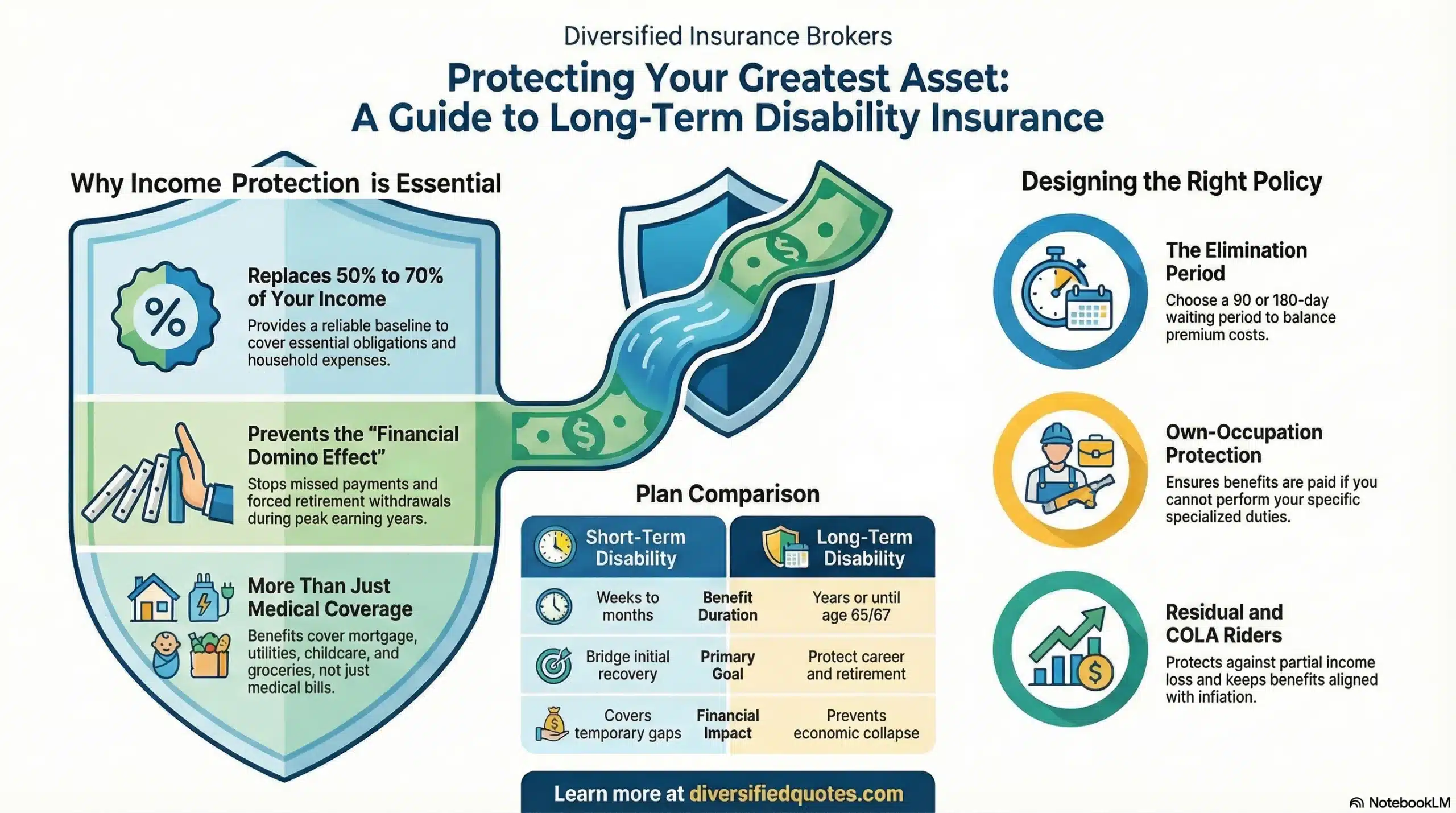
Talk With an Advisor Today
Choose how you’d like to connect—call or message us, then book a time that works for you.
Schedule here:
calendly.com/jason-dibcompanies/diversified-quotes
Licensed in all 50 states • Fiduciary, family-owned since 1980
FAQs: Disability Insurance for Professional Bowlers
Can professional bowlers actually get disability insurance — I’ve heard it’s difficult for athletes?
Disability insurance is available for professional bowlers — but carrier selection is significantly more consequential for this occupation than for most professional service careers, and working with an independent broker who specifically knows which carriers handle professional sports and performance professional income most favorably is essential rather than optional. Some disability insurance carriers classify professional bowlers alongside other performance professionals as occupations with high income instability that create challenging underwriting conditions, while other carriers have specific guidelines that accommodate mixed professional athletic income and provide meaningful disability coverage at appropriate benefit amounts. The difference between the right carrier and the wrong carrier for a professional bowler can be the difference between comprehensive own-occupation coverage and a decline or severely limited policy.
For professional bowlers whose total career income includes multiple streams — tournament prize money, sponsorship fees, coaching income, appearance fees, and pro shop work — documenting all streams completely in Schedule C records and presenting the total career income basis rather than only tournament prize distributions produces the most favorable income documentation for the benefit calculation. Coaching, instruction, and pro shop employment income that is more stable and consistent than tournament performance-based prize earnings may support more favorable underwriting than tournament prize income alone, making the complete income picture — not just the prize money component — the foundation of the strongest disability insurance application. A second opinion from an independent broker with performance professional placement experience identifies which carriers are genuinely available and favorable for professional bowling occupations before any formal application is submitted.
What exactly are the most common injuries that end professional bowling careers or prevent competition?
The orthopedic medicine literature documents four primary injury categories for competitive and professional bowlers, all arising from the sustained repetitive mechanics of professional bowling delivery at high volume. Bowler’s elbow — medial epicondylitis — is specifically documented as a common injury among professional bowlers from the constant wrist motion during delivery that strains the elbow tendons, with treatment requiring rest that eliminates tournament competition. Wrist tendinitis from the swinging and twisting motion of the delivery is documented as one of the most common bowler injuries, alongside wrist sprains from ligament stretching and carpal tunnel syndrome from repetitive strain. Shoulder tendinitis from the sustained shoulder rotation mechanics of the ball swing is documented as one of the four most common bowling injuries, with the longest typical recovery timeline among the four categories. Knee conditions from the approach slide and sustained tournament standing and movement round out the primary documented injury profile.
What makes these injuries particularly impactful for professional bowling income is their treatment requirement: rest. Unlike injuries that can sometimes be managed through modified activity, the primary treatment intervention for bowler’s elbow, wrist tendinitis, and shoulder tendinitis is rest from the specific repetitive motion producing the condition — which for a professional bowler means no competitive deliveries, no full practice sessions, and potentially no coaching demonstrations during the recovery period. A professional bowler treating bowler’s elbow for eight to twelve weeks has eight to twelve weeks without tournament participation and the prize earnings that tournament participation generates. The residual disability benefit provision in an individual disability policy specifically addresses the partial return-to-competition scenario — a bowler competing in some events at reduced frequency during recovery, receiving proportional income replacement for the competition volume reduction — rather than requiring total inability to bowl as the only benefit trigger.
My income comes from tournament prize money, sponsorships, and coaching — how is that documented for disability insurance?
All earned bowling-related income streams — tournament prize distributions, 1099 sponsorship and endorsement fees, coaching and instruction fees, appearance and exhibition fees, and any pro shop income — should be captured in Schedule C of your federal tax returns as self-employment income, with legitimate business expenses deducted to arrive at the net self-employment income forming the disability insurance benefit calculation basis. The multi-year averaging approach most carriers use — two to three year average of documented net Schedule C income — smooths year-to-year variability in tournament performance that prize money distribution naturally creates, producing a sustainable career income average rather than penalizing a tournament-poor year or rewarding an exceptional performance year.
The practical documentation approach for a professional bowler is consistent, complete reporting of all income streams across tax filings — not just the prize money that tournament organizers report on 1099 forms, but also the coaching fees, appearance income, and sponsorship payments that may arrive through multiple channels. The total documented career income from all streams produces a significantly stronger benefit calculation basis than tournament prize money alone, because coaching and sponsorship income is often more consistent year-to-year than prize earnings and is therefore more favorably evaluated by carriers assessing income stability. Bowlers whose career income heavily weights the more stable coaching and instruction components relative to tournament prize earnings may receive more favorable underwriting treatment by emphasizing that composition in their income documentation. Whether disability benefits are taxable for a self-employed professional bowler: individually purchased policies paid with after-tax income generally produce tax-free disability benefits — the full monthly benefit reaches the bowler without income tax reduction during competition-preventing disability periods.
I’ve been treated for wrist tendinitis from bowling — can I still get disability insurance?
Yes — though the underwriting outcome depends on the severity, current clinical status, and documentation of the prior wrist tendinitis. For most documented prior wrist tendinitis that is currently stable — a prior treatment episode that resolved with rest and therapy with documented full return to competitive bowling function — the standard underwriting outcome is a partial exclusion rider specifically for that documented wrist condition, providing full coverage for all other disability causes while limiting coverage specifically attributable to the documented prior wrist tendinitis. The policy with a wrist exclusion rider still provides protection for elbow injuries, shoulder injuries, knee conditions, illness-based disability, and all other qualifying causes outside the excluded wrist area.
The challenge for professional bowlers is that the wrist is precisely the body part most specifically at risk from the delivery mechanics that define the sport — a bilateral wrist exclusion rider limits coverage precisely where competitive bowling’s most characteristic overuse injury is concentrated. This reinforces the timing argument for early purchase: the wrist tendinitis, elbow epicondylitis, and shoulder tendinitis that orthopedic literature documents as common bowling injuries accumulate with competitive volume and years of practice. A competitive bowler who establishes disability insurance before any treatment history for these conditions is documented secures comprehensive bilateral wrist, elbow, and shoulder coverage that the prior-treatment route cannot replicate. Coverage for bowlers with prior wrist, elbow, or shoulder conditions is available through independent broker comparison across carriers whose guidelines for athletic overuse injury histories vary — some take a narrower, site-specific approach that is less restrictive than broad upper-extremity exclusions others apply for the same documented history.
I’m a semi-professional bowler who also works as a bowling coach and in a pro shop — which income matters for disability insurance?
All of it matters — and the coaching and pro shop income may actually be the most favorable component for disability insurance underwriting purposes because it is more consistent and stable than tournament prize income alone. The disability insurance benefit calculation uses documented average total self-employment income from all sources — tournament prizes, coaching fees, pro shop compensation — captured in Schedule C and 1099 documentation across two to three years. For a semi-professional bowler whose income mix includes more coaching and pro shop compensation than tour-level prize earnings, the more stable income components may support more favorable occupational class treatment and benefit sizing than professional tournament competition income alone.
The own-occupation definition in the disability policy is particularly important for a bowler in this position: confirming that the policy’s coverage encompasses inability to perform the bowling delivery functions specifically — the wrist, elbow, shoulder, and knee mechanics of competitive bowling — not just inability to perform coaching or pro shop work, is what makes the coverage genuinely protective when an overuse injury prevents competition but coaching might theoretically continue. An own-occupation policy encompassing competitive bowling delivery specifically pays benefits when the delivery mechanics are impaired, even if coaching or administrative pro shop functions remain possible. For a semi-professional bowler whose total career income depends on the combination of all three income streams, the disability insurance architecture should ideally encompass all three — protecting competition income through own-occupation coverage of bowling delivery, and protecting coaching and pro shop income through coverage of those functions as well. Self-employed professional and semi-professional bowlers access disability insurance through the complete Schedule C income documentation framework regardless of how the income is distributed across these career components.
When is the best time for a competitive bowler to purchase disability insurance?
The optimal window is as early in the competitive career as possible — before competitive bowling volume has had time to produce the documented overuse injury histories that generate exclusion riders at underwriting. Orthopedic literature specifically documents that bowler’s elbow, wrist tendinitis, and shoulder tendinitis arise from overuse and repetitive motions, accumulating with competitive delivery volume across tournaments and practice. A young competitive bowler at 20 or 22 who has bowled competitively for several years but has not yet developed documented treatment-requiring overuse conditions has the cleanest available health record for disability insurance underwriting purposes.
Establishing disability insurance at this career stage — before any wrist, elbow, or shoulder treatment history has been documented — secures comprehensive bilateral wrist, elbow, and shoulder coverage without the exclusion riders that documented treatment histories generate. Premium rates are age-rated; a bowler purchasing at 22 locks in the youngest available premium rate for the policy duration. The future increase option allows benefit increases as career income grows — from emerging professional levels through established tour status — without new medical underwriting that any overuse treatment history developed after the original policy might complicate. For professional bowlers in their earning prime who have not yet established disability insurance, the most important action is immediate purchase before any additional overuse conditions accumulate in medical records — the window narrows with each competitive season that adds to the occupational health documentation history that underwriters evaluate at application.
About the Author:
Jason Stolz, CLTC, CRPC, DIA, CAA and Chief Underwriter at Diversified Insurance Brokers (NPN 20471358), is a senior insurance and retirement professional with more than 25 years of real-world experience helping individuals, families, and business owners protect their income, assets, and long-term financial stability. As a long-time partner of the nationally licensed independent agency Diversified Insurance Brokers, Jason provides trusted guidance across multiple specialties—including fixed and indexed annuities, long-term care planning, personal and business disability insurance, life insurance solutions, Group Health, Travel Medical and Evacuation Insurance, and short-term health coverage. Diversified Insurance Brokers maintains active contracts with over 100 highly rated insurance carriers, ensuring clients have access to a broad and competitive marketplace.
His practical, education-first approach has earned recognition in publications such as VoyageATL, and contributions from his agency featured in Kiplinger and GoBankingRates— highlighting his commitment to financial clarity and client-focused planning. Drawing on deep product knowledge and years of hands-on field experience, Jason helps clients evaluate carriers, compare strategies, and build retirement and protection plans that are both secure and cost-efficient. Visitors who want to explore current annuity rates and compare options across multiple insurers can also use this annuity quote and comparison tool.
Explore More Disability Insurance Options: Browse our complete guide to Disability Insurance for Food, Hospitality, Arts & Entertainment — covering chefs, musicians, actors, bartenders, hospitality workers & entertainment professionals from 100+ carriers.
Last Reviewed: June 8, 2026 |
Reviewed by: Jason Stolz, CLTC, CRPC, DIA, CAA
Chief Underwriter, Diversified Insurance Brokers, Inc. | NPN: 20471358 | Diversified Insurance Brokers, Inc. — Licensed in all 50 states
Fact Checked by: Tonia Pettitt, CMIP©
Medicare Specialist, Diversified Insurance Brokers, Inc. | NPN: 14374308 | Diversified Insurance Brokers, Inc. — Licensed in all 50 states
Did you find this content helpful? Leave us a Google review — it helps others find trustworthy guidance too.
Editorial Standards: Diversified Insurance Brokers maintains rigorous editorial standards to ensure accuracy, clarity, and independence in all content. Learn more about our editorial standards and commitment to transparency.
