
Disability Insurance for Carpenters
As an Independent Disability Insurance Broker, we have access to exclusive discounts and negotiated pricing most captive agents can’t offer — see the full breakdown near the end of this page.
Disability Insurance for Carpenters

Jason Stolz CLTC, CRPC, DIA, CAA
Disability insurance for carpenters is income protection built around the physical reality of a trade where hands, back, and body are the instruments of production. Carpentry requires sustained physical output — framing, finish work, cabinetry, trim, structural repair — that involves power tools capable of serious injury, working at elevation on ladders and scaffolding, overhead work that loads the cervical spine and shoulders, and heavy material handling that accumulates into back and musculoskeletal conditions over the course of a career. When a back injury, hand laceration, shoulder tear, or respiratory condition from wood dust exposure ends or limits the work, the income stops with it. Workers’ compensation covers work-related injuries for employee carpenters, but it pays approximately two-thirds of wages for qualifying claims and covers nothing for the illness-based conditions — cancer, heart disease, diabetes — that represent the statistical majority of disabling events affecting working adults regardless of occupation. Self-employed and 1099 subcontract carpenters, who make up a substantial portion of the working carpenter population, often have no workers’ comp baseline at all. At Diversified Insurance Brokers, we help working carpenters, finish carpenters, cabinet makers, and carpentry contractors structure disability coverage that reflects the physical trade demands, workers’ comp gaps, and often self-employed income patterns of professional carpentry. The income protection insurance framework covers how individual policies are structured for physical trades professionals, and the disability insurance by occupation resource covers how carpentry is classified across the carrier landscape.
The documented occupational injury profile of carpentry is well-established in workers’ compensation and OSHA data. Falls from ladders, scaffolding, and roof structures are the leading cause of serious and fatal injuries in carpentry work — the same fall dynamics that drive construction industry fatalities affect carpenters who routinely work at elevation on residential and commercial projects. Power tool injuries — lacerations from circular saws, hand and finger injuries from nail guns, cuts from chisels and hand tools — represent a second high-frequency injury category. Repetitive motion and heavy lifting produce back strain, herniated discs, shoulder injuries, and elbow conditions that are among the most common career-limiting disability conditions for experienced carpenters. Respiratory conditions from sustained exposure to fine wood dust — a known cause of occupational asthma and a classified carcinogen in certain hardwood species — represent a longer-term occupational health risk that develops over years of work without adequate respiratory protection. Workers’ comp class code 5503 covers the general carpentry occupation, but workers’ comp provides neither the own-occupation protection nor the illness-based coverage that individual disability insurance delivers. The disability insurance for high-risk occupations framework covers how the hazard profile of carpentry translates into occupational class and coverage structure across carriers, and the own-occupation disability insurance standard covers how disability definitions are constructed for skilled trade professionals.
Compare Disability Insurance for Carpenters
We compare options across multiple carriers and structure coverage around the occupational injury profile, contractor employment structure, and income patterns of professional carpenters.
Request Disability Insurance OptionsDisability Insurance for Carpenters — Injury Risk, Employment Structure, and Coverage Design
| Disability Risk | How It Affects the Carpenter | Coverage Consideration |
|---|---|---|
| Falls from ladders, scaffolding, and elevation | Falls are the leading cause of serious injuries and fatalities in carpentry; residential carpenters routinely work on roofs, elevated decks, and scaffolding; commercial carpenters work at greater heights on multi-story structures; a serious fall producing spinal injury, traumatic brain injury, or lower extremity fracture can permanently end the trade career | Own-occupation disability insurance covering the physical trade functions of carpentry; any-cause coverage for fall-related disability; for 1099 contractors, individual coverage is often the only protection available since they may not have workers’ comp baseline |
| Power tool injuries — saws, nail guns, chisels | Circular saws, table saws, reciprocating saws, and nail guns are primary sources of lacerations, amputations, and penetrating hand and finger injuries; serious nail gun penetrations requiring surgical intervention are a frequently documented acute injury in residential framing work; hand and finger injuries affecting carpentry-specific dexterity can prevent the trade work even when gross function remains | Own-occupation language reflecting the hand tool and power tool skill functions of carpentry; a carpenter whose hand function is compromised by a serious laceration or nerve injury is disabled from carpentry even if they could do less demanding work; residual benefit captures partial capacity loss during recovery when full trade work isn’t possible |
| Back, shoulder, and musculoskeletal conditions | Sustained heavy material handling, overhead framing and finish work, and repetitive motion from sawing, nailing, and assembly create chronic loading on the lumbar spine, cervical spine, and shoulders; back disc disease, rotator cuff injuries, and elbow conditions (epicondylitis) are documented occupational conditions for experienced carpenters that accumulate over careers; these gradual conditions are not covered by workers’ comp’s acute-injury framework | Illness-based own-occupation coverage for chronic musculoskeletal conditions developing from occupational demands; a carpenter whose back condition prevents the sustained physical carpentry functions is disabled from the trade regardless of whether lighter work might be possible; long-term benefit period protecting the full career through these gradual onset conditions |
| Respiratory conditions from wood dust | Fine wood dust — particularly from certain hardwoods and pressed wood products — is classified as a respiratory carcinogen and documented cause of occupational asthma; carpenters without consistent respiratory protection accumulate dust exposure over years of cutting, sanding, and routing that can produce chronic respiratory conditions affecting stamina and work capacity | Illness-based disability coverage for respiratory conditions developing from occupational wood dust exposure; long-term benefit period addressing the cumulative nature of dust-related respiratory disease |
| Self-employed and 1099 contractor — no baseline coverage | Many carpenters work as independent subcontractors on construction projects, operating under 1099 arrangements with no employer group LTD, no workers’ comp coverage for their own injuries in many states, and no paid sick leave; carpenter contractors operating their own businesses face both personal income loss and business overhead exposure during disability | Individual disability insurance as the complete income protection plan; BOE coverage for contractor carpenters with shop, equipment, and business overhead costs; benefit sized to documented Schedule C or 1099 income averaged across 2-3 years |
Occupational Class and the Contractor Coverage Gap
Carpenters typically receive a middle occupational class in disability insurance underwriting that reflects the documented physical hazard profile — falls, power tool injury risk, heavy lifting, and repetitive motion — without the extreme hazard classifications reserved for the highest-risk trades. The specific class varies by carrier and by the type of carpentry performed: finish carpentry, trim work, and cabinetry in controlled indoor environments may receive more favorable classification than structural framing or roof deck work at elevation. Providing an accurate and specific description of carpentry duties during underwriting — distinguishing the mix of floor, elevation, tool, and material handling work — produces the most accurate classification outcome. The middle-class placement means coverage is available at reasonable rates for most healthy carpenter applicants, and the benefit period and definition structure is the primary quality variable to evaluate across carrier options. The construction trade disability planning parallels for closely related professions are at disability insurance for electricians, disability insurance for plumbers, disability insurance for roofers, disability insurance for welders, disability insurance for construction workers, and disability insurance for HVAC installation and repair professionals — all of whom share the same combination of physical hazard profile, contractor employment structure, and workers’ comp income gap that makes individual coverage essential. The contractor structure gap is covered at disability insurance for self-employed carpenters, disability insurance for 1099 workers, and disability insurance for independent contractors.
Business Overhead and Contractor Protection
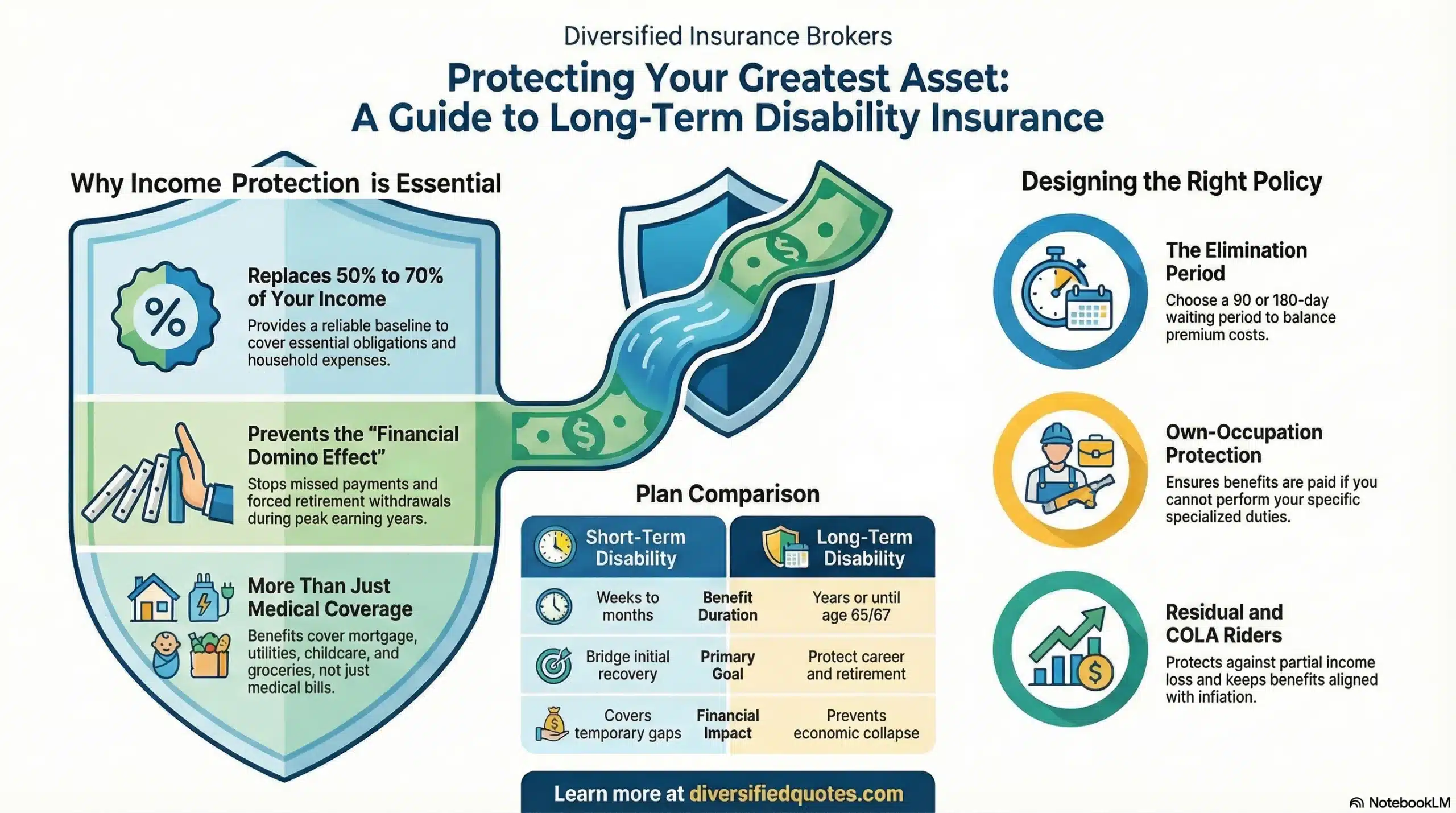
Carpenter contractors operating their own business — with a shop, tools, vehicle, and potentially employees or regular subcontractors — face the two-layer disability planning problem shared by all skilled trade business owners. Personal LTD replaces household income during disability. Business overhead disability insurance reimburses fixed business costs — tool payments, vehicle financing, shop lease, insurance, and any employee wages — that continue when the owner carpenter is unable to work. Without BOE coverage, a disability can threaten both personal financial stability and the business infrastructure that enables the return-to-work. The companion disability business overhead expense resource covers BOE design specifics for trade contractor businesses. The benefit period to retirement age — long-term disability insurance to age 65 — protects a full carpentry career. The elimination period should reflect available savings and any workers’ comp bridge; many carpenter contractors without sick leave should evaluate 30-60 day elimination periods. Short-term disability is especially relevant for carpenters given the frequency of injuries producing weeks-to-months recovery periods rather than permanent disability. The residual disability rider captures partial income loss when recovery allows light carpentry work but not full production. The full rider framework is at disability insurance riders explained. Tax treatment is at are disability insurance payments taxable. Benefit sizing is at how much disability insurance do I need. For a full independent review, get a 2nd opinion on your disability insurance quote.
Talk With an Advisor Today
Choose how you’d like to connect—call or message us, then book a time that works for you.
Schedule here:
calendly.com/jason-dibcompanies/diversified-quotes
Licensed in all 50 states • Fiduciary, family-owned since 1980
FAQs: Disability Insurance for Carpenters
What are the most common disabilities affecting carpenters?
Falls from ladders, scaffolding, and elevated work surfaces are the leading cause of serious and fatal injuries in carpentry. Power tool injuries — particularly from circular saws, nail guns, and reciprocating saws — produce lacerations, puncture wounds, and hand/finger injuries that can permanently affect carpentry-specific manual dexterity. Back injuries from sustained heavy lifting and overhead work, shoulder injuries from repetitive framing and finish work, and elbow conditions from repetitive motion are the most common chronic disability-producing conditions in experienced carpenter careers. Respiratory conditions from long-term wood dust exposure represent a career-length cumulative health risk.
Does workers’ compensation cover carpenters adequately?
Workers’ comp covers work-related injuries for employee carpenters at approximately two-thirds of wages, but has critical gaps. Illness-based disability from any cause — cancer, heart disease, diabetes, chronic musculoskeletal conditions that develop gradually — is completely outside workers’ comp coverage regardless of occupation. The two-thirds wage replacement at state caps may fall below total earnings for higher-earning carpenters. And many carpenters work as 1099 subcontractors in arrangements where employer workers’ comp coverage may not apply to them at all. Individual disability insurance fills all of these gaps.
What occupational class do carpenters receive for disability insurance?
Carpenters typically receive a middle occupational class reflecting the physical hazard profile — falls, power tools, heavy lifting — without reaching the extreme-hazard classifications. The specific class varies by carrier and by the type of carpentry: finish/trim work in controlled indoor settings may receive more favorable classification than exterior framing or elevated structural work. Providing an accurate description of actual work duties — distinguishing indoor finish from outdoor structural framing — during underwriting produces the most accurate classification outcome and avoids misrepresentation issues at claim time.
Should a self-employed carpenter contractor buy business overhead expense coverage?
If the contracting business has fixed costs that continue during disability — tool loans, vehicle payments, shop rent, equipment insurance, employee wages — BOE coverage is worth serious consideration alongside personal LTD. A personal disability policy replaces household income, but it does not cover the fixed business costs that continue accumulating when the owner carpenter cannot work. BOE coverage reimburses documented business overhead during the disability period, buying time to manage the business, bring in a temporary substitute, or plan a controlled transition without the simultaneous financial pressure of both personal income loss and mounting business overhead.
How do 1099 carpenter subcontractors document income for disability insurance?
1099 and self-employed carpenter subcontractors document disability insurance income through 1099 forms and Schedule C tax returns reflecting active earned carpentry income, averaged across two to three years to establish a consistent baseline. Net Schedule C income after legitimate business expenses — tools, materials, vehicle, business insurance — is the figure carriers use for benefit sizing for sole proprietors. Carpenters with variable project income from seasonal construction cycles benefit from the multi-year averaging approach that smooths the highs and lows of project-based carpenter income.
About the Author:
Jason Stolz, CLTC, CRPC, DIA, CAA and Chief Underwriter at Diversified Insurance Brokers (NPN 20471358), is a senior insurance and retirement professional with more than 25 years of real-world experience helping individuals, families, and business owners protect their income, assets, and long-term financial stability. As a long-time partner of the nationally licensed independent agency Diversified Insurance Brokers, Jason provides trusted guidance across multiple specialties—including fixed and indexed annuities, long-term care planning, personal and business disability insurance, life insurance solutions, Group Health, Travel Medical and Evacuation Insurance, and short-term health coverage. Diversified Insurance Brokers maintains active contracts with over 100 highly rated insurance carriers, ensuring clients have access to a broad and competitive marketplace.
His practical, education-first approach has earned recognition in publications such as VoyageATL, and contributions from his agency featured in Kiplinger and GoBankingRates— highlighting his commitment to financial clarity and client-focused planning. Drawing on deep product knowledge and years of hands-on field experience, Jason helps clients evaluate carriers, compare strategies, and build retirement and protection plans that are both secure and cost-efficient. Visitors who want to explore current annuity rates and compare options across multiple insurers can also use this annuity quote and comparison tool.
Explore More Disability Insurance Options: Browse our complete guide to Disability Insurance for Trades, Construction & Industrial — covering contractors, electricians, plumbers, welders, roofers, machinists & skilled trades from 100+ carriers.
Last Reviewed: June 6, 2026 |
Reviewed by: Jason Stolz, CLTC, CRPC, DIA, CAA
Chief Underwriter, Diversified Insurance Brokers, Inc. | NPN: 20471358 | Diversified Insurance Brokers, Inc. — Licensed in all 50 states
Fact Checked by: Tonia Pettitt, CMIP©
Medicare Specialist, Diversified Insurance Brokers, Inc. | NPN: 14374308 | Diversified Insurance Brokers, Inc. — Licensed in all 50 states
Did you find this content helpful? Leave us a Google review — it helps others find trustworthy guidance too.
Editorial Standards: Diversified Insurance Brokers maintains rigorous editorial standards to ensure accuracy, clarity, and independence in all content. Learn more about our editorial standards and commitment to transparency.
