
Disability Insurance for Bricklayers and Brick Masons
As an Independent Disability Insurance Broker, we have access to exclusive discounts and negotiated pricing most captive agents can’t offer — see the full breakdown near the end of this page.
Disability Insurance for Bricklayers and Brick Masons

Jason Stolz CLTC, CRPC, DIA, CAA
Bricklayers and brick masons work within one of the most physically demanding and well-documented high-risk categories in the construction trades. Bureau of Labor Statistics data places the median annual wage for brickmasons and blockmasons at approximately $60,800 — income that reflects the genuine skill, strength, and endurance the trade demands, and income that depends entirely on the physical capacity to lift, position, and set masonry materials across full working days on active construction sites. Research published in occupational health literature has specifically identified bricklayers as being at increased risk of lung cancer, low back pain, and upper and lower extremity complaints compared to the general working population — a finding that makes the absence of individual disability insurance not a planning gap but a financial exposure that a single disabling event will make concrete and irreversible.
At Diversified Insurance Brokers, Jason Stolz, CLTC, CRPC, DIA, CAA works with bricklayers, brick masons, blockmasons, and masonry contractors to build income protection structures that reflect the realities of how masonry income actually works — the union journeyman and apprentice who relies on an employer’s group plan that covers far less than assumed, the independent mason contractor operating as a sole proprietor with no workers’ comp coverage for their own injuries, and the masonry business owner with overhead obligations that continue whether the owner is on the job or in a hospital. The physical risks of bricklaying are not abstract — they are documented in OSHA publications, occupational health research, and the careers of working masons across the country — and the income protection structure that addresses those risks requires the same precision and expertise that the masonry trade itself demands.
Compare Disability Insurance for Bricklayers and Brick Masons
We review coverage options across 100+ carriers and identify the policy structure that fits your masonry income, business structure, and occupational risk profile.
Request Disability Insurance OptionsBricklayer and Brick Mason Disability Risk — Hazards, Income Exposure, and the Protection Gap
| Hazard Category | Primary Source | Resulting Disability Risk | Workers’ Comp Coverage | DI Coverage Gap |
|---|---|---|---|---|
| Repetitive musculoskeletal loading | An average mason lays approximately 1,000 bricks per working day; each lift, set, and tap involves bending, twisting, squatting, and force application to the lower back, shoulders, and wrists | Chronic lower back syndrome, herniated disc, rotator cuff tear, carpal tunnel, knee degeneration | Acute work incidents covered; cumulative and degenerative conditions frequently disputed as non-occupational | Major gap for chronic and degenerative musculoskeletal conditions; illness-based spinal and joint disease fully outside workers’ comp |
| Silica dust and respiratory exposure | Cutting, grinding, and drilling brick, block, and mortar generates respirable crystalline silica; daily cumulative inhalation exposure across a masonry career | Silicosis (incurable lung disease), lung cancer, COPD, occupational asthma — diseases that typically develop over years of exposure | Occupational disease provisions apply for employees; illness-based outcomes disputed; owner-operators typically excluded | Significant gap for gradual-onset respiratory diseases; owner fully exposed; illness-based respiratory disability outside workers’ comp |
| Falls from scaffolding and elevation | OSHA identified falls as the leading cause of fatality in construction; bricklayers work from scaffolding at height regularly across residential, commercial, and institutional projects | Spinal fracture, traumatic brain injury, multiple fractures, permanent neurological impairment | Covers employees for acute work-related falls; owner-operators excluded unless specifically elected | Full gap for owner-operators; employee gap for LTD during extended recovery when group plan benefit period is inadequate |
| Cement and chemical dermatitis | Portland cement contains calcium oxide and other compounds; prolonged skin contact during mortar mixing and laying produces sensitization and chronic dermatitis | Occupational contact dermatitis, chemical burns, sensitization that permanently limits ability to work with cement-based materials | Occupational disease for employees; gradual sensitization frequently disputed; owner-operators unprotected | Gap when sensitization is permanent and disabling; illness-based chemical sensitivity outside workers’ comp entirely for owners |
| Struck-by and crush incidents | Falling or swinging objects, unsecured materials, scaffold failure, equipment contact on active construction sites | Head trauma, crush injuries, limb fractures, traumatic amputation, permanent functional impairment | Covered for employees; owner-operators excluded without specific election | Full gap for owner-operators; permanent impairment from traumatic events requires LTD extending to retirement age |
| Illness-based disability (non-occupational) | Cardiac events, cancer, neurological conditions, and other serious health events unrelated to any specific workplace incident | Extended inability to perform the heavy physical demands of bricklaying — lifting, bending, standing, and material handling | Not covered — workers’ comp does not apply to non-occupational illness | Approximately 90% of long-term disabilities are illness-based; complete gap for all workers |
The table captures the full landscape of disability exposure for bricklayers — a profile that spans acute traumatic injury risk from falls and struck-by events, cumulative musculoskeletal loading from the repetitive physical demands of daily brick production, and the long-horizon respiratory disease risk that OSHA’s crystalline silica standard specifically identifies as a serious health hazard for masonry workers. The approximately 90 percent of long-term disabilities that are illness-based rather than traumatic-injury-based apply to bricklayers at the same population rate as any other worker — meaning the dominant disability risk by probability is not a scaffold fall but a cardiac event, a cancer diagnosis, or a degenerative spinal condition. Disability insurance by occupation recognizes that the right protection structure addresses the complete risk spectrum — not just the dramatic workplace events that construction work makes visible.
The Physical Demands of Bricklaying and Their Long-Term Disability Implications
Masonry work is characterized by Bureau of Labor Statistics as physically demanding, requiring heavy lifting and long periods of standing, kneeling, and bending — a description that understates the occupational loading that bricklayers experience at production volume. An average mason lays approximately 1,000 bricks in a working day. Each brick requires lifting the unit, applying mortar, positioning and aligning the brick, and striking it into place — a sequence that involves repeated forward trunk flexion exceeding 60 degrees and elevated arm work above 60 degrees, both of which occupational health research at the NIOSH threshold level has specifically identified as biomechanical load factors for lower back and upper extremity injury in bricklayers. Research published in occupational medicine literature has documented that energetic load, lower back loading exceeding NIOSH threshold values, and repetitive force exertions of the upper extremities are confirmed demands of bricklaying — and that bricklayers are at increased risk of low back pain and upper extremity complaints as a result.
The cumulative effect of this physical loading across a masonry career is the development of chronic musculoskeletal conditions that progress from manageable discomfort to disabling pathology over time. Herniated lumbar discs, chronic lower back syndrome, rotator cuff tears, and knee degeneration from the sustained squatting and kneeling that brick setting requires are occupational injuries that do not arrive as discrete sudden events — they develop progressively and eventually reach a threshold at which continued brick production is physically impossible. A bricklayer who reaches that threshold faces a recovery timeline measured in months following surgical intervention, a high probability of restrictions that limit return to full production capacity, and in the most serious cases a permanent disability that ends the trade career entirely. Long-term disability insurance provides the income floor for exactly these scenarios — the ones where a worker cannot return to their trade for extended periods and needs a reliable income source during the recovery or permanent disability period that follows.
The short-term disability dimension of bricklaying also deserves specific attention. The acute recoverable injuries that are common in the trade — a back strain from a heavy lift, a knee injury from scaffolding work, a wrist condition requiring surgical intervention — produce disability periods measured in weeks to months during which the bricklayer cannot work but from which they will ultimately recover. Short-term disability insurance addresses precisely this category: the gap between injury onset and the point at which long-term coverage would activate, replacing income during the recovery period when medical costs are accumulating and production income has stopped. Relying on savings alone to bridge a 60 or 90 day recovery period is a strategy that erodes the financial foundation that a full-career mason has built — individual short-term disability coverage prevents that erosion without depleting reserves built over years of skilled labor.
Silica Dust, Respiratory Disease, and the Long-Horizon Disability Risk of Masonry
OSHA’s respirable crystalline silica standard specifically identifies masonry saws, grinders, drills, jackhammers, and handheld chipping tools — the tools bricklayers use daily — as sources of the very small silica particles that can travel deep into the lungs and cause silicosis, lung cancer, and other potentially debilitating respiratory diseases including chronic obstructive pulmonary disease and kidney disease. OSHA documentation notes that approximately 2.3 million workers in the United States are exposed to silica at work, and that workers who inhale respirable crystalline silica particles are at increased risk of developing serious silica-related diseases. For bricklayers, silica exposure is not incidental — it is inherent to every cutting, grinding, and drilling operation the trade requires. Occupational health research has specifically documented that bricklayers are at increased risk of lung cancer as a result of this cumulative dust and quartz exposure, with levels exceeding regulatory limit values documented in working masonry environments. This is among the most significant findings in the occupational medicine literature on disability insurance for high-risk occupations — because it means a bricklayer’s disability exposure does not only exist during their working career but in the decades that follow, as silica-related diseases develop after years of cumulative exposure.
The disability insurance planning implication of respiratory disease risk for bricklayers is direct: the occupational disease pathway — silicosis, COPD, lung cancer arising from cumulative silica exposure — is an illness-based disability under the workers’ compensation framework, meaning it generates no workers’ comp benefit for owner-operators and only limited occupational disease coverage for employees whose claims are not disputed. Individual disability insurance covers disability from any qualifying cause regardless of whether it arose from a specific workplace incident, including illness-based respiratory conditions severe enough to prevent the sustained physical work bricklaying requires. A bricklayer who develops COPD severe enough to preclude the exertion demands of masonry work — heavy lifting, stair and scaffold climbing, sustained physical production — qualifies for disability benefits under an individual policy with the appropriate definition, regardless of whether a specific workplace incident precipitated the condition.
Workers’ Compensation and the Bricklayer — What It Covers and the Gaps That Remain
Workers’ compensation is the baseline income protection for employed bricklayers, covering approximately two-thirds of wages up to state maximums for work-related injuries and occupational diseases. For a union journeyman bricklayer injured on an employer’s construction project, workers’ comp provides the floor it is designed to provide: medical coverage and partial wage replacement during recovery from a documented workplace incident. But three structural gaps undermine the protection picture for most bricklayers in most working structures.
The first gap is the self-employment and owner-operator gap that affects the substantial portion of the masonry workforce operating as sole proprietors, single-member LLCs, and independent masonry contractors. Bureau of Labor Statistics data reflects that many experienced bricklayers progress to running their own operations — taking projects independently, assembling their own crews, and operating as the skilled craftsperson whose labor and expertise generate the revenue. For these masons, workers’ compensation as a default protection does not apply. Sole proprietors are not employees of their own businesses under the workers’ comp framework. Unless a self-employed mason has specifically elected to include themselves in their own workers’ comp coverage — an optional step most do not take — they carry zero workers’ comp protection for their own injuries. The person whose disability would eliminate the operation’s income has no floor. Understanding why bricklayers buy disability insurance begins here: it is the protection system for the people the workers’ comp system structurally excludes.
The second gap is the illness-based disability gap that applies universally regardless of employment status. Workers’ compensation covers only work-related injuries and occupational diseases attributable to a specific workplace exposure or incident. It does not cover disability from illness — the cancer diagnosis, the cardiac event, the neurological condition — that arises independently of any workplace incident. Since approximately 90 percent of long-term disabling conditions are illness-based, workers’ comp is structurally designed to address the minority of the disability risk that any bricklayer actually carries. Whether disability insurance is worth it for a bricklayer is answered most directly by calculating what twelve months of eliminated income would cost against the annual premium of a policy that prevents it.
The third gap applies to self-employed masonry contractors and owner-operators who have no employer-provided group long-term disability plan as a baseline. Even the most comprehensive group LTD plan through an employer provides coverage that ends when employment ends, transitions from own-occupation to any-occupation after 24 months, and caps benefits at levels that may underserve a senior journeyman’s earnings. Individual disability insurance operates outside these constraints — it is owned by the individual, not the employer, and its terms are determined at the time of purchase rather than subject to plan design changes the employer can make unilaterally.
Own-Occupation Coverage — The Definition That Determines What Gets Paid
The disability definition in a policy is the contractual language that determines whether a back condition that prevents bricklaying but theoretically permits a sedentary job generates a benefit payment or a denial. For a bricklayer whose income derives entirely from the ability to perform specific physical skilled trade work, the policy definition is not a technical detail — it is the most financially consequential choice in the coverage structure.
A true own-occupation disability insurance policy pays benefits when the insured cannot perform the material and substantial duties of their specific occupation — bricklaying — even if they are theoretically capable of working in some other capacity. For a bricklayer who has undergone lumbar spinal fusion and cannot return to the heavy lifting, bending, and squatting that production masonry requires, an own-occupation policy pays the benefit regardless of whether the insured could theoretically work as a retail associate or a customer service representative. The policy recognizes that the bricklayer’s income derives from a specific set of physical skills and that the loss of those skills is a genuine economic disability independent of what other work might theoretically be possible.
An any-occupation definition — common in group plans and in policies that do not specifically provide own-occupation language — pays benefits only when the insured cannot perform any gainful work for which they are reasonably suited. Understanding how short-term and long-term disability policies interact with these definitions — and specifically the 24-month transition that most group plans make from own-occupation to any-occupation — is essential context for any bricklayer evaluating whether existing coverage is actually adequate for the occupational disability scenarios the trade produces.
Business Overhead Expense Coverage for Masonry Contractors
Bricklayers who own their own masonry contracting operation face the same two-layer financial exposure when disability strikes that any skilled trade business owner faces: the personal income loss from not being able to work, and the continuation of business overhead obligations that do not pause because the owner is injured. For a masonry contractor who has taken on project commitments, maintains equipment, carries crew payroll, and has supply and material obligations, the overhead continues whether the owner is on the job or not. A personal disability income policy addresses the first layer. Business overhead expense disability insurance addresses the second.
The BOE structure pays a monthly benefit calibrated to the actual fixed operating costs of the masonry operation during the owner’s qualifying disability — funding the continuation of the business infrastructure rather than allowing it to collapse against zero revenue during the disability period. For a masonry contractor whose operation represents years of built customer relationships, equipment assets, and a skilled crew that would be costly and time-consuming to rebuild after a disability, the BOE structure is the difference between a disability that temporarily pauses the business and one that permanently ends it.
Occupational Class, Income Documentation, and Policy Design for Bricklayers
Bricklaying occupies the middle-to-lower tiers of most disability insurance carriers’ occupational class schedules — a classification reflecting the documented physical demands, fall risk, silica exposure, and musculoskeletal injury probability of the trade. This classification affects premium rate per dollar of benefit and the maximum approvable monthly benefit. For bricklayers who are 1099 earners or self-employed contractors, income documentation through tax returns and business financials establishes the income basis for underwriting — and the maximum approvable benefit is calculated as a percentage of documented net earned income. How much disability insurance a bricklayer needs is a calculation that should account for both personal income replacement and, for masonry contractors, the overhead obligations that BOE coverage addresses separately.
The elimination period — the waiting period between disability onset and first benefit payment — should reflect the bricklayer’s actual financial reserves. Common options of 30, 60, and 90 days each represent different trade-offs between premium cost and income floor activation speed. How elimination periods affect both coverage and premium is a design decision made in the context of real household finances, not a generic default. The benefit period should extend to age 65 for most active bricklayers — the chronic back condition and serious illness scenarios that most commonly end masonry careers are not short-term recoverable events. The riders available on individual policies — including the future insurability option that allows benefit increases as income grows without new medical underwriting, and the cost of living adjustment rider that protects real purchasing power during a long-term claim — add meaningful flexibility that a growing masonry career should carry.
Pre-Existing Conditions and Coverage Options for Bricklayers With Prior Injuries
Bricklayers who approach the disability insurance market with a documented prior back injury, a history of shoulder treatment, or a prior workers’ comp claim will find that underwriting outcomes vary significantly by carrier. Most carriers will offer coverage with a partial exclusion rider for the specific prior condition while providing full coverage for all other disabling causes — a structure that still delivers meaningful protection against the full range of health and injury events the bricklayer faces. Disability insurance with pre-existing conditions is available through independent broker channels that compare the full carrier market, and no-exam disability insurance options may serve bricklayers whose health history makes traditional underwriting uncertain. Working with an independent disability insurance broker who understands how trade occupation health histories are evaluated across the carrier market is the structure that produces the most complete and accurate picture of available coverage for any specific bricklayer’s profile.
Get Your Bricklayer Disability Insurance Review
We compare occupational class assignments, benefit structures, and BOE options across 100+ carriers to identify the coverage architecture that fits your masonry income and business obligations.
Request Disability Insurance Options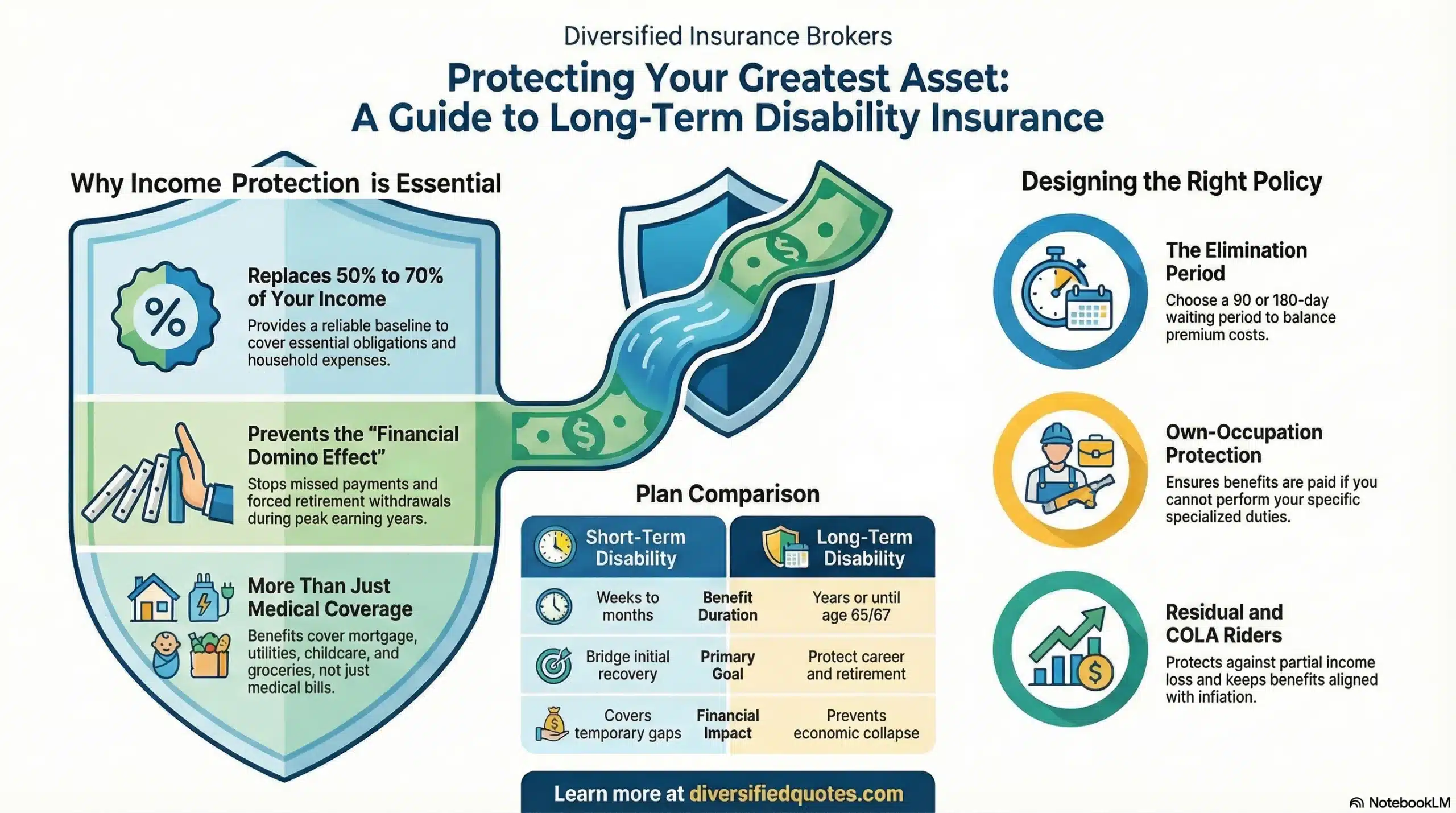
Talk With an Advisor Today
Choose how you’d like to connect—call or message us, then book a time that works for you.
Schedule here:
calendly.com/jason-dibcompanies/diversified-quotes
Licensed in all 50 states • Fiduciary, family-owned since 1980
FAQs: Disability Insurance for Bricklayers and Brick Masons
What occupational class does bricklaying receive and how does it affect my coverage?
Bricklaying and masonry work is typically assigned to the middle-to-lower tiers of most disability insurance carriers’ occupational class schedules — a classification that reflects the documented physical demands, fall risk, silica exposure, and musculoskeletal injury probability of the trade relative to sedentary professional occupations. The specific classification varies between carriers, which is one of the most important reasons to compare multiple carriers before committing to any policy: different classifications produce different premium rates and maximum approvable benefit amounts for identical coverage terms. A carrier that assigns bricklaying to a more favorable class than another carrier will produce meaningfully lower premium cost for the same benefit — and that difference is only identifiable through independent broker comparison, not through a single direct application.
The practical effects of lower-tier occupational classification include higher premiums per dollar of monthly benefit than top-tier professional occupations, and in some cases lower maximum monthly benefit ceilings. Neither of these effects prevents a bricklayer from obtaining meaningful, comprehensive disability protection. A residual disability benefit provision is particularly important for bricklayers, because partial disability — reduced work capacity following back surgery or a significant injury — is a realistic and common recovery trajectory in the trade. A policy with a residual benefit provision pays a partial benefit proportional to the income loss from partial disability, addressing the realistic scenario rather than only the total disability endpoint.
Are disability insurance benefits taxable for bricklayers?
The tax treatment of disability insurance benefits for bricklayers follows the same rule that applies to any worker: it depends on how the premiums were paid. When a bricklayer purchases individual disability insurance and pays premiums with after-tax dollars — the standard case for self-employed masons, sole proprietors, and independent masonry contractors — the monthly benefits received during a qualifying disability are generally received income-tax-free. This means the full monthly benefit amount reaches the household without income tax reduction, making the coverage significantly more financially effective than a gross benefit comparison would suggest. Whether disability insurance payments are taxable matters when calculating how large a benefit amount is actually needed to replace real take-home pay during a disability period.
For employed bricklayers whose employer or union pays some or all of disability insurance premiums, the tax treatment reverses: the resulting benefits are typically taxable as ordinary income at claim time. This effectively reduces the real purchasing power of a group plan benefit — a factor that employed masons should account for when evaluating whether an existing employer group plan actually covers their household obligations during a disability. Self-employed masonry contractors who deduct disability insurance premiums as a business expense should also confirm the specific tax treatment with a tax professional, as the deduction may affect the taxability of benefits when a claim occurs.
Can silica-related lung disease qualify as a disability insurance claim for a bricklayer?
Yes — individual disability insurance covers disability arising from respiratory illness including conditions that developed from occupational silica exposure, as long as the condition meets the policy’s definition of disability and no specific pre-existing respiratory exclusion applies to that condition. This is one of the most important advantages individual disability insurance provides over workers’ compensation for bricklayers with silica exposure: a respiratory disease like COPD or silicosis that develops from cumulative dust exposure over a masonry career is an illness-based disability under the workers’ comp framework, often difficult to compensate because it develops gradually and after years of exposure. Individual disability insurance does not require the condition to arise from a specific dated workplace incident — it requires the condition to meet the disability definition, which a respiratory illness severe enough to prevent the exertion demands of bricklaying typically does.
OSHA’s crystalline silica documentation identifies bricklayers as a high-exposure group, and the occupational health literature has specifically confirmed that bricklayers face increased risk of lung cancer and other respiratory diseases from dust and quartz exposure. Bricklayers who already have a documented respiratory history — an asthma diagnosis, early COPD findings — should expect that history to be reviewed during disability insurance underwriting. High-risk disability insurance options exist for applicants whose health history falls outside standard underwriting guidelines, and an independent broker who understands how carriers treat respiratory histories in construction occupations is essential for producing the best available outcome in these cases.
I’m a younger bricklayer just starting my career — why should I think about disability insurance now?
Early in a masonry career is actually the most strategically advantageous time to purchase disability insurance — for three reasons that compound over the length of a career. First, disability insurance premiums are age-rated, meaning the younger the applicant at issue, the lower the annual premium for any given benefit amount and policy structure. A bricklayer who purchases coverage at 24 locks in a substantially lower premium rate for a policy that can protect their income all the way to age 65 compared to one who waits until 40 — a difference that accumulates over decades of payments. Second, early purchase happens when health history is at its cleanest — before the back injuries, the shoulder conditions, and the cumulative health events that a construction career produces. Purchasing coverage before those histories develop means no exclusion riders, no table ratings, and no restricted benefit terms related to conditions that will develop later. Why young and healthy workers need disability insurance is most simply answered by noting that the ability to purchase comprehensive coverage without restrictions exists only while the health is genuinely clean — and in a physically demanding trade like bricklaying, that window is finite.
Third, the future insurability rider available on most individual disability policies allows benefit increases as income grows without new medical underwriting. A young apprentice mason who purchases a modest benefit at issuance can increase that benefit to match journeyman earnings — and eventually masonry contractor earnings — without undergoing new health screening. This preserves the clean health-based underwriting of the original issuance throughout the career’s income growth trajectory, which is one of the most valuable features an early-career purchase delivers.
I own a masonry contracting business — do I need both personal disability income coverage and business overhead coverage?
For a masonry contractor who owns their operation, disability creates a two-layer financial crisis that personal income replacement alone cannot fully address. The personal layer is the loss of the owner’s earned income — the wages or owner’s draw that funds household expenses. The business layer is the continuation of fixed overhead costs — equipment financing, vehicle and trailer payments, crew payroll if applicable, supply commitments, insurance premiums, and any leased yard or storage space — that do not pause because the owner-mason is injured or ill. A personal disability income policy addresses the first layer and nothing more. Business overhead expense disability insurance addresses the second layer specifically.
The key person disability insurance dimension is also worth evaluating for masonry contractors who have a key skilled foreman or lead mason whose disability would also create business disruption beyond the owner’s own absence. The combination of personal disability income coverage, BOE coverage, and key person coverage — each calibrated to the actual financial structure of the masonry operation — produces the most complete income and business protection picture for a masonry contractor. Having all three layers evaluated together, with benefit amounts coordinated to real cost structures rather than general estimates, is the planning process that produces genuinely adequate protection rather than the appearance of it.
My existing disability insurance quote seemed expensive — what should I do?
A single quote from a single carrier is not a market price — it is one carrier’s pricing for one occupational class assignment on one product structure. Disability insurance premiums for construction trade occupations vary meaningfully across carriers because carriers classify the same occupation differently, use different underwriting assumptions for the trade’s risk profile, and offer different product structures with different premium efficiencies. A quote that appears expensive from one carrier may reflect that carrier’s conservative classification of masonry work — while another carrier who classifies bricklaying more favorably produces a substantially lower premium for the same coverage terms.
Beyond pricing, the policy terms most worth comparing for bricklayers are the disability definition — own-occupation versus modified or any-occupation — the residual benefit provision, the available benefit period options, and the elimination period flexibility. A policy that costs less but uses a weaker disability definition or a shorter benefit period is not equivalent to one that costs more but provides true own-occupation coverage to age 65. A second opinion on your disability insurance quote through an independent broker who accesses the full market produces a genuine comparison rather than a single carrier’s answer. For bricklayers who found the first quote too expensive to act on, the right response is independent comparison before declining coverage — the financial consequence of being uninsured when a disabling event occurs will always exceed the premium savings from declining the policy.
About the Author:
Jason Stolz, CLTC, CRPC, DIA, CAA and Chief Underwriter at Diversified Insurance Brokers (NPN 20471358), is a senior insurance and retirement professional with more than 25 years of real-world experience helping individuals, families, and business owners protect their income, assets, and long-term financial stability. As a long-time partner of the nationally licensed independent agency Diversified Insurance Brokers, Jason provides trusted guidance across multiple specialties—including fixed and indexed annuities, long-term care planning, personal and business disability insurance, life insurance solutions, Group Health, Travel Medical and Evacuation Insurance, and short-term health coverage. Diversified Insurance Brokers maintains active contracts with over 100 highly rated insurance carriers, ensuring clients have access to a broad and competitive marketplace.
His practical, education-first approach has earned recognition in publications such as VoyageATL, and contributions from his agency featured in Kiplinger and GoBankingRates— highlighting his commitment to financial clarity and client-focused planning. Drawing on deep product knowledge and years of hands-on field experience, Jason helps clients evaluate carriers, compare strategies, and build retirement and protection plans that are both secure and cost-efficient. Visitors who want to explore current annuity rates and compare options across multiple insurers can also use this annuity quote and comparison tool.
Explore More Disability Insurance Options: Browse our complete guide to Disability Insurance for Trades, Construction & Industrial — covering contractors, electricians, plumbers, welders, roofers, machinists & skilled trades from 100+ carriers.
Last Reviewed: June 7, 2026 |
Reviewed by: Jason Stolz, CLTC, CRPC, DIA, CAA
Chief Underwriter, Diversified Insurance Brokers, Inc. | NPN: 20471358 | Diversified Insurance Brokers, Inc. — Licensed in all 50 states
Fact Checked by: Tonia Pettitt, CMIP©
Medicare Specialist, Diversified Insurance Brokers, Inc. | NPN: 14374308 | Diversified Insurance Brokers, Inc. — Licensed in all 50 states
Did you find this content helpful? Leave us a Google review — it helps others find trustworthy guidance too.
Editorial Standards: Diversified Insurance Brokers maintains rigorous editorial standards to ensure accuracy, clarity, and independence in all content. Learn more about our editorial standards and commitment to transparency.
