
Disability Insurance for Well Drillers
As an Independent Disability Insurance Broker, we have access to exclusive discounts and negotiated pricing most captive agents can’t offer — see the full breakdown near the end of this page.
Disability Insurance for Well Drillers

Jason Stolz CLTC, CRPC, DIA, CAA
Disability insurance for well drillers is one of the most important financial protections available for professionals working in physically demanding and high-risk environments. Well drilling involves heavy equipment operation, deep excavation, and exposure to unpredictable ground conditions — all of which require strength, coordination, and technical skill that cannot easily be substituted if an injury or illness removes you from the field. If a disability prevents you from performing your job, your ability to earn income can stop immediately, while your financial obligations continue without pause. At Diversified Insurance Brokers, we help well drillers and skilled trades professionals compare disability insurance options across multiple carriers to find coverage that matches the real-world risks of the profession and provides meaningful income replacement if the unexpected happens.
Unlike office-based careers, well drillers cannot easily transition into lighter duties without significant changes to their role or income level. Your livelihood is directly tied to your physical capability and your ability to operate machinery safely and efficiently in challenging environments. Disability insurance for well drillers provides a financial safety net — ensuring that if your ability to work is interrupted by injury or illness, your income continues while you recover, and your household does not face a financial crisis on top of a health one.
Protect Your Income as a Well Driller
Compare disability insurance options designed for skilled trades and heavy equipment operators.
Request Disability Insurance Options
Questions? Call 800-533-5969
Why Well Drillers Face Unique Disability Risk
Well drilling is a physically intensive profession that requires full use of the body, precise coordination, and the ability to operate heavy machinery in challenging and often unpredictable environments. Every job involves potential hazards — unstable ground conditions, equipment malfunctions, high-pressure systems, deep excavations, and exposure to extreme weather. These are not theoretical risks. They are daily realities that create meaningful exposure to both sudden injuries and the cumulative physical wear that develops over years of heavy work.
The financial risk created by this occupational environment is significant because well drillers’ income depends entirely on the ability to show up and physically perform. There is no desk work to fall back on during recovery, no reduced-duty assignment that maintains pay, and no employer sick leave in many cases for self-employed or contract drillers. When the work stops, the income stops — and it stops immediately. This is fundamentally different from office-based careers where a disability might allow for modified duties, remote work, or a gradual transition back to full productivity. For well drillers, disability insurance for income replacement is not a luxury product — it is the primary financial protection against the most consequential occupational risk they face. Many skilled trades professionals in similar roles recognize this same vulnerability, including disability insurance for plumbers and disability insurance for electricians, where income is equally tied to physical performance.
The Physical Demands and Injury Risks of Well Drilling
Well drillers perform physically demanding tasks on a daily basis — operating drilling rigs, handling heavy equipment, working in uneven or confined spaces, managing high-pressure systems, and performing repetitive heavy lifting and bending. These tasks require strength, endurance, and constant attention to safety conditions that change with every job site. The nature of the work often involves standing for extended periods, working in extreme heat or cold, and making rapid physical adjustments in response to changing ground conditions and equipment behavior.
In addition to immediate injury risks from equipment operation, well drilling creates exposure to long-term wear and tear that can develop into chronic conditions over the course of a career. Back injuries, shoulder and joint damage, hearing loss from equipment noise, vibration-related conditions, and reduced mobility from years of repetitive physical strain are all documented occupational health concerns in drilling and excavation work. These chronic conditions can reduce working capacity gradually — or end a career suddenly — in ways that a disability insurance policy can address through both total disability benefits and residual benefits that cover partial income loss when a driller can still work but at reduced capacity.
How Disability Insurance for Well Drillers Is Structured
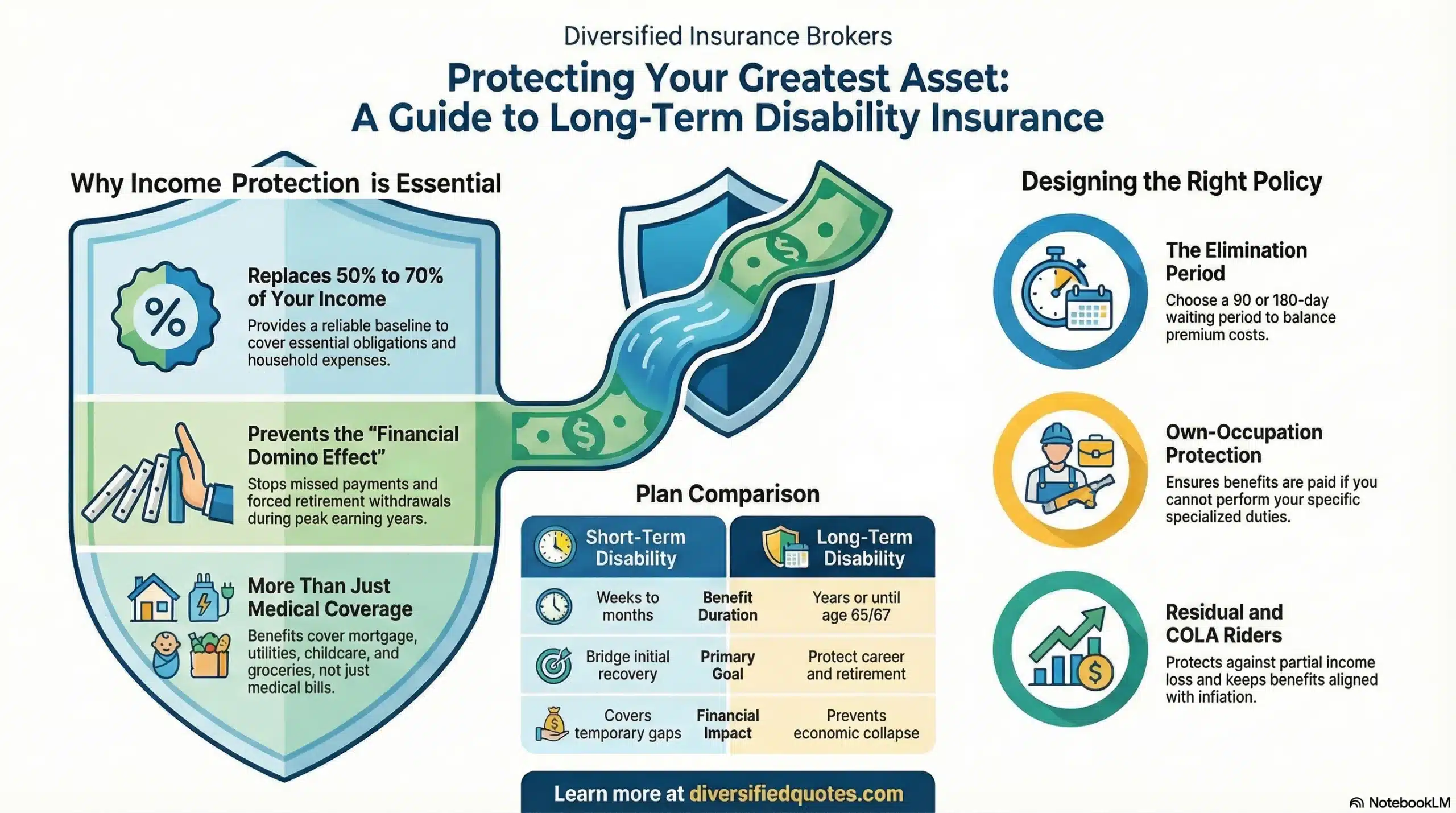
Disability insurance for well drillers should be tailored to reflect the physical demands and risks of the profession rather than selected as a generic income protection product. The key design decisions are the elimination period, the benefit period, the disability definition, and whether residual coverage is included. The elimination period — how long you wait before benefits begin — should be matched to the household’s liquid reserves and any short-term coverage available through employer arrangements or union programs. Most well drillers find that a 90-day elimination period creates an acceptable balance between premium affordability and coverage activation timing, particularly when emergency savings are in place to bridge the gap.
The benefit period determines how long disability benefits can be paid. Shorter benefit periods reduce premium but leave the most serious long-term disability scenarios unprotected. Given that well drillers face cumulative injury risks that can result in permanent or very long-duration disabilities, a benefit period that extends to age 65 is typically more appropriate than a two or five year benefit period. Residual disability coverage is particularly valuable for well drillers because many disabilities do not completely stop work — they reduce capacity and income. A back injury that prevents heavy lifting may still allow some field work at reduced hours or in a supervisory capacity. Residual benefits provide proportionate income replacement in these partial-disability scenarios, allowing for a smoother recovery and return to full capacity rather than creating an all-or-nothing claim structure that leaves partial disabilities unaddressed.
Income Structure and Financial Exposure for Well Drillers
Well drillers may be paid hourly, per project, or operate as independent contractors or business owners, which creates variability in income that increases financial exposure relative to salaried employees. When a disability occurs, income can drop to zero immediately while fixed expenses — equipment costs, transportation, insurance, and household obligations — continue without interruption. This makes disability insurance particularly important for well drillers because even a short-term disability can create significant financial strain without a dedicated income replacement mechanism in place.
For self-employed well drillers and independent contractors, the financial exposure is amplified further because there is typically no employer-sponsored disability coverage to serve as a baseline. Individual disability insurance is often the only meaningful income protection available. Carriers evaluating self-employed well drillers will typically require income documentation — tax returns and business financial statements — to verify the level of income being insured. If tax minimization strategies have significantly reduced reportable income, this can limit the benefit amount available, which is an important planning consideration. For a thorough overview of how disability underwriting works for self-employed professionals, our page on disability insurance for self-employed professionals covers the income documentation process in detail.
Why Occupation Classification Matters for Well Driller Disability Insurance
Disability insurance carriers classify occupations into risk categories — commonly ranging from Class 1 for the highest-risk physical occupations to Class 5 or 6 for professional office workers with the lowest disability risk. Well drilling typically falls into a higher-risk classification because of the physical demands, equipment exposure, and environmental hazards involved. This classification affects both the premium level and the type of disability definition available. Higher-risk occupation classes generally carry higher premiums, and carriers may apply modified disability definitions or shorter periods during which own-occupation language applies.
Because occupation classification significantly affects both cost and coverage terms for well driller disability insurance, the carrier selection process matters more for this type of applicant than for an office-based professional. Different carriers have different underwriting philosophies for physically demanding occupations, and some are more favorable than others for specific trades. Working with an independent disability insurance broker who can compare carriers specifically for your occupational classification is one of the most effective ways to ensure you are getting the best available combination of coverage terms and premium for your profession. For well drillers who want to understand how similar occupations are approached, our pages on disability insurance for heavy equipment operators and disability insurance for repairmen provide useful comparative context.
Integrating Well Driller Disability Insurance Into a Complete Financial Plan
Disability insurance for well drillers is a foundational component of financial protection, but it works best when integrated with a broader plan that addresses the full range of financial risks. A well-structured disability policy ensures income remains stable during periods of illness or injury, preventing a temporary disruption from becoming a long-term financial crisis. But other planning elements matter alongside it: emergency reserves to bridge the elimination period, liability coverage for the business if applicable, and long-term financial planning for retirement that accounts for the reality that physical well drilling cannot continue indefinitely.
Many well drillers also benefit from reviewing their coverage periodically as income changes, because a policy purchased at an earlier income level may provide inadequate replacement if earnings have grown substantially. A future purchase option or future increase option rider — which allows benefit increases without new medical underwriting at defined intervals — can be particularly valuable for this reason. Building this flexibility into the initial policy design is more cost-effective than attempting to add coverage later after health or occupational changes may complicate underwriting. Our disability insurance services page covers the full range of riders and design options available for skilled trades professionals across all major carriers.
Get Disability Insurance Quotes for Well Drillers
We compare options across multiple carriers for skilled trades and physically demanding occupations to find the right combination of coverage and value.
Get Disability Insurance Quotes
Questions? Call 800-533-5969
Financial Protection Essentials
Second opinion resources, annuity income planning, and Medicare coverage tools.
Talk With an Advisor Today
Choose how you’d like to connect—call or message us, then book a time that works for you.
Schedule here:
calendly.com/jason-dibcompanies/diversified-quotes
Licensed in all 50 states • Fiduciary, family-owned since 1980
Disability Insurance for Well Drillers — FAQs
Well drillers need disability insurance because their income depends entirely on physical capability — there is no office work to fall back on, no modified-duty assignment, and no employer-provided sick pay in many cases. If an injury or illness prevents a well driller from operating equipment, performing excavation, or performing the physical tasks that define the job, the income stops immediately while household and business expenses continue. This immediate income exposure is what makes disability insurance for well drillers a foundational financial protection rather than an optional add-on.
The occupational hazards of well drilling — heavy equipment operation, high-pressure systems, unstable ground conditions, repetitive physical strain, and environmental exposures — create meaningful statistical risk of both sudden injuries and cumulative conditions that develop over a career. Without disability insurance, a single significant injury or the gradual onset of a chronic condition like back damage or joint deterioration can permanently reduce earning capacity with no financial safety net in place. The combination of high physical risk and direct income dependency on physical performance is precisely why disability insurance is considered essential for well drillers and other skilled trades professionals in similar high-risk roles.
Well drillers face a range of occupational risks that are specifically relevant to disability insurance underwriting and coverage design. Acute risks include heavy equipment accidents, slips and falls on uneven or unstable terrain, injuries from high-pressure systems, and physical trauma from rotating or striking machinery. These sudden injury scenarios can result in fractures, soft tissue damage, head injuries, or other conditions that immediately prevent the driller from working and may require extended recovery periods. Disability insurance for well drillers covers these acute events from the end of the elimination period through the benefit period, providing income replacement during recovery.
Longer-term risks include the cumulative physical effects of years of heavy lifting, bending, standing on uneven surfaces, whole-body vibration from equipment operation, and exposure to noise levels that can cause hearing damage. These occupational health risks can develop gradually — often appearing as back pain that worsens, joint deterioration that progresses, or reduced mobility that increasingly limits the ability to perform the physical demands of the job. Residual disability coverage in a well driller disability insurance policy is specifically designed to address this type of partial, progressive disability — paying proportionate benefits when the driller can still work but at reduced capacity and reduced income, rather than requiring total inability to work before any benefit is triggered.
Yes — self-employed well drillers can obtain individual disability insurance policies that provide meaningful income replacement if they are unable to work due to a covered illness or injury. In fact, disability insurance is often more critical for self-employed well drillers than for employees because there is no employer-sponsored group disability coverage serving as a baseline, no paid sick leave, and no workers’ compensation that covers illness and non-work injuries. The individual disability policy is often the only meaningful income protection available, which makes the design and benefit amount decisions especially consequential.
The underwriting process for self-employed well drillers typically requires income documentation to verify the level of earnings being insured — usually two years of tax returns and sometimes business financial statements. Carriers use documented income to determine the maximum monthly benefit available, which is why aggressive tax minimization strategies that reduce reported income can unintentionally limit the disability benefit amount. If you are self-employed and want to maximize available disability coverage, it is worth considering the relationship between income documentation and benefit eligibility when planning. An independent broker who works specifically with skilled trades and self-employed professionals can help structure the application to produce the best available coverage given your specific income documentation situation.
Disability insurance for well drillers typically covers a portion of monthly income — usually 60 to 70 percent of pre-disability earnings — when the driller is unable to work due to a covered illness or injury and has satisfied the elimination period. The benefit is paid as a monthly cash payment that can be used however the policyholder needs: to cover the mortgage, utilities, food, business expenses, insurance premiums, and family obligations. It is income replacement in the most direct sense — money that keeps the household and business running during a period when the well driller’s physical incapacity has eliminated the primary income source.
For policies that include residual disability coverage, the benefit structure extends to partial disabilities as well — situations where the driller can still work but at reduced hours, in a limited capacity, or at lower productivity because of an illness or injury. In these cases, the policy pays a proportionate benefit based on the percentage of income loss relative to pre-disability earnings. This is one of the most practically valuable features in any well driller disability insurance policy because many occupational disabilities do not result in complete inability to work — they result in reduced capacity that nevertheless significantly reduces income. Residual coverage addresses that real-world scenario in a way that total-disability-only policies cannot.
Residual disability coverage — also called partial disability coverage — provides benefits when a disability reduces your ability to work and earn income without completely eliminating your ability to work. In a standard disability policy without residual coverage, benefits trigger only when you are completely unable to perform your occupational duties. In a policy with residual coverage, benefits also trigger when you can still work but your income has dropped by a specified minimum percentage — typically 20 to 25 percent — because of a covered disability. The benefit amount is proportionate to the income loss rather than a fixed payment, providing a sliding scale of protection that matches the reality of most occupational disabilities.
For well drillers, residual coverage is particularly important because many of the chronic, cumulative injuries common in the trade — back problems, joint deterioration, reduced lifting capacity, hearing damage — do not result in immediate complete disability. Instead, they reduce performance over time, limiting the hours the driller can work, the physical demands they can safely meet, or the type of jobs they can safely operate on. Without residual coverage, these very real, income-reducing disabilities may not trigger any policy benefit at all even when they are causing significant financial harm. With residual coverage, the policy responds proportionately throughout the progression of the disability, providing meaningful financial support during recovery, adaptation, and any period when full working capacity cannot be restored.
Benefit periods for disability insurance vary depending on the policy selected, and the right choice for a well driller depends on the type of disability risk being prioritized. Short benefit periods — two years or five years — are available and produce lower premiums, but they leave the most serious long-duration disability scenarios unprotected. If a back injury results in a permanent inability to continue drilling, a two-year benefit period exhausts well before retirement and leaves the disabled driller with no income replacement during what could be decades of reduced earning capacity.
Most disability insurance advisors recommend a benefit period that extends to age 65 or 67 for working-age professionals, particularly in physically demanding occupations where permanent or very long-duration disability is a realistic risk. This ensures that if a disability becomes permanent or extends across many years of what would have been productive working life, the income replacement continues throughout. The premium difference between a shorter benefit period and a benefit period to age 65 is often more modest than buyers expect, particularly when compared to the total income at risk over a career. For well drillers who are weighing benefit period options against budget constraints, it is often more cost-effective to choose a longer elimination period — which reduces premium — while maintaining a long benefit period, rather than shortening the benefit period to reduce cost.
Yes — disability insurance premiums for well drillers are typically higher than for office-based or lower-risk occupations because carriers price based on the probability and expected cost of a disability claim for the specific occupation. Well drilling’s physical demands, equipment exposure, and environmental hazards place it in a higher occupational risk classification than most white-collar professions, and that classification is directly reflected in the premium. The protection provided — meaningful income replacement in a high-risk occupation where a disability could permanently end a career — is also meaningfully more valuable than it would be in a profession where alternative duties or gradual recovery are more realistic options.
The higher premium for well driller disability insurance is best evaluated in context: as a percentage of the income being protected, the annual premium is typically a small fraction of the annual income at risk. A policy that costs several thousand dollars per year and protects tens of thousands of dollars of annual income is providing meaningful leverage — particularly if a disability occurs and benefits are paid for years or until retirement. Getting the best available rate for the occupation class requires comparing multiple carriers, as underwriting philosophy and pricing for skilled trades occupations varies more across carriers than for standard professional occupations. Working with an independent broker who specializes in this comparison is the most effective way to identify which carriers offer the best terms for well driller disability insurance.
About the Author:
Jason Stolz, CLTC, CRPC, DIA, CAA and Chief Underwriter at Diversified Insurance Brokers (NPN 20471358), is a senior insurance and retirement professional with more than 25 years of real-world experience helping individuals, families, and business owners protect their income, assets, and long-term financial stability. As a long-time partner of the nationally licensed independent agency Diversified Insurance Brokers, Jason provides trusted guidance across multiple specialties—including fixed and indexed annuities, long-term care planning, personal and business disability insurance, life insurance solutions, Group Health, Travel Medical and Evacuation Insurance, and short-term health coverage. Diversified Insurance Brokers maintains active contracts with over 100 highly rated insurance carriers, ensuring clients have access to a broad and competitive marketplace.
His practical, education-first approach has earned recognition in publications such as VoyageATL, and contributions from his agency featured in Kiplinger and GoBankingRates— highlighting his commitment to financial clarity and client-focused planning. Drawing on deep product knowledge and years of hands-on field experience, Jason helps clients evaluate carriers, compare strategies, and build retirement and protection plans that are both secure and cost-efficient. Visitors who want to explore current annuity rates and compare options across multiple insurers can also use this annuity quote and comparison tool.
Explore More Disability Insurance Options: Browse our complete guide to Disability Insurance for Trades, Construction & Industrial — covering contractors, electricians, plumbers, welders, roofers, machinists & skilled trades from 100+ carriers.
Last Reviewed: June 8, 2026 |
Reviewed by: Jason Stolz, CLTC, CRPC, DIA, CAA
Chief Underwriter, Diversified Insurance Brokers, Inc. | NPN: 20471358 | Diversified Insurance Brokers, Inc. — Licensed in all 50 states
Fact Checked by: Tonia Pettitt, CMIP©
Medicare Specialist, Diversified Insurance Brokers, Inc. | NPN: 14374308 | Diversified Insurance Brokers, Inc. — Licensed in all 50 states
Did you find this content helpful? Leave us a Google review — it helps others find trustworthy guidance too.
Editorial Standards: Diversified Insurance Brokers maintains rigorous editorial standards to ensure accuracy, clarity, and independence in all content. Learn more about our editorial standards and commitment to transparency.
