
Disability Insurance for Casino Workers
As an Independent Disability Insurance Broker, we have access to exclusive discounts and negotiated pricing most captive agents can’t offer — see the full breakdown near the end of this page.
Disability Insurance for Casino Workers

Jason Stolz CLTC, CRPC, DIA, CAA
Disability insurance for casino workers is an essential form of income protection for individuals working in a fast-paced, high-interaction environment where income is often tied to performance, tips, and consistent attendance. Whether you are a dealer, floor supervisor, slot technician, cage cashier, security officer, or hospitality staff member, your ability to show up and perform your role directly impacts your earnings. If an illness or injury prevents you from working, your income can stop immediately — often with little warning or backup. At Diversified Insurance Brokers, Jason Stolz, CLTC, CRPC, DIA, CAA helps casino professionals compare disability insurance options across multiple carriers to find coverage that matches their specific role, income structure, and occupational class rating.
Understanding why people buy disability insurance becomes especially important in professions where income is dependent on active participation. Casino workers do not have the option to “work from home” or shift into passive roles if they are unable to stand, interact with customers, or maintain focus for long hours. This type of exposure is similar to service-driven roles such as bartenders and chefs and bakers, where performance, stamina, and consistency are critical to earning income. For an introduction to how disability insurance functions as a product — what it covers, how benefits are triggered, and how it differs from workers’ compensation — our resource on how much Disability Insurance cost covers the costs, mechanics of benefit triggers, elimination periods, benefit periods, and definition of disability — the contract variables that determine how a policy actually performs when you need it.
Protect Your Income as a Casino Worker
Compare disability insurance options designed for hospitality, gaming, and service professionals — matched to your specific role, income structure, and occupational class.
Request Disability Insurance Options Call 800-533-5969Why Disability Insurance Is Important for Casino Workers
Casino workers operate in an environment that demands constant attention, physical presence, and interaction with customers. Roles such as dealers require precise hand movements, mental focus, and the ability to manage fast-paced gameplay without errors. Other positions — servers, floor staff, security officers — require long hours on your feet and the ability to handle physically demanding shifts. If any of these abilities are compromised, lost income follows quickly. Unlike some professions where modified duties are available, casino roles are highly specific. If you cannot perform your primary responsibilities, there may be limited opportunities to transition into alternative roles without a significant reduction in pay. Disability insurance provides a financial buffer during these periods, allowing you to maintain stability while recovering. Our resource on disability insurance for high-risk occupations covers the broader framework that applies to physically demanding, customer-facing, and service-driven occupations — the category that captures most casino worker profiles when disability carriers are evaluating risk.
Casino Worker Role Classification — Disability Insurance Underwriting Reference
Disability insurance carriers evaluate casino workers by specific role — not as a single occupational category. The physical demands, fine motor requirements, standing time, stress exposure, and income structure differ meaningfully between a table game dealer and a gaming manager, or between a cage cashier and a security officer. The table below maps the most common casino roles to their occupational class profile and the underwriting factors that most affect coverage terms and premiums. Understanding your classification before shopping for coverage helps set realistic expectations and identify the carriers most likely to offer the best terms for your specific position.
Occupational class ratings and availability vary by carrier. These are general reference points — individual underwriting outcomes depend on the specific carrier, health profile, income documentation, and policy design selected.
| Casino Role | Primary Physical Demands | Typical Occ. Class | DI Availability | Key Underwriting Concerns |
|---|---|---|---|---|
| Table Game Dealer | Repetitive fine motor movements (shuffling, dealing); prolonged standing; sustained mental focus; customer interaction | Class 2–3 at most carriers; varies by employer and casino tier | Broadly available; own-occupation definition may be limited at lower class ratings | Wrist/hand/repetitive strain history; tip income documentation; shift schedule and hours per week |
| Slot Technician | Machine repair and maintenance; bending, lifting, kneeling; manual dexterity; indoor noise exposure | Class 2–3; manual trades classification | Available; benefit period and definition may be more limited than white-collar roles | Back/joint history; lifting requirements; technical certification status |
| Floor Supervisor / Pit Boss | Supervisory/managerial; standing patrol; observation and oversight; limited direct physical task; high mental load | Class 3–4; supervisory role often rated more favorably than hands-on floor roles | Good availability; more carriers will offer own-occ definition at this class level | Income documentation (salaried vs. tipped); stress-related health history; mental health conditions |
| Cage Cashier | Cash handling; seated or standing at window; repetitive counting and data entry; sustained attention | Class 2–3; financial services/clerical classification at many carriers | Broadly available; typically more favorable underwriting than physical floor roles | Wrist/hand history (data entry); income structure; shift length |
| Casino Security Officer | Patrol and observation; physical intervention capability required; prolonged standing/walking; stress exposure | Class 2–3; security classification similar to other uniformed service roles | Available with limitations; injury and physical confrontation exposure affects terms | Physical confrontation history; musculoskeletal history; PTSD/stress-related conditions; firearm carry status |
| Server / Cocktail Waitstaff | Prolonged standing/walking; tray carrying; customer service in high-noise environment; shift-based tip income | Class 2; service worker classification | Available; tip income documentation is critical for accurate benefit sizing | Back/foot/joint history; tip income documentation; erratic shift schedules affecting benefit calculation |
| Food & Beverage / Kitchen Staff | Physical kitchen demands; heat exposure; repetitive food preparation; lifting and carrying | Class 2; similar to general food service/culinary classification | Available at most carriers that cover food service occupations | Burns, cuts, repetitive strain; income documentation; shift structure |
| Gaming Manager / Director | Administrative and managerial; primarily office-based; strategy, compliance, and operations oversight | Class 4–5; professional/managerial classification | Best availability and terms; own-occupation definition broadly available at this class | Income documentation; stress-related health history; coordination with employer group DI if in place |
The table’s most important takeaway for casino workers is that the occupational class rating — not just the job title — determines which policy features are available and at what premium. A table game dealer and a gaming director both work at the same casino, but they access very different DI product designs and definition-of-disability protections. Knowing your occupational class before submitting an application helps you target the right carriers, set realistic benefit expectations, and avoid spending time on products that won’t offer the definition or benefit period your role actually needs. For comparison with adjacent service-sector roles where occupational class plays a similar determining role, our resources on disability insurance for nail salon workers (repetitive fine motor demands) and disability insurance for jewelers (fine motor precision parallel to dealers) cover how carriers approach those closely related occupational profiles.
Physical and Mental Demands of Casino Work
Working in a casino involves both physical endurance and mental sharpness. Many employees work long shifts, often during nights or irregular hours, which can lead to fatigue and increased risk of health issues over time. Standing for extended periods, repetitive motions, and constant interaction with customers can contribute to both physical and emotional stress. In addition to physical strain, the environment requires continuous focus and attention to detail. Mistakes in dealing cards, managing bets, or handling transactions can have financial consequences, making cognitive performance just as important as physical ability. Conditions such as stress-related illnesses, fatigue, or neurological issues can directly impact job performance and, if severe enough, can qualify as disabling conditions that trigger DI benefits.
Table Game Dealers — The Underwriting Case Most Specific to Casino Work
Table game dealers occupy a unique position in DI underwriting because their income depends on a precise and narrow set of physical and cognitive capabilities that are difficult to replicate in modified duty arrangements. The dealer’s role requires sustained fine motor control of both hands — shuffling, dealing, and handling chips across multiple hours of each shift. Repetitive wrist and hand motion over a career spanning years creates measurable cumulative strain risk. Conditions such as carpal tunnel syndrome, tendinitis, trigger finger, and de Quervain’s tenosynovitis are among the most commonly seen occupational conditions in professional card dealers, and any of these can make it difficult or impossible to perform the primary job duties even when the rest of the body is healthy. This is precisely why the own-occupation definition of disability is the most valuable policy feature for dealers: it establishes that benefits are owed if the dealer cannot perform the specific duties of dealing — not just if they cannot perform any gainful occupation at all. For a full explanation of the own-occupation standard and why it matters, our resource on own-occupation disability insurance covers the definition types in detail, including how “own-occ,” “modified own-occ,” and “any-occ” definitions produce radically different outcomes for the same disability scenario. Our resource on disability insurance for prison and jail guards covers another high-stress, physically demanding service role where the definition of disability similarly determines whether benefits are available for role-specific limitations or only for total incapacity.
Casino Security Officers — Physical and Stress Exposure
Casino security officers face a different disability risk profile than floor gaming staff. Their role involves sustained physical patrol, rapid response capability, and the ongoing requirement to manage confrontational situations. The physical demands include prolonged walking and standing, the need to physically intervene when required, and shift work that often includes late-night and overnight rotations. Musculoskeletal injuries are among the most common disability triggers for security officers — back injuries from physical altercations, knee and ankle problems from constant patrol surfaces, and shoulder injuries from restraining and escorting situations. Security officers who carry firearms may find that some carriers are more conservative about coverage or apply exclusions related to firearm-related incidents, so understanding carrier appetite for this specific profile matters before submitting an application. Stress-related and psychological conditions are also relevant for security staff — chronic stress, anxiety disorders, and post-traumatic stress from workplace violence exposure can qualify as disabling conditions if they prevent the officer from performing their duties. Our resource on disability insurance for TSA employees covers the closely parallel profile — uniformed, public-facing security professionals with similar physical demand and stress exposure patterns — and the underwriting considerations that apply to that adjacent occupational class.
Tip Income and Disability Insurance Underwriting
A significant portion of many casino workers’ total income comes from tips — and tip income creates a specific underwriting documentation challenge that has direct consequences for how much DI benefit the worker can actually secure. DI carriers base maximum benefit amounts on documented earned income, and tip income counts — but only if it is properly reported to the IRS and provable through tax records. An individual earning $45,000 in base wages and $20,000 in tips has a total documented income of $65,000 if the tips are correctly reported. If tips are not reported, the carrier can only base the benefit calculation on the $45,000 base — producing a significantly lower maximum monthly benefit and leaving a meaningful protection gap. For casino workers whose tip income is a material portion of total compensation, ensuring that tips are consistently and accurately reported on W-2 or Schedule C records is not just a tax compliance issue — it is a fundamental prerequisite for securing disability coverage that actually replaces a meaningful percentage of actual earnings. Most DI carriers allow benefits to cover 60–70% of documented gross income, so the documentation quality of tip income directly determines the ceiling of the available protection. Our resource on disability insurance for self-employed professionals covers the income documentation dynamics that apply when income is variable, tip-based, or commission-driven rather than pure salary — the same challenge that faces casino workers whose total compensation is a mix of base and performance-linked tip income.
Real Financial Consequences of Going Without Coverage
Casino workers often rely on a combination of base pay and tips, which means income can fluctuate but is still dependent on consistent attendance. When you are unable to work, both sources stop immediately. Fixed expenses such as rent, utilities, and transportation do not pause, creating immediate financial pressure. Without disability insurance, many individuals turn to savings or credit to cover expenses. This can quickly lead to long-term financial strain, especially if the recovery period extends beyond a few weeks. What starts as a temporary interruption can become a lasting financial setback.
| Scenario — Casino Worker Earning $60,000/yr (Base + Tips) | Without Disability Insurance | With Disability Insurance |
|---|---|---|
| Hand injury (dealer unable to work) | Immediate loss of income and tips | $3,500–$4,000/month income replacement |
| Back or joint strain (limited mobility) | Reduced shifts or job loss | Partial income support (residual benefit) |
| Illness or extended absence | No income; reliance on savings or credit | Consistent income during recovery period |
| Long-term inability to return to casino work | Financial instability; potential loss of home or savings | Ongoing benefit protection through policy benefit period |
| Stress/mental health disability (cannot sustain focus for high-pressure dealing) | No income if unable to work full shifts; limited accommodation options | Benefits payable under policies that cover mental/nervous conditions (carrier and plan dependent) |
Short-Term vs Long-Term Disability Insurance for Casino Workers
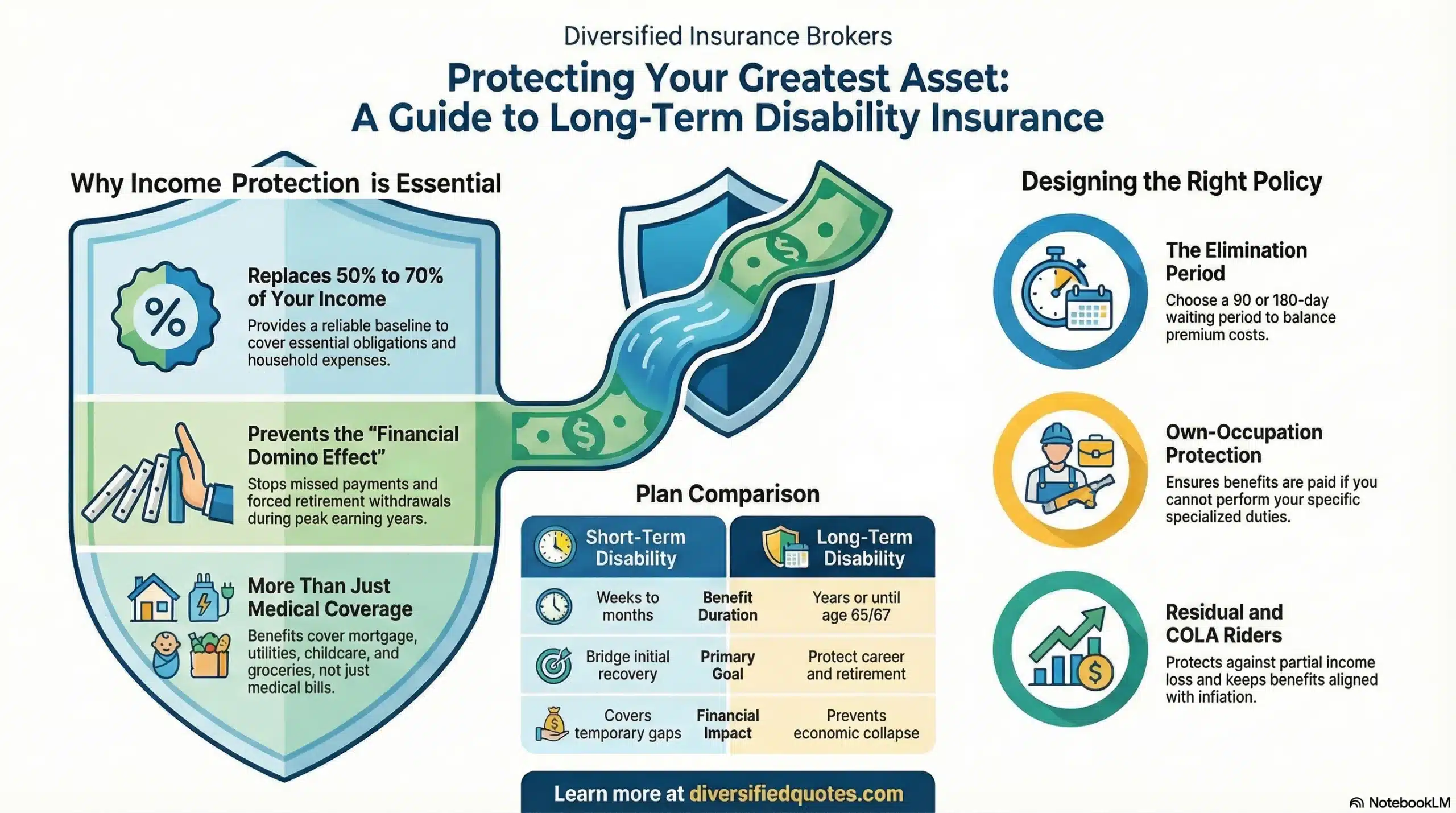
Short-term disabilities — minor injuries, illnesses, or post-surgical recovery — can still result in weeks or months of lost income. For casino workers, even a short absence can impact earnings significantly, especially when tips are a major component of income. Long-term disabilities, including chronic conditions, serious injuries, or conditions requiring extended rehabilitation, can prevent a return to work entirely. A comprehensive disability insurance policy addresses both scenarios by providing immediate support for short-term issues and long-term protection for more serious conditions. Short-term disability policies typically have an elimination period of 7–14 days and a benefit period of 90 days to one year. Long-term disability policies often have longer elimination periods (90–180 days is common) but can provide benefits to age 65 or for a defined number of years. For casino workers who have some financial reserve, a longer elimination period on the long-term policy reduces the premium cost — the financial reserve bridges the gap between disability onset and benefit payments, rather than paying for short-term benefits with the more expensive long-term policy structure. Our resource on disability insurance elimination period covers how the waiting period is selected, how it affects premium cost, and how to evaluate the right elimination period given existing savings, any short-term employer benefits, and monthly fixed expenses.
How Insurers View Casino Workers
Insurance providers typically evaluate casino workers based on their specific role rather than their employer or industry category. Positions that involve physical activity, repetitive motion, or customer-facing service are generally classified in occupational class 2 or 3, while supervisory, administrative, and management positions may qualify for class 3 or 4. Occupational class matters because it determines which product features are available — specifically, the definition of disability (own-occupation vs. modified own-occupation vs. any-occupation) and the maximum benefit period that can be offered for that class level. While premiums can vary, there are many policies available that accommodate service and hospitality professionals. The role classification table earlier on this page maps the most common casino positions to their typical occupational class range and the key underwriting factors that affect outcomes. Our resource on disability insurance for landscapers covers how physical, outdoor-labor occupations are classified in ways parallel to casino service workers — useful context for understanding how carriers approach roles where the physical demands are central to job function.
Designing the Right Policy for Casino Workers
The most effective policies include features such as own-occupation coverage, ensuring that benefits are paid if you cannot perform your specific job duties. This is especially important for roles that rely on specialized skills, such as dealing or technical operations. Residual disability coverage is also valuable, as it provides partial benefits if you return to work at a reduced capacity — allowing you to rebuild your income gradually without financial strain. A cost-of-living adjustment rider can increase benefit amounts over a long claim period to help offset inflation’s effect on purchasing power. A future increase option allows you to purchase additional coverage later without new medical underwriting, which is relevant for casino workers whose income grows over time through raises, promotions, or increased tip earnings. Learning why working with an independent disability insurance broker matters can help you make more informed decisions and secure the right level of protection by comparing multiple carriers simultaneously rather than accepting a single carrier’s terms.
Comparing Casino Workers to Other Service Professions
Casino workers share similarities with other service-based professions but often operate in a more fast-paced and high-pressure environment. Compared to bailiffs and bankers, casino workers rely more heavily on physical presence, tip-based income, and sustained manual performance. The repetitive hand and wrist demands of dealing have closer parallels to occupations like nail salon technicians and jewelers — roles where fine motor precision over long shifts creates cumulative strain exposure that standard underwriting evaluates carefully. The security and physical-presence dimension of the role parallels service professionals in controlled environments where physical demands and stress exposure are ongoing factors in long-term disability risk.
Integrating Disability Insurance Into Your Financial Plan
Disability insurance should be a key part of your overall financial strategy, particularly in professions where income depends on active work. It protects the earnings that support your lifestyle, savings, and long-term goals. Combining income protection with strategies such as long-term income planning can help create a more stable and resilient financial future. The goal is to ensure that a disability scenario — whether short-term or permanent — does not become a financial catastrophe. Casino workers who establish disability protection early, when they are healthy and actively working, secure better rates and lock in coverage before any health changes occur that might make future applications more difficult or expensive.
Get Disability Insurance Quotes for Casino Workers
We match your role, income structure, and occupational class to the carriers most likely to offer the best terms for casino and hospitality professionals.
Get Disability Insurance Quotes Call 800-533-5969Related Occupational DI Pages
Disability insurance for service, hospitality, and physically demanding casino-adjacent occupations.
Financial Protection Essentials
Additional DI resources for casino workers and adjacent service professionals.
Talk With an Advisor Today
Choose how you’d like to connect—call or message us, then book a time that works for you.
Schedule here:
calendly.com/jason-dibcompanies/diversified-quotes
Licensed in all 50 states • Fiduciary, family-owned since 1980
Disability Insurance for Casino Workers FAQs
Do casino workers really need disability insurance?
Yes — because income depends on active physical participation, cognitive performance, and consistent attendance. If you cannot work, your income typically stops immediately. Unlike office workers who may be able to work remotely or in a modified capacity during recovery, casino floor roles are highly specific: if you cannot deal, stand, interact with customers, or maintain the focus your role requires, there is generally no modified duty available at the same pay level. Disability insurance fills that gap by replacing 60–70% of documented income during the period you are unable to work, ensuring that fixed expenses continue to be met without depleting savings or accumulating debt.
Does disability insurance cover tip-based income for casino workers?
Yes — but only if tip income is properly documented through IRS tax reporting. Disability insurance carriers base benefit amounts on documented earned income, and tip income counts toward the income calculation if it appears on your W-2 or tax return as reported wages. Casino workers who consistently under-report tip income to reduce tax liability may find that their disability benefit is significantly lower than their actual take-home income — because the carrier can only base the benefit on what the tax record shows. Maintaining accurate tip reporting is not just a compliance issue; it is a prerequisite for securing disability coverage that genuinely replaces what you would have earned. When applying for disability insurance, you will typically need the last two years of tax returns to document income, so recent records reflecting full tip income produce the most accurate benefit sizing.
What are the most common disability risks for casino workers?
The most common disability triggers for casino workers fall into several categories depending on role. For table game dealers, repetitive strain injuries to the hands and wrists — carpal tunnel syndrome, tendinitis, de Quervain’s tenosynovitis — are the leading occupational disability risk because dealing requires sustained fine motor performance over long shifts. For floor staff, servers, and security officers, back injuries, knee problems, and foot and ankle conditions from prolonged standing and physical demands are among the most frequent claims. Stress-related and mental health conditions are also relevant across most casino roles — the high-pressure, high-noise environment combined with irregular shift schedules and customer conflict exposure creates ongoing psychological stress that can contribute to anxiety disorders, depression, and burnout, any of which may qualify as a disabling condition under appropriate policy terms.
Can I still receive benefits if I return to work part-time?
Yes, policies with residual or partial disability benefits allow you to receive a proportional income replacement if your earnings are reduced due to limited work capacity. Residual disability benefits are calculated based on the percentage income loss compared to your pre-disability earnings. For example, if you return to work at 60% of your prior income due to a limitation, a residual benefit provision pays a partial benefit that bridges the gap — typically proportional to the income reduction. This is particularly valuable for casino workers who may be able to return to light-duty or reduced-shift work during recovery but cannot yet perform the full job at full hours. Not all policies include residual benefits as a standard feature; some require it to be added as a rider, and the specific definition of residual disability varies by carrier.
How soon should I get disability insurance?
The best time to get coverage is while you are healthy and actively working, which allows you to secure better rates and ensures protection is in place before any health issues arise that might make future applications more difficult or expensive. Many health conditions that develop later — repetitive strain injuries, back problems, musculoskeletal conditions — can become pre-existing conditions that are excluded from a policy obtained after the condition is diagnosed. Securing coverage early means the policy does not carry those exclusions. Younger applicants also benefit from lower premium rates that remain level or scale predictably as coverage continues, compared to older applicants who may face higher rates and more underwriting scrutiny. Casino workers in physically demanding roles have every reason to prioritize early coverage given the cumulative nature of the occupational risks they face.
What is the difference between own-occupation and any-occupation disability definitions?
The definition of disability in a DI policy is the single most consequential contract variable for casino workers. Under an own-occupation definition, you are considered disabled — and eligible for benefits — if you cannot perform the material duties of your specific occupation, even if you could work in another capacity. A dealer with a disabling hand injury who cannot deal but could theoretically work a desk job would receive benefits under an own-occupation policy because they cannot perform their own occupation. Under an any-occupation definition, benefits are only paid if you are unable to perform any gainful occupation for which you are reasonably suited by education, training, or experience. The same dealer with the same hand injury might not qualify for benefits under an any-occupation policy if the carrier determines they could work in some other capacity. For casino workers in specialized roles, own-occupation coverage is significantly more protective and is the appropriate standard to target when designing a disability plan.
How does the elimination period work and what length should I choose?
The elimination period is the waiting period between the onset of disability and the date benefits begin — functionally, the “deductible” measured in time rather than dollars. Common elimination periods are 30, 60, 90, and 180 days. A shorter elimination period means benefits begin sooner but the policy costs more. A longer elimination period reduces the premium significantly — choosing 90 days over 30 days can produce a meaningful premium reduction on a long-term policy — but requires the policyholder to have sufficient savings or short-term resources to cover expenses during the waiting period. For casino workers, the right elimination period depends on how much financial reserve is available to bridge the waiting period, whether any employer-sponsored short-term disability benefit is in place, and the nature of the disability risks most likely to affect their specific role. Many long-term disability policies for service workers use a 90-day elimination period as the practical balance between cost and wait time.
How is my occupational class determined as a casino worker?
Occupational class is a carrier-assigned rating that reflects the physical demands, income stability, and work environment of your specific role. Most carriers rate occupations on a scale from class 1 (highest physical risk, most limited coverage terms) to class 5 or 6 (professional/managerial, most favorable terms). Casino workers are generally rated in the class 2–4 range depending on role: hands-on floor positions like dealers, servers, and technicians typically land in class 2–3, while supervisory and managerial roles may qualify for class 3–4. Occupational class determines which benefit features — particularly the own-occupation definition and maximum benefit period — are available, and it affects the premium cost. Carriers may classify the same job title differently, which is one reason working with an independent broker who regularly places disability coverage for service-sector workers produces better outcomes than submitting to a single carrier without carrier comparison.
What is workers’ compensation and how is it different from individual disability insurance?
Workers’ compensation provides income replacement and medical coverage for injuries or illnesses that occur directly as a result of workplace activities. It is employer-funded and state-mandated, and it covers work-related disability claims. Individual disability insurance is personally owned, covers disabilities regardless of whether they occur at work, and provides benefits that workers’ compensation does not — including off-the-job injuries, illnesses unrelated to work, and conditions that develop gradually from lifestyle or health factors rather than a specific workplace incident. For casino workers, workers’ compensation covers an on-the-job hand injury sustained while dealing but would not cover a carpal tunnel diagnosis that developed over years of dealing that cannot be attributed to a specific incident, nor would it cover an off-duty injury, illness, or non-occupational health condition that prevents a return to work. Individual disability insurance fills those gaps and provides a benefit level and definition structure that the worker controls, rather than depending on the workers’ compensation system’s determination of benefit eligibility.
Can casino workers who are union members still benefit from individual disability insurance?
Yes. Many casino workers are represented by unions — particularly in large casino markets — and may have some level of employer group disability coverage as a negotiated benefit. However, group disability coverage provided through an employer or union has several structural limitations compared to individual coverage. Group coverage is not portable: if you leave the employer or the union contract changes, the coverage ends. The benefit amount under group plans is typically capped at a lower percentage of income than an individual policy can provide. Group plans often use a modified own-occupation or any-occupation definition rather than a true own-occupation definition. And group coverage does not account for tip income that is not reflected in the base wage the group plan uses for calculation. Individual disability insurance supplements group coverage by providing the portability, definition strength, and tip income coverage that group plans typically do not offer — creating a more complete protection layer that the worker owns and controls regardless of employment changes.
About the Author:
Jason Stolz, CLTC, CRPC, DIA, CAA and Chief Underwriter at Diversified Insurance Brokers (NPN 20471358), is a senior insurance and retirement professional with more than 25 years of real-world experience helping individuals, families, and business owners protect their income, assets, and long-term financial stability. As a long-time partner of the nationally licensed independent agency Diversified Insurance Brokers, Jason provides trusted guidance across multiple specialties—including fixed and indexed annuities, long-term care planning, personal and business disability insurance, life insurance solutions, Group Health, Travel Medical and Evacuation Insurance, and short-term health coverage. Diversified Insurance Brokers maintains active contracts with over 100 highly rated insurance carriers, ensuring clients have access to a broad and competitive marketplace.
His practical, education-first approach has earned recognition in publications such as VoyageATL, and contributions from his agency featured in Kiplinger and GoBankingRates— highlighting his commitment to financial clarity and client-focused planning. Drawing on deep product knowledge and years of hands-on field experience, Jason helps clients evaluate carriers, compare strategies, and build retirement and protection plans that are both secure and cost-efficient. Visitors who want to explore current annuity rates and compare options across multiple insurers can also use this annuity quote and comparison tool.
Explore More Disability Insurance Options: Browse our complete guide to Disability Insurance for Food, Hospitality, Arts & Entertainment — covering chefs, musicians, actors, bartenders, hospitality workers & entertainment professionals from 100+ carriers.
Last Reviewed: May 31, 2026 |
Reviewed by: Jason Stolz, CLTC, CRPC, DIA, CAA
Chief Underwriter, Diversified Insurance Brokers, Inc. | NPN: 20471358 | Diversified Insurance Brokers, Inc. — Licensed in all 50 states
Fact Checked by: Tonia Pettitt, CMIP©
Medicare Specialist, Diversified Insurance Brokers, Inc. | NPN: 14374308 | Diversified Insurance Brokers, Inc. — Licensed in all 50 states
Did you find this content helpful? Leave us a Google review — it helps others find trustworthy guidance too.
Editorial Standards: Diversified Insurance Brokers maintains rigorous editorial standards to ensure accuracy, clarity, and independence in all content. Learn more about our editorial standards and commitment to transparency.
