
Disability Insurance for Farmers
As an Independent Disability Insurance Broker, we have access to exclusive discounts and negotiated pricing most captive agents can’t offer — see the full breakdown near the end of this page.
Disability Insurance for Farmers

Jason Stolz CLTC, CRPC, DIA, CAA
Disability insurance for farmers is one of the most critical and most frequently neglected forms of income protection in American agriculture. Whether you operate a crop farm producing grain, vegetables, fruit, or specialty commodities, run a livestock or dairy operation, manage a diversified family farm combining crop and animal production, or operate as a self-employed agricultural contractor providing farming services to others — your entire operation depends on your physical ability to work, make decisions, negotiate contracts, and manage the daily demands of agricultural production. A disabling injury or illness that removes you from the farm does not pause the costs, the obligations, or the financial pressure. It only eliminates the income.
Agriculture is consistently documented by the Bureau of Labor Statistics as one of the most hazardous industries in the United States. In a recent BLS reporting year, workers in the agriculture, forestry, fishing, and hunting sector experienced fatal injury rates of 24.4 deaths per 100,000 workers — more than six times the overall national average of 3.7 per 100,000 for all industries combined. NIOSH has documented that approximately 243 agricultural workers experience a lost-time injury every day across the United States — and these figures likely underestimate the true scope of the problem because farms with ten or fewer employees are exempt from OSHA reporting requirements. Farming is genuinely dangerous work, and the income protection need that follows from that danger is genuine and urgent.
At Diversified Insurance Brokers, we work with farmers and agricultural operators across all production types to structure disability insurance coverage that reflects the real physical hazards of farm work, the complex income documentation that agricultural self-employment requires, and the specific conditions most likely to remove a farmer from their operation for weeks, months, or permanently. A properly designed disability policy is not a luxury for a working farmer — it is the financial foundation that keeps the farm, the family, and the operation viable when a health event strikes.
Protect Your Farm Income
Compare disability insurance options designed for crop farmers, livestock operators, dairy producers, and all self-employed agricultural professionals.
Why Farmers Face an Extraordinary Disability Risk
Disability insurance for farmers must begin with a clear-eyed understanding of what agricultural work actually involves — because the hazard profile of farming is more serious and more diverse than most non-agricultural professionals recognize. Agriculture is not simply outdoor labor. It is year-round operation of heavy machinery, daily physical engagement with large and unpredictable animals, sustained manual labor under variable weather conditions, chemical handling for pest and weed management, and the management of mechanical systems operating at speeds and forces capable of producing catastrophic injury in a fraction of a second.
Tractors and agricultural machinery represent the leading cause of farm fatality and serious injury. A tractor rollover — which can occur on slopes, near ditches, or during turns with heavy attached implements — is capable of producing crushing, entrapment, and traumatic injuries that are immediately fatal or that produce permanent and severe disability in survivors. Power takeoff equipment — the rotating shafts that transmit power from tractors to implements — are responsible for some of the most catastrophic entanglement injuries in any industry, producing amputations, degloving, and traumatic injuries at a frequency that OSHA has specifically targeted for prevention programming. A farmer who loses an arm or hand to PTO entanglement, or who sustains spinal cord injury in a tractor rollover, faces a career-ending disability that eliminates farm income immediately and permanently for the specific physical farming tasks that generated that income.
Livestock handling creates a distinct injury category unique to animal agriculture. Large livestock — cattle, horses, swine, and dairy cows — are capable of producing serious injury through kicks, crushing against enclosures, trampling, and aggressive behavior. Livestock handling injuries including fractures, head injuries, and internal trauma are documented across cattle, equine, and swine operations as leading causes of agricultural worker hospitalization. A farmer managing a large dairy or beef cattle operation who sustains a serious livestock-related injury faces exactly the same immediate income interruption that any self-employed professional faces when a health event removes them from their work — with no employer sick pay, no group disability plan, and no institutional safety net of any kind. The hazardous animal handling component of livestock farming creates disability risk paralleling that faced by other professionals working in close proximity to large and unpredictable animals, including animal control professionals managing livestock and animal injury risk.
The Leading Disabling Conditions for Farmers
Disability insurance for farmers must be built around an understanding of the specific conditions most likely to interrupt or end a farming career. The injury and illness data from agriculture consistently identifies several primary categories that account for the majority of disabling events affecting working farmers.
Falls represent the single largest category of non-fatal agricultural injuries requiring days away from work, accounting for approximately 29% of such injuries in recent NIOSH data. Falls on farms occur from grain bins, silos, barn lofts, machinery platforms, ladders, hay stacks, and any number of elevated surfaces that are integral to daily farm operations. A fall from a grain bin ladder producing spinal injury, a fall from a barn loft producing lower extremity fractures, or a fall from a machinery platform producing head trauma can each produce disabling conditions requiring extended recovery — and for a self-employed farmer whose operation depends on their physical presence, that recovery period produces an immediate and complete income interruption.
Machinery-related injuries — including tractor accidents, PTO entanglements, auger and conveyor injuries, and combine-related trauma — are the most severe and the most likely to produce permanent disability or death. The distal upper extremity — hands, fingers, wrists, and forearms — is the body part most commonly injured in agricultural machinery accidents, reflecting the frequency with which farmers interact with mechanical components during operation and maintenance. A farmer who loses functional use of the dominant hand to a machinery injury has sustained a career-altering disability that affects the ability to operate tractors, handle livestock, manage crops, and perform the full range of physical tasks that farm operation requires. The machinery-related injury risk that farmers face daily has parallels in other heavy equipment professions, including crane operators managing heavy machinery injury exposure.
Musculoskeletal disorders from the sustained physical demands of farming — heavy lifting, repetitive bending and reaching during crop work, awkward postures during equipment maintenance, and the physical strain of sustained livestock handling — are the most prevalent chronic disability category for aging farmers. Back injuries, shoulder conditions, knee problems, and hand and wrist conditions accumulate over decades of agricultural physical labor and can eventually prevent a farmer from performing the sustained physical work that their operation requires. A farmer in their fifties or sixties who can no longer physically manage the daily demands of their operation due to accumulated musculoskeletal disease faces an occupational disability even without a single dramatic acute injury event. Residual disability coverage is particularly important for farmers whose musculoskeletal conditions may reduce rather than eliminate their ability to work — our resource on how residual disability insurance benefits work explains this coverage in full detail.
Pesticide exposure is a documented long-term disability risk for farmers who regularly handle herbicides, insecticides, and fungicides as part of crop production operations. NIOSH research priorities in agricultural health specifically include pesticide exposure, and research across farming populations consistently identifies associations between chronic pesticide exposure and neurological disease, respiratory conditions, and certain cancers. A farmer who develops a pesticide-related disabling illness after years of chemical application faces exactly the type of gradually developing occupational disease for which individual disability insurance is the primary financial protection available — and applying for coverage before any pesticide-related health conditions appear in the medical record is the most important timing decision any crop farmer can make regarding disability insurance. The pesticide exposure disability risk facing crop farmers closely parallels that documented for other chemically exposed agricultural workers, including crop dusters and aerial application professionals managing intensive pesticide exposure.
The Critical Income Documentation Challenge for Farmers
One of the most practically significant and least discussed aspects of disability insurance for farmers is the income documentation challenge — because the way farm income is structured, reported, and taxed creates a specific underwriting complication that does not affect most other self-employed professionals in the same way.
Disability insurance carriers base benefit amounts on verified earned income — typically using federal tax returns, with Schedule F net profit for farming operations serving as the primary income figure. The challenge for many farmers is that Schedule F net profit — after depreciation of equipment and structures, deduction of all farm operating expenses, and application of any loss carryforwards — may show significantly less income than the farmer actually generates from their operation and depends on for their household financial obligations.
Farm equipment depreciation is a particularly significant issue. A farmer who purchases a $350,000 combine may depreciate that asset aggressively over several years, reducing taxable net income substantially in years when the physical cash flow from the farm is healthy. The depreciated Schedule F income may significantly understate the farmer’s actual earning capacity and financial need during a disability — and if the benefit amount is calculated solely from the tax-reported net profit figure, the resulting disability benefit may be inadequate to actually sustain the farm household during a recovery period.
Working with an independent broker who understands agricultural income documentation — including how to present farm gross revenue, how depreciation affects net income figures, and how to document total farm household financial need in a way that underwriters can evaluate — is essential for farmers seeking benefit amounts that reflect genuine earning capacity. This is one of the most important services an independent broker provides for agricultural clients, and it is an area where the guidance of someone without agricultural self-employment income experience consistently produces inadequate benefit amounts. The income documentation complexity that farmers face parallels that encountered by other self-employed professionals with complex income structures, including independent contractors managing self-employment income documentation for underwriting purposes.
Mental Health and Farmer Disability — An Underrecognized Crisis
Agricultural mental health has emerged as a documented and serious occupational health concern that is directly relevant to disability insurance planning for farmers. Farming involves a unique combination of stressors that produces elevated rates of depression, anxiety, and suicidal ideation compared to the general working population — stressors including financial uncertainty driven by commodity price volatility and weather-dependent income, social isolation from rural geography, multi-generational family pressure around farm succession and land stewardship, and the physical and emotional toll of sustained physical work with limited recovery time.
Research from the CDC and agricultural health researchers has documented that farmers and agricultural workers experience mental health challenges at rates that have increased substantially during periods of agricultural financial stress — including drought years, periods of commodity price depression, and farm consolidation pressure. When depression, anxiety, or other mental health conditions reach a severity that prevents a farmer from effectively managing their operation — making sound crop management decisions, negotiating with lenders and purchasers, managing employees, and maintaining the operational focus that a farming business requires — these conditions constitute genuine occupational disability for a self-employed farmer whose business depends on their cognitive and emotional function.
Many disability insurance policies provide coverage for mental health conditions when they prevent performing occupational duties — but coverage terms vary significantly between carriers, with some limiting mental health benefit periods to 24 months. For farmers, where financial stress-driven mental health conditions represent a documented and growing disability risk, evaluating mental health coverage provisions carefully before purchasing any disability policy is an important planning step. Our resource on own-occupation disability insurance explained covers how mental and physical disability definitions protect self-employed professionals like farmers whose income depends on their full functional capacity.
Case Study: Self-Employed Farmer Earning $75,000 Net Per Year
Consider a self-employed corn and soybean farmer operating 800 acres, with documented net farm income of $75,000 annually after depreciation and operating expenses. During spring planting, this farmer sustains a serious PTO entanglement injury producing a traumatic below-elbow amputation of the dominant arm. Following surgical care and prosthetic fitting, an eight-month recovery and rehabilitation period is required before any return to modified farm duties is medically feasible.
| Scenario | Without Disability Insurance | With Disability Insurance |
|---|---|---|
| Monthly Income During Recovery | $0 personal income | $3,100–$4,000 |
| 8-Month Total Income | $0 | $24,800–$32,000 |
| Farm Operation Continuity | Hired labor costs must come from farm assets or debt | Income bridge supports hired labor costs and household obligations |
| Financial Outcome | Farm loan obligations at risk, land equity threatened, family financial crisis | Farm preserved, recovery completed, return to modified duties supported |
PTO entanglement injuries producing amputations are a documented and recurring occurrence in American agriculture — they are not remote or unlikely scenarios. For a farmer whose entire financial life is built around the ability to operate their farm, disability insurance ensures that a machinery injury does not simultaneously produce a financial crisis that threatens the land, the equipment, and the generational enterprise the farmer has worked to build and maintain.
Business Overhead Expense Coverage for Farm Operations
Self-employed farmers face a dual financial exposure when a disability occurs: the loss of personal income and the continuation of farm fixed costs. Farm loan payments on land, equipment notes on tractors and implements, seed and fertilizer financing costs, hired labor payroll, lease payments on rented ground, crop insurance premiums, and equipment maintenance costs all continue during a disability regardless of whether the farmer can physically work the operation. Personal disability income insurance replaces a portion of the farmer’s earned income — but it does not cover these ongoing farm business costs.
Business overhead expense insurance is designed specifically to cover these fixed business costs during a disability period, helping to keep the farm operation viable while the owner recovers. For a farmer who has spent decades building a productive operation, maintaining relationships with lenders, input suppliers, and grain buyers during a disability recovery period has financial value that extends far beyond any individual expense covered by the policy. Combined with personal income replacement disability coverage, business overhead expense insurance creates the most comprehensive financial protection framework available for a self-employed farming operation facing a disability event. Understanding the full spectrum of short-term and long-term disability coverage options is covered in our guide on how to buy short-term disability insurance as part of a complete income protection plan.
Key Policy Features for Farmer Disability Insurance
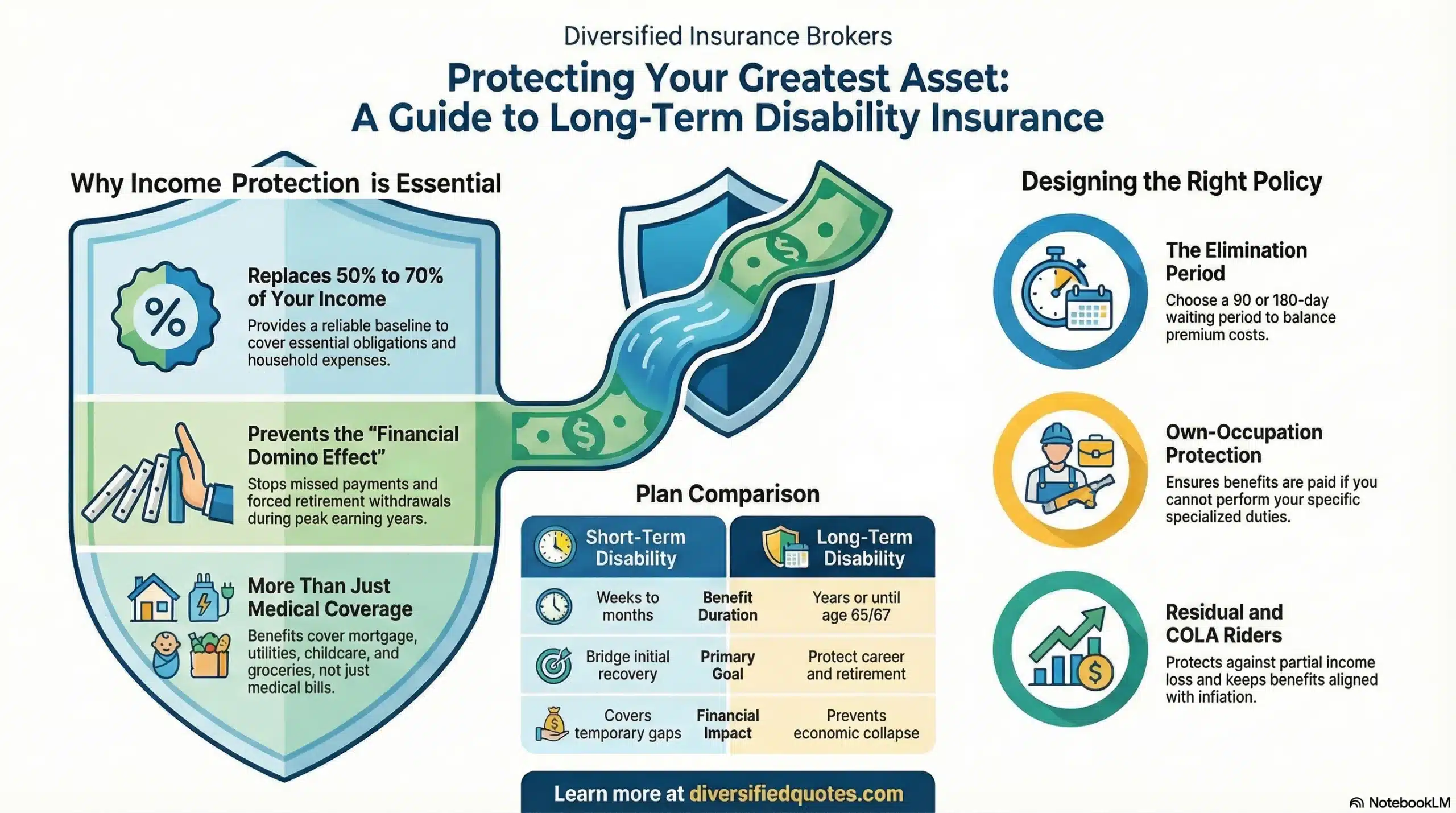
Disability insurance for farmers should incorporate specific policy provisions that address the realities of agricultural self-employment. The own-occupation definition is foundational — it pays benefits when a condition prevents the farmer from performing the specific duties of farm operation regardless of whether they could theoretically perform other less physically demanding employment. A farmer whose machinery injury prevents tractor operation, livestock handling, and the sustained physical work of farming has experienced a genuine occupational disability under an own-occupation policy, even if desk-based work remains theoretically possible.
A cost-of-living adjustment rider is particularly valuable for farmers who may experience long-term or permanent disability from serious machinery injury, progressive musculoskeletal disease, or pesticide-related occupational illness. Without COLA protection, a monthly benefit adequate at the onset of disability loses real purchasing power over years of sustained claim. Our resource on disability income insurance with a COLA rider explains how this inflation protection works and why it matters for extended agricultural disability scenarios.
The elimination period — the waiting time before benefits begin — requires careful calibration for farmers whose financial situation differs significantly from salaried employees. Farm cash flow is often seasonal, with income concentrated in harvest periods and costs distributed throughout the year. A farmer who is disabled during spring planting or fall harvest faces immediate and acute financial pressure, while one disabled during winter may have somewhat more financial runway. Our full guide on how disability insurance elimination periods work provides the framework for matching the waiting period to each farmer’s specific seasonal cash flow reality.
Why Farmers Need an Independent Disability Insurance Broker
Disability insurance for farmers presents underwriting challenges — particularly around income documentation — that require broker expertise beyond what a standard retail application provides. Presenting Schedule F income accurately while also documenting the full financial need that a farm disability creates, navigating depreciation effects on insurable income, and identifying carriers that understand agricultural self-employment income structures all require specialized knowledge that an independent broker brings to every farmer client engagement.
At Diversified Insurance Brokers, we work with farmers across all production types and income structures to structure disability coverage that accurately reflects earning capacity, addresses the specific physical hazards and income documentation realities of agricultural work, and provides the most comprehensive available income protection for the particular disability scenarios most likely to affect each individual farm operation. Our dedicated resource on why independent disability insurance brokers matter explains the full value of this approach for self-employed agricultural professionals navigating a disability insurance market that was not designed with farm income complexity in mind.
Final Thoughts on Disability Insurance for Farmers
American farmers produce the food that feeds the country and much of the world — and they do so in an occupational environment that the Bureau of Labor Statistics consistently documents as among the most hazardous in any industry sector. Tractor accidents, PTO entanglements, livestock injuries, falls from elevated surfaces, pesticide exposure, and the cumulative musculoskeletal burden of decades of physical agricultural labor all create genuine disability risks that can end or severely limit a farming career at any stage.
Disability insurance for farmers is the financial tool that ensures a health event on the farm does not also become a financial catastrophe that threatens the land, the operation, and the generational legacy that farming families work to build and preserve. A well-structured policy — calibrated to actual farm income including appropriate handling of depreciation effects, built around own-occupation protection for the specific physical demands of agricultural work, and equipped with business overhead expense coverage for ongoing farm costs — provides the income replacement that allows a farmer to recover from a disabling event from a position of financial stability.
Related Pages
Talk With an Advisor Today
Choose how you’d like to connect—call or message us, then book a time that works for you.
Schedule here:
calendly.com/jason-dibcompanies/diversified-quotes
Licensed in all 50 states • Fiduciary, family-owned since 1980
Disability Insurance for Farmers FAQs
Yes, farmers can obtain individual disability insurance, though the occupational classification and available policy features reflect the significant physical hazard profile of agricultural work. Farmers who spend the majority of their time in administrative, management, and supervisory capacities — with limited hands-on field and machinery work — may qualify for more favorable occupational classifications than those who perform direct physical farming operations daily. The most significant challenge for most farmers seeking disability insurance is income documentation — presenting Schedule F net farm income in a way that accurately reflects actual earning capacity and financial need, particularly when depreciation and operating expense deductions reduce reported net income below the household’s genuine financial dependency on farm operations. Working with an independent broker who understands agricultural income structures is essential for navigating this challenge effectively.
Agriculture is consistently documented by the Bureau of Labor Statistics as one of the most hazardous industries in the United States. In a recent reporting year, the agriculture, forestry, fishing, and hunting sector recorded fatal injury rates of 24.4 deaths per 100,000 workers — more than six times the overall national average of 3.7 per 100,000 for all industries combined. NIOSH has documented that approximately 243 agricultural workers experience a lost-time injury every day across the United States. Falls account for approximately 29% of non-fatal agricultural injuries requiring days away from work. Machinery-related injuries — tractor rollovers, PTO entanglements, auger accidents — are the most severe category, producing the highest rates of fatality and permanent disability. These figures likely underestimate the actual injury burden because farms with ten or fewer employees are exempt from OSHA recording requirements. For context on how similar machinery hazard exposure affects other heavy equipment operators, see our page on disability insurance for crane operators.
The biggest challenge is the gap between Schedule F net farm income — the figure disability insurance underwriters use — and the farmer’s actual financial need during a disability. Farm depreciation on tractors, combines, grain bins, and other capital equipment can significantly reduce taxable net income in years when the farm’s actual cash flow and financial dependency are substantially higher. A farmer who purchased a combine for $350,000 and is depreciating it aggressively may show modest Schedule F net income despite generating strong gross farm revenue and maintaining significant financial obligations including equipment loans, land payments, and operating costs. If the disability benefit is calculated solely from the depressed net income figure, the resulting benefit amount may be genuinely inadequate to sustain the farm household during a disability. An experienced independent broker understands how to document agricultural income in a way that presents the complete financial picture to underwriters — including gross revenue, the nature of depreciation deductions, and the household’s actual financial dependency on farm operations.
The most common disabling injury categories for farmers span machinery, falls, livestock, and cumulative musculoskeletal conditions. Machinery-related injuries — tractor rollovers, PTO entanglements, auger and conveyor injuries, and combine-related trauma — are the most severe and the most likely to produce permanent disability. The distal upper extremity — hands, fingers, wrists, and forearms — is the body part most commonly injured in agricultural machinery accidents, reflecting the frequency of direct interaction with mechanical components. Falls from grain bins, barn lofts, equipment platforms, and ladders account for approximately 29% of lost-time agricultural injuries. Livestock-related injuries from cattle, horses, swine, and other large animals produce significant fractures, head trauma, and internal injuries in animal agriculture operations. Chronic musculoskeletal conditions from decades of heavy lifting, repetitive motion, and physical agricultural labor round out the primary disability profile for aging farmers. Our resource on how residual disability benefits work covers partial disability protection relevant to musculoskeletal conditions that limit rather than eliminate farming capacity.
Yes. Individual disability insurance covers disabling conditions resulting from farm machinery accidents — including PTO entanglements, tractor rollovers, and other equipment-related injuries — when those conditions meet the policy’s definition of disability. If a PTO injury produces an amputation or permanent functional limitation that prevents the farmer from performing farm operation duties, disability benefits are payable under a well-structured own-occupation policy. Importantly, individual disability insurance covers disability from any cause regardless of whether it is work-related — filling the gap for any machinery accident that occurs on the farm, whether workers’ compensation would classify it as work-related or not. For self-employed farmers who have not elected workers’ compensation coverage for themselves, individual disability insurance is the only income replacement available from any source when a machinery injury prevents farming activity.
Own-occupation disability insurance pays benefits when a condition prevents a farmer from performing the specific duties of farming — operating machinery, handling livestock, managing crops, performing the physical and managerial work of their agricultural operation — regardless of whether they could theoretically perform other types of less physically demanding employment. Any-occupation coverage only pays if the farmer cannot perform virtually any gainful work. For a farmer whose machinery injury prevents tractor operation, livestock handling, and sustained physical farm work but who could technically perform desk-based work, an any-occupation policy would deny benefits. An own-occupation policy recognizes the genuine inability to perform farm operations and pays accordingly. Understanding this critical distinction thoroughly is essential before purchasing any disability policy. Our resource on own-occupation disability insurance explained covers this difference in full detail for self-employed professionals.
Yes, strongly. A farm is a business with ongoing fixed costs — equipment loan payments, land lease obligations, hired labor payroll, crop insurance premiums, seed and input financing costs, and equipment maintenance — that continue during a disability regardless of whether the farmer can physically work. Personal disability income insurance replaces a portion of the farmer’s earned income but does not cover these business costs. Business overhead expense insurance covers fixed farm operating costs during a disability period, helping to keep the operation viable while the farmer recovers. For a farmer who has spent decades building productive land, equipment, relationships with lenders and grain buyers, and operational infrastructure, maintaining the farm operation during a disability recovery has financial value far beyond any individual cost the policy covers. The combination of personal income replacement and business overhead expense coverage is the most comprehensive financial protection structure available to a self-employed farmer facing any disabling event.
Yes. Individual disability insurance covers disability from any cause — including occupational illness resulting from pesticide exposure — when the condition meets the policy’s definition of disability. A crop farmer who develops a disabling neurological condition, respiratory disease, or cancer associated with occupational pesticide exposure qualifies for disability benefits under a well-structured policy when the condition prevents farm operation. The critical planning consideration is timing: applying for disability insurance before any pesticide-related health conditions have been diagnosed and documented is essential. Conditions present in the medical record at the time of application may result in exclusion riders or restricted terms. For farmers who apply pesticides regularly as part of crop production, securing comprehensive coverage early in their farming career — before cumulative exposure produces any documented health findings — is the most important timing decision in disability insurance planning. See our page on disability insurance for crop dusters for parallel context on pesticide exposure disability planning.
The elimination period selection requires careful thought for farmers because farm cash flow is seasonal rather than monthly. A farmer disabled during spring planting or fall harvest — when physical presence is most critical and cash flow needs are acute — faces more immediate financial pressure than one disabled during winter. Farmers with meaningful emergency reserves and some ability to hire replacement labor to bridge a waiting period may manage a 90-day elimination period comfortably. Farmers with thin cash reserves, significant near-term financial obligations, or who are disabled during financially critical seasons should evaluate 30 or 60-day elimination periods carefully. The higher premium cost of a shorter waiting period must be weighed against the financial reality that farm fixed costs — loan payments, lease obligations, payroll — continue regardless of whether the farmer can work. Our full guide on how elimination periods work provides the framework for making this decision based on individual farm financial circumstances.
The best time is as early as possible in a farming career — before occupational health conditions from machinery exposure, pesticide contact, physical farm labor, or livestock handling have accumulated in the medical record. Disability insurance premiums are based in part on age and health status at the time of application, and younger farmers in good health secure the most comprehensive coverage at the most favorable rates. Musculoskeletal conditions that develop over decades of farming — back conditions, shoulder injuries, knee problems — can result in exclusion riders or restricted terms if present at application. For crop farmers with significant pesticide exposure, applying before any exposure-related health findings appear is equally important. The coverage secured at the beginning of a farming career is the coverage in force when a serious machinery accident, livestock injury, or occupational illness eventually occurs. A future increase option rider, where available, allows benefit amounts to grow with farm income without additional medical underwriting as the operation develops.
An independent broker brings agricultural income documentation expertise, carrier access across the full marketplace, and occupational underwriting knowledge that standard retail disability insurance applications do not provide for farming professionals. The Schedule F income documentation challenge — presenting depreciation-affected net farm income alongside the farmer’s actual financial need — requires broker experience that most general insurance agents do not have. An independent broker also compares occupational class assignments, policy definitions, exclusion rider policies, and premium structures across multiple carriers to identify the coverage that best serves each farmer’s specific production type, income structure, and disability risk profile. At Diversified Insurance Brokers, we work with agricultural professionals across all farming specializations and understand how to present farm income, navigate the business overhead expense question, and identify carriers that provide genuine comprehensive disability protection for farming operations. Our resource on why independent disability insurance brokers matter explains this value for self-employed professionals in full detail.
About the Author:
Jason Stolz, CLTC, CRPC, DIA, CAA and Chief Underwriter at Diversified Insurance Brokers (NPN 20471358), is a senior insurance and retirement professional with more than 25 years of real-world experience helping individuals, families, and business owners protect their income, assets, and long-term financial stability. As a long-time partner of the nationally licensed independent agency Diversified Insurance Brokers, Jason provides trusted guidance across multiple specialties—including fixed and indexed annuities, long-term care planning, personal and business disability insurance, life insurance solutions, Group Health, Travel Medical and Evacuation Insurance, and short-term health coverage. Diversified Insurance Brokers maintains active contracts with over 100 highly rated insurance carriers, ensuring clients have access to a broad and competitive marketplace.
His practical, education-first approach has earned recognition in publications such as VoyageATL, and contributions from his agency featured in Kiplinger and GoBankingRates— highlighting his commitment to financial clarity and client-focused planning. Drawing on deep product knowledge and years of hands-on field experience, Jason helps clients evaluate carriers, compare strategies, and build retirement and protection plans that are both secure and cost-efficient. Visitors who want to explore current annuity rates and compare options across multiple insurers can also use this annuity quote and comparison tool.
Explore More Disability Insurance Options: Browse our complete guide to Disability Insurance for Agriculture, Natural Resources & Outdoor Industries — covering farmers, ranchers, fishermen, foresters, miners, oil & gas workers & outdoor industries from 100+ carriers.
Last Reviewed: June 8, 2026 |
Reviewed by: Jason Stolz, CLTC, CRPC, DIA, CAA
Chief Underwriter, Diversified Insurance Brokers, Inc. | NPN: 20471358 | Diversified Insurance Brokers, Inc. — Licensed in all 50 states
Fact Checked by: Tonia Pettitt, CMIP©
Medicare Specialist, Diversified Insurance Brokers, Inc. | NPN: 14374308 | Diversified Insurance Brokers, Inc. — Licensed in all 50 states
Did you find this content helpful? Leave us a Google review — it helps others find trustworthy guidance too.
Editorial Standards: Diversified Insurance Brokers maintains rigorous editorial standards to ensure accuracy, clarity, and independence in all content. Learn more about our editorial standards and commitment to transparency.
