
Disability Insurance for Dog Catchers
As an Independent Disability Insurance Broker, we have access to exclusive discounts and negotiated pricing most captive agents can’t offer — see the full breakdown near the end of this page.
Disability Insurance for Dog Catchers

Jason Stolz CLTC, CRPC, DIA, CAA
Disability insurance for dog catchers — more formally known today as animal control officers — is an essential but consistently overlooked form of income protection for professionals who face genuine, daily occupational hazards that most people never think about. Whether you work for a municipal animal control department, a county animal services agency, or a contracted animal control operation, your job requires you to physically engage with unpredictable animals in uncontrolled environments, respond to dangerous situations involving aggressive or injured wildlife, and perform physically demanding work that carries real risk of injury every single shift.
The term “dog catcher” understates both the scope of the work and the seriousness of the occupational risks involved. Modern animal control officers handle dog bites and cat scratches, restrain frightened and aggressive animals in the field, respond to calls involving wildlife including raccoons, coyotes, and venomous reptiles, investigate animal cruelty cases, and manage the physical demands of loading, transporting, and housing animals of all sizes and temperaments. The physical and biological hazards in this profession are real, documented, and capable of producing disabling injuries and illnesses that interrupt or permanently end a career in animal control.
At Diversified Insurance Brokers, we help animal control officers and dog catchers structure disability insurance coverage that reflects the genuine risks of their profession. Understanding how carriers evaluate this occupational class, what policy features matter most for animal control work, and how to secure the most comprehensive coverage available is exactly the expertise we bring to every client conversation.
Protect Your Income as an Animal Control Officer
Compare disability insurance options designed for dog catchers, animal control officers, and animal services professionals.
What Animal Control Officers and Dog Catchers Actually Do
Disability insurance for dog catchers begins with a clear understanding of what the work actually involves — because the occupational risks are embedded in the daily duties of the role. Animal control officers respond to calls involving stray, dangerous, injured, or abused animals across a wide geographic service area, often working alone and without backup when situations escalate unexpectedly.
A typical shift for an animal control officer may involve capturing a stray dog with unknown vaccination and bite history, responding to a report of an injured wild animal on a roadway, investigating an animal cruelty complaint that requires physical interaction with malnourished or aggressive animals, transporting animals in a vehicle that creates handling challenges in confined spaces, and fielding confrontational interactions with members of the public who may dispute animal seizures. Each of these scenarios carries injury potential that is not present in a standard office or service role.
Animal control officers employed by municipalities are often classified alongside public safety personnel — a recognition that the physical risks of the job are genuine and meaningful. Many work irregular hours including evenings, weekends, and on-call schedules that add fatigue-related risk to an already physically demanding profession. The combination of animal handling hazards, physical exertion, driving exposure, and public contact creates an occupational risk profile that makes disability insurance for dog catchers an important financial planning priority. This is a risk structure similar to other public safety and animal-handling professions, such as zookeepers managing dangerous animal encounters in controlled facility settings.
The Real Occupational Risks — Why Disability Insurance for Dog Catchers Matters
Dog bites are the most frequently occurring occupational hazard for animal control officers and dog catchers. The physical trauma from a serious dog bite can range from deep puncture wounds and tendon damage requiring surgery to permanent nerve damage and loss of hand function that directly affects the ability to perform animal handling duties. Beyond the immediate physical injury, dog bites carry infection risks including Pasteurella, Capnocytophaga, and other bacterial pathogens that can cause serious systemic illness, particularly in individuals with any compromise to immune function.
Zoonotic disease exposure is a significant long-term occupational health risk for animal control professionals that receives far less attention than it deserves. Animal control officers regularly handle animals with unknown health histories, working in environments where exposure to rabies, leptospirosis, ringworm, toxoplasmosis, and various other zoonotic pathogens is an occupational reality rather than a remote possibility. While vaccination protocols reduce some risks, they do not eliminate them — and some zoonotic infections can produce chronic health effects that affect long-term work capacity. The parallel to other animal-adjacent professions is clear: beekeepers facing venom exposure and allergic risk and animal control officers both face biological hazards that are invisible on the day of exposure but potentially disabling in their long-term consequences.
Musculoskeletal injuries represent a chronic, accumulative risk for dog catchers who regularly lift, restrain, and physically manage animals ranging from small cats to large aggressive dogs weighing over 100 pounds. Back injuries from improper lifting, shoulder strains from animal restraint, and knee damage from sudden directional changes during animal pursuits are all documented occupational conditions for animal control workers. Over a full career, the cumulative physical demands of the role create orthopedic wear patterns similar to other physically demanding public service professions.
Vehicle accidents are an underappreciated source of disability risk for animal control officers who spend significant portions of their shifts driving service vehicles across large geographic areas, often under time pressure when responding to urgent calls. A serious motor vehicle accident can produce spinal injuries, traumatic brain injuries, or other disabling conditions regardless of whether the officer was at fault. Disability insurance for dog catchers provides income replacement from any cause of disability — on the job or off — making vehicle accident coverage a natural and important component of the financial protection provided.
Psychological stress and compassion fatigue are meaningful occupational health considerations for animal control professionals who regularly encounter animal cruelty, animal suffering, and the emotional burden of euthanasia responsibilities. Over time, repeated exposure to these experiences can contribute to burnout, anxiety disorders, and depression that affect work performance and, in serious cases, the ability to continue in the role. These mental health dimensions of animal control work deserve the same protective consideration as the physical hazards, and disability insurance for dog catchers should include meaningful mental health benefit provisions. The psychological burden of working with animal suffering parallels the experience documented among social service professionals managing repeated exposure to trauma.
Disability Insurance for Dog Catchers — Employment Structure and Coverage Gaps
Most animal control officers are employed by municipal or county government agencies, which means they typically have access to some form of employer-sponsored disability coverage through government employee benefit programs or collective bargaining agreements. However, government employee disability plans carry the same fundamental limitations that affect employer-sponsored plans in any sector — and for animal control officers whose income needs are specific and whose risks are elevated, those limitations matter.
Government disability plans typically replace 60% or less of base salary, calculated without overtime or any additional compensation components. For animal control officers who regularly work overtime shifts — covering evenings, weekends, and emergency call-ins — the base salary calculation can significantly understate actual monthly income and leave a meaningful gap between what the plan pays and what the officer actually needs to maintain financial obligations during a disability.
Government disability plans are also tied to continued employment. When an animal control officer separates from the municipality — whether by choice, disability-related separation, or government restructuring — the employer plan terminates. An individual disability insurance policy purchased through an independent broker belongs to the officer personally and follows them throughout their career regardless of employer changes. This portability is a fundamental advantage of individual coverage over employer-sponsored plans, particularly for professionals in public sector roles where budget pressures can affect benefit structures at any time. For animal control officers who want a clear picture of how individual coverage differs from group plans, our overview of working with an independent disability insurance broker explains the full comparison.
How Carriers Underwrite Disability Insurance for Dog Catchers
Disability insurance underwriting for animal control officers and dog catchers involves evaluation of both occupational classification and individual health history. Carriers assign occupational classes to different job types that reflect the estimated risk of disability — higher-risk occupational classes typically receive lower policy benefit ceilings, more restricted policy definitions, and higher premium rates than desk-based professional classes.
Animal control officers are generally classified in the lower occupational tiers that reflect the combination of animal handling hazards, physical exertion requirements, and field work exposure of the role. This means the maximum monthly benefit available, the definition of disability offered, and the policy features accessible may be more limited than those available to lower-risk applicants. However, disability insurance for dog catchers is obtainable from carriers that specialize in physical and public safety occupational classes — and working with an experienced independent broker is the most reliable way to identify those carriers and secure the best available terms.
Individual health history matters significantly in the underwriting of disability insurance for animal control officers. Prior dog bites that resulted in documented medical treatment, existing musculoskeletal conditions from physical animal handling work, allergic reactions to animal dander or environmental exposures, and any documented mental health treatment history may all be examined by underwriters. Applying early in a career — before these conditions have accumulated — consistently produces the most comprehensive and cost-effective coverage. This timing principle applies across all animal-handling professions, from small business operators managing physical occupational risk to animal control officers whose on-the-job exposure accumulates over years of field service.
Case Study: Animal Control Officer Earning $52,000 Per Year
Consider a municipal animal control officer earning $52,000 annually including overtime. A serious dog bite during a field capture results in tendon damage to the dominant hand requiring surgery and six months of recovery, during which the officer cannot perform animal restraint duties. The employer’s group disability plan covers 60% of base salary — but overtime is excluded from the calculation, and the officer’s base salary is significantly lower than total annual compensation.
| Scenario | Employer Plan Only | Employer Plan + Individual Policy |
|---|---|---|
| Monthly Income Replaced | ~$1,900 (base only, 60%) | $1,900 + $1,500 supplemental benefit |
| 6-Month Total Income | ~$11,400 | ~$20,400 |
| Non-Work Disability Coverage | None | Full benefit regardless of cause |
| Financial Outcome | Significant shortfall, savings depleted | Income gap substantially reduced, obligations maintained |
The $9,000 difference in total income over a six-month disability period is not a minor variance — it represents the difference between financial stability and financial hardship during an already difficult recovery. Disability insurance for dog catchers closes the gap that employer plans consistently leave open.
Own-Occupation vs. Any-Occupation Definitions for Animal Control Officers
The definition of disability written into a policy determines when and how benefits are paid — and for dog catchers and animal control officers, this distinction has direct practical consequences. Own-occupation disability insurance pays benefits when a condition prevents the officer from performing the specific duties of their role, regardless of whether they could theoretically perform other types of work. Any-occupation coverage only pays if the officer cannot perform virtually any gainful employment.
For an animal control officer who develops a hand or wrist condition that permanently prevents animal restraint but does not prevent all other employment, an any-occupation policy would deny benefits entirely. An own-occupation policy would recognize the genuine inability to perform animal control duties and pay accordingly. While pure own-occupation definitions may be more limited in availability for higher physical risk occupational classes, an experienced independent broker identifies the best available definition for each individual application. Securing the strongest possible disability definition is consistently more important than securing the lowest possible premium — a principle that holds equally for coaches and performance professionals whose ability to work is tied to specific physical capacities.
Mental Health Coverage in Disability Insurance for Dog Catchers
Compassion fatigue, burnout, and mental health conditions are occupational realities for animal control officers who regularly encounter animal suffering, euthanasia responsibilities, animal cruelty investigations, and confrontational interactions with distressed pet owners. These psychological demands accumulate over a career in ways that can produce clinically significant anxiety, depression, and stress-related conditions that affect work performance and, in serious cases, the ability to continue in the role.
Many individual disability insurance policies do provide coverage for mental health and nervous system conditions — but the terms vary significantly between carriers. Some policies pay full benefits for mental health disabilities through the entire benefit period. Others limit mental health claims to a 24-month benefit period even when the base policy would otherwise pay to age 65. For animal control officers whose occupational stress exposure is sustained and cumulative, reviewing the specific mental health provisions of any disability policy before purchase is essential. At Diversified Insurance Brokers, we specifically evaluate these provisions when structuring disability insurance for dog catchers, because mental health coverage is not a secondary consideration for this profession — it is a primary one.
Residual Disability Coverage for Animal Control Officers in Recovery
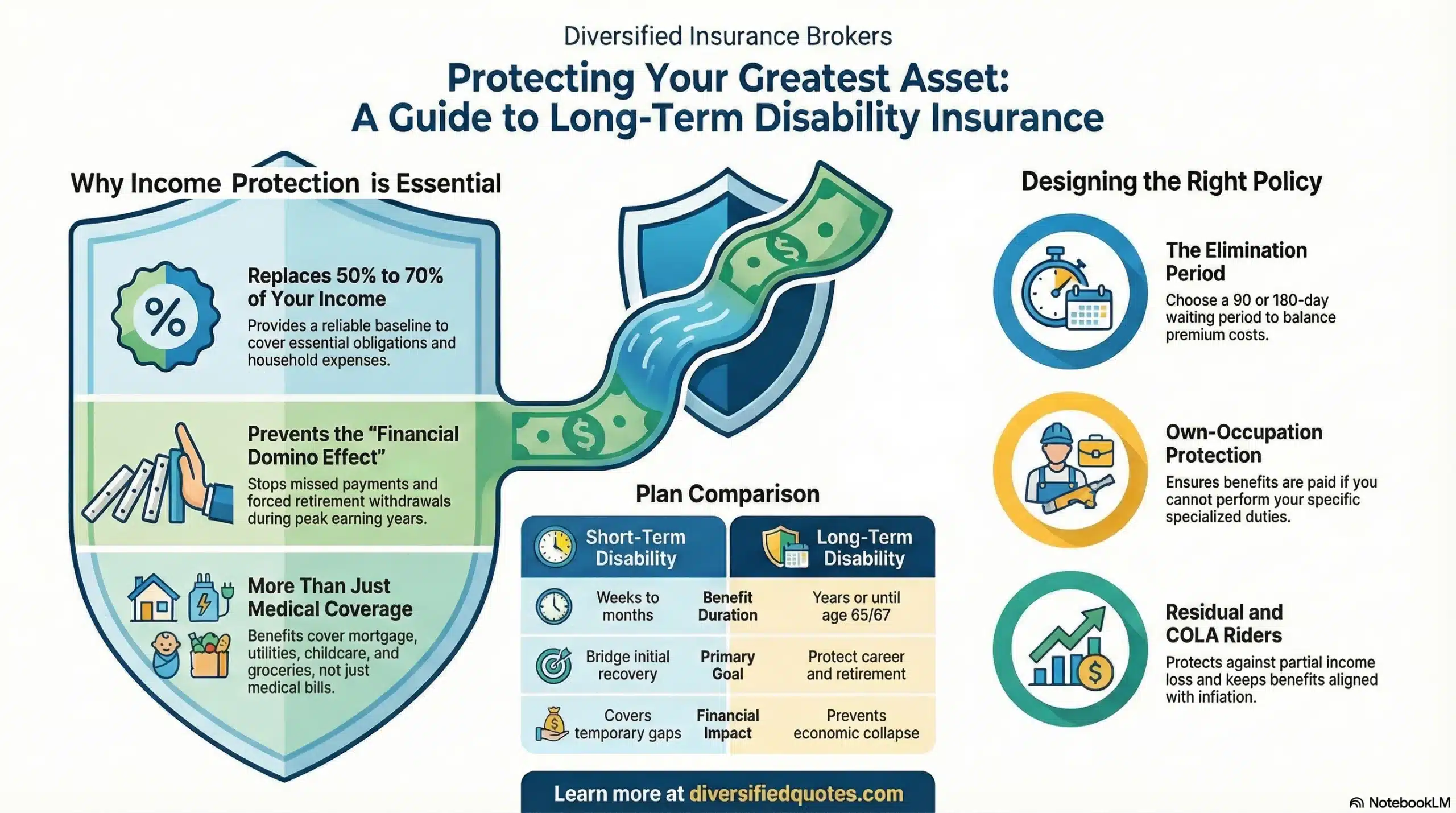
Disability insurance for dog catchers should include residual disability coverage — the provision that pays proportional benefits when a condition reduces earning capacity without eliminating the ability to work entirely. This is particularly relevant for animal control officers recovering from physical injuries who may return to modified duty — light office work, administrative functions, or limited animal handling — before receiving full medical clearance to resume normal field operations.
A dog catcher returning to modified duty at reduced hours and pay may be earning 50% to 60% of normal income during a recovery period that lasts weeks or months. Without a residual disability rider, a policy that only pays total disability benefits would provide nothing during this transition. With residual coverage, the policy supplements reduced earnings proportionally, ensuring that the officer’s financial obligations remain manageable throughout the entire recovery arc rather than only during the acute phase of total inability to work. The graduated return-to-work protection that residual coverage provides is among the most valuable features in any disability policy for a physically active public safety professional. Our broader discussion of whether disability insurance delivers real value for working professionals addresses this feature in greater depth.
Integrating Disability Insurance Into an Animal Control Officer’s Financial Plan
For most animal control officers, income is the financial foundation upon which all other goals depend. Mortgage payments, family expenses, retirement savings contributions, and everyday financial obligations are all sustained by the monthly paycheck. Disability insurance for dog catchers ensures that a single disabling event — a serious dog bite, a vehicle accident, a zoonotic illness, or a mental health crisis — does not unravel the financial structure that years of public service employment has built.
Once disability coverage is in place, animal control officers can build additional layers of financial protection. Life insurance options for public safety professionals address the family protection dimension of working in a role with genuine physical risk. For those thinking further ahead toward retirement planning, understanding how indexed annuities work for retirement income provides a foundation for building guaranteed income that complements any pension or government retirement benefit available through municipal employment.
The combination of individual disability insurance, employer group plan coverage, and a thoughtful broader financial plan creates the most resilient income protection framework available to a working animal control officer. Disability insurance for dog catchers is the layer that prevents a health event from becoming a financial catastrophe — and it is the one layer that no employer, union, or government program can fully replicate.
Why Dog Catchers and Animal Control Officers Need an Independent Broker
Disability insurance for dog catchers is not a standard retail application. The occupational classification, the physical risk factors, the animal handling exposure, and the need to identify carriers that actually write this occupational class without disqualifying exclusions all require broker expertise that goes well beyond what a general insurance agent can provide. Many carriers decline physical and animal handling occupational classes entirely. Others offer policies with exclusion riders that eliminate coverage for bite injuries — precisely the risk most likely to affect an animal control officer’s career.
At Diversified Insurance Brokers, we have the carrier relationships and occupational underwriting expertise to find disability coverage for animal control officers that actually responds to their real risks. We compare options across multiple carriers, identify the strongest available policy definitions, and structure coverage that complements whatever employer or government plan is already in place. The result is a comprehensive income protection strategy — not a generic policy that leaves the most important risks uncovered. For more on what working with an experienced broker provides, our dedicated resource on why independent disability insurance brokers matter covers the full picture.
Final Thoughts on Disability Insurance for Dog Catchers
Animal control officers and dog catchers perform essential public safety work that protects communities from dangerous animals, prevents the spread of zoonotic disease, and ensures the humane treatment of animals across their service areas. The physical risks of this work are real, the psychological demands are sustained, and the financial consequences of a disabling injury or illness are immediate.
Disability insurance for dog catchers is the financial tool that ensures those consequences do not define the outcome. A well-structured policy — built around the actual risks of animal control work, designed with strong mental health provisions and residual disability coverage, and placed through an independent broker with access to the right carriers — provides the income protection that allows an animal control officer to recover and return to the work they have dedicated their career to performing.
Related Pages
Talk With an Advisor Today
Choose how you’d like to connect—call or message us, then book a time that works for you.
Schedule here:
calendly.com/jason-dibcompanies/diversified-quotes
Licensed in all 50 states • Fiduciary, family-owned since 1980
Disability Insurance for Dog Catchers FAQs
Yes, animal control officers and dog catchers can obtain individual disability insurance, though it requires working with a broker who has access to carriers that write physical and animal handling occupational classifications. Some standard disability insurance carriers decline this occupational class or issue policies with animal bite exclusion riders that eliminate coverage for the most common disability risk facing animal control professionals. An experienced independent broker identifies carriers that offer comprehensive coverage for animal control work without exclusions that undermine the policy’s value at claim time. The occupational classification assigned affects premium cost, maximum benefit amounts, and available policy features — all areas where broker expertise produces materially better outcomes than applying directly to a single carrier.
Dog bites are the most frequently occurring occupational injury for animal control professionals, ranging from puncture wounds and soft tissue damage to tendon injuries and permanent nerve damage that can affect hand function and the ability to perform animal restraint duties. Zoonotic disease exposure from handling animals with unknown health histories creates biological risk including bacterial infections, viral exposure, and parasitic illness that can produce chronic health effects. Musculoskeletal injuries from lifting, restraining, and physically managing animals of varying sizes accumulate over a full career of animal control service. Vehicle accidents during field response create additional injury risk. Psychological conditions including compassion fatigue, burnout, and trauma-related stress disorders from repeated exposure to animal suffering and cruelty investigations are also meaningful occupational health concerns for animal control officers.
Government employee disability plans provide valuable baseline coverage but consistently fall short of full income replacement for animal control officers. These plans typically replace 60% or less of base salary — and for officers whose total annual compensation includes meaningful overtime, that base-only calculation significantly understates actual monthly income. Government plans are also tied to employment status and terminate when an officer leaves the agency, regardless of the reason. Individual disability insurance owned personally by the officer provides portable coverage that follows them throughout their career, covers total compensation more accurately when properly structured, and fills the income gap that the employer plan leaves open. At Diversified Insurance Brokers, we design individual policies specifically to complement existing government coverage rather than duplicate it. Learn more about this approach by reviewing how an independent disability broker structures supplemental coverage.
Whether dog bites are covered depends entirely on the specific policy — which is exactly why working with an experienced broker matters for animal control officers. Some disability insurance carriers issue policies for animal control applicants that include exclusion riders specifically eliminating coverage for animal bite injuries, which is the most common occupational disability risk in the profession. Other carriers, particularly those that specialize in physical and higher-risk occupational placements, offer policies without animal bite exclusions that provide comprehensive coverage for disabling injuries from any cause including occupational animal bites. An independent broker who knows which carriers write animal control occupational classes without these exclusions is the essential resource for obtaining a policy that actually protects against the risks most likely to disable an animal control officer.
Many individual disability insurance policies do provide coverage for mental health conditions including anxiety disorders, clinical depression, burnout-related illness, and post-traumatic stress — but the terms vary significantly between carriers. Some policies pay full benefits for mental health disabilities throughout the entire benefit period. Others limit mental health and nervous system disorder claims to a 24-month benefit period, even when the base policy would otherwise pay to age 65. For animal control officers who face sustained psychological stress from animal cruelty exposure, euthanasia responsibilities, and compassion fatigue over a full career, the mental health benefit period provision in any disability policy is a critical selection criterion. Diversified Insurance Brokers specifically evaluates this provision when structuring disability insurance for dog catchers, because mental health coverage is not a secondary consideration for this profession.
Zoonotic diseases are illnesses that can be transmitted from animals to humans through bites, scratches, direct contact with bodily fluids, or environmental exposure in areas where animals are housed. Animal control officers regularly handle animals with unknown health histories, creating ongoing exposure to conditions including rabies, leptospirosis, ringworm, toxoplasmosis, Pasteurella, and other bacterial and viral pathogens. Some zoonotic infections resolve with treatment; others can produce chronic effects that affect long-term health and work capacity. Individual disability insurance covers disability from any illness — including zoonotic disease — when that illness meets the policy’s definition of disability. For animal control officers whose zoonotic exposure is an occupational constant, having coverage in place before a significant exposure occurs is essential, since a documented serious illness can affect future insurability if the application is delayed.
Residual disability coverage pays proportional benefits when a disability reduces income without eliminating the ability to work entirely. For an animal control officer who has been injured and returns to light or modified duty — administrative work, dispatch assistance, or limited animal handling — income during the return-to-work phase is typically well below normal full-duty compensation. Without a residual disability rider, a total-disability-only policy would provide no benefits during this period because the officer can technically perform some work. A residual disability rider ensures the policy supplements reduced earnings proportionally throughout the transition back to full duty, providing financial support during the entire recovery arc rather than only during complete inability to work. For animal control officers whose recovery from physical injuries often involves weeks or months of restricted duty, this rider is among the most important features in any disability policy. For more context, see our page on the real value of disability insurance for working professionals.
Disability insurance carriers base benefit amounts on verified earned income, typically using two to three years of W-2 statements or tax returns. For animal control officers who earn meaningful overtime, documenting total annual compensation rather than just base salary is essential to securing a benefit amount that reflects actual earning capacity. Some carriers use a weighted average of recent income years, which can be advantageous for officers whose overtime fluctuates seasonally or varies by assignment. An experienced broker understands how to present variable income documentation to underwriters in the most accurate and favorable light, ensuring that overtime-dependent income is reflected in the benefit calculation rather than excluded by default. Without this expertise, animal control officers frequently end up with disability benefits sized to base salary only — leaving the overtime portion of their income completely unprotected during a disability.
The best time is early in a career, before occupational health conditions have accumulated in the medical record. Disability insurance underwriting evaluates health history at the time of application — a dog catcher who applies while young and in excellent health, before documented bite injuries, musculoskeletal wear, allergic sensitization, or mental health treatment history appear in medical records, secures the most comprehensive coverage at the most favorable rates. Waiting until mid-career — after years of animal handling work have produced documented health findings — significantly narrows available options and can result in exclusion riders or higher premiums that reduce the policy’s value precisely when the occupational risks have accumulated most. The coverage secured early is the coverage available when it is most needed.
The elimination period — the waiting time between the onset of disability and when policy benefits begin — should be calibrated to the officer’s available financial reserves and the speed at which income loss would create real hardship. Animal control officers with access to government sick leave, emergency savings, or other short-term income sources that can carry them through the first few months of a disability are often well served by a 90-day elimination period, which meaningfully reduces premiums. Officers with fewer reserves or significant fixed monthly obligations may prefer a 60 or 30-day period that provides faster benefit access in exchange for a higher premium. Diversified Insurance Brokers helps each client assess the right elimination period based on their specific financial situation rather than defaulting to a standard option.
An independent broker has access to multiple carriers and can compare policy terms, occupational class assignments, exclusion rider policies, mental health benefit provisions, and premium structures across the entire marketplace — not just a single company’s offerings. For animal control officers, carrier selection is particularly consequential because some carriers issue animal bite exclusion riders that eliminate the most relevant coverage, while others write the occupational class comprehensively. A captive agent representing one carrier cannot offer alternatives when that carrier’s terms are unfavorable. An independent broker works exclusively for the client, with no incentive to favor any particular carrier, and navigates the full market to find the best available coverage for each individual animal control officer’s situation. Our page on why working with an independent disability broker matters explains this in full.
About the Author:
Jason Stolz, CLTC, CRPC, DIA, CAA and Chief Underwriter at Diversified Insurance Brokers (NPN 20471358), is a senior insurance and retirement professional with more than 25 years of real-world experience helping individuals, families, and business owners protect their income, assets, and long-term financial stability. As a long-time partner of the nationally licensed independent agency Diversified Insurance Brokers, Jason provides trusted guidance across multiple specialties—including fixed and indexed annuities, long-term care planning, personal and business disability insurance, life insurance solutions, Group Health, Travel Medical and Evacuation Insurance, and short-term health coverage. Diversified Insurance Brokers maintains active contracts with over 100 highly rated insurance carriers, ensuring clients have access to a broad and competitive marketplace.
His practical, education-first approach has earned recognition in publications such as VoyageATL, and contributions from his agency featured in Kiplinger and GoBankingRates— highlighting his commitment to financial clarity and client-focused planning. Drawing on deep product knowledge and years of hands-on field experience, Jason helps clients evaluate carriers, compare strategies, and build retirement and protection plans that are both secure and cost-efficient. Visitors who want to explore current annuity rates and compare options across multiple insurers can also use this annuity quote and comparison tool.
Explore More Disability Insurance Options: Browse our complete guide to Disability Insurance for Food, Hospitality, Arts & Entertainment — covering chefs, musicians, actors, bartenders, hospitality workers & entertainment professionals from 100+ carriers.
Last Reviewed: June 7, 2026 |
Reviewed by: Jason Stolz, CLTC, CRPC, DIA, CAA
Chief Underwriter, Diversified Insurance Brokers, Inc. | NPN: 20471358 | Diversified Insurance Brokers, Inc. — Licensed in all 50 states
Fact Checked by: Tonia Pettitt, CMIP©
Medicare Specialist, Diversified Insurance Brokers, Inc. | NPN: 14374308 | Diversified Insurance Brokers, Inc. — Licensed in all 50 states
Did you find this content helpful? Leave us a Google review — it helps others find trustworthy guidance too.
Editorial Standards: Diversified Insurance Brokers maintains rigorous editorial standards to ensure accuracy, clarity, and independence in all content. Learn more about our editorial standards and commitment to transparency.
