
Disability Insurance for Zookeepers
As an Independent Disability Insurance Broker, we have access to exclusive discounts and negotiated pricing most captive agents can’t offer — see the full breakdown near the end of this page.
Disability Insurance for Zookeepers

Jason Stolz CLTC, CRPC, DIA, CAA
Zookeepers and zoo animal care professionals occupy a professional category where the disability risk profile combines the acute large-animal physical hazard of an agricultural worker, the documented zoonotic disease exposure of a veterinary or wildlife medicine professional, and the sustained heavy physical demands of an outdoor facilities maintenance role — all for compensation that BLS documents at a median annual wage of $33,470 for animal caretakers and $38,750 for animal trainers as of May 2024, making the income being protected modest but no less essential to the household that depends on it. BLS specifically states that animal care and service workers risk injury when caring for animals — and the veterinary services industry, which shares the closest documented occupational profile to zoo animal care, produced a nonfatal injury and illness rate of 10.6 per 100 full-time workers in 2023 according to BLS data, compared to the all-worker private sector rate of 2.4 — meaning the animal care sector’s documented injury rate is more than four times the workforce average. The International Zoo Yearbook published a study in 2013 documenting zookeeper injury data from 1990 through 2011, finding that primates accounted for 34 percent of zookeeper injuries and big cats for 29 percent of cases — with chimpanzees specifically cited as the most frequent and most severe primate injury source, and tigers as the most frequent big cat injury cause. Chester Zoo’s head of health and safety, Richie Owen, documenting the actual injury pattern at one of the world’s leading zoological institutions in IOSH Magazine, provides a more grounded picture of what produces the most injuries: the top three causes every year are heavy lifting and handling, slips, trips, and falls, and cuts from knives during food preparation — with global zoological consultant Douglas Richardson specifically identifying back injuries as the top issue by a wide margin across international zoo populations. The zoonotic disease dimension adds a disability pathway unique to the animal care profession: peer-reviewed research documents that 12 circus elephant handlers at an Illinois animal farm were infected with M. tuberculosis after three elephants died of the disease; an M. bovis outbreak in zoo rhinoceroses and monkeys in Louisiana caused seven previously-negative animal handlers to test positive for tuberculosis. Macaque monkeys can transmit Herpes B virus to zookeepers through bites or scratches — a pathogen that has caused fatal cases in exposed handlers. OSHA does not designate a specific section of standards and regulations for zoo workers — zoo occupational safety falls under OSHA’s general regulations, meaning the documented hazards of zoo animal care work operate within a regulatory framework that does not specifically enumerate zoonotic disease or large-animal attack as defined OSHA hazard categories the way specific industries receive tailored standards. The agricultural worker disability framework captures the closest parallel to zookeeper occupational risk — livestock handling, zoonotic exposure, heavy physical work — and applies with comparable force to the zoo and zoological facility setting where the animals are wild species rather than domesticated livestock. Understanding how disability insurance applies across the full animal care occupational spectrum is the starting point for any zookeeper’s income protection planning.
At Diversified Insurance Brokers, Jason Stolz, CLTC, CRPC, DIA, CAA works with zoo and animal care professionals across the full spectrum of the sector’s employment settings — zookeepers at AZA-accredited zoos and aquariums whose employer group plan access may provide a modest benefit baseline at the income levels the occupation pays, wildlife rehabilitators and sanctuary workers whose employment structures vary from institutional employment through nonprofit contractor arrangements, aquarists whose large marine animal and specialized saltwater habitat work creates specific physical and chemical exposure profiles, animal trainers at zoological facilities whose protected-contact animal work creates specific large-animal physical interaction risk, and animal care professionals at wildlife parks, education centers, and zoological collections operated by municipalities, universities, and nonprofit organizations. The coverage architecture for zoo animal care professionals requires specific attention to the modest income level that creates a genuine household financial planning imperative even when the absolute benefit amount is lower than for high-earning professionals — at a median of $33,470, even a brief disability period without income protection creates severe household financial disruption — and to the employer group plan structural limitations that apply with particular force when the group plan benefit amount is already modest relative to household obligations. Self-employed animal care professionals including independent wildlife rehabilitators, contract animal trainers, and private zoological consultants carry the complete self-employment coverage gap alongside the documented animal handling hazards of their work. Independent animal care contractors who provide specialized care services to zoological facilities on a project basis document all contract income through the same framework as any self-employed professional.
Compare Disability Coverage for Zoo and Animal Care Professionals
We review coverage options across 100+ carriers and identify the policy structure, income documentation approach, and coverage tier that fits your specific zoo or animal care role and employment setting.
Request Disability Insurance OptionsZookeeper Disability Risk — Animal Attacks, Zoonotic Disease, Physical Demands, and the Mental Health Burden
| Risk Category | Research and Occupational Context | Resulting Disability Risk | Coverage Status | Income Protection Gap |
|---|---|---|---|---|
| Musculoskeletal disorders — back injuries, heavy lifting, and physical demands | Global zoological consultant Douglas Richardson specifically identifies back injuries as the top issue by a wide margin across international zoo populations; Chester Zoo’s head of safety identifies heavy lifting and handling as the top injury cause — moving animals, opening and closing heavy gates, removing waste and bedding, cleaning habitats; BLS documents the veterinary services sector injury rate at 10.6 per 100 full-time workers — more than four times the all-worker private sector rate; zookeeper physical demands include carrying heavy food, moving substrate and enrichment, manipulating heavy habitat elements, and the sustained bending and lifting of daily animal care routines | Lumbar disc conditions from sustained heavy lifting of food, substrate, and habitat materials; shoulder conditions from sustained overhead and awkward-posture habitat cleaning; cumulative MSD conditions from the sustained physical demands of a full zoo animal care career eventually preventing continued zookeeper work | Workers’ comp for documented acute incidents at employer zoo facilities; cumulative MSD conditions disputed; employer group plan access varies by zoo size and budget; individual DI covers qualifying disability from any MSD cause | Significant gap for cumulative back and MSD conditions; individual DI fills where workers’ comp attribution fails for the most common actual disability pathway in zoo animal care work |
| Primate and big cat animal attacks | International Zoo Yearbook study documents primates accounted for 34% of zookeeper injuries from 1990-2011, big cats for 29%; chimpanzees specifically cited as the most frequent and severe primate injury source — with documented fatal mauling at Denver Zoo; tigers cited as most frequent big cat injury cause; published research documents that large primates like chimpanzees are physically capable of causing devastating injuries requiring surgical intervention; animal attacks can occur through “protected contact” barrier failures, during transfer and shift changes, and during routine husbandry when animal behavior is unpredictable | Severe lacerations, crush injuries, or amputations from primate attack requiring extended surgical recovery and rehabilitation; bite and claw injuries from big cat encounters producing permanent scarring, nerve damage, or functional impairment; fatal attack injuries documented at multiple US zoo facilities | Workers’ comp for employed zookeepers at documented acute incidents; employer group plan benefit ceiling modest at zookeeper income levels; individual DI covers qualifying disability from all animal attack injury causes | Group plan structural gap and modest benefit ceiling; individual own-occupation DI provides meaningful supplemental protection for the documented primary acute injury categories of zoo animal care work |
| Zoonotic disease — tuberculosis, Herpes B, and pathogen transmission | Peer-reviewed research documents M. tuberculosis transmission to 12 elephant handlers at an Illinois animal facility after three elephants died of the disease; an M. bovis outbreak in zoo rhinoceroses and monkeys caused 7 previously-negative animal handlers to test positive; macaque monkeys can transmit Herpes B virus through bites or scratches — with some exposed handlers developing fatal outcomes; published zoo occupational health research documents infection risks including tuberculosis, cat scratch fever, tetanus, pneumonia from animal respiratory pathogen exposure, and bacterial infections from animal wounds contaminated with saliva or feces; venomous reptile handling creates envenomation risk that may require fasciotomy if anti-venom is unavailable | Tuberculosis infection from exposure to infected zoo animals — a documented occupational zoonosis with potentially serious pulmonary consequences; Herpes B encephalitis from macaque bite or scratch — documented as potentially fatal in some exposed handlers; serious bacterial infections from animal wound contamination producing chronic health consequences; zoonotic illness requiring extended treatment preventing continued zoo animal care work | Zoonotic illness outside workers’ comp incident attribution for gradual exposure; individual DI covers all qualifying illness-based disability regardless of occupational causation difficulty; OSHA does not have specific zoo worker zoonotic standards | Significant gap for zoonotic illness conditions; individual DI specifically covers illness-based disability that workers’ comp’s incident attribution framework fails to address for occupational pathogen exposure without a specific datable incident |
| Chemical exposure — anesthetics, disinfectants, and veterinary drugs | Zoo animal care work involves regular use of potent disinfectants for habitat cleaning and biosecurity — including concentrated bleach, quaternary ammonium compounds, and specialized zoo-grade disinfectants; animal medical procedures use veterinary anesthetics and sedatives that pose occupational exposure risk during administration; one published zoo occupational health source specifically notes that at least one ultra-potent narcotic used in zoo animal immobilization is “so deadly that even one drop of it under the skin caused by mishandling a syringe could prove fatal” — requiring strict pharmacological safety protocols; x-ray radiation exposure from animal imaging procedures represents an additional occupational health consideration for zoo animal care professionals involved in veterinary support | Respiratory conditions from sustained disinfectant chemical exposure; needlestick injury with potent veterinary pharmacological agents; radiation exposure from sustained x-ray involvement in animal health procedures; chemical sensitization from sustained zoo-grade disinfectant use in daily habitat cleaning | Gradual chemical exposure conditions outside workers’ comp incident framework; acute needlestick incidents with potent agents may qualify as acute incidents; individual DI covers all qualifying disability from chemical and pharmacological exposure causes | Significant gap for gradual chemical exposure; individual DI fills where workers’ comp’s incident attribution fails for the most consequential chemical disability pathways in zoo animal care |
| Compassion fatigue and mental health burden | Zoo animal care professionals bear the emotional weight of animal death and euthanasia decisions — the loss of animals to whom they have devoted sustained professional care, sometimes for years; compassion fatigue is a documented occupational mental health condition in animal care professions characterized by emotional exhaustion, reduced empathy, and burnout from sustained emotional engagement with animal welfare and suffering; the combination of physical demands, modest compensation, emotionally challenging animal welfare decisions, and the isolation of animal care shift work creates the occupational stress profile documented across the animal care and veterinary professions at elevated rates compared to the general workforce | Disabling compassion fatigue or occupational burnout preventing continued zoo animal care engagement; depression or anxiety from sustained animal welfare emotional burden eliminating the professional capacity for the emotionally demanding work that zoo animal care requires; psychiatric conditions documented at elevated rates in animal care professions | Workers’ comp does not cover mental health; group plans cap mental health at 24 months; individual DI with unlimited mental health benefit period is the only comprehensive protection for this documented disability pathway | Complete gap without own-occupation individual DI; unlimited mental health benefit period in individual DI specifically addresses the sustained compassion fatigue and psychiatric disability that animal care professions document at elevated rates |
The table documents a disability risk profile that is both specifically documented in the zoo occupational health literature — the International Zoo Yearbook injury study, the published zoonotic transmission incidents, the IOSH Magazine interview with Chester Zoo’s safety leadership — and comprehensively underprotected at the income level BLS documents for this profession. Why zoo animal care professionals prioritize income protection is answered by the arithmetic of their income level and their documented disability risk: at a median annual wage of $33,470, a three-month disability period without income protection represents a severe household financial disruption with no automatic protection mechanism in place for employed zoo workers beyond whatever modest group plan benefit their employer provides — and nothing whatsoever for the self-employed segment of the animal care workforce.
The Back Injury and Physical Demand Reality — What Zoo Safety Research Actually Documents
The most important corrective to public perception about zookeeper disability risk is the finding that the day-to-day physical demands of the job — not dramatic animal attacks — produce the most frequent and most disabling occupational injuries across the zoo animal care profession. Global zoological consultant Douglas Richardson, speaking to IOSH Magazine, identifies back injuries as the top issue by a wide margin across international zoo populations, explicitly attributing this to the sustained heavy lifting demands of the work. Chester Zoo’s head of health and safety confirms the pattern at one of Europe’s leading zoological institutions: the top three injury causes every year are heavy lifting and handling, slips, trips, and falls, and cuts from food preparation knives. This injury profile — dominated by the physical demands of moving animals, maintaining habitats, preparing food, and performing the daily physical labor of animal care — mirrors the musculoskeletal injury pattern documented for physically demanding outdoor service occupations across all industries, with the specific wrinkle that zoo habitat environments often require particularly awkward postures, confined space cleaning, and heavy substrate manipulation that amplifies the MSD loading.
The disability consequence of a serious back injury for a zookeeper is specific and career-defining in the same way it is for any physical trade worker whose occupation requires sustained lifting, bending, and physical endurance: the zookeeper whose lumbar disc condition prevents the heavy habitat cleaning, substrate movement, and animal care physical demands that the daily schedule requires has experienced a genuine occupational disability that eliminates their ability to work as a zookeeper — even when cognitive function, interpersonal skills, and general health are fully preserved. Long-term disability income coverage to age 65 provides the income floor during extended or permanent disability from the back and musculoskeletal conditions that zoo occupational health literature identifies as the top disability pathway by frequency across the profession. Short-term disability coverage fills the immediate income gap from the first day of disability before long-term coverage activates. Accident-only disability income insurance provides a targeted and accessible lower-cost coverage layer for zoo animal care professionals who want specific protection for the acute physical incident scenarios — animal attacks, falls, equipment injuries — that the International Zoo Yearbook study and the IOSH Magazine research document as the acute injury categories in zoo animal care. How disability insurance works for documented high-injury-rate occupations provides context for how zoo animal care fits within the broader framework of professions where the all-worker injury rate comparison is the most relevant reference point for the occupational class assignment that determines premium cost and coverage terms.
Zoonotic Disease — The Illness-Based Disability Pathway That Workers’ Comp Cannot Address
The zoonotic disease dimension of zoo animal care is the disability pathway most specific to this profession — and the pathway that workers’ compensation is least equipped to address. The peer-reviewed literature is specific and documented: 12 elephant handlers at an Illinois animal facility developed M. tuberculosis infection after three elephants died of tuberculosis, with testing indicating the elephants were the probable transmission source for most of the infected handlers. An M. bovis outbreak in zoo rhinoceroses and monkeys in Louisiana caused seven previously-negative animal handlers to convert to positive tuberculosis status. These are not theoretical risks — they are documented transmission events at American zoological facilities, producing occupational illness from sustained animal care exposure.
The Herpes B virus transmitted by macaque monkeys through bites or scratches is a documented occupational hazard specifically noted in zoo animal care health literature — with published documentation of fatal cases in handlers who were bitten or scratched by macaques. The zoonotic disease exposure of zoo animal care is broad across species: bacterial infections from saliva, feces, urine, and blood contamination; respiratory pathogen exposure in enclosed animal facilities; vectorborne illness from ectoparasites on animal species; and the full range of zoonotic pathogen categories that OSHA identifies as documented agricultural worker hazards and that apply with equivalent or greater intensity to zoo workers who handle wild species from across the globe. For disability insurance purposes, the critical distinction is that zoonotic illness developing from sustained occupational exposure — without a specific datable incident that workers’ compensation’s attribution requirement can identify as causative — is a qualifying disability for individual disability insurance regardless of whether any specific exposure event can be identified. A zookeeper who develops tuberculosis after years of elephant care has a qualifying illness-based disability regardless of the attribution difficulty that would defeat a workers’ comp claim for this specific type of gradual exposure condition.
Coverage Options, Income Documentation, and Policy Design for Zoo Animal Care Professionals
Zoo animal care professionals receive Class A to Class B occupational class assignments from most disability insurance carriers — reflecting the physical animal handling demands, the zoonotic exposure profile, the heavy lifting injury documentation, and the general physical hazard of the work environment. This produces higher premiums than sedentary professional occupations, but at the income levels that BLS documents for zoo animal care — $33,470 median for caretakers — the premium cost represents a meaningful but not prohibitive percentage of monthly income, and the household financial consequence of any significant disability period without income protection at this income level makes comprehensive coverage more consequential, not less. Own-occupation disability coverage for a zookeeper should encompass the specific physical animal care functions — habitat cleaning, animal handling, food preparation and delivery, enrichment provision — that constitute the material and substantial duties of zoo animal care work, not merely generic inability to perform any physical work. Residual disability coverage addresses the partial disability scenario — a zookeeper managing administrative, behavioral documentation, or education functions during recovery from a back injury while unable to perform the full physical animal care demands — paying proportionally based on actual income reduction.
How short-term and long-term disability structures interact maps the coverage from the first day of any qualifying disability through the full benefit period. Coverage for zoo animal care professionals with prior back or musculoskeletal conditions is available through independent broker comparison — typically with partial exclusion riders for documented prior conditions and full coverage for all other disability causes including the zoonotic illness and animal attack injury pathways that define the most specific disability scenarios of the profession. Specialty and modified options address zoo professionals whose specific occupational classification or documented health history creates standard underwriting complexity. How much disability income a zoo animal care professional needs reflects documented W-2 income from the employing zoo or zoological facility — including overtime and shift differentials that may meaningfully supplement the base annual wage — and household financial obligations during a disability period. At a median of $33,470 annually, even a 60 percent replacement benefit of approximately $1,674 per month provides a meaningful income floor rather than a theoretical one. The elimination period should reflect actual financial reserves — for zoo workers at the lower end of the income scale, shorter elimination periods at modestly higher premiums may be appropriate given limited savings margins. The rider architecture for a zoo animal care professional includes the future increase option for early-career zookeepers whose income may grow with seniority and curatorial advancement, and the cost of living adjustment rider for permanent disability scenarios where the benefit must maintain purchasing power over decades. Self-employed animal care professionals including independent wildlife rehabilitators, contract trainers, and zoological consultants access disability insurance through Schedule C documentation of net self-employment income averaged across two to three years. 1099-earning contract animal care workers follow the same documentation framework for all contract income. Guarantee issue disability insurance provides a last-resort access point when standard underwriting produces limited terms. Why early-career zoo animal care professionals need income protection before any animal attack or zoonotic illness history develops is answered directly by the back injury data and the tuberculosis transmission documentation: the back injury risk begins from the first shift of heavy habitat cleaning, and the zoonotic exposure begins from the first day of animal care contact. No-exam disability coverage provides streamlined approval for healthy zoo professionals. Getting the best available rates means independent broker comparison across the full carrier market. Whether disability benefits are taxable for an employed zoo worker: benefits from personally purchased individual policies paid with after-tax income are generally received tax-free — the full monthly benefit reaches the household without income tax reduction during the disability period. Whether disability insurance is worth the cost for a zoo animal care professional is answered by calculating what a three-month back injury disability represents against a $33,470 annual income — and recognizing that no automatic income floor exists beyond whatever modest group plan the employing zoo provides, which itself may carry the 24-month own-to-any occupation transition that terminates benefits precisely when a chronic back condition has made continued zoo animal care impossible. A second opinion on any disability insurance proposal for a zoo animal care professional confirms whether the occupational class is competitive, the policy definition encompasses the specific physical and animal care functions that generate the income, and the coverage amount is sized appropriately to actual documented compensation before any premium commitment is made.
Get Your Zoo Animal Care Coverage Review
We compare occupational class assignments for animal handling work, zoonotic exposure underwriting approaches, and coverage structures across 100+ carriers to build the disability protection your zoo career requires.
Request Disability Insurance Options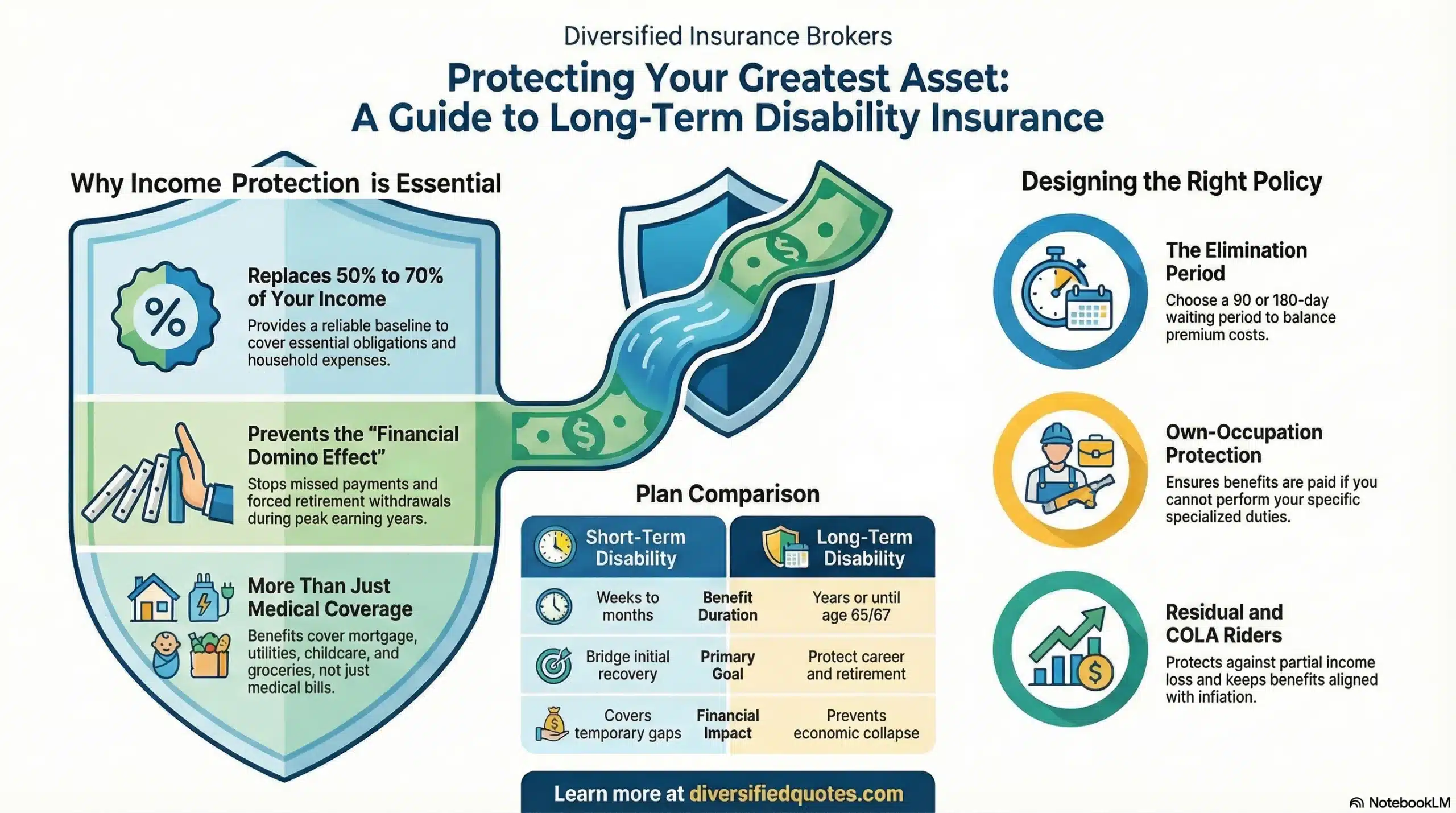
Talk With an Advisor Today
Choose how you’d like to connect—call or message us, then book a time that works for you.
Schedule here:
calendly.com/jason-dibcompanies/diversified-quotes
Licensed in all 50 states • Fiduciary, family-owned since 1980
FAQs: Disability Insurance for Zookeepers
My zoo provides group disability insurance — is that enough given the hazards of the work?
Enrolling at the maximum available employer group disability benefit is always the right starting point for any employed zookeeper with group plan access — it provides an immediate income baseline without additional premium cost. But the structural limitations of employer group disability plans are specifically consequential for zoo animal care professionals in ways that warrant individual supplemental coverage. The most important structural gap at the income level zoo animal care pays is the benefit ceiling in dollar terms: most group plans pay 60 percent of salary up to a monthly maximum, and at a median annual wage of $33,470, the maximum monthly benefit from even a generous group plan may be $1,674 or less — an amount that represents a genuine income floor rather than a theoretical one, but one that may fall short of actual household financial obligations when combined with the daily living expenses that $33,470 annually supports.
The 24-month own-to-any occupation definition transition is also specifically problematic for a zookeeper whose back condition or physical limitation prevents the specific heavy lifting, habitat cleaning, and physical animal care demands of zoo work — but who could theoretically perform some other lighter physical or sedentary employment. An any-occupation standard after 24 months can terminate group plan benefits for a zookeeper who cannot continue zoo animal care but could theoretically work in retail or administrative settings, leaving the household income exposed at precisely the point when a chronic physical disability has made the zoo career permanently impossible. Individual own-occupation disability insurance purchased personally fills both gaps: it sizes the benefit to actual documented compensation rather than to a group plan formula, maintains the own-occupation standard beyond 24 months, and remains in force through any employment change at any zoo or zoological facility. A second opinion specifically mapping your current group plan’s terms against these structural gaps is the most effective starting point for any employed zookeeper evaluating their total disability income protection.
I hurt my back doing heavy habitat cleaning — will disability insurance cover that?
A back injury from heavy habitat cleaning work is a qualifying disability for individual disability insurance when the injury prevents you from performing the material and substantial duties of your zoo animal care occupation — the habitat cleaning, animal handling, food preparation, and physical daily care functions that constitute the zookeeper role. Global zoological consultant Douglas Richardson specifically identifies back injuries as the top issue by a wide margin across international zoo populations, and Chester Zoo’s head of safety confirms heavy lifting and handling as the top injury cause — making back injury from habitat cleaning precisely the disability scenario that zoo occupational health research most specifically documents.
The more consequential planning point is timing. A back condition in your medical record creates a potential partial exclusion rider at future underwriting — meaning a disability insurance application after a documented back injury may produce coverage excluding claims attributable to that specific documented back condition, while an application before any back injury history produces comprehensive lumbar coverage without restriction. For a profession that occupational health research specifically identifies as producing back injuries as the top disability cause by frequency and severity, the window to purchase comprehensive bilateral spinal coverage without exclusion riders is before any zoo habitat cleaning or heavy lifting has produced the health record that underwriters evaluate at application. Coverage for zoo animal care professionals with prior back conditions is still available through independent broker comparison across carriers whose guidelines for animal care occupation back histories vary — some take narrower, disc-level-specific exclusion approaches that are less restrictive than the broad spinal exclusions others apply for the same documented history.
Can zookeepers get disability insurance if they develop a zoonotic illness from animal exposure?
Yes — individual disability insurance covers qualifying disability from any illness cause, including zoonotic illnesses arising from occupational animal exposure. The documented cases of tuberculosis transmission from zoo elephants to 12 handlers, and the M. bovis conversion of 7 previously-negative animal handlers following a zoo rhinoceros and monkey outbreak, illustrate the type of illness-based disability that individual disability insurance specifically covers — and that workers’ compensation’s incident attribution requirement specifically fails to address. A zookeeper who develops tuberculosis or another serious zoonotic illness from sustained zoo animal care exposure has a qualifying disability for individual disability insurance purposes regardless of whether a specific exposure incident can be identified and attributed to a specific employer or date.
The critical distinction between workers’ compensation and individual disability insurance for zoonotic illness is precisely this attribution requirement. Workers’ comp requires demonstration that a specific workplace incident or occupational exposure caused the illness — a burden that is relatively straightforward for an acute needlestick injury but very difficult for a tuberculosis infection that develops across months of elephant care without a single identifiable exposure event. Individual disability insurance covers qualifying disability from any illness cause regardless of the difficulty of occupational causation attribution. For zookeepers who work with species known to carry transmissible pathogens — elephants, macaques, rhinoceroses, exotic species from zoonotic disease-endemic regions — the individual disability insurance policy is the only coverage that provides meaningful income protection for the gradual-onset zoonotic illness pathway that workers’ compensation specifically cannot address. Why establishing coverage early in a zoo career before any zoonotic illness history develops is the most protective approach — early purchase secures comprehensive illness coverage without respiratory or zoonotic exclusion riders before any documented animal-exposure health events appear in the medical record.
Are disability insurance benefits taxable for an employed zookeeper?
The tax treatment of disability insurance benefits for an employed zookeeper depends on how the premiums are paid. For individually purchased disability insurance where the zookeeper pays all premiums personally with after-tax income, monthly disability benefits received during a qualifying disability are generally received income-tax-free — the full benefit reaches the household without income tax reduction during the disability period when no zoo employment income is being generated. Understanding the full tax treatment of disability insurance benefits matters particularly at the income level zoo animal care pays: at $33,470 annually and a 60 percent replacement benefit of approximately $1,674 per month, the difference between a taxable benefit and a tax-free benefit is meaningful in absolute dollar terms relative to household obligations.
For employed zookeepers whose zoo employer pays all or part of their group disability plan premium, the resulting group plan disability benefits are typically taxable as ordinary income at claim time — reducing the effective replacement rate below the stated 60 percent plan percentage. At a median annual wage of $33,470 and even a modest federal income tax rate, the taxable portion of a group plan benefit reduces the effective monthly take-home below what the household’s actual financial obligations require. Individually purchased supplemental coverage paid with personal after-tax income delivers its benefits tax-free on top of the taxable group plan benefit, producing a more financially effective combined coverage architecture at claim time. This tax efficiency consideration is more consequential at lower income levels — where the absolute dollar difference between taxable and tax-free benefit delivery is a larger percentage of actual household cash flow needs — than at higher income levels where the percentage impact is smaller relative to total household resources.
What about compassion fatigue — can disability insurance cover burnout from zoo animal care work?
Compassion fatigue — the documented occupational mental health condition arising from sustained emotional engagement with animal suffering, welfare decisions, and animal death — can produce a genuine occupational disability for a zoo animal care professional when it reaches the severity that prevents continued professional functioning. When compassion fatigue or the related occupational burnout conditions it produces — depression, anxiety, emotional exhaustion — eliminate the emotional capacity, sustained care quality, and professional engagement that zoo animal care work requires, the resulting psychiatric condition is a qualifying disability for individual disability insurance with an unlimited mental health benefit period. The documented elevated rates of compassion fatigue and burnout in animal care professions generally, and the specific emotional burden of zoo animal care including euthanasia decisions, reflect a genuine occupational mental health risk that the insurance coverage should address.
The specific policy feature that matters most for compassion fatigue and psychiatric disability coverage is the mental health benefit period — the duration for which the policy will pay benefits for psychiatric disability. Most employer group LTD plans cap mental health and substance use disorder benefits at 24 months, regardless of the severity or persistence of the condition. Individual disability insurance with an unlimited mental health benefit period specifically addresses this structural gap: if disabling compassion fatigue or occupational depression persists beyond 24 months, the individual policy continues paying benefits while the group plan has terminated them. The animal care professions’ documented elevated mental health burden — including the compassion fatigue research in veterinary and zoo medicine literature — makes the unlimited mental health benefit period a specifically important coverage feature for any zoo animal care professional purchasing disability insurance. If you are personally experiencing compassion fatigue or occupational distress, speaking with a mental health professional familiar with animal care burnout is an important step alongside any insurance planning — resources specific to veterinary and animal care mental health are available through professional associations and the broader agricultural and animal care professional support network.
When should a new zookeeper or recent animal care graduate purchase disability insurance?
Career start — at the first zoo or zoological facility position — is the most strategically important purchase point, and the documented injury pattern of the profession makes the timing argument more specific than it might first appear. The back injury risk that occupational safety research identifies as the top disability cause by frequency in zoo animal care begins from the first shift of heavy habitat cleaning. The zoonotic exposure that tuberculosis transmission research documents for elephant handlers begins from the first day of elephant care. The compassion fatigue that the animal care profession’s mental health literature documents as an occupational risk begins accumulating with the first animal loss and the first euthanasia experience.
A zoo professional who purchases disability insurance at career start — before any back injury, before any zoonotic illness documentation, and before any mental health treatment history has appeared in medical records — secures the most comprehensive available coverage across all documented disability pathways without exclusion riders. Premium rates are age-rated and lock in at policy issuance; an entry-level zookeeper at 24 locks in substantially lower annual premiums than the same coverage at 34 after ten years of heavy zoo animal care work have potentially produced back, respiratory, or other health documentation. The future increase option allows benefit increases as zoo career income grows — from entry-level keeper through senior keeper, curator, and curatorial leadership positions — without new medical underwriting that any animal care health findings after the original purchase might affect. For a profession where BLS projects animal care and service worker employment to grow 11 percent from 2024 to 2034 — much faster than the average for all occupations — career investment in the field is meaningful, and the income protection that guards that investment against disability is most effectively established before the career’s physical and zoonotic demands have had time to produce the occupational health record that narrows the most comprehensive coverage terms.
About the Author:
Jason Stolz, CLTC, CRPC, DIA, CAA and Chief Underwriter at Diversified Insurance Brokers (NPN 20471358), is a senior insurance and retirement professional with more than 25 years of real-world experience helping individuals, families, and business owners protect their income, assets, and long-term financial stability. As a long-time partner of the nationally licensed independent agency Diversified Insurance Brokers, Jason provides trusted guidance across multiple specialties—including fixed and indexed annuities, long-term care planning, personal and business disability insurance, life insurance solutions, Group Health, Travel Medical and Evacuation Insurance, and short-term health coverage. Diversified Insurance Brokers maintains active contracts with over 100 highly rated insurance carriers, ensuring clients have access to a broad and competitive marketplace.
His practical, education-first approach has earned recognition in publications such as VoyageATL, and contributions from his agency featured in Kiplinger and GoBankingRates— highlighting his commitment to financial clarity and client-focused planning. Drawing on deep product knowledge and years of hands-on field experience, Jason helps clients evaluate carriers, compare strategies, and build retirement and protection plans that are both secure and cost-efficient. Visitors who want to explore current annuity rates and compare options across multiple insurers can also use this annuity quote and comparison tool.
Explore More Disability Insurance Options: Browse our complete guide to Disability Insurance for Agriculture, Natural Resources & Outdoor Industries — covering farmers, ranchers, fishermen, foresters, miners, oil & gas workers & outdoor industries from 100+ carriers.
Last Reviewed: June 8, 2026 |
Reviewed by: Jason Stolz, CLTC, CRPC, DIA, CAA
Chief Underwriter, Diversified Insurance Brokers, Inc. | NPN: 20471358 | Diversified Insurance Brokers, Inc. — Licensed in all 50 states
Fact Checked by: Tonia Pettitt, CMIP©
Medicare Specialist, Diversified Insurance Brokers, Inc. | NPN: 14374308 | Diversified Insurance Brokers, Inc. — Licensed in all 50 states
Did you find this content helpful? Leave us a Google review — it helps others find trustworthy guidance too.
Editorial Standards: Diversified Insurance Brokers maintains rigorous editorial standards to ensure accuracy, clarity, and independence in all content. Learn more about our editorial standards and commitment to transparency.
